North America Network Automation Market Report: Trends, Growth and Forecast (2027-2033)
By Component (Software, Services (Professional Services, Consulting & Advisory, Deployment & Integration, Training, Support & Maintenance), Managed Services), By Deployment Mode (On-Premises, Cloud-Based), By Network Environment (Data Center Networks, Campus & Branch Networks, WAN & SD-WAN, Service Provider Networks, Cloud & Multi-Cloud Networks, Others), By End User (Telecommunications, IT, BFSI, Manufacturing, Government & Public Sector, Retail & E-commerce, Healthcare, Others), By Country (The US, Canada, Mexico) ... Read more
|
Major Players
|
North America Network Automation Market Overview
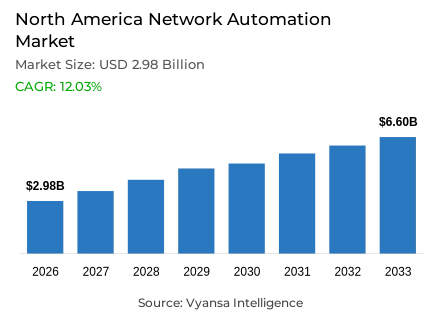
Network automation software and services let enterprises, service providers, and hyperscale data center operators configure, monitor, and remediate network infrastructure across campus, data center, and cloud environments with reduced manual scripting. IT operations teams, managed service providers, and network engineering groups consume it to provision, secure, and optimize increasingly complex hybrid and multi-cloud networks. The North America network automation market is projected to grow at a CAGR of 12.03% between 2027 and 2033.
Key Highlights of the North America Network Automation Market
- The North America network automation market was valued at USD 2.98 billion in 2026 and is estimated at USD 3.34 billion in 2027, and the market is forecast to reach USD 6.60 billion by 2033.
- Overall, the market is projected to expand at a CAGR of 12.03% across the 2027 to 2033 forecast period.
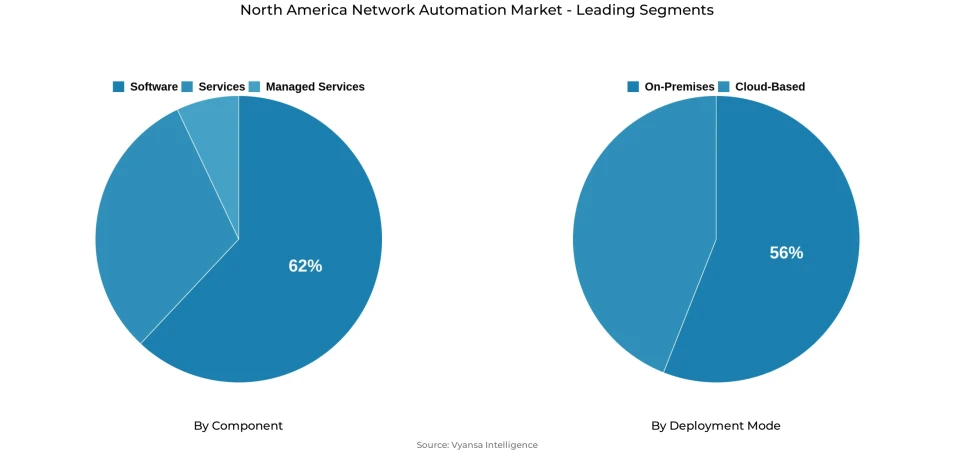
- By component, software led with a 62% share in 2026.
- Services is the fastest-growing component, expanding at a 13.91% CAGR between 2027 and 2033.
- By deployment mode, on-premises formats led with a 56% share in 2026.
- Cloud-based deployment is the fastest-growing mode, expanding at a 16.27% CAGR between 2027 and 2033.
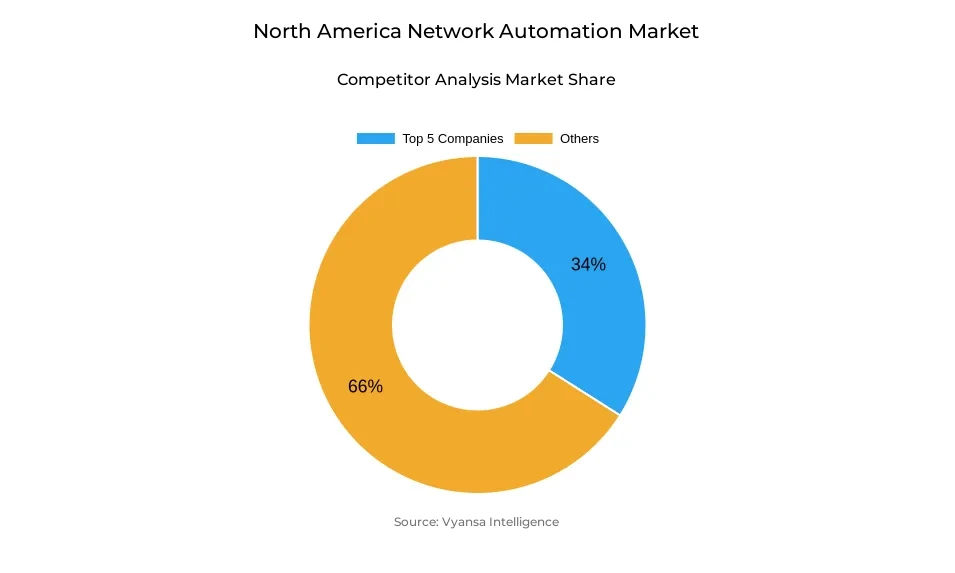
- The market is moderately fragmented, with the top five companies holding a combined 34% share in 2026.
The network automation market in North America is being supported by the rapid expansion of computing infrastructure, broadband networks, and increasingly distributed connectivity across the region. In the United States, the U.S. Department of Energy (DOE) estimated that data centers consumed 192 TWh of electricity in 2024, representing 4.7% of total U.S. electricity consumption. The DOE's 2025 update projects data-center electricity consumption to reach 464 TWh by 2028, reflecting the continued expansion of AI, cloud computing, and high-performance digital infrastructure. As network environments become larger and more dynamic, organizations increasingly require automated provisioning, configuration, monitoring, and performance optimization.
At the same time, broadband and 5G infrastructure is expanding the number of connected network endpoints that operators must manage. According to the Federal Communications Commission (FCC), the share of Americans with access to 100/20 Mbps fixed-wireline service combined with 5G-NR service of at least 35/3 Mbps increased from approximately 89% in June 2024 to 91% in June 2025. Rural availability also continued to improve, increasing the geographical complexity of network deployment and management.
This expansion is further supported by the NTIA's USD 42.45 billion BEAD program, which is funding broadband deployment and upgrades across 56 states and territories. By May 2026, 50 had signed and returned their award agreements, moving projects toward implementation.
Together, these developments are increasing network scale and operational complexity, strengthening demand for automated network provisioning, orchestration, configuration management, fault detection, and real-time network assurance.
North America Network Automation Market Drivers
AI Infrastructure Expansion Is Making Automated Network Provisioning Operationally Necessary
AI and GPU infrastructure expansion is increasing the speed at which data center networks must be configured, validated, and brought online. Dense AI clusters require large numbers of high-speed network connections to operate reliably, making repeated manual configuration increasingly impractical. Data-center operators and network-engineering teams therefore need automation capable of provisioning large network fabrics without requiring proportional growth in engineering staff.
North American data-center capacity under construction increased approximately 25% year over year during the first half of 2026, illustrating how quickly new infrastructure is being added. Networking investment is expanding alongside this buildout, with Arista raising its AI-networking expectations in May 2026 as demand for data-center switching continued to strengthen. The market relevance is the increasing volume of network infrastructure that must be configured and maintained rather than the physical data-center capacity itself.
Through the forecast period, hyperscale and enterprise AI projects should continue creating large amounts of incremental provisioning work. Organizations are unlikely to expand specialist network-engineering teams at the same pace as infrastructure, making automated configuration, validation and monitoring increasingly necessary. AI infrastructure therefore acts as a direct demand driver for network automation rather than simply providing another workload running over existing networks.
North America Network Automation Market Challenges
Shortages of Automation, Cloud and AI Skills Slow Enterprise Deployment
Network organizations increasingly require engineers who understand automation, cloud connectivity and AI-assisted operations rather than conventional device configuration alone. This creates an implementation gap because purchasing an automation platform does not automatically give an enterprise the expertise required to design workflows, validate automated changes and safely operate complex hybrid networks.
In 2026, more than half of surveyed organizations reported difficulty hiring and retaining network engineers. The commercial impact is slower deployment rather than weaker need for automation. Organizations may postpone broader automation projects, restrict platforms to simpler use cases or rely heavily on professional services when internal teams lack sufficient technical capability.
Vendors are responding with low-code interfaces, AI-assisted operations and managed-service offerings that reduce the amount of specialized expertise customers must maintain internally. This redirects part of market growth toward Managed Services and professional support because customers increasingly purchase operational capability alongside software. The skills shortage therefore raises implementation friction while simultaneously creating demand for simpler automation platforms and externally managed operations.
North America Network Automation Market Recent Trends
Network Automation is Moving Toward Cloud-Delivered Subscription Consumption
The commercial model for network automation is shifting from locally managed perpetual software toward cloud-delivered subscriptions. Under the earlier model, enterprises purchased software licenses, operated supporting infrastructure, and managed upgrades themselves. Cloud delivery transfers more maintenance and feature management to the vendor while allowing customers to expand automation consumption as their networks grow.
Extreme networks demonstrated this direction in July 2025 when it made Platform ONE generally available as a cloud-managed platform combining wired, wireless, security, and AI-assisted network operations. Rather than requiring customers to operate separate management tools for each network domain, the platform consolidates functions into one subscription-based environment.
This delivery model lowers the infrastructure and operational barrier for organizations that cannot justify a large on-premises automation environment. Mid-market and multi-site enterprises can adopt automation through recurring subscription spending rather than large upfront software and infrastructure commitments. Through 2032, this should steadily convert automation revenue toward recurring cloud consumption while broadening the market beyond large enterprises with dedicated network operations teams.
Agentic AI Is Moving Network Automation Toward Predictive and Semi-Autonomous Operations
Network automation technology is moving beyond rule-based workflows toward AI agents that can interpret network telemetry, identify likely causes of problems, and recommend or execute corrective actions within defined controls. Traditional automation works effectively when engineers already know the condition they want to automate. Agentic AI extends the model toward incidents that require investigation and reasoning rather than merely executing a predefined script.
Commercial platforms began demonstrating this capability more clearly during 2026. In May, NetBrain highlighted a customer case in which its diagnostic AI investigated a network problem that had remained unresolved for weeks and identified the cause within minutes. Cisco, HPE and Nokia are similarly embedding agentic capabilities into their network-operating platforms, indicating that AI reasoning is becoming a competitive feature rather than an isolated experimental tool.
The market impact is a shift from automating repetitive configuration toward reducing the time engineers spend diagnosing and resolving network incidents. Adoption still depends on trustworthy telemetry and strong operating controls, but platforms with deeper network context can use AI more effectively. Through the forecast period, vendors should increasingly compete on the quality of autonomous diagnosis and remediation rather than simply the number of workflows they can automate.
North America Network Automation Market Future Opportunities
Simplified Cloud Automation Opens an Underserved SMB and Mid-Market Customer Base
Small and mid-sized organizations increasingly operate cloud applications, distributed offices, and hybrid networks but often lack dedicated network-automation specialists. Many enterprise automation platforms were originally designed around large network operations teams, leaving smaller organizations with infrastructure complexity that exceeds their staffing capability. This creates an opportunity for simplified automation that delivers useful workflows without requiring extensive internal scripting or integration expertise.
Itential moved further toward this opportunity in March 2025 through its AUTOMATEx Partner Program, designed to enable resellers, systems integrators, and managed-service providers to deliver network automation to a broader customer base. The channel model is important because smaller organizations are more likely to consume automation through an existing technology partner than establish a specialized internal automation function.
Capturing this market requires low-code operation, standardized templates, subscription pricing, and managed support rather than simply reducing the price of an enterprise platform. Vendors able to make automation easy for channel partners and managed-service providers to operate can extend subscription demand into organizations historically excluded by implementation complexity and staffing requirements.
Unlock Market Intelligence
Explore the market potential with our data-driven report
North America Network Automation Market Segmentation Analysis
By Component:
- Software
- Services
- Professional Services
- Consulting & Advisory
- Deployment & Integration
- Training, Support & Maintenance
- Managed Services
Software Retains Component Leadership at 62% as Services Gain Share from Integration and Operational Complexity
Software leads the component category with a 62% share in 2026 because enterprises increasingly consolidate provisioning, configuration, and assurance into vendor-supported platforms rather than maintaining custom scripts, giving software the largest single claim on automation budgets. Its lead also rests on deployment economics: once a platform is licensed, incremental network growth adds to consumption without a proportional rise in professional services spend, unlike services engagements that scale closer to headcount.
Vendors continue reinforcing this software-first positioning; in February 2026, NetBrain Technologies, Inc. released its NetBrain 12.3 platform update adding AI agents that investigate network issues, identify root causes, and suggest fixes directly within the software layer, extending the platform's value without requiring additional professional services hours. Software should hold its lead through the forecast period provided vendors keep embedding AI capability inside the platform itself rather than requiring services engagements to unlock it.
Services is the fastest-growing component, expanding at a 13.91% CAGR between 2027 and 2033, with Managed Services the strongest contributor at a 15.97% CAGR, driven by organizations that own increasingly complex hybrid infrastructure but lack in-house staff to operate automation platforms continuously. Managed Services grows faster than the broader software base because it directly answers the skills shortage constraining automation deployment, converting a staffing gap into consumption rather than a deployment blocker.
In February 2025, Extreme Networks, Inc. made Extreme Platform ONE for Managed Service Providers generally available with consumption-based billing and poolable licensing, letting MSPs manage automation for multiple end-user organizations from a single multi-tenant workspace. Services grow faster than Software precisely because they monetize the operational gap software alone cannot close for under-resourced network teams.
By Deployment Mode:
- On-Premises
- Cloud-Based
On-Premises Retains Deployment Leadership at 56% Before Cloud-Based Automation Takes the Lead
On-Premises deployment leads with a 56% share in 2026 because data center and regulated infrastructure environments require direct operational control over automation platforms handling sensitive configuration and topology data, a requirement cloud-hosted alternatives cannot always satisfy for these workloads. It also benefits from installed-base inertia: large enterprises with existing on-premises network management infrastructure continue extending those deployments rather than migrating live production automation to a new delivery model. Vendors are still actively developing for this base; in February 2026, Cisco Systems, Inc. expanded its AgenticOps portfolio with a data center capability enhancing observability and unified operations for Cisco Nexus One, reaching controlled availability in June 2026 for on-premises data center networks running traditional and AI workloads. On-Premises should hold its position through the forecast period, as data-sovereignty and latency requirements in data center environments continue to outweigh the operational simplicity of cloud delivery.
Cloud-Based deployment is the fastest-growing mode, expanding at a 16.27% CAGR between 2027 and 2033 as organizations without the infrastructure or staff for on-premises platforms adopt subscription-delivered automation instead. It grows faster than On-Premises because it removes the upfront infrastructure and specialized staffing requirement that on-premises deployment presupposes, opening automation to mid-market and multi-site organizations that On-Premises formats structurally exclude. In February 2026, BlueCat Networks introduced BlueCat Horizon, a SaaS-first intelligent network operations platform built for cloud-first and hybrid environments, unifying DNS, DHCP, IP address management, and AI-assisted automation from a shared cloud control plane. Cloud-Based is expected to grow faster because its addressable base includes every organization.
Unlock Market Intelligence
Explore the market potential with our data-driven report
North America Network Automation Market Regional Analysis
The United States dominates the North America network automation market with an 84% share in 2026, supported by the region's largest concentration of hyperscale data centers, AI infrastructure projects, major enterprises and network-technology vendors. These environments operate large and increasingly complex network estates where manual configuration becomes difficult to sustain, creating substantial demand for automated provisioning, assurance and network-management platforms.
AI infrastructure expansion further reinforces U.S. leadership. North American data-center capacity under construction increased approximately 25% year over year during the first half of 2026, while data-center switching investment accelerated alongside AI compute deployment. Much of this activity is concentrated in the United States, where hyperscale and enterprise AI projects require large network fabrics to be configured and operated on compressed deployment schedules.
The country also hosts several of the market's major automation and networking suppliers, including Cisco Systems, Hewlett Packard Enterprise, IBM and Arista Networks. This combination of large enterprise technology budgets, expanding AI infrastructure and a strong domestic vendor ecosystem keeps the United States substantially ahead of other North American markets and should preserve its dominant position through the forecast period
North America Network Automation Market Competitive Landscape
The North America network automation market is moderately fragmented, with the five leading companies accounting for a combined 34% share in 2026. The major companies in the market are Cisco Systems Inc., Hewlett Packard Enterprise Company, International Business Machines Corporation, Arista Networks Inc. and Nokia of America Corporation.
Key Companies in the North America Network Automation Market
- Cisco Systems, Inc.
- Hewlett Packard Enterprise Company
- International Business Machines Corporation
- Arista Networks, Inc.
- Nokia of America Corporation
- Ericsson Inc.
- Extreme Networks, Inc.
- NetBrain Technologies, Inc.
- BMC Software, Inc.
- Fujitsu Network Communications, Inc.
- BlueCat Networks, Inc.
- Itential, Inc.
Company Profiling
The following five companies represent the leading participants in the North America network automation market.
Cisco Systems Inc.: Cisco participates through its AgenticOps portfolio and automation capabilities spanning campus, branch, data-center and security environments across Catalyst, Nexus and Meraki. Its strategy is increasingly centered on bringing networking, security and observability under common AI-assisted operations. In June 2026, Cisco introduced Cloud Control, a unified operating environment designed to let network teams and AI agents manage infrastructure from a shared control surface.
Hewlett Packard Enterprise Company: HPE participates through HPE Networking, Aruba and Juniper Mist following its approximately USD 14 billion acquisition of Juniper Networks completed in July 2025, which significantly expanded its networking business. In June 2026, HPE extended its Marvis AI capabilities into Aruba Central, bringing the Mist and Aruba operating environments closer together and strengthening its position in AI-assisted network operations.
International Business Machines Corporation: IBM participates through Network Intelligence, an AI-led network operations service designed to identify network anomalies and potential issues before they develop into larger outages. IBM launched the platform in September 2025 using its broader watsonx and AI technology stack. Its position is differentiated from hardware-led competitors because it approaches network automation primarily through AI reasoning and operational intelligence rather than proprietary switching infrastructure.
Arista Networks Inc.: Arista participates through EOS and CloudVision, which automate and monitor large data-center, campus and AI networking environments. The company had shipped approximately 150 million network ports by early 2026, providing a useful indication of the infrastructure base over which its software operates. In May 2026, Arista introduced a new high-density networking architecture for AI data centers designed to reduce infrastructure footprint while supporting larger AI fabrics.
Nokia of America Corporation: Nokia participates through its Network Services Platform and Autonomous Networks Suite, focusing particularly on automation across IP and service-provider networks. In June 2026, Nokia introduced a new agentic AI framework for its Network Services Platform, designed to allow AI agents to support increasingly autonomous network operations within defined trust controls. Commercial availability was targeted for later in 2026.
Recent Developments in the North America Network Automation Market
- March 2026: Ericsson and Future Technologies Venture expanded their North American collaboration around enterprise wireless and private 5G deployments. The partnership broadens automation requirements beyond conventional enterprise wired networks into industrial and critical-infrastructure environments that need repeatable provisioning and ongoing network management.
Frequently Asked Questions
Related Report
- Market Segmentation
- Research Scope
- Research Methodology
- Definitions and Assumptions
- Executive Summary
- North America Network Automation Market Policies, Regulations, and Standards
- North America Network Automation Market Dynamics
- Growth Factors
- Challenges
- Trends
- Opportunities
- North America Network Automation Market Statistics, 2023-2033F
- Market Size & Growth Outlook
- By Revenues in USD Million
- Market Segmentation & Growth Outlook
- By Component
- Software- Market Insights and Forecast 2023-2033, USD Million
- Services- Market Insights and Forecast 2023-2033, USD Million
- Professional Services- Market Insights and Forecast 2023-2033, USD Million
- Consulting & Advisory- Market Insights and Forecast 2023-2033, USD Million
- Deployment & Integration- Market Insights and Forecast 2023-2033, USD Million
- Training, Support & Maintenance- Market Insights and Forecast 2023-2033, USD Million
- Managed Services- Market Insights and Forecast 2023-2033, USD Million
- By Deployment Mode
- On-Premises- Market Insights and Forecast 2023-2033, USD Million
- Cloud-Based- Market Insights and Forecast 2023-2033, USD Million
- By Network Environment
- Data Center Networks- Market Insights and Forecast 2023-2033, USD Million
- Campus & Branch Networks- Market Insights and Forecast 2023-2033, USD Million
- WAN & SD-WAN- Market Insights and Forecast 2023-2033, USD Million
- Service Provider Networks- Market Insights and Forecast 2023-2033, USD Million
- Cloud & Multi-Cloud Networks- Market Insights and Forecast 2023-2033, USD Million
- Others- Market Insights and Forecast 2023-2033, USD Million
- By End User
- Telecommunications- Market Insights and Forecast 2023-2033, USD Million
- IT- Market Insights and Forecast 2023-2033, USD Million
- BFSI- Market Insights and Forecast 2023-2033, USD Million
- Manufacturing- Market Insights and Forecast 2023-2033, USD Million
- Government & Public Sector- Market Insights and Forecast 2023-2033, USD Million
- Retail & E-commerce- Market Insights and Forecast 2023-2033, USD Million
- Healthcare- Market Insights and Forecast 2023-2033, USD Million
- Others- Market Insights and Forecast 2023-2033, USD Million
- By Country
- The US
- Canada
- Mexico
- By Competitors
- Competition Characteristics
- Market Share & Analysis
- By Component
- Market Size & Growth Outlook
- The US Network Automation Market Statistics, 2023-2033F
- Market Size & Growth Outlook
- By Revenues in USD Million
- Market Segmentation & Growth Outlook
- By Component- Market Insights and Forecast 2023-2033, USD Million
- By Deployment Mode- Market Insights and Forecast 2023-2033, USD Million
- By Network Environment- Market Insights and Forecast 2023-2033, USD Million
- By End User- Market Insights and Forecast 2023-2033, USD Million
- Market Size & Growth Outlook
- Canada Network Automation Market Statistics, 2023-2033F
- Market Size & Growth Outlook
- By Revenues in USD Million
- Market Segmentation & Growth Outlook
- By Component- Market Insights and Forecast 2023-2033, USD Million
- By Deployment Mode- Market Insights and Forecast 2023-2033, USD Million
- By Network Environment- Market Insights and Forecast 2023-2033, USD Million
- By End User- Market Insights and Forecast 2023-2033, USD Million
- Market Size & Growth Outlook
- Mexico Network Automation Market Statistics, 2023-2033F
- Market Size & Growth Outlook
- By Revenues in USD Million
- Market Segmentation & Growth Outlook
- By Component- Market Insights and Forecast 2023-2033, USD Million
- By Deployment Mode- Market Insights and Forecast 2023-2033, USD Million
- By Network Environment- Market Insights and Forecast 2023-2033, USD Million
- By End User- Market Insights and Forecast 2023-2033, USD Million
- Market Size & Growth Outlook
- Competitive Outlook
- Company Profiles
- Cisco Systems, Inc.
- Business Description
- Product Portfolio
- Collaborations & Alliances
- Recent Developments
- Financial Details
- Others
- Hewlett Packard Enterprise Company
- Business Description
- Product Portfolio
- Collaborations & Alliances
- Recent Developments
- Financial Details
- Others
- International Business Machines Corporation
- Business Description
- Product Portfolio
- Collaborations & Alliances
- Recent Developments
- Financial Details
- Others
- Arista Networks, Inc.
- Business Description
- Product Portfolio
- Collaborations & Alliances
- Recent Developments
- Financial Details
- Others
- Nokia of America Corporation
- Business Description
- Product Portfolio
- Collaborations & Alliances
- Recent Developments
- Financial Details
- Others
- Ericsson Inc.
- Business Description
- Product Portfolio
- Collaborations & Alliances
- Recent Developments
- Financial Details
- Others
- Extreme Networks, Inc.
- Business Description
- Product Portfolio
- Collaborations & Alliances
- Recent Developments
- Financial Details
- Others
- NetBrain Technologies, Inc.
- Business Description
- Product Portfolio
- Collaborations & Alliances
- Recent Developments
- Financial Details
- Others
- BMC Software, Inc.
- Business Description
- Product Portfolio
- Collaborations & Alliances
- Recent Developments
- Financial Details
- Others
- Fujitsu Network Communications, Inc.
- Business Description
- Product Portfolio
- Collaborations & Alliances
- Recent Developments
- Financial Details
- Others
- BlueCat Networks, Inc.
- Business Description
- Product Portfolio
- Collaborations & Alliances
- Recent Developments
- Financial Details
- Others
- Itential, Inc
- Business Description
- Product Portfolio
- Collaborations & Alliances
- Recent Developments
- Financial Details
- Others
- Cisco Systems, Inc.
- Company Profiles
- Disclaimer
| Segment | Sub-Segment |
|---|---|
| By Component |
|
| By Deployment Mode |
|
| By Network Environment |
|
| By End User |
|
| By Country |
|
Research Methodology
This study followed a structured approach comprising four key phases to assess the size and scope of the electro-oxidation market. The process began with thorough secondary research to collect data on the target market, related markets, and broader industry context. These findings, along with preliminary assumptions and estimates, were then validated through extensive primary research involving industry experts from across the value chain. To calculate the overall market size, both top-down and bottom-up methodologies were employed. Finally, market segmentation and data triangulation techniques were applied to refine and validate segment-level estimations.
Secondary Research
The secondary research phase involved gathering data from a wide range of credible and published sources. This step helped in identifying industry trends, defining market segmentation, and understanding the market landscape and value chain.
Sources consulted during this phase included:
- Company annual reports, investor presentations, and press releases
- Industry white papers and certified publications
- Trade directories and market-recognized databases
- Articles from authoritative authors and reputable journals
- Gold and silver standard websites
Secondary research was critical in mapping out the industry's value chain and monetary flow, identifying key market segments, understanding regional variations, and tracking significant industry developments.
Other key sources:
- Financial disclosures
- Industry associations and trade bodies
- News outlets and business magazines
- Academic journals and research studies
- Paid industry databases
Primary Research
To validate secondary data and gain deeper market insights, primary research was conducted with key stakeholders across both the supply and demand sides of the market.
On the demand side, participants included decision-makers and influencers from end-user industries—such as CIOs, CTOs, and CSOs—who provided first-hand perspectives on market needs, product usage, and future expectations.
On the supply side, interviews were conducted with manufacturers, industry associations, and institutional participants to gather insights into current offerings, product pipelines, and market challenges.
Primary interviews provided critical inputs such as:
- Market size and revenue data
- Product and service breakdowns
- Market forecasts
- Regional and application-specific trends
Stakeholders consulted included:
- Leading OEM and solution providers
- Channel and distribution partners
- End users across various applications
- Independent consultants and industry specialists
Market Size Estimation and Data Triangulation
- Identifying Key Market Participants (Secondary Research)
- Goal: To identify the major players or companies in the target market. This typically involves using publicly available data sources such as industry reports, market research publications, and financial statements of companies.
- Tools: Reports from firms like Gartner, Forrester, Euromonitor, Statista, IBISWorld, and others. Public financial statements, news articles, and press releases from top market players.
- Extracting Earnings of Key Market Participants
- Goal: To estimate the earnings generated from the product or service being analyzed. This step helps in understanding the revenue potential of each market player in a specific geography.
- Methods: Earnings data can be gathered from:
- Publicly available financial reports (for listed companies).
- Interviews and primary data sources from professionals, such as Directors, VPs, SVPs, etc. This is especially useful for understanding more nuanced, internal data that isn't publicly disclosed.
- Annual reports and investor presentations of key players.
- Data Collation and Development of a Relevant Data Model
- Goal: To collate inputs from both primary and secondary sources into a structured, data-driven model for market estimation. This model will incorporate key market KPIs and any independent variables relevant to the market.
- Key KPIs: These could include:
- Market size, growth rate, and demand drivers.
- Industry-specific metrics like market share, average revenue per customer (ARPC), or average deal size.
- External variables, such as economic growth rates, inflation rates, or commodity prices, that could affect the market.
- Data Modeling: Based on this data, the market forecasts are developed for the next 5 years. A combination of trend analysis, scenario modeling, and statistical regression might be used to generate projections.
- Scenario Analysis
- Goal: To test different assumptions and validate how sensitive the market is to changes in key variables (e.g., market demand, regulatory changes, technological disruptions).
- Types of Scenarios:
- Base Case: Based on current assumptions and historical data.
- Best-Case Scenario: Assuming favorable market conditions, regulatory environments, and technological advancements.
- Worst-Case Scenario: Accounting for adverse factors, such as economic downturns, stricter regulations, or unexpected disruptions.












