GCC Network Security Market Report: Trends, Growth and Forecast (2027-2033)
By Security Offering (Solutions (Network Firewall, Intrusion Detection and Prevention Systems (IDPS), Secure Web Gateway, Unified Threat Management (UTM), Distributed Denial-of-Service (DDoS) Protection, Zero Trust Network Access (ZTNA), Network Access Control (NAC), Other Solutions), Services (Professional Services, Managed Security Services)), By Deployment Mode (Cloud, On-Premises, Hybrid), By Enterprise Size (Small and Medium Enterprises (SMEs), Large Enterprises), By End-user Industry (IT and Telecom, BFSI, Government and Defence, Healthcare, Manufacturing, Retail and E-commerce), By Country (Saudi Arabia, The UAE, Qatar, Kuwait, Oman, Bahrain) ... Read more
|
Major Players
|
GCC Network Security Market Overview
Network security covers the firewalls, intrusion detection and prevention systems, secure access controls, and managed defence services that protect enterprise and government networks from cyberattacks. Government bodies, banks, telecom operators, and energy, healthcare, and industrial organisations across Saudi Arabia, the UAE, Qatar, Kuwait, Bahrain, and Oman consume it to secure cloud and hybrid infrastructure. The GCC network security market is forecast to grow at a CAGR of 10.3% between 2027 and 2033.
Key Highlights of the GCC Network Security Market
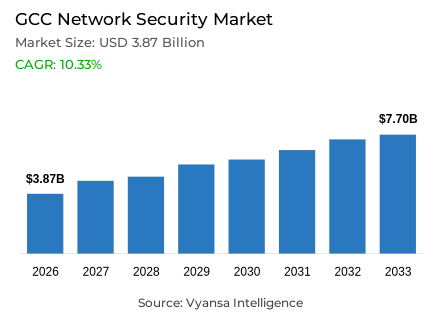
- The GCC network security market was valued at USD 3.87 billion in 2026 and is estimated at USD 4.27 billion in 2027, forecast to reach USD 7.70 billion by 2033.
- The market is forecast to expand at an overall CAGR of 10.3% across the 2027 to 2033 forecast period.
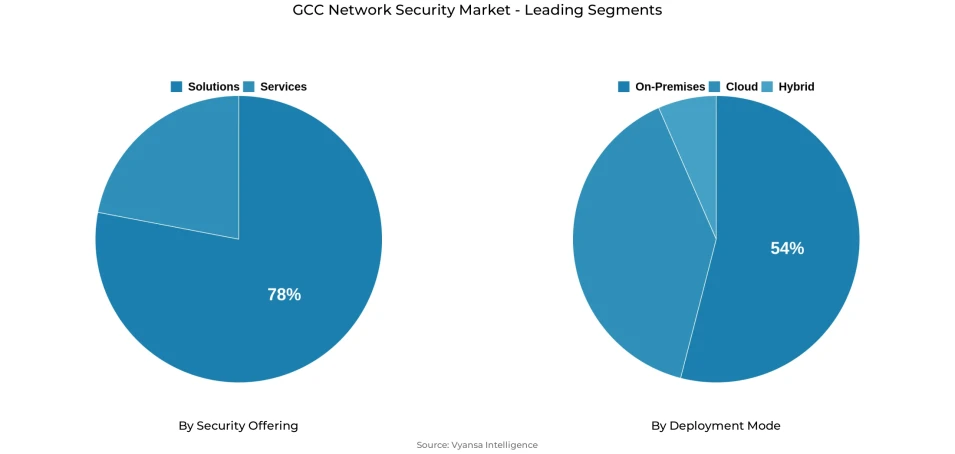
- By security type, solutions led the market with a 78% share in 2026, ahead of standalone professional and managed services.
- Services is the fastest-growing security type, expanding at a 7.6% CAGR between 2027 and 2033.
- By deployment, on-premises accounted for the leading share of the industry with 54% share in 2026.
- While the fastest-growing by deployment was cloud based deployment, expanding at a 15.8% CAGR between 2027 and 2033.
- Saudi Arabia is the dominant player in the region holding a 43% market share in 2026.
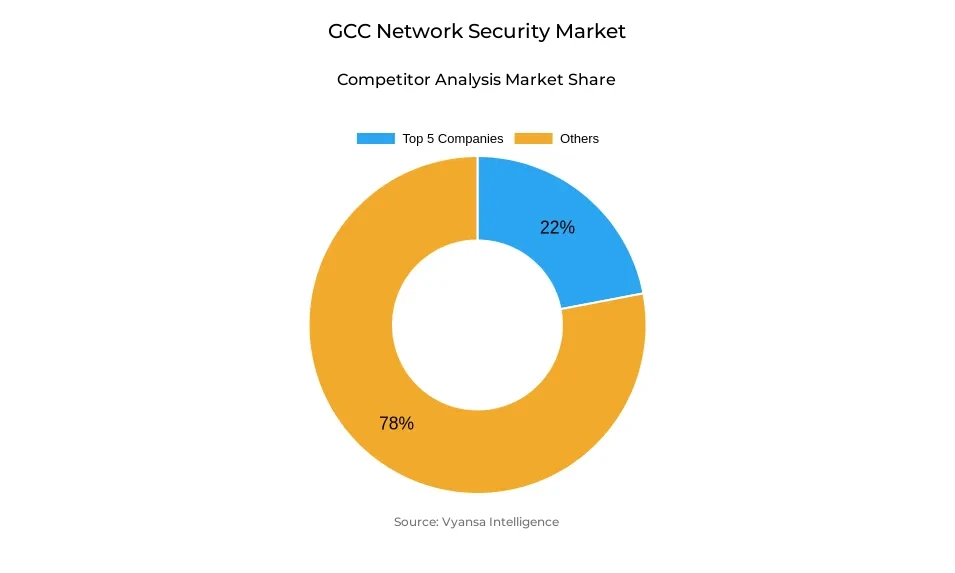
- The market structure is moderately fragmented, with the top five companies holding a combined 22.00% share as of 2026.
The GCC network security market is expanding alongside rapid digitalization, increasing connectivity, critical-infrastructure modernization, and stronger national cybersecurity frameworks. Saudi Arabia provides the region's clearest quantified indicator: according to the National Cybersecurity Authority (NCA), the Kingdom's cybersecurity market reached SAR 15.2 billion (approximately USD 4.05 billion) in 2024, increasing 14% year-on-year. Private-sector entities accounted for SAR 10.3 billion (USD 2.75 billion; 68%), while government entities contributed SAR 4.8 billion (USD 1.28 billion; 32%). The NCA also identifies network security among the key cybersecurity product and service categories.
The UAE's expanding digital infrastructure is another major demand catalyst. The UAE Government reported that national digital-transformation initiatives generated AED 20 billion (approximately USD 5.45 billion) in direct government savings in 2024, while more than 530 million working hours were saved across government entities. Digital government services also generated more than AED 368 billion (approximately USD 100.2 billion) in customer savings over the preceding decade.
Network exposure is increasing further: in August 2026, the UAE's Telecommunications and Digital Government Regulatory Authority reported 99.7% household fibre-optic penetration and introduced enhanced telecom-licence requirements covering network resilience, backup capacity, international connectivity diversification, and disaster recovery. Meanwhile, Qatar's National Cyber Security Strategy 2024–2030 prioritizes cybersecurity resilience, legislation, innovation, workforce development, and regional cooperation.
Government Regulations Shaping the GCC Network Security Market
Government regulation is becoming a direct demand driver for network-security solutions across the GCC as national authorities introduce mandatory cybersecurity controls for critical infrastructure, government systems, data exchanges, cloud environments, and AI applications. In Saudi Arabia, the National Cybersecurity Authority's Essential Cybersecurity Controls (ECC 2-2024) establish baseline requirements for protecting national entities' information and technology assets, while the Data Cybersecurity Controls (DCC-1:2022) establish minimum requirements for protecting data throughout its lifecycle. Saudi Arabia has also introduced a regulatory framework for licensing Managed Security Operations Center (SOC) services, creating a formal compliance environment for outsourced security monitoring and incident-response providers.
In the UAE, the regulatory framework has expanded beyond conventional cybersecurity toward interconnected digital infrastructure. The Critical Information Infrastructure Protection Policy, updated in 2026, establishes baseline security requirements and assurance mechanisms for critical assets. The National Data Exchange Security Policy specifically covers network security, access control, cryptography, system hardening, logging, and performance monitoring, directly supporting demand for integrated network-security technologies.
The UAE has also introduced a National Cyber Security Policy for Artificial Intelligence, requiring security controls for AI/ML infrastructure, applications, networks, data, vulnerability management, adversarial-AI threats, continuous monitoring, and automated incident response.
In Qatar, cloud and connectivity regulation is also strengthening the security environment. The country's cloud-policy framework incorporates security, privacy, and data-protection requirements, while a 2026 CRA regulation governing access to submarine-cable landing stations supports more resilient international connectivity infrastructure.
Overall, these regulations are shifting network security from a discretionary IT expenditure toward a compliance- and resilience-driven requirement, supporting demand for firewalls, zero-trust solutions, SOC services, network monitoring, cloud security, encryption, vulnerability management and AI-enabled threat detection across GCC enterprises and government entities.
GCC Network Security Market Drivers
Rapid Cloud, AI and Data-Centre Expansion Is Increasing the Network Attack Surface
GCC governments and enterprises are rapidly expanding cloud, AI and data center infrastructure, creating more workloads, connections and data flows that require continuous network protection. Unlike conventional IT expansion, AI and cloud environments create highly distributed traffic patterns across data centers, cloud platforms, applications and users, increasing requirements for secure access, segmentation, threat detection and traffic inspection.
Abu Dhabi's Digital Strategy 2025–2027 is backed by approximately USD 3.54 billion and targets 100% sovereign-cloud adoption across government operations alongside more than 200 AI solutions. This migration increases the amount of government activity operating across cloud infrastructure and consequently expands the environment requiring secure connectivity, policy enforcement, and continuous monitoring.
Saudi Arabia is creating another major infrastructure base. In August 2026, AMD, Cisco and HUMAIN confirmed that production AI infrastructure had gone live in the country, with up to 250 MW of additional AI capacity planned from 2027 and a longer-term target of 1 GW by 2030. As these environments scale, demand increases for network segmentation, secure connectivity, and AI-ready cybersecurity around high-value computing infrastructure.
GCC Network Security Market Challenges
Different National Cybersecurity Frameworks Increase Regional Deployment Complexity
Network-security vendors operating across the GCC must address separate national cybersecurity authorities, control frameworks and localization requirements rather than deploying one identical compliance model across all six countries. Products may technically perform the same function across Saudi Arabia, the UAE, Qatar, Kuwait, Oman and Bahrain, but supporting documentation, deployment architecture and customer qualification can differ between jurisdictions.
This increases regional expansion costs because security vendors and integrators need local compliance expertise, implementation partners and, in some cases, locally hosted infrastructure. Even cloud-delivered platforms may require country-specific routing or data-location configurations, increasing the investment required to serve regulated organizations across several GCC markets.
The challenge therefore affects smaller vendors most strongly. Large cybersecurity platforms can spread localization and compliance costs across a wider customer base, while newer entrants must invest in local qualification before generating meaningful regional revenue, potentially lengthening market-entry and enterprise procurement cycles.
GCC Network Security Market Recent Trends
Enterprises Are Consolidating Networking and Security into Unified SASE Platforms
GCC enterprises are increasingly moving away from managing separate firewalls, secure web gateways, remote-access systems and branch-security tools toward integrated cloud-delivered architectures. Secure Access Service Edge combines networking and security functions through a common policy environment, allowing organizations to protect users and applications consistently whether traffic originates from offices, remote employees, or cloud workloads.
Regional infrastructure is making this architecture more practical. Help AG's Cyber Edge X delivers networking and multiple security functions through a locally hosted cloud platform, while major global security vendors have expanded cloud-security infrastructure across Saudi Arabia, the UAE and Qatar. This gives organizations more options to deploy cloud-delivered protection while maintaining lower latency and meeting regional hosting requirements.
Through 2033, platform consolidation should reduce reliance on independently managed security appliances across distributed enterprises. Competitive differentiation should increasingly depend on how effectively vendors integrate secure access, firewall capabilities, threat protection and policy management rather than on the performance of an individual security product alone.
AI Is Moving Network Security Toward Automated Threat Detection and Response
Artificial intelligence is increasingly being incorporated directly into network-security platforms to analyze large volumes of traffic, prioritize alerts and automate threat investigation. At the same time, enterprises adopting generative and agentic AI need protection specifically designed for AI workloads, creating a new layer of network-security requirements around model access, data flows and AI infrastructure.
Saudi Arabia's National Cybersecurity Authority opened consultation on dedicated AI Cybersecurity Guidelines in July 2026 covering governance, cybersecurity defence, resilience and third-party risk for technologies including generative and agentic AI. This shows AI security moving from vendor-led experimentation toward formal cybersecurity architecture in the region.
Commercial vendors are expanding in parallel. Deloitte and Palo Alto Networks opened the Middle East's first Cortex XSIAM Executive Briefing Center in Dubai in October 2025, demonstrating AI-driven security operations and automated incident response to regional customers. As AI capabilities mature, procurement should increasingly focus on measurable detection speed and automation rather than traditional alert generation alone.
GCC Network Security Market Future Opportunities
Mid-Sized Industrial Operators Create an Underserved OT Security Opportunity
GCC energy majors and critical infrastructure operators already invest heavily in specialized cybersecurity, but smaller manufacturers, utilities, water operators, and industrial businesses frequently have fewer internal cybersecurity resources. Their operational networks still contain connected controllers, industrial systems and remote access points that require protection, creating an addressable market below the region's largest national infrastructure accounts.
Industrial cybersecurity also requires different operating priorities from conventional enterprise IT because production systems cannot always be interrupted for upgrades or incident response. Saudi Arabia maintains dedicated Operational Technology cybersecurity controls, illustrating how industrial environments are increasingly treated as a distinct security domain rather than an extension of office IT.
The opportunity is strongest for regional integrators and managed-security providers that can offer continuous OT network monitoring, assessment and incident support without requiring each industrial company to build its own security operations capability. Subscription-based delivery can convert smaller industrial accounts into recurring revenue while extending sophisticated network-security services beyond major oil, gas and government operators.
Unlock Market Intelligence
Explore the market potential with our data-driven report
GCC Network Security Market Segmentation Analysis
By Security Offering:
- Solutions
- Services
Solutions Hold a 78% Share of the Market, while Services Emerge as the Fastest-Growing
Solutions accounted for 78% of GCC network security demand in 2026, supported by investment in directly deployable controls such as firewalls, IDPS, secure web gateways, DDoS protection, NAC, and UTM platforms. The regional significance is reflected in Saudi Arabia, where cybersecurity spending reached approximately USD 4.1 billion in 2024, representing 14% growth from 2023. Cybersecurity products accounted for 51% of spending, while network security was among the most demanded cybersecurity categories, reinforcing the importance of solution based procurement across the GCC.
Services are expected to record the fastest growth in the GCC network security market at a CAGR of 7.6% during 2025 to 2032 as organizations increasingly require specialized expertise for deployment, monitoring, maintenance, threat detection, and ongoing security management. The shift is particularly relevant for enterprises with limited internal cybersecurity capabilities, creating demand for professional and managed security services. Saudi Arabia's cybersecurity ecosystem has also expanded through formal provider registration and licensing initiatives, strengthening the foundation for regional service based delivery and recurring security engagements.
By Deployment:
- On-Premises
- Cloud-Based
- Hybrid
On-Premises Deployment Holds 54% Market Share, while Cloud-Based Deployment Records the Fastest Growth
On-premises deployment accounted for 54% of the GCC network security market in 2026, reflecting the continued preference of regulated organizations for direct infrastructure control, localized data handling, and integration with established security environments. Saudi Arabia's Cloud Cybersecurity Controls, updated through CCC 2:2024, reinforce requirements concerning data localization and security responsibilities for cloud providers and tenants. These considerations support continued investment in on-premises infrastructure even as organizations expand hybrid environments and gradually migrate selected workloads to cloud platforms.
Cloud-based network security is expected to grow at a 15.8% CAGR during 2025 to 2032 as GCC governments and enterprises increase adoption of sovereign and public cloud environments. Saudi government spending on cloud computing increased 42% in 2025 compared with 2024, while Abu Dhabi's Digital Strategy 2025 to 2027 targets 100% sovereign cloud adoption for government operations by 2027. This migration is increasing demand for scalable cloud-delivered security, centralized policy enforcement, and secure connectivity across distributed digital environments.
Unlock Market Intelligence
Explore the market potential with our data-driven report
GCC Network Security Market Regional Analysis
Saudi Arabia Leads GCC Network Security Demand with 43% Share
Saudi Arabia accounts for approximately 43% of GCC network security demand, supported by its large cybersecurity expenditure base, extensive government and critical-infrastructure requirements and expanding digital infrastructure. The country's overall cybersecurity market reached approximately USD 4.02 billion in 2024, increasing 14% year over year, while network security ranked among the most demanded cybersecurity product categories.
The country is also strengthening its domestic cybersecurity ecosystem. In June 2026, the National Cybersecurity Authority launched the third cohort of its Cybersecurity Accelerator with seven local startups, while Saudi Arabia retained first place in the IMD cybersecurity ranking for the third consecutive year. These initiatives reinforce local supplier development alongside continued procurement from global security platforms.
GCC Network Security Market Competitive Landscape
The GCC network security market is moderately fragmented, with the top five companies holding a combined 22.00% share as of 2026. The leading participants are Palo Alto Networks, Inc., Fortinet, Inc., Cisco Systems, Inc., Check Point Software Technologies Ltd. and Trend Micro Incorporated.
Key Companies in the GCC Network Security Market
- Palo Alto Networks, Inc.
- Fortinet, Inc.
- Cisco Systems, Inc.
- Check Point Software Technologies Ltd.
- Trend Micro Incorporated
- Huawei Technologies Co., Ltd.
- Broadcom Inc. (Symantec)
- IBM Corporation
- Zscaler, Inc.
- SonicWall Inc.
- Juniper Networks, Inc.
- Musarubra US LLC (Trellix)
News and Recent Developments in the GCC Network Security Market
- August 2026: AMD, Cisco and HUMAIN confirmed that production AI infrastructure had gone live in Saudi Arabia, with an additional buildout of up to 250 MW scheduled to begin in 2027. The deployment expands the country's high-value AI network infrastructure and consequently increases security requirements around large-scale computing environments.
- July 2026: Saudi Arabia's National Cybersecurity Authority opened consultation on dedicated AI Cybersecurity Guidelines covering governance, defence, resilience and third-party risks associated with generative and agentic AI systems.
- June 2026: The Saudi National Cybersecurity Authority launched the third cohort of its Cybersecurity Accelerator with seven local cybersecurity startups, supporting domestic product development and expanding the local supplier ecosystem.
Frequently Asked Questions
Related Report
- Market Segmentation
- Research Scope
- Research Methodology
- Definitions and Assumptions
- Executive Summary
- GCC Network Security Market Policies, Regulations, and Standards
- GCC Network Security Market Dynamics
- Growth Factors
- Challenges
- Trends
- Opportunities
- GCC Network Security Market Statistics, 2023-2033F
- Market Size & Growth Outlook
- By Revenues in USD Million
- Market Segmentation & Growth Outlook
- By Security Offering
- Solutions- Market Insights and Forecast 2023-2033, USD Million
- Network Firewall- Market Insights and Forecast 2023-2033, USD Million
- Intrusion Detection and Prevention Systems (IDPS)- Market Insights and Forecast 2023-2033, USD Million
- Secure Web Gateway- Market Insights and Forecast 2023-2033, USD Million
- Unified Threat Management (UTM)- Market Insights and Forecast 2023-2033, USD Million
- Distributed Denial-of-Service (DDoS) Protection- Market Insights and Forecast 2023-2033, USD Million
- Zero Trust Network Access (ZTNA)- Market Insights and Forecast 2023-2033, USD Million
- Network Access Control (NAC)- Market Insights and Forecast 2023-2033, USD Million
- Other Solutions- Market Insights and Forecast 2023-2033, USD Million
- Services- Market Insights and Forecast 2023-2033, USD Million
- Professional Services- Market Insights and Forecast 2023-2033, USD Million
- Managed Security Services- Market Insights and Forecast 2023-2033, USD Million
- Solutions- Market Insights and Forecast 2023-2033, USD Million
- By Deployment Mode
- Cloud- Market Insights and Forecast 2023-2033, USD Million
- On-Premises- Market Insights and Forecast 2023-2033, USD Million
- Hybrid- Market Insights and Forecast 2023-2033, USD Million
- By Enterprise Size
- Small and Medium Enterprises (SMEs)- Market Insights and Forecast 2023-2033, USD Million
- Large Enterprises- Market Insights and Forecast 2023-2033, USD Million
- By End-user Industry
- IT and Telecom
- BFSI
- Government and Defence
- Healthcare
- Manufacturing
- Retail and E-commerce
- By Country
- Saudi Arabia
- The UAE
- Qatar
- Kuwait
- Oman
- Bahrain
- By Competitors
- Competition Characteristics
- Market Share & Analysis
- By Security Offering
- Market Size & Growth Outlook
- Saudi Arabia Network Security Market Statistics, 2023-2033F
- Market Size & Growth Outlook
- By Revenues in USD Million
- Market Segmentation & Growth Outlook
- By Security Offering- Market Insights and Forecast 2023-2033, USD Million
- By Deployment Mode- Market Insights and Forecast 2023-2033, USD Million
- By Enterprise Size- Market Insights and Forecast 2023-2033, USD Million
- Market Size & Growth Outlook
- The UAE Network Security Market Statistics, 2023-2033F
- Market Size & Growth Outlook
- By Revenues in USD Million
- Market Segmentation & Growth Outlook
- By Security Offering- Market Insights and Forecast 2023-2033, USD Million
- By Deployment Mode- Market Insights and Forecast 2023-2033, USD Million
- By Enterprise Size- Market Insights and Forecast 2023-2033, USD Million
- Market Size & Growth Outlook
- Qatar Network Security Market Statistics, 2023-2033F
- Market Size & Growth Outlook
- By Revenues in USD Million
- Market Segmentation & Growth Outlook
- By Security Offering- Market Insights and Forecast 2023-2033, USD Million
- By Deployment Mode- Market Insights and Forecast 2023-2033, USD Million
- By Enterprise Size- Market Insights and Forecast 2023-2033, USD Million
- Market Size & Growth Outlook
- Kuwait Network Security Market Statistics, 2023-2033F
- Market Size & Growth Outlook
- By Revenues in USD Million
- Market Segmentation & Growth Outlook
- By Security Offering- Market Insights and Forecast 2023-2033, USD Million
- By Deployment Mode- Market Insights and Forecast 2023-2033, USD Million
- By Enterprise Size- Market Insights and Forecast 2023-2033, USD Million
- Market Size & Growth Outlook
- Oman Network Security Market Statistics, 2023-2033F
- Market Size & Growth Outlook
- By Revenues in USD Million
- Market Segmentation & Growth Outlook
- By Security Offering- Market Insights and Forecast 2023-2033, USD Million
- By Deployment Mode- Market Insights and Forecast 2023-2033, USD Million
- By Enterprise Size- Market Insights and Forecast 2023-2033, USD Million
- Market Size & Growth Outlook
- Bahrain Network Security Market Statistics, 2023-2033F
- Market Size & Growth Outlook
- By Revenues in USD Million
- Market Segmentation & Growth Outlook
- By Security Offering- Market Insights and Forecast 2023-2033, USD Million
- By Deployment Mode- Market Insights and Forecast 2023-2033, USD Million
- By Enterprise Size- Market Insights and Forecast 2023-2033, USD Million
- Market Size & Growth Outlook
- Competitive Outlook
- Company Profiles
- Palo Alto Networks, Inc.
- Business Description
- Product Portfolio
- Collaborations & Alliances
- Recent Developments
- Financial Details
- Others
- Fortinet, Inc.
- Business Description
- Product Portfolio
- Collaborations & Alliances
- Recent Developments
- Financial Details
- Others
- Cisco Systems, Inc.
- Business Description
- Product Portfolio
- Collaborations & Alliances
- Recent Developments
- Financial Details
- Others
- Check Point Software Technologies Ltd.
- Business Description
- Product Portfolio
- Collaborations & Alliances
- Recent Developments
- Financial Details
- Others
- Trend Micro Incorporated
- Business Description
- Product Portfolio
- Collaborations & Alliances
- Recent Developments
- Financial Details
- Others
- Huawei Technologies Co., Ltd.
- Business Description
- Product Portfolio
- Collaborations & Alliances
- Recent Developments
- Financial Details
- Others
- Broadcom Inc. (Symantec)
- Business Description
- Product Portfolio
- Collaborations & Alliances
- Recent Developments
- Financial Details
- Others
- IBM Corporation
- Business Description
- Product Portfolio
- Collaborations & Alliances
- Recent Developments
- Financial Details
- Others
- Zscaler, Inc.
- Business Description
- Product Portfolio
- Collaborations & Alliances
- Recent Developments
- Financial Details
- Others
- SonicWall Inc.
- Business Description
- Product Portfolio
- Collaborations & Alliances
- Recent Developments
- Financial Details
- Others
- Juniper Networks, Inc.
- Business Description
- Product Portfolio
- Collaborations & Alliances
- Recent Developments
- Financial Details
- Others
- Musarubra US LLC (Trellix)
- Business Description
- Product Portfolio
- Collaborations & Alliances
- Recent Developments
- Financial Details
- Others
- Palo Alto Networks, Inc.
- Company Profiles
- Disclaimer
| Segment | Sub-Segment |
|---|---|
| By Security Offering |
|
| By Deployment Mode |
|
| By Enterprise Size |
|
| By End-user Industry |
|
| By Country |
|
Research Methodology
This study followed a structured approach comprising four key phases to assess the size and scope of the electro-oxidation market. The process began with thorough secondary research to collect data on the target market, related markets, and broader industry context. These findings, along with preliminary assumptions and estimates, were then validated through extensive primary research involving industry experts from across the value chain. To calculate the overall market size, both top-down and bottom-up methodologies were employed. Finally, market segmentation and data triangulation techniques were applied to refine and validate segment-level estimations.
Secondary Research
The secondary research phase involved gathering data from a wide range of credible and published sources. This step helped in identifying industry trends, defining market segmentation, and understanding the market landscape and value chain.
Sources consulted during this phase included:
- Company annual reports, investor presentations, and press releases
- Industry white papers and certified publications
- Trade directories and market-recognized databases
- Articles from authoritative authors and reputable journals
- Gold and silver standard websites
Secondary research was critical in mapping out the industry's value chain and monetary flow, identifying key market segments, understanding regional variations, and tracking significant industry developments.
Other key sources:
- Financial disclosures
- Industry associations and trade bodies
- News outlets and business magazines
- Academic journals and research studies
- Paid industry databases
Primary Research
To validate secondary data and gain deeper market insights, primary research was conducted with key stakeholders across both the supply and demand sides of the market.
On the demand side, participants included decision-makers and influencers from end-user industries—such as CIOs, CTOs, and CSOs—who provided first-hand perspectives on market needs, product usage, and future expectations.
On the supply side, interviews were conducted with manufacturers, industry associations, and institutional participants to gather insights into current offerings, product pipelines, and market challenges.
Primary interviews provided critical inputs such as:
- Market size and revenue data
- Product and service breakdowns
- Market forecasts
- Regional and application-specific trends
Stakeholders consulted included:
- Leading OEM and solution providers
- Channel and distribution partners
- End users across various applications
- Independent consultants and industry specialists
Market Size Estimation and Data Triangulation
- Identifying Key Market Participants (Secondary Research)
- Goal: To identify the major players or companies in the target market. This typically involves using publicly available data sources such as industry reports, market research publications, and financial statements of companies.
- Tools: Reports from firms like Gartner, Forrester, Euromonitor, Statista, IBISWorld, and others. Public financial statements, news articles, and press releases from top market players.
- Extracting Earnings of Key Market Participants
- Goal: To estimate the earnings generated from the product or service being analyzed. This step helps in understanding the revenue potential of each market player in a specific geography.
- Methods: Earnings data can be gathered from:
- Publicly available financial reports (for listed companies).
- Interviews and primary data sources from professionals, such as Directors, VPs, SVPs, etc. This is especially useful for understanding more nuanced, internal data that isn't publicly disclosed.
- Annual reports and investor presentations of key players.
- Data Collation and Development of a Relevant Data Model
- Goal: To collate inputs from both primary and secondary sources into a structured, data-driven model for market estimation. This model will incorporate key market KPIs and any independent variables relevant to the market.
- Key KPIs: These could include:
- Market size, growth rate, and demand drivers.
- Industry-specific metrics like market share, average revenue per customer (ARPC), or average deal size.
- External variables, such as economic growth rates, inflation rates, or commodity prices, that could affect the market.
- Data Modeling: Based on this data, the market forecasts are developed for the next 5 years. A combination of trend analysis, scenario modeling, and statistical regression might be used to generate projections.
- Scenario Analysis
- Goal: To test different assumptions and validate how sensitive the market is to changes in key variables (e.g., market demand, regulatory changes, technological disruptions).
- Types of Scenarios:
- Base Case: Based on current assumptions and historical data.
- Best-Case Scenario: Assuming favorable market conditions, regulatory environments, and technological advancements.
- Worst-Case Scenario: Accounting for adverse factors, such as economic downturns, stricter regulations, or unexpected disruptions.












