Brazil Machine Learning Market Report: Trends, Growth and Forecast (2027-2033)
By Component (Hardware, Software, Services), By Deployment (Cloud-based, On-premises), By Enterprise Size (Large Enterprises, Small and Medium-sized Enterprises), By End Use (BFSI, Healthcare, Retail, Manufacturing, Agriculture, Automotive and Transportation, Advertising and Media, IT and Telecommunications, Government and Public Sector, Others), By Region (North, Center-West, Northeast, Southeast, South) ... Read more
|
Major Players
|
Brazil Machine Learning Market Overview
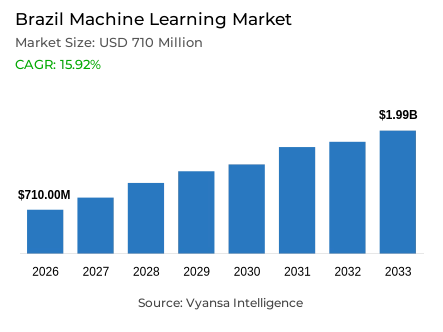
Machine learning enables software to identify patterns in data and generate predictions, classifications, recommendations, and automated decisions. The Brazil machine learning market includes development platforms, model-management software, accelerated computing hardware, and services supporting deployment, monitoring, and integration. Applications span financial fraud detection, customer service, industrial maintenance, healthcare decision support and agricultural monitoring. Purchasing decisions depend on how effectively these capabilities connect with existing business records, technology infrastructure, and operational processes. The market is projected to expand at a CAGR of 15.92% during 2027–2033.
Key Highlights of the Brazil Machine Learning Market
- The market is valued at USD 710 million in 2026 and to reach USD 0.82 billion in 2027 and estimated to reach USD 1.99 billion by 2033.
- The market is projected to expand at a CAGR of 15.92% during 2027–2033.
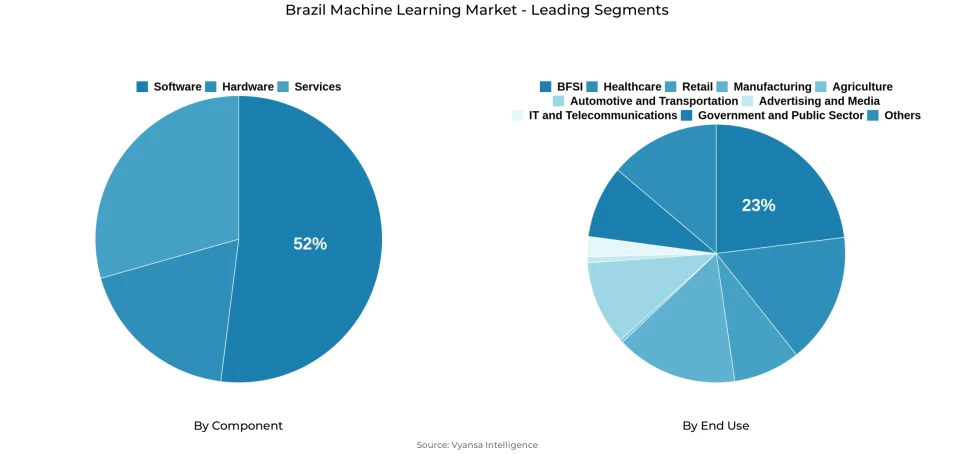
- Software is estimated to account for the largest component share of 52% in 2026.
- Hardware is the fastest-growing component, with a projected CAGR of 35.12% during the forecasted period of 2027–2033.
- Banking, financial services, and insurance are estimated to account for the leading end-use share of 23% in 2026.
- Agriculture is the fastest-growing end use, with a projected CAGR of 36.68% during the forecasted period of 2027–2033.
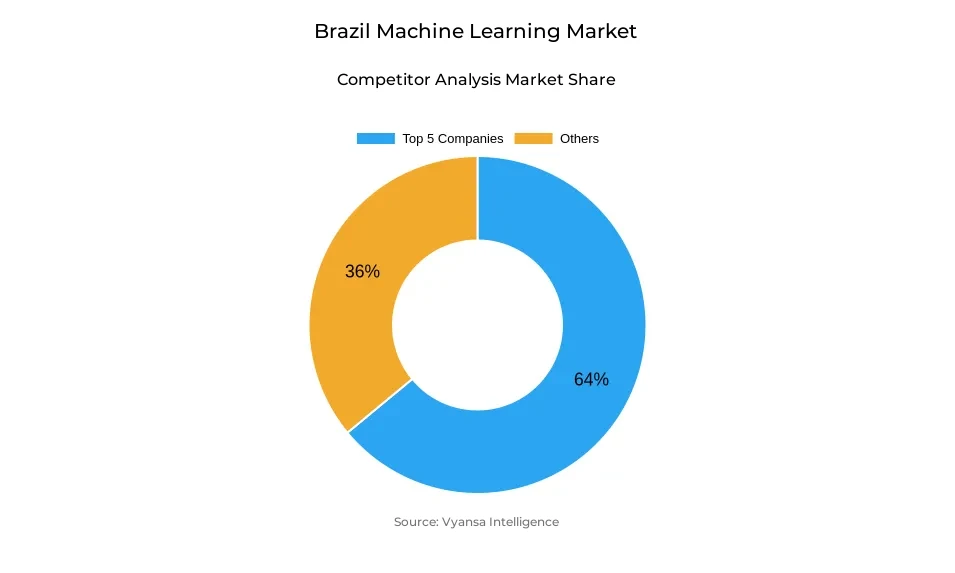
- The five leading companies are estimated to hold a combined market share of 64% in 2026.
Brazil's machine learning market is developing around enterprise applications that convert operating data into decisions. Cetic.br's 2025 enterprise survey found that 17% of businesses with at least 10 employees used artificial intelligence, compared with 13% in 2024. Adoption reached 50% among large businesses and 15% among small businesses. Although these indicators cover AI broadly, they demonstrate an expanding customer base for the computing, software and integration capabilities that support machine learning.
Industrial adoption provides an established foundation beyond conversational applications. The Brazilian Institute of Geography and Statistics found that AI use among industrial businesses with at least 100 employees increased from 16.9% in 2022 to 41.9% in 2024. This earlier comparison remains relevant because it identifies substantial use within businesses capable of deploying models across production and administrative systems. It supports demand for forecasting, process analysis, predictive maintenance and applications connected to existing industrial data.
The demand base is also becoming better equipped to operate these systems. In 2025, 36% of surveyed Brazilian businesses purchased cloud-processing capacity, compared with 33% a year earlier, according to Cetic.br. This provides a broader infrastructure foundation for hosted model development and inference. Through the forecast period, growth is expected to depend on translating access into dependable operating applications, with managed platforms and implementation services helping businesses that lack dedicated data-science and engineering teams.
Brazil Machine Learning Market Drivers
Real-Time Financial Activity Expands Recurring Model Workloads
Brazil's financial institutions need to assess customer activity, identify suspicious behavior and maintain rapid service across continuously operating digital channels. Machine learning can support these decisions by combining account histories, transaction patterns and contextual information into signals that employees and automated systems can act upon. As payment and data-sharing activity expands, the demand opportunity extends across model development, deployment, monitoring and retraining, creating recurring workloads for infrastructure providers, software vendors and implementation partners.
The Central Bank of Brazil reported that more than 170 million individuals had used Pix and over seven billion transactions were processed in May 2026. Monthly transaction volumes subsequently exceeded 7.8 billion in September. Meanwhile, the Brazilian Federation of Banks reported more than 154 million active Open Finance consents in early 2026. Payment activity and permissioned financial records expand the information available for fraud assessment, customer analysis and continuously updated credit-scoring applications.
The federation's 2026 banking technology survey identified predictive transaction monitoring as a priority for 76% of surveyed banks and AI and machine learning for fraud detection for 56%. These priorities connect the scale of digital activity with identifiable demand for analytical systems. Through the forecast period, suppliers that integrate data preparation, scoring and monitoring into existing banking workflows should benefit as institutions pursue better detection while maintaining the response times required by digital services.
Brazil Machine Learning Market Challenges
Limited Deployment Skills Increase Reliance on External Providers
Brazilian businesses can obtain model access more readily than they can assemble teams capable of preparing data, integrating applications and maintaining systems after deployment. Production use requires responsibilities across engineering, business operations and risk management, often while existing technology teams continue supporting legacy systems. The constraint becomes particularly important when businesses need models adapted to proprietary records or specialized decisions. Limited internal capacity can therefore extend implementation schedules and increase dependence on external providers.
The industrial innovation survey's 2024 results illustrate this structural constraint: 54.2% of businesses using advanced digital technologies reported a shortage of qualified personnel, compared with 60.6% among nonadopters. The measures cover advanced technologies collectively, but remain relevant to the preparation and integration required for machine learning. More recent evidence shows how companies respond: the 2025 enterprise survey found that 80% of AI adopters purchased ready-to-use systems and 60% hired suppliers to develop or adapt solutions.
Training responses are emerging, including a September 2026 initiative from AWS and J.Ex targeting 5,000 Brazilian justice-sector professionals. However, workforce development must be accompanied by practical experience in integration, validation and ongoing maintenance. The purchasing categories reported in the enterprise survey can overlap, reflecting combined approaches to implementation. Suppliers offering applications alongside monitoring, technical support and knowledge transfer are therefore positioned to address the gap, while customers gradually build the capacity to manage deployments internally.
Brazil Machine Learning Market Trends
Local Infrastructure and Portuguese-Language Models Broaden Deployment Options
Brazilian organizations need computing infrastructure and language-processing tools suited to the location, content and operating requirements of their data. Local hosting can influence response times, resilience and customer control, while Portuguese-language adaptation affects the relevance of model outputs. The commercial opportunity increasingly connects these layers: infrastructure must support deployment, and applications must perform reliably on the information businesses actually use. This encourages demand for integrated hosting, model adaptation and evaluation services across Brazilian enterprises.
In August 2026, Alibaba Cloud opened its first Brazilian cloud region with two data centers. The additional infrastructure expands supplier choice for computing, storage and associated cloud services used in model development and inference. For enterprise customers, the significance is a wider range of local deployment options and service configurations. Providers must translate infrastructure availability into dependable application support, making connectivity, operational resilience and integration capabilities relevant considerations alongside access to processing capacity.
Brazilian Portuguese model development is advancing alongside infrastructure. Researchers released Manacá-1B in August 2026, a reproducible language model with approximately 1.72 billion parameters, followed by an instruction-tuned research version in October. These releases demonstrate progress in locally adapted language technology, while commercial use requires appropriate licensing and application validation. Through the forecast period, suppliers combining local hosting with fine-tuning and evaluation capabilities can address demand for applications better aligned with Brazilian language and business contexts.
AI Agents Connect Models with Enterprise Workflows
Enterprise applications are extending from standalone responses toward systems that retrieve records, select actions and complete defined tasks across connected software. An agent's usefulness depends on access to the correct information, permission to take approved actions and an escalation path when human review is necessary. This changes the purchasing requirement from model access to a complete set of connectors, orchestration tools and controls. Businesses must evaluate whether the complete workflow can deliver dependable results in production.
In March 2026, Agibank reported that agents connected to its customer-service systems retained 70% of interactions within the relevant automated flows, leaving exceptions for employees. The result demonstrates how model-based applications can handle meaningful operating volumes when supported by reliable records and defined escalation rules. Its significance for the market is the connection between model capability and a specific business process, giving customers a clearer basis for evaluating automation against existing service arrangements.
Platform development supports this transition. In April 2026, SAS expanded Viya with embedded assistants, a Model Context Protocol server and an accelerator for building and governing agents. These capabilities connect analytical models and decision tools with broader workflows. Through the forecast period, demand should extend to identity management, enterprise-data connectors and monitoring as businesses integrate similar systems. Suppliers able to maintain control over data access, actions and exceptions are positioned to compete on production reliability.
Brazil Machine Learning Market Opportunities
Connected Hospitals Create Demand for Validated Clinical Models
Healthcare providers offer an opportunity for machine learning systems that connect patient records, monitoring equipment and clinical workflows. Applications can support deterioration alerts, patient prioritization and hospital-capacity planning, but adoption depends on dependable data and evidence that outputs are suitable for the intended setting. Suppliers must also make results usable within established care processes. This creates demand for complete implementation capabilities that combine validated models, integration and ongoing monitoring around clearly defined clinical responsibilities.
In 2025, 18% of Brazilian healthcare establishments used AI, rising to 31% among facilities with more than 50 beds. The public intelligent-intensive-care initiative selected 14 hospitals, and the Ministry of Health reported six already connected to its monitoring technology in September 2026. These developments identify both a relatively limited adoption base and an initial route to deployment. Larger institutions provide a practical starting point because connected records and monitoring systems can support clinical applications.
Implementation advanced in October 2026 when the Ministry signed a management agreement supporting the intelligent-hospital and connected-intensive-care network, incorporating 78 performance indicators. Medical AI rules effective from August also require proportionate governance, validation and human responsibility. These developments strengthen the case for suppliers that can demonstrate clinical suitability and measurable operating outcomes. Through the forecast period, integration with hospital records and clear accountability should influence purchasing as providers expand deployment while physicians retain treatment authority.
Unlock Market Intelligence
Explore the market potential with our data-driven report
Brazil Machine Learning Market Segmentation Analysis
By Component
- Hardware
- Software
- Services
Software Leads the Market While Hardware is the Fastest Growing
Software is estimated to account for the largest component share of 52% in 2026. Enterprises need platforms connecting models with existing security, finance and operating applications. In September 2026, Vivo and Assai described Auditus, an internal-audit agent developed with Microsoft Copilot Studio and connected to workplace tools. The project included a controlled proof of concept, illustrating demand for application development, connectors and governance software as businesses validate specialized uses before broader deployment.
Hardware is projected to grow fastest, at a CAGR of 35.12% during 2027–2033. Google Cloud made Blackwell-based G4 virtual machines available in Sao Paulo in September 2026, expanding access to accelerated infrastructure. At the device level, Positivo introduced its Master Copilot+ PC with an integrated neural processor delivering up to 48 trillion operations per second. These developments support demand across hosted inference and local processing, broadening hardware requirements beyond large training clusters.
By End Use
- Banking, Financial Services and Insurance
- Healthcare
- Retail
- Manufacturing
- Agriculture
- Automotive and Transportation
- Advertising and Media
- Information Technology and Telecommunications
- Government and Public Sector
- Others
Banking, Financial Services and Insurance Leads the Market While Agriculture is the Fastest Growing
Banking, financial services and insurance is estimated to lead with a 23% share in 2026. Its established data infrastructure supports models across risk assessment, customer analysis and payment operations. In March 2026, Bank of Brazil and Visa completed an agent-initiated payment in a controlled production environment using Visa Intelligent Commerce. The transaction demonstrates the sector's extension from analytical recommendations toward authorized execution, supporting demand for model integration, authentication and transaction controls.
Agriculture is projected to grow fastest, at a CAGR of 36.68% during 2027–2033. The National Supply Company estimated grain production of 361.7 million metric tons for 2025–2026 in September 2026, followed by an October forecast of 367.1 million metric tons for 2026–2027. This scale strengthens the potential value of crop-monitoring, yield-forecasting and input-allocation models. Growth will depend on integrating agronomic data with usable farm applications, equipment and advisory services across different crop-production environments.
Unlock Market Intelligence
Explore the market potential with our data-driven report
Brazil Machine Learning Market Competitive Landscape
The market is moderately consolidated, with the five leading companies estimated to hold a combined share of 64.0% in 2026. The five leading companies in the Brazil machine learning market are Amazon Web Services Inc., Microsoft Corporation, Google LLC, International Business Machines Corporation and SAS Institute Inc.
Key Companies in the Brazil Machine Learning Market
- Amazon Web Services Inc. (AWS)
- Microsoft Corporation (Microsoft Azure)
- Google LLC (Google Cloud)
- International Business Machines Corporation (IBM)
- SAS Institute Inc.
- SAP SE
- Oracle Corporation
- Salesforce Inc.
- Databricks Inc.
- Intel Corporation
Company Profiling
Amazon Web Services Inc. (AWS): AWS provides accelerated cloud computing, managed machine learning and enterprise model services through platforms including SageMaker AI and Amazon Bedrock. Its portfolio supports model development, customization, deployment and integration with cloud-based applications, including management of computing resources and deployment environments. In October 2026, AWS introduced training-session APIs for serverless model customization, allowing developers to control training algorithms while AWS manages GPU infrastructure; the initial release covered cloud regions in the United States and India.
Microsoft Corporation (Microsoft Azure): Microsoft serves Brazilian organizations through Azure computing, machine learning tools and Copilot Studio, supporting model development, enterprise-agent integration and application management. Its portfolio connects data services with tools used to build and govern business applications. In September 2026, Microsoft opened its Sovereignty and Digital Resilience Studio in Sao Paulo, providing an environment where customers can test architectures and develop approaches to secure cloud and AI adoption aligned with their operational and regulatory requirements.
Google LLC (Google Cloud): Google Cloud provides data management, accelerated infrastructure and model-development capabilities through its Brazilian cloud operations. Its services support enterprise applications that connect models with business information, development tools and managed computing resources. In September 2026, Google announced local processing for Gemini 3.5 Flash in the web version of Gemini Enterprise from October 2026, extending the options available to organizations seeking to process supported enterprise-AI workloads within Brazil while maintaining access to cloud-based application services.
International Business Machines Corporation (IBM): IBM supplies enterprise machine learning, model governance and orchestration through watsonx and associated infrastructure. Its portfolio supports organizations developing applications that require controlled data access, integration and model management across business systems. In October 2026, IBM released Granite Speech 5.0 2B, an open model supporting Portuguese transcription and translation alongside other languages, expanding the tools available for speech-based enterprise applications, recorded-information processing and customer-service systems adapted to the language requirements of Brazilian organizations.
SAS Institute Inc.: SAS provides analytics, predictive modeling, decisioning and model-management software through Viya. Its offerings support organizations that need to prepare data, develop analytical models and integrate results into repeatable operating decisions. At its September 2026 Sao Paulo event, SAS presented Bahiagas' HubGas Analytics deployment, which uses Viya-based predictive models and scenario simulations to support natural-gas consumption forecasting and daily operating decisions, demonstrating the application of its platform to an established Brazilian utility workflow.
Recent Developments in the Brazil Machine Learning Market
- In September 2026, Databricks announced an expansion of its Brazilian operations covering enterprise data and AI applications, local delivery capabilities and partner support. Its existing network included more than 300 local partners, alongside a plan to train over 150,000 people in data and AI skills over three and a half years. The initiative expands the implementation ecosystem supporting production adoption, providing additional routes for organizations seeking platform integration, application development and ongoing technical assistance.
- In August 2026, the Federal Data Processing Service, known as Serpro, launched an AI platform keeping customer data and processing within Brazil. The service provides another domestic deployment option for organizations seeking greater control over sensitive information and the environments handling it. Its market relevance lies in extending supplier choice for locally hosted applications, particularly where customers evaluate data location, operating oversight and integration requirements before moving workloads into routine use.
- In August 2026, the government announced plans for a public AI supercomputer in Rio Grande do Norte. The planned infrastructure is intended to support companies, universities, research institutions and public bodies, potentially widening access to computing capacity for organizations without private clusters. Its contribution to the market will depend on implementation and the access arrangements established for users, with potential demand extending to model development, technical support and applications requiring substantial processing resources.
Frequently Asked Questions
Related Report
- Market Segmentation
- Research Scope
- Research Methodology
- Definitions and Assumptions
- Executive Summary
- Brazil Machine Learning Market Policies, Regulations, and Standards
- Brazil Machine Learning Market Dynamics
- Growth Factors
- Challenges
- Trends
- Opportunities
- Brazil Machine Learning Market Statistics, 2023-2033F
- Market Size & Growth Outlook
- By Revenues in USD Million
- Market Segmentation & Growth Outlook
- By Component
- Hardware- Market Insights and Forecast 2023-2033, USD Million
- Software- Market Insights and Forecast 2023-2033, USD Million
- Services- Market Insights and Forecast 2023-2033, USD Million
- By Deployment
- Cloud-based- Market Insights and Forecast 2023-2033, USD Million
- On-premises- Market Insights and Forecast 2023-2033, USD Million
- By Enterprise Size
- Large Enterprises- Market Insights and Forecast 2023-2033, USD Million
- Small and Medium-sized Enterprises- Market Insights and Forecast 2023-2033, USD Million
- By End Use
- BFSI- Market Insights and Forecast 2023-2033, USD Million
- Healthcare- Market Insights and Forecast 2023-2033, USD Million
- Retail- Market Insights and Forecast 2023-2033, USD Million
- Manufacturing- Market Insights and Forecast 2023-2033, USD Million
- Agriculture- Market Insights and Forecast 2023-2033, USD Million
- Automotive and Transportation- Market Insights and Forecast 2023-2033, USD Million
- Advertising and Media- Market Insights and Forecast 2023-2033, USD Million
- IT and Telecommunications- Market Insights and Forecast 2023-2033, USD Million
- Government and Public Sector- Market Insights and Forecast 2023-2033, USD Million
- Others- Market Insights and Forecast 2023-2033, USD Million
- By Region
- North- Market Insights and Forecast 2023-2033, USD Million
- Center-West- Market Insights and Forecast 2023-2033, USD Million
- Northeast- Market Insights and Forecast 2023-2033, USD Million
- Southeast- Market Insights and Forecast 2023-2033, USD Million
- South- Market Insights and Forecast 2023-2033, USD Million
- By Competitors
- Competition Characteristics
- Market Share & Analysis
- By Component
- Market Size & Growth Outlook
- Brazil Hardware Market Statistics, 2023-2033
- Market Size & Growth Outlook
- By Revenues in USD Million
- Market Segmentation & Growth Outlook
- By Deployment- Market Insights and Forecast 2023-2033, USD Million
- By Enterprise Size- Market Insights and Forecast 2023-2033, USD Million
- By End Use- Market Insights and Forecast 2023-2033, USD Million
- By Region- Market Insights and Forecast 2023-2033, USD Million
- Market Size & Growth Outlook
- Brazil Software Market Statistics, 2023-2033
- Market Size & Growth Outlook
- By Revenues in USD Million
- Market Segmentation & Growth Outlook
- By Deployment- Market Insights and Forecast 2023-2033, USD Million
- By Enterprise Size- Market Insights and Forecast 2023-2033, USD Million
- By End Use- Market Insights and Forecast 2023-2033, USD Million
- By Region- Market Insights and Forecast 2023-2033, USD Million
- Market Size & Growth Outlook
- Brazil Services Market Statistics, 2023-2033
- Market Size & Growth Outlook
- By Revenues in USD Million
- Market Segmentation & Growth Outlook
- By Deployment- Market Insights and Forecast 2023-2033, USD Million
- By Enterprise Size- Market Insights and Forecast 2023-2033, USD Million
- By End Use- Market Insights and Forecast 2023-2033, USD Million
- By Region- Market Insights and Forecast 2023-2033, USD Million
- Market Size & Growth Outlook
- Competitive Outlook
- Company Profiles
- Amazon Web Services Brazil Ltd.
- Business Description
- Product Portfolio
- Collaborations & Alliances
- Recent Developments
- Financial Details
- Others
- Microsoft Brazil Ltd.
- Business Description
- Product Portfolio
- Collaborations & Alliances
- Recent Developments
- Financial Details
- Others
- Google Cloud Brazil Computing and Data Services Ltd.
- Business Description
- Product Portfolio
- Collaborations & Alliances
- Recent Developments
- Financial Details
- Others
- IBM Brazil Industry, Machines and Services Ltd.
- Business Description
- Product Portfolio
- Collaborations & Alliances
- Recent Developments
- Financial Details
- Others
- SAS Institute Brazil Ltd.
- Business Description
- Product Portfolio
- Collaborations & Alliances
- Recent Developments
- Financial Details
- Others
- SAP Brazil Ltd.
- Business Description
- Product Portfolio
- Collaborations & Alliances
- Recent Developments
- Financial Details
- Others
- Oracle Brazil Systems Ltd.
- Business Description
- Product Portfolio
- Collaborations & Alliances
- Recent Developments
- Financial Details
- Others
- Salesforce Technology Brazil Ltd.
- Business Description
- Product Portfolio
- Collaborations & Alliances
- Recent Developments
- Financial Details
- Others
- Databricks Brazil Ltd.
- Business Description
- Product Portfolio
- Collaborations & Alliances
- Recent Developments
- Financial Details
- Others
- Intel Semiconductors Brazil Ltd.
- Business Description
- Product Portfolio
- Collaborations & Alliances
- Recent Developments
- Financial Details
- Others
- Amazon Web Services Brazil Ltd.
- Company Profiles
- Disclaimer
| Segment | Sub-Segment |
|---|---|
| By Component |
|
| By Deployment |
|
| By Enterprise Size |
|
| By End Use |
|
| By Region |
|
Research Methodology
This study followed a structured approach comprising four key phases to assess the size and scope of the electro-oxidation market. The process began with thorough secondary research to collect data on the target market, related markets, and broader industry context. These findings, along with preliminary assumptions and estimates, were then validated through extensive primary research involving industry experts from across the value chain. To calculate the overall market size, both top-down and bottom-up methodologies were employed. Finally, market segmentation and data triangulation techniques were applied to refine and validate segment-level estimations.
Secondary Research
The secondary research phase involved gathering data from a wide range of credible and published sources. This step helped in identifying industry trends, defining market segmentation, and understanding the market landscape and value chain.
Sources consulted during this phase included:
- Company annual reports, investor presentations, and press releases
- Industry white papers and certified publications
- Trade directories and market-recognized databases
- Articles from authoritative authors and reputable journals
- Gold and silver standard websites
Secondary research was critical in mapping out the industry's value chain and monetary flow, identifying key market segments, understanding regional variations, and tracking significant industry developments.
Other key sources:
- Financial disclosures
- Industry associations and trade bodies
- News outlets and business magazines
- Academic journals and research studies
- Paid industry databases
Primary Research
To validate secondary data and gain deeper market insights, primary research was conducted with key stakeholders across both the supply and demand sides of the market.
On the demand side, participants included decision-makers and influencers from end-user industries—such as CIOs, CTOs, and CSOs—who provided first-hand perspectives on market needs, product usage, and future expectations.
On the supply side, interviews were conducted with manufacturers, industry associations, and institutional participants to gather insights into current offerings, product pipelines, and market challenges.
Primary interviews provided critical inputs such as:
- Market size and revenue data
- Product and service breakdowns
- Market forecasts
- Regional and application-specific trends
Stakeholders consulted included:
- Leading OEM and solution providers
- Channel and distribution partners
- End users across various applications
- Independent consultants and industry specialists
Market Size Estimation and Data Triangulation
- Identifying Key Market Participants (Secondary Research)
- Goal: To identify the major players or companies in the target market. This typically involves using publicly available data sources such as industry reports, market research publications, and financial statements of companies.
- Tools: Reports from firms like Gartner, Forrester, Euromonitor, Statista, IBISWorld, and others. Public financial statements, news articles, and press releases from top market players.
- Extracting Earnings of Key Market Participants
- Goal: To estimate the earnings generated from the product or service being analyzed. This step helps in understanding the revenue potential of each market player in a specific geography.
- Methods: Earnings data can be gathered from:
- Publicly available financial reports (for listed companies).
- Interviews and primary data sources from professionals, such as Directors, VPs, SVPs, etc. This is especially useful for understanding more nuanced, internal data that isn't publicly disclosed.
- Annual reports and investor presentations of key players.
- Data Collation and Development of a Relevant Data Model
- Goal: To collate inputs from both primary and secondary sources into a structured, data-driven model for market estimation. This model will incorporate key market KPIs and any independent variables relevant to the market.
- Key KPIs: These could include:
- Market size, growth rate, and demand drivers.
- Industry-specific metrics like market share, average revenue per customer (ARPC), or average deal size.
- External variables, such as economic growth rates, inflation rates, or commodity prices, that could affect the market.
- Data Modeling: Based on this data, the market forecasts are developed for the next 5 years. A combination of trend analysis, scenario modeling, and statistical regression might be used to generate projections.
- Scenario Analysis
- Goal: To test different assumptions and validate how sensitive the market is to changes in key variables (e.g., market demand, regulatory changes, technological disruptions).
- Types of Scenarios:
- Base Case: Based on current assumptions and historical data.
- Best-Case Scenario: Assuming favorable market conditions, regulatory environments, and technological advancements.
- Worst-Case Scenario: Accounting for adverse factors, such as economic downturns, stricter regulations, or unexpected disruptions.