Japan Reinsurance Market Report: Trends, Growth and Forecast (2027-2033)
By Reinsurance Type (Facultative Reinsurance, Treaty Reinsurance), By Line of Business (Property & Casualty, Life & Health, Specialty, Aviation, Marine, Energy, Others), By Distribution Channel (Direct Writing, Broker-Mediated), By Capital Source (Traditional Rated Reinsurers, Alternative Capital, ILS, Sidecars) ... Read more
|
Major Players
|
Japan Reinsurance Market Overview
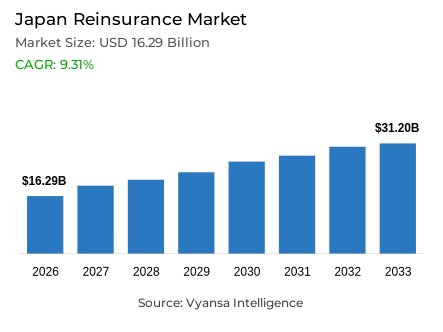
The Japan reinsurance market involves the transfer of insurance risks from primary insurers to reinsurers in exchange for premiums. It enables Japanese insurers to manage catastrophe-related losses, strengthen capital adequacy, and expand underwriting capacity. The market encompasses treaty and facultative reinsurance across life and non-life insurance, including property, casualty, natural disaster, and specialty risk coverage. The Japan reinsurance market is forecast to grow at a compound annual growth rate (CAGR) of 9.31% between 2027 and 2033.
Key Highlights of the Japan Reinsurance Market
- The Japan reinsurance market was valued at USD 16.29 billion in 2026 and is estimated at USD 18.29 billion in 2027 and is forecast to reach USD 31.20 billion by 2033.
- The market is forecast to expand at a CAGR of 9.31% between 2027 and 2033.
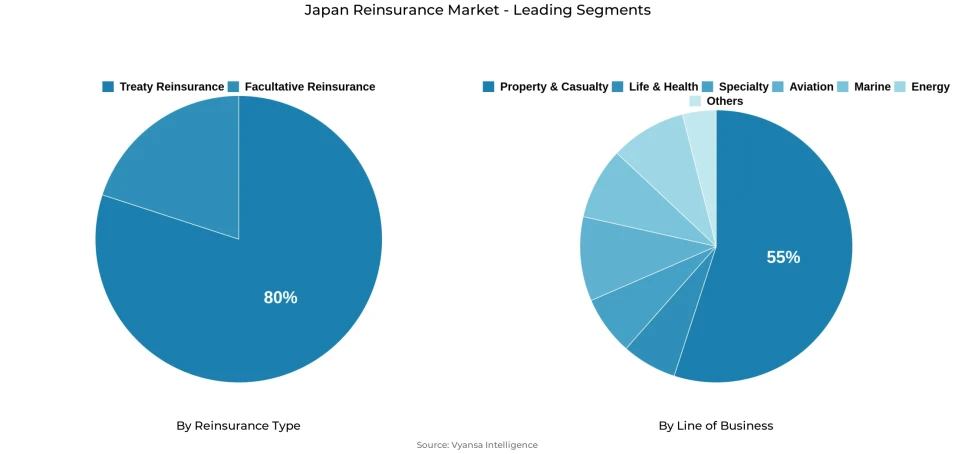
- By reinsurance type, treaty reinsurance led the market with an approximate 80% share in 2026.
- Facultative reinsurance is the fastest-growing reinsurance type, expanding at a CAGR of 11.89% between 2027 and 2033.
- By line of business, property & casualty led the market with an approximate 55% share in 2026.
- Life & health is the fastest-growing line of business, expanding at a CAGR of 11.48% between 2027 and 2033.
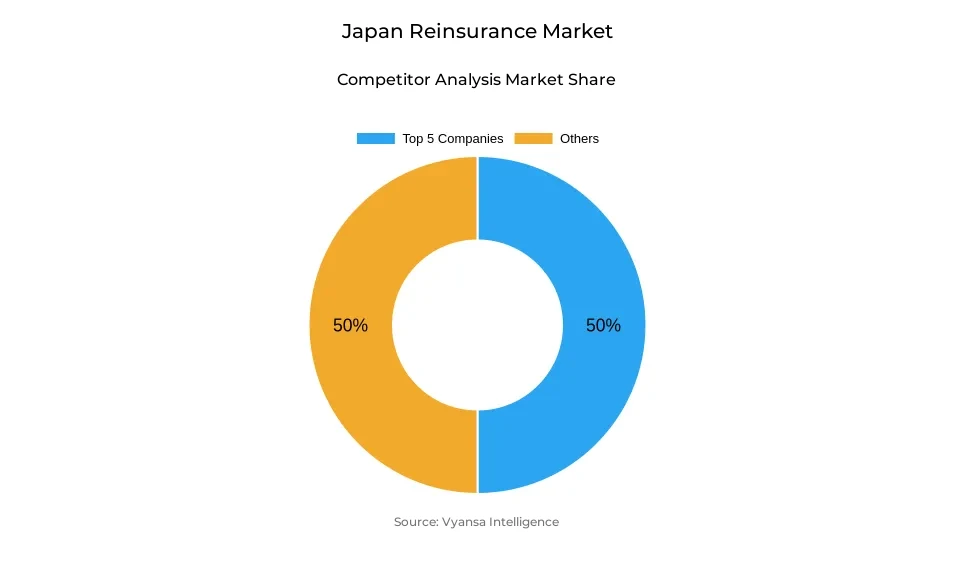
- The market is moderately consolidated, with the top five companies holding a combined 50% share in 2026.
Japan’s reinsurance market is supported by the simultaneous need to protect physical assets and manage long-duration insurance liabilities. In September 2025, the Earthquake Research Committee revised its 30-year assessment for a magnitude 8 to 9 Nankai Trough earthquake to two scientifically valid ranges of 60% to 90% or higher and 20% to 50%. Both estimates remain in the highest risk category, sustaining demand for earthquake capacity even during periods of limited insured losses.
Demographic conditions create another substantial requirement for risk transfer. People aged 65 and above represented approximately 29.6% of Japan’s population in September 2026, increasing insurers’ exposure to longevity, whole-life and annuity liabilities. Non-life exposure also remains active beyond major earthquakes. During fiscal 2025, insurers had paid 33,421 claims associated with the August rainfall event and 10,931 claims following the earthquake off Aomori Prefecture, demonstrating how weather and seismic events generate different reinsurance requirements.
Over the forecast period, insurers are expected to use reinsurance more actively for capital management, catastrophe protection and the transfer of mature life portfolios. Traditional treaty capacity will remain central, but facultative placements, structured life transactions and insurance-linked securities will widen the available capital base. Lower property-catastrophe pricing may moderate premium growth, although Japan’s accumulation risk, ageing population and need for dependable claims-paying capacity should sustain long-term market expansion.
Japan Reinsurance Market Government Compliance
Japan’s economic value-based solvency framework applies to fiscal years ending on or after 31 March 2026. The framework evaluates assets and liabilities using economic values, making insurers’ exposure to interest rates, market movements, longevity and other long-duration risks more visible in their solvency positions.
The change directly affects reinsurance demand because insurers can transfer selected liabilities and their associated capital requirements instead of relying entirely on new equity or adjustments to investment portfolios. Life insurers holding whole-life and annuity blocks can use coinsurance, funded reinsurance and other structured arrangements to improve capital efficiency under the new framework.
The Financial Services Agency also amended its supervisory guidelines from 1 July 2026 in response to the increasing use of reinsurance by life insurers. Stronger expectations concerning governance, risk transfer and counterparty management increase the preparation required for each transaction. This favors reinsurers with strong financial capacity, transparent collateral arrangements and previous experience completing complex transactions with Japanese insurers.
Japan Reinsurance Market Drivers
Capital Relief for Long-Dated Life Liabilities
Japanese life insurers hold substantial portfolios of whole-life, savings and annuity policies whose obligations can continue for several decades. These portfolios consume capital because their profitability remains sensitive to interest rates, policyholder behavior, investment performance and longevity. Reinsurance allows insurers to transfer part of these risks while releasing capital for new underwriting and other business requirements.
AM Best reported in June 2026 that Japan’s life insurance cession rate exceeded 24% of gross written premium in both 2023 and 2024, compared with slightly below 10% in 2020. Despite this increase, an estimated 1% to 2% of the sector’s in-force individual life and annuity business had been ceded, leaving a sizeable pool of existing liabilities that could support further transactions.
Demand should consequently extend beyond occasional portfolio transfers. Once an insurer establishes the required operational, collateral and reporting arrangements with a reinsurer, the same structure can be applied to further blocks or newly written policies. This supports recurring flow reinsurance alongside larger one-time transactions and gives reinsurers with asset-management and liability-modelling expertise a growing role in Japan’s life insurance sector.
Japan Reinsurance Market Challenges
Lower Property-Catastrophe Pricing
Abundant global reinsurance capital and limited recent Japanese catastrophe losses are increasing competition at annual renewals. Cedants can use competitive placements to purchase the same protection at lower rates or redirect savings toward additional layers. This improves affordability for primary insurers but reduces the premium reinsurers receive for each unit of exposure.
Howden Re reported that risk-adjusted prices for Japanese catastrophe excess-of-loss programmes declined by as much as 20% at the April 2026 renewal, with the overall reduction estimated at approximately 16%. The pricing movement returned rates to levels last observed during the early 2020s. A later buyer survey found that 86% of respondents expected property reinsurance prices to decline again in 2027, with most anticipating reductions of 7.5% to 15%.
Continued price reductions could restrict market value growth even when ceded limits increase. Reinsurers must therefore balance market-share retention against the need to maintain sufficient returns for earthquake and typhoon exposure. Companies may respond by tightening contract conditions, protecting pricing on loss-affected risks or allocating more capital toward life, specialty and structured reinsurance where demand is less dependent on annual catastrophe pricing.
Japan Reinsurance Market Recent Trends
Catastrophe Bonds Broaden Available Capacity
Japanese insurers are increasingly placing catastrophe bonds alongside traditional treaty protection. These instruments transfer defined catastrophe risks to capital-market investors, provide multi-year protection and reduce dependence on the annual availability of rated reinsurance capacity. They are particularly suitable for low-frequency but severe exposures such as major earthquakes.
In March 2026, Tokio Marine & Nichido Fire Insurance Co., Ltd. sponsored the USD 100 million Kizuna Re III Series 2026-1 catastrophe bond for Japanese earthquake protection. The transaction provided multi-year capacity through a Singapore-based special-purpose vehicle and was priced at the midpoint of its marketed range.
The wider insurance-linked securities market provides a growing capital pool for similar placements. Alternative reinsurance capital reached a record USD 144.5 billion by June 2026, while catastrophe-bond issuance totalled USD 24.9 billion during the preceding twelve months. This expansion gives Japanese cedants more options for capacity, duration and pricing while increasing demand for modelling, structuring and capital-market placement capabilities.
Artificial Intelligence Improves Insurance Data Workflows
Japanese insurers are introducing generative artificial intelligence into policy administration, product support and internal inquiry handling. These activities influence reinsurance operations because portfolio transactions and renewals require consistent policy records, exposure information and supporting documentation from the cedant.
SOMPO Himawari Life Insurance Inc. introduced its generative artificial intelligence inquiry assistant in January 2026 to support new-business questions from branch and head-office employees. The insurer aims to reduce the time spent handling these inquiries by 6,500 hours annually by fiscal 2030. Separately, Tokio Marine Holdings, Inc. entered a strategic collaboration with OpenAI in September 2025 to develop artificial intelligence agents across customer proposals and insurance operations.
As these systems move into wider use, cedants should be able to retrieve policy information and prepare submissions more efficiently. Reinsurers can benefit through more structured data, faster portfolio evaluation and fewer manual clarification cycles. Adoption will still depend on data quality, governance and the ability to verify generated outputs, making controlled implementation more important than unrestricted automation.
Japan Reinsurance Market Future Opportunities
Parametric Earthquake Cover for Business Interruption
Traditional property insurance commonly requires evidence of physical damage before a claim is paid. Japanese manufacturers, transport companies and other businesses can nevertheless experience substantial losses when earthquakes interrupt power, logistics, suppliers or employee access without causing sufficient damage to activate conventional business-interruption policies.
This creates an opportunity for parametric earthquake cover, under which payment is based on an independently recorded seismic measurement. Munich Re Specialty introduced such cover through Lloyd’s Japan in July 2026, using readings from Japan’s K-NET and KiK-net monitoring stations. The structure can provide liquidity without waiting for a complete physical-damage assessment.
The underlying protection gap remains substantial. Natural catastrophes generated approximately USD 65 billion of economic losses across Asia in 2025, but only around USD 5 billion was insured. Parametric products can address part of this gap by covering predetermined liquidity requirements, lost production and additional operating costs. Reinsurers that combine seismic modelling, local distribution and sufficient capacity can develop solutions for manufacturers, utilities, property operators and infrastructure owners.
Unlock Market Intelligence
Explore the market potential with our data-driven report
Japan Reinsurance Market Segmentation Analysis
By Reinsurance Type:
- Facultative Reinsurance
- Treaty Reinsurance
Recurring Portfolio Capacity Keeps Treaty Reinsurance at Approximately 80% of Demand
Treaty reinsurance held an approximate 80% share in 2026. It leads because Japanese insurers require recurring portfolio-wide protection for large groups of policies rather than negotiating separate contracts for every exposure. Earthquake, typhoon, mortality and other accumulated risks are therefore commonly transferred through proportional or excess-of-loss treaties renewed on an annual or multi-year basis.
Facultative reinsurance is forecast to grow at a CAGR of 11.89% between 2027 and 2033. Its expansion will be supported by high-value commercial properties, data centres, industrial facilities, marine assets and infrastructure projects that require individual underwriting. Facultative placement allows insurers to secure additional limits or specialist expertise when a risk is too large, unusual or concentrated to be included fully within an existing treaty.
By Line of Business:
- Property & Casualty
- Life & Health
- Specialty (Aviation, Marine, Energy)
- Others
Earthquake and Typhoon Exposure Holds Property and Casualty at Approximately 55% of Line of Business Demand
Property and casualty held an approximate 55% share in 2026. Earthquake and typhoon accumulation makes this business structurally dependent on external capacity because one event can affect numerous insured properties simultaneously. In April 2026, the National Mutual Insurance Federation of Agricultural Cooperatives issued the USD 100 million Nakama Re 2026-1 catastrophe bond, adding multi-year earthquake capacity to its property protection.
Life and health is forecast to grow at a CAGR of 11.48% between 2027 and 2033. Growth is being supported by transfers of mature whole-life and annuity portfolios as insurers seek to manage capital and long-duration liabilities. In June 2026, Pacific Life Re International Limited completed its third asset-intensive block transaction with Tokio Marine & Nichido Life Insurance Co., Ltd. (Anshin Life), demonstrating that insurers can return to established reinsurance structures for additional portfolios.
Unlock Market Intelligence
Explore the market potential with our data-driven report
Japan Reinsurance Market Competitive Landscape
The industry is moderately consolidated, with the top five companies holding a combined share of 50.00% of total revenue in 2026, so no single company holds a majority of ceded premium. The five companies are Swiss Re Asia Pte. Ltd., Japan Branch (Swiss Re), Munich Re, Japan Branch, RGA Reinsurance Company Japan Branch, The Toa Reinsurance Company, Limited and SCOR SE.
Key Companies in the Japan Reinsurance Market
- Athene Life Re Ltd.
- General Reinsurance AG Tokyo Branch (Gen Re)
- Hannover Rück SE (Hannover Re)
- Japan Earthquake Reinsurance Co.,Ltd.
- Munich Re, Japan Branch
- Pacific Life Re International Limited (Pacific Life Re)
- RGA Reinsurance Company Japan Branch
- SCOR SE
- Swiss Re Asia Pte. Ltd., Japan Branch (Swiss Re)
- The Toa Reinsurance Company, Limited
Recent Developments in the Japan Reinsurance Market
- October 2026: Pacific Life Re International Limited completed a structured reinsurance transaction for a leading Japanese life insurer on 13 October 2026. The transaction was the company’s second structured reinsurance agreement in Japan during 2026 and expanded the availability of capital and risk-management solutions for domestic life insurers.
- April 2026: The Dai-ichi Life Insurance Company, Limited entered an agreement with Prismic Life Reinsurance, Ltd. in April 2026 covering an in-force portfolio of whole-life and annuity policies. The agreement demonstrated growing demand for transactions that combine liability transfer with specialist management of the supporting assets.
- March 2026: Aflac Re Bermuda Ltd. announced a reinsurance transaction with Japan Post Insurance Co., Ltd. on 31 March 2026. The agreement expanded Japan Post Insurance’s use of external reinsurance and added another international provider to the growing market for transferring Japanese annuity and savings-related liabilities.
Frequently Asked Questions
Related Report
- Market Segmentation
- Research Scope
- Research Methodology
- Definitions and Assumptions
- Executive Summary
- Japan Reinsurance Market Policies, Regulations, and Standards
- Japan Reinsurance Market Dynamics
- Growth Factors
- Challenges
- Trends
- Opportunities
- Japan Reinsurance Market Statistics, 2023-2033F
- Market Size & Growth Outlook
- By Revenues in USD Million
- Market Segmentation & Growth Outlook
- By Reinsurance Type
- Facultative Reinsurance- Market Insights and Forecast 2023-2033, USD Million
- Treaty Reinsurance- Market Insights and Forecast 2023-2033, USD Million
- By Line of Business
- Property & Casualty- Market Insights and Forecast 2023-2033, USD Million
- Life & Health- Market Insights and Forecast 2023-2033, USD Million
- Specialty- Market Insights and Forecast 2023-2033, USD Million
- Aviation- Market Insights and Forecast 2023-2033, USD Million
- Marine- Market Insights and Forecast 2023-2033, USD Million
- Energy- Market Insights and Forecast 2023-2033, USD Million
- Others- Market Insights and Forecast 2023-2033, USD Million
- By Distribution Channel
- Direct Writing- Market Insights and Forecast 2023-2033, USD Million
- Broker-Mediated- Market Insights and Forecast 2023-2033, USD Million
- By Capital Source
- Traditional Rated Reinsurers- Market Insights and Forecast 2023-2033, USD Million
- Alternative Capital- Market Insights and Forecast 2023-2033, USD Million
- ILS- Market Insights and Forecast 2023-2033, USD Million
- Sidecars- Market Insights and Forecast 2023-2033, USD Million
- By Competitors
- Competition Characteristics
- Market Share & Analysis
- By Reinsurance Type
- Market Size & Growth Outlook
- Japan Facultative Reinsurance Market Statistics, 2023-2033
- Market Size & Growth Outlook
- By Revenues in USD Million
- Market Segmentation & Growth Outlook
- By Line of Business- Market Insights and Forecast 2023-2033, USD Million
- By Distribution Channel- Market Insights and Forecast 2023-2033, USD Million
- By Capital Source- Market Insights and Forecast 2023-2033, USD Million
- Market Size & Growth Outlook
- Japan Treaty Reinsurance Market Statistics, 2023-2033
- Market Size & Growth Outlook
- By Revenues in USD Million
- Market Segmentation & Growth Outlook
- By Line of Business- Market Insights and Forecast 2023-2033, USD Million
- By Distribution Channel- Market Insights and Forecast 2023-2033, USD Million
- By Capital Source- Market Insights and Forecast 2023-2033, USD Million
- Market Size & Growth Outlook
- Competitive Outlook
- Company Profiles
- Athene Life Re Ltd.
- Business Description
- Product Portfolio
- Collaborations & Alliances
- Recent Developments
- Financial Details
- Others
- General Reinsurance AG Tokyo Branch (Gen Re)
- Business Description
- Product Portfolio
- Collaborations & Alliances
- Recent Developments
- Financial Details
- Others
- Hannover Rück SE (Hannover Re)
- Business Description
- Product Portfolio
- Collaborations & Alliances
- Recent Developments
- Financial Details
- Others
- Japan Earthquake Reinsurance Co.,Ltd.
- Business Description
- Product Portfolio
- Collaborations & Alliances
- Recent Developments
- Financial Details
- Others
- Munich Re, Japan Branch
- Business Description
- Product Portfolio
- Collaborations & Alliances
- Recent Developments
- Financial Details
- Others
- Pacific Life Re International Limited (Pacific Life Re)
- Business Description
- Product Portfolio
- Collaborations & Alliances
- Recent Developments
- Financial Details
- Others
- RGA Reinsurance Company Japan Branch
- Business Description
- Product Portfolio
- Collaborations & Alliances
- Recent Developments
- Financial Details
- Others
- SCOR SE
- Business Description
- Product Portfolio
- Collaborations & Alliances
- Recent Developments
- Financial Details
- Others
- Swiss Re Asia Pte. Ltd., Japan Branch (Swiss Re)
- Business Description
- Product Portfolio
- Collaborations & Alliances
- Recent Developments
- Financial Details
- Others
- The Toa Reinsurance Company, Limited
- Business Description
- Product Portfolio
- Collaborations & Alliances
- Recent Developments
- Financial Details
- Others
- Athene Life Re Ltd.
- Company Profiles
- Disclaimer
| Segment | Sub-Segment |
|---|---|
| By Reinsurance Type |
|
| By Line of Business |
|
| By Distribution Channel |
|
| By Capital Source |
|
Research Methodology
This study followed a structured approach comprising four key phases to assess the size and scope of the electro-oxidation market. The process began with thorough secondary research to collect data on the target market, related markets, and broader industry context. These findings, along with preliminary assumptions and estimates, were then validated through extensive primary research involving industry experts from across the value chain. To calculate the overall market size, both top-down and bottom-up methodologies were employed. Finally, market segmentation and data triangulation techniques were applied to refine and validate segment-level estimations.
Secondary Research
The secondary research phase involved gathering data from a wide range of credible and published sources. This step helped in identifying industry trends, defining market segmentation, and understanding the market landscape and value chain.
Sources consulted during this phase included:
- Company annual reports, investor presentations, and press releases
- Industry white papers and certified publications
- Trade directories and market-recognized databases
- Articles from authoritative authors and reputable journals
- Gold and silver standard websites
Secondary research was critical in mapping out the industry's value chain and monetary flow, identifying key market segments, understanding regional variations, and tracking significant industry developments.
Other key sources:
- Financial disclosures
- Industry associations and trade bodies
- News outlets and business magazines
- Academic journals and research studies
- Paid industry databases
Primary Research
To validate secondary data and gain deeper market insights, primary research was conducted with key stakeholders across both the supply and demand sides of the market.
On the demand side, participants included decision-makers and influencers from end-user industries—such as CIOs, CTOs, and CSOs—who provided first-hand perspectives on market needs, product usage, and future expectations.
On the supply side, interviews were conducted with manufacturers, industry associations, and institutional participants to gather insights into current offerings, product pipelines, and market challenges.
Primary interviews provided critical inputs such as:
- Market size and revenue data
- Product and service breakdowns
- Market forecasts
- Regional and application-specific trends
Stakeholders consulted included:
- Leading OEM and solution providers
- Channel and distribution partners
- End users across various applications
- Independent consultants and industry specialists
Market Size Estimation and Data Triangulation
- Identifying Key Market Participants (Secondary Research)
- Goal: To identify the major players or companies in the target market. This typically involves using publicly available data sources such as industry reports, market research publications, and financial statements of companies.
- Tools: Reports from firms like Gartner, Forrester, Euromonitor, Statista, IBISWorld, and others. Public financial statements, news articles, and press releases from top market players.
- Extracting Earnings of Key Market Participants
- Goal: To estimate the earnings generated from the product or service being analyzed. This step helps in understanding the revenue potential of each market player in a specific geography.
- Methods: Earnings data can be gathered from:
- Publicly available financial reports (for listed companies).
- Interviews and primary data sources from professionals, such as Directors, VPs, SVPs, etc. This is especially useful for understanding more nuanced, internal data that isn't publicly disclosed.
- Annual reports and investor presentations of key players.
- Data Collation and Development of a Relevant Data Model
- Goal: To collate inputs from both primary and secondary sources into a structured, data-driven model for market estimation. This model will incorporate key market KPIs and any independent variables relevant to the market.
- Key KPIs: These could include:
- Market size, growth rate, and demand drivers.
- Industry-specific metrics like market share, average revenue per customer (ARPC), or average deal size.
- External variables, such as economic growth rates, inflation rates, or commodity prices, that could affect the market.
- Data Modeling: Based on this data, the market forecasts are developed for the next 5 years. A combination of trend analysis, scenario modeling, and statistical regression might be used to generate projections.
- Scenario Analysis
- Goal: To test different assumptions and validate how sensitive the market is to changes in key variables (e.g., market demand, regulatory changes, technological disruptions).
- Types of Scenarios:
- Base Case: Based on current assumptions and historical data.
- Best-Case Scenario: Assuming favorable market conditions, regulatory environments, and technological advancements.
- Worst-Case Scenario: Accounting for adverse factors, such as economic downturns, stricter regulations, or unexpected disruptions.