Global Serverless Computing Market Report: Trends, Growth and Forecast (2026-2032)
By Component (Platform/Solution, Services, Professional Services, Managed Services), By Service Type (Function-as-a-Service, Backend-as-a-Service, Serverless Containers, Serverless Databases, Serverless Storage, Serverless API Management, Serverless Monitoring & Security), By Application (Web & Mobile Applications, API Backends, Real-Time Data Processing, IoT Applications, AI & Machine Learning Workloads, Event-Driven Automation, Microservices, Data Pipeline Automation), By Deployment Model (Public Cloud, Private Cloud, Hybrid Cloud, Multi-Cloud, Edge Cloud), By Organization Size (Large Enterprises, Small & Medium Enterprises), By End User (BFSI, IT & Telecom, Retail & E-Commerce, Healthcare, Media & Entertainment, Gaming, Manufacturing, Government, Others), By Region (North America, South America, Europe, Middle East & Africa, Asia Pacific) ... Read more
|
Major Players
|
Global Serverless Computing Market Statistics and Insights, 2026
- Market Size Statistics
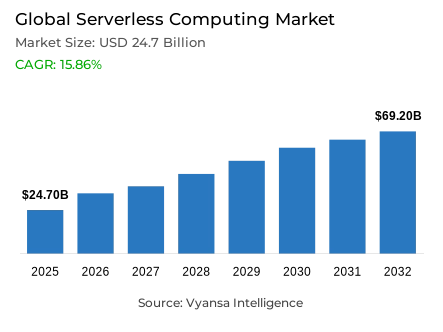
- Serverless computing market size in Global was valued at USD 24.7 billion in 2025 and is estimated at USD 29.61 billion in 2026.
- The market size is expected to grow to USD 69.2 billion by 2032.
- Market to register a CAGR of around 15.86% during 2026-32.
- Service Type Shares
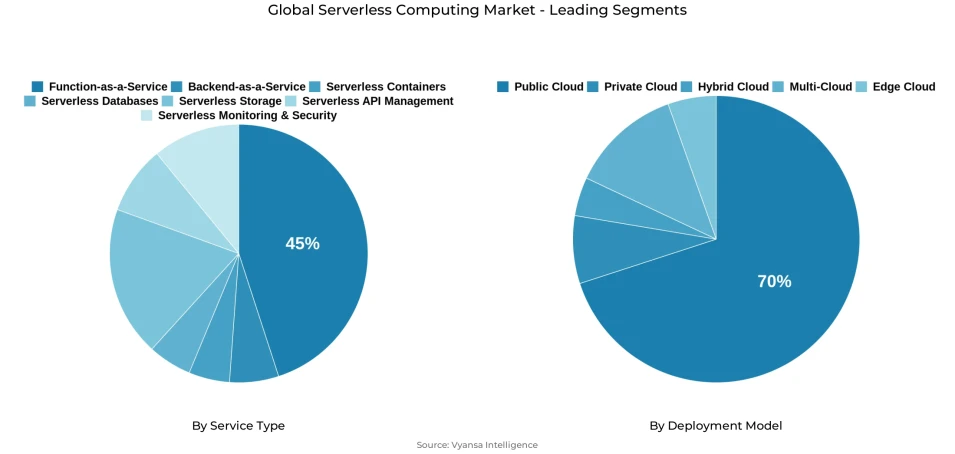
- Function-as-a-service grabbed market share of 45%.
- Competition
- More than 30 companies are actively engaged in producing serverless computing.
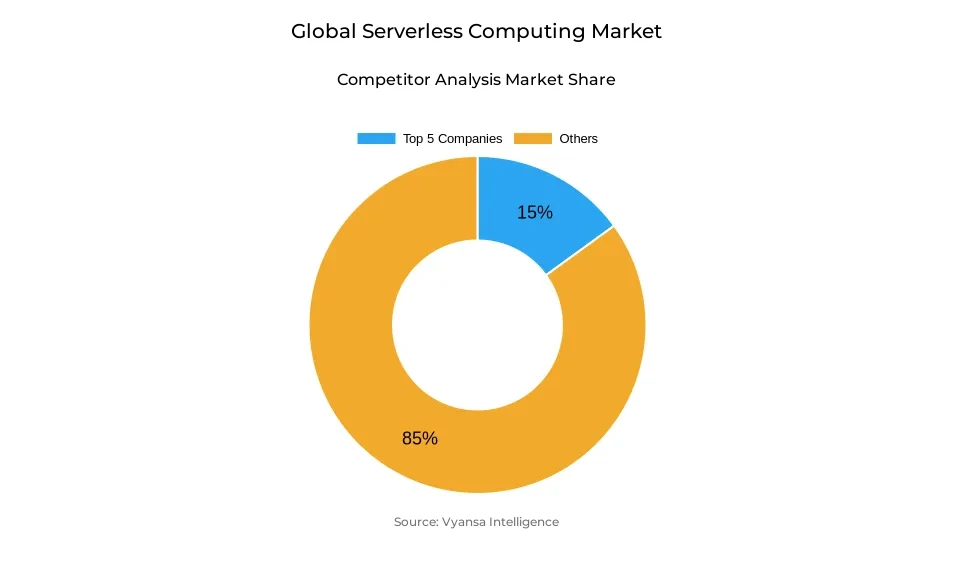
- Top 5 companies acquired around 15% of the market share.
- Oracle Cloud Infrastructure, Alibaba Cloud, Tencent Cloud, Amazon Web Services, Microsoft Azure etc., are few of the top companies.
- Deployment Model
- Public cloud grabbed 70% of the market.
- Region
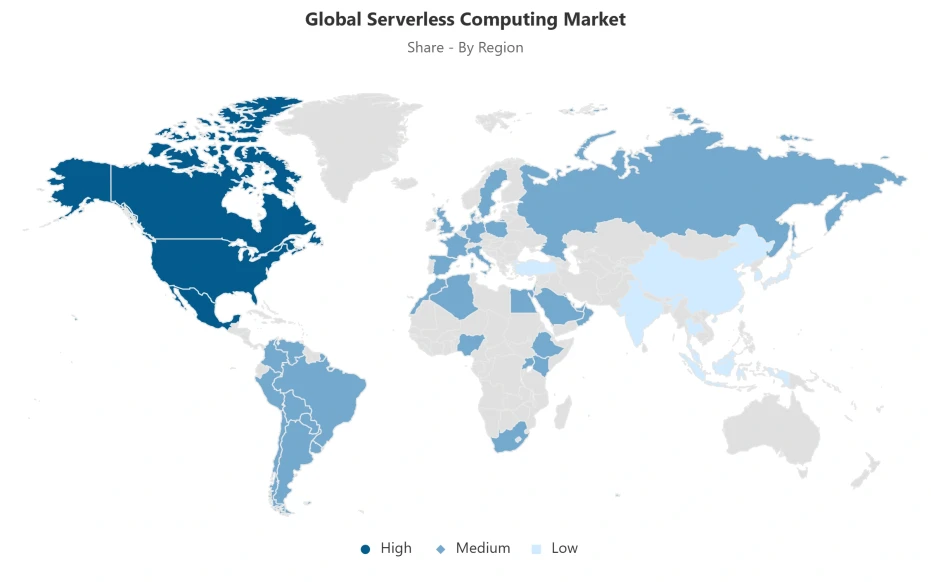
- North America leads with a 45% share of the global market.
Global Serverless Computing Market Outlook
The Global serverless computing market was valued at USD 24.7 billion in 2025 and is projected to advance from USD 29.61 billion in 2026 to USD 69.2 billion by 2032, registering a CAGR of 15.86% across the forecast period. This exceptional and architecturally driven expansion reflects a commercially transformative growth environment within the Global serverless computing market, where enterprises are progressively moving away from fixed-capacity infrastructure management toward scalable cloud execution models that support serverless application development, event-driven automation, AI workloads, real-time data processing, and API-connected digital services without the provisioning cycles, operating system maintenance, and idle-capacity costs that traditional server ownership imposes. Growth is anchored not in infrastructure novelty but in the structural enterprise preference for pay-per-use computing models that improve developer velocity, reduce operational overhead, and align infrastructure cost directly with actual workload demand.
Function-as-a-Service commands approximately 45% of the service type segment within the Global serverless computing market, reflecting the consistent and commercially embedded enterprise preference for event-triggered code execution that allows developers to deploy small, independent logic units responsive to API calls, file uploads, payment events, database changes, IoT signals, and AI prompt workflows without managing the underlying runtime environment or server capacity. As per data published by Stanford HAI, 78% of organisations used AI in 2024, up from 55% in 2023, while generative AI use in at least one business function rose from 33% to 71% during the same period, confirming that the event-driven and modular workload patterns that define FaaS platforms adoption are being directly reinforced by the rapid enterprise integration of AI-enabled applications that require scalable, short-duration, and API-connected execution across chatbot routing, document processing, retrieval workflows, and automation pipelines.
Public cloud serverless deployment leads at approximately 70% of total market share, anchored in the structural alignment between serverless execution requirements and the elastic compute pools, managed databases, API gateways, identity systems, event buses, and observability tools that hyperscale cloud ecosystems already deliver at production scale. serverless computing is not valuable in isolation from the broader managed-service environment that enables functions to connect with storage, authenticate users, consume queues, call external APIs, and trigger downstream workflows, which is precisely why public cloud infrastructure provides the deployment context that private or on-premise environments cannot replicate with equivalent development speed or integration richness.
North America anchors the serverless computing market with approximately 45% of global demand, supported by mature enterprise software ecosystems, hyperscale data-centre concentration, advanced AI investment, and a technology sector culture that rewards developer productivity, cloud-native engineering, and rapid digital product iteration at commercial scale. As per data published by Stanford HAI, U.S. private AI investment reached USD 109.1 billion in 2024, nearly 12 times China's USD 9.3 billion, while IEA data confirm that the United States accounted for 45% of global data-centre electricity consumption in 2024, collectively establishing the infrastructure scale and AI investment depth that sustains North America's commercial leadership position across cloud-native and serverless computing adoption.
Global Serverless Computing Market Growth Driver
Cloud-Native Enterprise Transformation and AI Workload Expansion Are Building Structurally Durable Serverless Demand
Cloud-native application transformation is the most commercially significant demand driver within the Global serverless computing market, sustaining platform adoption across enterprises that need faster development velocity, automatic scaling for variable workloads, and pay-per-use economics that reduce idle infrastructure spending across digital services, APIs, automation workflows, and AI-enabled applications. As per data published by Eurostat via the European Commission, 52.7% of EU enterprises used paid cloud computing services in 2025, rising 7.4 percentage points from 2023 and far above the 17.8% share recorded in 2014, confirming that the enterprise cloud adoption base providing the managed-service ecosystem within which serverless functions deliver their highest operational value continues to expand across productivity, database, security, and analytics workload categories that progressively prepare organisations for higher-order serverless adoption.
Vendor concentration risk, cold-start latency constraints, and escalating data-centre energy demand are simultaneously creating the most commercially consequential structural challenges within the enterprise serverless market, while the convergence of AI-driven event architecture and composable application design is simultaneously creating the strongest growth opportunity for vendors capable of delivering integrated observability, multi-cloud portability, serverless security automation, and AI-ready workflow orchestration. Evidence drawn from public data released by the IEA confirms that global data-centre electricity consumption reached approximately 415 TWh in 2024 growing at 12% annually since 2017, while WTO analysis confirms that AI-enabling goods rose from approximately 13% to nearly 17% of world trade between 2023 and the end of 2025, collectively establishing that the infrastructure expansion sustaining serverless computing capacity and the AI investment intensifying serverless workload demand are both advancing at a commercially self-reinforcing pace.
Global Serverless Computing Market Challenge
Vendor Lock-In Exposure, Cost Visibility Gaps, and Cold-Start Latency Are Raising Enterprise Adoption Friction
The most commercially consequential structural challenge within the serverless cloud computing market is the combination of vendor concentration risk, execution cost opacity, and performance predictability constraints that collectively raise the governance complexity and long-term commercial risk exposure associated with deep serverless adoption beyond the tolerance thresholds of risk-conscious enterprise buyers. Based on data from the U.K. Competition and Markets Authority, provisional findings published in January 2025 from its cloud services market investigation identified competition concerns in public cloud infrastructure supply covering egress fees, technical barriers, and committed-spend discounts that directly affect the workload portability and switching flexibility of enterprises whose serverless architecture workloads depend on provider-specific event models, runtimes, API integrations, and managed service bindings that are difficult to replicate across alternative cloud environments without substantial re-engineering investment.
Cold-start latency in latency-sensitive applications and the security governance complexity of large-scale function estates compound these structural challenges by raising the engineering skill requirements for successful production serverless deployment beyond what many organisations currently maintain internally. As indicated by authoritative sources at the European Commission, the EU Data Act applicable from September 12, 2025 specifically addresses cloud switching by allowing customers to transfer data and switch between cloud providers more easily, confirming that vendor lock-in risks in serverless environments are commercially significant enough to have attracted formal regulatory intervention, and that enterprises evaluating deep serverless investment must incorporate portability architecture, least-privilege identity governance, dependency scanning, and runtime monitoring into their deployment strategies to sustain long-term operational security and cost control.
Unlock Market Intelligence
Explore the market potential with our data-driven report
Global Serverless Computing Market Trend
Event-Driven AI-Ready Architecture Is Redefining Serverless as an Enterprise Execution Fabric
A well-defined and commercially transformative structural trend is reshaping the product scope and strategic positioning of serverless computing across the Global serverless computing market, as the enterprise application development agenda progressively shifts from isolated code execution toward deeply integrated event-driven serverless workflows that connect functions, managed databases, AI model APIs, event buses, observability layers, and security controls into cohesive composable application architectures that execute only when triggered and scale automatically in response to demand. As per data published by Stanford HAI, global private investment in generative AI reached USD 33.9 billion in 2024 reflecting an 18.7% increase from 2023, while 78% of organisations used AI in 2024 and generative AI use in at least one business function reached 71%, confirming that the modular, API-connected, and event-triggered workload patterns driving serverless AI workloads adoption are becoming mainstream rather than experimental across enterprise software development programmes.
The opportunity within this trend is most commercially concentrated in public-cloud-native serverless expansion supported by AI-linked digital infrastructure investment that is continuously enlarging the addressable workload base for scalable event-driven execution. Validated reports from WTO confirm that world trade grew faster than expected in 2025 as surging demand for AI-related goods partially offset trade-policy uncertainty, with AI-enabling goods rising from approximately 13% to nearly 17% of world trade between 2023 and 2025, while U.S. Energy Information Administration forecasts confirm commercial-sector electricity sales including data centres growing 2.2% in 2026 and 5.3% in 2027, collectively establishing that the infrastructure capacity and AI investment momentum supporting serverless cloud services demand expansion are both structurally durable commercial forces rather than cyclical technology spending fluctuations.
Global Serverless Computing Market Opportunity
Public Cloud Ecosystem Depth and AI Infrastructure Expansion Are Creating the Largest and Most Scalable Commercial Demand Pool
The most commercially significant and structurally recurring growth opportunity within the Global Serverless Computing Market lies in the expanding public cloud ecosystem, where enterprises scaling AI applications, digital products, real-time analytics, and serverless API backends can adopt FaaS, managed databases, event queues, and workflow orchestration services without building or maintaining the underlying elastic infrastructure that makes serverless performance commercially viable. As per official figures from Stanford HAI, global private investment in generative AI reached USD 33.9 billion in 2024, rising 18.7% from 2023, directly sustaining cloud infrastructure expansion that provides public cloud serverless platforms with greater capacity, regional availability, and managed-service depth across the AI-enabled application workloads where serverless execution is increasingly preferred over fixed-compute alternatives.
The infrastructure investment dimension of this opportunity extends into energy and data-center expansion that reinforces public cloud capacity at a scale directly relevant to serverless platform growth. Data compiled from internationally recognised public authorities at the IEA confirms that data centers consumed approximately 415 TWh of electricity in 2024 and that the United States accounted for 45% of global data-center electricity consumption, while EIA's May 2026 Short-Term Energy Outlook forecasts U.S. electricity demand rising 1.3% in 2026 with commercial-sector growth including data centers leading demand expansion, collectively confirming that the infrastructure base supporting serverless cloud services in North America is actively deepening in ways that strengthen regional platform capacity, availability resilience, and the ecosystem density that makes serverless computing for digital transformation operationally credible across enterprise, mid-market, and public-sector buyer segments alike.
Global Serverless Computing Market Regional Analysis
By Region
- North America
- South America
- Europe
- Middle East & Africa
- Asia Pacific
North America commands the most commercially influential position within the Global serverless computing market with approximately 45% of global demand, a concentration that reflects the region's exceptional convergence of mature enterprise cloud adoption, hyperscale data-centre infrastructure, advanced AI investment depth, and a technology sector culture that systematically rewards cloud-native engineering practices, developer productivity tooling, and rapid digital product iteration at commercially significant scale. As per data published by Stanford HAI, U.S. private AI investment reached USD 109.1 billion in 2024, nearly 12 times China's USD 9.3 billion, while U.S. institutions produced 40 notable AI models in 2024 compared with China's 15 and Europe's 3, confirming that the AI development ecosystem sustaining serverless workload demand intensity in North America is both structurally deeper and commercially more self-reinforcing than any competing regional market.
The region's structural advantages extend into energy and digital infrastructure buildout that is simultaneously enabling accelerated serverless and AI workload deployment at a scale that reinforces North American commercial leadership through capacity availability rather than merely investment intent. Validated reports from the U.S. Energy Information Administration confirm that U.S. electricity demand is forecast to rise 1.3% in 2026 to almost 4,250 billion kilowatthours with commercial-sector sales including data centres growing 2.2% in 2026 and 5.3% in 2027, while IEA data confirm the United States holds 45% of global data-centre electricity consumption, collectively establishing that the physical infrastructure capacity sustaining North America serverless computing market expansion is advancing with the pace and investment depth required to support the AI-enabled, event-driven, and cloud-native workload growth that defines the region's serverless demand trajectory through 2032.
Unlock Market Intelligence
Explore the market potential with our data-driven report
Global Serverless Computing Market Segmentation Analysis
By Service Type
- Function-as-a-Service
- Backend-as-a-Service
- Serverless Containers
- Serverless Databases
- Serverless Storage
- Serverless API Management
- Serverless Monitoring & Security
Function-as-a-Service commands the highest share within the service type category at approximately 45%, reflecting the consistent and broadly embedded enterprise preference within the Global serverless computing market for event-triggered code execution models that allow developers to deploy small, independent application logic units without managing runtime environments, provisioning server capacity, or maintaining idle compute resources across workloads that may spike dramatically and then return to near-zero demand between events. Enterprises across retail, banking, healthcare, media, fintech, and technology sectors consistently adopt FaaS because it directly solves the infrastructure cost inefficiency, developer bottleneck, and scaling complexity that traditional application architectures impose on organisations that need to process payment events, validate documents, route AI prompts, update inventory, generate notifications, and automate workflows across variable-demand digital environments.
The segment's commercial depth within the Global serverless computing market is further reinforced by the AI adoption momentum that is continuously generating new event-driven workload patterns for which FaaS is architecturally optimised. As per data published by Stanford HAI, U.S. institutions produced 40 notable AI models in 2024 while enterprise AI adoption rose from 55% to 78% of organisations in a single year, confirming that the serverless AI inference and AI workflow automation demand layer feeding Function-as-a-Service adoption is both commercially substantial and advancing at a pace that is progressively mainstreaming event-triggered serverless execution as the default architectural choice for AI-enabled application backends across enterprise software development programmes.
By Deployment Model
- Public Cloud
- Private Cloud
- Hybrid Cloud
- Multi-Cloud
- Edge Cloud
Public Cloud commands the highest share within the deployment model category at approximately 70%, establishing hyperscale-managed infrastructure as the overwhelmingly preferred execution environment within the Global serverless computing market and reflecting the commercially embedded recognition among enterprise buyers that serverless cloud deployment delivers its highest value when functions can connect directly to co-located managed storage, event queues, API gateways, identity systems, serverless databases, and AI services within a single integrated cloud ecosystem rather than operating across isolated private infrastructure where integration depth, scaling elasticity, and managed-service availability are structurally more limited. Enterprises consistently select public cloud serverless platforms because the development speed, automatic scaling, and production-grade reliability that make serverless economically compelling depend on the managed service ecosystem that only hyperscale public cloud environments currently deliver at the breadth and depth that enterprise workload complexity requires.
The segment's structural dominance is reinforced by the AI and digital infrastructure investment trajectory that is continuously enlarging the workload portfolio serverless public cloud platforms must serve. Evidence drawn from public data released by the IEA confirms that global data-centre electricity consumption reached approximately 415 TWh in 2024 with the United States accounting for 45% of that total, while EIA forecasts confirm U.S. commercial-sector electricity demand growing 2.2% in 2026 and 5.3% in 2027 driven substantially by data-centre expansion, confirming that the physical infrastructure sustaining public cloud serverless capacity growth is advancing at a pace that provides the elastic compute foundation needed to absorb the AI-driven workload intensification that is structurally elevating serverless execution volume across enterprise production environments.
Market Players in Global Serverless Computing Market
These market players maintain a significant presence in the Global serverless computing market sector and contribute to its ongoing evolution.
- Oracle Cloud Infrastructure
- Alibaba Cloud
- Tencent Cloud
- Amazon Web Services
- Microsoft Azure
- Google Cloud
- Cloudflare
- IBM
- Vercel
- Netlify
- Fastly
- DigitalOcean
- Red Hat
- Akamai Technologies
- Datadog
Market News & Updates
- Google Cloud, 2026:
Google Cloud announced new Cloud Run updates at Google Cloud Next ’26 in April 2026. The update added one-click deployment from Google AI Studio to Cloud Run, Gemini Enterprise Agent Platform integration, and a fully managed remote MCP server. The release expands Cloud Run’s serverless use across AI applications and agent workloads.
- Microsoft Azure, 2026:
Microsoft made Azure Functions support for MCP resource triggers generally available in March 2026. The update allows Azure Functions to respond to Model Context Protocol resource events for serverless application workflows. The release supports event-driven automation and AI-connected serverless execution on Azure Functions.
Frequently Asked Questions
Related Report
- Market Segmentation
- Research Scope
- Research Methodology
- Definitions and Assumptions
- Executive Summary
- Global Serverless Computing Market Policies, Regulations, and Standards
- Global Serverless Computing Market Dynamics
- Growth Factors
- Challenges
- Trends
- Opportunities
- Global Serverless Computing Market Statistics, 2022-2032F
- Market Size & Growth Outlook
- By Revenues in USD Million
- Market Segmentation & Growth Outlook
- By Component
- Platform/Solution- Market Insights and Forecast 2022-2032, USD Million
- Services- Market Insights and Forecast 2022-2032, USD Million
- Professional Services- Market Insights and Forecast 2022-2032, USD Million
- Managed Services- Market Insights and Forecast 2022-2032, USD Million
- By Service Type
- Function-as-a-Service- Market Insights and Forecast 2022-2032, USD Million
- Backend-as-a-Service- Market Insights and Forecast 2022-2032, USD Million
- Serverless Containers- Market Insights and Forecast 2022-2032, USD Million
- Serverless Databases- Market Insights and Forecast 2022-2032, USD Million
- Serverless Storage- Market Insights and Forecast 2022-2032, USD Million
- Serverless API Management- Market Insights and Forecast 2022-2032, USD Million
- Serverless Monitoring & Security- Market Insights and Forecast 2022-2032, USD Million
- By Application
- Web & Mobile Applications- Market Insights and Forecast 2022-2032, USD Million
- API Backends- Market Insights and Forecast 2022-2032, USD Million
- Real-Time Data Processing- Market Insights and Forecast 2022-2032, USD Million
- IoT Applications- Market Insights and Forecast 2022-2032, USD Million
- AI & Machine Learning Workloads- Market Insights and Forecast 2022-2032, USD Million
- Event-Driven Automation- Market Insights and Forecast 2022-2032, USD Million
- Microservices- Market Insights and Forecast 2022-2032, USD Million
- Data Pipeline Automation- Market Insights and Forecast 2022-2032, USD Million
- By Deployment Model
- Public Cloud- Market Insights and Forecast 2022-2032, USD Million
- Private Cloud- Market Insights and Forecast 2022-2032, USD Million
- Hybrid Cloud- Market Insights and Forecast 2022-2032, USD Million
- Multi-Cloud- Market Insights and Forecast 2022-2032, USD Million
- Edge Cloud- Market Insights and Forecast 2022-2032, USD Million
- By Organization Size
- Large Enterprises- Market Insights and Forecast 2022-2032, USD Million
- Small & Medium Enterprises- Market Insights and Forecast 2022-2032, USD Million
- By End User
- BFSI- Market Insights and Forecast 2022-2032, USD Million
- IT & Telecom- Market Insights and Forecast 2022-2032, USD Million
- Retail & E-Commerce- Market Insights and Forecast 2022-2032, USD Million
- Healthcare- Market Insights and Forecast 2022-2032, USD Million
- Media & Entertainment- Market Insights and Forecast 2022-2032, USD Million
- Gaming- Market Insights and Forecast 2022-2032, USD Million
- Manufacturing- Market Insights and Forecast 2022-2032, USD Million
- Government- Market Insights and Forecast 2022-2032, USD Million
- Others- Market Insights and Forecast 2022-2032, USD Million
- By Region
- North America
- South America
- Europe
- Middle East & Africa
- Asia Pacific
- By Competitors
- Competition Characteristics
- Market Share & Analysis
- By Component
- Market Size & Growth Outlook
- North America Serverless Computing Market Statistics, 2022-2032F
- Market Size & Growth Outlook
- By Revenues in USD Million
- Market Segmentation & Growth Outlook
- By Component- Market Insights and Forecast 2022-2032, USD Million
- By Service Type- Market Insights and Forecast 2022-2032, USD Million
- By Application- Market Insights and Forecast 2022-2032, USD Million
- By Deployment Model- Market Insights and Forecast 2022-2032, USD Million
- By Organization Size- Market Insights and Forecast 2022-2032, USD Million
- By End User- Market Insights and Forecast 2022-2032, USD Million
- By Country
- US
- Canada
- Mexico
- Rest of North America
- US Serverless Computing Market Statistics, 2022-2032F
- Market Size & Growth Outlook
- By Revenues in USD Million
- Market Segmentation & Growth Outlook
- By Component- Market Insights and Forecast 2022-2032, USD Million
- By Service Type- Market Insights and Forecast 2022-2032, USD Million
- By Application- Market Insights and Forecast 2022-2032, USD Million
- By Deployment Model- Market Insights and Forecast 2022-2032, USD Million
- By Organization Size- Market Insights and Forecast 2022-2032, USD Million
- By End User- Market Insights and Forecast 2022-2032, USD Million
- Market Size & Growth Outlook
- Canada Serverless Computing Market Statistics, 2022-2032F
- Market Size & Growth Outlook
- By Revenues in USD Million
- Market Segmentation & Growth Outlook
- By Component- Market Insights and Forecast 2022-2032, USD Million
- By Service Type- Market Insights and Forecast 2022-2032, USD Million
- By Application- Market Insights and Forecast 2022-2032, USD Million
- By Deployment Model- Market Insights and Forecast 2022-2032, USD Million
- By Organization Size- Market Insights and Forecast 2022-2032, USD Million
- By End User- Market Insights and Forecast 2022-2032, USD Million
- Market Size & Growth Outlook
- Mexico Serverless Computing Market Statistics, 2022-2032F
- Market Size & Growth Outlook
- By Revenues in USD Million
- Market Segmentation & Growth Outlook
- By Component- Market Insights and Forecast 2022-2032, USD Million
- By Service Type- Market Insights and Forecast 2022-2032, USD Million
- By Application- Market Insights and Forecast 2022-2032, USD Million
- By Deployment Model- Market Insights and Forecast 2022-2032, USD Million
- By Organization Size- Market Insights and Forecast 2022-2032, USD Million
- By End User- Market Insights and Forecast 2022-2032, USD Million
- Market Size & Growth Outlook
- Market Size & Growth Outlook
- South America Serverless Computing Market Statistics, 2022-2032F
- Market Size & Growth Outlook
- By Revenues in USD Million
- Market Segmentation & Growth Outlook
- By Component- Market Insights and Forecast 2022-2032, USD Million
- By Service Type- Market Insights and Forecast 2022-2032, USD Million
- By Application- Market Insights and Forecast 2022-2032, USD Million
- By Deployment Model- Market Insights and Forecast 2022-2032, USD Million
- By Organization Size- Market Insights and Forecast 2022-2032, USD Million
- By End User- Market Insights and Forecast 2022-2032, USD Million
- By Country
- Brazil
- Chile
- Argentina
- Rest of South America
- Brazil Serverless Computing Market Statistics, 2022-2032F
- Market Size & Growth Outlook
- By Revenues in USD Million
- Market Segmentation & Growth Outlook
- By Component- Market Insights and Forecast 2022-2032, USD Million
- By Service Type- Market Insights and Forecast 2022-2032, USD Million
- By Application- Market Insights and Forecast 2022-2032, USD Million
- By Deployment Model- Market Insights and Forecast 2022-2032, USD Million
- By Organization Size- Market Insights and Forecast 2022-2032, USD Million
- By End User- Market Insights and Forecast 2022-2032, USD Million
- Market Size & Growth Outlook
- Chile Serverless Computing Market Statistics, 2022-2032F
- Market Size & Growth Outlook
- By Revenues in USD Million
- Market Segmentation & Growth Outlook
- By Component- Market Insights and Forecast 2022-2032, USD Million
- By Service Type- Market Insights and Forecast 2022-2032, USD Million
- By Application- Market Insights and Forecast 2022-2032, USD Million
- By Deployment Model- Market Insights and Forecast 2022-2032, USD Million
- By Organization Size- Market Insights and Forecast 2022-2032, USD Million
- By End User- Market Insights and Forecast 2022-2032, USD Million
- Market Size & Growth Outlook
- Argentina Serverless Computing Market Statistics, 2022-2032F
- Market Size & Growth Outlook
- By Revenues in USD Million
- Market Segmentation & Growth Outlook
- By Component- Market Insights and Forecast 2022-2032, USD Million
- By Service Type- Market Insights and Forecast 2022-2032, USD Million
- By Application- Market Insights and Forecast 2022-2032, USD Million
- By Deployment Model- Market Insights and Forecast 2022-2032, USD Million
- By Organization Size- Market Insights and Forecast 2022-2032, USD Million
- By End User- Market Insights and Forecast 2022-2032, USD Million
- Market Size & Growth Outlook
- Market Size & Growth Outlook
- Europe Serverless Computing Market Statistics, 2022-2032F
- Market Size & Growth Outlook
- By Revenues in USD Million
- Market Segmentation & Growth Outlook
- By Component- Market Insights and Forecast 2022-2032, USD Million
- By Service Type- Market Insights and Forecast 2022-2032, USD Million
- By Application- Market Insights and Forecast 2022-2032, USD Million
- By Deployment Model- Market Insights and Forecast 2022-2032, USD Million
- By Organization Size- Market Insights and Forecast 2022-2032, USD Million
- By End User- Market Insights and Forecast 2022-2032, USD Million
- By Country
- UK
- Germany
- France
- Netherlands
- Italy
- Spain
- Sweden
- Rest of Europe
- UK Serverless Computing Market Statistics, 2022-2032F
- Market Size & Growth Outlook
- By Revenues in USD Million
- Market Segmentation & Growth Outlook
- By Component- Market Insights and Forecast 2022-2032, USD Million
- By Service Type- Market Insights and Forecast 2022-2032, USD Million
- By Application- Market Insights and Forecast 2022-2032, USD Million
- By Deployment Model- Market Insights and Forecast 2022-2032, USD Million
- By Organization Size- Market Insights and Forecast 2022-2032, USD Million
- By End User- Market Insights and Forecast 2022-2032, USD Million
- Market Size & Growth Outlook
- Germany Serverless Computing Market Statistics, 2022-2032F
- Market Size & Growth Outlook
- By Revenues in USD Million
- Market Segmentation & Growth Outlook
- By Component- Market Insights and Forecast 2022-2032, USD Million
- By Service Type- Market Insights and Forecast 2022-2032, USD Million
- By Application- Market Insights and Forecast 2022-2032, USD Million
- By Deployment Model- Market Insights and Forecast 2022-2032, USD Million
- By Organization Size- Market Insights and Forecast 2022-2032, USD Million
- By End User- Market Insights and Forecast 2022-2032, USD Million
- Market Size & Growth Outlook
- France Serverless Computing Market Statistics, 2022-2032F
- Market Size & Growth Outlook
- By Revenues in USD Million
- Market Segmentation & Growth Outlook
- By Component- Market Insights and Forecast 2022-2032, USD Million
- By Service Type- Market Insights and Forecast 2022-2032, USD Million
- By Application- Market Insights and Forecast 2022-2032, USD Million
- By Deployment Model- Market Insights and Forecast 2022-2032, USD Million
- By Organization Size- Market Insights and Forecast 2022-2032, USD Million
- By End User- Market Insights and Forecast 2022-2032, USD Million
- Market Size & Growth Outlook
- Netherlands Serverless Computing Market Statistics, 2022-2032F
- Market Size & Growth Outlook
- By Revenues in USD Million
- Market Segmentation & Growth Outlook
- By Component- Market Insights and Forecast 2022-2032, USD Million
- By Service Type- Market Insights and Forecast 2022-2032, USD Million
- By Application- Market Insights and Forecast 2022-2032, USD Million
- By Deployment Model- Market Insights and Forecast 2022-2032, USD Million
- By Organization Size- Market Insights and Forecast 2022-2032, USD Million
- By End User- Market Insights and Forecast 2022-2032, USD Million
- Market Size & Growth Outlook
- Italy Serverless Computing Market Statistics, 2022-2032F
- Market Size & Growth Outlook
- By Revenues in USD Million
- Market Segmentation & Growth Outlook
- By Component- Market Insights and Forecast 2022-2032, USD Million
- By Service Type- Market Insights and Forecast 2022-2032, USD Million
- By Application- Market Insights and Forecast 2022-2032, USD Million
- By Deployment Model- Market Insights and Forecast 2022-2032, USD Million
- By Organization Size- Market Insights and Forecast 2022-2032, USD Million
- By End User- Market Insights and Forecast 2022-2032, USD Million
- Market Size & Growth Outlook
- Spain Serverless Computing Market Statistics, 2022-2032F
- Market Size & Growth Outlook
- By Revenues in USD Million
- Market Segmentation & Growth Outlook
- By Component- Market Insights and Forecast 2022-2032, USD Million
- By Service Type- Market Insights and Forecast 2022-2032, USD Million
- By Application- Market Insights and Forecast 2022-2032, USD Million
- By Deployment Model- Market Insights and Forecast 2022-2032, USD Million
- By Organization Size- Market Insights and Forecast 2022-2032, USD Million
- By End User- Market Insights and Forecast 2022-2032, USD Million
- Market Size & Growth Outlook
- Sweden Serverless Computing Market Statistics, 2022-2032F
- Market Size & Growth Outlook
- By Revenues in USD Million
- Market Segmentation & Growth Outlook
- By Component- Market Insights and Forecast 2022-2032, USD Million
- By Service Type- Market Insights and Forecast 2022-2032, USD Million
- By Application- Market Insights and Forecast 2022-2032, USD Million
- By Deployment Model- Market Insights and Forecast 2022-2032, USD Million
- By Organization Size- Market Insights and Forecast 2022-2032, USD Million
- By End User- Market Insights and Forecast 2022-2032, USD Million
- Market Size & Growth Outlook
- Market Size & Growth Outlook
- Middle East & Africa Serverless Computing Market Statistics, 2022-2032F
- Market Size & Growth Outlook
- By Revenues in USD Million
- Market Segmentation & Growth Outlook
- By Component- Market Insights and Forecast 2022-2032, USD Million
- By Service Type- Market Insights and Forecast 2022-2032, USD Million
- By Application- Market Insights and Forecast 2022-2032, USD Million
- By Deployment Model- Market Insights and Forecast 2022-2032, USD Million
- By Organization Size- Market Insights and Forecast 2022-2032, USD Million
- By End User- Market Insights and Forecast 2022-2032, USD Million
- By Country
- UAE
- Saudi Arabia
- Israel
- Qatar
- South Africa
- Rest of Middle East & Africa
- UAE Serverless Computing Market Statistics, 2022-2032F
- Market Size & Growth Outlook
- By Revenues in USD Million
- Market Segmentation & Growth Outlook
- By Component- Market Insights and Forecast 2022-2032, USD Million
- By Service Type- Market Insights and Forecast 2022-2032, USD Million
- By Application- Market Insights and Forecast 2022-2032, USD Million
- By Deployment Model- Market Insights and Forecast 2022-2032, USD Million
- By Organization Size- Market Insights and Forecast 2022-2032, USD Million
- By End User- Market Insights and Forecast 2022-2032, USD Million
- Market Size & Growth Outlook
- Saudi Arabia Serverless Computing Market Statistics, 2022-2032F
- Market Size & Growth Outlook
- By Revenues in USD Million
- Market Segmentation & Growth Outlook
- By Component- Market Insights and Forecast 2022-2032, USD Million
- By Service Type- Market Insights and Forecast 2022-2032, USD Million
- By Application- Market Insights and Forecast 2022-2032, USD Million
- By Deployment Model- Market Insights and Forecast 2022-2032, USD Million
- By Organization Size- Market Insights and Forecast 2022-2032, USD Million
- By End User- Market Insights and Forecast 2022-2032, USD Million
- Market Size & Growth Outlook
- Israel Serverless Computing Market Statistics, 2022-2032F
- Market Size & Growth Outlook
- By Revenues in USD Million
- Market Segmentation & Growth Outlook
- By Component- Market Insights and Forecast 2022-2032, USD Million
- By Service Type- Market Insights and Forecast 2022-2032, USD Million
- By Application- Market Insights and Forecast 2022-2032, USD Million
- By Deployment Model- Market Insights and Forecast 2022-2032, USD Million
- By Organization Size- Market Insights and Forecast 2022-2032, USD Million
- By End User- Market Insights and Forecast 2022-2032, USD Million
- Market Size & Growth Outlook
- Qatar Serverless Computing Market Statistics, 2022-2032F
- Market Size & Growth Outlook
- By Revenues in USD Million
- Market Segmentation & Growth Outlook
- By Component- Market Insights and Forecast 2022-2032, USD Million
- By Service Type- Market Insights and Forecast 2022-2032, USD Million
- By Application- Market Insights and Forecast 2022-2032, USD Million
- By Deployment Model- Market Insights and Forecast 2022-2032, USD Million
- By Organization Size- Market Insights and Forecast 2022-2032, USD Million
- By End User- Market Insights and Forecast 2022-2032, USD Million
- Market Size & Growth Outlook
- South Africa Serverless Computing Market Statistics, 2022-2032F
- Market Size & Growth Outlook
- By Revenues in USD Million
- Market Segmentation & Growth Outlook
- By Component- Market Insights and Forecast 2022-2032, USD Million
- By Service Type- Market Insights and Forecast 2022-2032, USD Million
- By Application- Market Insights and Forecast 2022-2032, USD Million
- By Deployment Model- Market Insights and Forecast 2022-2032, USD Million
- By Organization Size- Market Insights and Forecast 2022-2032, USD Million
- By End User- Market Insights and Forecast 2022-2032, USD Million
- Market Size & Growth Outlook
- Market Size & Growth Outlook
- Asia Pacific Serverless Computing Market Statistics, 2022-2032F
- Market Size & Growth Outlook
- By Revenues in USD Million
- Market Segmentation & Growth Outlook
- By Component- Market Insights and Forecast 2022-2032, USD Million
- By Service Type- Market Insights and Forecast 2022-2032, USD Million
- By Application- Market Insights and Forecast 2022-2032, USD Million
- By Deployment Model- Market Insights and Forecast 2022-2032, USD Million
- By Organization Size- Market Insights and Forecast 2022-2032, USD Million
- By End User- Market Insights and Forecast 2022-2032, USD Million
- By Country
- Japan
- India
- China
- Australia
- Singapore
- South Korea
- Indonesia
- Malaysia
- Rest of Asia-Pacific
- Japan Serverless Computing Market Statistics, 2022-2032F
- Market Size & Growth Outlook
- By Revenues in USD Million
- Market Segmentation & Growth Outlook
- By Component- Market Insights and Forecast 2022-2032, USD Million
- By Service Type- Market Insights and Forecast 2022-2032, USD Million
- By Application- Market Insights and Forecast 2022-2032, USD Million
- By Deployment Model- Market Insights and Forecast 2022-2032, USD Million
- By Organization Size- Market Insights and Forecast 2022-2032, USD Million
- By End User- Market Insights and Forecast 2022-2032, USD Million
- Market Size & Growth Outlook
- India Serverless Computing Market Statistics, 2022-2032F
- Market Size & Growth Outlook
- By Revenues in USD Million
- Market Segmentation & Growth Outlook
- By Component- Market Insights and Forecast 2022-2032, USD Million
- By Service Type- Market Insights and Forecast 2022-2032, USD Million
- By Application- Market Insights and Forecast 2022-2032, USD Million
- By Deployment Model- Market Insights and Forecast 2022-2032, USD Million
- By Organization Size- Market Insights and Forecast 2022-2032, USD Million
- By End User- Market Insights and Forecast 2022-2032, USD Million
- Market Size & Growth Outlook
- China Serverless Computing Market Statistics, 2022-2032F
- Market Size & Growth Outlook
- By Revenues in USD Million
- Market Segmentation & Growth Outlook
- By Component- Market Insights and Forecast 2022-2032, USD Million
- By Service Type- Market Insights and Forecast 2022-2032, USD Million
- By Application- Market Insights and Forecast 2022-2032, USD Million
- By Deployment Model- Market Insights and Forecast 2022-2032, USD Million
- By Organization Size- Market Insights and Forecast 2022-2032, USD Million
- By End User- Market Insights and Forecast 2022-2032, USD Million
- Market Size & Growth Outlook
- Australia Serverless Computing Market Statistics, 2022-2032F
- Market Size & Growth Outlook
- By Revenues in USD Million
- Market Segmentation & Growth Outlook
- By Component- Market Insights and Forecast 2022-2032, USD Million
- By Service Type- Market Insights and Forecast 2022-2032, USD Million
- By Application- Market Insights and Forecast 2022-2032, USD Million
- By Deployment Model- Market Insights and Forecast 2022-2032, USD Million
- By Organization Size- Market Insights and Forecast 2022-2032, USD Million
- By End User- Market Insights and Forecast 2022-2032, USD Million
- Market Size & Growth Outlook
- Singapore Serverless Computing Market Statistics, 2022-2032F
- Market Size & Growth Outlook
- By Revenues in USD Million
- Market Segmentation & Growth Outlook
- By Component- Market Insights and Forecast 2022-2032, USD Million
- By Service Type- Market Insights and Forecast 2022-2032, USD Million
- By Application- Market Insights and Forecast 2022-2032, USD Million
- By Deployment Model- Market Insights and Forecast 2022-2032, USD Million
- By Organization Size- Market Insights and Forecast 2022-2032, USD Million
- By End User- Market Insights and Forecast 2022-2032, USD Million
- Market Size & Growth Outlook
- South Korea Serverless Computing Market Statistics, 2022-2032F
- Market Size & Growth Outlook
- By Revenues in USD Million
- Market Segmentation & Growth Outlook
- By Component- Market Insights and Forecast 2022-2032, USD Million
- By Service Type- Market Insights and Forecast 2022-2032, USD Million
- By Application- Market Insights and Forecast 2022-2032, USD Million
- By Deployment Model- Market Insights and Forecast 2022-2032, USD Million
- By Organization Size- Market Insights and Forecast 2022-2032, USD Million
- By End User- Market Insights and Forecast 2022-2032, USD Million
- Market Size & Growth Outlook
- Indonesia Serverless Computing Market Statistics, 2022-2032F
- Market Size & Growth Outlook
- By Revenues in USD Million
- Market Segmentation & Growth Outlook
- By Component- Market Insights and Forecast 2022-2032, USD Million
- By Service Type- Market Insights and Forecast 2022-2032, USD Million
- By Application- Market Insights and Forecast 2022-2032, USD Million
- By Deployment Model- Market Insights and Forecast 2022-2032, USD Million
- By Organization Size- Market Insights and Forecast 2022-2032, USD Million
- By End User- Market Insights and Forecast 2022-2032, USD Million
- Market Size & Growth Outlook
- Malaysia Serverless Computing Market Statistics, 2022-2032F
- Market Size & Growth Outlook
- By Revenues in USD Million
- Market Segmentation & Growth Outlook
- By Component- Market Insights and Forecast 2022-2032, USD Million
- By Service Type- Market Insights and Forecast 2022-2032, USD Million
- By Application- Market Insights and Forecast 2022-2032, USD Million
- By Deployment Model- Market Insights and Forecast 2022-2032, USD Million
- By Organization Size- Market Insights and Forecast 2022-2032, USD Million
- By End User- Market Insights and Forecast 2022-2032, USD Million
- Market Size & Growth Outlook
- Market Size & Growth Outlook
- Competitive Outlook
- Company Profiles
- Global Serverless Computing Market
- Business Description
- Product Portfolio
- Collaborations & Alliances
- Recent Developments
- Financial Details
- Others
- Amazon Web Services
- Business Description
- Product Portfolio
- Collaborations & Alliances
- Recent Developments
- Financial Details
- Others
- Microsoft Azure
- Business Description
- Product Portfolio
- Collaborations & Alliances
- Recent Developments
- Financial Details
- Others
- Google Cloud
- Business Description
- Product Portfolio
- Collaborations & Alliances
- Recent Developments
- Financial Details
- Others
- Cloudflare
- Business Description
- Product Portfolio
- Collaborations & Alliances
- Recent Developments
- Financial Details
- Others
- IBM
- Business Description
- Product Portfolio
- Collaborations & Alliances
- Recent Developments
- Financial Details
- Others
- Oracle Cloud Infrastructure
- Business Description
- Product Portfolio
- Collaborations & Alliances
- Recent Developments
- Financial Details
- Others
- Alibaba Cloud
- Business Description
- Product Portfolio
- Collaborations & Alliances
- Recent Developments
- Financial Details
- Others
- Tencent Cloud
- Business Description
- Product Portfolio
- Collaborations & Alliances
- Recent Developments
- Financial Details
- Others
- Vercel
- Business Description
- Product Portfolio
- Collaborations & Alliances
- Recent Developments
- Financial Details
- Others
- Netlify
- Business Description
- Product Portfolio
- Collaborations & Alliances
- Recent Developments
- Financial Details
- Others
- Fastly
- Business Description
- Product Portfolio
- Collaborations & Alliances
- Recent Developments
- Financial Details
- Others
- DigitalOcean
- Business Description
- Product Portfolio
- Collaborations & Alliances
- Recent Developments
- Financial Details
- Others
- Red Hat
- Business Description
- Product Portfolio
- Collaborations & Alliances
- Recent Developments
- Financial Details
- Others
- Akamai Technologies
- Business Description
- Product Portfolio
- Collaborations & Alliances
- Recent Developments
- Financial Details
- Others
- Datadog
- Business Description
- Product Portfolio
- Collaborations & Alliances
- Recent Developments
- Financial Details
- Others
- Global Serverless Computing Market
- Company Profiles
- Disclaimer
| Segment | Sub-Segment |
|---|---|
| By Component |
|
| By Service Type |
|
| By Application |
|
| By Deployment Model |
|
| By Organization Size |
|
| By End User |
|
| By Region |
|
Research Methodology
This study followed a structured approach comprising four key phases to assess the size and scope of the electro-oxidation market. The process began with thorough secondary research to collect data on the target market, related markets, and broader industry context. These findings, along with preliminary assumptions and estimates, were then validated through extensive primary research involving industry experts from across the value chain. To calculate the overall market size, both top-down and bottom-up methodologies were employed. Finally, market segmentation and data triangulation techniques were applied to refine and validate segment-level estimations.
Secondary Research
The secondary research phase involved gathering data from a wide range of credible and published sources. This step helped in identifying industry trends, defining market segmentation, and understanding the market landscape and value chain.
Sources consulted during this phase included:
- Company annual reports, investor presentations, and press releases
- Industry white papers and certified publications
- Trade directories and market-recognized databases
- Articles from authoritative authors and reputable journals
- Gold and silver standard websites
Secondary research was critical in mapping out the industry's value chain and monetary flow, identifying key market segments, understanding regional variations, and tracking significant industry developments.
Other key sources:
- Financial disclosures
- Industry associations and trade bodies
- News outlets and business magazines
- Academic journals and research studies
- Paid industry databases
Primary Research
To validate secondary data and gain deeper market insights, primary research was conducted with key stakeholders across both the supply and demand sides of the market.
On the demand side, participants included decision-makers and influencers from end-user industries—such as CIOs, CTOs, and CSOs—who provided first-hand perspectives on market needs, product usage, and future expectations.
On the supply side, interviews were conducted with manufacturers, industry associations, and institutional participants to gather insights into current offerings, product pipelines, and market challenges.
Primary interviews provided critical inputs such as:
- Market size and revenue data
- Product and service breakdowns
- Market forecasts
- Regional and application-specific trends
Stakeholders consulted included:
- Leading OEM and solution providers
- Channel and distribution partners
- End users across various applications
- Independent consultants and industry specialists
Market Size Estimation and Data Triangulation
- Identifying Key Market Participants (Secondary Research)
- Goal: To identify the major players or companies in the target market. This typically involves using publicly available data sources such as industry reports, market research publications, and financial statements of companies.
- Tools: Reports from firms like Gartner, Forrester, Euromonitor, Statista, IBISWorld, and others. Public financial statements, news articles, and press releases from top market players.
- Extracting Earnings of Key Market Participants
- Goal: To estimate the earnings generated from the product or service being analyzed. This step helps in understanding the revenue potential of each market player in a specific geography.
- Methods: Earnings data can be gathered from:
- Publicly available financial reports (for listed companies).
- Interviews and primary data sources from professionals, such as Directors, VPs, SVPs, etc. This is especially useful for understanding more nuanced, internal data that isn't publicly disclosed.
- Annual reports and investor presentations of key players.
- Data Collation and Development of a Relevant Data Model
- Goal: To collate inputs from both primary and secondary sources into a structured, data-driven model for market estimation. This model will incorporate key market KPIs and any independent variables relevant to the market.
- Key KPIs: These could include:
- Market size, growth rate, and demand drivers.
- Industry-specific metrics like market share, average revenue per customer (ARPC), or average deal size.
- External variables, such as economic growth rates, inflation rates, or commodity prices, that could affect the market.
- Data Modeling: Based on this data, the market forecasts are developed for the next 5 years. A combination of trend analysis, scenario modeling, and statistical regression might be used to generate projections.
- Scenario Analysis
- Goal: To test different assumptions and validate how sensitive the market is to changes in key variables (e.g., market demand, regulatory changes, technological disruptions).
- Types of Scenarios:
- Base Case: Based on current assumptions and historical data.
- Best-Case Scenario: Assuming favorable market conditions, regulatory environments, and technological advancements.
- Worst-Case Scenario: Accounting for adverse factors, such as economic downturns, stricter regulations, or unexpected disruptions.












