Global Cloud Migration Market Report: Trends, Growth and Forecast (2026-2032)
By Component (Migration Tools/Platform, Services, Professional Services, Managed Services), By Service Type (Cloud Assessment & Consulting, Application Migration, Database Migration, Infrastructure Migration, Cloud Modernization, Security & Compliance Migration, Post-Migration Managed Services), By Migration Strategy (Rehost/Lift & Shift, Replatform, Refactor, Rearchitect, Repurchase, Retire, Retain), By Deployment Model (Public Cloud, Private Cloud, Hybrid Cloud, Multi-Cloud), By End User (BFSI, IT & Telecom, Healthcare, Retail & E-Commerce, Manufacturing, Government & Public Sector, Energy & Utilities, Education, Others), By Region (North America, South America, Europe, Middle East & Africa, Asia Pacific) ... Read more
|
Major Players
|
Global Cloud Migration Market Statistics and Insights, 2026
- Market Size Statistics
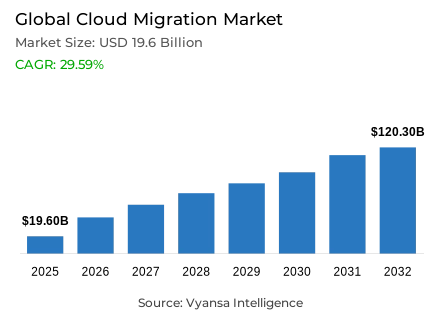
- Cloud migration market size in Global was valued at USD 19.6 billion in 2025 and is estimated at USD 23.6 billion in 2026.
- The market size is expected to grow to USD 120.3 billion by 2032.
- Market to register a CAGR of around 29.59% during 2026-32.
- Component Shares
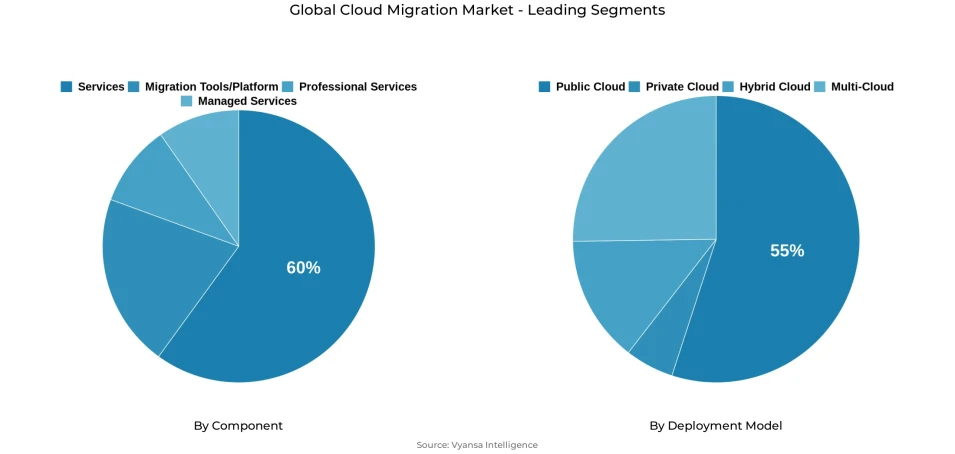
- Services grabbed market share of 60%.
- Competition
- More than 25 companies are actively engaged in producing cloud migration.
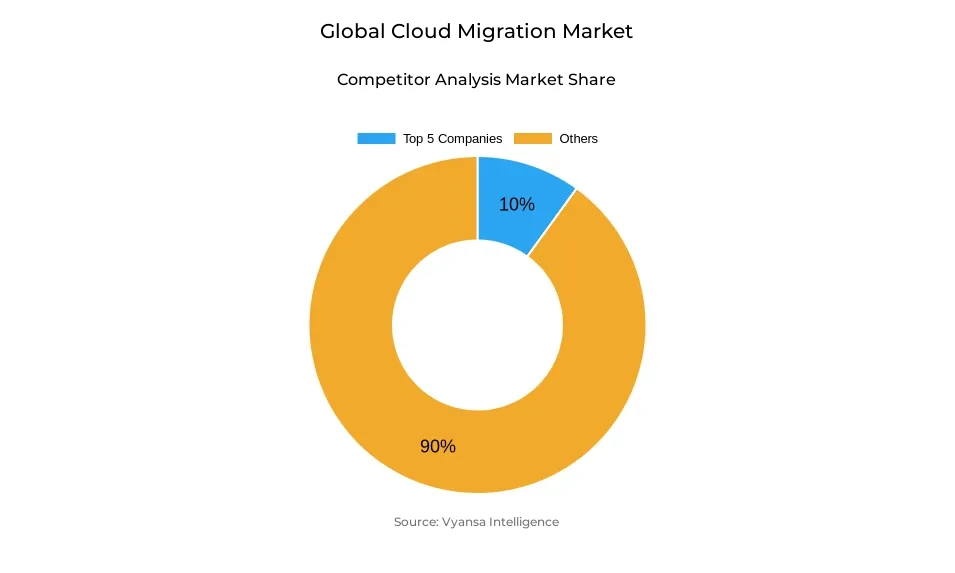
- Top 5 companies acquired around 10% of the market share.
- Accenture, Tata Consultancy Services, Infosys, Amazon Web Services, Microsoft Azure etc., are few of the top companies.
- Deployment Model
- Public cloud grabbed 55% of the market.
- Region
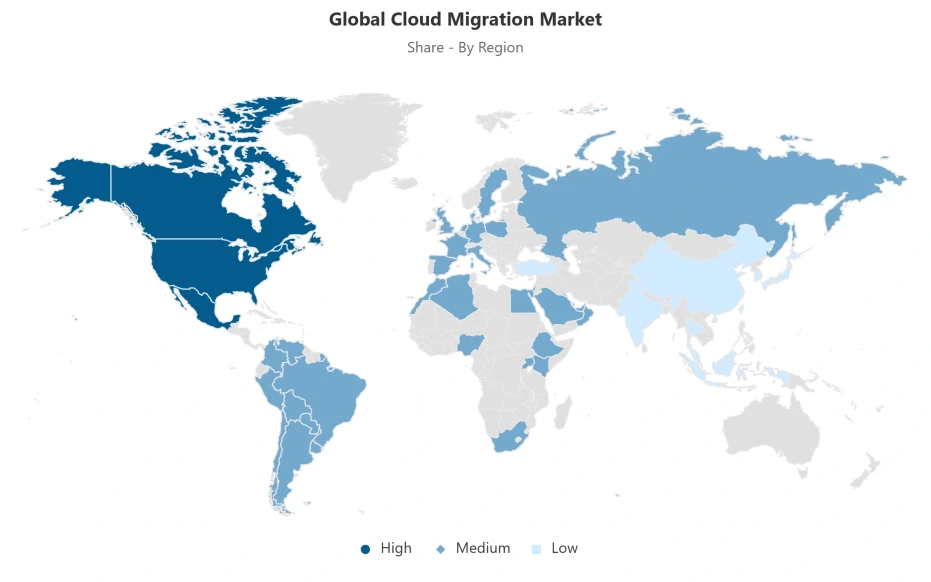
- North America leads with a 45% share of the global market.
Global Cloud Migration Market Outlook
The Global cloud migration market was valued at USD 19.6 billion in 2025 and is projected to advance from USD 23.6 billion in 2026 to USD 120.3 billion by 2032, registering a CAGR of 29.59% across the forecast period. This exceptional and structurally anchored expansion reflects a commercially transformative growth environment within the Global cloud migration market, where enterprises are progressively moving from legacy data centres, fragmented application estates, and hardware-intensive IT environments toward scalable cloud platforms that support application modernization, data storage, analytics, cybersecurity, AI workloads, remote operations, and digital customer services across a migration agenda that has evolved well beyond one-time infrastructure relocation into a multi-stage transformation programme covering assessment, workload discovery, database migration, security redesign, governance setup, and managed operations. As per data published by Eurostat via the European Commission, 52.74% of EU enterprises used paid cloud computing services in 2025, rising 7.42 percentage points from 2023, confirming that cloud adoption has crossed into mainstream enterprise territory and that the migration workload generating commercial demand continues to deepen and diversify across productivity, database, security, and analytics application categories.
cloud migration services command approximately 60% of the component segment within the Global cloud migration market, reflecting the consistent and practically embedded enterprise recognition that large-scale migration requires technical execution rather than simply cloud capacity procurement, with application dependency mapping, data transfer planning, identity redesign, network configuration, cloud security architecture, workload testing, disaster recovery planning, and post-migration optimisation collectively constituting a service-intensive transformation programme that cloud subscriptions alone cannot deliver. As per data published by Eurostat, large enterprises reached 84.67% paid cloud service adoption in 2025 while medium-sized enterprises reached 66.78% and small enterprises reached 49.3%, confirming that the enterprise segments driving the most complex and service-intensive cloud modernization demand are already deeply engaged with cloud platforms and now require higher-order migration capabilities beyond basic hosting.
Public cloud migration leads the deployment model segment at approximately 55% of total market share, anchored in the enterprise preference for elastic compute, managed databases, cloud-native analytics, global availability zones, API-led services, and pay-as-use infrastructure that reduce fixed data-centre ownership obligations while enabling the scalability and service richness that modern digital and AI-driven application environments require. The combination of services leadership and public cloud deployment dominance confirms that the Global cloud migration market is simultaneously service-intensive and infrastructure-consumption-led, with migration partners playing a commercially decisive role in converting legacy workloads into scalable and operationally optimised cloud deployments.
North America anchors the enterprise cloud migration market with approximately 45% of global demand, supported by mature enterprise IT modernisation spending, hyperscale cloud infrastructure concentration, advanced SaaS adoption, cybersecurity investment depth, AI infrastructure development, and a sustained government cloud modernisation programme that has institutionalised data center migration and cloud-first procurement across public agencies and regulated industries since 2010. As per data published by the U.S. Energy Information Administration, U.S. electricity demand is forecast to rise 1.3% in 2026 with commercial sector sales including data centres growing 2.2% in 2026 and 5.3% in 2027, confirming that the infrastructure buildout sustaining North American cloud capacity expansion is both commercially substantial and continuing to accelerate throughout the forecast period.
Global Cloud Migration Market Growth Driver
Enterprise Modernization Imperatives and AI Readiness Requirements Are Creating a Structurally Durable Migration Demand Foundation
Enterprise application and infrastructure modernisation is the most commercially significant demand driver within the Global cloud migration market, sustaining migration project volume across organisations that need to reduce legacy infrastructure burden, improve IT flexibility, support digital service delivery, and create the scalable cloud data and compute environments that AI adoption requires at meaningful operational scale. As per data published by the World Bank's Digital Progress and Trends Report 2025, cloud computing is identified as one of the four foundational components of AI ecosystems alongside connectivity, context, and competency, confirming that cloud migration strategy and AI workload migration are becoming structurally inseparable priorities for enterprises that cannot deploy AI models, automation tools, or analytics platforms at scale while data, applications, and development environments remain fragmented across disconnected legacy systems.
Energy infrastructure intensity and vendor concentration are simultaneously creating the most commercially consequential structural challenges within the cloud transformation services market, while the transition from lift-and-shift execution toward cloud-native transformation and AI-ready data platform modernisation is simultaneously creating the strongest opportunity for providers capable of packaging consulting, security, database migration, DevOps, and managed operations into full transformation programmes. Evidence drawn from public data released by the IEA confirms that global data-centre electricity consumption reached approximately 415 TWh in 2024 growing at 12% annually over the prior five years, while OECD's 2025 cloud competition analysis confirms that two providers hold a combined market share of up to 80% in some large OECD economies, both challenges that are reshaping how enterprises plan multi-cloud migration architectures and evaluate cloud migration cost optimization as integral components of long-term workload strategy throughout the forecast period.
Global Cloud Migration Market Challenge
Energy Demand Growth, Vendor Lock-In Risk, and Security Complexity Are Constraining Migration Execution Quality
The most commercially consequential structural challenge within the enterprise cloud migration market is the combination of rapidly escalating data-centre energy demand, rising vendor concentration risk, and security architecture complexity that collectively raise the execution difficulty and long-term cost exposure associated with large-scale workload migration beyond the capacity of underprepared organisations to manage without specialist guidance. Based on data from the IEA, global data-centre electricity consumption is projected to reach approximately 945 TWh by 2030 representing just under 3% of total global electricity demand, growing at approximately 15% annually between 2024 and 2030 and more than four times faster than electricity demand from all other sectors combined, confirming that enterprises migrating workloads without architectural optimisation face meaningful cost exposure from overprovisioned compute, duplicated storage, and inefficient data movement patterns that compound migration investment rather than reducing infrastructure burden.
Cloud security redesign adds a separately significant layer of execution complexity that increases migration project scope and specialisation requirements across every regulated workload category. As indicated by authoritative sources at NIST's National Cybersecurity Center of Excellence, the final practice guide for Implementing a Zero Trust Architecture demonstrates end-to-end architectures with 24 vendors, confirming that cloud security migration requires coordinated redesign across identity, device, application, network, and data control layers rather than simply transferring existing perimeter-based security configurations, raising both the technical bar for migration service providers and the governance investment required from enterprises seeking to avoid the access control, logging, and encryption weaknesses that poorly planned cloud migration can introduce across business-critical application and data environments.
Unlock Market Intelligence
Explore the market potential with our data-driven report
Global Cloud Migration Market Trend
AI-Ready Cloud-Native Modernisation Is Redefining Enterprise Migration Strategy and Value Expectations
A well-defined and commercially transformative structural trend is reshaping the scope and commercial value of cloud migration engagements across the Global cloud migration market, as the enterprise migration agenda progressively shifts from basic rehost cloud migration and infrastructure lift-and-shift execution toward deep application modernization programmes that redesign workloads into microservices, move databases into managed cloud environments, expose data through APIs, add observability and identity management, and connect migrated systems with analytics and AI services within scalable cloud-native architectures. As per data published by Eurostat via the European Commission, 45.5% of cloud-using EU enterprises purchased database hosting services in 2025 while 65.5% used cloud security software applications, confirming that enterprises are already migrating operational business workloads beyond productivity tools into the database, security, and analytics layers where cloud-native redesign and AI-readiness preparation create the most durable long-term migration value.
The opportunity within this trend is concentrated in managed services and post-migration optimisation, where the recurring operational support requirements of migrated enterprises create commercially durable revenue streams that extend well beyond initial project completion. Validated reports from the World Bank's Digital Progress and Trends Report 2025 confirm that cloud computing is a foundational AI ecosystem component, while OECD's Going Digital Toolkit confirms that cloud computing encompasses servers, storage, network components, and software applications, collectively establishing that the breadth of enterprise migration scope is expanding continuously as organisations layer analytics, automation, and AI capabilities onto migrated infrastructure and recognise that post-migration optimization, FinOps governance, and continuous managed cloud operations are not project completion activities but structurally ongoing commercial requirements for sustaining the performance, security, and cost efficiency of cloud-native environments throughout the forecast period.
Global Cloud Migration Market Opportunity
Public Cloud Transformation and Managed Services Are Creating High-Value Multi-Stage Revenue Opportunities
The most commercially significant and structurally durable growth opportunity within the Global Cloud Migration Market lies in the combination of public cloud-led transformation, managed post-migration services, regulated workload migration, and AI readiness architecture that collectively create multi-stage revenue streams extending well beyond initial workload transfer engagements. As per official figures from Eurostat, among EU enterprises using paid cloud services in 2025, 85.15% used cloud email, 71.69% used office software, and 71.53% used file storage, confirming that a large and already cloud-comfortable enterprise base is positioned for the next migration wave into database hosting, business application modernisation, cybersecurity platforms, and AI-ready data systems that represent substantially higher commercial value than the productivity and storage workloads already migrated.
Data compiled from internationally recognised public authorities at the International Energy Agency confirming projected data-center electricity consumption of approximately 945 TWh by 2030 further creates a commercially compelling opportunity for cloud cost optimization and workload efficiency services, as enterprises migrating without architectural redesign face rising cloud costs that create sustained demand for rightsizing, reserved-capacity planning, FinOps governance, and workload optimisation throughout the forecast period.
Global Cloud Migration Market Regional Analysis
By Region
- North America
- South America
- Europe
- Middle East & Africa
- Asia Pacific
North America commands the most commercially influential position within the Global cloud migration market with approximately 45% of global demand, a concentration that reflects the region's exceptional convergence of mature enterprise IT modernisation investment, hyperscale cloud infrastructure concentration, advanced SaaS ecosystem depth, cybersecurity modernisation spending, AI infrastructure development, and a federal cloud policy framework that has institutionalised cloud-first procurement discipline across public agencies and regulated industries since 2010. As per data published by GAO, U.S. federal agencies have been required to shift IT services to cloud when feasible since 2010 with OMB updating the cloud strategy through Cloud Smart in 2019, confirming that the public sector cloud migration demand base sustaining US cloud migration market growth is both institutionally mandated and procedurally mature in ways that generate sustained professional services, security architecture, and compliance migration demand across the largest government IT modernisation programme in the world.
The region's structural advantages extend into energy infrastructure development that is simultaneously enabling and incentivising accelerated cloud workload migration and AI deployment at a scale no other regional market currently matches. Evidence drawn from public data released by the IEA confirms that the United States accounts for by far the largest share of projected global data-centre electricity demand growth to 2030, while U.S. Energy Information Administration forecasts confirm commercial sector electricity sales growing 2.2% in 2026 and 5.3% in 2027 as data-centre demand intensifies, collectively confirming that the physical infrastructure buildout sustaining North America cloud migration market capacity expansion is proceeding at a pace that provides both the compute availability and the AI infrastructure foundation required to sustain the region's market leadership position as enterprises progressively migrate legacy workloads, modernise application architectures, and build AI-ready cloud data environments throughout the forecast period.
Unlock Market Intelligence
Explore the market potential with our data-driven report
Global Cloud Migration Market Segmentation Analysis
By Component
- Migration Tools/Platform
- Services
- Professional Services
- Managed Services
Services command the highest share within the component category at approximately 60%, reflecting the consistent and commercially embedded enterprise recognition within the Global cloud migration market that large-scale workload migration requires expert technical execution across assessment, planning, architecture, security, database conversion, testing, cutover management, and post-migration optimisation rather than simply purchasing cloud capacity and initiating infrastructure transfers. Enterprises consistently engage professional and managed migration services because application dependency complexity, legacy system age, data governance requirements, compliance obligations, and business continuity risks collectively create execution failure scenarios that make specialist-led migration delivery more commercially durable than self-directed migration approaches, particularly for large enterprises managing complex hybrid environments where a single misconfigured migration can disrupt revenue systems, customer experience, or regulatory reporting.
The segment's commercial durability within the Global cloud migration market is further reinforced by the advisory dimension of modern migration programmes that extends service value beyond technical transfer into cloud migration roadmap development, workload classification strategy, refactor cloud migration versus rehost decision-making, cloud-native architecture design, FinOps cost governance, zero trust security integration, and managed cloud operations delivery. Evidence drawn from public data released by NIST's NCCoE confirms that zero trust implementation requires coordination across identities, devices, applications, networks, and data through architectures demonstrated with 24 vendors, directly confirming that security architecture complexity during migration is a structurally service-intensive challenge that sustains the segment's leadership as the primary commercial value pool within the Global cloud migration market throughout the forecast period.
By Deployment Model
- Public Cloud
- Private Cloud
- Hybrid Cloud
- Multi-Cloud
Public Cloud commands the highest share within the deployment model category at approximately 55%, establishing elastic cloud infrastructure as the most commercially preferred and operationally practical deployment model within the Global cloud migration market and reflecting the consistent and broadly motivated enterprise preference for scalable compute, managed databases, cloud-native analytics, global availability zones, pay-as-use infrastructure, and integrated AI services that reduce fixed data-centre ownership obligations while enabling the application performance, development agility, and analytics capability that modern digital service and AI workload environments require. Enterprises consistently select public cloud deployment because it supports the variable capacity requirements of retail seasonal peaks, financial reporting cycles, media campaign bursts, and AI model training workloads that on-premise infrastructure cannot serve efficiently without permanent hardware over-provisioning.
The segment's structural leadership within the Global cloud migration market is reinforced by the AI readiness dimension that is progressively redefining public cloud from a cheaper hosting alternative into a strategic foundation for analytics, machine learning, and automated enterprise operations. As per data published by the World Bank's Digital Progress and Trends Report 2025, compute including cloud computing is identified as one of the four AI ecosystem foundations, while OECD's 2025 cloud competition analysis confirms that hybrid cloud migration architectures are increasingly used by enterprises seeking to balance public cloud scalability with private environment requirements for sensitive data residency, low latency, or regulatory isolation, confirming that the segment's 55% share reflects genuine commercial preference for elastic public infrastructure while leaving meaningful room for multi-cloud and hybrid deployment strategies that sustain migration complexity and service demand throughout the forecast period.
Market Players in Global Cloud Migration Market
These market players maintain a significant presence in the Global cloud migration market sector and contribute to its ongoing evolution.
- Accenture
- Tata Consultancy Services
- Infosys
- Amazon Web Services
- Microsoft Azure
- Google Cloud
- Oracle Cloud Infrastructure
- IBM
- Wipro
- HCLTech
- Cognizant
- Capgemini
- Deloitte
- DXC Technology
- Kyndryl
Market News & Updates
- Google Cloud, 2026:
Google Cloud announced new Database Migration Service capabilities at Google Cloud Next ’26 in April 2026. The update added automated networking, parallel source consolidation into a single destination, and support for migrating tables without primary keys. The release strengthens Google Cloud’s move-to-managed migration support for PostgreSQL workloads.
- Oracle Corporation, 2026:
Oracle announced Oracle Zero Downtime Migration 26.1 in April 2026. The release updates Oracle’s database migration tool for Oracle Cloud, multicloud, and related migration environments. The upgrade supports enterprise database migration use cases where downtime reduction and migration reliability remain key deployment requirements.
Frequently Asked Questions
Related Report
- Market Segmentation
- Research Scope
- Research Methodology
- Definitions and Assumptions
- Executive Summary
- Global Cloud Migration Market Policies, Regulations, and Standards
- Global Cloud Migration Market Dynamics
- Growth Factors
- Challenges
- Trends
- Opportunities
- Global Cloud Migration Market Statistics, 2022-2032F
- Market Size & Growth Outlook
- By Revenues in USD Million
- Market Segmentation & Growth Outlook
- By Component
- Migration Tools/Platform- Market Insights and Forecast 2022-2032, USD Million
- Services- Market Insights and Forecast 2022-2032, USD Million
- Professional Services- Market Insights and Forecast 2022-2032, USD Million
- Managed Services- Market Insights and Forecast 2022-2032, USD Million
- By Service Type
- Cloud Assessment & Consulting- Market Insights and Forecast 2022-2032, USD Million
- Application Migration- Market Insights and Forecast 2022-2032, USD Million
- Database Migration- Market Insights and Forecast 2022-2032, USD Million
- Infrastructure Migration- Market Insights and Forecast 2022-2032, USD Million
- Cloud Modernization- Market Insights and Forecast 2022-2032, USD Million
- Security & Compliance Migration- Market Insights and Forecast 2022-2032, USD Million
- Post-Migration Managed Services- Market Insights and Forecast 2022-2032, USD Million
- By Migration Strategy
- Rehost/Lift & Shift- Market Insights and Forecast 2022-2032, USD Million
- Replatform- Market Insights and Forecast 2022-2032, USD Million
- Refactor- Market Insights and Forecast 2022-2032, USD Million
- Rearchitect- Market Insights and Forecast 2022-2032, USD Million
- Repurchase- Market Insights and Forecast 2022-2032, USD Million
- Retire- Market Insights and Forecast 2022-2032, USD Million
- Retain- Market Insights and Forecast 2022-2032, USD Million
- By Deployment Model
- Public Cloud- Market Insights and Forecast 2022-2032, USD Million
- Private Cloud- Market Insights and Forecast 2022-2032, USD Million
- Hybrid Cloud- Market Insights and Forecast 2022-2032, USD Million
- Multi-Cloud- Market Insights and Forecast 2022-2032, USD Million
- By End User
- BFSI- Market Insights and Forecast 2022-2032, USD Million
- IT & Telecom- Market Insights and Forecast 2022-2032, USD Million
- Healthcare- Market Insights and Forecast 2022-2032, USD Million
- Retail & E-Commerce- Market Insights and Forecast 2022-2032, USD Million
- Manufacturing- Market Insights and Forecast 2022-2032, USD Million
- Government & Public Sector- Market Insights and Forecast 2022-2032, USD Million
- Energy & Utilities- Market Insights and Forecast 2022-2032, USD Million
- Education- Market Insights and Forecast 2022-2032, USD Million
- Others- Market Insights and Forecast 2022-2032, USD Million
- By Region
- North America
- South America
- Europe
- Middle East & Africa
- Asia Pacific
- By Competitors
- Competition Characteristics
- Market Share & Analysis
- By Component
- Market Size & Growth Outlook
- North America Cloud Migration Market Statistics, 2022-2032F
- Market Size & Growth Outlook
- By Revenues in USD Million
- Market Segmentation & Growth Outlook
- By Component- Market Insights and Forecast 2022-2032, USD Million
- By Service Type- Market Insights and Forecast 2022-2032, USD Million
- By Migration Strategy- Market Insights and Forecast 2022-2032, USD Million
- By Deployment Model- Market Insights and Forecast 2022-2032, USD Million
- By End User- Market Insights and Forecast 2022-2032, USD Million
- By Country
- US
- Canada
- Mexico
- Rest of North America
- US Cloud Migration Market Statistics, 2022-2032F
- Market Size & Growth Outlook
- By Revenues in USD Million
- Market Segmentation & Growth Outlook
- By Component- Market Insights and Forecast 2022-2032, USD Million
- By Service Type- Market Insights and Forecast 2022-2032, USD Million
- By Migration Strategy- Market Insights and Forecast 2022-2032, USD Million
- By Deployment Model- Market Insights and Forecast 2022-2032, USD Million
- By End User- Market Insights and Forecast 2022-2032, USD Million
- Market Size & Growth Outlook
- Canada Cloud Migration Market Statistics, 2022-2032F
- Market Size & Growth Outlook
- By Revenues in USD Million
- Market Segmentation & Growth Outlook
- By Component- Market Insights and Forecast 2022-2032, USD Million
- By Service Type- Market Insights and Forecast 2022-2032, USD Million
- By Migration Strategy- Market Insights and Forecast 2022-2032, USD Million
- By Deployment Model- Market Insights and Forecast 2022-2032, USD Million
- By End User- Market Insights and Forecast 2022-2032, USD Million
- Market Size & Growth Outlook
- Mexico Cloud Migration Market Statistics, 2022-2032F
- Market Size & Growth Outlook
- By Revenues in USD Million
- Market Segmentation & Growth Outlook
- By Component- Market Insights and Forecast 2022-2032, USD Million
- By Service Type- Market Insights and Forecast 2022-2032, USD Million
- By Migration Strategy- Market Insights and Forecast 2022-2032, USD Million
- By Deployment Model- Market Insights and Forecast 2022-2032, USD Million
- By End User- Market Insights and Forecast 2022-2032, USD Million
- Market Size & Growth Outlook
- Market Size & Growth Outlook
- South America Cloud Migration Market Statistics, 2022-2032F
- Market Size & Growth Outlook
- By Revenues in USD Million
- Market Segmentation & Growth Outlook
- By Component- Market Insights and Forecast 2022-2032, USD Million
- By Service Type- Market Insights and Forecast 2022-2032, USD Million
- By Migration Strategy- Market Insights and Forecast 2022-2032, USD Million
- By Deployment Model- Market Insights and Forecast 2022-2032, USD Million
- By End User- Market Insights and Forecast 2022-2032, USD Million
- By Country
- Brazil
- Chile
- Argentina
- Colombia
- Peru
- Rest of South America
- Brazil Cloud Migration Market Statistics, 2022-2032F
- Market Size & Growth Outlook
- By Revenues in USD Million
- Market Segmentation & Growth Outlook
- By Component- Market Insights and Forecast 2022-2032, USD Million
- By Service Type- Market Insights and Forecast 2022-2032, USD Million
- By Migration Strategy- Market Insights and Forecast 2022-2032, USD Million
- By Deployment Model- Market Insights and Forecast 2022-2032, USD Million
- By End User- Market Insights and Forecast 2022-2032, USD Million
- Market Size & Growth Outlook
- Chile Cloud Migration Market Statistics, 2022-2032F
- Market Size & Growth Outlook
- By Revenues in USD Million
- Market Segmentation & Growth Outlook
- By Component- Market Insights and Forecast 2022-2032, USD Million
- By Service Type- Market Insights and Forecast 2022-2032, USD Million
- By Migration Strategy- Market Insights and Forecast 2022-2032, USD Million
- By Deployment Model- Market Insights and Forecast 2022-2032, USD Million
- By End User- Market Insights and Forecast 2022-2032, USD Million
- Market Size & Growth Outlook
- Argentina Cloud Migration Market Statistics, 2022-2032F
- Market Size & Growth Outlook
- By Revenues in USD Million
- Market Segmentation & Growth Outlook
- By Component- Market Insights and Forecast 2022-2032, USD Million
- By Service Type- Market Insights and Forecast 2022-2032, USD Million
- By Migration Strategy- Market Insights and Forecast 2022-2032, USD Million
- By Deployment Model- Market Insights and Forecast 2022-2032, USD Million
- By End User- Market Insights and Forecast 2022-2032, USD Million
- Market Size & Growth Outlook
- Colombia Cloud Migration Market Statistics, 2022-2032F
- Market Size & Growth Outlook
- By Revenues in USD Million
- Market Segmentation & Growth Outlook
- By Component- Market Insights and Forecast 2022-2032, USD Million
- By Service Type- Market Insights and Forecast 2022-2032, USD Million
- By Migration Strategy- Market Insights and Forecast 2022-2032, USD Million
- By Deployment Model- Market Insights and Forecast 2022-2032, USD Million
- By End User- Market Insights and Forecast 2022-2032, USD Million
- Market Size & Growth Outlook
- Peru Cloud Migration Market Statistics, 2022-2032F
- Market Size & Growth Outlook
- By Revenues in USD Million
- Market Segmentation & Growth Outlook
- By Component- Market Insights and Forecast 2022-2032, USD Million
- By Service Type- Market Insights and Forecast 2022-2032, USD Million
- By Migration Strategy- Market Insights and Forecast 2022-2032, USD Million
- By Deployment Model- Market Insights and Forecast 2022-2032, USD Million
- By End User- Market Insights and Forecast 2022-2032, USD Million
- Market Size & Growth Outlook
- Market Size & Growth Outlook
- Europe Cloud Migration Market Statistics, 2022-2032F
- Market Size & Growth Outlook
- By Revenues in USD Million
- Market Segmentation & Growth Outlook
- By Component- Market Insights and Forecast 2022-2032, USD Million
- By Service Type- Market Insights and Forecast 2022-2032, USD Million
- By Migration Strategy- Market Insights and Forecast 2022-2032, USD Million
- By Deployment Model- Market Insights and Forecast 2022-2032, USD Million
- By End User- Market Insights and Forecast 2022-2032, USD Million
- By Country
- Germany
- UK
- France
- Netherlands
- Italy
- Spain
- Nordic
- Rest of Europe
- Germany Cloud Migration Market Statistics, 2022-2032F
- Market Size & Growth Outlook
- By Revenues in USD Million
- Market Segmentation & Growth Outlook
- By Component- Market Insights and Forecast 2022-2032, USD Million
- By Service Type- Market Insights and Forecast 2022-2032, USD Million
- By Migration Strategy- Market Insights and Forecast 2022-2032, USD Million
- By Deployment Model- Market Insights and Forecast 2022-2032, USD Million
- By End User- Market Insights and Forecast 2022-2032, USD Million
- Market Size & Growth Outlook
- UK Cloud Migration Market Statistics, 2022-2032F
- Market Size & Growth Outlook
- By Revenues in USD Million
- Market Segmentation & Growth Outlook
- By Component- Market Insights and Forecast 2022-2032, USD Million
- By Service Type- Market Insights and Forecast 2022-2032, USD Million
- By Migration Strategy- Market Insights and Forecast 2022-2032, USD Million
- By Deployment Model- Market Insights and Forecast 2022-2032, USD Million
- By End User- Market Insights and Forecast 2022-2032, USD Million
- Market Size & Growth Outlook
- France Cloud Migration Market Statistics, 2022-2032F
- Market Size & Growth Outlook
- By Revenues in USD Million
- Market Segmentation & Growth Outlook
- By Component- Market Insights and Forecast 2022-2032, USD Million
- By Service Type- Market Insights and Forecast 2022-2032, USD Million
- By Migration Strategy- Market Insights and Forecast 2022-2032, USD Million
- By Deployment Model- Market Insights and Forecast 2022-2032, USD Million
- By End User- Market Insights and Forecast 2022-2032, USD Million
- Market Size & Growth Outlook
- Netherlands Cloud Migration Market Statistics, 2022-2032F
- Market Size & Growth Outlook
- By Revenues in USD Million
- Market Segmentation & Growth Outlook
- By Component- Market Insights and Forecast 2022-2032, USD Million
- By Service Type- Market Insights and Forecast 2022-2032, USD Million
- By Migration Strategy- Market Insights and Forecast 2022-2032, USD Million
- By Deployment Model- Market Insights and Forecast 2022-2032, USD Million
- By End User- Market Insights and Forecast 2022-2032, USD Million
- Market Size & Growth Outlook
- Italy Cloud Migration Market Statistics, 2022-2032F
- Market Size & Growth Outlook
- By Revenues in USD Million
- Market Segmentation & Growth Outlook
- By Component- Market Insights and Forecast 2022-2032, USD Million
- By Service Type- Market Insights and Forecast 2022-2032, USD Million
- By Migration Strategy- Market Insights and Forecast 2022-2032, USD Million
- By Deployment Model- Market Insights and Forecast 2022-2032, USD Million
- By End User- Market Insights and Forecast 2022-2032, USD Million
- Market Size & Growth Outlook
- Spain Cloud Migration Market Statistics, 2022-2032F
- Market Size & Growth Outlook
- By Revenues in USD Million
- Market Segmentation & Growth Outlook
- By Component- Market Insights and Forecast 2022-2032, USD Million
- By Service Type- Market Insights and Forecast 2022-2032, USD Million
- By Migration Strategy- Market Insights and Forecast 2022-2032, USD Million
- By Deployment Model- Market Insights and Forecast 2022-2032, USD Million
- By End User- Market Insights and Forecast 2022-2032, USD Million
- Market Size & Growth Outlook
- Nordic Cloud Migration Market Statistics, 2022-2032F
- Market Size & Growth Outlook
- By Revenues in USD Million
- Market Segmentation & Growth Outlook
- By Component- Market Insights and Forecast 2022-2032, USD Million
- By Service Type- Market Insights and Forecast 2022-2032, USD Million
- By Migration Strategy- Market Insights and Forecast 2022-2032, USD Million
- By Deployment Model- Market Insights and Forecast 2022-2032, USD Million
- By End User- Market Insights and Forecast 2022-2032, USD Million
- Market Size & Growth Outlook
- Market Size & Growth Outlook
- Middle East & Africa Cloud Migration Market Statistics, 2022-2032F
- Market Size & Growth Outlook
- By Revenues in USD Million
- Market Segmentation & Growth Outlook
- By Component- Market Insights and Forecast 2022-2032, USD Million
- By Service Type- Market Insights and Forecast 2022-2032, USD Million
- By Migration Strategy- Market Insights and Forecast 2022-2032, USD Million
- By Deployment Model- Market Insights and Forecast 2022-2032, USD Million
- By End User- Market Insights and Forecast 2022-2032, USD Million
- By Country
- UAE
- Saudi Arabia
- Egypt
- Turkey
- Israel
- Qatar
- South Africa
- Rest of Middle East & Africa
- UAE Cloud Migration Market Statistics, 2022-2032F
- Market Size & Growth Outlook
- By Revenues in USD Million
- Market Segmentation & Growth Outlook
- By Component- Market Insights and Forecast 2022-2032, USD Million
- By Service Type- Market Insights and Forecast 2022-2032, USD Million
- By Migration Strategy- Market Insights and Forecast 2022-2032, USD Million
- By Deployment Model- Market Insights and Forecast 2022-2032, USD Million
- By End User- Market Insights and Forecast 2022-2032, USD Million
- Market Size & Growth Outlook
- Saudi Arabia Cloud Migration Market Statistics, 2022-2032F
- Market Size & Growth Outlook
- By Revenues in USD Million
- Market Segmentation & Growth Outlook
- By Component- Market Insights and Forecast 2022-2032, USD Million
- By Service Type- Market Insights and Forecast 2022-2032, USD Million
- By Migration Strategy- Market Insights and Forecast 2022-2032, USD Million
- By Deployment Model- Market Insights and Forecast 2022-2032, USD Million
- By End User- Market Insights and Forecast 2022-2032, USD Million
- Market Size & Growth Outlook
- Egypt Cloud Migration Market Statistics, 2022-2032F
- Market Size & Growth Outlook
- By Revenues in USD Million
- Market Segmentation & Growth Outlook
- By Component- Market Insights and Forecast 2022-2032, USD Million
- By Service Type- Market Insights and Forecast 2022-2032, USD Million
- By Migration Strategy- Market Insights and Forecast 2022-2032, USD Million
- By Deployment Model- Market Insights and Forecast 2022-2032, USD Million
- By End User- Market Insights and Forecast 2022-2032, USD Million
- Market Size & Growth Outlook
- Turkey Cloud Migration Market Statistics, 2022-2032F
- Market Size & Growth Outlook
- By Revenues in USD Million
- Market Segmentation & Growth Outlook
- By Component- Market Insights and Forecast 2022-2032, USD Million
- By Service Type- Market Insights and Forecast 2022-2032, USD Million
- By Migration Strategy- Market Insights and Forecast 2022-2032, USD Million
- By Deployment Model- Market Insights and Forecast 2022-2032, USD Million
- By End User- Market Insights and Forecast 2022-2032, USD Million
- Market Size & Growth Outlook
- Israel Cloud Migration Market Statistics, 2022-2032F
- Market Size & Growth Outlook
- By Revenues in USD Million
- Market Segmentation & Growth Outlook
- By Component- Market Insights and Forecast 2022-2032, USD Million
- By Service Type- Market Insights and Forecast 2022-2032, USD Million
- By Migration Strategy- Market Insights and Forecast 2022-2032, USD Million
- By Deployment Model- Market Insights and Forecast 2022-2032, USD Million
- By End User- Market Insights and Forecast 2022-2032, USD Million
- Market Size & Growth Outlook
- Qatar Cloud Migration Market Statistics, 2022-2032F
- Market Size & Growth Outlook
- By Revenues in USD Million
- Market Segmentation & Growth Outlook
- By Component- Market Insights and Forecast 2022-2032, USD Million
- By Service Type- Market Insights and Forecast 2022-2032, USD Million
- By Migration Strategy- Market Insights and Forecast 2022-2032, USD Million
- By Deployment Model- Market Insights and Forecast 2022-2032, USD Million
- By End User- Market Insights and Forecast 2022-2032, USD Million
- Market Size & Growth Outlook
- South Africa Cloud Migration Market Statistics, 2022-2032F
- Market Size & Growth Outlook
- By Revenues in USD Million
- Market Segmentation & Growth Outlook
- By Component- Market Insights and Forecast 2022-2032, USD Million
- By Service Type- Market Insights and Forecast 2022-2032, USD Million
- By Migration Strategy- Market Insights and Forecast 2022-2032, USD Million
- By Deployment Model- Market Insights and Forecast 2022-2032, USD Million
- By End User- Market Insights and Forecast 2022-2032, USD Million
- Market Size & Growth Outlook
- Market Size & Growth Outlook
- Asia Pacific Cloud Migration Market Statistics, 2022-2032F
- Market Size & Growth Outlook
- By Revenues in USD Million
- Market Segmentation & Growth Outlook
- By Component- Market Insights and Forecast 2022-2032, USD Million
- By Service Type- Market Insights and Forecast 2022-2032, USD Million
- By Migration Strategy- Market Insights and Forecast 2022-2032, USD Million
- By Deployment Model- Market Insights and Forecast 2022-2032, USD Million
- By End User- Market Insights and Forecast 2022-2032, USD Million
- By Country
- India
- China
- Japan
- Australia
- Singapore
- South Korea
- Indonesia
- Malaysia
- Rest of Asia-Pacific
- India Cloud Migration Market Statistics, 2022-2032F
- Market Size & Growth Outlook
- By Revenues in USD Million
- Market Segmentation & Growth Outlook
- By Component- Market Insights and Forecast 2022-2032, USD Million
- By Service Type- Market Insights and Forecast 2022-2032, USD Million
- By Migration Strategy- Market Insights and Forecast 2022-2032, USD Million
- By Deployment Model- Market Insights and Forecast 2022-2032, USD Million
- By End User- Market Insights and Forecast 2022-2032, USD Million
- Market Size & Growth Outlook
- China Cloud Migration Market Statistics, 2022-2032F
- Market Size & Growth Outlook
- By Revenues in USD Million
- Market Segmentation & Growth Outlook
- By Component- Market Insights and Forecast 2022-2032, USD Million
- By Service Type- Market Insights and Forecast 2022-2032, USD Million
- By Migration Strategy- Market Insights and Forecast 2022-2032, USD Million
- By Deployment Model- Market Insights and Forecast 2022-2032, USD Million
- By End User- Market Insights and Forecast 2022-2032, USD Million
- Market Size & Growth Outlook
- Japan Cloud Migration Market Statistics, 2022-2032F
- Market Size & Growth Outlook
- By Revenues in USD Million
- Market Segmentation & Growth Outlook
- By Component- Market Insights and Forecast 2022-2032, USD Million
- By Service Type- Market Insights and Forecast 2022-2032, USD Million
- By Migration Strategy- Market Insights and Forecast 2022-2032, USD Million
- By Deployment Model- Market Insights and Forecast 2022-2032, USD Million
- By End User- Market Insights and Forecast 2022-2032, USD Million
- Market Size & Growth Outlook
- Australia Cloud Migration Market Statistics, 2022-2032F
- Market Size & Growth Outlook
- By Revenues in USD Million
- Market Segmentation & Growth Outlook
- By Component- Market Insights and Forecast 2022-2032, USD Million
- By Service Type- Market Insights and Forecast 2022-2032, USD Million
- By Migration Strategy- Market Insights and Forecast 2022-2032, USD Million
- By Deployment Model- Market Insights and Forecast 2022-2032, USD Million
- By End User- Market Insights and Forecast 2022-2032, USD Million
- Market Size & Growth Outlook
- Singapore Cloud Migration Market Statistics, 2022-2032F
- Market Size & Growth Outlook
- By Revenues in USD Million
- Market Segmentation & Growth Outlook
- By Component- Market Insights and Forecast 2022-2032, USD Million
- By Service Type- Market Insights and Forecast 2022-2032, USD Million
- By Migration Strategy- Market Insights and Forecast 2022-2032, USD Million
- By Deployment Model- Market Insights and Forecast 2022-2032, USD Million
- By End User- Market Insights and Forecast 2022-2032, USD Million
- Market Size & Growth Outlook
- South Korea Cloud Migration Market Statistics, 2022-2032F
- Market Size & Growth Outlook
- By Revenues in USD Million
- Market Segmentation & Growth Outlook
- By Component- Market Insights and Forecast 2022-2032, USD Million
- By Service Type- Market Insights and Forecast 2022-2032, USD Million
- By Migration Strategy- Market Insights and Forecast 2022-2032, USD Million
- By Deployment Model- Market Insights and Forecast 2022-2032, USD Million
- By End User- Market Insights and Forecast 2022-2032, USD Million
- Market Size & Growth Outlook
- Indonesia Cloud Migration Market Statistics, 2022-2032F
- Market Size & Growth Outlook
- By Revenues in USD Million
- Market Segmentation & Growth Outlook
- By Component- Market Insights and Forecast 2022-2032, USD Million
- By Service Type- Market Insights and Forecast 2022-2032, USD Million
- By Migration Strategy- Market Insights and Forecast 2022-2032, USD Million
- By Deployment Model- Market Insights and Forecast 2022-2032, USD Million
- By End User- Market Insights and Forecast 2022-2032, USD Million
- Market Size & Growth Outlook
- Malaysia Cloud Migration Market Statistics, 2022-2032F
- Market Size & Growth Outlook
- By Revenues in USD Million
- Market Segmentation & Growth Outlook
- By Component- Market Insights and Forecast 2022-2032, USD Million
- By Service Type- Market Insights and Forecast 2022-2032, USD Million
- By Migration Strategy- Market Insights and Forecast 2022-2032, USD Million
- By Deployment Model- Market Insights and Forecast 2022-2032, USD Million
- By End User- Market Insights and Forecast 2022-2032, USD Million
- Market Size & Growth Outlook
- Market Size & Growth Outlook
- Competitive Outlook
- Company Profiles
- Global Cloud Migration Market
- Business Description
- Product Portfolio
- Collaborations & Alliances
- Recent Developments
- Financial Details
- Others
- Amazon Web Services
- Business Description
- Product Portfolio
- Collaborations & Alliances
- Recent Developments
- Financial Details
- Others
- Microsoft Azure
- Business Description
- Product Portfolio
- Collaborations & Alliances
- Recent Developments
- Financial Details
- Others
- Google Cloud
- Business Description
- Product Portfolio
- Collaborations & Alliances
- Recent Developments
- Financial Details
- Others
- Oracle Cloud Infrastructure
- Business Description
- Product Portfolio
- Collaborations & Alliances
- Recent Developments
- Financial Details
- Others
- IBM
- Business Description
- Product Portfolio
- Collaborations & Alliances
- Recent Developments
- Financial Details
- Others
- Accenture
- Business Description
- Product Portfolio
- Collaborations & Alliances
- Recent Developments
- Financial Details
- Others
- Tata Consultancy Services
- Business Description
- Product Portfolio
- Collaborations & Alliances
- Recent Developments
- Financial Details
- Others
- Infosys
- Business Description
- Product Portfolio
- Collaborations & Alliances
- Recent Developments
- Financial Details
- Others
- Wipro
- Business Description
- Product Portfolio
- Collaborations & Alliances
- Recent Developments
- Financial Details
- Others
- HCLTech
- Business Description
- Product Portfolio
- Collaborations & Alliances
- Recent Developments
- Financial Details
- Others
- Cognizant
- Business Description
- Product Portfolio
- Collaborations & Alliances
- Recent Developments
- Financial Details
- Others
- Capgemini
- Business Description
- Product Portfolio
- Collaborations & Alliances
- Recent Developments
- Financial Details
- Others
- Deloitte
- Business Description
- Product Portfolio
- Collaborations & Alliances
- Recent Developments
- Financial Details
- Others
- DXC Technology
- Business Description
- Product Portfolio
- Collaborations & Alliances
- Recent Developments
- Financial Details
- Others
- Kyndryl
- Business Description
- Product Portfolio
- Collaborations & Alliances
- Recent Developments
- Financial Details
- Others
- Global Cloud Migration Market
- Company Profiles
- Disclaimer
| Segment | Sub-Segment |
|---|---|
| By Component |
|
| By Service Type |
|
| By Migration Strategy |
|
| By Deployment Model |
|
| By End User |
|
| By Region |
|
Research Methodology
This study followed a structured approach comprising four key phases to assess the size and scope of the electro-oxidation market. The process began with thorough secondary research to collect data on the target market, related markets, and broader industry context. These findings, along with preliminary assumptions and estimates, were then validated through extensive primary research involving industry experts from across the value chain. To calculate the overall market size, both top-down and bottom-up methodologies were employed. Finally, market segmentation and data triangulation techniques were applied to refine and validate segment-level estimations.
Secondary Research
The secondary research phase involved gathering data from a wide range of credible and published sources. This step helped in identifying industry trends, defining market segmentation, and understanding the market landscape and value chain.
Sources consulted during this phase included:
- Company annual reports, investor presentations, and press releases
- Industry white papers and certified publications
- Trade directories and market-recognized databases
- Articles from authoritative authors and reputable journals
- Gold and silver standard websites
Secondary research was critical in mapping out the industry's value chain and monetary flow, identifying key market segments, understanding regional variations, and tracking significant industry developments.
Other key sources:
- Financial disclosures
- Industry associations and trade bodies
- News outlets and business magazines
- Academic journals and research studies
- Paid industry databases
Primary Research
To validate secondary data and gain deeper market insights, primary research was conducted with key stakeholders across both the supply and demand sides of the market.
On the demand side, participants included decision-makers and influencers from end-user industries—such as CIOs, CTOs, and CSOs—who provided first-hand perspectives on market needs, product usage, and future expectations.
On the supply side, interviews were conducted with manufacturers, industry associations, and institutional participants to gather insights into current offerings, product pipelines, and market challenges.
Primary interviews provided critical inputs such as:
- Market size and revenue data
- Product and service breakdowns
- Market forecasts
- Regional and application-specific trends
Stakeholders consulted included:
- Leading OEM and solution providers
- Channel and distribution partners
- End users across various applications
- Independent consultants and industry specialists
Market Size Estimation and Data Triangulation
- Identifying Key Market Participants (Secondary Research)
- Goal: To identify the major players or companies in the target market. This typically involves using publicly available data sources such as industry reports, market research publications, and financial statements of companies.
- Tools: Reports from firms like Gartner, Forrester, Euromonitor, Statista, IBISWorld, and others. Public financial statements, news articles, and press releases from top market players.
- Extracting Earnings of Key Market Participants
- Goal: To estimate the earnings generated from the product or service being analyzed. This step helps in understanding the revenue potential of each market player in a specific geography.
- Methods: Earnings data can be gathered from:
- Publicly available financial reports (for listed companies).
- Interviews and primary data sources from professionals, such as Directors, VPs, SVPs, etc. This is especially useful for understanding more nuanced, internal data that isn't publicly disclosed.
- Annual reports and investor presentations of key players.
- Data Collation and Development of a Relevant Data Model
- Goal: To collate inputs from both primary and secondary sources into a structured, data-driven model for market estimation. This model will incorporate key market KPIs and any independent variables relevant to the market.
- Key KPIs: These could include:
- Market size, growth rate, and demand drivers.
- Industry-specific metrics like market share, average revenue per customer (ARPC), or average deal size.
- External variables, such as economic growth rates, inflation rates, or commodity prices, that could affect the market.
- Data Modeling: Based on this data, the market forecasts are developed for the next 5 years. A combination of trend analysis, scenario modeling, and statistical regression might be used to generate projections.
- Scenario Analysis
- Goal: To test different assumptions and validate how sensitive the market is to changes in key variables (e.g., market demand, regulatory changes, technological disruptions).
- Types of Scenarios:
- Base Case: Based on current assumptions and historical data.
- Best-Case Scenario: Assuming favorable market conditions, regulatory environments, and technological advancements.
- Worst-Case Scenario: Accounting for adverse factors, such as economic downturns, stricter regulations, or unexpected disruptions.












