India Application Security Market Report: Trends, Growth and Forecast (2027-2033)
By Type (Web Application Security, Mobile Application Security), By Component (Solutions, Services), By Testing Type (Static Application Security Testing (SAST), Dynamic Application Security Testing (DAST), Interactive Application Security Testing (IAST), Runtime Application Self-Protection (RASP)), By Deployment Mode (Cloud, On-Premises), By Organization Size (Large Enterprises, Small and Medium Enterprises), By Industry Vertical (BFSI, IT and ITES, Telecommunications, Government and Public Sector, Healthcare, Manufacturing, Retail and E-Commerce, Education, Others), By Region (North, East, West, South) ... Read more
|
Major Players
|
India Application Security Market Overview
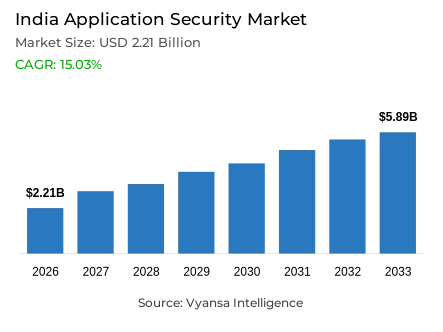
Application security is the set of testing tools, web application firewalls, and managed services that find and block vulnerabilities in web and mobile software before attackers exploit them. Banks, digital payment operators, e-commerce platforms, insurers, and government portals in India consume it to protect customer-facing applications and the application programming interfaces (APIs) linking them. The India application security market is forecast to grow at a CAGR of 15.03% between 2027 and 2033.
Key Highlights of the India Application Security Market
- The India application security market was valued at USD 2.21 billion in 2026 and is estimated at USD 2.54 billion in 2027 and is projected to reach USD 5.89 billion by 2033.
- The market is forecast to expand at a compound annual growth rate of 15.03% across the 2027 to 2033 forecast period.
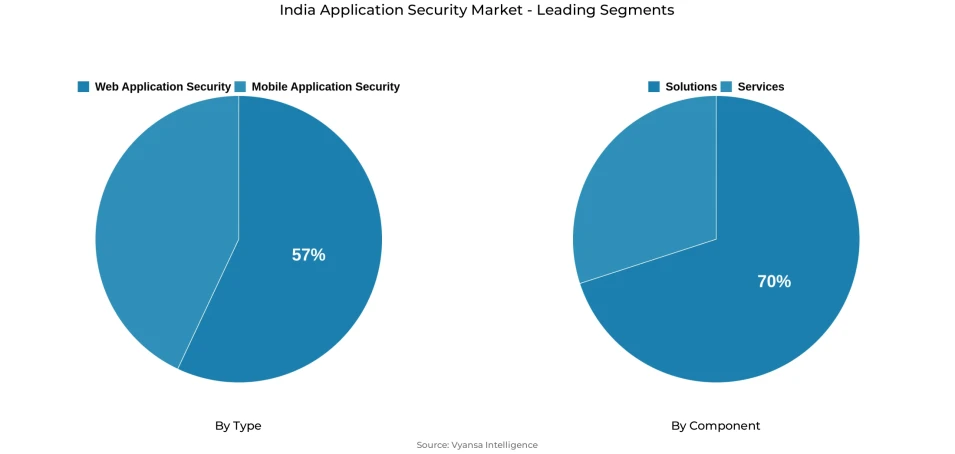
- By type, web application security led the market with a 57% share in 2026.
- Mobile application security is the fastest-growing type segment, expanding at a 16.70% CAGR between 2027 and 2033.
- By component, solutions accounted for the largest share of the market at 70.00% in 2026.
- Services is the fastest-growing component segment, expanding at an 18.01% CAGR between 2027 and 2033.
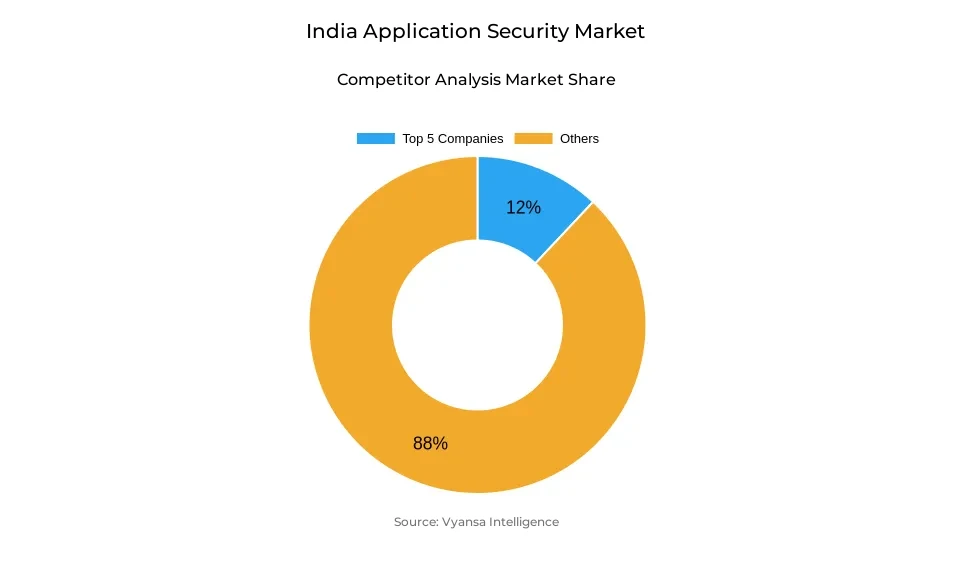
- The market is fragmented, with the top five companies holding a combined 12.00% share in 2026.
India’s application security market is being supported by the rapid expansion of the country’s digital ecosystem and the rising frequency of cyber incidents. In 2025, CERT-In recorded 29.44 lakh cybersecurity incidents, compared with 2.41 million in 2024, representing a 44.2% year-on-year increase. The growing volume of incidents is increasing the need for vulnerability management, secure coding, application testing, threat monitoring, and runtime protection across enterprise and government applications.
The attack surface is expanding alongside digital adoption. India crossed 10.5 million internet connections in 2025, while average monthly wireless data consumption reached 24.01 GB per subscriber, up from only 61.66 MB in 2014. At the transaction layer, UPI processed more than 21 billion transactions worth over USD 310.3 billion in December 2025 alone, increasing the security requirements around payment applications and APIs.
Government-led cybersecurity spending is also strengthening demand. The Union Budget 2025–26 allocated USD 81.65 million for cybersecurity projects, while CERT-In had 231 empanelled cybersecurity audit organisations by 2025. CERT-In also conducted 122 cybersecurity drills involving around 1,570 organisations, indicating increasing institutional emphasis on application and infrastructure resilience. Additionally, India achieved a 98.49/100 score in the 2024 Global Cybersecurity Index, reflecting the strengthening regulatory and institutional cybersecurity environment.
India Application Security Market Government Compliance
Government and financial-sector cybersecurity requirements are strengthening the need for application testing, vulnerability management and continuous security monitoring in India. MeitY notified the Digital Personal Data Protection Rules, 2025, on November 14, 2025, establishing operational requirements around personal-data protection and breach management for organisations covered by the framework.
In the securities market, SEBI's Cybersecurity and Cyber Resilience Framework (CSCRF), issued on August 20, 2024, establishes requirements covering Vulnerability Assessment and Penetration Testing (VAPT), patch management, cyber audits, software security, log management, and data security for regulated entities. SEBI subsequently issued clarifications and implementation extensions during 2025, demonstrating continued regulatory focus on cyber resilience.
RBI's existing cybersecurity requirements for regulated entities also incorporate VAPT, security audits, application/API testing, source-code review, patch management and secure software development controls, creating recurring compliance requirements around application security.
Overall, the regulatory environment is shifting application security from an optional IT-control activity toward a recurring compliance, testing and assurance requirement, supporting demand for VAPT, application security testing, secure development and managed cybersecurity services.
India Application Security Industry Drivers
Rising Confirmed Cyber-Incident Volume Is the Most Direct Demand Signal for Testing and Protection Spend
Application-layer exposure is becoming the most direct trigger for testing and protection budgets in the industry, because organisations that see confirmed incident volume rising treat it as a leading indicator rather than a lagging one. Banks, payment operators, retailers and government departments are most affected, since their customer-facing software is now the primary channel through which residents transact, making a compromised application immediately visible to end users rather than an internal technical failure.
CERT-In handled more than 29.5 million cyber incidents in 2025, up from 2.41 million in 2024, and had 231 empanelled audit organisations in place to support VAPT work nationwide. That rising incident count converts directly into board-level urgency for testing engagements and application-layer monitoring, since each publicised incident raises the perceived cost of the next unpatched vulnerability.
Through the forecast period, this urgency should deepen as the exposed application surface keeps expanding, most visibly through Unified Payments Interface (UPI) transactions, which reached USD 2.56 billion in volume nationally in fiscal year 2025-26, a nearly 30% increase over the prior year, with each transaction representing an application interaction that must be protected. Banking, payment and e-governance applications gain the most budget weight as a result, keeping rising incident exposure a commercially live driver of recurring testing and protection spend across the application security industry.
India Application Security Industry Challenges
Regulatory Evolution Creates a Growing Compliance Burden
India’s evolving application security regulatory landscape is creating a compliance burden beyond the requirements of any individual mandate. SEBI’s Cybersecurity and Cyber Resilience Framework (CSCRF), introduced in August 2024, was followed by multiple clarification and implementation-related circulars through 2024 and 2025. For regulated entities, these successive updates increase the need to continuously interpret regulatory requirements, revise internal controls, and maintain evidence demonstrating compliance.
The complexity is particularly significant for organisations operating across multiple regulatory environments, where application-security obligations may differ by sector and data type. Financial institutions and market intermediaries, for example, must align cybersecurity controls with applicable SEBI and RBI requirements, while organisations processing personal data must also account for MeitY’s Digital Personal Data Protection framework. This creates additional requirements for compliance teams, security architects, auditors, and testing providers to maintain regulatory coverage across multiple frameworks.
As a result, demand is gradually extending beyond one-time vulnerability assessment and penetration testing (VAPT) engagements toward recurring compliance-support services. Specialist cybersecurity providers and CERT-In-empanelled auditors can support organisations through periodic assessments, documentation, remediation validation, and audit preparation. Consequently, regulatory complexity can increase both the cost of maintaining application-security controls and the demand for continuous, audit-ready security services.
India Application Security Industry Recent Trends
Enterprises Are Replacing On-Premises, Appliance-Based WAFs With Cloud-Delivered, SaaS WAAP
Application protection in the industry is shifting away from on-premises, appliance-based web application firewalls (WAFs) toward cloud-delivered web application and API protection (WAAP) platforms managed by a third-party provider. This replaces a model in which enterprises owned and tuned physical or virtualised WAF appliances in-house, a setup that struggled to support custom ports, socket-based connections and rapid onboarding of new applications.
In January 2026, Indusface documented a regulated Indian brokerage's migration of its trading platform from an on-premises Akamai WAF to its AppTrana WAAP, onboarding the firm's core trading systems and more than sixty applications with zero downtime while keeping virtual patching aligned to the Securities and Exchange Board of India's remediation timelines. The migration blocked 6.5 million attacks annually and produced over forty clean vulnerability reports, replacing manual policy tuning with a managed, always-current rule set.
Through the forecast period, this shift reduces the procurement and deployment friction that previously slowed new application onboarding, letting enterprises protect applications from day one rather than after a lengthy tuning cycle. Demand consequently moves toward consolidated, cloud-delivered platforms that bundle WAF, distributed denial-of-service (DDoS) protection, bot mitigation and API security into a single managed subscription, strengthening the application security industry's shift away from point-product ownership.
OpenText's Fortify SAST Engine Added a Generative AI Analyzer Capability to Accelerate Language Coverage
Static application security testing (SAST) engines have historically lagged behind the pace at which enterprises adopt new programming languages and frameworks, leaving newly written code unscanned until vendors manually build detection rules for each language. This gap directly limits how quickly the industry's testing tools can cover the code enterprises are actually shipping.
In January 2026, OpenText released Fortify Static Code Analyzer 26.1, introducing an AI Analyzer that used generative models to accelerate new-language rule development rather than relying solely on manual engineering. The release lifted supported vulnerability categories to 1,524 across more than 44 languages, up from 1,443 in January 2025, and further to 1,542 by July 2026, while adding native coverage for a dozen additional languages at launch.
Adopting this capability requires development teams to route new-language codebases through the updated scanning engine rather than exempting them until manual rule coverage catches up. As AI-assisted development compresses the time between code creation and deployment, faster language-coverage cycles let testing keep pace with release velocity, widening the gap between vendors that can scan modern codebases immediately and those still building manual rule sets, and strengthening demand for AI-accelerated testing platforms across the application security industry.
India Application Security Industry Opportunities
Rapid API Threat Growth Creates a Security Coverage Gap
India’s application security landscape is facing a widening gap between the growing importance of APIs and the scope of conventional security testing programs. While application security assessments have traditionally focused heavily on websites and web applications, APIs increasingly serve as critical interfaces for customer data, payment transactions, and backend services. The emergence of undocumented and shadow APIs further complicates security coverage, as these assets may remain outside formal application inventories and testing scopes.
According to Indusface’s State of Application Security Report – India, covering the first half of 2025 and published in September 2025, API attacks increased 126% year-on-year, compared with an 11% increase in website attacks. More than 1.36 billion API attacks were recorded in India during the six-month period, highlighting the rapidly expanding threat exposure associated with API-driven applications.
This divergence creates a measurable opportunity for application security providers to expand beyond periodic web-application assessments toward continuous API discovery, inventory management, automated testing, and runtime protection. Automated identification of undocumented APIs can help organisations address assets that may otherwise remain outside conventional security assessments.
Consequently, vendors offering continuous API security capabilities can address an expanding portion of the application attack surface and potentially increase demand for recurring security testing and protection services.
Unlock Market Intelligence
Explore the market potential with our data-driven report
India Application Security Market Segmentation Analysis
By Type:
- Web Application Security
- Mobile Application Security
Web Application Security Commands 57% of Type-Based Demand
By type, the industry is segmented into web application security and mobile application security. Web application security leads with a 57% share in 2026, because it carries the largest installed base of applications still needing protection, spanning banking portals, e-commerce storefronts and government e-services built years before mobile-first design became standard, and because the compliance instruments requiring VAPT and penetration testing were written primarily around browser-based and internet-facing systems.
In April 2025, Akamai Technologies introduced App & API Protector Hybrid, extending its web application firewall protections beyond the content delivery network to on-premises, multicloud and CDN-agnostic environments, widening the deployment options available to enterprises still running legacy web applications. OpenText's Application Security Content update released alongside Fortify 26.1 in January 2026 similarly expanded dynamic testing coverage for web applications through its DAST SecureBase content, reinforcing tooling depth for the segment. Web application security should hold its lead through the forecast period provided legacy application volumes are not retired faster than new mobile-first services replace them.
Mobile application security is the fastest-growing type segment, expanding at a 16.70% CAGR between 2027 and 2033, driven by banking and payment applications shifting core transaction volume onto mobile channels where malware-driven fraud is rising fastest. In May 2026, Zimperium launched its Mobile App Response Agent, part of its Mobile App Protection Suite, to help security and fraud teams investigate mobile banking threats after its own research found mobile banking malware-driven transactions rose 67% year-on-year in 2025.
Appknox, a Bengaluru-founded mobile testing provider, added Store Release Readiness to its platform in July 2026 to catch app-store rejection risks before submission. Mobile application security grows faster than web application security because its addressable base is expanding on new mobile-first transaction volume, while web application security's growth is constrained by the larger, more mature base it must scale from.
By Component:
- Solutions
- Services
Solutions Hold 70% of Component-Based Demand
By component, the industry is segmented into solutions and services. Solutions lead with a 70.00% share in 2026, because enterprises with in-house security teams continue to license testing and protection software directly rather than outsourcing execution, and because platform vendors increasingly bundle multiple testing types into a single subscription that displaces the need for separate service engagements. Qualys launched TotalAppSec in February 2025, unifying API security, web application scanning and web malware detection into one AI-powered solution available directly to existing customers as a self-service upgrade. Checkmarx introduced Checkmarx Fusion in July 2026, adding a hybrid scanning engine to its Checkmarx One platform that combines rules-based detection with frontier AI reasoning. Solutions should hold their lead through the forecast period provided platform vendors keep absorbing service-like capability directly into software licensing.
Services is the fastest-growing component segment, expanding at an 18.01% CAGR between 2027 and 2033, driven by the recurring, mandated testing cadences that regulated banks, NBFCs and securities intermediaries must now outsource rather than build in-house. Tata Consultancy Services introduced its Cyber Defense Suite as part of a set of India-focused offerings in 2025, delivering managed testing, monitoring and compliance-reporting services from its domestic delivery centres. Rapid7 opened a global capability centre in Pune in April 2025 dedicated to expanding round-the-clock managed security service delivery. Services grows faster than solutions because compliance-driven testing cadences require sustained execution capacity that most regulated entities cannot economically staff in-house, while solutions' growth is capped by the smaller pool of enterprises still adding net-new software licences each year.
Unlock Market Intelligence
Explore the market potential with our data-driven report
India Application Security Market Competitive Landscape
The India application security industry is fragmented, with the top five companies holding a combined 12.00% share in 2026. IBM India Private Limited leads, followed by Synopsys India Private Limited, Open Text Technologies India PVT Ltd, Akamai Technologies India Private Limited and Fortinet Technologies India Private Limited. The remaining share is distributed across a broad base of specialist testing, WAAP and managed-service providers competing for regulated and enterprise accounts nationwide.
Key Companies in the India Application Security Market
- IBM India Private Limited
- Synopsys India Private Limited
- Open Text Technologies India PVT Ltd.
- Akamai Technologies India Private Limited
- Fortinet Technologies India Private Limited
- Checkmarx Software India Private Limited
- Rapid7, Inc.
- Qualys, Inc.
- Indusface Private Limited
- Tata Consultancy Services Limited
Recent Developments in the India Application Security Industry
- In May 2026, SEBI issued an advisory on emerging advanced artificial intelligence (AI) tools for vulnerability detection, highlighting the potential for such tools to identify vulnerabilities at greater speed and scale and create additional risks related to data confidentiality, application integrity, and output reliability. SEBI also outlined the need for regulated entities to develop longer-term approaches covering AI-enabled vulnerability detection, continuous vulnerability management, and autonomous or agentic mitigation. The development expands the application-security focus beyond conventional VAPT toward continuous and AI-assisted security operations.
- In May 2026, Synopsys announced an agreement to sell its Software Integrity business to Clearlake Capital Group and Francisco Partners for approximately US$2.1 billion. The transaction was subsequently completed in October 2024, with the business operating as Black Duck. The separation created a standalone application-security company focused on software composition analysis, application security testing, and related software-integrity solutions. For Indian enterprises and security-service providers, the development is relevant to vendor portfolios, product strategies, and long-term application-security technology partnerships.
Frequently Asked Questions
Related Report
- Market Segmentation
- Research Scope
- Research Methodology
- Definitions and Assumptions
- Executive Summary
- India Application Security Market Policies, Regulations, and Standards
- India Application Security Market Dynamics
- Growth Factors
- Challenges
- Trends
- Opportunities
- India Application Security Market Statistics, 2023-2033F
- Market Size & Growth Outlook
- By Revenues in USD Million
- Market Segmentation & Growth Outlook
- By Type
- Web Application Security- Market Insights and Forecast 2023-2033, USD Million
- Mobile Application Security- Market Insights and Forecast 2023-2033, USD Million
- By Component
- Solutions- Market Insights and Forecast 2023-2033, USD Million
- Services- Market Insights and Forecast 2023-2033, USD Million
- By Testing Type
- Static Application Security Testing (SAST)- Market Insights and Forecast 2023-2033, USD Million
- Dynamic Application Security Testing (DAST)- Market Insights and Forecast 2023-2033, USD Million
- Interactive Application Security Testing (IAST)- Market Insights and Forecast 2023-2033, USD Million
- Runtime Application Self-Protection (RASP)- Market Insights and Forecast 2023-2033, USD Million
- By Deployment Mode
- Cloud- Market Insights and Forecast 2023-2033, USD Million
- On-Premises- Market Insights and Forecast 2023-2033, USD Million
- By Organization Size
- Large Enterprises- Market Insights and Forecast 2023-2033, USD Million
- Small and Medium Enterprises- Market Insights and Forecast 2023-2033, USD Million
- By Industry Vertical
- BFSI- Market Insights and Forecast 2023-2033, USD Million
- IT and ITES- Market Insights and Forecast 2023-2033, USD Million
- Telecommunications- Market Insights and Forecast 2023-2033, USD Million
- Government and Public Sector- Market Insights and Forecast 2023-2033, USD Million
- Healthcare- Market Insights and Forecast 2023-2033, USD Million
- Manufacturing- Market Insights and Forecast 2023-2033, USD Million
- Retail and E-Commerce- Market Insights and Forecast 2023-2033, USD Million
- Education- Market Insights and Forecast 2023-2033, USD Million
- Others- Market Insights and Forecast 2023-2033, USD Million
- By Region
- North- Market Insights and Forecast 2023-2033, USD Million
- East- Market Insights and Forecast 2023-2033, USD Million
- West- Market Insights and Forecast 2023-2033, USD Million
- South- Market Insights and Forecast 2023-2033, USD Million
- By Competitors
- Competition Characteristics
- Market Share & Analysis
- By Type
- Market Size & Growth Outlook
- India Web Application Security Market Statistics, 2023-2033
- Market Size & Growth Outlook
- By Revenues in USD Million
- Market Segmentation & Growth Outlook
- By Component- Market Insights and Forecast 2023-2033, USD Million
- By Testing Type- Market Insights and Forecast 2023-2033, USD Million
- By Deployment Mode- Market Insights and Forecast 2023-2033, USD Million
- By Organization Size- Market Insights and Forecast 2023-2033, USD Million
- By Industry Vertical- Market Insights and Forecast 2023-2033, USD Million
- By Region- Market Insights and Forecast 2023-2033, USD Million
- Market Size & Growth Outlook
- India Mobile Application Security Market Statistics, 2023-2033
- Market Size & Growth Outlook
- By Revenues in USD Million
- Market Segmentation & Growth Outlook
- By Component- Market Insights and Forecast 2023-2033, USD Million
- By Testing Type- Market Insights and Forecast 2023-2033, USD Million
- By Deployment Mode- Market Insights and Forecast 2023-2033, USD Million
- By Organization Size- Market Insights and Forecast 2023-2033, USD Million
- By Industry Vertical- Market Insights and Forecast 2023-2033, USD Million
- By Region- Market Insights and Forecast 2023-2033, USD Million
- Market Size & Growth Outlook
- Competitive Outlook
- Company Profiles
- IBM India Private Limited
- Business Description
- Product Portfolio
- Collaborations & Alliances
- Recent Developments
- Financial Details
- Others
- Synopsys India Private Limited
- Business Description
- Product Portfolio
- Collaborations & Alliances
- Recent Developments
- Financial Details
- Others
- Open Text Technologies India PVT Ltd.
- Business Description
- Product Portfolio
- Collaborations & Alliances
- Recent Developments
- Financial Details
- Others
- Akamai Technologies India Private Limited
- Business Description
- Product Portfolio
- Collaborations & Alliances
- Recent Developments
- Financial Details
- Others
- Fortinet Technologies India Private Limited
- Business Description
- Product Portfolio
- Collaborations & Alliances
- Recent Developments
- Financial Details
- Others
- Checkmarx Software India Private Limited
- Business Description
- Product Portfolio
- Collaborations & Alliances
- Recent Developments
- Financial Details
- Others
- Rapid7, Inc.
- Business Description
- Product Portfolio
- Collaborations & Alliances
- Recent Developments
- Financial Details
- Others
- Qualys, Inc.
- Business Description
- Product Portfolio
- Collaborations & Alliances
- Recent Developments
- Financial Details
- Others
- Indusface Private Limited
- Business Description
- Product Portfolio
- Collaborations & Alliances
- Recent Developments
- Financial Details
- Others
- Tata Consultancy Services Limited
- Business Description
- Product Portfolio
- Collaborations & Alliances
- Recent Developments
- Financial Details
- Others
- IBM India Private Limited
- Company Profiles
- Disclaimer
| Segment | Sub-Segment |
|---|---|
| By Type |
|
| By Component |
|
| By Testing Type |
|
| By Deployment Mode |
|
| By Organization Size |
|
| By Industry Vertical |
|
| By Region |
|
Research Methodology
This study followed a structured approach comprising four key phases to assess the size and scope of the electro-oxidation market. The process began with thorough secondary research to collect data on the target market, related markets, and broader industry context. These findings, along with preliminary assumptions and estimates, were then validated through extensive primary research involving industry experts from across the value chain. To calculate the overall market size, both top-down and bottom-up methodologies were employed. Finally, market segmentation and data triangulation techniques were applied to refine and validate segment-level estimations.
Secondary Research
The secondary research phase involved gathering data from a wide range of credible and published sources. This step helped in identifying industry trends, defining market segmentation, and understanding the market landscape and value chain.
Sources consulted during this phase included:
- Company annual reports, investor presentations, and press releases
- Industry white papers and certified publications
- Trade directories and market-recognized databases
- Articles from authoritative authors and reputable journals
- Gold and silver standard websites
Secondary research was critical in mapping out the industry's value chain and monetary flow, identifying key market segments, understanding regional variations, and tracking significant industry developments.
Other key sources:
- Financial disclosures
- Industry associations and trade bodies
- News outlets and business magazines
- Academic journals and research studies
- Paid industry databases
Primary Research
To validate secondary data and gain deeper market insights, primary research was conducted with key stakeholders across both the supply and demand sides of the market.
On the demand side, participants included decision-makers and influencers from end-user industries—such as CIOs, CTOs, and CSOs—who provided first-hand perspectives on market needs, product usage, and future expectations.
On the supply side, interviews were conducted with manufacturers, industry associations, and institutional participants to gather insights into current offerings, product pipelines, and market challenges.
Primary interviews provided critical inputs such as:
- Market size and revenue data
- Product and service breakdowns
- Market forecasts
- Regional and application-specific trends
Stakeholders consulted included:
- Leading OEM and solution providers
- Channel and distribution partners
- End users across various applications
- Independent consultants and industry specialists
Market Size Estimation and Data Triangulation
- Identifying Key Market Participants (Secondary Research)
- Goal: To identify the major players or companies in the target market. This typically involves using publicly available data sources such as industry reports, market research publications, and financial statements of companies.
- Tools: Reports from firms like Gartner, Forrester, Euromonitor, Statista, IBISWorld, and others. Public financial statements, news articles, and press releases from top market players.
- Extracting Earnings of Key Market Participants
- Goal: To estimate the earnings generated from the product or service being analyzed. This step helps in understanding the revenue potential of each market player in a specific geography.
- Methods: Earnings data can be gathered from:
- Publicly available financial reports (for listed companies).
- Interviews and primary data sources from professionals, such as Directors, VPs, SVPs, etc. This is especially useful for understanding more nuanced, internal data that isn't publicly disclosed.
- Annual reports and investor presentations of key players.
- Data Collation and Development of a Relevant Data Model
- Goal: To collate inputs from both primary and secondary sources into a structured, data-driven model for market estimation. This model will incorporate key market KPIs and any independent variables relevant to the market.
- Key KPIs: These could include:
- Market size, growth rate, and demand drivers.
- Industry-specific metrics like market share, average revenue per customer (ARPC), or average deal size.
- External variables, such as economic growth rates, inflation rates, or commodity prices, that could affect the market.
- Data Modeling: Based on this data, the market forecasts are developed for the next 5 years. A combination of trend analysis, scenario modeling, and statistical regression might be used to generate projections.
- Scenario Analysis
- Goal: To test different assumptions and validate how sensitive the market is to changes in key variables (e.g., market demand, regulatory changes, technological disruptions).
- Types of Scenarios:
- Base Case: Based on current assumptions and historical data.
- Best-Case Scenario: Assuming favorable market conditions, regulatory environments, and technological advancements.
- Worst-Case Scenario: Accounting for adverse factors, such as economic downturns, stricter regulations, or unexpected disruptions.












