Japan Photonic Integrated Circuit Market Report: Trends, Growth and Forecast (2026-2032)
By Component (Optical Transceivers, Optical Switches, Optical Sensors, Modulators, Waveguides, Photonic Lasers, Other Photonic Components), By Raw Material (Silicon, Indium Phosphide (InP), Silicon Nitride (SiN), Gallium Arsenide (GaAs), Others), By Integration Type (Monolithic PICs, Hybrid PICs, Heterogeneous Integration, Others), By End User (Telecommunications, Data Centers, Quantum Computing & Quantum Communications, Automotive, Healthcare & Biomedical Sensing, Defense & Aerospace, Consumer Electronics & IoT, Others) ... Read more
|
Major Players
|
Japan Photonic Integrated Circuit Market Size Overview
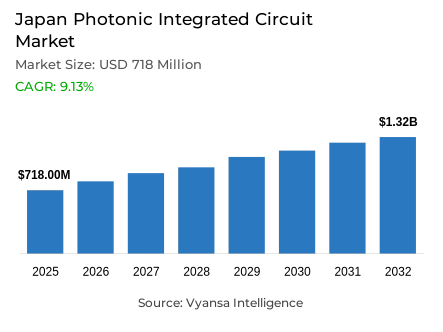
Photonic integrated circuits (PICs) integrate multiple optical components onto a single semiconductor chip, enabling high-speed data transmission, improved energy efficiency, and compact system architectures. The photonic integrated circuit market in Japan is projected to expand steadily across these end-use applications, registering a strong CAGR of 9.13% during 2026–2032.
Key highlights of the Japan photonic integrated circuit market:
- The Japan photonic integrated circuit industry was valued at USD 718 million in 2025 and is expected to reach USD 782 million in 2026. Meanwhile, it is projected to increase to USD 1.32 billion by 2032.
- The market is forecast to grow at a CAGR of 9.13% during 2026–2032.
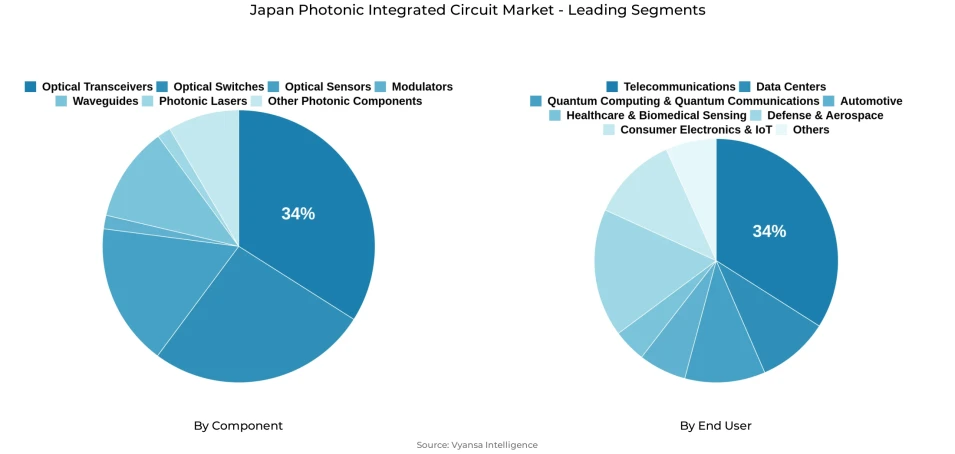
- Optical transceivers led the component segment with an estimated 34% share in 2026.
- However, photonic lasers are expected to grow fastest, recording a CAGR of 11.43% through 2032.
- Telecommunications dominated the end-user segment with around 34% share in 2026.
- Meanwhile, quantum computing and quantum communications is projected to grow fastest at a CAGR of 15.65%.
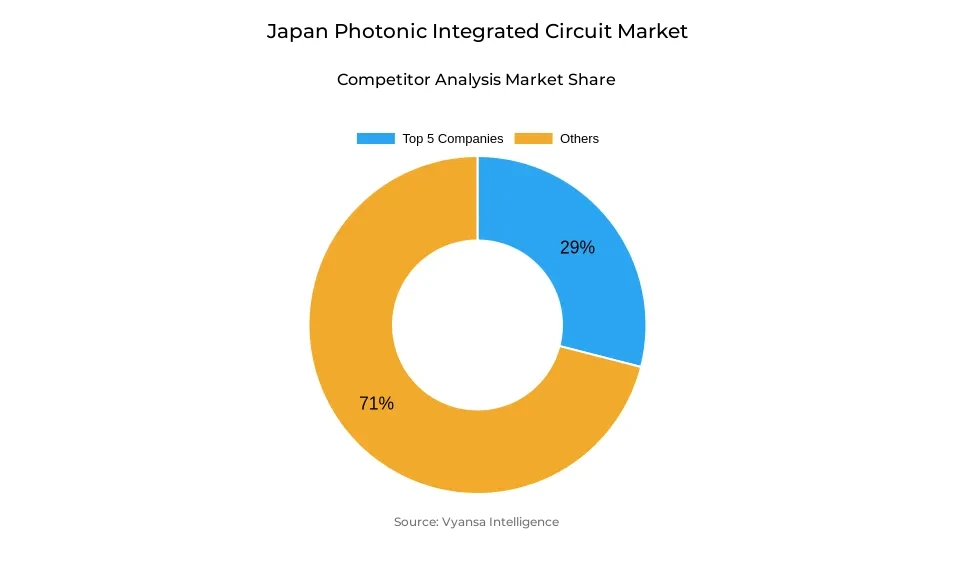
- The top five companies held approximately 29% of the market, indicating a moderately competitive market structure.
The Japan photonic integrated circuit industry is becoming more significant as the country continues to grow its semiconductor industry and digital infrastructure. Demand is increasing from AI computing, data centers, and advanced optical networks that require faster and more efficient data transfer. Japan’s government support, including JPY 50–70 billion (USD 350–500 million) under METI and NEDO programs (2023–2025) along with USD 25.7 billion in semiconductor funding, is helping to strengthen research, pilot production, and wider commercial use.
At the same time, rising investment in cloud services, AI platforms, and large data centres is driving the need for high-speed and low-power optical connectivity. As data usage continues to grow, companies are looking for photonic integrated circuits that can improve network performance, reduce energy consumption, and ensure stable digital operations. This growing need is also pushing suppliers to improve product development, testing, packaging, and local support services across Japan.
During the period 2026–2032, the photonic integrated circuit market in Japan is expected to experience a clear shift toward silicon photonics, co-packaged optics, and highly integrated solutions designed for AI servers, 6G networks, and high-performance computing systems. Companies that deliver reliable products, scalable manufacturing capabilities, and strong packaging and technical support will be better positioned to capture emerging opportunities. Overall, sustained investment in Japan’s digital infrastructure will continue to drive steady, long-term market growth throughout the forecast period.
Recent Investments in the Japan Photonic Integrated Circuit Market
On July 14, 2026, Japan’s Ministry of Economy, Trade and Industry (METI) approved a semiconductor supply-security plan involving Tower Semiconductor Ltd., supporting the company’s strategic expansion of silicon photonics (SiPho), silicon germanium (SiGe), and advanced optical-packaging capabilities in Japan. The project represents a total investment of more than JPY 600 billion, with government support of up to approximately JPY 160 billion. Tower Semiconductor expects its net investment, after government grants, to be approximately USD 3 billion.
Under the first track, Tower Semiconductor plans to repurpose its Arai facility in Myoko, Niigata Prefecture, formerly designated Fab 6, for 300mm silicon photonics and advanced packaging, while maximizing 300mm manufacturing capacity at Fab 7 in Uozu, Toyama Prefecture. Full production readiness for the first track is expected during the fourth quarter of 2027. Tower has also indicated significant capacity expansion for silicon photonics and silicon germanium to address rising demand from artificial intelligence (AI), data centers, and next-generation optical connectivity applications.
The second track involves the construction of an additional 300mm manufacturing facility adjacent to Fab 7 in Uozu, subject to the completion of the relevant agreements. The facility is expected to provide a multi-fold increase in silicon photonics and silicon germanium capacity and is anticipated to become highly accretive to Tower’s business beginning in 2029.
The investment is expected to strengthen Japan’s domestic photonic semiconductor manufacturing base, enhance supply-chain resilience, expand collaboration with local suppliers and research institutions, and increase the country’s capacity to support high-speed optical connectivity requirements associated with AI infrastructure and data centers. Tower’s expansion also reflects the growing commercialization of silicon photonics, with the company reporting USD 1.3 billion in contracted silicon-photonics revenue for 2027 and additional capacity commitments for 2028.
Japan Photonic Integrated Circuit Market Drivers
Growing Investment in High-Speed Digital Infrastructure
Japan’s continued investment in cloud platforms, artificial intelligence, and communication networks is strengthening demand for faster and more efficient data transfer. Photonic integrated circuits support this expansion by moving information through light while reducing power use and system size. As digital infrastructure develops, PICs are becoming important components in transceivers, switches, servers, and high-capacity network equipment across Japan at scale.
Supporting this expansion, the U.S. Commercial Service reported in 2025 that Japan’s cloud services market would increase from USD 28.97 billion in 2025 to USD 33.53 billion in 2026, representing 15.7% growth. Rising cloud activity increases connections among servers, storage systems, and networks, further supporting demand for optical links, modulators, detectors, lasers, and integrated photonic devices throughout Japan’s digital economy.
As investment continues through 2026–2032, data centers, telecom operators, and enterprise users will require more PIC-based components for higher bandwidth and lower power use. Suppliers offering reliable performance, scalable production, and local technical support will gain stronger demand. Broader deployment will also encourage spending on photonic design, wafer fabrication, packaging, testing, and customer qualification across Japan’s domestic market over time.
Japan Photonic Integrated Circuit Market Restraints
Complex Manufacturing and High Development Costs
Japan’s photonic integrated circuit industry faces a major challenge from complex manufacturing and high development costs. PIC production requires advanced wafer fabrication, precise optical alignment, specialized packaging, and detailed testing. Even small process errors can reduce yields and product reliability. These requirements raise capital needs, lengthen development cycles, and make commercial production harder for smaller suppliers and new market entrants.
New Energy and Industrial Technology Development Organization (NEDO)’s Next-generation Digital Infrastructure Programme has a budget of up to USD 1.196 billion and supports photonics-electronics convergence devices and optical smart network interface cards. The programme’s scale shows the high cost of research, prototyping, packaging, testing, and system qualification before commercial use. Such expenses can restrict participation and slow production expansion among smaller Japanese PIC suppliers during commercial scale-up.
As this challenge continues through 2026–2032, high capital needs and lengthy qualification processes may delay launches and limit early price reductions. Smaller suppliers may rely on external foundries, packaging companies, and testing providers, increasing lead times and reducing production control. Market progress will depend on better yields, shared infrastructure, skilled workers, and stronger cooperation across Japan’s photonics supply chain industry.
Japan Photonic Integrated Circuit Market Recent Trends
Shift Toward Co-Packaged Optics and Heterogeneous Integration
Japan’s photonics sector is shifting toward co-packaged optics and heterogeneous integration as computing systems require faster data movement with lower power use. These methods place photonic devices closer to processors, switches, and memory components, reducing electrical signal distances. The shift supports better performance in AI servers, supercomputers, optical switches, and next-generation high-capacity network equipment across Japan over the coming years.
The International Energy Agency reported in 2025 that Japan’s data-center electricity use could increase by about 15 TWh, or 80%, by 2030. This expected rise is encouraging operators to adopt system designs that move more data while using less energy. Co-packaged optics and heterogeneous integration support this shift by improving communication between electronic processors and photonic components in computing systems.
As this technology shift advances through 2026–2032, demand will rise for integrated lasers, optical engines, processors, and switches within connected packages. Suppliers will also need stronger capabilities in advanced substrates, fiber attachment, thermal control, three-dimensional integration, and precision testing. Companies that improve reliability and production yields will be better positioned across AI, computing, telecom, and data-center applications in Japan overall.
Japan Photonic Integrated Circuit Market Future Opportunities
Expansion of Quantum Technology Applications
Japan’s growing focus on quantum technologies is creating new opportunities for photonic integrated circuits in secure communication, sensing, and quantum computing. These chips can guide, control, split, and detect light within compact systems. Strong cooperation among government agencies, universities, research institutes, and semiconductor companies is helping move photonic ideas from laboratory testing toward practical products and commercial services across Japan.
Supporting this development, the Ministry of Economy, Trade and Industry (METI) stated in 2026 that Japan secured about USD 0.629 billion through a supplementary budget for next-generation quantum computer development. This funding can increase demand for photonic chips, detectors, optical control devices, specialized materials, and advanced packaging. It also allows PIC suppliers to join projects, test products, and build relationships with future quantum-system quantum system developers across Japan nationwide.
As these programs progress, quantum applications can open revenue streams beyond telecom and data centers across the 2026–2032 period. Suppliers may offer custom PIC design, low-loss optical circuits, detector integration, packaging, testing, and small-volume production. Companies with reliable performance and strong research partnerships will be better placed to support Japan’s shift from experimental quantum systems toward early commercial use.
Unlock Market Intelligence
Explore the market potential with our data-driven report
Japan Photonic Integrated Circuit Market Segmentation Analysis
By Component
- Optical Transceivers
- Optical Switches
- Optical Sensors
- Modulators
- Waveguides
- Photonic Lasers
- Other Photonic Components
Optical Transceivers Lead the Market, while Photonic Lasers are the Fastest Growing
Optical transceivers led the Japan photonic integrated circuit industry with an estimated 34% share in 2026. Their leading position is supported by strong demand from telecom networks, data centers, cloud systems, and high-speed communication equipment. These devices convert electrical signals into optical signals and support fast data transfer through fiber networks. Continued upgrades in Japan’s digital and communication infrastructure are increasing demand for compact transceivers that provide higher bandwidth, lower power use, and reliable network performance.
Meanwhile, photonic lasers are projected to grow at the fastest CAGR of approximately 11.43% during 2026–2032. These lasers provide the light source required for optical communication, sensing, quantum systems, and other integrated photonic devices. Demand is rising from coherent communication, LiDAR, biomedical sensing, and quantum applications. While optical transceivers will remain the largest component segment, photonic lasers will benefit from growing demand for integrated light sources in advanced optical systems.
By End User
- Telecommunications
- Data Centers
- Quantum Computing & Quantum Communications
- Automotive
- Healthcare & Biomedical Sensing
- Defense & Aerospace
- Consumer Electronics & IoT
- Others
Telecommunications Leads the Market, while Quantum Computing & Quantum Communications are the Fastest Growing
Telecommunications dominated the Japan photonic integrated circuit market with an estimated 34% share in 2026. The segment’s leadership is supported by continued investment in fiber networks, broadband services, mobile backhaul, and long-distance optical communication. Telecom operators use PIC-based transceivers, modulators, lasers, switches, and detectors to increase network capacity while reducing equipment size and power use. Rising data traffic will continue to support demand for photonic components across Japan’s telecom infrastructure.
Meanwhile, quantum computing & quantum communications is projected to grow at the fastest CAGR of approximately 15.65% during 2026–2032. Growth is supported by investment in quantum processors, secure communication networks, sensing systems, and national research programs. These applications require low-loss waveguides, photon detectors, optical control devices, and integrated light sources. Telecommunications will remain the largest end-user segment, while quantum applications will create growing demand for specialized and high-value PIC solutions.
Unlock Market Intelligence
Explore the market potential with our data-driven report
Japan Photonic Integrated Circuit Market Competitive Landscape
The Japan photonic integrated circuit market is moderately fragmented, with the top five companies accounting for approximately 29%of total revenue, reflecting a competitive landscape where global semiconductor leaders and domestic photonics specialists coexist. Customers prioritize high-speed optical performance, low power consumption, manufacturing reliability, and seamless integration with existing semiconductor platforms. Continuous innovation in silicon photonics, heterogeneous integration, advanced packaging, and wafer-scale manufacturing has become the primary competitive differentiator. Leading companies strengthen their market positions through sustained R&D investments, strategic partnerships, and vertically integrated production capabilities.
Key Companies in the Japan Photonic Integrated Circuit Market
- Furukawa Electric Co. Ltd.
- Sumitomo Electric Industries Ltd.
- Fujitsu Limited
- NTT Corporation (including brands)
- Hamamatsu Photonics K.K.
- Mitsubishi Electric Corporation
- Coherent Corp.
- Lumentum Holdings Inc.
- Broadcom Inc.
- Nokia Corporation
Company Profiles
The leading companies are profiled below to understand their product portfolio, optical technology expertise, and competitive positioning in the Japan photonic integrated circuit market.
Furukawa Electric Co., Ltd.: Headquartered in Tokyo, Furukawa Electric participates in the Japan photonic integrated circuit market through high-output distributed feedback laser diode chips, external laser sources, and optical components supporting silicon-photonics transceivers. Its DFB lasers provide single-wavelength light sources for 800G and 1.6T optical transceivers and emerging co-packaged optics. In December 2025, the company announced a JPY 38.0 billion investment in a new Iwate manufacturing plant and related facilities, targeting more than a 500% increase in DFB laser-chip capacity by 2028 compared with FY2025. Strong semiconductor-laser expertise, domestic production, and Furukawa FITEL Optical Device capabilities strengthen its position in Japan’s AI data-center and optical-communication ecosystem.
Sumitomo Electric Industries, Ltd.: Sumitomo Electric participates through InP semiconductor lasers, electro-absorption modulated lasers, optical coupling devices, planar light wave circuits, photodetectors, and compound-semiconductor materials. Its FlexBeamGuidE-WD combines CWDM multiplexing with PLC technology to couple optical fibers with silicon-photonics chips and high-speed photodetector arrays. The product targets 800G and 1.6T transceivers and beyond-3.2T co-packaged optics. The company is also developing heterogeneous integration that bonds InP light sources and modulators to silicon-photonics substrates, combining high-speed compound semiconductors with compact, low-power silicon waveguides. Its coverage of InP substrates, active optical devices, fiber coupling, and connectivity gives Sumitomo Electric a broad position across Japan’s PIC supply chain.
Hamamatsu Photonics K.K.: Hamamatsu Photonics participates primarily as an enabling optoelectronics supplier through semiconductor lasers, photodetectors, photo ICs, VCSEL-based transceivers, and integrated optical sensing devices. The company develops its semiconductor-laser processes internally, covering epitaxial growth, chip fabrication, assembly, and driver development. Its P16671-01AS optical transceiver integrates an 850 nm VCSEL, driver IC, PIN photodiode, and signal-processing IC, supporting data rates of up to 1.25 Gbps for industrial equipment, medical systems, and specialized optical links. Hamamatsu is also expanding its PIC ecosystem exposure through investments in Enosemi, which develops electronic-photonic design IP, and Femtum, which provides laser-processing solutions for silicon-photonics and PIC manufacturing.
Fujitsu Limited / 1FINITY Inc.: Fujitsu’s position in the Japan photonic integrated circuit market is now mainly represented by 1FINITY Inc., its wholly owned network-products subsidiary established in July 2025. Fujitsu transferred its photonics, optical-transmission equipment, related software, manufacturing, sales, maintenance, and network research operations to 1FINITY. The company operates mainly as an optical-networking system developer and PIC technology integrator rather than a merchant PIC chip supplier. Its portfolio includes high-capacity optical transport equipment, 800G pluggable-transceiver platforms, and optical line systems for data-center interconnection, metro, and long-haul networks. Fujitsu’s earlier silicon-photonics research, including a 400 Gbps high-density optical transceiver developed with NEDO and PETRA, supports its long-term photonic-integration expertise.
Coherent Corp.: Coherent participates through silicon-photonics PICs, InP lasers, electro-absorption modulated lasers, VCSELs, photodetectors, optical transceivers, and related compound-semiconductor technologies. Its multi-platform portfolio allows customers to select silicon-photonics, InP, or GaAs-based architectures according to speed, power, cost, and transmission-distance requirements. At OFC 2026, Coherent demonstrated 1.6T transceivers incorporating silicon-photonics PICs, high-power InP continuous-wave lasers, 200G InP EMLs, and 200G GaAs VCSELs. It also demonstrated a silicon-photonics implementation for emerging 3.2T transceivers. Coherent maintains a direct operating presence in Japan through Coherent Japan, Inc. in Tokyo, supporting its participation in the country’s telecommunications, data-center, semiconductor, and industrial-photonics markets.
Recent Developments in the Japan Photonic Integrated Circuit Industry
- In March 2026, NTT developed a 200-GHz-class photodetector for next-generation optical communication systems. The device combines high operating speed, strong responsivity, integrated semiconductor lenses, and commercially relevant reliability. It is designed to support future 3.2-Tbps-and-above optical transceivers, expanding Japan’s photonic device development for AI data centers and high-speed optical networks.
Frequently Asked Questions
Related Report
- Market Segmentation
- Research Scope
- Research Methodology
- Definitions and Assumptions
- Executive Summary
- Japan Photonic Integrated Circuit Market Policies, Regulations, and Standards
- Japan Photonic Integrated Circuit Import & Export Analysis
- Japan Photonic Integrated Circuit Market Dynamics
- Growth Factors
- Challenges
- Trends
- Opportunities
- Japan Photonic Integrated Circuit Market Statistics, 2022-2032F
- Market Size & Growth Outlook
- By Revenues in USD Million
- Market Segmentation & Growth Outlook
- By Component
- Optical Transceivers- Market Insights and Forecast 2022-2032, USD Million
- Optical Switches- Market Insights and Forecast 2022-2032, USD Million
- Optical Sensors- Market Insights and Forecast 2022-2032, USD Million
- Modulators- Market Insights and Forecast 2022-2032, USD Million
- Waveguides- Market Insights and Forecast 2022-2032, USD Million
- Photonic Lasers- Market Insights and Forecast 2022-2032, USD Million
- Other Photonic Components- Market Insights and Forecast 2022-2032, USD Million
- By Raw Material
- Silicon- Market Insights and Forecast 2022-2032, USD Million
- Indium Phosphide (InP)- Market Insights and Forecast 2022-2032, USD Million
- Silicon Nitride (SiN)- Market Insights and Forecast 2022-2032, USD Million
- Gallium Arsenide (GaAs)- Market Insights and Forecast 2022-2032, USD Million
- Others- Market Insights and Forecast 2022-2032, USD Million
- By Integration Type
- Monolithic PICs- Market Insights and Forecast 2022-2032, USD Million
- Hybrid PICs- Market Insights and Forecast 2022-2032, USD Million
- Heterogeneous Integration- Market Insights and Forecast 2022-2032, USD Million
- Others- Market Insights and Forecast 2022-2032, USD Million
- By End User
- Telecommunications- Market Insights and Forecast 2022-2032, USD Million
- Data Centers- Market Insights and Forecast 2022-2032, USD Million
- Quantum Computing & Quantum Communications- Market Insights and Forecast 2022-2032, USD Million
- Automotive- Market Insights and Forecast 2022-2032, USD Million
- Healthcare & Biomedical Sensing- Market Insights and Forecast 2022-2032, USD Million
- Defense & Aerospace- Market Insights and Forecast 2022-2032, USD Million
- Consumer Electronics & IoT- Market Insights and Forecast 2022-2032, USD Million
- Others- Market Insights and Forecast 2022-2032, USD Million
- By Competitors
- Competition Characteristics
- Market Share & Analysis
- By Component
- Market Size & Growth Outlook
- Japan Optical Transceivers Market Statistics, 2022-2032
- Market Size & Growth Outlook
- By Revenues in USD Million
- Market Segmentation & Growth Outlook
- By Raw Material- Market Insights and Forecast 2022-2032, USD Million
- By Integration Type- Market Insights and Forecast 2022-2032, USD Million
- By End User- Market Insights and Forecast 2022-2032, USD Million
- Market Size & Growth Outlook
- Japan Optical Switches Market Statistics, 2022-2032
- Market Size & Growth Outlook
- By Revenues in USD Million
- Market Segmentation & Growth Outlook
- By Raw Material- Market Insights and Forecast 2022-2032, USD Million
- By Integration Type- Market Insights and Forecast 2022-2032, USD Million
- By End User- Market Insights and Forecast 2022-2032, USD Million
- Market Size & Growth Outlook
- Japan Optical Sensors Market Statistics, 2022-2032
- Market Size & Growth Outlook
- By Revenues in USD Million
- Market Segmentation & Growth Outlook
- By Raw Material- Market Insights and Forecast 2022-2032, USD Million
- By Integration Type- Market Insights and Forecast 2022-2032, USD Million
- By End User- Market Insights and Forecast 2022-2032, USD Million
- Market Size & Growth Outlook
- Japan Modulators Market Statistics, 2022-2032
- Market Size & Growth Outlook
- By Revenues in USD Million
- Market Segmentation & Growth Outlook
- By Raw Material- Market Insights and Forecast 2022-2032, USD Million
- By Integration Type- Market Insights and Forecast 2022-2032, USD Million
- By End User- Market Insights and Forecast 2022-2032, USD Million
- Market Size & Growth Outlook
- Japan Waveguides Market Statistics, 2022-2032
- Market Size & Growth Outlook
- By Revenues in USD Million
- Market Segmentation & Growth Outlook
- By Raw Material- Market Insights and Forecast 2022-2032, USD Million
- By Integration Type- Market Insights and Forecast 2022-2032, USD Million
- By End User- Market Insights and Forecast 2022-2032, USD Million
- Market Size & Growth Outlook
- Japan Photonic Lasers Market Statistics, 2022-2032
- Market Size & Growth Outlook
- By Revenues in USD Million
- Market Segmentation & Growth Outlook
- By Raw Material- Market Insights and Forecast 2022-2032, USD Million
- By Integration Type- Market Insights and Forecast 2022-2032, USD Million
- By End User- Market Insights and Forecast 2022-2032, USD Million
- Market Size & Growth Outlook
- Japan Other Photonic Components Market Statistics, 2022-2032
- Market Size & Growth Outlook
- By Revenues in USD Million
- Market Segmentation & Growth Outlook
- By Raw Material- Market Insights and Forecast 2022-2032, USD Million
- By Integration Type- Market Insights and Forecast 2022-2032, USD Million
- By End User- Market Insights and Forecast 2022-2032, USD Million
- Market Size & Growth Outlook
- Competitive Outlook
- Company Profiles
- Furukawa Electric Co., Ltd.
- Business Description
- Product Portfolio
- Collaborations & Alliances
- Recent Developments
- Financial Details
- Others
- Sumitomo Electric Industries, Ltd.
- Business Description
- Product Portfolio
- Collaborations & Alliances
- Recent Developments
- Financial Details
- Others
- Fujitsu Limited
- Business Description
- Product Portfolio
- Collaborations & Alliances
- Recent Developments
- Financial Details
- Others
- NTT Corporation, including its brands and subsidiaries
- Business Description
- Product Portfolio
- Collaborations & Alliances
- Recent Developments
- Financial Details
- Others
- Hamamatsu Photonics K.K.
- Business Description
- Product Portfolio
- Collaborations & Alliances
- Recent Developments
- Financial Details
- Others
- Mitsubishi Electric Corporation
- Business Description
- Product Portfolio
- Collaborations & Alliances
- Recent Developments
- Financial Details
- Others
- Coherent Corp.
- Business Description
- Product Portfolio
- Collaborations & Alliances
- Recent Developments
- Financial Details
- Others
- Lumentum Holdings Inc.
- Business Description
- Product Portfolio
- Collaborations & Alliances
- Recent Developments
- Financial Details
- Others
- Broadcom Inc.
- Business Description
- Product Portfolio
- Collaborations & Alliances
- Recent Developments
- Financial Details
- Others
- Nokia Corporation
- Business Description
- Product Portfolio
- Collaborations & Alliances
- Recent Developments
- Financial Details
- Others
- Furukawa Electric Co., Ltd.
- Company Profiles
- Disclaimer
| Segment | Sub-Segment |
|---|---|
| By Component |
|
| By Raw Material |
|
| By Integration Type |
|
| By End User |
|
Research Methodology
This study followed a structured approach comprising four key phases to assess the size and scope of the electro-oxidation market. The process began with thorough secondary research to collect data on the target market, related markets, and broader industry context. These findings, along with preliminary assumptions and estimates, were then validated through extensive primary research involving industry experts from across the value chain. To calculate the overall market size, both top-down and bottom-up methodologies were employed. Finally, market segmentation and data triangulation techniques were applied to refine and validate segment-level estimations.
Secondary Research
The secondary research phase involved gathering data from a wide range of credible and published sources. This step helped in identifying industry trends, defining market segmentation, and understanding the market landscape and value chain.
Sources consulted during this phase included:
- Company annual reports, investor presentations, and press releases
- Industry white papers and certified publications
- Trade directories and market-recognized databases
- Articles from authoritative authors and reputable journals
- Gold and silver standard websites
Secondary research was critical in mapping out the industry's value chain and monetary flow, identifying key market segments, understanding regional variations, and tracking significant industry developments.
Other key sources:
- Financial disclosures
- Industry associations and trade bodies
- News outlets and business magazines
- Academic journals and research studies
- Paid industry databases
Primary Research
To validate secondary data and gain deeper market insights, primary research was conducted with key stakeholders across both the supply and demand sides of the market.
On the demand side, participants included decision-makers and influencers from end-user industries—such as CIOs, CTOs, and CSOs—who provided first-hand perspectives on market needs, product usage, and future expectations.
On the supply side, interviews were conducted with manufacturers, industry associations, and institutional participants to gather insights into current offerings, product pipelines, and market challenges.
Primary interviews provided critical inputs such as:
- Market size and revenue data
- Product and service breakdowns
- Market forecasts
- Regional and application-specific trends
Stakeholders consulted included:
- Leading OEM and solution providers
- Channel and distribution partners
- End users across various applications
- Independent consultants and industry specialists
Market Size Estimation and Data Triangulation
- Identifying Key Market Participants (Secondary Research)
- Goal: To identify the major players or companies in the target market. This typically involves using publicly available data sources such as industry reports, market research publications, and financial statements of companies.
- Tools: Reports from firms like Gartner, Forrester, Euromonitor, Statista, IBISWorld, and others. Public financial statements, news articles, and press releases from top market players.
- Extracting Earnings of Key Market Participants
- Goal: To estimate the earnings generated from the product or service being analyzed. This step helps in understanding the revenue potential of each market player in a specific geography.
- Methods: Earnings data can be gathered from:
- Publicly available financial reports (for listed companies).
- Interviews and primary data sources from professionals, such as Directors, VPs, SVPs, etc. This is especially useful for understanding more nuanced, internal data that isn't publicly disclosed.
- Annual reports and investor presentations of key players.
- Data Collation and Development of a Relevant Data Model
- Goal: To collate inputs from both primary and secondary sources into a structured, data-driven model for market estimation. This model will incorporate key market KPIs and any independent variables relevant to the market.
- Key KPIs: These could include:
- Market size, growth rate, and demand drivers.
- Industry-specific metrics like market share, average revenue per customer (ARPC), or average deal size.
- External variables, such as economic growth rates, inflation rates, or commodity prices, that could affect the market.
- Data Modeling: Based on this data, the market forecasts are developed for the next 5 years. A combination of trend analysis, scenario modeling, and statistical regression might be used to generate projections.
- Scenario Analysis
- Goal: To test different assumptions and validate how sensitive the market is to changes in key variables (e.g., market demand, regulatory changes, technological disruptions).
- Types of Scenarios:
- Base Case: Based on current assumptions and historical data.
- Best-Case Scenario: Assuming favorable market conditions, regulatory environments, and technological advancements.
- Worst-Case Scenario: Accounting for adverse factors, such as economic downturns, stricter regulations, or unexpected disruptions.












