Japan Network Automation Market Report: Trends, Growth and Forecast (2026-2032)
By Component (Software, Services (Professional Services (Consulting & Advisory, Deployment & Integration, Training, Support & Maintenance), Managed Services)), By Deployment Mode (On-Premises, Cloud-Based), By Network Environment (Data Center Networks, Campus & Branch Networks, WAN & SD-WAN, Service Provider Networks, Cloud & Multi-Cloud Networks, Others), By End User (Telecommunications, IT, BFSI, Manufacturing, Government & Public Sector, Retail & E-commerce, Healthcare, Others) ... Read more
|
Major Players
|
Japan Network Automation Market Overview
Network automation uses software, orchestration platforms, analytics, and services to automatically configure, monitor, optimize, and secure network operations. In Japan, telecom operators, enterprises, and service providers are adopting these solutions to manage complex networks. The market is projected to grow at a CAGR of 7.64% during 2026–2032, driven by 5G expansion, cloud adoption, SDN, AI-based operations, and rising infrastructure demands.
Key Highlights of Japan Network Automation Market:
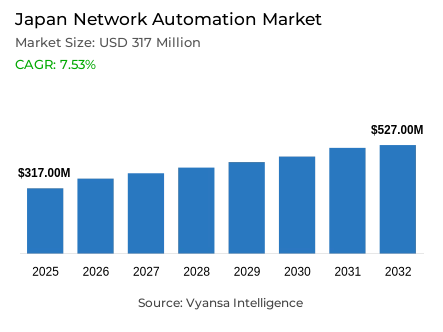
- The Japan network automation industry stood at USD 317 million in 2025 and reached USD 339 million in 2026, with its value projected to reach USD 527 million by 2032.
- The market is forecast to grow at a CAGR of 7.64% during 2026–2032.
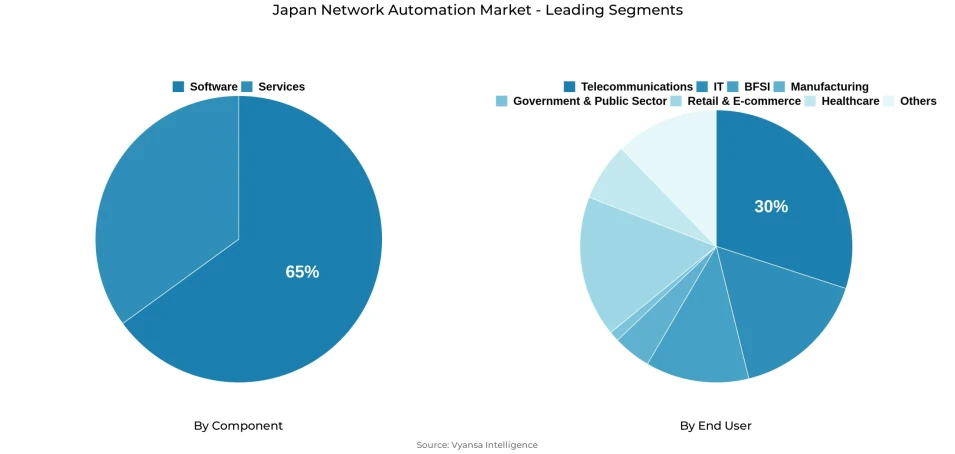
- By component, software led the market with a 65% share in 2026.
- However, services represent the fastest-growing component segment, with a projected CAGR of 8.3% during 2026–2032.
- By end user, telecommunications dominated the market with a 30% share in 2026.
- Meanwhile, the information technology segment is expected to register the fastest growth, expanding at a CAGR of 24.66% during 2026–2032.
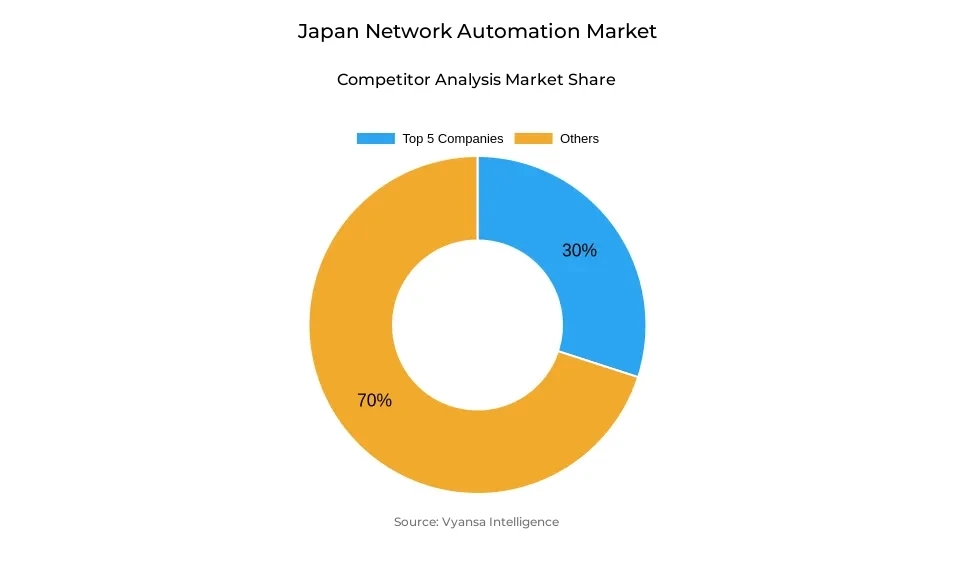
- The top five companies collectively held approximately 30% of the market, indicating a moderately fragmented competitive structure.
The Japan network automation market is being supported by expanding cloud use, distributed operations, and growing dependence on reliable digital connections. Enterprises increasingly manage applications and data across offices, data centers, cloud platforms, factories, and remote locations. This is raising demand for automated configuration, monitoring, traffic management, and policy control that improve visibility, consistency, and daily network performance.
Demand is also increasing across manufacturing, telecommunications, financial services, healthcare, retail, and education. According to the International Federation of Robotics (IFR), Japan installed 44,453 industrial robots in 2024, while its operational stock reached 450,530 units. This large and growing installed base of industrial robots highlights Japan’s high level of automation and machine connectivity, especially in manufacturing environments. As these robots rely on continuous data exchange, real-time monitoring, and coordinated control systems, it significantly increases the need for stable networks, faster fault detection, secure access, and centralized management across factories and business facilities throughout the country.
During 2026–2032, the Japan network automation market is expected to expand steadily as organizations focus on reliable services, faster network changes, lower operating costs, and stronger control over complex infrastructure. Suppliers offering scalable platforms, simple integration, dependable technical support, and managed services will be better positioned to capture demand and build long-term relationships with enterprises and telecom operators across Japan.
Government Regulations Shaping the Japan Network Automation Market
Japan’s Critical Infrastructure Unified Cybersecurity Standards, approved on July 31, 2026 and effective from October 1, 2026, establish common cybersecurity requirements for 15 critical infrastructure sectors. The framework directs responsible ministries to strengthen sector-specific rules covering asset identification, risk assessment, access control, continuous monitoring, incident response, recovery, and supply-chain security. During 2026–2032, the regulation will support the Japan network automation market by increasing demand for automated asset discovery, configuration management, network monitoring, threat detection, compliance reporting, and recovery tools. Vendors offering secure platforms, integration services, and recurring managed support will benefit from continuing compliance requirements across these essential service networks.
Japan Network Automation Market Driver
Expanding Cloud Adoption Increasing Demand for Automated Network Management
Growth in the Japan network automation market is being supported by wider cloud adoption among Japanese enterprises. Businesses increasingly operate applications, databases, collaboration tools, and storage across public clouds, private clouds, and internal systems. This creates more connections, routing changes, bandwidth requirements, and application dependencies, making manual network management slower, less efficient, and more exposed to configuration errors during expansion.
According to the Ministry of Internal Affairs and Communications (MIC), 83.5% of Japanese enterprises used cloud services across their organizations or selected departments in 2025. This adoption rate shows that cloud-based operations have become a standard business requirement, increasing demand for automated configuration, performance monitoring, traffic management, and reliable connectivity across distributed enterprise environments and business locations nationwide in Japan.
During 2026–2032, continued cloud migration will support demand for automated configuration, traffic routing, capacity allocation, application monitoring, and fault detection. Enterprises will adopt network automation to reduce manual work, improve service reliability, and support faster application deployment. Vendors offering cloud orchestration, performance-management platforms, and managed automation services will benefit from expanding demand across Japan’s digital business environment throughout the period.
Japan Network Automation Market Challenge
Legacy Infrastructure and Digital-Skills Shortages Slowing Automation Deployment
Adoption in the Japan network automation market is being limited by the continued use of older network and information-technology systems. Many legacy systems lack standard software interfaces, updated network records, and central management functions. Companies must assess existing infrastructure, replace incompatible equipment, standardize configurations, and test automated changes carefully before deploying automation across wider business operations and network environments nationally.
According to the Information-technology Promotion Agency, Japan (IPA), 85.1% of Japanese companies reported shortages of personnel required to support digital transformation. Although this figure covers the digital workforce, it indicates limited availability of professionals who can manage system upgrades, integrate older and newer networks, and implement complex automation projects without creating operational disruption, delays, or additional consulting requirements across Japan.
During 2026–2032, legacy-system complexity and workforce shortages may extend implementation timelines and increase migration, consulting, training, and testing costs. Companies are therefore expected to introduce automation gradually instead of replacing complete networks. Vendors providing infrastructure assessments, configuration audits, migration support, employee training, and managed network services will be better positioned to address these barriers and secure long-term contracts over time.
Japan Network Automation Market Trend
Convergence of Network Access and Cybersecurity Policy Management
The Japan network automation market is witnessing closer integration between network management and cybersecurity administration. Organizations increasingly manage connectivity, user identity, device access, application permissions, and security rules through unified platforms. This approach allows businesses to apply consistent access controls across offices, data centers, cloud services, remote employees, and connected devices while reducing separate manual processes and policy-management complexity nationally.
According to the National Institute of Information and Communications Technology (NICT), approximately 701 billion cyberattack-related packets were observed through its NICTER network in 2025, increasing about 2.2% from 2024. The institute also recorded 900,000 distributed reflection denial-of-service attacks targeting Japan, compared with around 170,000 in 2024, highlighting rising pressure on network and security operations teams and increasing operational security requirements.
During 2026–2032, rising security requirements will increase demand for platforms combining network configuration, identity-based access, policy enforcement, traffic control, and security monitoring. Organizations will adopt zero-trust network access, secure access service edge, automated segmentation, and centralized policy management. These solutions will help apply consistent security rules across distributed networks while reducing manual administration and response times in Japan over time.
AI-Based Predictive Assurance and Automated Network Restoration
Technology development in the Japan network automation market is moving from fixed scripts and basic alerts toward systems that can predict faults and support automatic recovery. Artificial intelligence can analyze traffic, equipment performance, and network behavior to identify early warning signs. Digital network models can also test routing changes and recovery actions before operators apply them to live infrastructure environments.
According to the National Institute of Information and Communications Technology (NICT), evaluations found that cooperation between network operators could increase communication services restored immediately after disruption by 78%. Cooperation between cloud and network operators could increase immediately restored cloud services by 97%. These findings reflect research and proof-of-concept evaluations rather than completed nationwide commercial deployment across Japan’s network infrastructure currently.
During 2026–2032, predictive fault analysis, automated path switching, digital-network testing, and controlled recovery will help reduce downtime and manual intervention. Telecom operators, cloud providers, and large enterprises will create demand for systems offering accurate analysis, human approval for high-risk changes, clear operational decisions, and reliable rollback functions. These capabilities will strengthen service continuity across Japan’s increasingly digital economy over time.
Japan Network Automation Market Opportunity
Energy-Aware Automation for Telecom and Data-Centre Networks
The Japan network automation market presents a growing opportunity in managing electricity use across telecom and data center networks. Routers, switches, optical systems, servers, and cooling equipment operate continuously, including during periods when installed capacity remains underused. Automated control can adjust network resources according to traffic and workload requirements, helping operators reduce unnecessary power consumption without affecting service performance over time.
According to the Agency for Natural Resources and Energy (ANRE), under the Ministry of Economy, Trade and Industry (METI), Japan’s electricity demand could reach approximately 0.9 trillion to 1.1 trillion kilowatt-hours in fiscal 2040. The government expects demand to increase partly because of new data centers, semiconductor plants, and other digital infrastructure requiring electricity supply and energy management over time.
During 2026–2032, this development will create demand for energy-aware routing, automatic capacity consolidation, scheduled equipment activation, low-power operating modes, and workload-placement software. Network automation providers can generate revenue through optimization platforms, equipment-control systems, consulting, and recurring managed services. Suppliers that reduce power costs without lowering network performance will gain stronger commercial opportunities across Japan’s expanding digital infrastructure market over time.
Unlock Market Intelligence
Explore the market potential with our data-driven report
Japan Network Automation Market Segmentation Analysis
By Component
- Software
- Services
- Professional Services
- Consulting & Advisory
- Deployment & Integration
- Training, Support & Maintenance
- Managed Services
- Professional Services
Software Lead on Implementation, Services Accelerate on Innovation
The Software segment accounted for the largest share of the Japan network automation market, capturing approximately 65% in 2026. Its leadership is driven by the growing adoption of software-defined networking (SDN), AI-powered network management, and centralized orchestration platforms that automate network provisioning, monitoring, and security. According to the U.S. Commercial Service, citing Japan's Ministry of Economy, Trade and Industry (METI), failure to modernize legacy IT systems could result in economic losses of up to USD 120 billion by 2025, prompting enterprises to accelerate digital transformation and network automation initiatives. As organizations modernize their IT infrastructure, demand for intelligent network automation software continues to rise across telecommunications, manufacturing, BFSI, and government sectors.
The Services segment is projected to register the fastest growth in the Japan network automation market, expanding at a CAGR of approximately 8.3% during 2026–2032. Growth is fueled by rising demand for consulting, deployment, integration, managed services, and continuous network optimization as organizations modernize increasingly complex hybrid and multi-cloud environments. According to JETRO (Japan External Trade Organization), Japan's government is actively partnering with private enterprises to accelerate nationwide digitalization, creating significant opportunities for IT implementation and managed service providers supporting enterprise transformation. While Software continues to dominate due to its widespread deployment and scalability, Services are growing faster as organizations increasingly rely on specialist expertise to design, integrate, secure, and manage automated network infrastructures throughout their lifecycle.
By End User
- Telecommunications
- IT
- BFSI
- Manufacturing
- Government & Public Sector
- Retail & E-commerce
- Healthcare
- Others
Telecommunications Lead on Network Scale, IT & Cloud Providers Accelerate on Digitalization
Telecommunications held the largest share of the Japan network automation market, accounting for 30% in 2026. Telecom operators continue investing heavily in network automation to support nationwide 5G deployment, optimize network performance, automate provisioning, improve fault management, and reduce operational costs. According to the US Commercial Service, Japan's four mobile network operators are investing more than USD 14 billion in capital expenditure to expand their 5G networks, including investments in base stations, fiber-optic infrastructure, and servers. This large-scale network expansion is increasing the need for AI-driven network orchestration, software-defined networking (SDN), and automated network operations to efficiently manage increasingly complex telecom infrastructure.
IT sector is projected to record the fastest growth, registering an 24.66% CAGR during 2026–2032. Rising enterprise cloud migration, hybrid IT adoption, and demand for managed networking services are accelerating investments in automation platforms, centralized orchestration, and AI-based monitoring. Compared with telecommunications, which primarily focuses on managing carrier-grade mobile infrastructure, this segment benefits from the rapid expansion of multi-cloud environments, data centers, and enterprise digital transformation initiatives, enabling faster adoption of intelligent network automation solutions while telecommunications continue to maintain the largest overall market share.
Unlock Market Intelligence
Explore the market potential with our data-driven report
Japan Network Automation Market Competitive Landscape
Japan network automation market ismoderately fragmented, with the top five companies holding around 30% market share in 2026. Leading players include NEC Corporation, Fujitsu Limited, NTT DATA Group Corporation, Cisco Systems Inc., and Nokia Corporation, competing through automation, AI-driven networking, cloud capabilities, and enterprise solutions.
Key Companies in Japan Network Automation Market
- NEC Corporation
- Fujitsu Limited
- NTT DATA Group Corporation
- Cisco Systems Inc.
- Juniper Networks Inc. (A Hewlett Packard Enterprise Company)
- Nokia Corporation
- Telefonaktiebolaget LM Ericsson
- VMware LLC (Broadcom Inc.)
- IBM Corporation
- Huawei Technologies Co. Ltd.
- Hitachi Ltd. (Network & Digital Infrastructure Solutions)
- HPE Aruba Networking (Hewlett Packard Enterprise)
Recent Developments in Japan Network Automation Market
- In March 2026, NEC and NTT DOCOMO launched Japan’s first commercial 5G core network on AWS. The deployment uses AI-based technology to automate core-network construction, reducing the time from network design to initial service launch from several weeks to a few hours. The update expands cloud-based network automation within Japan’s telecommunications sector.
- In March 2026, Ericsson signed a multi-year agreement to expand and modernize SoftBank’s core network in Japan. The deployment includes cloud-native 5G Core, Cloud IMS, orchestration, and automation technologies for real-time resource optimization and simplified network operations. The update supports more autonomous and efficient management of SoftBank’s nationwide 4G and 5G infrastructure.
Frequently Asked Questions
Related Report
- Market Segmentation
- Research Scope
- Research Methodology
- Definitions and Assumptions
- Executive Summary
- Japan Network Automation Market Policies, Regulations, and Standards
- Japan IT Spending 2022-2032
- By Country
- By Module
- Japan Network Automation Market Dynamics
- Growth Factors
- Challenges
- Trends
- Opportunities
- Japan Network Automation Market Statistics, 2022-2032F
- Market Size & Growth Outlook
- By Revenues in USD Million
- Market Segmentation & Growth Outlook
- By Component
- Software- Market Insights and Forecast 2022-2032, USD Million
- Services- Market Insights and Forecast 2022-2032, USD Million
- Professional Services- Market Insights and Forecast 2022-2032, USD Million
- Consulting & Advisory- Market Insights and Forecast 2022-2032, USD Million
- Deployment & Integration- Market Insights and Forecast 2022-2032, USD Million
- Training, Support & Maintenance- Market Insights and Forecast 2022-2032, USD Million
- Managed Services- Market Insights and Forecast 2022-2032, USD Million
- Professional Services- Market Insights and Forecast 2022-2032, USD Million
- By Deployment Mode
- On-Premises- Market Insights and Forecast 2022-2032, USD Million
- Cloud-Based- Market Insights and Forecast 2022-2032, USD Million
- By Network Environment
- Data Center Networks- Market Insights and Forecast 2022-2032, USD Million
- Campus & Branch Networks- Market Insights and Forecast 2022-2032, USD Million
- WAN & SD-WAN- Market Insights and Forecast 2022-2032, USD Million
- Service Provider Networks- Market Insights and Forecast 2022-2032, USD Million
- Cloud & Multi-Cloud Networks- Market Insights and Forecast 2022-2032, USD Million
- Others- Market Insights and Forecast 2022-2032, USD Million
- By End User
- Telecommunications- Market Insights and Forecast 2022-2032, USD Million
- IT - Market Insights and Forecast 2022-2032, USD Million
- BFSI- Market Insights and Forecast 2022-2032, USD Million
- Manufacturing- Market Insights and Forecast 2022-2032, USD Million
- Government & Public Sector- Market Insights and Forecast 2022-2032, USD Million
- Retail & E-commerce- Market Insights and Forecast 2022-2032, USD Million
- Healthcare- Market Insights and Forecast 2022-2032, USD Million
- Others- Market Insights and Forecast 2022-2032, USD Million
- By Competitors
- Competition Characteristics
- Market Share & Analysis
- By Component
- Market Size & Growth Outlook
- Japan Network Automation Software Market Statistics, 2022-2032
- Market Size & Growth Outlook
- By Revenues in USD Million
- Market Segmentation & Growth Outlook
- By Deployment Mode- Market Insights and Forecast 2022-2032, USD Million
- By Network Environment- Market Insights and Forecast 2022-2032, USD Million
- By End User- Market Insights and Forecast 2022-2032, USD Million
- Market Size & Growth Outlook
- Japan Network Automation Services Market Statistics, 2022-2032
- Market Size & Growth Outlook
- By Revenues in USD Million
- Market Segmentation & Growth Outlook
- By Deployment Mode- Market Insights and Forecast 2022-2032, USD Million
- By Network Environment- Market Insights and Forecast 2022-2032, USD Million
- By End User- Market Insights and Forecast 2022-2032, USD Million
- Market Size & Growth Outlook
- Competitive Outlook
- Company Profiles
- NEC Corporation
- Business Description
- Service Portfolio
- Collaborations & Alliances
- Recent Developments
- Financial Details
- Others
- Fujitsu Limited
- Business Description
- Service Portfolio
- Collaborations & Alliances
- Recent Developments
- Financial Details
- Others
- NTT DATA Group Corporation
- Business Description
- Service Portfolio
- Collaborations & Alliances
- Recent Developments
- Financial Details
- Others
- Cisco Systems Inc.
- Business Description
- Service Portfolio
- Collaborations & Alliances
- Recent Developments
- Financial Details
- Others
- Juniper Networks Inc. (Hewlett Packard Enterprise Company)
- Business Description
- Service Portfolio
- Collaborations & Alliances
- Recent Developments
- Financial Details
- Others
- Nokia Corporation
- Business Description
- Service Portfolio
- Collaborations & Alliances
- Recent Developments
- Financial Details
- Others
- Telefonaktiebolaget LM Ericsson
- Business Description
- Service Portfolio
- Collaborations & Alliances
- Recent Developments
- Financial Details
- Others
- VMware LLC (Broadcom Inc.)
- Business Description
- Service Portfolio
- Collaborations & Alliances
- Recent Developments
- Financial Details
- Others
- IBM Corporation
- Business Description
- Service Portfolio
- Collaborations & Alliances
- Recent Developments
- Financial Details
- Others
- Huawei Technologies Co. Ltd.
- Business Description
- Service Portfolio
- Collaborations & Alliances
- Recent Developments
- Financial Details
- Others
- NEC Corporation
- Company Profiles
- Disclaimer
| Segment | Sub-Segment |
|---|---|
| By Component |
|
| By Deployment Mode |
|
| By Network Environment |
|
| By End User |
|
Research Methodology
This study followed a structured approach comprising four key phases to assess the size and scope of the electro-oxidation market. The process began with thorough secondary research to collect data on the target market, related markets, and broader industry context. These findings, along with preliminary assumptions and estimates, were then validated through extensive primary research involving industry experts from across the value chain. To calculate the overall market size, both top-down and bottom-up methodologies were employed. Finally, market segmentation and data triangulation techniques were applied to refine and validate segment-level estimations.
Secondary Research
The secondary research phase involved gathering data from a wide range of credible and published sources. This step helped in identifying industry trends, defining market segmentation, and understanding the market landscape and value chain.
Sources consulted during this phase included:
- Company annual reports, investor presentations, and press releases
- Industry white papers and certified publications
- Trade directories and market-recognized databases
- Articles from authoritative authors and reputable journals
- Gold and silver standard websites
Secondary research was critical in mapping out the industry's value chain and monetary flow, identifying key market segments, understanding regional variations, and tracking significant industry developments.
Other key sources:
- Financial disclosures
- Industry associations and trade bodies
- News outlets and business magazines
- Academic journals and research studies
- Paid industry databases
Primary Research
To validate secondary data and gain deeper market insights, primary research was conducted with key stakeholders across both the supply and demand sides of the market.
On the demand side, participants included decision-makers and influencers from end-user industries—such as CIOs, CTOs, and CSOs—who provided first-hand perspectives on market needs, product usage, and future expectations.
On the supply side, interviews were conducted with manufacturers, industry associations, and institutional participants to gather insights into current offerings, product pipelines, and market challenges.
Primary interviews provided critical inputs such as:
- Market size and revenue data
- Product and service breakdowns
- Market forecasts
- Regional and application-specific trends
Stakeholders consulted included:
- Leading OEM and solution providers
- Channel and distribution partners
- End users across various applications
- Independent consultants and industry specialists
Market Size Estimation and Data Triangulation
- Identifying Key Market Participants (Secondary Research)
- Goal: To identify the major players or companies in the target market. This typically involves using publicly available data sources such as industry reports, market research publications, and financial statements of companies.
- Tools: Reports from firms like Gartner, Forrester, Euromonitor, Statista, IBISWorld, and others. Public financial statements, news articles, and press releases from top market players.
- Extracting Earnings of Key Market Participants
- Goal: To estimate the earnings generated from the product or service being analyzed. This step helps in understanding the revenue potential of each market player in a specific geography.
- Methods: Earnings data can be gathered from:
- Publicly available financial reports (for listed companies).
- Interviews and primary data sources from professionals, such as Directors, VPs, SVPs, etc. This is especially useful for understanding more nuanced, internal data that isn't publicly disclosed.
- Annual reports and investor presentations of key players.
- Data Collation and Development of a Relevant Data Model
- Goal: To collate inputs from both primary and secondary sources into a structured, data-driven model for market estimation. This model will incorporate key market KPIs and any independent variables relevant to the market.
- Key KPIs: These could include:
- Market size, growth rate, and demand drivers.
- Industry-specific metrics like market share, average revenue per customer (ARPC), or average deal size.
- External variables, such as economic growth rates, inflation rates, or commodity prices, that could affect the market.
- Data Modeling: Based on this data, the market forecasts are developed for the next 5 years. A combination of trend analysis, scenario modeling, and statistical regression might be used to generate projections.
- Scenario Analysis
- Goal: To test different assumptions and validate how sensitive the market is to changes in key variables (e.g., market demand, regulatory changes, technological disruptions).
- Types of Scenarios:
- Base Case: Based on current assumptions and historical data.
- Best-Case Scenario: Assuming favorable market conditions, regulatory environments, and technological advancements.
- Worst-Case Scenario: Accounting for adverse factors, such as economic downturns, stricter regulations, or unexpected disruptions.












