Global Agentic AI Systems Market Report: Trends, Growth and Forecast (2026-2032)
By Segmentation (By Component, Software, Computational Agents, Robotic Agents, Services, Deployment & Integration, Consulting, Support & Maintenance, Others), By Deployment Mode (Cloud-Based, On-Premises), By Technology (Machine Learning, Natural Language Processing, Computer Vision, Embodied AI, Generative AI, Others), By Application (Workflow Automation & Orchestration, Planning & Decision Support, Navigation & Mobility, Inspection & Monitoring, Simulation & Virtual Autonomy Training, Others), By End User (Technology Companies, BFSI, Retail & E-Commerce, IT & Telecom, Healthcare, Government & Defense, Research Institutions, Manufacturing, Media & Entertainment, Others), By Region (North America, South America, Europe, Middle East & Africa, Asia-Pacific) ... Read more
|
Major Players
|
Global Agentic AI Systems Market Statistics and Insights, 2026
- Market Size Statistics
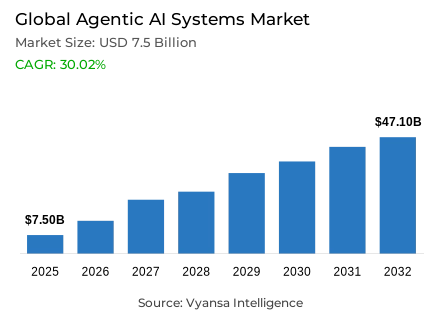
- Agentic ai systems market market size in Global was valued at USD 7.5 billion in 2025 and is estimated at USD 9.8 billion in 2026.
- The market size is expected to grow to USD 47.1 billion by 2032.
- Market to register a CAGR of around 30.02% during 2026-32.
- Component Shares
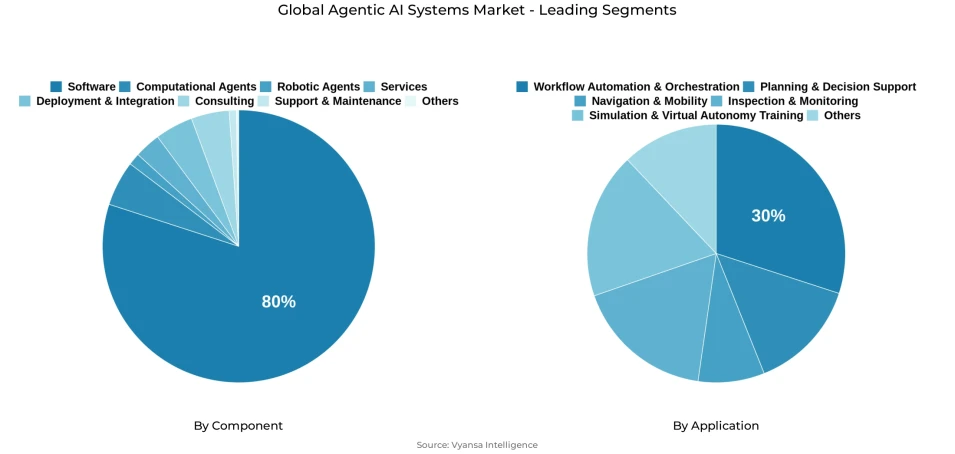
- Software grabbed market share of 80%.
- Competition
- More than 20 companies are actively engaged in producing agentic ai systems market.
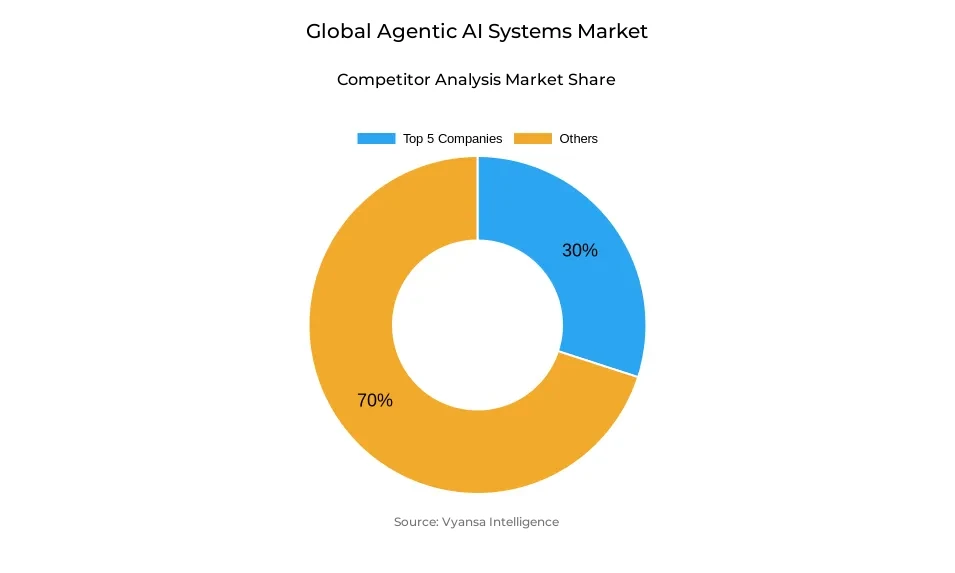
- Top 5 companies acquired around 30% of the market share.
- Salesforce, Microsoft, Oracle, OpenAI, Alphabet (Google) etc., are few of the top companies.
- Application
- Workflow automation & orchestration grabbed 30% of the market.
- Region
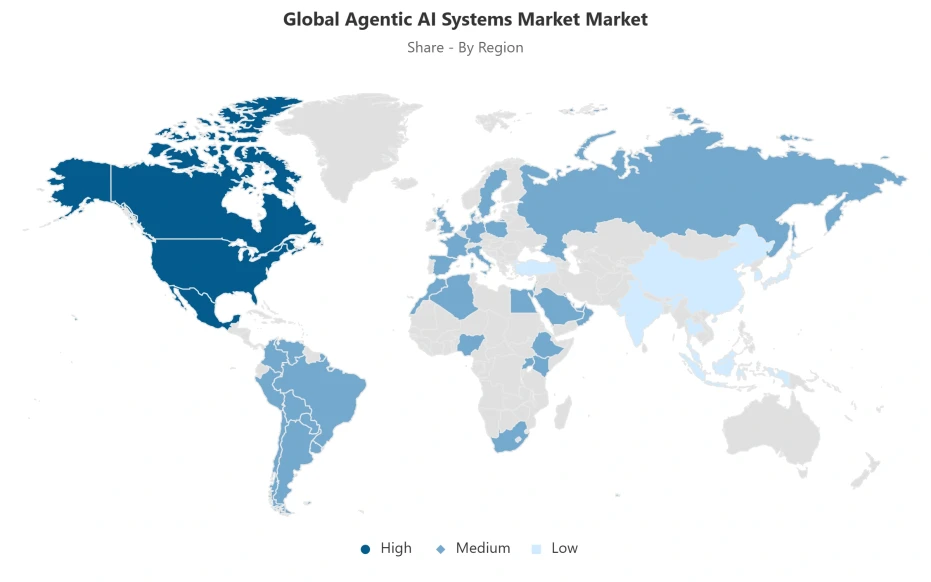
- North America leads with a 40% share of the global market.
Global Agentic AI Systems Market Outlook
The Global Agentic AI Systems Market was valued at USD 7.5 billion in 2025 and is projected to advance from USD 9.8 billion in 2026 to USD 47.1 billion by 2032, registering a CAGR of 30.02% across the forecast period. This exceptional expansion reflects a structural transition within the Autonomous AI Systems Market from passive generative tools toward active execution layers that plan tasks, retrieve data, call APIs, trigger multi-step workflows, monitor outcomes, and escalate exceptions across IT service management, customer operations, finance, procurement, software development, and enterprise knowledge systems. The market is being redefined not by what AI can generate but by what autonomous AI agents can independently accomplish within real business environments.
Software commands the largest component share at 80%, confirming that value creation within the Global Agentic AI Market is concentrated in the orchestration, governance, and integration layer rather than in underlying compute infrastructure. Agent builders, task planners, model routers, memory frameworks, workflow connectors, monitoring dashboards, permission controls, and audit modules collectively define whether autonomous systems can operate safely and productively within enterprise environments. This software-intensive structure distinguishes agentic AI from broader AI infrastructure categories where hardware and cloud capacity typically dominate commercial spending.
Workflow Automation and Orchestration leads the application segment with a 30% share, reflecting enterprise prioritisation of AI deployment in operational contexts where productivity impact is immediate and measurable. Ticket routing, invoice review, CRM updates, claims triage, compliance documentation, code review, and incident management all involve three to eight connected steps across multiple systems, creating precisely the multi-tool, multi-system execution challenge that AI agent orchestration is architecturally designed to address.
North America holds a 40% share of the global market, supported by capital depth, cloud infrastructure maturity, advanced model availability, and enterprise software readiness. As per data published by Stanford HAI, the cost of querying a model at GPT-3.5-level performance declined from USD 20 per million tokens in November 2022 to USD 0.07 per million tokens by October 2024, a more than 280-fold reduction that makes repeated multi-step agent execution commercially viable at scale. OECD data further confirms that 20.2% of firms reported using AI in 2025, up from 8.7% in 2023, creating the digital enterprise base from which autonomous enterprise operations can now be systematically scaled.
Global Agentic AI Systems Market Growth Driver
Enterprise Productivity Demand and Falling Inference Costs Are Creating a Self-Reinforcing Adoption Cycle
The primary demand driver within the Agentic AI Systems Market is the enterprise imperative to reduce manual coordination across high-volume, rule-informed, time-sensitive workflows where agentic execution delivers measurable labour-time reduction and process speed improvement. As per data published by the OECD, AI adoption among firms reached 20.2% in 2025, rising from 14.2% in 2024 and 8.7% in 2023, confirming that the digital enterprise base capable of deploying autonomous workflow agents has more than doubled within two years. In customer support, finance, IT operations, and sales, agents are already classifying tickets, comparing invoices, generating follow-up communications, and preparing audit documentation across connected enterprise systems with quantifiable efficiency gains.
Cost improvements are making this adoption commercially self-sustaining at scale. According to statistics released by Stanford HAI, AI hardware costs declined by 30% annually while energy efficiency improved by 40% per year, both trends directly reducing the per-task economics of multi-step agentic workflows that may require five or more model calls to complete. IMF research additionally confirms that approximately 40% of global employment is exposed to AI, rising to around 60% in advanced economies, establishing the workforce exposure and administrative automation opportunity that sustains long-term AI-driven process automation demand across the most commercially active enterprise markets.
Global Agentic AI Systems Market Challenge
Governance Complexity and Autonomous Risk Exposure Are Structurally Slowing Enterprise Deployment
The most consequential structural challenge within the Global Agentic AI Market is the difficulty of maintaining reliable control over autonomous systems that retrieve data, update records, trigger payments, and influence operational outcomes across connected enterprise applications. Based on data from the National Institute of Standards and Technology, the 2024 Generative AI Profile identified governance, content provenance, pre-deployment testing, and incident disclosure as the four primary risk management requirements for autonomous AI deployment, each adding a distinct control layer that must be implemented before agentic systems can be trusted in production environments handling contracts, medical records, compliance files, or financial documents.
The challenge intensifies significantly in regulated sectors including banking, insurance, healthcare, and public services, where a single agent error propagating across connected CRM, ERP, and legal systems creates multi-system operational exposure that exceeds the risk profile of conventional software failures. As indicated by authoritative sources at the NIST, a 2026 concept note for a trustworthy AI profile focused on critical infrastructure confirms that AI governance for autonomous systems requirements are expanding into energy, transport, telecommunications, and healthcare, raising procurement complexity, extending sales cycles, and making enterprise buyers progressively more selective about vendors that cannot demonstrate verifiable control, traceability, and safety boundaries within their agentic platform architectures.
Unlock Market Intelligence
Explore the market potential with our data-driven report
Global Agentic AI Systems Market Trend
Collapsing Inference Costs and Advancing AI Performance Are Accelerating the Shift Toward Execution-Layer Platforms
The most commercially transformative structural trend shaping the Agentic AI Systems Market is the sustained and dramatic reduction in AI inference costs, which is progressively making multi-step autonomous workflow execution economically viable across departments that previously could not justify repeated model calls at scale. Evidence drawn from public data released by Stanford HAI confirms that GPT-3.5-level inference cost declined more than 280-fold between November 2022 and October 2024, while AI system performance on SWE-bench advanced from solving 4.4% of coding problems in 2023 to 71.7% in 2024, confirming that both the economics and the capabilities of autonomous workflow agents have simultaneously reached commercially deployable thresholds.
These converging improvements are reshaping the product architecture of the market in observable ways. Vendors are systematically building agent studios, workflow automation layers, AI agent APIs, model routers, task planners, semantic memory systems, and observability dashboards that allow autonomous systems to coordinate work across SaaS applications rather than remaining confined within a single interface. The product shift is clear and commercially consequential: agentic AI platforms are transitioning from productivity add-ons into operating layers for knowledge-intensive business processes, a repositioning that both expands the addressable market and deepens the strategic value of platform relationships with enterprise buyers throughout the forecast period.
Global Agentic AI Systems Market Opportunity
Secure Private Deployment and Small-Model Routing Are Opening High-Value Expansion Windows
The highest-yield commercial opportunity within the AI Agent Systems Market lies in deployment models that make autonomous AI systems secure, cost-efficient, and operationally adaptable across enterprise environments with varying infrastructure maturity and data governance requirements. As per official figures from the World Bank's 2025 Digital Progress and Trends Report, the rising importance of affordable small AI solutions is particularly relevant for organisations that cannot or choose not to rely exclusively on expensive frontier models, creating strong demand for agentic platforms with intelligent model routing that directs simple tasks including ticket classification, invoice matching, and CRM updates to smaller efficient models while escalating complex legal review, risk analysis, and multi-document reasoning to larger systems.
Private deployment represents a separately significant and commercially durable opportunity layer for vendors serving regulated enterprise buyers. Data compiled from internationally recognised public authorities at UNCTAD confirms that the United States holds approximately one-third of the top 500 supercomputers and more than half of overall global computational performance, confirming the infrastructure concentration that motivates enterprises in banking, healthcare, insurance, legal services, and government to demand on-premise AI systems, virtual private cloud, and encrypted permission-controlled deployments rather than shared public cloud environments. Vendors combining small-model routing, private deployment architecture, AI agent governance controls, and workflow orchestration are positioned to address both the cost-efficiency priorities of digitally mature enterprises and the sovereignty requirements of regulated industries across advanced and emerging markets.
Global Agentic AI Systems Market Regional Analysis
By Region
- North America
- South America
- Europe
- Middle East & Africa
- Asia-Pacific
North America commands the most influential position within the Global Agentic AI Systems Market with a 40% share, supported by a structural convergence of enterprise software maturity, hyperscale cloud infrastructure, advanced model availability, and the deepest concentration of AI investment capital in the world. As per data published by Stanford HAI, US private AI investment reached USD 109.1 billion in 2024, nearly 12 times China's USD 9.3 billion, while US-based institutions produced 40 notable AI models in 2024 compared with China's 15 and Europe's 3, confirming the innovation depth that gives North American platform vendors a structurally faster commercialisation pathway. IMF research further establishes that approximately 60% of jobs in advanced economies are exposed to AI, creating the workforce automation opportunity and enterprise readiness that sustains North America agentic AI market demand across banking, healthcare, insurance, retail, government, and technology services.
Infrastructure and trade dynamics are reinforcing the region's structural advantages with physical and supply-chain depth that compounds its software and capital strengths. Evidence drawn from public data released by UNCTAD confirms that the United States holds approximately one-third of the top 500 supercomputers and more than half of overall global computational performance, while the International Energy Agency reports that data-centre electricity demand rose 17% in 2025, with AI-focused facilities growing even faster against global electricity demand growth of 3%. The World Trade Organization's March 2026 Global Trade Outlook confirms that world merchandise trade volume grew 4.6% in 2025, partially driven by surging demand for AI-related goods linked to the global investment boom in AI agent infrastructure. Together these indicators confirm that North America's 40% share is sustained by the infrastructure capacity, capital availability, enterprise readiness, and AI supply-chain momentum required to deploy autonomous AI systems at commercial scale across complex enterprise environments.
Unlock Market Intelligence
Explore the market potential with our data-driven report
Global Agentic AI Systems Market Segmentation Analysis
By Component
- Software
- Computational Agents
- Robotic Agents
- Services
- Deployment & Integration
- Consulting
- Support & Maintenance
- Others
Software holds the highest share within the component category at approximately 80%, reflecting the institutional recognition within the Global Agentic AI Market that commercial value in autonomous AI deployment resides overwhelmingly in the orchestration, governance, and integration layer rather than in underlying compute capacity. Agent builders, task planners, retrieval systems, policy engines, role-based access controls, monitoring dashboards, and audit logs collectively determine whether autonomous systems can operate safely and scalably across real business processes involving CRM, ERP, ITSM, HRIS, document platforms, and code repositories. As inference costs decline and model access commoditises, the central competitive question for enterprise buyers shifts from affordability of model calls to reliability of workflow control, a dynamic that structurally advantages software-layer platform vendors.
The segment's dominance is further reinforced by the recurring revenue characteristics of enterprise software relationships within the Agentic AI Systems Market, where continuous model updates, connector additions, security patches, compliance modules, and usage analytics create deepening commercial dependency as enterprises add workflows over time. OECD data confirms that 20.2% of firms used AI in 2025 compared with 8.7% in 2023, and as this adoption base expands, the demand for centralised software platforms that prevent fragmented agent deployment, eliminate governance gaps, and maintain cost visibility across multi-department programmes is expected to sustain the segment's commanding commercial position throughout the forecast period.
By Application
- Workflow Automation & Orchestration
- Planning & Decision Support
- Navigation & Mobility
- Inspection & Monitoring
- Simulation & Virtual Autonomy Training
- Others
Workflow Automation and Orchestration commands the highest share within the application category at approximately 30%, establishing multi-step process execution as the most commercially compelling and immediately measurable use case within the Global Agentic AI Systems Market. Enterprises consistently prioritise this application because recurring operational workflows including service tickets, invoice review, compliance documentation, incident management, and sales operations involve contextual interpretation, system retrieval, structured decision-making, and coordinated action across multiple enterprise platforms, precisely the combination of capabilities that AI workflow automation architectures are designed to deliver beyond what conventional robotic process automation can provide. Its leadership reflects practical buyer behaviour driven by visible returns rather than speculative adoption.
Technical performance improvements are expanding the application's addressable scope within the Agentic AI Systems Market in commercially meaningful ways. Evidence from Stanford HAI confirming that SWE-bench performance advanced from 4.4% to 71.7% between 2023 and 2024 indicates that autonomous systems are increasingly capable of handling the coding, API integration, structured reasoning, and system-level tasks that underpin IT operations, software development, data workflow management, and enterprise support automation. Combined with OECD sector data showing 44% average AI adoption in information and communication services in 2024, this segment is expected to maintain its application leadership as enterprises in banking, healthcare, telecom, retail, legal services, and technology progressively expand their agentic deployment programmes throughout the forecast period.
Market Players in Global Agentic AI Systems Market
These market players maintain a significant presence in the Global agentic ai systems market market sector and contribute to its ongoing evolution.
- Salesforce
- Microsoft
- Oracle
- OpenAI
- Alphabet (Google)
- AWS
- IBM
- Nvidia
- The AnyLogic Company
- Ampcome Technologies Private Limited
- UiPath Inc.
- Epicor Software Corporation
- Coupa Software Inc.
- Zycus Inc.
- ServiceNow, Inc.
Market News & Updates
- OpenAI, 2026:
OpenAI updated its Agents SDK with new infrastructure for agent loops and native sandbox execution. The SDK helps developers build agents that inspect files, run commands, edit code, and complete long-horizon tasks inside controlled sandbox environments. The update supports more structured agent development using OpenAI models and tools
- Salesforce, 2026:
Salesforce introduced Agentforce Operations for back-office agentic execution. The solution uses specialized AI agents to coordinate processes, verify data, manage compliance steps, and operate across business systems such as email and ERP. Agentforce Operations was generally available at launch, with ecosystem integration features expected in beta in May 2026
Frequently Asked Questions
Related Report
- Market Segmentation
- Research Scope
- Research Methodology
- Definitions and Assumptions
- Executive Summary
- Global Agentic AI Systems Market Policies, Regulations, and Standards
- Global Agentic AI Systems Market Dynamics
- Growth Factors
- Challenges
- Trends
- Opportunities
- Global Agentic AI Systems Market Statistics, 2022-2032F
- Market Size & Growth Outlook
- By Revenues in USD Million
- Market Segmentation & Growth Outlook
- Market Segmentation
- By Component- Market Insights and Forecast 2022-2032, USD Million
- Software- Market Insights and Forecast 2022-2032, USD Million
- Computational Agents- Market Insights and Forecast 2022-2032, USD Million
- Robotic Agents- Market Insights and Forecast 2022-2032, USD Million
- Services- Market Insights and Forecast 2022-2032, USD Million
- Deployment & Integration- Market Insights and Forecast 2022-2032, USD Million
- Consulting- Market Insights and Forecast 2022-2032, USD Million
- Support & Maintenance- Market Insights and Forecast 2022-2032, USD Million
- Others- Market Insights and Forecast 2022-2032, USD Million
- By Deployment Mode
- Cloud-Based- Market Insights and Forecast 2022-2032, USD Million
- On-Premises- Market Insights and Forecast 2022-2032, USD Million
- By Technology
- Machine Learning- Market Insights and Forecast 2022-2032, USD Million
- Natural Language Processing- Market Insights and Forecast 2022-2032, USD Million
- Computer Vision- Market Insights and Forecast 2022-2032, USD Million
- Embodied AI- Market Insights and Forecast 2022-2032, USD Million
- Generative AI- Market Insights and Forecast 2022-2032, USD Million
- Others- Market Insights and Forecast 2022-2032, USD Million
- By Application
- Workflow Automation & Orchestration- Market Insights and Forecast 2022-2032, USD Million
- Planning & Decision Support- Market Insights and Forecast 2022-2032, USD Million
- Navigation & Mobility- Market Insights and Forecast 2022-2032, USD Million
- Inspection & Monitoring- Market Insights and Forecast 2022-2032, USD Million
- Simulation & Virtual Autonomy Training- Market Insights and Forecast 2022-2032, USD Million
- Others- Market Insights and Forecast 2022-2032, USD Million
- By End User
- Technology Companies- Market Insights and Forecast 2022-2032, USD Million
- BFSI- Market Insights and Forecast 2022-2032, USD Million
- Retail & E-Commerce- Market Insights and Forecast 2022-2032, USD Million
- IT & Telecom- Market Insights and Forecast 2022-2032, USD Million
- Healthcare- Market Insights and Forecast 2022-2032, USD Million
- Government & Defense- Market Insights and Forecast 2022-2032, USD Million
- Research Institutions- Market Insights and Forecast 2022-2032, USD Million
- Manufacturing- Market Insights and Forecast 2022-2032, USD Million
- Media & Entertainment- Market Insights and Forecast 2022-2032, USD Million
- Others- Market Insights and Forecast 2022-2032, USD Million
- By Region
- North America
- South America
- Europe
- Middle East & Africa
- Asia-Pacific
- By Competitors
- Competition Characteristics
- Market Share & Analysis
- Market Segmentation
- Market Size & Growth Outlook
- North America Agentic AI Systems Market Statistics, 2022-2032F
- Market Size & Growth Outlook
- By Revenues in USD Million
- Market Segmentation & Growth Outlook
- Market Segmentation- Market Insights and Forecast 2022-2032, USD Million
- By Deployment Mode- Market Insights and Forecast 2022-2032, USD Million
- By Technology- Market Insights and Forecast 2022-2032, USD Million
- By Application- Market Insights and Forecast 2022-2032, USD Million
- By End User- Market Insights and Forecast 2022-2032, USD Million
- By Country
- US
- Canada
- Mexico
- Rest of North America
- US Agentic AI Systems Market Statistics, 2022-2032F
- Market Size & Growth Outlook
- By Revenues in USD Million
- Market Segmentation & Growth Outlook
- Market Segmentation- Market Insights and Forecast 2022-2032, USD Million
- By Deployment Mode- Market Insights and Forecast 2022-2032, USD Million
- By Technology- Market Insights and Forecast 2022-2032, USD Million
- By Application- Market Insights and Forecast 2022-2032, USD Million
- By End User- Market Insights and Forecast 2022-2032, USD Million
- Market Size & Growth Outlook
- Canada Agentic AI Systems Market Statistics, 2022-2032F
- Market Size & Growth Outlook
- By Revenues in USD Million
- Market Segmentation & Growth Outlook
- Market Segmentation- Market Insights and Forecast 2022-2032, USD Million
- By Deployment Mode- Market Insights and Forecast 2022-2032, USD Million
- By Technology- Market Insights and Forecast 2022-2032, USD Million
- By Application- Market Insights and Forecast 2022-2032, USD Million
- By End User- Market Insights and Forecast 2022-2032, USD Million
- Market Size & Growth Outlook
- Mexico Agentic AI Systems Market Statistics, 2022-2032F
- Market Size & Growth Outlook
- By Revenues in USD Million
- Market Segmentation & Growth Outlook
- Market Segmentation- Market Insights and Forecast 2022-2032, USD Million
- By Deployment Mode- Market Insights and Forecast 2022-2032, USD Million
- By Technology- Market Insights and Forecast 2022-2032, USD Million
- By Application- Market Insights and Forecast 2022-2032, USD Million
- By End User- Market Insights and Forecast 2022-2032, USD Million
- Market Size & Growth Outlook
- Market Size & Growth Outlook
- South America Agentic AI Systems Market Statistics, 2022-2032F
- Market Size & Growth Outlook
- By Revenues in USD Million
- Market Segmentation & Growth Outlook
- Market Segmentation- Market Insights and Forecast 2022-2032, USD Million
- By Deployment Mode- Market Insights and Forecast 2022-2032, USD Million
- By Technology- Market Insights and Forecast 2022-2032, USD Million
- By Application- Market Insights and Forecast 2022-2032, USD Million
- By End User- Market Insights and Forecast 2022-2032, USD Million
- By Country
- Brazil
- Argentina
- Rest of South America
- Brazil Agentic AI Systems Market Statistics, 2022-2032F
- Market Size & Growth Outlook
- By Revenues in USD Million
- Market Segmentation & Growth Outlook
- Market Segmentation- Market Insights and Forecast 2022-2032, USD Million
- By Deployment Mode- Market Insights and Forecast 2022-2032, USD Million
- By Technology- Market Insights and Forecast 2022-2032, USD Million
- By Application- Market Insights and Forecast 2022-2032, USD Million
- By End User- Market Insights and Forecast 2022-2032, USD Million
- Market Size & Growth Outlook
- Argentina Agentic AI Systems Market Statistics, 2022-2032F
- Market Size & Growth Outlook
- By Revenues in USD Million
- Market Segmentation & Growth Outlook
- Market Segmentation- Market Insights and Forecast 2022-2032, USD Million
- By Deployment Mode- Market Insights and Forecast 2022-2032, USD Million
- By Technology- Market Insights and Forecast 2022-2032, USD Million
- By Application- Market Insights and Forecast 2022-2032, USD Million
- By End User- Market Insights and Forecast 2022-2032, USD Million
- Market Size & Growth Outlook
- Market Size & Growth Outlook
- Europe Agentic AI Systems Market Statistics, 2022-2032F
- Market Size & Growth Outlook
- By Revenues in USD Million
- Market Segmentation & Growth Outlook
- Market Segmentation- Market Insights and Forecast 2022-2032, USD Million
- By Deployment Mode- Market Insights and Forecast 2022-2032, USD Million
- By Technology- Market Insights and Forecast 2022-2032, USD Million
- By Application- Market Insights and Forecast 2022-2032, USD Million
- By End User- Market Insights and Forecast 2022-2032, USD Million
- By Country
- Germany
- UK
- France
- Spain
- Italy
- Poland
- Rest of Europe
- Germany Agentic AI Systems Market Statistics, 2022-2032F
- Market Size & Growth Outlook
- By Revenues in USD Million
- Market Segmentation & Growth Outlook
- Market Segmentation- Market Insights and Forecast 2022-2032, USD Million
- By Deployment Mode- Market Insights and Forecast 2022-2032, USD Million
- By Technology- Market Insights and Forecast 2022-2032, USD Million
- By Application- Market Insights and Forecast 2022-2032, USD Million
- By End User- Market Insights and Forecast 2022-2032, USD Million
- Market Size & Growth Outlook
- UK Agentic AI Systems Market Statistics, 2022-2032F
- Market Size & Growth Outlook
- By Revenues in USD Million
- Market Segmentation & Growth Outlook
- Market Segmentation- Market Insights and Forecast 2022-2032, USD Million
- By Deployment Mode- Market Insights and Forecast 2022-2032, USD Million
- By Technology- Market Insights and Forecast 2022-2032, USD Million
- By Application- Market Insights and Forecast 2022-2032, USD Million
- By End User- Market Insights and Forecast 2022-2032, USD Million
- Market Size & Growth Outlook
- France Agentic AI Systems Market Statistics, 2022-2032F
- Market Size & Growth Outlook
- By Revenues in USD Million
- Market Segmentation & Growth Outlook
- Market Segmentation- Market Insights and Forecast 2022-2032, USD Million
- By Deployment Mode- Market Insights and Forecast 2022-2032, USD Million
- By Technology- Market Insights and Forecast 2022-2032, USD Million
- By Application- Market Insights and Forecast 2022-2032, USD Million
- By End User- Market Insights and Forecast 2022-2032, USD Million
- Market Size & Growth Outlook
- Spain Agentic AI Systems Market Statistics, 2022-2032F
- Market Size & Growth Outlook
- By Revenues in USD Million
- Market Segmentation & Growth Outlook
- Market Segmentation- Market Insights and Forecast 2022-2032, USD Million
- By Deployment Mode- Market Insights and Forecast 2022-2032, USD Million
- By Technology- Market Insights and Forecast 2022-2032, USD Million
- By Application- Market Insights and Forecast 2022-2032, USD Million
- By End User- Market Insights and Forecast 2022-2032, USD Million
- Market Size & Growth Outlook
- Italy Agentic AI Systems Market Statistics, 2022-2032F
- Market Size & Growth Outlook
- By Revenues in USD Million
- Market Segmentation & Growth Outlook
- Market Segmentation- Market Insights and Forecast 2022-2032, USD Million
- By Deployment Mode- Market Insights and Forecast 2022-2032, USD Million
- By Technology- Market Insights and Forecast 2022-2032, USD Million
- By Application- Market Insights and Forecast 2022-2032, USD Million
- By End User- Market Insights and Forecast 2022-2032, USD Million
- Market Size & Growth Outlook
- Poland Agentic AI Systems Market Statistics, 2022-2032F
- Market Size & Growth Outlook
- By Revenues in USD Million
- Market Segmentation & Growth Outlook
- Market Segmentation- Market Insights and Forecast 2022-2032, USD Million
- By Deployment Mode- Market Insights and Forecast 2022-2032, USD Million
- By Technology- Market Insights and Forecast 2022-2032, USD Million
- By Application- Market Insights and Forecast 2022-2032, USD Million
- By End User- Market Insights and Forecast 2022-2032, USD Million
- Market Size & Growth Outlook
- Market Size & Growth Outlook
- Middle East & Africa Agentic AI Systems Market Statistics, 2022-2032F
- Market Size & Growth Outlook
- By Revenues in USD Million
- Market Segmentation & Growth Outlook
- Market Segmentation- Market Insights and Forecast 2022-2032, USD Million
- By Deployment Mode- Market Insights and Forecast 2022-2032, USD Million
- By Technology- Market Insights and Forecast 2022-2032, USD Million
- By Application- Market Insights and Forecast 2022-2032, USD Million
- By End User- Market Insights and Forecast 2022-2032, USD Million
- By Country
- Saudi Arabia
- UAE
- Egypt
- Nigeria
- South Africa
- Rest of Middle East & Africa
- Saudi Arabia Agentic AI Systems Market Statistics, 2022-2032F
- Market Size & Growth Outlook
- By Revenues in USD Million
- Market Segmentation & Growth Outlook
- Market Segmentation- Market Insights and Forecast 2022-2032, USD Million
- By Deployment Mode- Market Insights and Forecast 2022-2032, USD Million
- By Technology- Market Insights and Forecast 2022-2032, USD Million
- By Application- Market Insights and Forecast 2022-2032, USD Million
- By End User- Market Insights and Forecast 2022-2032, USD Million
- Market Size & Growth Outlook
- UAE Agentic AI Systems Market Statistics, 2022-2032F
- Market Size & Growth Outlook
- By Revenues in USD Million
- Market Segmentation & Growth Outlook
- Market Segmentation- Market Insights and Forecast 2022-2032, USD Million
- By Deployment Mode- Market Insights and Forecast 2022-2032, USD Million
- By Technology- Market Insights and Forecast 2022-2032, USD Million
- By Application- Market Insights and Forecast 2022-2032, USD Million
- By End User- Market Insights and Forecast 2022-2032, USD Million
- Market Size & Growth Outlook
- Egypt Agentic AI Systems Market Statistics, 2022-2032F
- Market Size & Growth Outlook
- By Revenues in USD Million
- Market Segmentation & Growth Outlook
- Market Segmentation- Market Insights and Forecast 2022-2032, USD Million
- By Deployment Mode- Market Insights and Forecast 2022-2032, USD Million
- By Technology- Market Insights and Forecast 2022-2032, USD Million
- By Application- Market Insights and Forecast 2022-2032, USD Million
- By End User- Market Insights and Forecast 2022-2032, USD Million
- Market Size & Growth Outlook
- Nigeria Agentic AI Systems Market Statistics, 2022-2032F
- Market Size & Growth Outlook
- By Revenues in USD Million
- Market Segmentation & Growth Outlook
- Market Segmentation- Market Insights and Forecast 2022-2032, USD Million
- By Deployment Mode- Market Insights and Forecast 2022-2032, USD Million
- By Technology- Market Insights and Forecast 2022-2032, USD Million
- By Application- Market Insights and Forecast 2022-2032, USD Million
- By End User- Market Insights and Forecast 2022-2032, USD Million
- Market Size & Growth Outlook
- South Africa Agentic AI Systems Market Statistics, 2022-2032F
- Market Size & Growth Outlook
- By Revenues in USD Million
- Market Segmentation & Growth Outlook
- Market Segmentation- Market Insights and Forecast 2022-2032, USD Million
- By Deployment Mode- Market Insights and Forecast 2022-2032, USD Million
- By Technology- Market Insights and Forecast 2022-2032, USD Million
- By Application- Market Insights and Forecast 2022-2032, USD Million
- By End User- Market Insights and Forecast 2022-2032, USD Million
- Market Size & Growth Outlook
- Market Size & Growth Outlook
- Asia-Pacific Agentic AI Systems Market Statistics, 2022-2032F
- Market Size & Growth Outlook
- By Revenues in USD Million
- Market Segmentation & Growth Outlook
- Market Segmentation- Market Insights and Forecast 2022-2032, USD Million
- By Deployment Mode- Market Insights and Forecast 2022-2032, USD Million
- By Technology- Market Insights and Forecast 2022-2032, USD Million
- By Application- Market Insights and Forecast 2022-2032, USD Million
- By End User- Market Insights and Forecast 2022-2032, USD Million
- By Country
- China
- India
- Japan
- South Korea
- Australia
- Indonesia
- Rest of Asia Pacific
- China Agentic AI Systems Market Statistics, 2022-2032F
- Market Size & Growth Outlook
- By Revenues in USD Million
- Market Segmentation & Growth Outlook
- Market Segmentation- Market Insights and Forecast 2022-2032, USD Million
- By Deployment Mode- Market Insights and Forecast 2022-2032, USD Million
- By Technology- Market Insights and Forecast 2022-2032, USD Million
- By Application- Market Insights and Forecast 2022-2032, USD Million
- By End User- Market Insights and Forecast 2022-2032, USD Million
- Market Size & Growth Outlook
- India Agentic AI Systems Market Statistics, 2022-2032F
- Market Size & Growth Outlook
- By Revenues in USD Million
- Market Segmentation & Growth Outlook
- Market Segmentation- Market Insights and Forecast 2022-2032, USD Million
- By Deployment Mode- Market Insights and Forecast 2022-2032, USD Million
- By Technology- Market Insights and Forecast 2022-2032, USD Million
- By Application- Market Insights and Forecast 2022-2032, USD Million
- By End User- Market Insights and Forecast 2022-2032, USD Million
- Market Size & Growth Outlook
- Japan Agentic AI Systems Market Statistics, 2022-2032F
- Market Size & Growth Outlook
- By Revenues in USD Million
- Market Segmentation & Growth Outlook
- Market Segmentation- Market Insights and Forecast 2022-2032, USD Million
- By Deployment Mode- Market Insights and Forecast 2022-2032, USD Million
- By Technology- Market Insights and Forecast 2022-2032, USD Million
- By Application- Market Insights and Forecast 2022-2032, USD Million
- By End User- Market Insights and Forecast 2022-2032, USD Million
- Market Size & Growth Outlook
- South Korea Agentic AI Systems Market Statistics, 2022-2032F
- Market Size & Growth Outlook
- By Revenues in USD Million
- Market Segmentation & Growth Outlook
- Market Segmentation- Market Insights and Forecast 2022-2032, USD Million
- By Deployment Mode- Market Insights and Forecast 2022-2032, USD Million
- By Technology- Market Insights and Forecast 2022-2032, USD Million
- By Application- Market Insights and Forecast 2022-2032, USD Million
- By End User- Market Insights and Forecast 2022-2032, USD Million
- Market Size & Growth Outlook
- Australia Agentic AI Systems Market Statistics, 2022-2032F
- Market Size & Growth Outlook
- By Revenues in USD Million
- Market Segmentation & Growth Outlook
- Market Segmentation- Market Insights and Forecast 2022-2032, USD Million
- By Deployment Mode- Market Insights and Forecast 2022-2032, USD Million
- By Technology- Market Insights and Forecast 2022-2032, USD Million
- By Application- Market Insights and Forecast 2022-2032, USD Million
- By End User- Market Insights and Forecast 2022-2032, USD Million
- Market Size & Growth Outlook
- Indonesia Agentic AI Systems Market Statistics, 2022-2032F
- Market Size & Growth Outlook
- By Revenues in USD Million
- Market Segmentation & Growth Outlook
- Market Segmentation- Market Insights and Forecast 2022-2032, USD Million
- By Deployment Mode- Market Insights and Forecast 2022-2032, USD Million
- By Technology- Market Insights and Forecast 2022-2032, USD Million
- By Application- Market Insights and Forecast 2022-2032, USD Million
- By End User- Market Insights and Forecast 2022-2032, USD Million
- Market Size & Growth Outlook
- Market Size & Growth Outlook
- Competitive Outlook
- Company Profiles
- Company Names
- Business Description
- Product Portfolio
- Collaborations & Alliances
- Recent Developments
- Financial Details
- Others
- OpenAI
- Business Description
- Product Portfolio
- Collaborations & Alliances
- Recent Developments
- Financial Details
- Others
- Alphabet (Google)
- Business Description
- Product Portfolio
- Collaborations & Alliances
- Recent Developments
- Financial Details
- Others
- AWS
- Business Description
- Product Portfolio
- Collaborations & Alliances
- Recent Developments
- Financial Details
- Others
- IBM
- Business Description
- Product Portfolio
- Collaborations & Alliances
- Recent Developments
- Financial Details
- Others
- Nvidia
- Business Description
- Product Portfolio
- Collaborations & Alliances
- Recent Developments
- Financial Details
- Others
- Salesforce
- Business Description
- Product Portfolio
- Collaborations & Alliances
- Recent Developments
- Financial Details
- Others
- Microsoft
- Business Description
- Product Portfolio
- Collaborations & Alliances
- Recent Developments
- Financial Details
- Others
- Oracle
- Business Description
- Product Portfolio
- Collaborations & Alliances
- Recent Developments
- Financial Details
- Others
- The AnyLogic Company
- Business Description
- Product Portfolio
- Collaborations & Alliances
- Recent Developments
- Financial Details
- Others
- Ampcome Technologies Private Limited
- Business Description
- Product Portfolio
- Collaborations & Alliances
- Recent Developments
- Financial Details
- Others
- UiPath Inc.
- Business Description
- Product Portfolio
- Collaborations & Alliances
- Recent Developments
- Financial Details
- Others
- Epicor Software Corporation
- Business Description
- Product Portfolio
- Collaborations & Alliances
- Recent Developments
- Financial Details
- Others
- Coupa Software Inc.
- Business Description
- Product Portfolio
- Collaborations & Alliances
- Recent Developments
- Financial Details
- Others
- Zycus Inc.
- Business Description
- Product Portfolio
- Collaborations & Alliances
- Recent Developments
- Financial Details
- Others
- ServiceNow, Inc.
- Business Description
- Product Portfolio
- Collaborations & Alliances
- Recent Developments
- Financial Details
- Others
- Company Names
- Company Profiles
- Disclaimer
| Segment | Sub-Segment |
|---|---|
| Market Segmentation | |
| By Component |
|
| By Deployment Mode |
|
| By Technology |
|
| By Application |
|
| By End User |
|
| By Region |
|
Research Methodology
This study followed a structured approach comprising four key phases to assess the size and scope of the electro-oxidation market. The process began with thorough secondary research to collect data on the target market, related markets, and broader industry context. These findings, along with preliminary assumptions and estimates, were then validated through extensive primary research involving industry experts from across the value chain. To calculate the overall market size, both top-down and bottom-up methodologies were employed. Finally, market segmentation and data triangulation techniques were applied to refine and validate segment-level estimations.
Secondary Research
The secondary research phase involved gathering data from a wide range of credible and published sources. This step helped in identifying industry trends, defining market segmentation, and understanding the market landscape and value chain.
Sources consulted during this phase included:
- Company annual reports, investor presentations, and press releases
- Industry white papers and certified publications
- Trade directories and market-recognized databases
- Articles from authoritative authors and reputable journals
- Gold and silver standard websites
Secondary research was critical in mapping out the industry's value chain and monetary flow, identifying key market segments, understanding regional variations, and tracking significant industry developments.
Other key sources:
- Financial disclosures
- Industry associations and trade bodies
- News outlets and business magazines
- Academic journals and research studies
- Paid industry databases
Primary Research
To validate secondary data and gain deeper market insights, primary research was conducted with key stakeholders across both the supply and demand sides of the market.
On the demand side, participants included decision-makers and influencers from end-user industries—such as CIOs, CTOs, and CSOs—who provided first-hand perspectives on market needs, product usage, and future expectations.
On the supply side, interviews were conducted with manufacturers, industry associations, and institutional participants to gather insights into current offerings, product pipelines, and market challenges.
Primary interviews provided critical inputs such as:
- Market size and revenue data
- Product and service breakdowns
- Market forecasts
- Regional and application-specific trends
Stakeholders consulted included:
- Leading OEM and solution providers
- Channel and distribution partners
- End users across various applications
- Independent consultants and industry specialists
Market Size Estimation and Data Triangulation
- Identifying Key Market Participants (Secondary Research)
- Goal: To identify the major players or companies in the target market. This typically involves using publicly available data sources such as industry reports, market research publications, and financial statements of companies.
- Tools: Reports from firms like Gartner, Forrester, Euromonitor, Statista, IBISWorld, and others. Public financial statements, news articles, and press releases from top market players.
- Extracting Earnings of Key Market Participants
- Goal: To estimate the earnings generated from the product or service being analyzed. This step helps in understanding the revenue potential of each market player in a specific geography.
- Methods: Earnings data can be gathered from:
- Publicly available financial reports (for listed companies).
- Interviews and primary data sources from professionals, such as Directors, VPs, SVPs, etc. This is especially useful for understanding more nuanced, internal data that isn't publicly disclosed.
- Annual reports and investor presentations of key players.
- Data Collation and Development of a Relevant Data Model
- Goal: To collate inputs from both primary and secondary sources into a structured, data-driven model for market estimation. This model will incorporate key market KPIs and any independent variables relevant to the market.
- Key KPIs: These could include:
- Market size, growth rate, and demand drivers.
- Industry-specific metrics like market share, average revenue per customer (ARPC), or average deal size.
- External variables, such as economic growth rates, inflation rates, or commodity prices, that could affect the market.
- Data Modeling: Based on this data, the market forecasts are developed for the next 5 years. A combination of trend analysis, scenario modeling, and statistical regression might be used to generate projections.
- Scenario Analysis
- Goal: To test different assumptions and validate how sensitive the market is to changes in key variables (e.g., market demand, regulatory changes, technological disruptions).
- Types of Scenarios:
- Base Case: Based on current assumptions and historical data.
- Best-Case Scenario: Assuming favorable market conditions, regulatory environments, and technological advancements.
- Worst-Case Scenario: Accounting for adverse factors, such as economic downturns, stricter regulations, or unexpected disruptions.












