Vietnam Food Additives Market Report: Trends, Growth and Forecast (2027-2033)
By Additive Type (Flavors and Flavor Enhancers, Sweeteners, Preservatives, Antioxidants, Emulsifiers, Stabilizers, Thickeners, and Gelling Agents, Food Colorants, Acidulants and Acidity Regulators, Anticaking Agents, Food Enzymes, Other Additives), By Application (Bakery and Confectionery, Dairy Products and Frozen Desserts, Beverages, Meat and Poultry Products, Fish and Seafood Products, Soups, Sauces, Dressings, and Condiments, Snacks and Convenience Foods, Other Food Applications), By Source (Natural, Synthetic), By Form (Dry, Liquid, Other Forms) ... Read more
|
Major Players
|
Vietnam Food Additives Market Overview
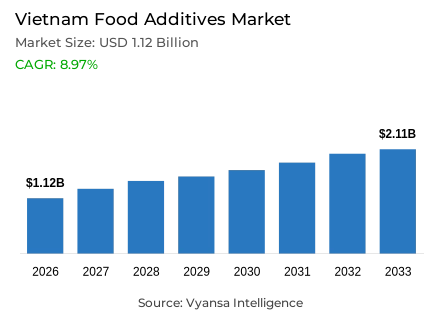
Food additives in Vietnam are functional ingredients such as sweeteners, flavors, preservatives, emulsifiers and enzymes that manufacturers add during production to hold taste, shelf life, texture and color constant at scale. Beverage, dairy, meat, seafood, bakery, seasoning and instant food processors consume them through importers and distributors. The Vietnam food additives market is forecast to grow at a compound annual growth rate (CAGR) of 8.97% between 2027 and 2033.
Key Highlights of the Vietnam Food Additives Market
- The market is estimated at USD 1.12 billion in 2026 and projected to reach USD 1.26 billion in 2027.
- Market value is forecast to reach USD 2.11 billion by 2033, expanding at a CAGR of 8.97% during 2027–2033.
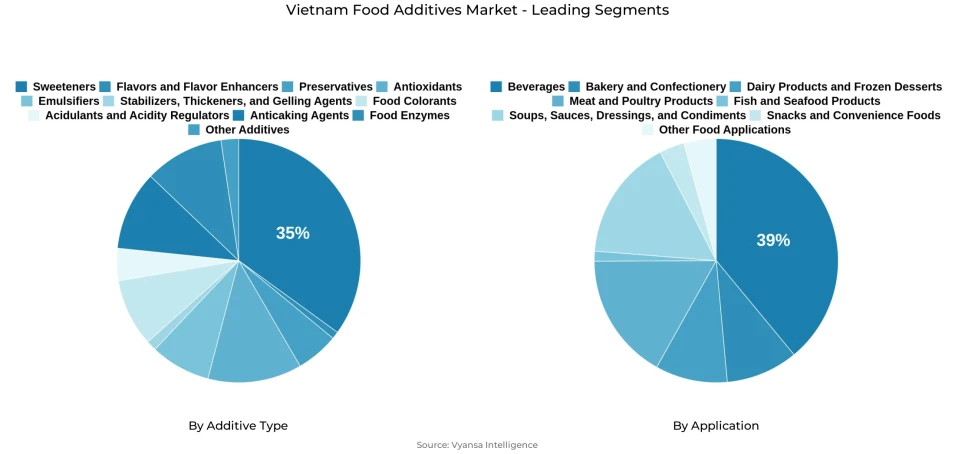
- By additive type, Sweeteners are projected to lead with a 35% share in 2026.
- Food Enzymes are the fastest-growing additive type, with a projected CAGR of 9.15% during 2027–2033.
- By application, Beverages are projected to account for the largest share, at 39% in 2026.
- Meat and Poultry Products are the fastest-growing application, with a projected CAGR of 7.30% during 2027–2033.
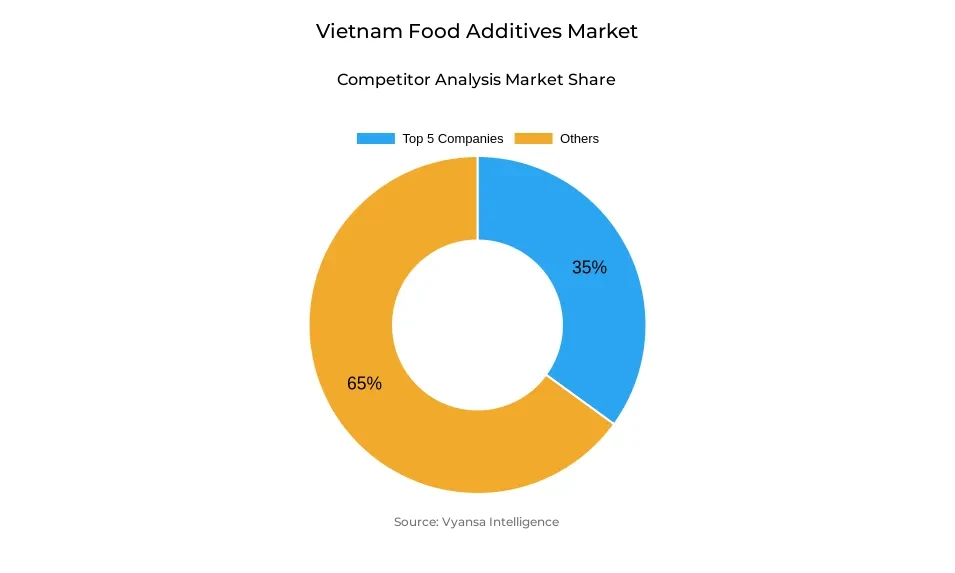
- The market is moderately fragmented, with the five leading companies projected to hold a combined share of approximately 35% in 2026.
Vietnam’s food additives market is expanding alongside industrial food production and demand for consistent packaged products. Sweeteners, flavors, preservatives, emulsifiers, and stabilizers help processors maintain product quality across larger production runs and wider distribution networks. USDA FAS reported that Vietnam’s food processing industry grew 11% to approximately USD 88 billion in 2025, serving a domestic population exceeding 101 million. This manufacturing base supports recurring ingredient purchases across beverages, dairy products, seasonings, bakery goods, and convenience foods.
Domestic production also demonstrates the scale of established ingredient categories. USDA FAS reported approximately 324,000 tons of sodium glutamate production in 2025, while refined sugar output increased from 1.337 million tons in 2024 to 1.451 million tons in 2025. These figures show substantial demand for sweetness and flavor enhancement within Vietnam’s food system. Alongside conventional ingredients, manufacturers are evaluating blended sweeteners, taste modulators, and texture systems that maintain product performance when recipes change.
Consumer spending provides a further demand foundation. Retail sales of goods and consumer services increased 13.4% nominally during the first nine months of 2026, with reported growth of approximately 7.6%–7.8% after price adjustments. Although this measure extends beyond food, it indicates improving purchasing activity supporting packaged-product distribution. Through 2033, additive demand should benefit from greater processed-food output and wider adoption of specialized formulations. Suppliers combining dependable availability with application support should capture more repeat procurement.
Vietnam Food Additives Market Drivers
Sugar Reduction and Beverage Expansion Increase Demand for Reformulation Ingredients
Sugar reduction is creating new formulation requirements for Vietnamese beverage manufacturers. Under the revised Law on Special Consumption Tax, qualifying beverages containing more than 5 g of sugar per 100 ml face an 8% excise tax from January 2027 and 10% from January 2028. Their exclusion from the 2026 value-added tax reduction adds earlier pricing pressure. Manufacturers seeking to reduce sugar while retaining sweetness, body, and flavor therefore have stronger reasons to evaluate high-intensity sweeteners, bulking ingredients, and taste-modulation systems.
Production expansion increases the potential scale of these purchases. In July 2026, Suntory PepsiCo Vietnam opened its Tay Ninh plant with annual production capacity of approximately 1.24 billion liters. This represents manufacturing capacity rather than actual output, but it expands the production base that ingredient suppliers can serve. Mandatory nutrition declarations introduced in January 2026, with updated guidance issued in July, also make recipe composition more visible without requiring manufacturers to reformulate.
Through 2033, beverage capacity expansion and sugar-reduction programs should support demand for application-specific ingredient combinations. Suppliers that preserve taste and stability at commercially acceptable formulation costs should be better positioned to secure repeat orders.
Vietnam Food Additives Market Challenges
Changing Food Safety Procedures Complicate Ingredient Procurement
Changes to Vietnam’s food safety framework can interrupt additive procurement by altering documentation, inspection, and product-declaration requirements. Decree 46/2026/ND-CP took effect in January 2026, introducing revised import controls involving document review, physical inspection, and laboratory testing. Resolution 09/2026/NQ-CP suspended implementation in February following clearance disruptions, while subsequent government action extended the transition as the Food Safety Law underwent revision.
USDA FAS reported in April 2026 that regulatory uncertainty caused ingredient importers to hesitate. For processors using imported flavors, preservatives, or specialized additive blends, uncertainty can complicate purchasing schedules, inventory planning, and supplier qualification. Manufacturers may need additional stock or alternative approved sources to maintain production.
Enforcement also increases the importance of ingredient traceability. Ho Chi Minh City planned inspections of 1,320 food facilities before Tet 2026 following the discovery of borax use at a noodle producer in December 2025. A 74-article draft replacement Food Safety Law presented in October 2026 further signals continued regulatory change.
Through 2033, dependable supply will increasingly depend on documentation and regulatory execution alongside product performance. Distributors maintaining compliant inventories and clear batch records should have an advantage in securing processor contracts.
Vietnam Food Additives Market Recent Trends
Dedicated Distribution Partnerships Expand Access to Specialized Additives
Ingredient suppliers are strengthening local distribution arrangements to support product selection, application testing, and regulatory documentation. USDA FAS reported that Vietnamese processors generally purchase minor ingredients, including additives, flavors, and preservatives, through importers or distributors. This makes local technical capability an important route to converting international ingredient portfolios into factory purchases.
In October 2026, DKSH expanded its partnership with GNT to distribute Exberry natural colors in Vietnam. The arrangement includes logistics, regulatory support, and technical services, extending cooperation already established in Australia, New Zealand, and Japan. It gives Vietnamese manufacturers a locally supported route to evaluate plant-based coloring systems across beverage, dairy, bakery, and confectionery applications.
Supplier engagement is also broadening. Fi Vietnam, held in May 2026, brought together more than 300 exhibitors and approximately 9,000 industry professionals from 40 countries and territories. Such events facilitate ingredient sampling and customer qualification, although attendance alone does not measure additive consumption.
Through 2033, distribution partnerships should help specialized ingredients reach more processors. Suppliers able to demonstrate color stability, recipe compatibility, and reliable replenishment should be better placed to turn trials into recurring orders.
Digital Sampling and Formulation Support Improve Ingredient Selection
Digital ingredient platforms are giving food manufacturers additional ways to identify suitable flavors, request samples, and obtain formulation support. These services can simplify early product development, particularly for processors evaluating several ingredient combinations before conducting factory trials.
In January 2026, Kerry promoted KerryNow alongside its 2026 Taste Charts, providing digital access to flavor portfolios, sampling, and application and regulatory support. The charts draw on a global network exceeding 1,300 scientists, 100 flavorists, and 250 marketing and insights specialists. These capabilities support ingredient screening and concept development; they do not establish a measured reduction in Vietnamese manufacturers’ development times.
Adoption remains uneven. A December 2025 industry assessment reported that approximately 9% of Vietnamese manufacturers, mainly large and foreign-invested enterprises, used advanced tools such as digital twins, AI analytics, or smart-manufacturing platforms. This broader manufacturing figure indicates that digital capability remains concentrated rather than widespread across food processors.
Through 2033, supplier-operated platforms could make technical support more accessible to smaller manufacturers. Ingredient companies that connect digital recommendations with local testing and dependable product supply should be better positioned to convert development projects into commercial purchases.
Vietnam Food Additives Market Future Opportunities
Sodium Reduction Creates Opportunities in Seasonings and Convenience Foods
Reduced-sodium formulations offer opportunities for suppliers serving Vietnam’s fish sauce, seasoning powder, soup, and instant noodle manufacturers. These products require solutions that maintain savory taste while addressing salt’s contribution to preservation and processing performance.
Vietnamese salt consumption averages approximately 8.1 g per person daily, compared with the WHO recommendation of less than 5 g. The Ministry of Health’s March 2024 sodium recommendations cover 11 main processed-food groups and 46 subgroups, establishing category-specific reference points for reformulation. Work to update these recommendations and review food-salt standards continued during 2025–2026, alongside consideration of potassium-enriched salt.
The addressable manufacturing base is substantial. Vietnam consumed approximately 8.23 billion servings of instant noodles in 2025, up 1.2% year over year. Even partial reformulation across this category could create repeat demand for suitable flavor enhancers, taste-masking ingredients, and lower-sodium seasoning systems. Commercial adoption, however, depends on maintaining familiar taste and acceptable production costs.
Through 2033, suppliers that validate complete seasoning systems with major noodle and condiment processors could move from small trials to sustained purchasing. Clearer category targets would strengthen this opportunity, while the current recommendations remain distinct from mandatory sodium limits.
Unlock Market Intelligence
Explore the market potential with our data-driven report
Vietnam Food Additives Market Segmentation Analysis
By Additive Type
- Flavors and Flavor Enhancers
- Sweeteners
- Preservatives
- Antioxidants
- Emulsifiers
- Stabilizers, Thickeners, and Gelling Agents
- Food Colorants
- Acidulants and Acidity Regulators
- Anticaking Agents
- Food Enzymes
- Other Food Additives
Sweeteners Hold 35% of Additive Demand as Every Reformulated Recipe Starts with Sugar Replacement
Sweeteners lead because they are dosed by weight in the largest volume applications rather than as trace additions, so each litre of drink or kilogram of confectionery, bakery and dairy output consumes more sweetener than any other additive type. They are specified in more recipes across the food additives industry, which sends reformulation briefs to sweetener suppliers first. The lead should hold through 2033 unless sugar-tax reformulation shifts value toward flavor modulators.
In February 2026, Tate & Lyle PLC and Manus launched Yume M Stevia Sweetener on an all-Americas Reb M supply chain, and in June 2026 Cargill, Incorporated launched a Truvia allulose, stevia and monk fruit tri-blend offering one-to-one sugar replacement in beverages and baking. Both position stevia and allulose systems for the sugar-reduction briefs Vietnamese beverage makers now face.
Food Enzymes are the fastest-growing additive type at a CAGR of 9.15% between 2027 and 2033, as dairy and bakery lines modernise. The government's dairy development strategy to 2045, reported in February 2026, targets 40 litres of milk per person by 2030 from about 26 to 28 litres, and USDA FAS forecasts wheat imports of 6.1 million tons in marketing year 2026/27. Enzymes grow faster than sweeteners because they start from a smaller base and gain from dairy and bakery modernisation rather than one taxed category.
By Application
- Bakery and Confectionery
- Dairy Products and Frozen Desserts
- Beverages
- Meat and Poultry Products
- Fish and Seafood Products
- Soups, Sauces, Dressings, and Condiments
- Snacks and Convenience Foods
- Other Food Applications
Beverages Command 39% of Application Demand with Every Liter Carrying a Full Additive System
Beverages lead because each litre of carbonate, ready-to-drink tea or energy drink carries sweetener, acidulant, flavor and color, so one application consumes the widest set of additive types. Volume is recovering, with the Vietnam Beer-Alcohol-Beverage Association reporting higher production and consumption in the first half of 2026, helped by hot weather. The lead holds through 2033 unless taxed volumes fall faster than reformulation lifts additive use per litre.
In July 2025, Coca-Cola Beverages Vietnam Ltd. opened a USD 136 million factory in Tay Ninh with five filling lines and capacity of up to 1 billion litres a year, and in June 2026 Suntory PepsiCo Vietnam Beverage Co., Ltd. launched BOSS Energy Coffee, an energy drink with Robusta coffee extract and B-complex vitamins. Each added litre needs a full additive system supplied by the industry.
Meat and Poultry Products are the fastest-growing application at a CAGR of 7.30% between 2027 and 2033, as more carcass tonnage moves into marinated, cooked and coated lines. The national statistics office reported poultry meat output of 2.02 million tons in the first nine months of 2026, up 5.3%, and Vietnam and South Korea agreed in April 2026 to open their markets to processed chicken. Meat grows faster than beverages because processing multiplies additive use per ton, while beverage volumes face the sugar-tax transition.
Unlock Market Intelligence
Explore the market potential with our data-driven report
Vietnam Food Additives Market Competitive Landscape
The food additives industry in Vietnam is moderately fragmented, with the top five companies holding a combined share of approximately 35% in 2026. The five companies are Ajinomoto Vietnam Co., Ltd, VEDAN Viet Nam Enterprise Corp., Ltd, AIG Asia Ingredients Corporation, Givaudan International SA and Kerry Group plc, which are profiled below. The remaining share is distributed across other ingredient manufacturers, importers and distributors.
Key Companies in the Vietnam Food Additives Market
- Ajinomoto Vietnam Co., Ltd.
- VEDAN Viet Nam Enterprise Corp., Ltd.
- International Flavors & Fragrances Inc.
- DSM-Firmenich AG
- Brenntag Vietnam Co., Ltd.
- AIG Asia Ingredients Corporation
- Givaudan International SA
- Kerry Group plc
- DKSH Holding Ltd.
- Viet Huong Flavor and Fragrance Joint Stock Company
Recent Developments in the Vietnam Food Additives Market
- In May 2026, Asia Coconut Processing Joint Stock Company, part of Asia Ingredients Group, began a USD 24 million Vinh Long plant adding 48,000 tons of sterilisation capacity for 2027.
- In May 2026, Informa Markets held Fi Vietnam 2026, with over 300 brands and 9,000 expected visitors, per the Ministry of Agriculture and Environment, widening additive supplier qualification routes.
- In October 2026, Gia Lai’s people’s committee approved Quang Ngai Sugar Joint Stock Company’s USD 69.7 million An Khe plant, producing 21 million litres of food-grade alcohol yearly from 2028.
Frequently Asked Questions
Related Report
- Market Segmentation
- Research Scope
- Research Methodology
- Definitions and Assumptions
- Executive Summary
- Vietnam Food Additives Market Policies, Regulations, and Standards
- Vietnam Food Additives Market Dynamics
- Growth Factors
- Challenges
- Trends
- Opportunities
- Vietnam Food Additives Market Statistics, 2023-2033F
- Market Size & Growth Outlook
- By Revenues in USD Million
- Market Segmentation & Growth Outlook
- By Additive Type
- Flavors and Flavor Enhancers- Market Insights and Forecast 2023-2033, USD Million
- Sweeteners- Market Insights and Forecast 2023-2033, USD Million
- Preservatives- Market Insights and Forecast 2023-2033, USD Million
- Antioxidants- Market Insights and Forecast 2023-2033, USD Million
- Emulsifiers- Market Insights and Forecast 2023-2033, USD Million
- Stabilizers, Thickeners, and Gelling Agents- Market Insights and Forecast 2023-2033, USD Million
- Food Colorants- Market Insights and Forecast 2023-2033, USD Million
- Acidulants and Acidity Regulators- Market Insights and Forecast 2023-2033, USD Million
- Anticaking Agents- Market Insights and Forecast 2023-2033, USD Million
- Food Enzymes- Market Insights and Forecast 2023-2033, USD Million
- Other Additives- Market Insights and Forecast 2023-2033, USD Million
- By Application
- Bakery and Confectionery- Market Insights and Forecast 2023-2033, USD Million
- Dairy Products and Frozen Desserts- Market Insights and Forecast 2023-2033, USD Million
- Beverages- Market Insights and Forecast 2023-2033, USD Million
- Meat and Poultry Products- Market Insights and Forecast 2023-2033, USD Million
- Fish and Seafood Products- Market Insights and Forecast 2023-2033, USD Million
- Soups, Sauces, Dressings, and Condiments- Market Insights and Forecast 2023-2033, USD Million
- Snacks and Convenience Foods- Market Insights and Forecast 2023-2033, USD Million
- Other Food Applications- Market Insights and Forecast 2023-2033, USD Million
- By Source
- Natural- Market Insights and Forecast 2023-2033, USD Million
- Synthetic- Market Insights and Forecast 2023-2033, USD Million
- By Form
- Dry- Market Insights and Forecast 2023-2033, USD Million
- Liquid- Market Insights and Forecast 2023-2033, USD Million
- Other Forms- Market Insights and Forecast 2023-2033, USD Million
- By Competitors
- Competition Characteristics
- Market Share & Analysis
- By Additive Type
- Market Size & Growth Outlook
- Vietnam Flavors and Flavor Enhancers Market Statistics, 2023-2033
- Market Size & Growth Outlook
- By Revenues in USD Million
- Market Segmentation & Growth Outlook
- By Application- Market Insights and Forecast 2023-2033, USD Million
- By Source- Market Insights and Forecast 2023-2033, USD Million
- By Form- Market Insights and Forecast 2023-2033, USD Million
- Market Size & Growth Outlook
- Vietnam Sweeteners Market Statistics, 2023-2033
- Market Size & Growth Outlook
- By Revenues in USD Million
- Market Segmentation & Growth Outlook
- By Application- Market Insights and Forecast 2023-2033, USD Million
- By Source- Market Insights and Forecast 2023-2033, USD Million
- By Form- Market Insights and Forecast 2023-2033, USD Million
- Market Size & Growth Outlook
- Vietnam Preservatives Market Statistics, 2023-2033
- Market Size & Growth Outlook
- By Revenues in USD Million
- Market Segmentation & Growth Outlook
- By Application- Market Insights and Forecast 2023-2033, USD Million
- By Source- Market Insights and Forecast 2023-2033, USD Million
- By Form- Market Insights and Forecast 2023-2033, USD Million
- Market Size & Growth Outlook
- Vietnam Antioxidants Market Statistics, 2023-2033
- Market Size & Growth Outlook
- By Revenues in USD Million
- Market Segmentation & Growth Outlook
- By Application- Market Insights and Forecast 2023-2033, USD Million
- By Source- Market Insights and Forecast 2023-2033, USD Million
- By Form- Market Insights and Forecast 2023-2033, USD Million
- Market Size & Growth Outlook
- Vietnam Emulsifiers Market Statistics, 2023-2033
- Market Size & Growth Outlook
- By Revenues in USD Million
- Market Segmentation & Growth Outlook
- By Application- Market Insights and Forecast 2023-2033, USD Million
- By Source- Market Insights and Forecast 2023-2033, USD Million
- By Form- Market Insights and Forecast 2023-2033, USD Million
- Market Size & Growth Outlook
- Vietnam Stabilizers, Thickeners, and Gelling Agents Market Statistics, 2023-2033
- Market Size & Growth Outlook
- By Revenues in USD Million
- Market Segmentation & Growth Outlook
- By Application- Market Insights and Forecast 2023-2033, USD Million
- By Source- Market Insights and Forecast 2023-2033, USD Million
- By Form- Market Insights and Forecast 2023-2033, USD Million
- Market Size & Growth Outlook
- Vietnam Food Colorants Market Statistics, 2023-2033
- Market Size & Growth Outlook
- By Revenues in USD Million
- Market Segmentation & Growth Outlook
- By Application- Market Insights and Forecast 2023-2033, USD Million
- By Source- Market Insights and Forecast 2023-2033, USD Million
- By Form- Market Insights and Forecast 2023-2033, USD Million
- Market Size & Growth Outlook
- Vietnam Acidulants and Acidity Regulators Market Statistics, 2023-2033
- Market Size & Growth Outlook
- By Revenues in USD Million
- Market Segmentation & Growth Outlook
- By Application- Market Insights and Forecast 2023-2033, USD Million
- By Source- Market Insights and Forecast 2023-2033, USD Million
- By Form- Market Insights and Forecast 2023-2033, USD Million
- Market Size & Growth Outlook
- Vietnam Anticaking Agents Market Statistics, 2023-2033
- Market Size & Growth Outlook
- By Revenues in USD Million
- Market Segmentation & Growth Outlook
- By Application- Market Insights and Forecast 2023-2033, USD Million
- By Source- Market Insights and Forecast 2023-2033, USD Million
- By Form- Market Insights and Forecast 2023-2033, USD Million
- Market Size & Growth Outlook
- Vietnam Food Enzymes Market Statistics, 2023-2033
- Market Size & Growth Outlook
- By Revenues in USD Million
- Market Segmentation & Growth Outlook
- By Application- Market Insights and Forecast 2023-2033, USD Million
- By Source- Market Insights and Forecast 2023-2033, USD Million
- By Form- Market Insights and Forecast 2023-2033, USD Million
- Market Size & Growth Outlook
- Vietnam Other Food Additives Market Statistics, 2023-2033
- Market Size & Growth Outlook
- By Revenues in USD Million
- Market Segmentation & Growth Outlook
- By Application- Market Insights and Forecast 2023-2033, USD Million
- By Source- Market Insights and Forecast 2023-2033, USD Million
- By Form- Market Insights and Forecast 2023-2033, USD Million
- Market Size & Growth Outlook
- Competitive Outlook
- Company Profiles
- Ajinomoto Vietnam Co., Ltd (AJI-NO-MOTO)
- Business Description
- Product Portfolio
- Collaborations & Alliances
- Recent Developments
- Financial Details
- Others
- VEDAN Viet Nam Enterprise Corp., Ltd
- Business Description
- Product Portfolio
- Collaborations & Alliances
- Recent Developments
- Financial Details
- Others
- AIG Asia Ingredients Corporation
- Business Description
- Product Portfolio
- Collaborations & Alliances
- Recent Developments
- Financial Details
- Others
- Givaudan International SA
- Business Description
- Product Portfolio
- Collaborations & Alliances
- Recent Developments
- Financial Details
- Others
- Kerry Group plc
- Business Description
- Product Portfolio
- Collaborations & Alliances
- Recent Developments
- Financial Details
- Others
- International Flavors & Fragrances Inc.
- Business Description
- Product Portfolio
- Collaborations & Alliances
- Recent Developments
- Financial Details
- Others
- DSM-Firmenich AG
- Business Description
- Product Portfolio
- Collaborations & Alliances
- Recent Developments
- Financial Details
- Others
- Brenntag Vietnam Co., Ltd.
- Business Description
- Product Portfolio
- Collaborations & Alliances
- Recent Developments
- Financial Details
- Others
- DKSH Holding Ltd
- Business Description
- Product Portfolio
- Collaborations & Alliances
- Recent Developments
- Financial Details
- Others
- Viet Huong Flavour and Fragrance Joint Stock Company
- Business Description
- Product Portfolio
- Collaborations & Alliances
- Recent Developments
- Financial Details
- Others
- Ajinomoto Vietnam Co., Ltd (AJI-NO-MOTO)
- Company Profiles
- Disclaimer
| Segment | Sub-Segment |
|---|---|
| By Additive Type |
|
| By Application |
|
| By Source |
|
| By Form |
|
Research Methodology
This study followed a structured approach comprising four key phases to assess the size and scope of the electro-oxidation market. The process began with thorough secondary research to collect data on the target market, related markets, and broader industry context. These findings, along with preliminary assumptions and estimates, were then validated through extensive primary research involving industry experts from across the value chain. To calculate the overall market size, both top-down and bottom-up methodologies were employed. Finally, market segmentation and data triangulation techniques were applied to refine and validate segment-level estimations.
Secondary Research
The secondary research phase involved gathering data from a wide range of credible and published sources. This step helped in identifying industry trends, defining market segmentation, and understanding the market landscape and value chain.
Sources consulted during this phase included:
- Company annual reports, investor presentations, and press releases
- Industry white papers and certified publications
- Trade directories and market-recognized databases
- Articles from authoritative authors and reputable journals
- Gold and silver standard websites
Secondary research was critical in mapping out the industry's value chain and monetary flow, identifying key market segments, understanding regional variations, and tracking significant industry developments.
Other key sources:
- Financial disclosures
- Industry associations and trade bodies
- News outlets and business magazines
- Academic journals and research studies
- Paid industry databases
Primary Research
To validate secondary data and gain deeper market insights, primary research was conducted with key stakeholders across both the supply and demand sides of the market.
On the demand side, participants included decision-makers and influencers from end-user industries—such as CIOs, CTOs, and CSOs—who provided first-hand perspectives on market needs, product usage, and future expectations.
On the supply side, interviews were conducted with manufacturers, industry associations, and institutional participants to gather insights into current offerings, product pipelines, and market challenges.
Primary interviews provided critical inputs such as:
- Market size and revenue data
- Product and service breakdowns
- Market forecasts
- Regional and application-specific trends
Stakeholders consulted included:
- Leading OEM and solution providers
- Channel and distribution partners
- End users across various applications
- Independent consultants and industry specialists
Market Size Estimation and Data Triangulation
- Identifying Key Market Participants (Secondary Research)
- Goal: To identify the major players or companies in the target market. This typically involves using publicly available data sources such as industry reports, market research publications, and financial statements of companies.
- Tools: Reports from firms like Gartner, Forrester, Euromonitor, Statista, IBISWorld, and others. Public financial statements, news articles, and press releases from top market players.
- Extracting Earnings of Key Market Participants
- Goal: To estimate the earnings generated from the product or service being analyzed. This step helps in understanding the revenue potential of each market player in a specific geography.
- Methods: Earnings data can be gathered from:
- Publicly available financial reports (for listed companies).
- Interviews and primary data sources from professionals, such as Directors, VPs, SVPs, etc. This is especially useful for understanding more nuanced, internal data that isn't publicly disclosed.
- Annual reports and investor presentations of key players.
- Data Collation and Development of a Relevant Data Model
- Goal: To collate inputs from both primary and secondary sources into a structured, data-driven model for market estimation. This model will incorporate key market KPIs and any independent variables relevant to the market.
- Key KPIs: These could include:
- Market size, growth rate, and demand drivers.
- Industry-specific metrics like market share, average revenue per customer (ARPC), or average deal size.
- External variables, such as economic growth rates, inflation rates, or commodity prices, that could affect the market.
- Data Modeling: Based on this data, the market forecasts are developed for the next 5 years. A combination of trend analysis, scenario modeling, and statistical regression might be used to generate projections.
- Scenario Analysis
- Goal: To test different assumptions and validate how sensitive the market is to changes in key variables (e.g., market demand, regulatory changes, technological disruptions).
- Types of Scenarios:
- Base Case: Based on current assumptions and historical data.
- Best-Case Scenario: Assuming favorable market conditions, regulatory environments, and technological advancements.
- Worst-Case Scenario: Accounting for adverse factors, such as economic downturns, stricter regulations, or unexpected disruptions.