Europe Pizza Market Report: Trends, Growth and Forecast (2027-2033)
By Product Format (Freshly Prepared Pizza, Chilled Pizza, Frozen Pizza), By Topping Type (Non-Vegetarian Pizza, Vegetarian Pizza), By Sales Channel (Foodservice (Quick-Service Restaurants, Full-Service Restaurants, Other Foodservice Outlets), Retail), By Country (Germany, The UK, France, Spain, Italy, Benelux, Nordic, Russia, Rest of Europe) ... Read more
|
Major Players
|
Europe Pizza Market Overview
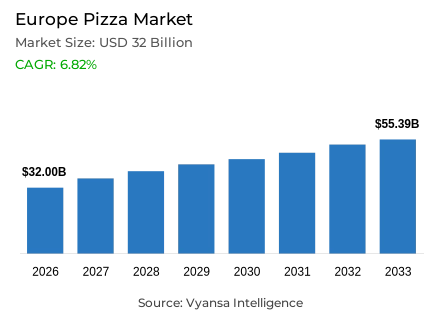
The Europe pizza market covers freshly prepared, chilled and frozen pizzas sold through restaurants, takeaway outlets, delivery services and retail stores. Demand spans shared meals, individual portions, snacks and convenient meals prepared at home. Competition centers on taste, affordability, preparation time and availability across consumption occasions. The market is estimated to expand at a CAGR of 6.82% between 2027 and 2033.
Key Highlights of the Europe Pizza Market
- The Europe pizza market is estimated at USD 32 billion in 2026 and USD 37.29 billion in 2027, reaching USD 55.39 billion by 2033.
- The market is projected to expand at a CAGR of 6.82% during the forecasted period of 2027–2033.
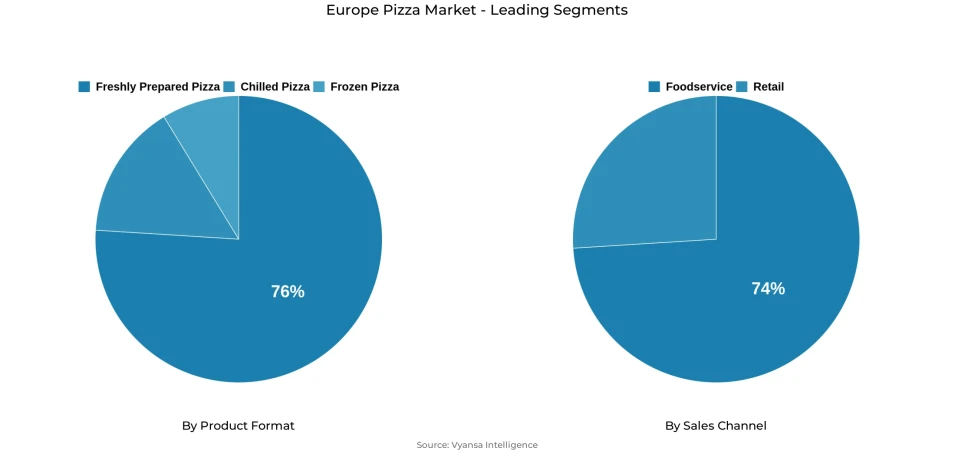
- Freshly Prepared Pizza is projected to account for 76% of the market in 2026.
- Frozen Pizza is the fastest-growing product format, with a projected CAGR of 8.07% during the forecasted period of 2027–2033.
- Foodservice is projected to account for 74% of the market in 2026.
- Retail is projected to expand at a CAGR of 5.54% during the forecasted period of 2027–2033.
- Italy is projected to lead the regional market with a 31% share in 2026.
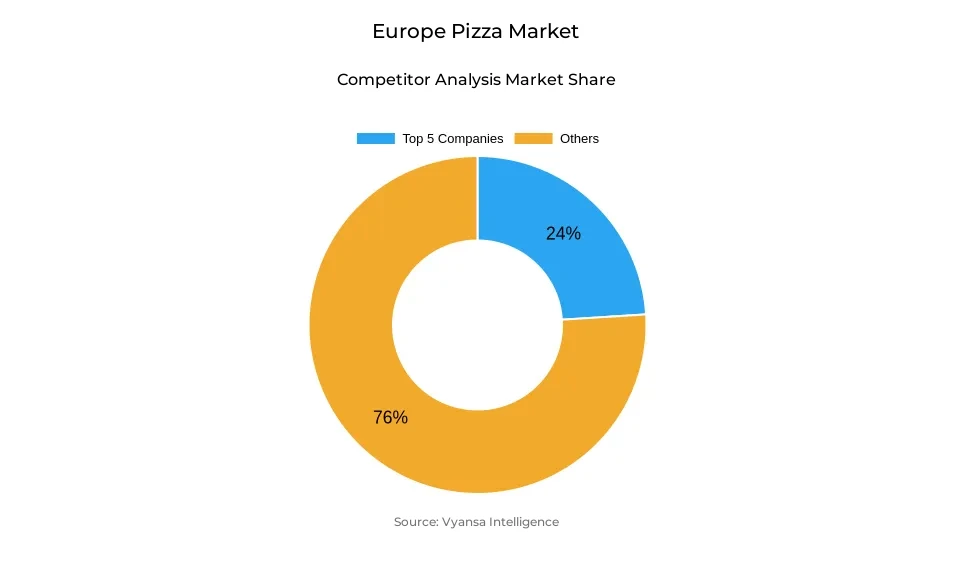
- The market is fragmented, with the five leading companies estimated to hold a combined 24% share in 2026.
Pizza benefits from an established position across European dining, takeaway and home-consumption occasions. Its adaptable toppings, shareable portions and availability across fresh, chilled and frozen formats support demand across household budgets. Tourism provides an additional source of foodservice demand: Eurostat recorded 3.1 billion nights in EU tourist accommodation in 2025, up 4.1%, followed by a further 1.7% increase during the first half of 2026. This expands the addressable customer base for pizzerias near accommodation, transport hubs and visitor destinations.
Affordability remains central to purchasing decisions. Euro-area household real consumption per person increased by 0.4% in the third quarter of 2025 and 0.5% in the fourth quarter, indicating gradual improvement in spending capacity. However, Austrian food and beverage serving prices were 5.4% higher year over year in February 2026. These indicators suggest that pizza suppliers must balance premium ingredients and menu innovation with accessible meal options, particularly where consumers compare delivery costs with supermarket alternatives.
Retail demand provides a complementary growth base. Germany's frozen-pizza volumes reached 427,876 metric tons across retail, home delivery and foodservice in 2025, increasing 1.6%, according to German Frozen Food Institute. Although this is a national measure, it demonstrates the continuing scale of demand for ready-to-prepare pizza. Through 2033, growth is expected to favor suppliers that serve several occasions through differentiated crusts, convenient portions and consistent preparation quality.
Europe Pizza Market Drivers
Convenient Ordering and Home Preparation Support Repeat Purchases
Pizza combines straightforward digital ordering with convenient home preparation, allowing consumers to choose between delivered meals and supermarket products according to time and budget. These options broaden access beyond restaurant visits and make the category suitable for routine household purchases.
Eurostat reported that 78% of people in the EU bought or ordered goods or services online in 2025, rising to 84% among those aged 16–24. These broader shopping habits support the addressable audience for pizza apps and online ordering. Separately, German frozen-food volumes through grocery retail and home-delivery services increased 2.7% to 2.070 million metric tons in 2025. This covers all frozen foods, but indicates stronger demand for convenient meals consumed at home.
For pizza suppliers, the opportunity is to convert accessibility into repeat purchases through simple reordering, reliable delivery and oven-ready products. Businesses offering convenient options at several price points are better positioned to retain customers as consumption shifts between delivery and retail.
Europe Pizza Market Challenges
Rising Labor Costs Limit Affordable Expansion
Pizza operators must maintain preparation speed and delivery coverage while managing staffing costs across kitchens, counters and delivery operations. Higher employment costs increase the order volumes required to sustain an outlet, particularly where customers resist further menu-price increases.
EU hourly labor costs increased 4.1% in 2025, while service-sector hourly labor costs rose 3.1% year over year in the second quarter of 2026. These broader indicators show that cost pressure continued into 2026. At company level, Domino's Pizza Group reported a 0.9% decline in total orders during 2025, illustrating the difficulty of maintaining transaction growth in a constrained consumer environment.
The resulting pressure can delay franchise expansion and increase reliance on promotional offers. Through the forecast period, new openings are likely to depend increasingly on local demand density, efficient staffing and the ability to maintain competitive meal prices.
Europe Pizza Market Trends
Cross-Border Expansion Combines Standardized Operations with Local Menus
Pizza chains are extending their European presence through development partners while adapting menus to national preferences. A repeatable operating model supports expansion, while local flavors help new entrants establish relevance against independent pizzerias and established chains.
Dodo Pizza formally launched its Spanish operation in Sabadell in February 2026, following a soft launch in December. It targeted three to four restaurants by the end of 2026 and introduced a Spanish menu comprising 18 pizzas, including locally developed options such as goat cheese pizza. Its initial focus on the Barcelona area prioritizes delivery coverage and operating density before wider expansion.
This approach links network growth with product localization rather than relying on a uniform international menu. As additional brands enter European cities, competition is expected to intensify around delivery convenience, distinctive toppings and consistent execution.
Integrated Dispatch Systems Improve Delivery Coordination
Pizza delivery technology is moving toward systems that connect ordering channels, restaurant operations and courier allocation. Combining in-house drivers with external delivery fleets allows operators to adjust fulfillment to demand while reducing manual coordination.
In a 2026 update, Deliverect reported that its hybrid fulfillment platform operated across approximately 400 Papa Johns UK stores and delivered an approximately 10% improvement in its under-30-minute delivery metric. This is a supplier-reported result. Separately, Domino's Pizza Group recorded an average UK delivery time of 24.3 minutes in 2025, compared with 24.5 minutes in 2024, demonstrating the importance established operators place on delivery speed.
For the European market, integrated dispatch can support more dependable service during peak periods and better use of available drivers. Wider adoption will depend on effective connections between ordering systems, kitchen capacity and delivery partners, with operational reliability becoming a stronger basis for competition.
Europe Pizza Market Opportunities
Reformulated and Portion-Controlled Pizza Creates Additional Consumption Occasions
Manufacturers can expand pizza beyond the traditional whole-pizza meal through smaller portions, snack formats and recipes designed to meet nutritional criteria. The commercial opportunity combines easier preparation with products suitable for lighter meals and additional household occasions.
Goodfella's introduced Pizza Pinwheels in two flavors, Cheese & Tomato and Cheese & Ham, through Iceland in November 2025. The products were described as non-HFSS and suitable for preparation in an air fryer, microwave or oven. The launch demonstrates that convenient pizza snacks meeting the relevant nutritional classification were already reaching shelves before 2026.
Manufacturers that preserve flavor while improving recipe profiles and preparation flexibility can compete for both meal and snack purchases. Through 2033, this could support broader retail ranges and greater product differentiation, particularly where nutritional classification affects promotional access.
Unlock Market Intelligence
Explore the market potential with our data-driven report
Europe Pizza Market Segmentation Analysis
By Product Format
- Freshly Prepared Pizza
- Chilled Pizza
- Frozen Pizza
Freshly Prepared Pizza Leads the Market with 76% Market Share and Frozen Pizza is The Fastest Growing
Freshly prepared pizza is projected to lead because restaurants and delivery kitchens combine immediate consumption with customization and a dining experience that packaged products cannot fully replicate. Operators are also developing formats that serve whole pizzas, individual slices, collection and delivery from the same premises.
New York Slice Club opened its Hamburg flagship in July 2026, offering slices and whole pizzas exceeding 50 centimeters in diameter. Milano Vice opened its sixth Berlin restaurant in October 2026, compared with one restaurant a year earlier, combining dine-in service with collection, delivery and catering. These developments illustrate how differentiated products and flexible restaurant formats support the segment's established position.
Frozen pizza is expected to record the strongest growth among product formats as households seek convenient meals with predictable portions and limited preparation. Product development can improve crust texture, broaden toppings and extend pizza into smaller meal occasions. Germany's wider frozen-food market increased 2.5% to 4.238 million metric tons in 2025, with consumption reaching 51.6 kilograms per person. These figures cover all frozen foods. More specifically, frozen-pizza volumes supplied to the German foodservice market rose 6.9%, indicating that demand also extends to professional kitchens seeking convenient preparation.
By Sales Channel
- Foodservice
- Retail
Foodservice Is the Dominant Segment with 74% Market Share While Retail Is the Fastest Growing
Foodservice retains its leading position through the combined reach of dine-in restaurants, takeaway outlets, delivery kitchens and institutional venues. Its principal advantage is the ability to offer freshly prepared pizza alongside service, customization and immediate availability.
PizzaExpress opened a smaller quick-service format in Brixton in May 2026, introducing self-ordering for dine-in, takeaway and delivery. The location was announced as the first of three smaller restaurants planned for rollout over the following months. This illustrates how established restaurant brands are adapting their footprints to serve more convenient consumption occasions. Such formats can extend brands into locations unsuited to a conventional full-service restaurant. Their contribution to growth will depend on maintaining throughput and product quality within a smaller operating footprint.
Retail benefits from supermarket distribution, household stock-up purchases and the availability of chilled and frozen products across different price points. It allows consumers to access branded and private-label pizza without the additional service costs associated with restaurant delivery. German grocery retail and home-delivery frozen-pizza volumes reached 366,857 metric tons in 2025, up 0.8%. Separately, PizzaExpress extended its Marry Me Chicken pizza from restaurants into Sainsbury's in April 2026, demonstrating how restaurant-led innovation can enter the chilled supermarket category.
Unlock Market Intelligence
Explore the market potential with our data-driven report
Europe Pizza Market Regional Analysis
Italy is projected to lead the Europe pizza market with a 31% share in 2026, supported by its extensive pizzeria network, established consumption habits and specialised ingredient supply chains. A sector overview published by Italy's National Research Council in January 2026 reported more than 50,000 pizzerias producing over eight million pizzas daily. This operating base supports widespread availability, repeat consumption and demand for differentiated doughs, toppings and preparation styles across independent restaurants and organized operators.
Demand also extends to home consumption, with ISMEA reporting a 4.2% increase in household pizza purchase volumes during the first half of 2025. Product differentiation is developing alongside this demand: Campania launched its “100% Campania Pizza” pilot in November 2025, involving 100 pizzerias worldwide and 25 certified regional ingredients supported by digital traceability. Together, household demand and verifiable ingredient provenance are expected to support Italy's position through convenient retail products and distinctive restaurant offerings.
Europe Pizza Market Competitive Landscape
The five leading companies are estimated to hold a combined 24% share in 2026. Leading participants include Le Duff Group (Del Arte), Dr. Oetker, Domino's Pizza Enterprises Limited, Suedzucker AG and Orkla ASA.
Key Companies in the Europe Pizza Market
- Le Duff Group (Del Arte)
- Dr. Oetker
- Domino's Pizza Enterprises Limited
- Suedzucker AG
- Orkla ASA
- DODO Brands International DMCC (Dodo Pizza)
- Food Delivery Brands S.A.
- PizzaExpress (Restaurants) Limited
- Food Service Project S.A.
- AmRest Holdings SE
- Papa Johns (GB) Limited
- Nomad Foods Europe Limited (Goodfella's)
Company Profiling
Le Duff Group (Del Arte): Le Duff Group participates in the European pizza market through Del Arte, its Italian restaurant chain with more than 170 locations in France. The brand combines a predominantly franchised network with pizza dough prepared daily in restaurants. In fall 2026, Del Arte introduced a seasonal menu featuring new pizzas, including Bella Montagna and Scamorza e Pepperoni. The launch expands its pizza selection with seasonal ingredients and flavor combinations
Dr. Oetker: Dr. Oetker manufactures branded frozen pizzas for retail and professional foodservice customers. Its Wittenburg facility produces approximately one million pizzas daily for around 50 countries, supporting its international supply network. In September 2026, the company introduced Rustica Filled Crust in two limited-edition variants, 5 Cheese and Triple Pepperoni, extending its frozen range with cheese-filled crusts and a thicker base.
Domino's Pizza Enterprises Limited: Domino's Pizza Enterprises Limited operates Domino's master franchises across several European markets, including Germany, France, the Netherlands, Belgium and Luxembourg. Its business centers on freshly prepared pizza sold through delivery and collection networks. In August 2026, Domino's Germany expanded its dip range with three new flavors: Truffle Style, Jalapeño Lime and Hot. The launch broadened customization options alongside pizza and other menu items.
Suedzucker AG: Südzucker participates in the pizza market through Freiberger, a manufacturer supplying frozen and chilled products to retail and foodservice customers. Freiberger's network produces more than 3.5 million pizzas daily and supports both private-label and branded offerings. In 2026, the group introduced Ernie's Pizza in the United Kingdom, securing distribution across more than 375 Asda stores and extending its branded presence in supermarket freezers.
Orkla ASA: Orkla participates through its food businesses and the Grandiosa brand, supplying frozen pizzas across Nordic markets. Its portfolio combines established recipes with market-specific flavors and convenient formats. In September 2026, Orkla Finland launched Grandiosa inspired by Taffel Furious, a 330-gram stone-baked pizza featuring pepperoni, green pepper, jalapeño and sauces inspired by the Taffel snack range. The launch extended its collaboration between pizza and snack brands.
Recent Developments in the Europe Pizza Market
- In May 2026, Domino's UK and Ireland launched Italianos, a range of five thinner-style pizzas. The launch broadened its offering for consumers seeking a different crust and ingredient combination from its established menu.
- In February 2026, Dr. Oetker Professional relaunched Pizza Perfettissima with revised sauce, cheese presentation and toppings. The 17-variant range includes plain bases and smaller pizzas, supporting foodservice operators seeking adaptable products with straightforward preparation.
Frequently Asked Questions
Related Report
- Market Segmentation
- Research Scope
- Research Methodology
- Definitions and Assumptions
- Executive Summary
- Europe Pizza Market Policies, Regulations, and Standards
- Europe Pizza Market Dynamics
- Growth Factors
- Challenges
- Trends
- Opportunities
- Europe Pizza Market Statistics, 2023-2033F
- Market Size & Growth Outlook
- By Revenues in USD Million
- Market Segmentation & Growth Outlook
- By Product Format
- Freshly Prepared Pizza- Market Insights and Forecast 2023-2033, USD Million
- Chilled Pizza- Market Insights and Forecast 2023-2033, USD Million
- Frozen Pizza- Market Insights and Forecast 2023-2033, USD Million
- By Topping Type
- Non-Vegetarian Pizza- Market Insights and Forecast 2023-2033, USD Million
- Vegetarian Pizza- Market Insights and Forecast 2023-2033, USD Million
- By Sales Channel
- Foodservice- Market Insights and Forecast 2023-2033, USD Million
- Quick-Service Restaurants- Market Insights and Forecast 2023-2033, USD Million
- Full-Service Restaurants- Market Insights and Forecast 2023-2033, USD Million
- Other Foodservice Outlets- Market Insights and Forecast 2023-2033, USD Million
- Retail- Market Insights and Forecast 2023-2033, USD Million
- Foodservice- Market Insights and Forecast 2023-2033, USD Million
- By Country
- Germany
- The UK
- France
- Spain
- Italy
- Benelux
- Nordic
- Russia
- Rest of Europe
- By Competitors
- Competition Characteristics
- Market Share & Analysis
- By Product Format
- Market Size & Growth Outlook
- Germany Pizza Market Statistics, 2023-2033F
- Market Size & Growth Outlook
- By Revenues in USD Million
- Market Segmentation & Growth Outlook
- By Product Format- Market Insights and Forecast 2023-2033, USD Million
- By Topping Type- Market Insights and Forecast 2023-2033, USD Million
- By Sales Channel- Market Insights and Forecast 2023-2033, USD Million
- Market Size & Growth Outlook
- The UK Pizza Market Statistics, 2023-2033F
- Market Size & Growth Outlook
- By Revenues in USD Million
- Market Segmentation & Growth Outlook
- By Product Format- Market Insights and Forecast 2023-2033, USD Million
- By Topping Type- Market Insights and Forecast 2023-2033, USD Million
- By Sales Channel- Market Insights and Forecast 2023-2033, USD Million
- Market Size & Growth Outlook
- France Pizza Market Statistics, 2023-2033F
- Market Size & Growth Outlook
- By Revenues in USD Million
- Market Segmentation & Growth Outlook
- By Product Format- Market Insights and Forecast 2023-2033, USD Million
- By Topping Type- Market Insights and Forecast 2023-2033, USD Million
- By Sales Channel- Market Insights and Forecast 2023-2033, USD Million
- Market Size & Growth Outlook
- Spain Pizza Market Statistics, 2023-2033F
- Market Size & Growth Outlook
- By Revenues in USD Million
- Market Segmentation & Growth Outlook
- By Product Format- Market Insights and Forecast 2023-2033, USD Million
- By Topping Type- Market Insights and Forecast 2023-2033, USD Million
- By Sales Channel- Market Insights and Forecast 2023-2033, USD Million
- Market Size & Growth Outlook
- Italy Pizza Market Statistics, 2023-2033F
- Market Size & Growth Outlook
- By Revenues in USD Million
- Market Segmentation & Growth Outlook
- By Product Format- Market Insights and Forecast 2023-2033, USD Million
- By Topping Type- Market Insights and Forecast 2023-2033, USD Million
- By Sales Channel- Market Insights and Forecast 2023-2033, USD Million
- Market Size & Growth Outlook
- Benelux Pizza Market Statistics, 2023-2033F
- Market Size & Growth Outlook
- By Revenues in USD Million
- Market Segmentation & Growth Outlook
- By Product Format- Market Insights and Forecast 2023-2033, USD Million
- By Topping Type- Market Insights and Forecast 2023-2033, USD Million
- By Sales Channel- Market Insights and Forecast 2023-2033, USD Million
- Market Size & Growth Outlook
- Nordic Pizza Market Statistics, 2023-2033F
- Market Size & Growth Outlook
- By Revenues in USD Million
- Market Segmentation & Growth Outlook
- By Product Format- Market Insights and Forecast 2023-2033, USD Million
- By Topping Type- Market Insights and Forecast 2023-2033, USD Million
- By Sales Channel- Market Insights and Forecast 2023-2033, USD Million
- Market Size & Growth Outlook
- Russia Pizza Market Statistics, 2023-2033F
- Market Size & Growth Outlook
- By Revenues in USD Million
- Market Segmentation & Growth Outlook
- By Product Format- Market Insights and Forecast 2023-2033, USD Million
- By Topping Type- Market Insights and Forecast 2023-2033, USD Million
- By Sales Channel- Market Insights and Forecast 2023-2033, USD Million
- Market Size & Growth Outlook
- Competitive Outlook
- Company Profiles
- Le Duff Group (Del Arte)
- Business Description
- Product Portfolio
- Collaborations & Alliances
- Recent Developments
- Financial Details
- Others
- Dr. August Oetker Nahrungsmittel KG
- Business Description
- Product Portfolio
- Collaborations & Alliances
- Recent Developments
- Financial Details
- Others
- Domino's Pizza Enterprises Limited
- Business Description
- Product Portfolio
- Collaborations & Alliances
- Recent Developments
- Financial Details
- Others
- Südzucker AG
- Business Description
- Product Portfolio
- Collaborations & Alliances
- Recent Developments
- Financial Details
- Others
- Orkla ASA
- Business Description
- Product Portfolio
- Collaborations & Alliances
- Recent Developments
- Financial Details
- Others
- DODO Brands International DMCC (Dodo Pizza)
- Business Description
- Product Portfolio
- Collaborations & Alliances
- Recent Developments
- Financial Details
- Others
- FOOD DELIVERY BRANDS S.A.
- Business Description
- Product Portfolio
- Collaborations & Alliances
- Recent Developments
- Financial Details
- Others
- PizzaExpress (Restaurants) Limited
- Business Description
- Product Portfolio
- Collaborations & Alliances
- Recent Developments
- Financial Details
- Others
- FOOD SERVICE PROJECT, S.A.
- Business Description
- Product Portfolio
- Collaborations & Alliances
- Recent Developments
- Financial Details
- Others
- AmRest Holdings SE
- Business Description
- Product Portfolio
- Collaborations & Alliances
- Recent Developments
- Financial Details
- Others
- Papa Johns (GB) Limited
- Business Description
- Product Portfolio
- Collaborations & Alliances
- Recent Developments
- Financial Details
- Others
- Nomad Foods Europe Limited (Goodfella’s)
- Business Description
- Product Portfolio
- Collaborations & Alliances
- Recent Developments
- Financial Details
- Others
- Le Duff Group (Del Arte)
- Company Profiles
- Disclaimer
| Segment | Sub-Segment |
|---|---|
| By Product Format |
|
| By Topping Type |
|
| By Sales Channel |
|
| By Country |
|
Research Methodology
This study followed a structured approach comprising four key phases to assess the size and scope of the electro-oxidation market. The process began with thorough secondary research to collect data on the target market, related markets, and broader industry context. These findings, along with preliminary assumptions and estimates, were then validated through extensive primary research involving industry experts from across the value chain. To calculate the overall market size, both top-down and bottom-up methodologies were employed. Finally, market segmentation and data triangulation techniques were applied to refine and validate segment-level estimations.
Secondary Research
The secondary research phase involved gathering data from a wide range of credible and published sources. This step helped in identifying industry trends, defining market segmentation, and understanding the market landscape and value chain.
Sources consulted during this phase included:
- Company annual reports, investor presentations, and press releases
- Industry white papers and certified publications
- Trade directories and market-recognized databases
- Articles from authoritative authors and reputable journals
- Gold and silver standard websites
Secondary research was critical in mapping out the industry's value chain and monetary flow, identifying key market segments, understanding regional variations, and tracking significant industry developments.
Other key sources:
- Financial disclosures
- Industry associations and trade bodies
- News outlets and business magazines
- Academic journals and research studies
- Paid industry databases
Primary Research
To validate secondary data and gain deeper market insights, primary research was conducted with key stakeholders across both the supply and demand sides of the market.
On the demand side, participants included decision-makers and influencers from end-user industries—such as CIOs, CTOs, and CSOs—who provided first-hand perspectives on market needs, product usage, and future expectations.
On the supply side, interviews were conducted with manufacturers, industry associations, and institutional participants to gather insights into current offerings, product pipelines, and market challenges.
Primary interviews provided critical inputs such as:
- Market size and revenue data
- Product and service breakdowns
- Market forecasts
- Regional and application-specific trends
Stakeholders consulted included:
- Leading OEM and solution providers
- Channel and distribution partners
- End users across various applications
- Independent consultants and industry specialists
Market Size Estimation and Data Triangulation
- Identifying Key Market Participants (Secondary Research)
- Goal: To identify the major players or companies in the target market. This typically involves using publicly available data sources such as industry reports, market research publications, and financial statements of companies.
- Tools: Reports from firms like Gartner, Forrester, Euromonitor, Statista, IBISWorld, and others. Public financial statements, news articles, and press releases from top market players.
- Extracting Earnings of Key Market Participants
- Goal: To estimate the earnings generated from the product or service being analyzed. This step helps in understanding the revenue potential of each market player in a specific geography.
- Methods: Earnings data can be gathered from:
- Publicly available financial reports (for listed companies).
- Interviews and primary data sources from professionals, such as Directors, VPs, SVPs, etc. This is especially useful for understanding more nuanced, internal data that isn't publicly disclosed.
- Annual reports and investor presentations of key players.
- Data Collation and Development of a Relevant Data Model
- Goal: To collate inputs from both primary and secondary sources into a structured, data-driven model for market estimation. This model will incorporate key market KPIs and any independent variables relevant to the market.
- Key KPIs: These could include:
- Market size, growth rate, and demand drivers.
- Industry-specific metrics like market share, average revenue per customer (ARPC), or average deal size.
- External variables, such as economic growth rates, inflation rates, or commodity prices, that could affect the market.
- Data Modeling: Based on this data, the market forecasts are developed for the next 5 years. A combination of trend analysis, scenario modeling, and statistical regression might be used to generate projections.
- Scenario Analysis
- Goal: To test different assumptions and validate how sensitive the market is to changes in key variables (e.g., market demand, regulatory changes, technological disruptions).
- Types of Scenarios:
- Base Case: Based on current assumptions and historical data.
- Best-Case Scenario: Assuming favorable market conditions, regulatory environments, and technological advancements.
- Worst-Case Scenario: Accounting for adverse factors, such as economic downturns, stricter regulations, or unexpected disruptions.