Philippines Apple Cider Vinegar Market Report: Trends, Growth and Forecast (2027-2033)
By Form (Liquid, Powder, Capsules, Tablets, Gummies), By Nature (Organic, Conventional), By Application (Food & Beverages, Dietary Supplements, Personal Care, Others), By Distribution Channel (Supermarkets & Hypermarkets, Traditional Grocery & Convenience Stores, Pharmacies & Drugstores, Health & Specialty Stores, Online Retail, Direct & B2B Sales, Others) ... Read more
|
Major Players
|
Philippines Apple Cider Vinegar Market Overview
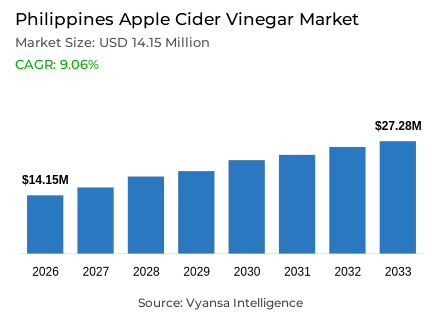
Apple cider vinegar in the Philippines is a vinegar sold as a liquid for cooking and household use, and as powder, capsule, tablet and gummy supplements for weight and digestive care. The Philippines apple cider vinegar market is forecast to grow at a compound annual growth rate (CAGR) of 9.06% between 2027 and 2033.
Key Highlights of the Philippines Apple Cider Vinegar Market
- The Philippines apple cider vinegar market was valued at USD 14.15 million in 2026 and is projected to reach USD 16.21 million in 2027 and USD 27.28 million by 2033.
- The market is forecast to grow at a CAGR of 9.06% during the forecasted period of 2027–2033.
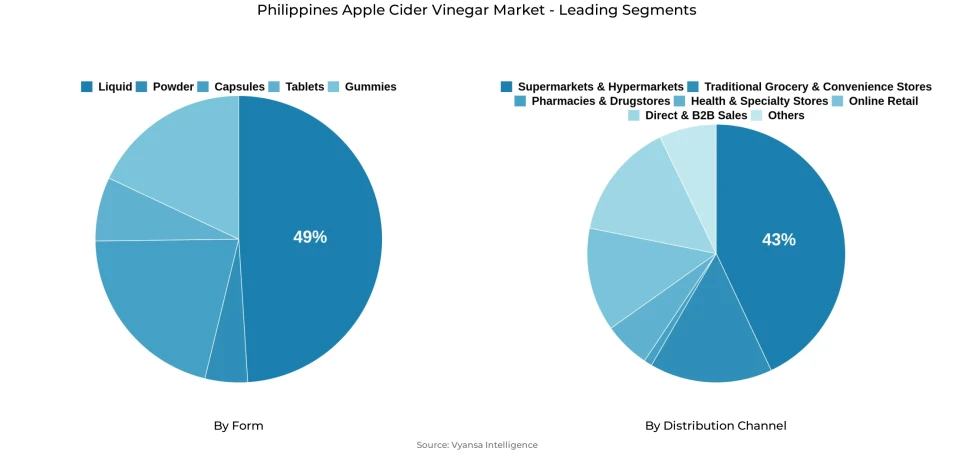
- Liquid is projected to lead the form segment with a 49% share in 2026.
- Gummies are projected to be the fastest-growing form, recording a 12.17% CAGR during 2027–2033.
- Supermarkets & Hypermarkets are projected to lead the distribution channel segment with a 43% share in 2026.
- Online Retail is projected to be the fastest-growing distribution channel, recording a 15.53% CAGR during 2027–2033.
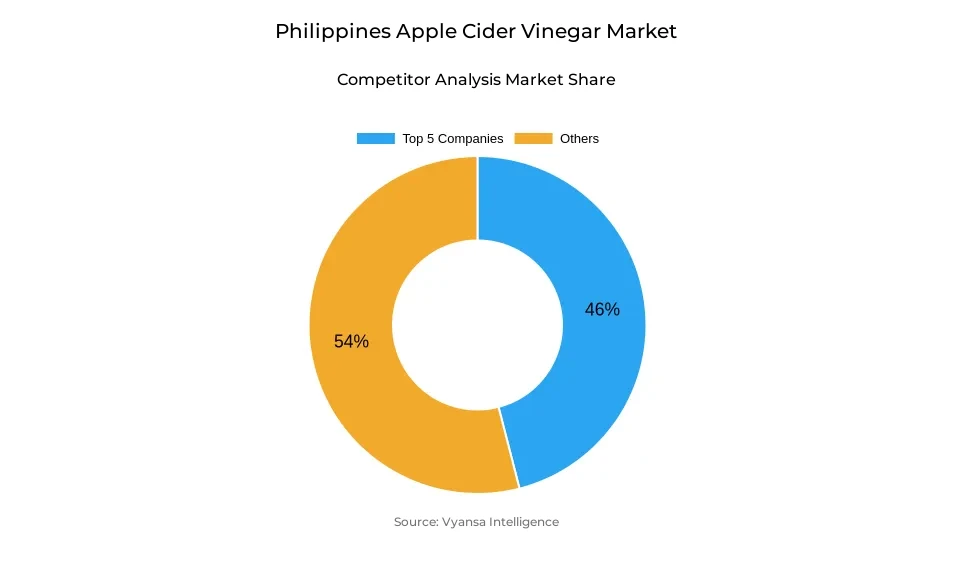
- The five leading companies are projected to hold a combined 46% market share in 2026.
The Philippines offers a substantial consumer base for apple cider vinegar (ACV) products, supported by a growing number of households and diverse consumption preferences. In 2024, the country recorded a population of 112.73 million and 29.67 million households, representing a 12.4% increase in household numbers compared with 2020. This expanding household base creates opportunities for ACV manufacturers to reach consumers through both conventional food applications and wellness-oriented products. Liquid vinegar is commonly used in food preparation, while capsules and gummies provide alternative formats for consumers seeking convenient ways to incorporate ACV into their daily routines.
Product availability across Philippine retail channels further supports market accessibility. Retailers offer liquid vinegar in 500 ml bottles, alongside capsules and gummies in 30-count and 60-count packs. This variety allows consumers to choose products according to their budgets, taste preferences, and consumption habits. Smaller packs can encourage first-time purchases by reducing upfront spending, whereas larger bottles and multi-serving supplement packs can support continued consumption.
Over the forecast period, market growth will depend partly on converting occasional users into regular consumers. Interest in digestive wellness and weight management may support demand, although manufacturers must avoid unsubstantiated health claims and communicate product benefits responsibly. Companies that combine affordable pricing, appropriate product registration, broad retail distribution, and convenient formulations that address vinegar's strong taste will be better positioned to expand their customer base across Metro Manila and provincial markets.
Philippines Apple Cider Vinegar Market Drivers
Rising Metabolic Health Concerns Support Routine Consumption
The prevalence of overweight and obesity among Filipino adults increased from 39.8% in 2023 to 44.5% in 2025. The International Diabetes Federation separately estimated that 4.73 million adults in the Philippines were living with diabetes in 2024, representing 7.5% of the adult population. These figures are increasing public attention toward body weight, blood-sugar management, diet quality and everyday wellness practices.
Apple cider vinegar benefits commercially from this attention because it is widely positioned as a convenient addition to diet and weight-management routines. Consumers can purchase the product without a prescription and choose between liquid, capsule and gummy formats. Although apple cider vinegar is not a substitute for medical treatment, the ability to incorporate it into a self-directed routine supports regular consumption and recurring product replenishment.
The expanding population affected by metabolic health concerns gives companies a growing audience for products positioned around responsible dietary support. Leading players in apple cider vinegar industry that communicate permitted benefits without overstating medical effects can serve consumers seeking manageable lifestyle changes. Through 2033, this health-conscious audience should remain a central source of demand, particularly for products that are easy to consume consistently and clearly disclose their ingredients and serving instructions.
Philippines Apple Cider Vinegar Market Challenges
Import Costs and Household Budget Pressure Limit Wider Adoption
Much of the branded apple cider vinegar sold in the Philippines is imported. Retail listings identify liquid products manufactured in countries including Italy and the United States, while several supplement companies distribute products manufactured abroad. Importers consequently face foreign-exchange exposure, international freight costs and longer replenishment cycles, which can make apple cider vinegar more expensive than locally produced cane or coconut vinegar.
Affordability became a greater concern in 2026. Philippine headline inflation reached 7.2% in September, while household consumption growth slowed to 2.8% in the second quarter from 5.2% a year earlier. When essential expenses rise faster, imported wellness products face greater scrutiny because households can postpone purchases or reduce consumption without immediately affecting their basic needs.
This pressure can lengthen repurchase intervals and increase dependence on promotions, smaller packs and entry-level formats. Premium organic products and imported gummies are particularly exposed because their pricing includes formulation, registration and distribution costs beyond the underlying vinegar. Suppliers must therefore control serving costs and offer clear reasons for consumers to continue purchasing after the initial trial, especially outside higher-income urban markets.
Philippines Apple Cider Vinegar Market Recent Trends
Reduced-Sugar and Multi-Ingredient Formats Gain Attention
Apple cider vinegar supplements are moving beyond basic vinegar powder toward formulations designed around taste, sugar content and complementary ingredients. This allows brands to distinguish otherwise similar gummies and capsules while addressing consumers who dislike liquid vinegar. Product development is consequently focusing on easier daily consumption rather than reproducing the characteristics of bottled vinegar alone.
Goli’s Philippine range includes a zero-sugar ACV+ gummy formulated with soluble tapioca fibre, fructooligosaccharides, stevia, beetroot, pomegranate and vitamins B9 and B12. Its conventional gummies also combine apple cider vinegar with fruit-derived ingredients and B vitamins. These formulations position apple cider vinegar within a broader wellness routine and give consumers reasons to compare ingredient profiles rather than only vinegar concentration.
This trend should produce more differentiated products covering sugar-free, vegan and blended formulations. However, additional ingredients must provide a clear consumer purpose and comply with approved labelling requirements. Suppliers that control sweetness while keeping ingredient lists understandable can appeal to consumers who want a convenient format but remain attentive to sugar intake and unnecessary additives.
Philippines Apple Cider Vinegar Market Future Opportunities
Ready-to-Drink Products Create a New Consumption Occasion
Traditional apple cider vinegar usually requires dilution and retains a sharp taste and smell. Gummies and capsules remove that preparation step but move the product into the supplement category. Ready-to-drink beverages offer a third route by combining apple cider vinegar with fruit juice, flavoring, or prebiotic ingredients in a product that can be consumed directly.
In May 2026, Lv Jie disclosed plans to expand its ready-to-drink apple cider vinegar portfolio into Southeast Asia. Its range includes portable 15 ml sachets and 200 ml canned beverages combining apple cider vinegar with apple juice and prebiotic ingredients. These formats are intended to make vinegar more palatable and convenient for younger consumers who may not prepare diluted liquid at home.
Philippine suppliers can use this model to reach convenience stores, cafés, gyms and beverage aisles in addition to existing grocery and supplement channels. The strongest products would control sugar, retain a meaningful apple cider vinegar content and use flavors familiar to local consumers. A successful ready-to-drink range could increase consumption frequency by moving the category from a planned household routine into an on-the-go beverage occasion.
Unlock Market Intelligence
Explore the market potential with our data-driven report
Philippines Apple Cider Vinegar Market Segmentation Analysis
By Form:
- Liquid
- Powder
- Capsules
- Tablets
- Gummies
Liquid Holds 49% of Form Demand as the Household Staple
Liquid is projected to account for 49% of the Philippines apple cider vinegar market in 2026. It remains the leading form because households can use one bottle for cooking, marinades, dressings and diluted drinks. The format is familiar, requires limited processing and generally offers more servings per package than supplements. Unfiltered products containing the mother also provide brands with a recognizable point of differentiation within the established liquid category.
Gummies are projected to grow at a CAGR of 12.17% during 2027–2033. They remove the strong vinegar taste, provide a fixed serving and require no dilution, making them easier to incorporate into a daily routine. Registered products from Goli, Wellspring and Watsons demonstrate that the format is developing beyond specialist health stores. Continued growth will depend on balancing flavor and convenience with acceptable sugar content and compliant product claims.
By Distribution Channel:
- Supermarkets & Hypermarkets
- Traditional Grocery & Convenience Stores
- Pharmacies & Drugstores
- Health & Specialty Stores
- Online Retail
- Direct & B2B Sales
- Others
Supermarkets and Hypermarkets Hold 43% of Channel Demand Through the Weekly Grocery Trip
Supermarkets & Hypermarkets are projected to hold 43% of the Philippines apple cider vinegar market in 2026. These stores place liquid vinegar beside cooking ingredients while also carrying wellness products in dedicated sections, allowing the category to reach culinary and health-oriented consumers during the same visit. Puregold operated 794 stores by June 2026, illustrating the physical reach available to brands that obtain listings with national retail chains.
Online Retail is projected to grow at a CAGR of 15.53% during 2027–2033. Online platforms allow imported and specialist products to reach consumers without depending on physical shelf space in every province. The Philippine digital economy represented 9.8% of national GDP in 2025, while e-commerce contributed 32.2% of digital-economy gross value added. Marketplace search, reviews and home delivery support comparison and repeat ordering across multiple apple cider vinegar formats.
Unlock Market Intelligence
Explore the market potential with our data-driven report
Philippines Apple Cider Vinegar Market Competitive Landscape
The apple cider vinegar industry in the Philippines is moderately fragmented, with the top five companies holding a combined 46% share in 2026. The top 5 five companies in the market are JIA2 Corporation, Suncoast Brands International Corporation, Skyheglobal Inc., Mondial88 Trading Corporation, and Organica Nutrition, Inc.
Key Companies in the Market
- JIA2 Corporation
- Suncoast Brands International Corporation
- Skyheglobal Inc.
- Mondial88 Trading Corporation
- Organica Nutrition, Inc.
- Healthy Options Corporation
- Betabrands Corp.
- Watsons Personal Care Stores (Philippines), Inc.
- Robinson's Supermarket Corporation
- LifeStrong Marketing Inc.
Recent Developments in the Philippines Apple Cider Vinegar Market
- October 2026: Bragg launched Tropical Zing, a ready-to-drink sparkling beverage containing one tablespoon of organic apple cider vinegar and real fruit juice in each can. The four-flavour range contains no added sugar and extends the brand beyond bottled vinegar and supplements. The development provides JIA2 Corporation with a potential product for future introduction into the Philippine functional food and beverage market.
- August 2026: The Department of Science and Technology introduced an iron-enriched vinegar formulation developed to address nutritional deficiencies while creating a commercially viable fortified condiment. Although the initial formulation is not specifically an apple cider vinegar product, the development demonstrates how vinegar can serve as a carrier for additional functional benefits and creates a pathway for similar value-added innovation within the apple cider vinegar category.
Frequently Asked Questions
Related Report
- Market Segmentation
- Research Scope
- Research Methodology
- Definitions and Assumptions
- Executive Summary
- Philippines Apple Cider Vinegar Market Policies, Regulations, and Standards
- Philippines Apple Cider Vinegar Market Dynamics
- Growth Factors
- Challenges
- Trends
- Opportunities
- Philippines Apple Cider Vinegar Market Statistics, 2023-2033F
- Market Size & Growth Outlook
- By Revenues in USD Million
- Market Segmentation & Growth Outlook
- By Form
- Liquid- Market Insights and Forecast 2023-2033, USD Million
- Powder- Market Insights and Forecast 2023-2033, USD Million
- Capsules- Market Insights and Forecast 2023-2033, USD Million
- Tablets- Market Insights and Forecast 2023-2033, USD Million
- Gummies- Market Insights and Forecast 2023-2033, USD Million
- By Nature
- Organic- Market Insights and Forecast 2023-2033, USD Million
- Conventional- Market Insights and Forecast 2023-2033, USD Million
- By Application
- Food & Beverages- Market Insights and Forecast 2023-2033, USD Million
- Dietary Supplements- Market Insights and Forecast 2023-2033, USD Million
- Personal Care- Market Insights and Forecast 2023-2033, USD Million
- Others- Market Insights and Forecast 2023-2033, USD Million
- By Distribution Channel
- Supermarkets & Hypermarkets- Market Insights and Forecast 2023-2033, USD Million
- Traditional Grocery & Convenience Stores- Market Insights and Forecast 2023-2033, USD Million
- Pharmacies & Drugstores- Market Insights and Forecast 2023-2033, USD Million
- Health & Specialty Stores- Market Insights and Forecast 2023-2033, USD Million
- Online Retail- Market Insights and Forecast 2023-2033, USD Million
- Direct & B2B Sales- Market Insights and Forecast 2023-2033, USD Million
- Others- Market Insights and Forecast 2023-2033, USD Million
- By Competitors
- Competition Characteristics
- Market Share & Analysis
- By Form
- Market Size & Growth Outlook
- Philippines Liquid Apple Cider Vinegar Market Statistics, 2023-2033
- Market Size & Growth Outlook
- By Revenues in USD Million
- Market Segmentation & Growth Outlook
- By Nature- Market Insights and Forecast 2023-2033, USD Million
- By Application- Market Insights and Forecast 2023-2033, USD Million
- By Distribution Channel- Market Insights and Forecast 2023-2033, USD Million
- Market Size & Growth Outlook
- Philippines Powdered Apple Cider Vinegar Market Statistics, 2023-2033
- Market Size & Growth Outlook
- By Revenues in USD Million
- Market Segmentation & Growth Outlook
- By Nature- Market Insights and Forecast 2023-2033, USD Million
- By Application- Market Insights and Forecast 2023-2033, USD Million
- By Distribution Channel- Market Insights and Forecast 2023-2033, USD Million
- Market Size & Growth Outlook
- Philippines Apple Cider Vinegar Capsules Market Statistics, 2023-2033
- Market Size & Growth Outlook
- By Revenues in USD Million
- Market Segmentation & Growth Outlook
- By Nature- Market Insights and Forecast 2023-2033, USD Million
- By Application- Market Insights and Forecast 2023-2033, USD Million
- By Distribution Channel- Market Insights and Forecast 2023-2033, USD Million
- Market Size & Growth Outlook
- Philippines Apple Cider Vinegar Tablets Market Statistics, 2023-2033
- Market Size & Growth Outlook
- By Revenues in USD Million
- Market Segmentation & Growth Outlook
- By Nature- Market Insights and Forecast 2023-2033, USD Million
- By Application- Market Insights and Forecast 2023-2033, USD Million
- By Distribution Channel- Market Insights and Forecast 2023-2033, USD Million
- Market Size & Growth Outlook
- Philippines Apple Cider Vinegar Gummies Market Statistics, 2023-2033
- Market Size & Growth Outlook
- By Revenues in USD Million
- Market Segmentation & Growth Outlook
- By Nature- Market Insights and Forecast 2023-2033, USD Million
- By Application- Market Insights and Forecast 2023-2033, USD Million
- By Distribution Channel- Market Insights and Forecast 2023-2033, USD Million
- Market Size & Growth Outlook
- Competitive Outlook
- Company Profiles
- JIA2 Corporation (Bragg)
- Business Description
- Product Portfolio
- Collaborations & Alliances
- Recent Developments
- Financial Details
- Others
- Suncoast Brands International Corporation (Skinny Mamas)
- Business Description
- Product Portfolio
- Collaborations & Alliances
- Recent Developments
- Financial Details
- Others
- Skyheglobal Inc. (Goli)
- Business Description
- Product Portfolio
- Collaborations & Alliances
- Recent Developments
- Financial Details
- Others
- Mondial88 Trading Corporation (American Garden)
- Business Description
- Product Portfolio
- Collaborations & Alliances
- Recent Developments
- Financial Details
- Others
- Organica Nutrition, Inc. (BestShape)
- Business Description
- Product Portfolio
- Collaborations & Alliances
- Recent Developments
- Financial Details
- Others
- Healthy Options Corporation
- Business Description
- Product Portfolio
- Collaborations & Alliances
- Recent Developments
- Financial Details
- Others
- Betabrands Corp. (Wellspring)
- Business Description
- Product Portfolio
- Collaborations & Alliances
- Recent Developments
- Financial Details
- Others
- Watsons Personal Care Stores (Philippines), Inc. (Watsons Generics)
- Business Description
- Product Portfolio
- Collaborations & Alliances
- Recent Developments
- Financial Details
- Others
- Robinson's Supermarket Corporation (Meadows)
- Business Description
- Product Portfolio
- Collaborations & Alliances
- Recent Developments
- Financial Details
- Others
- LifeStrong Marketing Inc. (NutriXpert)
- Business Description
- Product Portfolio
- Collaborations & Alliances
- Recent Developments
- Financial Details
- Others
- JIA2 Corporation (Bragg)
- Company Profiles
- Disclaimer
| Segment | Sub-Segment |
|---|---|
| By Form |
|
| By Nature |
|
| By Application |
|
| By Distribution Channel |
|
Research Methodology
This study followed a structured approach comprising four key phases to assess the size and scope of the electro-oxidation market. The process began with thorough secondary research to collect data on the target market, related markets, and broader industry context. These findings, along with preliminary assumptions and estimates, were then validated through extensive primary research involving industry experts from across the value chain. To calculate the overall market size, both top-down and bottom-up methodologies were employed. Finally, market segmentation and data triangulation techniques were applied to refine and validate segment-level estimations.
Secondary Research
The secondary research phase involved gathering data from a wide range of credible and published sources. This step helped in identifying industry trends, defining market segmentation, and understanding the market landscape and value chain.
Sources consulted during this phase included:
- Company annual reports, investor presentations, and press releases
- Industry white papers and certified publications
- Trade directories and market-recognized databases
- Articles from authoritative authors and reputable journals
- Gold and silver standard websites
Secondary research was critical in mapping out the industry's value chain and monetary flow, identifying key market segments, understanding regional variations, and tracking significant industry developments.
Other key sources:
- Financial disclosures
- Industry associations and trade bodies
- News outlets and business magazines
- Academic journals and research studies
- Paid industry databases
Primary Research
To validate secondary data and gain deeper market insights, primary research was conducted with key stakeholders across both the supply and demand sides of the market.
On the demand side, participants included decision-makers and influencers from end-user industries—such as CIOs, CTOs, and CSOs—who provided first-hand perspectives on market needs, product usage, and future expectations.
On the supply side, interviews were conducted with manufacturers, industry associations, and institutional participants to gather insights into current offerings, product pipelines, and market challenges.
Primary interviews provided critical inputs such as:
- Market size and revenue data
- Product and service breakdowns
- Market forecasts
- Regional and application-specific trends
Stakeholders consulted included:
- Leading OEM and solution providers
- Channel and distribution partners
- End users across various applications
- Independent consultants and industry specialists
Market Size Estimation and Data Triangulation
- Identifying Key Market Participants (Secondary Research)
- Goal: To identify the major players or companies in the target market. This typically involves using publicly available data sources such as industry reports, market research publications, and financial statements of companies.
- Tools: Reports from firms like Gartner, Forrester, Euromonitor, Statista, IBISWorld, and others. Public financial statements, news articles, and press releases from top market players.
- Extracting Earnings of Key Market Participants
- Goal: To estimate the earnings generated from the product or service being analyzed. This step helps in understanding the revenue potential of each market player in a specific geography.
- Methods: Earnings data can be gathered from:
- Publicly available financial reports (for listed companies).
- Interviews and primary data sources from professionals, such as Directors, VPs, SVPs, etc. This is especially useful for understanding more nuanced, internal data that isn't publicly disclosed.
- Annual reports and investor presentations of key players.
- Data Collation and Development of a Relevant Data Model
- Goal: To collate inputs from both primary and secondary sources into a structured, data-driven model for market estimation. This model will incorporate key market KPIs and any independent variables relevant to the market.
- Key KPIs: These could include:
- Market size, growth rate, and demand drivers.
- Industry-specific metrics like market share, average revenue per customer (ARPC), or average deal size.
- External variables, such as economic growth rates, inflation rates, or commodity prices, that could affect the market.
- Data Modeling: Based on this data, the market forecasts are developed for the next 5 years. A combination of trend analysis, scenario modeling, and statistical regression might be used to generate projections.
- Scenario Analysis
- Goal: To test different assumptions and validate how sensitive the market is to changes in key variables (e.g., market demand, regulatory changes, technological disruptions).
- Types of Scenarios:
- Base Case: Based on current assumptions and historical data.
- Best-Case Scenario: Assuming favorable market conditions, regulatory environments, and technological advancements.
- Worst-Case Scenario: Accounting for adverse factors, such as economic downturns, stricter regulations, or unexpected disruptions.