South Africa Liquid Smoke Market Report: Trends, Growth and Forecast (2027-2033)
By Smoke Type (Hickory, Mesquite, Applewood, Oak, Others), By Application (Meat & Poultry, Seafood, Sauces, Dressings & Marinades, Dairy Products, Bakery & Confectionery, Snacks & Savory Products, Plant-Based Meat Alternatives, Pet Food, Others), By Region (Gauteng, Western Cape, KwaZulu-Natal, Other Provinces) ... Read more
|
Major Players
|
South Africa Liquid Smoke Market Overview
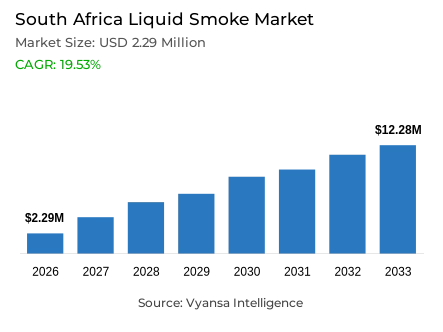
Liquid smoke is a manufactured ingredient that reproduces wood-smoke flavor, aroma and color without every batch passing through a smokehouse. South African processed-meat and poultry manufacturers consume it as a recurring formulation input, while sauce, marinade, snack, foodservice and plant-based meat producers increasingly specify it for grilled and smoked profiles. The South Africa liquid smoke market is forecast to expand at a 19.53% CAGR between 2027 and 2033.
Key Highlights of the South Africa Liquid Smoke Market
- The South Africa liquid smoke market was valued at USD 2.29 million in 2026 and is estimated at USD 4.21 million in 2027 and is projected to expand to USD 12.28 million by 2033.
- The market is forecast to register a 19.53% compound annual growth rate across the 2027 to 2033 forecast period.
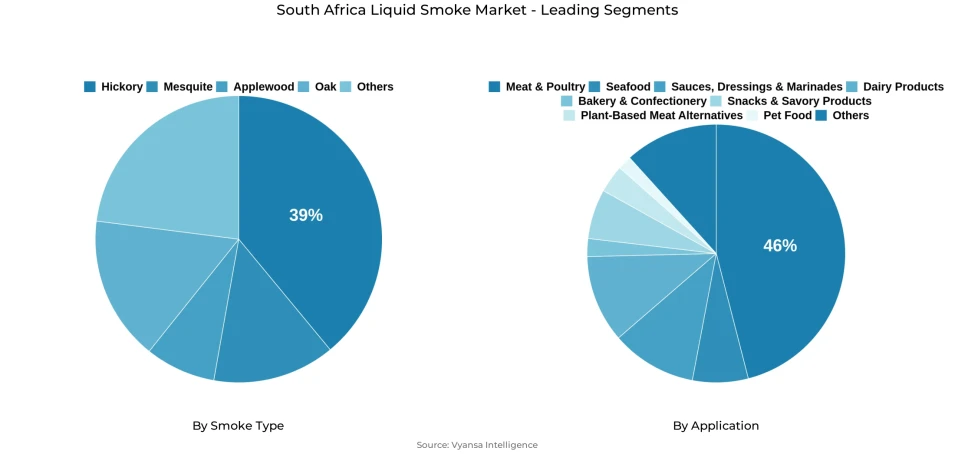
- By smoke type, hickory leads the market with a 39% share in 2026.
- Applewood is the fastest-growing smoke type in the market, expanding at an 11.43% CAGR between 2027 and 2033.
- By application, meat & poultry leads the market with a 46% share in 2026.
- Plant-based meat alternatives are the fastest-growing segment in the market, expanding at an 18.42% CAGR between 2027 and 2033.
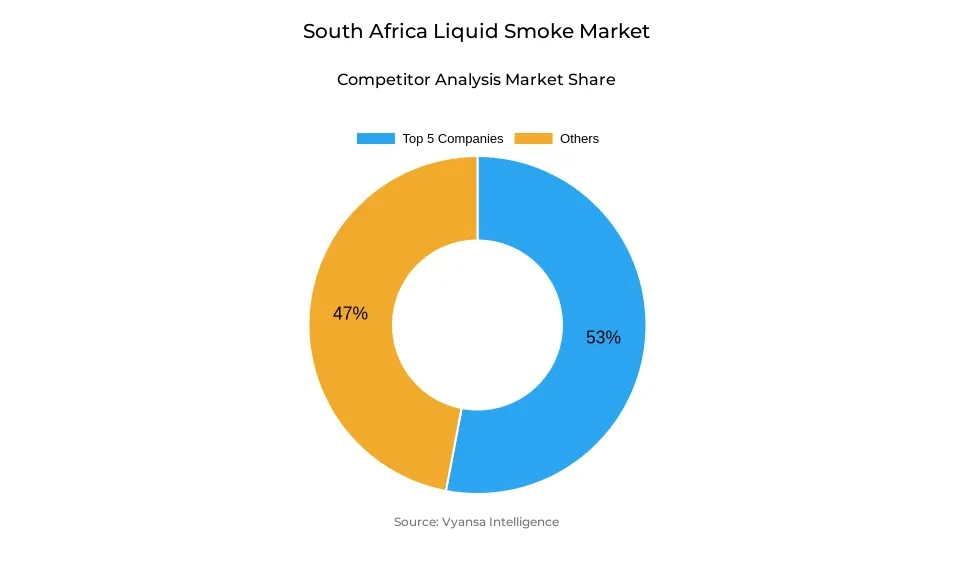
- The market structure is consolidated, with the top five companies holding a combined 53% share in 2026.
South Africa’s liquid smoke market is supported by repeat demand from food processors, particularly those making meat and poultry products. Chicken accounts for about 60% of the country’s meat consumption, giving processors a large base for products differentiated by smoked taste. Liquid smoke can be blended into a recipe or applied during processing to deliver consistent flavor and color across batches. It also allows manufacturers to make smoked products without putting every batch through a conventional smokehouse.
The ingredient is finding uses beyond processed meat. South African food and beverage manufacturing output rose 4.1% year on year in July 2026, while a local liquid smoke supplier reports serving 200 commercial customers across businesses including butcheries, vegetarian food producers and coffee shops. These figures describe different parts of the food industry, but together show why suppliers need formulations suited to more than one type of customer. In sauces and marinades, for example, smoke can be added during mixing rather than through a separate smoking step.
Through the forecast period, meat and poultry processing should remain the principal source of recurring demand. Growth beyond that base will depend on whether suppliers can help manufacturers achieve the right smoke intensity in other foods at a cost that works for regular production. Consistent flavor, reliable supply and practical formulation support will therefore matter as much as the range of wood profiles offered.
South Africa Liquid Smoke Market Drivers
Growth in Domestic Poultry Processing Supports Recurring Ingredient Demand
The volume of poultry processed in South Africa is a direct driver of liquid smoke purchases. Once a manufacturer specifies a smoke formulation for a sausage, coated portion or other prepared product, the ingredient is needed each time that product is made. Liquid application also helps high-volume processors control flavor and color without relying on a separate conventional smoking cycle for every batch.
The USDA Foreign Agricultural Service forecasts South African chicken production of 1.68 million tonnes in 2026, up 2% from 2025. Industry investment between 2019 and 2023 expanded production facilities and added capacity for 19 million broilers annually. The additional birds do not all become smoked products, but a larger domestic processing base gives manufacturers more scope to develop seasoned and further-processed ranges that use smoke flavor as a regular input.
This driver depends on processors converting poultry throughput into higher-value products. Suppliers that can provide repeatable results on existing production lines are better placed to become part of those formulations and retain the resulting orders.
South Africa Liquid Smoke Market Challenges
Animal Disease Disrupts the Meat Processing Supply Base
Animal disease can interrupt liquid smoke demand before an ingredient reaches the processing line. Outbreak controls affect the movement and availability of livestock, making it harder for some meat processors to plan production and maintain established product volumes. The effect is most direct in beef-linked applications; it should not be treated as an equal constraint on every liquid smoke customer.
South Africa’s 2026 foot-and-mouth outbreak was reported across all nine provinces, although its severity varied by location. The trade impact was already substantial: beef export volumes to China fell 69.2% between 2024 and 2025. Export losses alone do not measure liquid smoke consumption, but the outbreak and related restrictions show the uncertainty facing processors that depend on a stable cattle supply.
The national vaccination program is intended to bring the disease under control, with a target of covering 80% of the cattle herd by the end of 2026. Until supply and movement become more predictable, smoke-flavor suppliers serving red-meat processors may face less reliable order schedules and slower qualification of new products.
South Africa Liquid Smoke Market Recent Trends
Liquid Smoke Moves into Sauces and Other Prepared Foods
Manufacturers are using liquid smoke to build flavor into foods that are mixed, coated or seasoned rather than conventionally smoked. This changes how the ingredient is sold: a sauce producer may need a smoke note that remains balanced after blending, while a foodservice customer may want a recognizable grilled profile across several menu items. Those requirements create demand for application-specific formulations rather than one standard smoke concentrate.
The shift is visible in products available locally. Deli Spices describes its TRU*SMOKE 25N as suitable for sauces and other applications requiring a lower-acid profile. South African specialist smoked flavors also offers commercial-grade liquid smoke for sauces, marinades and foodservice uses. These offerings show a practical route into new formulations, although their availability does not establish the sales volume of those applications.
As more producers test smoked variants of existing foods, suppliers can win business by helping them set dosage and maintain the intended taste through production and shelf life.
Digital Flavor Platforms Shorten Product Development
Flavor suppliers are making discovery, technical information and sample requests available through digital platforms. For manufacturers, this can shorten the early stage of development: a product team can compare profiles, obtain documentation and request a sample before committing time to a full formulation trial. The change concerns how ingredients are selected and qualified, rather than how liquid smoke is applied in a factory.
In January 2026, Kerry launched its Global Taste Charts with KerryNow, a platform through which customers can browse flavor information, order samples and seek application support. Its charts cover categories including meat and meals, savory snacks, and soups and dressings. Kerry has not disclosed South African liquid smoke orders generated through the platform, so the development is evidence of a changing supplier service model rather than measured local market growth.
For South African manufacturers evaluating smoke profiles, faster access to samples and technical guidance could make smaller product trials easier to run. Suppliers will still need to prove that the selected flavor performs consistently in the customer’s finished product.
South Africa Liquid Smoke Market Future Opportunities
Plant-Based Products Create Demand for Grilled Flavor
Plant-based meat alternatives give liquid smoke suppliers an opportunity to sell flavor as part of a product’s core sensory design. Manufacturers in this category must create a convincing cooked or grilled character using non-meat ingredients. A suitable smoke formulation can contribute that character without requiring the product itself to be conventionally smoked.
Local product development provides a route to this business. Fry Family Foods introduced its Flexi Range in South Africa in 2025, and its Braai Sizzler is positioned around a familiar local grilling occasion. These products demonstrate demand for recognizable grilled profiles, but their published descriptions do not establish that they contain liquid smoke. The opportunity for ingredient suppliers is to win future development briefs by showing how their formulations perform in plant proteins, coatings and cooking processes.
South Africa’s meat-analogue rules, published in 2025 and effective from July 2026, clarify permitted product descriptions while restricting certain references to animal species. They affect how finished products are presented to buyers; they do not themselves require liquid smoke. Suppliers that can support compliant product development and deliver the intended grilled taste have a clearer route to long-term formulation contracts.
Unlock Market Intelligence
Explore the market potential with our data-driven report
South Africa Liquid Smoke Market Segmentation Analysis
By Smoke Type:
- Hickory
- Mesquite
- Applewood
- Oak
- Others
Hickory Leads Smoke-Type Demand with a 39% Share
Hickory accounts for 39% of liquid smoke demand by smoke type, supported by its strong, distinctive flavor profile across processed meat products, including sausages, bacon, and barbecue-style poultry. Its established use in these applications is reinforced by product availability across multiple suppliers, including Kerry Red Arrow, Azelis, and Colgin. In January 2026, a supplier listing confirmed that Colgin continued to offer hickory-flavored liquid smoke in retail and foodservice packaging formats. Hickory is expected to maintain its leading position as demand for smoked meat and poultry products sustains ingredient consumption.
Applewood is projected to register the fastest growth among smoke types, with a CAGR of 11.43% during 2027–2033. Its milder, sweeter flavor profile supports applications across poultry, seafood, and marinades, where a strong smoke flavor may be less suitable. In December 2024, Besmoke Limited confirmed a distribution partnership with Azelis, expanding access to its Apple-profile PureSmoke range. This broader distribution reach could support adoption across additional food applications. While hickory benefits from established demand in processed meat, Applewood's versatility offers opportunities to penetrate diverse product categories and expand from a smaller market base.
By Application:
- Meat & Poultry
- Seafood
- Sauces, Dressings & Marinades
- Dairy Products
- Bakery & Confectionery
- Snacks & Savory Products
- Plant-Based Meat Alternatives
- Pet Food
- Others
Meat & Poultry Commands 46% of Application Demand
Meat & Poultry accounts for 46% of application demand in 2026 because liquid smoke performs its original function in this industry, replacing a full smokehouse cycle across sausages, bacon, ham and further-processed poultry lines at industrial line speed. Deli Spices distributes its TRU*SMOKE 45P for drenching industrial meat and TRU*SMOKE 25N for direct internal addition, giving local processors purpose-built formats rather than one generic liquid smoke. The segment's absolute volume keeps expanding alongside domestic poultry-processing growth, though its share gradually narrows as non-meat applications expand faster through the forecast period.
Plant-based meat alternatives is forecast to grow at an 18.42% CAGR between 2027 and 2033, the fastest of any application, as regulatory clarity lets formulators invest confidently in grilled and smoked flavor systems for meat analogues. Fry Family Foods launched its Flexi Range in August 2025, including a Braai Sizzler built to replicate charred sensory character, while LIVEKINDLY Collective Africa's Pinetown facility was cited in December 2025 alongside plans for 2026 growth. It outpaces Meat & Poultry by expanding from a smaller base into a formulation pathway meat processing occupies.
Unlock Market Intelligence
Explore the market potential with our data-driven report
South Africa Liquid Smoke Market Competitive Landscape
The South Africa liquid smoke market is consolidated, with the top five companies holding a combined 53% share of this industry in 2026, the base year applied throughout this competitive assessment. The top five companies profiled here are Kerry Ingredients South Africa (PTY) Ltd. (Kerry Red Arrow), Azelis South Africa (Pty) Ltd, Deli Spices (Pty) Ltd, Besmoke Limited and Colgin Inc.
Key Companies in the South Africa Liquid Smoke Market
- Kerry Ingredients South Africa (PTY) Ltd. (Kerry Red Arrow™)
- Azelis South Africa (Pty) Ltd (Scansmoke®)
- Deli Spices (Pty) Ltd (Tru*Smoke)
- Freddy Hirsch Group (Pty) Ltd
- Besmoke Ltd (Puresmoke)
- Smoked Flavors
- Colgin Inc. (Colgin Liquid Smoke)
- B&G Foods, Inc. (Wright's)
- Bamboo Spirit Pty Ltd (BAMLIQUA™)
- Martinnaise Food Products
Company Profiling
The following profiles cover the five leading suppliers shaping product development, distribution and competitive positioning in the South Africa liquid smoke market.
Kerry Ingredients South Africa (Pty) Ltd. (Kerry Red Arrow): Kerry serves food manufacturers through its Red Arrow smoke and grill portfolio, which includes liquid smoke condensates and other ingredients for meat, prepared foods and savoury applications. Its application support helps processors select a smoke profile that remains consistent when production moves beyond the trial stage. In 2026, Kerry identified innovation using smoke and grill technologies among the activities supporting its meat business.
Azelis South Africa (Pty) Ltd. (Scansmoke): Azelis supplies Scansmoke through its food-ingredient distribution network. Its position combines access to smoke flavorings with technical support for manufacturers adapting an ingredient to their own recipes and processes. The company opened a food and nutrition application laboratory in Johannesburg in 2022, giving South African customers a local facility for formulation and product trials.
Deli Spices (Pty) Ltd. (TRU*SMOKE): Deli Spices supplies TRUSMOKE liquid formulations for direct addition to food and for application to processed meat during production. Its local product range and familiarity with meat-processing methods make it relevant to manufacturers seeking an ingredient that fits existing recipes and equipment. Its 2026 product certification includes TRUSMOKE 25N and 45P, providing current documentation for buyers evaluating these formulations.
Besmoke Limited (PureSmoke): Besmoke develops smoke ingredients using its filtration technology and offers PureSmoke profiles for a range of food applications. Its portfolio gives manufacturers options when a standard smoke flavor does not suit the intended product. By 2026, the company listed Carst & Walker as its South African distributor, providing a named local channel for access to its ingredients and technical support.
Colgin Inc. (Colgin Liquid Smoke): Colgin offers hickory, mesquite, pecan and apple liquid smoke flavors in retail and larger pack formats. In South Africa, its visible route to customers is through imported product listings rather than a disclosed local industrial distribution network. Colgin liquid smoke was listed for purchase through a South African online retailer in 2026, confirming product availability.
Recent Developments in the South Africa Liquid Smoke Market
- In July 2026, Tiger Brands opened an expanded culinary manufacturing site in Paarl, bringing chutney production in-house and adding capacity for its condiments portfolio. The investment expands South Africa’s local base for manufactured sauces and condiments, a potential customer group for liquid smoke suppliers.
Frequently Asked Questions
Related Report
- Market Segmentation
- Research Scope
- Research Methodology
- Definitions and Assumptions
- Executive Summary
- South Africa Liquid Smoke Market Policies, Regulations, and Standards
- South Africa Liquid Smoke Market Dynamics
- Growth Factors
- Challenges
- Trends
- Opportunities
- South Africa Liquid Smoke Market Statistics, 2033-2033F
- Market Size & Growth Outlook
- By Revenues in USD Million
- Market Segmentation & Growth Outlook
- By Smoke Type
- Hickory- Market Insights and Forecast 2033-2033, USD Million
- Mesquite- Market Insights and Forecast 2033-2033, USD Million
- Applewood- Market Insights and Forecast 2033-2033, USD Million
- Oak- Market Insights and Forecast 2033-2033, USD Million
- Others- Market Insights and Forecast 2033-2033, USD Million
- By Application
- Meat & Poultry- Market Insights and Forecast 2033-2033, USD Million
- Seafood- Market Insights and Forecast 2033-2033, USD Million
- Sauces, Dressings & Marinades- Market Insights and Forecast 2033-2033, USD Million
- Dairy Products- Market Insights and Forecast 2033-2033, USD Million
- Bakery & Confectionery- Market Insights and Forecast 2033-2033, USD Million
- Snacks & Savory Products- Market Insights and Forecast 2033-2033, USD Million
- Plant-Based Meat Alternatives- Market Insights and Forecast 2033-2033, USD Million
- Pet Food- Market Insights and Forecast 2033-2033, USD Million
- Others- Market Insights and Forecast 2033-2033, USD Million
- By Region
- Gauteng- Market Insights and Forecast 2033-2033, USD Million
- Western Cape- Market Insights and Forecast 2033-2033, USD Million
- KwaZulu-Natal- Market Insights and Forecast 2033-2033, USD Million
- Other Provinces- Market Insights and Forecast 2033-2033, USD Million
- By Competitors
- Competition Characteristics
- Market Share & Analysis
- By Smoke Type
- Market Size & Growth Outlook
- South Africa Hickory Smoke Market Statistics, 2033-2033
- Market Size & Growth Outlook
- By Revenues in USD Million
- Market Segmentation & Growth Outlook
- By Application- Market Insights and Forecast 2033-2033, USD Million
- By Region- Market Insights and Forecast 2033-2033, USD Million
- Market Size & Growth Outlook
- South Africa Mesquite Smoke Market Statistics, 2033-2033
- Market Size & Growth Outlook
- By Revenues in USD Million
- Market Segmentation & Growth Outlook
- By Application- Market Insights and Forecast 2033-2033, USD Million
- By Region- Market Insights and Forecast 2033-2033, USD Million
- Market Size & Growth Outlook
- South Africa Applewood Smoke Market Statistics, 2033-2033
- Market Size & Growth Outlook
- By Revenues in USD Million
- Market Segmentation & Growth Outlook
- By Application- Market Insights and Forecast 2033-2033, USD Million
- By Region- Market Insights and Forecast 2033-2033, USD Million
- Market Size & Growth Outlook
- South Africa Oak Smoke Market Statistics, 2033-2033
- Market Size & Growth Outlook
- By Revenues in USD Million
- Market Segmentation & Growth Outlook
- By Application- Market Insights and Forecast 2033-2033, USD Million
- By Region- Market Insights and Forecast 2033-2033, USD Million
- Market Size & Growth Outlook
- Competitive Outlook
- Company Profiles
- Kerry Ingredients South Africa (Pty) Ltd. (Kerry Red Arrow)
- Business Description
- Product Portfolio
- Collaborations & Alliances
- Recent Developments
- Financial Details
- Others
- Azelis South Africa (Pty) Ltd (Scansmoke)
- Business Description
- Product Portfolio
- Collaborations & Alliances
- Recent Developments
- Financial Details
- Others
- Deli Spices (Pty) Ltd (TRU*SMOKE)
- Business Description
- Product Portfolio
- Collaborations & Alliances
- Recent Developments
- Financial Details
- Others
- Besmoke Limited
- Business Description
- Product Portfolio
- Collaborations & Alliances
- Recent Developments
- Financial Details
- Others
- Colgin Inc. (Colgin Liquid Smoke)
- Business Description
- Product Portfolio
- Collaborations & Alliances
- Recent Developments
- Financial Details
- Others
- B&G Foods, Inc. (Wright's)
- Business Description
- Product Portfolio
- Collaborations & Alliances
- Recent Developments
- Financial Details
- Others
- Bamboo Spirit Pty Ltd (BAMLIQUA)
- Business Description
- Product Portfolio
- Collaborations & Alliances
- Recent Developments
- Financial Details
- Others
- Freddy Hirsch Group (Pty) Ltd (Zesti Smoke)
- Business Description
- Product Portfolio
- Collaborations & Alliances
- Recent Developments
- Financial Details
- Others
- Martinnaise Food Products (Martinnaise)
- Business Description
- Product Portfolio
- Collaborations & Alliances
- Recent Developments
- Financial Details
- Others
- Ruitenberg Ingredients B.V.
- Business Description
- Product Portfolio
- Collaborations & Alliances
- Recent Developments
- Financial Details
- Others
- Kerry Ingredients South Africa (Pty) Ltd. (Kerry Red Arrow)
- Company Profiles
- Disclaimer
| Segment | Sub-Segment |
|---|---|
| By Smoke Type |
|
| By Application |
|
| By Region |
|
Research Methodology
This study followed a structured approach comprising four key phases to assess the size and scope of the electro-oxidation market. The process began with thorough secondary research to collect data on the target market, related markets, and broader industry context. These findings, along with preliminary assumptions and estimates, were then validated through extensive primary research involving industry experts from across the value chain. To calculate the overall market size, both top-down and bottom-up methodologies were employed. Finally, market segmentation and data triangulation techniques were applied to refine and validate segment-level estimations.
Secondary Research
The secondary research phase involved gathering data from a wide range of credible and published sources. This step helped in identifying industry trends, defining market segmentation, and understanding the market landscape and value chain.
Sources consulted during this phase included:
- Company annual reports, investor presentations, and press releases
- Industry white papers and certified publications
- Trade directories and market-recognized databases
- Articles from authoritative authors and reputable journals
- Gold and silver standard websites
Secondary research was critical in mapping out the industry's value chain and monetary flow, identifying key market segments, understanding regional variations, and tracking significant industry developments.
Other key sources:
- Financial disclosures
- Industry associations and trade bodies
- News outlets and business magazines
- Academic journals and research studies
- Paid industry databases
Primary Research
To validate secondary data and gain deeper market insights, primary research was conducted with key stakeholders across both the supply and demand sides of the market.
On the demand side, participants included decision-makers and influencers from end-user industries—such as CIOs, CTOs, and CSOs—who provided first-hand perspectives on market needs, product usage, and future expectations.
On the supply side, interviews were conducted with manufacturers, industry associations, and institutional participants to gather insights into current offerings, product pipelines, and market challenges.
Primary interviews provided critical inputs such as:
- Market size and revenue data
- Product and service breakdowns
- Market forecasts
- Regional and application-specific trends
Stakeholders consulted included:
- Leading OEM and solution providers
- Channel and distribution partners
- End users across various applications
- Independent consultants and industry specialists
Market Size Estimation and Data Triangulation
- Identifying Key Market Participants (Secondary Research)
- Goal: To identify the major players or companies in the target market. This typically involves using publicly available data sources such as industry reports, market research publications, and financial statements of companies.
- Tools: Reports from firms like Gartner, Forrester, Euromonitor, Statista, IBISWorld, and others. Public financial statements, news articles, and press releases from top market players.
- Extracting Earnings of Key Market Participants
- Goal: To estimate the earnings generated from the product or service being analyzed. This step helps in understanding the revenue potential of each market player in a specific geography.
- Methods: Earnings data can be gathered from:
- Publicly available financial reports (for listed companies).
- Interviews and primary data sources from professionals, such as Directors, VPs, SVPs, etc. This is especially useful for understanding more nuanced, internal data that isn't publicly disclosed.
- Annual reports and investor presentations of key players.
- Data Collation and Development of a Relevant Data Model
- Goal: To collate inputs from both primary and secondary sources into a structured, data-driven model for market estimation. This model will incorporate key market KPIs and any independent variables relevant to the market.
- Key KPIs: These could include:
- Market size, growth rate, and demand drivers.
- Industry-specific metrics like market share, average revenue per customer (ARPC), or average deal size.
- External variables, such as economic growth rates, inflation rates, or commodity prices, that could affect the market.
- Data Modeling: Based on this data, the market forecasts are developed for the next 5 years. A combination of trend analysis, scenario modeling, and statistical regression might be used to generate projections.
- Scenario Analysis
- Goal: To test different assumptions and validate how sensitive the market is to changes in key variables (e.g., market demand, regulatory changes, technological disruptions).
- Types of Scenarios:
- Base Case: Based on current assumptions and historical data.
- Best-Case Scenario: Assuming favorable market conditions, regulatory environments, and technological advancements.
- Worst-Case Scenario: Accounting for adverse factors, such as economic downturns, stricter regulations, or unexpected disruptions.