China Organic Food & Beverages Market Report: Trends, Growth and Forecast (2027-2033)
By Product Type (Organic Food (Fruits & Vegetables, Cereals, Grains & Pulses, Meat, Poultry & Seafood, Dairy Products & Eggs, Packaged & Processed Foods, Other Organic Foods), Organic Beverages (Fruit & Vegetable Juices, Tea & Coffee, Dairy Beverages, Plant-Based Beverages, Other Organic Beverages)), By Distribution Channel (Supermarkets & Hypermarkets, Specialty Stores, Convenience Stores, Online Stores, Others), By End Consumer (Household Consumers, HoReCa/ Foodservice, Institutional & Other Commercial) ... Read more
|
Major Players
|
China Organic Food & Beverages Market Overview
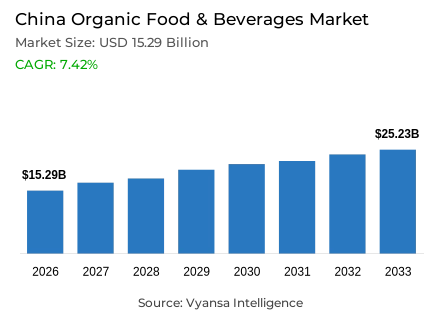
Organic food and beverages in China are products certified free of synthetic pesticides, chemical fertilizers, and genetically modified inputs under national organic standards, spanning fresh produce, dairy, packaged staples, and plant-based drinks. Urban households, foodservice operators, and premium retailers consume these products as substitutes for conventional groceries across everyday meals and beverage occasions. The China organic food & beverages market is forecast to grow at a CAGR of 7.42% between 2027 and 2033.
Key Highlights of the China Organic Food & Beverages Market
- The organic food & beverages market in China was valued at USD 15.29 billion in 2026 and is estimated at USD 16.42 billion in 2027, forecast to reach USD 25.23 billion by 2033.
- The market is forecast to expand at a compound annual growth rate of 7.42% across the 2027 to 2033 forecast period.
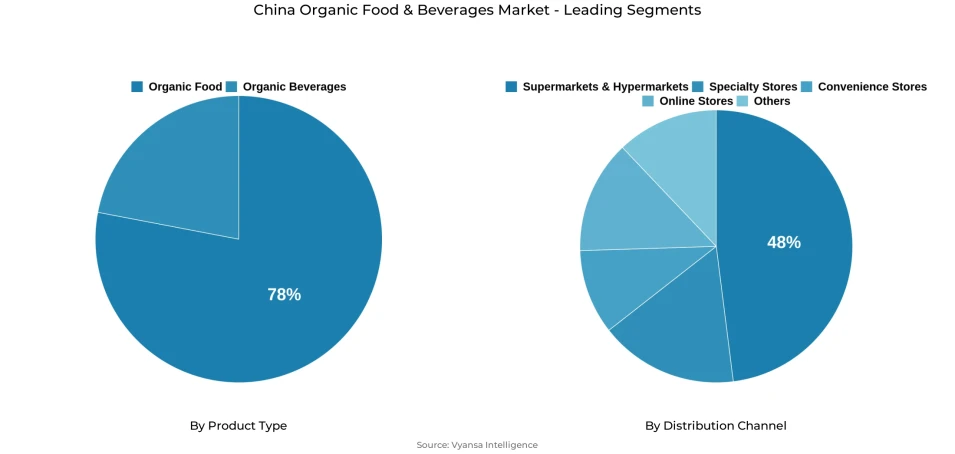
- By product type, organic food led the market with a 78% share in 2026.
- Plant-based beverages are the fastest-growing product type in the market, expanding at a 4.5% CAGR between 2027 and 2033.
- By distribution channel, Supermarkets & Hypermarkets led the market with a 48% share in 2026.
- Online Stores are the fastest-growing distribution channel in the market, expanding at a 14% CAGR between 2027 and 2032.
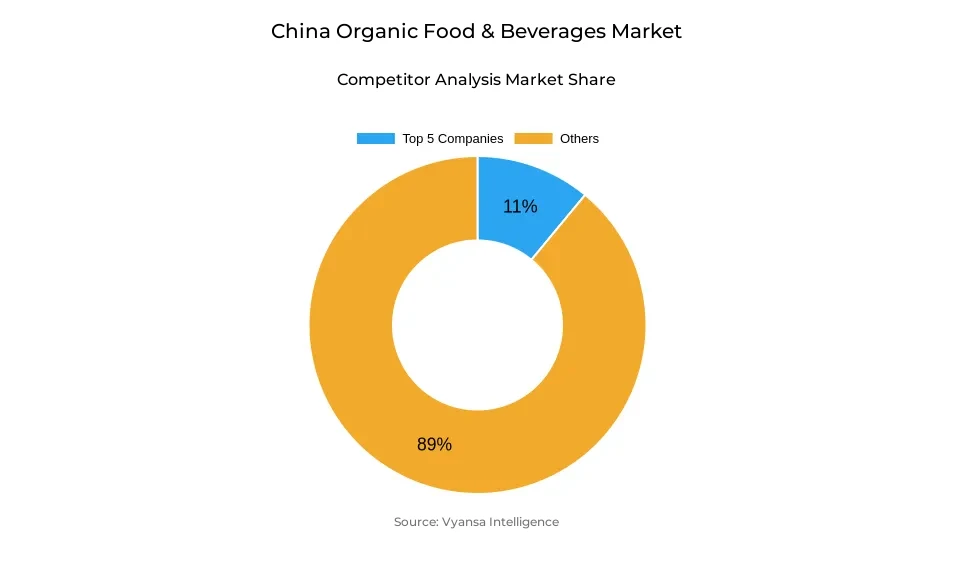
- The market is fragmented, with the top five companies holding a combined 11% share in 2026, reflecting a broad base of regional and national competitors.
China organic food and beverages market is entering a broader consumption phase, supported by double-digit growth in organic product sales, expanding certified supply, and faster adoption of online food retail. China's total organic product sales reached around USD 213 billion in 2025, up 22% YoY. The market has also remained among the world's top three organic consumption markets since 2022, indicating that organic products are moving beyond a niche premium category.
Expanding organic production is strengthening the supply base. China's domestic organic crop cultivation area reached 3.696 million hectares in 2025, placing the country fourth globally, while the area expanded at approximately 6% CAGR during 2021–2025. Moreover, the five major agricultural provinces, including Heilongjiang and Inner Mongolia, accounted for nearly 70% of China's organic cultivation area, creating a sizeable domestic raw-material base for organic food and beverage manufacturers.
Processed organic products are becoming the primary commercial growth engine. More than 90% of China's organic product sales in 2025 came from processed products, while dairy products, alcoholic beverages and infant foods together accounted for more than 70% of the market. At the same time, organic vegetable products, convenience foods and beverages recorded strong increases in sales, indicating that growth is increasingly coming from ready-to-consume and packaged formats rather than only fresh organic produce.
Certification expansion is also widening the addressable market. The number of registered organic certification marks reached 6.65 billion in 2025, up 16.7% YoY. China's national certification framework also uses a one-product, one-code traceability mechanism, strengthening verification across the supply chain and supporting consumer confidence as organic products enter more mainstream retail channels.
These indicators point toward continued market penetration through processed organic foods, dairy and infant products, beverages, convenience formats, and digital grocery channels, while affordability remains an important factor determining how quickly organic products transition from occasional premium purchases to routine household consumption.
China Organic Food & Beverages Market Government Compliance
China’s organic food and beverages market operates under a national certification framework administered by the Certification and Accreditation Administration of China (CNCA). The Organic Product Certification Management Measures establish requirements covering the organic certification catalogue, applicable standards, certification procedures, labeling, and use of the organic certification mark. Organic producers and processors must comply with the relevant certification requirements before making certified organic claims and marks can be used on products.
A significant regulatory update took effect on January 1, 2026, when CNCA’s 2025 Organic Product Certification Implementation Rules replaced the previous 2019 framework. The revised rules strengthen requirements for certification implementation, post-certification management, certification-body controls, inspection arrangements, and digitalized certification management. CNCA issued an official interpretation on December 16, 2025, clarifying implementation of the revised rules.
These requirements increase the operational complexity of obtaining and maintaining organic certification, particularly for companies managing multiple production, processing, and supply-chain stages. Consequently, businesses with established certification systems, documented production controls, traceability capabilities, and experience with approved certification bodies may face fewer compliance-related barriers than new entrants. This regulatory tightening also supports greater confidence in certified organic products as the category expands into mainstream retail and processed food and beverage segments.
China Organic Food & Beverages Market Drivers
Faster Online Grocery Growth Expands Organic Distribution Reach
China's online retail infrastructure is expanding faster than conventional retail, creating a direct route for organic brands to reach households without requiring physical organic-store coverage. In 2025, online retail sales of physical goods reached USD 1.84 trillion and represented 26.1% of total consumer-goods retail sales, while online food sales increased 14.5%. For organic suppliers, this matters because digital channels can present certified products to households that do not have a nearby specialist organic retailer.
The mechanism is therefore broader than simple e-commerce growth. Online grocery reduces the geographic constraint attached to organic distribution, allowing brands to carry larger assortments without matching physical-store expansion. This is particularly important as organic consumption becomes more mainstream and consumers increasingly expect organic versions of familiar food categories. The rapid expansion of organic product sales in 2025, alongside rising online food consumption, indicates that digital access is becoming an important route through which existing consumer interest converts into actual purchases.
China Organic Food & Beverages Market Challenges
Persistent Certification and Verification Risk Limits Consumer Trust
China's 2025 certification-validity inspections found 11 non-compliant batches among 150 sampled organic-product batches, resulting in the withdrawal of 16 organic certification certificates. Although the 2026 inspection showed improvement, with 2 non-compliant products among 138 batches and three certificates withdrawn, the continued occurrence of non-compliance demonstrates that certification credibility remains an active industry issue.
The regulatory response is becoming stricter. CNCA's revised organic product certification implementation rules took effect on January 1, 2026, strengthening certification requirements and the management framework surrounding certification activities. At the same time, China's national organic system increasingly emphasizes one-product-one-code traceability. This raises the operational burden for producers and processors, particularly smaller companies that lack integrated quality-control and traceability systems.
China Organic Food & Beverages Market Recent Trends
Organic Consumption Is Expanding Across Everyday Processed Food and Beverage Categories
Organic consumption is broadening beyond specialist fresh products into commercially scalable processed food and beverage categories. In 2025, organic processed products accounted for more than 90% of China's organic-product sales, while dairy, alcoholic beverages and infant foods together represented more than 70% of the market. At the same time, sales of vegetable products, convenience foods and organic beverages increased substantially, indicating that organic purchasing is becoming embedded in more frequent and familiar consumption occasions.
This changes the market mechanism because processed products can be distributed through mainstream retail, e-commerce and foodservice channels more easily than a narrow fresh-produce assortment. It also creates additional repeat-purchase occasions across households, particularly in categories such as dairy, infant nutrition, beverages and packaged foods. The result is a shift from organic being an occasional specialist purchase toward organic products being incorporated into established food routines.
Full-Chain Digital Traceability Is Becoming a Competitive Differentiator
Organic certification is increasingly moving from a static certification claim toward continuously verifiable product information. China's national system has established one-product-one-code traceability, while the revised 2025 certification rules introduce stronger requirements for certification organizations and processes from 2026. This is encouraging organic producers to connect certification, production, processing and product-level information rather than relying solely on periodic batch testing.
The commercial significance is particularly high for premium categories where consumers are paying more for certification-based attributes. Full-chain traceability can allow brands to demonstrate the origin and certification status of individual products, reduce the risk of a non-compliant batch affecting broader consumer perception and provide retailers with stronger verification before listing. As the category expands, companies with integrated traceability infrastructure should therefore gain an advantage in maintaining consumer confidence and premium positioning.
China Organic Food & Beverages Market Future Opportunities
Livestream and Content Commerce Can Extend Organic Access into Lower-Tier Cities
China's online food retail market is already expanding rapidly, with online food sales increasing 14.5% in 2025 while total retail sales grew 3.7%. Online physical-goods retail represented 26.1% of total consumer-goods retail, demonstrating that digital purchasing is already sufficiently established to support broader geographic market access.
For organic brands, the commercial gap is that lower-tier cities can contain households willing to purchase premium food products without having the same physical organic retail infrastructure available in major metropolitan areas. Livestream and content-driven commerce can combine product education, certification communication, and direct conversion within one digital environment, allowing mid-sized organic brands to reach these households without first securing expensive nationwide hypermarket distribution.
The opportunity is particularly attractive because organic products require explanation and trust-building. Livestream commerce can demonstrate certification, product origin, production practices, and usage simultaneously, reducing the information barrier that exists when consumers encounter an unfamiliar premium product on a conventional shelf. Brands that combine localized fulfillment with digital education can therefore convert geographically underserved households into recurring organic buyers without replicating the capital requirements of national physical expansion.
Unlock Market Intelligence
Explore the market potential with our data-driven report
China Organic Food & Beverages Market Segmentation Analysis
By Product Type:
- Organic Food
- Fruits & Vegetables
- Cereals, Grains & Pulses
- Meat, Poultry & Seafood
- Dairy Products & Eggs
- Packaged & Processed Foods
- Other Organic Foods
- Organic Beverages
- Fruit & Vegetable Juices
- Tea & Coffee
- Dairy Beverages
- Plant-Based Beverages
- Other Organic Beverages
Organic Food Commands 78% of Product Type Demand
Organic food leads product-type demand because it maps onto the weekly grocery basket, fruits, vegetables, grains, meat, dairy, and packaged staples, giving it far more repeat-purchase occasions than an occasional beverage. It also benefits from processing familiarity, since organic rice, vegetables, and dairy run on largely the same lines as conventional versions. This position should hold provided certified supply keeps pace with demand. Supply is responding: Bright Dairy & Food Co., Ltd. added its Youjia High-Calcium Organic Pure Milk to its 2025 range, while Hema expanded its organic vegetable base to over 100 sites across 20-plus provinces by August 2025, supplying 60 to 80 varieties each quarter.
Plant-Based Beverages account for an estimated 4.5% share of the China Organic Food & Beverages Market in 2027 and are the fastest-growing product type, expanding at a 9.8% CAGR during 2027–2033. Growth is supported by increasing adoption of oat, soy, and other plant-based drinks among health-conscious and flexitarian consumers, while the segment continues to expand from a comparatively small certified-organic base.
By Distribution Channel:
- Supermarkets & Hypermarkets
- Specialty Stores
- Convenience Stores
- Online Stores
- Others
Supermarkets and Hypermarkets Hold 48% of Channel Demand
Supermarkets and Hypermarkets lead distribution because they remain the format most households already visit weekly, letting organic products piggyback on an existing shopping trip rather than requiring a dedicated visit to a specialty store. They also carry cold-chain and produce-handling infrastructure most specialty and convenience formats lack. This lead should hold provided the channel keeps expanding its organic assortment at pace with demand. Investment continues: in January 2025, Yonghui Superstores renovated its national flagship Fuzhou Aoti store around the Hai Fu Cai brand, a joint venture with the Fujian Supply and Marketing Cooperative Modern Agriculture Service Group's farms, widening organic and green-positioned produce on shelf, while Sam's Club removed over 40 artificial additives from 96% of its Member's Mark range by June 2025.
Online Stores account for an estimated 14.0% share of the China Organic Food & Beverages Market in 2027 and are the fastest-growing distribution channel, expanding at an 11.6% CAGR during 2027–2033. Growth is supported by broader online grocery penetration, improved fresh-food fulfilment and the ability of digital platforms to distribute certified organic products beyond major metropolitan retail networks.
Unlock Market Intelligence
Explore the market potential with our data-driven report
China Organic Food & Beverages Industry Competitive Landscape
China's organic food and beverages industry is fragmented, with the top five companies holding a combined 11% share in 2026. Inner Mongolia Yili Industrial Group Co., Ltd. holds the leading position, followed by China Mengniu Dairy Company Limited, Bright Dairy & Food Co., Ltd., China Feihe Limited, and Junlebao Dairy Group Co., Ltd. The remaining share is distributed across regional dairy processors, packaged-food manufacturers, and specialty organic producers competing for share outside the top five.
Key Companies in the China Organic Food & Beverages Market
- Inner Mongolia Yili Industrial Group Co., Ltd
- China Mengniu Dairy Company Limited
- Bright Dairy & Food Co., Ltd.
- China Feihe Limited
- Junlebao Dairy Group Co., Ltd.
- Beijing Sanyuan Foods Co., Ltd.
- Beingmate Baby & Child Food Co., Ltd.
- New Hope Dairy Co., Ltd.
- Beidahuang Wondersun Dairy Co., Ltd. (Wondersun)
- China Shengmu Organic Milk Limited
Recent Developments in the China Organic Food & Beverages Market
- In 2025, China issued more than 6.66 billion organic product certification marks nationwide, with the country becoming the world's third-largest organic consumption market by that measure, according to certification volume data from the Certification and Accreditation Administration. The scale of the certified base signals that supply-side certification has kept pace with the shelf expansion organic brands have pursued across supermarkets, hypermarkets, and e-commerce over the same period.
Frequently Asked Questions
Related Report
- Market Segmentation
- Research Scope
- Research Methodology
- Definitions and Assumptions
- Executive Summary
- China Organic Food and Beverages Market Policies, Regulations, and Standards
- China Organic Food and Beverages Market Dynamics
- Growth Factors
- Challenges
- Trends
- Opportunities
- China Organic Food and Beverages Market Statistics, 2023-2033
- Market Size & Growth Outlook
- By Revenues in USD Million
- Market Segmentation & Growth Outlook
- By Product Type
- Organic Food- Market Insights and Forecast 2023-2033, USD Million
- Fruits & Vegetables- Market Insights and Forecast 2023-2033, USD Million
- Cereals, Grains & Pulses- Market Insights and Forecast 2023-2033, USD Million
- Meat, Poultry & Seafood- Market Insights and Forecast 2023-2033, USD Million
- Dairy Products & Eggs- Market Insights and Forecast 2023-2033, USD Million
- Packaged & Processed Foods- Market Insights and Forecast 2023-2033, USD Million
- Other Organic Foods- Market Insights and Forecast 2023-2033, USD Million
- Organic Beverages- Market Insights and Forecast 2023-2033, USD Million
- Fruit & Vegetable Juices- Market Insights and Forecast 2023-2033, USD Million
- Tea & Coffee- Market Insights and Forecast 2023-2033, USD Million
- Dairy Beverages- Market Insights and Forecast 2023-2033, USD Million
- Plant-Based Beverages- Market Insights and Forecast 2023-2033, USD Million
- Other Organic Beverages- Market Insights and Forecast 2023-2033, USD Million
- Organic Food- Market Insights and Forecast 2023-2033, USD Million
- By Distribution Channel
- Supermarkets & Hypermarkets- Market Insights and Forecast 2023-2033, USD Million
- Specialty Stores- Market Insights and Forecast 2023-2033, USD Million
- Convenience Stores- Market Insights and Forecast 2023-2033, USD Million
- Online Stores- Market Insights and Forecast 2023-2033, USD Million
- Others- Market Insights and Forecast 2023-2033, USD Million
- By End Consumer
- Household Consumers- Market Insights and Forecast 2023-2033, USD Million
- HoReCa/ Foodservice- Market Insights and Forecast 2023-2033, USD Million
- Institutional & Other Commercial - Market Insights and Forecast 2023-2033, USD Million
- By Competitors
- Competition Characteristics
- Market Share & Analysis
- By Product Type
- Market Size & Growth Outlook
- China Organic Food Market Statistics, 2023-2033
- Market Size & Growth Outlook
- By Revenues in USD Million
- Market Segmentation & Growth Outlook
- By Distribution Channel- Market Insights and Forecast 2023-2033, USD Million
- By End Consumer- Market Insights and Forecast 2023-2033, USD Million
- Market Size & Growth Outlook
- China Organic Beverages Market Statistics, 2023-2033
- Market Size & Growth Outlook
- By Revenues in USD Million
- Market Segmentation & Growth Outlook
- By Distribution Channel- Market Insights and Forecast 2023-2033, USD Million
- By End Consumer- Market Insights and Forecast 2023-2033, USD Million
- Market Size & Growth Outlook
- Competitive Outlook
- Company Profiles
- Inner Mongolia Yili Industrial Group Co., Ltd
- Business Description
- Product Portfolio
- Collaborations & Alliances
- Recent Developments
- Financial Details
- Others
- China Mengniu Dairy Company Limited
- Business Description
- Product Portfolio
- Collaborations & Alliances
- Recent Developments
- Financial Details
- Others
- Bright Dairy & Food Co., Ltd
- Business Description
- Product Portfolio
- Collaborations & Alliances
- Recent Developments
- Financial Details
- Others
- China Feihe Limited
- Business Description
- Product Portfolio
- Collaborations & Alliances
- Recent Developments
- Financial Details
- Others
- Junlebao Dairy Group Co., Ltd.
- Business Description
- Product Portfolio
- Collaborations & Alliances
- Recent Developments
- Financial Details
- Others
- Beijing Sanyuan Foods Co., Ltd.
- Business Description
- Product Portfolio
- Collaborations & Alliances
- Recent Developments
- Financial Details
- Others
- Beingmate Baby & Child Food Co., Ltd.
- Business Description
- Product Portfolio
- Collaborations & Alliances
- Recent Developments
- Financial Details
- Others
- New Hope Dairy Co., Ltd.
- Business Description
- Product Portfolio
- Collaborations & Alliances
- Recent Developments
- Financial Details
- Others
- Beidahuang Wondersun Dairy Co., Ltd.
- Business Description
- Product Portfolio
- Collaborations & Alliances
- Recent Developments
- Financial Details
- Others
- China Shengmu Organic Milk Limited
- Business Description
- Product Portfolio
- Collaborations & Alliances
- Recent Developments
- Financial Details
- Others
- Inner Mongolia Yili Industrial Group Co., Ltd
- Company Profiles
- Disclaimer
| Segment | Sub-Segment |
|---|---|
| By Product Type |
|
| By Distribution Channel |
|
| By End Consumer |
|
Research Methodology
This study followed a structured approach comprising four key phases to assess the size and scope of the electro-oxidation market. The process began with thorough secondary research to collect data on the target market, related markets, and broader industry context. These findings, along with preliminary assumptions and estimates, were then validated through extensive primary research involving industry experts from across the value chain. To calculate the overall market size, both top-down and bottom-up methodologies were employed. Finally, market segmentation and data triangulation techniques were applied to refine and validate segment-level estimations.
Secondary Research
The secondary research phase involved gathering data from a wide range of credible and published sources. This step helped in identifying industry trends, defining market segmentation, and understanding the market landscape and value chain.
Sources consulted during this phase included:
- Company annual reports, investor presentations, and press releases
- Industry white papers and certified publications
- Trade directories and market-recognized databases
- Articles from authoritative authors and reputable journals
- Gold and silver standard websites
Secondary research was critical in mapping out the industry's value chain and monetary flow, identifying key market segments, understanding regional variations, and tracking significant industry developments.
Other key sources:
- Financial disclosures
- Industry associations and trade bodies
- News outlets and business magazines
- Academic journals and research studies
- Paid industry databases
Primary Research
To validate secondary data and gain deeper market insights, primary research was conducted with key stakeholders across both the supply and demand sides of the market.
On the demand side, participants included decision-makers and influencers from end-user industries—such as CIOs, CTOs, and CSOs—who provided first-hand perspectives on market needs, product usage, and future expectations.
On the supply side, interviews were conducted with manufacturers, industry associations, and institutional participants to gather insights into current offerings, product pipelines, and market challenges.
Primary interviews provided critical inputs such as:
- Market size and revenue data
- Product and service breakdowns
- Market forecasts
- Regional and application-specific trends
Stakeholders consulted included:
- Leading OEM and solution providers
- Channel and distribution partners
- End users across various applications
- Independent consultants and industry specialists
Market Size Estimation and Data Triangulation
- Identifying Key Market Participants (Secondary Research)
- Goal: To identify the major players or companies in the target market. This typically involves using publicly available data sources such as industry reports, market research publications, and financial statements of companies.
- Tools: Reports from firms like Gartner, Forrester, Euromonitor, Statista, IBISWorld, and others. Public financial statements, news articles, and press releases from top market players.
- Extracting Earnings of Key Market Participants
- Goal: To estimate the earnings generated from the product or service being analyzed. This step helps in understanding the revenue potential of each market player in a specific geography.
- Methods: Earnings data can be gathered from:
- Publicly available financial reports (for listed companies).
- Interviews and primary data sources from professionals, such as Directors, VPs, SVPs, etc. This is especially useful for understanding more nuanced, internal data that isn't publicly disclosed.
- Annual reports and investor presentations of key players.
- Data Collation and Development of a Relevant Data Model
- Goal: To collate inputs from both primary and secondary sources into a structured, data-driven model for market estimation. This model will incorporate key market KPIs and any independent variables relevant to the market.
- Key KPIs: These could include:
- Market size, growth rate, and demand drivers.
- Industry-specific metrics like market share, average revenue per customer (ARPC), or average deal size.
- External variables, such as economic growth rates, inflation rates, or commodity prices, that could affect the market.
- Data Modeling: Based on this data, the market forecasts are developed for the next 5 years. A combination of trend analysis, scenario modeling, and statistical regression might be used to generate projections.
- Scenario Analysis
- Goal: To test different assumptions and validate how sensitive the market is to changes in key variables (e.g., market demand, regulatory changes, technological disruptions).
- Types of Scenarios:
- Base Case: Based on current assumptions and historical data.
- Best-Case Scenario: Assuming favorable market conditions, regulatory environments, and technological advancements.
- Worst-Case Scenario: Accounting for adverse factors, such as economic downturns, stricter regulations, or unexpected disruptions.












