Japan Organic Food & Beverages Market Report: Trends, Growth and Forecast (2026-2032)
By Product Type (Organic Food (Fruits & Vegetables, Cereals, Grains & Pulses, Meat, Poultry & Seafood, Dairy Products & Eggs, Packaged & Processed Foods, Other Organic Foods), Organic Beverages (Fruit & Vegetable Juices, Tea & Coffee, Dairy Beverages, Plant-Based Beverages, Other Organic Beverages)), By Distribution Channel (Supermarkets & Hypermarkets, Specialty Stores, Convenience Stores, Online Stores, Others), By End Consumer (Household Consumers, HoReCa/ Foodservice, Institutional & Other Commercial) ... Read more
|
Major Players
|
Japan Organic Food & Beverages Market Overview
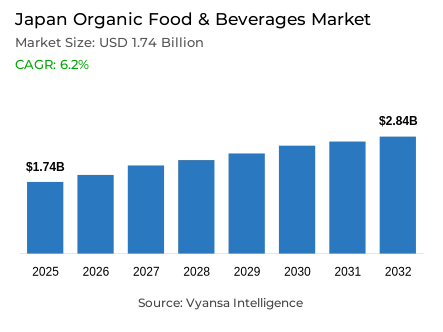
The Japan organic food & beverages market comprises certified fresh, processed, and beverage products produced and labelled under recognized organic standards. Consumption extends across household meals, foodservice, and institutional use, with certification separating organic products from conventional, reduced-input, and broader natural-food positioning. The market is expected to grow at a CAGR of 6.2% during the forecasted period.
Key Highlights of the Japan Organic Food & Beverages Market
- The Japan organic food & beverages market was valued at USD 1.74 billion in 2025, establishing the base for the current forecast period.
- The market is valued at USD 1.98 billion in 2026 and is projected to reach USD 2.84 billion by 2032.
- Market revenue is forecast to expand at a 6.2% CAGR between 2026 and 2032.
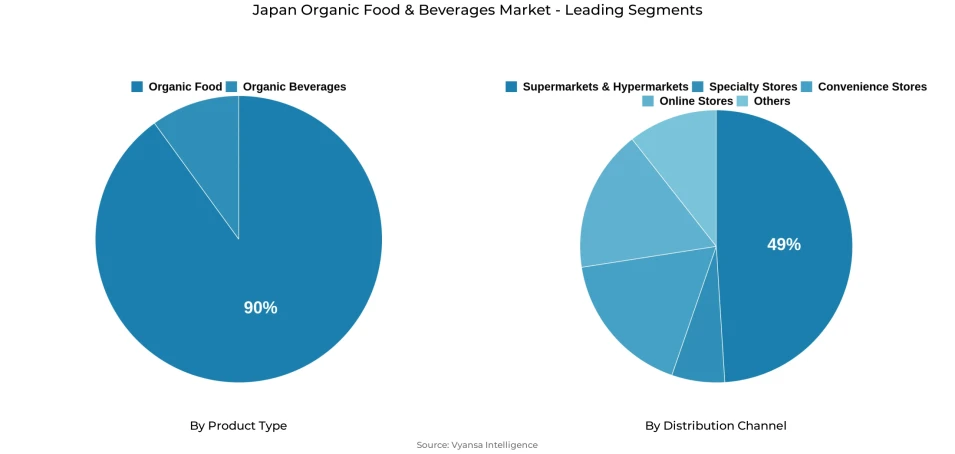
- Organic Food leads by product type with a 90% share in 2026, while organic beverages represent the fastest-growing product category through 2032.
- Supermarkets & Hypermarkets account for 49% of distribution in 2026, while Online Stores represent the fastest-growing distribution channel through the forecast period.
- Household Consumers account for 85% of consumption in 2026, while HoReCa/Foodservice represents the fastest-growing end-consumer group through 2032.
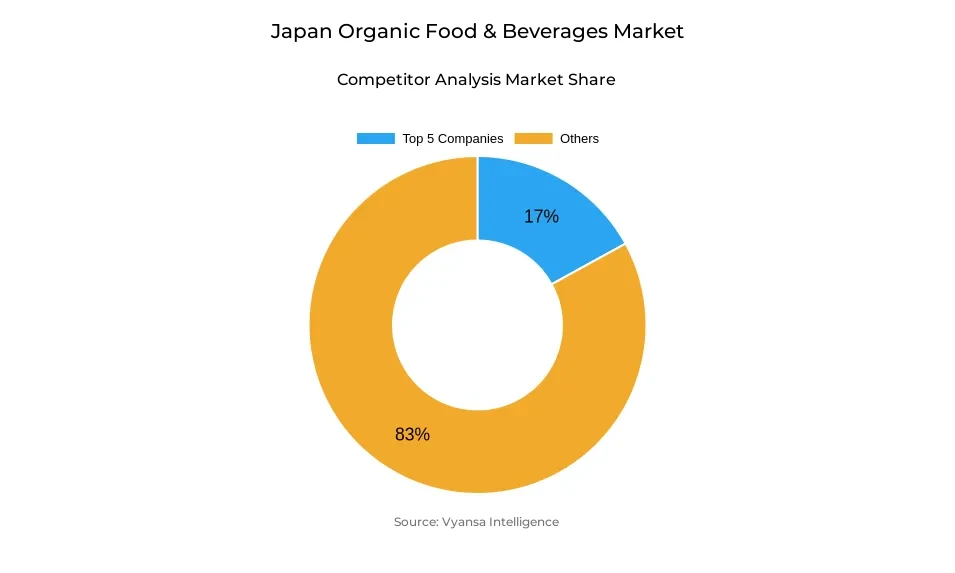
- The industry remains fragmented, with the five leading companies accounting for a combined 17% share in 2026.
Organic consumption in Japan is fundamentally a food-quality and trust proposition. Certification converts farming and processing practices that are difficult for consumers to observe into a verifiable product claim. A national consumer study published in 2026 found that 77.0% of organic consumers associated these products with safety and 75.6% with reassurance. Environmental considerations support the category, but immediate consumption decisions remain closely connected to food quality, safety and confidence in production practices.
The commercial opportunity lies in converting that trust into normal grocery replenishment rather than treating organic as a separate lifestyle basket. Among consumers familiar with organic products, 66.2% reported personally consuming them. The consumption pattern extends through vegetables, rice, tofu, natto, miso, bread and soy sauce, showing that certified products increasingly compete item by item against conventional equivalents in established Japanese meals. This creates recurring consumption whenever quality assurance justifies the additional household expenditure.
Supply remains the counterweight to this conversion. Organic farming covered approximately 39,800 hectares in fiscal 2024, equivalent to only 0.9% of Japan's cultivated land. Certified availability therefore depends on more than consumer intent. Farms, processors and distributors must coordinate certification, crop planning, aggregation and delivery while maintaining consistent quantities across the year. Expansion of domestic supply without comparable improvements in labour productivity and route-to-market efficiency would leave retail availability uneven.
The market through 2032 should consequently advance through a combination of wider access and better production economics. Digital grocery makes specialized assortments easier to replenish, while farm automation can lower the labour burden attached to organic cultivation. At the same time, the price difference against conventional food remains a practical conversion threshold. Companies that narrow delivered costs, maintain certified year-round volumes and make organic products available within ordinary consumption occasions should convert more occasional use into repeat expenditure.
Government Regulations and Policy Support Shaping the Japan Organic Food & Beverages Market
Japan Agricultural Standards (JAS) certification is the principal market-access mechanism for organic products. Updated standards for organic processed foods and feed became effective on July 31, 2024, while revised standards for organic plant-origin and livestock products became effective on January 1, 2025. These requirements determine the production, processing and certification conditions under which qualifying products can carry the Organic JAS mark. Certification therefore affects both domestic output and the imported assortment legitimately positioned as organic in Japan.
Policy is also addressing supply formation and international market access. Japan had 154 Organic Village municipalities across 46 prefectures by December 26, 2025, up from 131 in the preceding fiscal year, connecting organic production with processing, distribution and local consumption. In May 2025, Japan and the European Union also widened organic equivalence to additional animal-origin products and organic alcoholic beverages, reducing duplicate certification work for qualifying trade. Together, these measures improve the infrastructure through which certified supply reaches Japanese end users.
Japan Organic Food & Beverages Market Drivers
E-commerce is Expanding the Accessible Market
Japan's food, beverage and alcohol business-to-consumer e-commerce market approximately increased at 6.36% year on year. Yet online penetration remained only 4.52% compared with 9.78% for the wider merchandise market. The difference indicates that a substantial portion of grocery expenditure remains available for digital migration.
For organic food, the effect extends beyond moving an existing transaction online. Searchability allows consumers to locate certified products that may not be stocked nearby, while scheduled deliveries and subscriptions remove the need to repeatedly search for specialist items. Specialist platforms already demonstrate that this model can support recurring demand at scale, with one major organic and natural food delivery platform reporting more than 350,000 members.
E-commerce therefore increases the accessible demand pool while also improving purchasing frequency among existing users. As organic remains a partial household basket, the ability to repeatedly replenish vegetables, packaged foods, beverages and other certified staples can gradually increase the share of household food expenditure captured by organic products.
Japan Organic Food & Beverages Market Challenges
Price and Procurement Economics
The principal constraint on market demand is not a lack of perceived value in organic food but the point at which that value no longer justifies the price difference against a conventional substitute. This creates a direct ceiling on household conversion because organic products frequently compete against familiar alternatives within the same shopping basket.
The latest establishment research reinforces the supply-side origin of this pressure. Among organizations not handling domestically produced organic products, 47.7% identified high procurement prices as a barrier. Limited certified volumes require retailers, processors and foodservice operators to manage supplier qualification, segregation and logistics across a smaller procurement base, reducing the scale efficiencies available in conventional food.
The resulting price difference reaches consumers who remain highly sensitive to premiums. Around 30.0% of surveyed consumers would not accept even a small organic premium, while another 28.3% indicated willingness around only a 10% premium. This sensitivity became more relevant as Japan's broader food Consumer Price Index increased 6.8% in 2025.
Price therefore restricts both customer acquisition and basket depth. A household may continue purchasing organic vegetables while selecting conventional alternatives for several other categories, limiting the revenue captured from an otherwise receptive consumer. Market expansion consequently depends on narrowing delivered-cost differences through larger procurement pools, efficient distribution, private-label scale and higher throughput rather than relying solely on consumers becoming willing to pay progressively larger premiums.
Japan Organic Food & Beverages Market Recent Trends
Organic is expanding from fresh produce into routine processed staples
The next stage of demand development is increasingly occurring inside products consumers already purchase regularly. Organic has historically had a natural fit with fresh produce because the connection between farming practices and the final product is easy to communicate. However, relying primarily on fresh categories limits the number of occasions in which certified products can capture household expenditure.
Current purchasing patterns show the category moving beyond that boundary. Organic purchases include rice, natto, tofu, miso, bread and soy sauce alongside vegetables and fruit. These products are important because they are incorporated into established Japanese meals and frequently replenished, giving organic certification an opportunity to influence routine rather than occasional purchasing.
Product development is reinforcing this shift. Certified ingredients are appearing in infant foods, dairy products, beverages and prepared foods, combining organic positioning with convenience, portion control and specific consumption occasions. In June 2025, a national private-label platform expanded its infant-food range with products that included Organic JAS-certified items across approximately 470 stores.
This expansion increases demand differently from simply adding more organic produce. Each new processed format creates another point at which a conventional food purchase can be substituted with a certified alternative. The wider the number of everyday formats carrying credible organic positioning, the greater the potential expenditure captured from households that already buy some organic products but have not converted the majority of their food basket.
Organic Rice Weed Control Robotics
Technology development in organic agriculture matters to market demand when it changes the economics or availability of the finished product. Organic rice provides a clear example because weed control requires substantial labour when conventional herbicides cannot be used, contributing to the production-cost gap between organic and conventional rice.
NARO field trials across 36 organic rice fields found that automatic weed-suppression technology was associated with a 10% increase in average yield and a 58% reduction in mechanical-weeding frequency. The subsequent IGAM2 program is being implemented across 11 prefectures and 30 farming businesses, with a target of reducing organic-rice weeding time by 80%.
The market impact comes from the additional supply that farms can manage with the same labour base and the potential reduction in production costs per unit. Labour efficiency is particularly important in Japan, where agricultural workforce constraints make expansion through additional manual work increasingly difficult.
If the technology performs consistently across different field conditions, producers can manage larger organic acreage without proportionally increasing labour requirements. Greater output and more predictable costs improve the ability of distributors and retailers to secure recurring volumes. For end users, the eventual effect is improved availability and a better prospect of organic rice being offered within an acceptable premium over conventional alternatives. Technology therefore supports demand not because consumers purchase robotics, but because it helps make the certified product they purchase more commercially scalable.
Japan Organic Food & Beverages Market Future Opportunities
Year-Round Domestic Organic Supply Aggregation
Japan has potential demand for additional domestically produced organic food that is not fully converting into purchases because individual buyers cannot consistently obtain the required volume and assortment. The strongest opportunity therefore lies between farm production and final distribution: aggregating certified supply into a form that supermarkets, processors, restaurants and institutional buyers can procure reliably.
Among establishments not currently handling domestic organic products, 30.1% reported that existing suppliers did not provide suitable organic products, 20.5% cited difficulty securing supply consistently throughout the year and 14.4% identified insufficient quantities. Importantly, 31.0% of establishments not currently handling domestic organic products, or relying only on imported products, expressed interest in handling domestic organic supply in the future.
This indicates latent commercial demand rather than an absence of buyer interest. A supermarket, processor or restaurant may be willing to increase organic procurement but remain unable to justify a product range when supply varies by season, farm or region. Regional aggregation can close this gap by combining certified volumes from multiple producers, coordinating crop and harvest schedules, standardizing specifications and consolidating logistics. Different grades can then be allocated across fresh retail, processing, foodservice and institutional uses rather than relying on a single sales route.
The opportunity is significant because it simultaneously addresses market availability and buyer confidence. More reliable year-round supply allows retailers to maintain permanent organic ranges, gives processors confidence to develop certified products and enables foodservice operators to place organic ingredients into regular menus. In this way, aggregation converts fragmented agricultural production into recurring downstream demand and provides one of the clearest pathways for scaling the Japan organic food & beverages market through 2032.
Unlock Market Intelligence
Explore the market potential with our data-driven report
Japan Organic Food & Beverages Market Consumer Purchase Behaviour
Organic purchasing in Japan is still concentrated among households that selectively substitute conventional products with organic alternatives rather than shift their entire grocery basket. Purchase decisions are driven more by taste safety reassurance and health than by environmental considerations, while price and limited understanding of organic certification continue to restrict deeper adoption.
- 79.2% of consumers associate organic products with high prices.
- 30.0% would not accept even a small price premium for organic products.
- 28.3% would accept a premium of approximately 10%.
- 17.4% of consumers purchase organic products approximately weekly or more often.
- 83.5% of organic buyers purchase through supermarkets, including online supermarkets.
- 7.5% always check the Organic JAS mark, while 12.0% mostly check it.
- A separate Ministry of Agriculture, Forestry and Fisheries series reported weekly organic use rising from 17.5% in 2017 to 32.6% in 2022.
Japan Organic Food & Beverages Market Segmentation Analysis
By Product Type:
- Organic Food
- Fruits & Vegetables
- Cereals, Grains & Pulses
- Meat, Poultry & Seafood
- Dairy Products & Eggs
- Packaged & Processed Foods
- Other Organic Foods
- Organic Beverages
- Fruit & Vegetable Juices
- Tea & Coffee
- Dairy Beverages
- Plant-Based Beverages
- Other Organic Beverages
Organic Food Anchors Everyday Organic Consumption at 90%
Organic Food retains its leadership because certification is applied across products embedded in routine Japanese meals. Vegetables, rice, tofu, natto, miso, bread, fruit, eggs and other frequently replenished categories give households repeated opportunities to substitute an organic product for its conventional equivalent. The breadth of these consumption occasions creates a larger recurring revenue base than beverages alone. The category should retain its lead through 2032 unless certified beverage availability expands across considerably more routine consumption occasions.
Organic Beverages represent the fastest-growing product category through the forecast period. New certified formats are broadening the category beyond traditional organic tea and juice. In September 2025, Kaneka Foods Corporation launched Pur Natur Organic Drinking Yogurt Plain, an Organic JAS-certified A2-milk drinking yogurt distributed through organic specialty stores, supermarkets and online channels. Beverage formats offer convenient single-use or repeat consumption occasions, enabling the smaller category to expand faster than the much larger Organic Food base.
By End Consumer:
- Household Consumers
- HoReCa/Foodservice
- Institutional & Other Commercial
Households Convert Certification Trust into Repeat Consumption at 85%
Household Consumers lead because organic food is primarily replenished through normal domestic meal preparation rather than one-time discretionary use. Among people familiar with organic products, 66.2% reported personally consuming them. The breadth of frequently consumed organic vegetables, rice, tofu, natto, miso and bread reinforces this household role. Certification therefore generates the highest commercial value when it converts individual items within the regular grocery basket rather than requiring an entirely organic diet.
HoReCa/Foodservice is the fastest-growing end-consumer group through the forecast period. Commercial kitchens can use certified ingredients to differentiate menu quality while concentrating procurement volumes that individual households consume separately. Institutional & Other Commercial demand provides an additional route where coordinated local procurement can connect certified farms with school meals and public-sector consumption. Organic Village programs increasingly link production, processing, distribution and local consumption, creating a more organized channel for certified food outside direct household retail.
Unlock Market Intelligence
Explore the market potential with our data-driven report
Japan Organic Food & Beverages Market Competitive Landscape
The Japan organic food & beverages industry remains fragmented, with the five leading companies accounting for a combined 17% share in 2026. Competition spans general retailers with private-label organic ranges, subscription-based food platforms and specialist certified-organic distributors. The top five supplied participants are AEON Co. Ltd., Seven & i Holdings Co. Ltd., Oisix Inc. formerly Oisix ra daichi Inc., Life Corporation and Bio Market Co. Ltd. No single participant controls a dominant portion of industry revenue, leaving market access distributed across physical grocery, digital delivery and specialized organic channels.
Prominent Companies in the Japan Organic Food & Beverages Market
- AEON Co. Ltd.
- Seven & i Holdings Co. Ltd.
- Oisix Inc.
- Life Corporation
- Bio Market Co. Ltd.
- Kodawariya Co. Ltd.
- MUSO Co. Ltd.
- Lawson Inc.
- Natural House Co. Ltd.
- Kaneka Foods Corporation
Recent Developments in the Japan Organic Food & Beverages Market
- June 2026: Bio Market Co. Ltd. launched an organic Kitasato Yakumo beef croquette through its Bio Marche platform, extending certified organic meat into a prepared convenience format. The product reduces preparation requirements and broadens the use of organic ingredients beyond raw-protein purchases.
Frequently Asked Questions
Related Report
- Market Segmentation
- Research Scope
- Research Methodology
- Definitions and Assumptions
- Executive Summary
- Japan Organic Food and Beverages Market Policies, Regulations, and Standards
- Japan Organic Food and Beverages Market Dynamics
- Growth Factors
- Challenges
- Trends
- Opportunities
- Japan Organic Food and Beverages Market Statistics, 2022-2032
- Market Size & Growth Outlook
- By Revenues in USD Million
- Market Segmentation & Growth Outlook
- By Product Type
- Organic Food- Market Insights and Forecast 2022-2032, USD Million
- Fruits & Vegetables- Market Insights and Forecast 2022-2032, USD Million
- Cereals, Grains & Pulses- Market Insights and Forecast 2022-2032, USD Million
- Meat, Poultry & Seafood- Market Insights and Forecast 2022-2032, USD Million
- Dairy Products & Eggs- Market Insights and Forecast 2022-2032, USD Million
- Packaged & Processed Foods- Market Insights and Forecast 2022-2032, USD Million
- Other Organic Foods- Market Insights and Forecast 2022-2032, USD Million
- Organic Beverages- Market Insights and Forecast 2022-2032, USD Million
- Fruit & Vegetable Juices- Market Insights and Forecast 2022-2032, USD Million
- Tea & Coffee- Market Insights and Forecast 2022-2032, USD Million
- Dairy Beverages- Market Insights and Forecast 2022-2032, USD Million
- Plant-Based Beverages- Market Insights and Forecast 2022-2032, USD Million
- Other Organic Beverages- Market Insights and Forecast 2022-2032, USD Million
- Organic Food- Market Insights and Forecast 2022-2032, USD Million
- By Distribution Channel
- Supermarkets & Hypermarkets- Market Insights and Forecast 2022-2032, USD Million
- Specialty Stores- Market Insights and Forecast 2022-2032, USD Million
- Convenience Stores- Market Insights and Forecast 2022-2032, USD Million
- Online Stores- Market Insights and Forecast 2022-2032, USD Million
- Others- Market Insights and Forecast 2022-2032, USD Million
- By End Consumer
- Household Consumers- Market Insights and Forecast 2022-2032, USD Million
- HoReCa/ Foodservice- Market Insights and Forecast 2022-2032, USD Million
- Institutional & Other Commercial - Market Insights and Forecast 2022-2032, USD Million
- By Competitors
- Competition Characteristics
- Market Share & Analysis
- By Product Type
- Market Size & Growth Outlook
- Japan Organic Food Market Statistics, 2022-2032
- Market Size & Growth Outlook
- By Revenues in USD Million
- Market Segmentation & Growth Outlook
- By Distribution Channel- Market Insights and Forecast 2022-2032, USD Million
- By End Consumer- Market Insights and Forecast 2022-2032, USD Million
- Market Size & Growth Outlook
- Japan Organic Beverages Market Statistics, 2022-2032
- Market Size & Growth Outlook
- By Revenues in USD Million
- Market Segmentation & Growth Outlook
- By Distribution Channel- Market Insights and Forecast 2022-2032, USD Million
- By End Consumer- Market Insights and Forecast 2022-2032, USD Million
- Market Size & Growth Outlook
- Competitive Outlook
- Company Profiles
- AEON Co. Ltd. (including brands)
- Business Description
- Product Portfolio
- Collaborations & Alliances
- Recent Developments
- Financial Details
- Others
- Seven & i Holdings Co. Ltd. (Seven Premium)
- Business Description
- Product Portfolio
- Collaborations & Alliances
- Recent Developments
- Financial Details
- Others
- Oisix ra daichi Inc. (including brands)
- Business Description
- Product Portfolio
- Collaborations & Alliances
- Recent Developments
- Financial Details
- Others
- Life Corporation (BIO-RAL)
- Business Description
- Product Portfolio
- Collaborations & Alliances
- Recent Developments
- Financial Details
- Others
- Bio Market Co. Ltd. (Bio Marche)
- Business Description
- Product Portfolio
- Collaborations & Alliances
- Recent Developments
- Financial Details
- Others
- Kodawariya Co. Ltd.
- Business Description
- Product Portfolio
- Collaborations & Alliances
- Recent Developments
- Financial Details
- Others
- MUSO Co. Ltd.
- Business Description
- Product Portfolio
- Collaborations & Alliances
- Recent Developments
- Financial Details
- Others
- Lawson Inc. (Natural Lawson)
- Business Description
- Product Portfolio
- Collaborations & Alliances
- Recent Developments
- Financial Details
- Others
- Natural House Co. Ltd.
- Business Description
- Product Portfolio
- Collaborations & Alliances
- Recent Developments
- Financial Details
- Others
- Kaneka Foods Corporation (Pur Natur)
- Business Description
- Product Portfolio
- Collaborations & Alliances
- Recent Developments
- Financial Details
- Others
- AEON Co. Ltd. (including brands)
- Company Profiles
- Disclaimer
| Segment | Sub-Segment |
|---|---|
| By Product Type |
|
| By Distribution Channel |
|
| By End Consumer |
|
Research Methodology
This study followed a structured approach comprising four key phases to assess the size and scope of the electro-oxidation market. The process began with thorough secondary research to collect data on the target market, related markets, and broader industry context. These findings, along with preliminary assumptions and estimates, were then validated through extensive primary research involving industry experts from across the value chain. To calculate the overall market size, both top-down and bottom-up methodologies were employed. Finally, market segmentation and data triangulation techniques were applied to refine and validate segment-level estimations.
Secondary Research
The secondary research phase involved gathering data from a wide range of credible and published sources. This step helped in identifying industry trends, defining market segmentation, and understanding the market landscape and value chain.
Sources consulted during this phase included:
- Company annual reports, investor presentations, and press releases
- Industry white papers and certified publications
- Trade directories and market-recognized databases
- Articles from authoritative authors and reputable journals
- Gold and silver standard websites
Secondary research was critical in mapping out the industry's value chain and monetary flow, identifying key market segments, understanding regional variations, and tracking significant industry developments.
Other key sources:
- Financial disclosures
- Industry associations and trade bodies
- News outlets and business magazines
- Academic journals and research studies
- Paid industry databases
Primary Research
To validate secondary data and gain deeper market insights, primary research was conducted with key stakeholders across both the supply and demand sides of the market.
On the demand side, participants included decision-makers and influencers from end-user industries—such as CIOs, CTOs, and CSOs—who provided first-hand perspectives on market needs, product usage, and future expectations.
On the supply side, interviews were conducted with manufacturers, industry associations, and institutional participants to gather insights into current offerings, product pipelines, and market challenges.
Primary interviews provided critical inputs such as:
- Market size and revenue data
- Product and service breakdowns
- Market forecasts
- Regional and application-specific trends
Stakeholders consulted included:
- Leading OEM and solution providers
- Channel and distribution partners
- End users across various applications
- Independent consultants and industry specialists
Market Size Estimation and Data Triangulation
- Identifying Key Market Participants (Secondary Research)
- Goal: To identify the major players or companies in the target market. This typically involves using publicly available data sources such as industry reports, market research publications, and financial statements of companies.
- Tools: Reports from firms like Gartner, Forrester, Euromonitor, Statista, IBISWorld, and others. Public financial statements, news articles, and press releases from top market players.
- Extracting Earnings of Key Market Participants
- Goal: To estimate the earnings generated from the product or service being analyzed. This step helps in understanding the revenue potential of each market player in a specific geography.
- Methods: Earnings data can be gathered from:
- Publicly available financial reports (for listed companies).
- Interviews and primary data sources from professionals, such as Directors, VPs, SVPs, etc. This is especially useful for understanding more nuanced, internal data that isn't publicly disclosed.
- Annual reports and investor presentations of key players.
- Data Collation and Development of a Relevant Data Model
- Goal: To collate inputs from both primary and secondary sources into a structured, data-driven model for market estimation. This model will incorporate key market KPIs and any independent variables relevant to the market.
- Key KPIs: These could include:
- Market size, growth rate, and demand drivers.
- Industry-specific metrics like market share, average revenue per customer (ARPC), or average deal size.
- External variables, such as economic growth rates, inflation rates, or commodity prices, that could affect the market.
- Data Modeling: Based on this data, the market forecasts are developed for the next 5 years. A combination of trend analysis, scenario modeling, and statistical regression might be used to generate projections.
- Scenario Analysis
- Goal: To test different assumptions and validate how sensitive the market is to changes in key variables (e.g., market demand, regulatory changes, technological disruptions).
- Types of Scenarios:
- Base Case: Based on current assumptions and historical data.
- Best-Case Scenario: Assuming favorable market conditions, regulatory environments, and technological advancements.
- Worst-Case Scenario: Accounting for adverse factors, such as economic downturns, stricter regulations, or unexpected disruptions.












