Global Liquid Smoke Market Report: Trends, Growth and Forecast (2027-2033)
By Smoke Type (Hickory, Mesquite, Applewood, Oak, Others), By Application (Meat & Poultry, Seafood, Sauces, Dressings & Marinades, Dairy Products, Bakery & Confectionery, Snacks & Savory Products, Plant-Based Meat Alternatives, Pet Food, Others), By Region (North America, South America, Europe, Middle East & Africa, Asia Pacific) ... Read more
|
Major Players
|
Liquid Smoke Market Overview
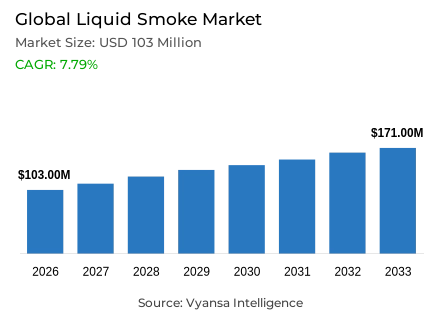
Liquid smoke is a concentrate made by condensing and refining wood smoke, which food processors spray, inject, or blend into products to add smoke flavor, color, and a preservation cue without running a smokehouse. The Liquid smoke market is forecast to grow at a CAGR of 7.79% between 2027 and 2033.
Key Highlights of the Liquid Smoke Market
- The liquid smoke market was valued at USD 103 million in 2026 and is estimated at USD 109 million in 2027. The market is forecast to reach USD 171 million by 2033.
- The market is forecast to expand at a CAGR of 7.79% between 2027 and 2033.
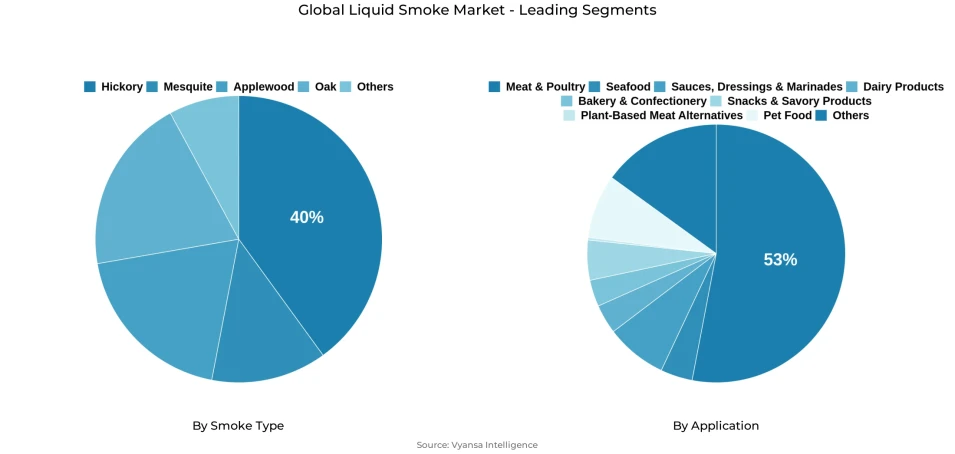
- By smoke type, hickory led the market with a 40% share in 2026.
- Applewood is projected to grow fastest under smoke type, at an estimated CAGR of 11.21% during 2027–2033
- By application, meat and poultry led the market with a 53% share in 2026.
- Plant-based meat alternatives are projected to grow fastest under application, at an estimated 20.01% CAGR during 2027–2033.
- By region, North America led the market with a 36% share in 2026.
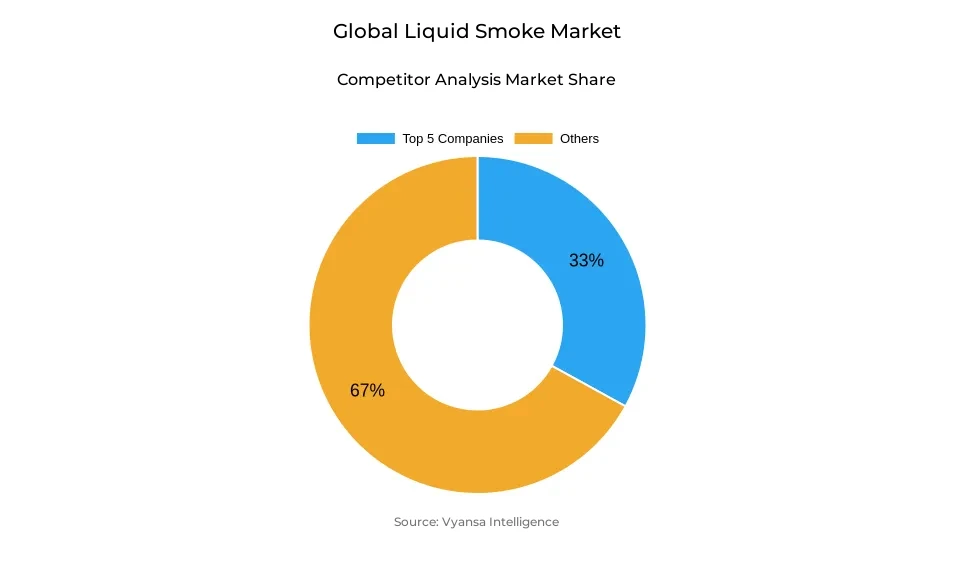
- The market is moderately fragmented, with the top five companies holding a combined 33% share in 2026.
The global food processing industry provides a recurring demand base for liquid smoke, which manufacturers use to deliver consistent smoky flavors and color across processed food products. By incorporating condensed smoke into production lines, manufacturers can standardize flavor profiles while reducing reliance on conventional smoking methods. According to the FAO, global meat production is projected to reach 391.3 million tonnes in 2026, with poultry accounting for a substantial share of the increase. Although liquid smoke is used only in products requiring smoky characteristics, expanding meat production creates additional opportunities for ingredient suppliers to secure long-term processing contracts.
Recent industrial investments illustrate the integration of liquid smoke into commercial food production. Makowski’s Real Sausage began operations at its new US facility in December 2025, incorporating a liquid smoke system into its processing infrastructure. In January 2026, GEA highlighted an inline bacon-processing technology that applies condensed smoke during cooking and can reduce smoking time by approximately 50% compared with the traditional process evaluated. These developments demonstrate how liquid smoke can support production efficiency, flavor consistency, and capacity expansion.
North America accounted for an estimated 36% of global liquid smoke demand in 2026, according to the supplied market model, reflecting its established processed and smoked-food industry. Future market growth will depend on adoption across additional product categories and the integration of liquid smoke into new and upgraded processing lines. Once incorporated into standardized formulations, the ingredient can generate recurring demand aligned with ongoing food production.
Liquid Smoke Market Drivers
Growth in Further-Processed Meat Production
Increasing production of further-processed meat products, including bacon, sausages, and cooked poultry, is creating opportunities for liquid smoke suppliers. Manufacturers use liquid smoke to achieve consistent flavor and appearance across production batches while improving process control. Depending on the application, spraying, dipping, or blending smoke ingredients into processing lines can help standardize product characteristics and manage production time.
According to the OECD–FAO Agricultural Outlook 2025–2034, global meat consumption is projected to increase by 47.9 million tonnes by 2034, while poultry consumption is expected to grow by approximately 21%. This expansion could increase the addressable market for cooked and further-processed meat products. However, additional meat consumption will translate into liquid smoke demand only where manufacturers incorporate smoky flavors into their product formulations.
Investment in processing capacity further illustrates this opportunity. In August 2025, JBS announced a USD 100 million investment plan for a facility in Ankeny, Iowa, intended to expand ready-to-eat bacon and sausage production. As manufacturers increase capacity for these products, liquid smoke suppliers can pursue recurring ingredient contracts by meeting processors’ requirements for flavor consistency, application performance, and product specifications.
Liquid Smoke Market Challenges
Reformulating Without Losing the Expected Taste
Replacing an established smoke ingredient is a technical challenge because smoke contributes several sensory effects at once. A substitute that recreates the aroma may not give the same color or depth after cooking. Manufacturers therefore need to test a replacement in the finished product, assess consumer acceptance, and update their ingredient specifications before switching supply.
The safety assessment adds to that work. The European Food Safety Authority (EFSA) identified genotoxicity concerns that could not be ruled out for the smoke flavoring primary products it assessed for renewal. The finding concerns the assessed products and the available evidence; it should not be read as a finding that every smoky ingredient has the same risk.
The response requires product development, rather than a simple change of supplier. In May 2026, Symrise expanded its range of smoke-type flavorings and smoked ingredients in dry and liquid forms for manufacturers reviewing their recipes. Such alternatives give food makers options, but each still has to meet the intended product’s taste, labelling and production needs. The time and cost of that work can delay purchasing decisions even where manufacturers intend to retain a smoky flavor.
Liquid Smoke Market Recent Trends
Smoked Flavors Expand Across Prepared Foods
Smoke is increasingly specified for its taste, including in products that were never traditionally smoked. Snack and ready-meal developers can pair it with sweet, spicy or roasted notes to give a familiar product a distinct flavor. This changes who selects the ingredient: brand and flavor-development teams become as relevant to suppliers as meat-plant operators.
Kerry reported in October 2025 that Europe accounted for 47% of global new savory products featuring smoke or roasted notes. In its June 2026 culinary review, International Flavors & Fragrances Inc. (IFF) identified smoke and grill flavors in ready meals, sauces and snacks, alongside emerging uses such as smoked chocolate and drinks. These figures and examples concern broader smoky flavor development; they do not measure liquid smoke consumption directly.
For liquid smoke suppliers, the opportunity lies in grades that work reliably at the concentration and format each recipe needs. A sauce may need even dispersion, while a snack seasoning needs a flavor that survives drying and storage. Suppliers that help manufacturers solve those application problems can gain business outside traditional smoked meat processing.
Better Filtration and More Precise Smoke Profiles
Liquid smoke producers are refining how they capture, filter and formulate smoke so manufacturers can specify more than a general “smoky” taste. A processor may need a mild wood note, a stronger grilled aroma or a particular color effect. More controlled production helps suppliers deliver those characteristics consistently between batches.
Filtration is also becoming a point of technical differentiation. Besmoke states that its PureTech process removes up to 95% of harmful polycyclic aromatic hydrocarbons from its smoke ingredients. That is a supplier-reported reduction in a particular group of compounds; it does not, by itself, establish that a product is authorized for every market or application.
This development raises the value of test results, product specifications and application support. Food manufacturers changing an established recipe need to know how a replacement behaves during cooking and whether its taste remains stable in the finished food. Suppliers able to document composition and reproduce a chosen profile can compete on performance as well as price.
Liquid Smoke Market Future Opportunities
Smoke Ingredients for Plant-Based Meat
The expansion of plant-based meat products presents an opportunity for liquid smoke suppliers to support flavor development. Manufacturers use smoke ingredients to replicate grilled and cooked-meat flavor profiles in plant-based burgers, sausages, and other savory products. According to the Good Food Institute, global retail sales of plant-based meat and seafood reached USD 6.6 billion in 2025, establishing a potential customer base for specialized flavoring ingredients. However, this figure represents the broader product category rather than direct demand for liquid smoke.
Flavor consistency remains essential in this application. Smoke ingredients must complement the underlying protein and retain a balanced profile after cooking. Excessive smoke intensity can overpower other flavors, while insufficient intensity may fail to deliver the intended grilled character. Suppliers such as Besmoke already offer smoke and grill flavor profiles for vegan and plant-based applications, demonstrating the availability of specialized solutions for product formulation.
The opportunity lies in supporting plant-based manufacturers developing products with specific smoked or grilled flavor profiles. Suppliers that provide formulation guidance, product samples, and consistent ingredient quality can strengthen relationships with manufacturers and establish recurring demand as successful formulations progress from product trials to commercial production.
Unlock Market Intelligence
Explore the market potential with our data-driven report
Liquid Smoke Market Segmentation Analysis
By Smoke Type:
- Hickory
- Mesquite
- Applewood
- Oak
- Others
Hickory Leads While Applewood Grows Fastest
Hickory accounts for an estimated 40.0% of the global liquid smoke market by smoke type in 2026. Its strong, recognisable barbecue flavor makes it a familiar choice for processors developing smoked meat and other savoury products. The profile is widely available in concentrated form, allowing manufacturers to adjust flavor intensity while maintaining consistency across batches. These established uses support hickory’s leading position through the forecast period.
Applewood is projected to grow fastest, at an estimated CAGR of 11.21% during 2027–2033. Its lighter, sweeter profile suits products where a stronger smoke note could overpower the main ingredients, giving manufacturers more scope to use it in poultry, cheese and other formulations. Suppliers already offer applewood as a distinct liquid smoke variety, supporting its adoption beyond conventional barbecue recipes.
By Application:
- Meat & Poultry
- Seafood
- Sauces, Dressings & Marinades
- Dairy Products
- Bakery & Confectionery
- Snacks & Savory Products
- Plant-Based Meat Alternatives
- Pet Food
- Others
Meat and Poultry Lead While Plant-Based Alternatives Grow Fastest
Meat and poultry account for an estimated 53.0% of liquid smoke demand by application in 2026. Bacon, sausages, cooked poultry and other processed products can require a consistent smoked taste across repeated production batches. Liquid smoke can be incorporated into a processor’s established recipe and application process, making this segment a substantial source of regular ingredient orders. A 2026 review of liquid smoke research documents its use in meat products for flavor and other product characteristics.
Plant-based meat alternatives are projected to grow fastest, at an estimated 20.01% CAGR during 2027–2033, from a much smaller base. Smoke can help a plant-based product develop the cooked or grilled character expected of a burger, sausage or pâté. A 2025 study formulated a plant-based pâté using a liquid natural smoke flavor, demonstrating its direct use in this type of product.
Unlock Market Intelligence
Explore the market potential with our data-driven report
Liquid Smoke Market Geographical Analysis
North America Leads While Asia Pacific Grows Fastest
North America accounts for an estimated 36% of global liquid smoke demand in 2026. Its established market for smoked and barbecue-style foods gives suppliers an extensive base of manufacturers already familiar with smoke ingredients. Continued production of these foods supports the region’s lead, even as faster growth elsewhere reduces its estimated share to 33.0% by 2033. An independent liquid smoke market assessment also identifies North America as the leading region, although it uses a different forecast model.
Asia Pacific is projected to grow fastest, at an estimated CAGR of 10.79% during 2027–2033. The opportunity depends on more of the region’s food output entering processed products that require a smoked flavor, rather than on raw food production alone. FAO reported in 2026 that Asia accounted for 76% of global aquatic animal and algae production, indicating the scale of its potential seafood-processing base.

Liquid Smoke Market Competitive Landscape
The liquid smoke industry is moderately fragmented, with participants ranging from flavor houses to specialist smoke producers and retail brand owners. The top five companies held a combined 33.00% share in 2026. The five leading companies are Kerry Group plc (Red Arrow), International Flavors & Fragrances Inc., Azelis Denmark A/S (Scansmoke), Baumer Foods, Inc. (Figaro) and B&G Foods, Inc. (Wright's).
Key Companies in the Liquid Smoke Market
- Kerry Group plc (Red Arrow)
- International Flavors & Fragrances Inc.
- Azelis Denmark A/S (Scansmoke)
- B&G Foods, Inc. (Wright's)
- Besmoke Limited (including brands)
- Colgin Inc.
- Ruitenberg Ingredients B.V.
- D2 Ingredients, LP
- Baumer Foods, Inc. (Figaro)
- McCormick & Company, Incorporated (Stubb's)
- Symrise AG
- MSK Ingredients Limited
- QST Liquid Smoke
- PS Seasoning
- United Group of Food Consultants
Company Profiling
The following profiles cover the five leading companies shaping product development, distribution and competitive positioning in the liquid smoke industry.
Kerry Group plc (Red Arrow). Kerry supplies smoke ingredients and smoke-and-grill flavor systems for food manufacturing through Red Arrow. Its portfolio covers applications that require a consistent wood-smoke character across production runs. In January 2026, Kerry released its global Taste Charts to guide food and beverage product development across regions and categories.
International Flavors & Fragrances Inc. IFF develops smoke-and-grill flavors for food manufacturers, including alternatives designed for recipes that cannot use traditional smoke condensates. Its replacement collection includes six smoke profiles offered in powder and liquid formats, giving customers options when matching an existing product’s taste. In June 2026, IFF presented smoke and grill as one of the culinary directions shaping its food innovation work.
Azelis Denmark A/S (Scansmoke). Azelis Denmark manufactures and supplies Scansmoke ingredients and acts as Azelis’s centre of excellence for the range. The products are intended for controlled smoke flavor and colour application in food processing. Its more recent smoke-market activity includes a distribution partnership with Besmoke, announced around the end of 2024, to widen access to specialist smoke ingredients in European markets.
Baumer Foods, Inc. (Figaro). Baumer participates through Figaro liquid smoke and marinade products for retail and foodservice use. Its documented range includes hickory and mesquite varieties. A January 2026 Orthodox Union certificate lists both Figaro varieties among the products prepared at Baumer’s Louisiana facility, providing current evidence of the active line.
B&G Foods, Inc. (Wright’s). B&G Foods sells Wright’s liquid smoke to household and foodservice customers. The brand’s current range includes hickory, mesquite and applewood, allowing users to choose different smoke profiles for cooking or seasoning. In its 2026 company disclosures, B&G continued to identify Wright’s within its spices and flavor solutions portfolio; a more recent Wright’s-specific launch was not documented in the reviewed company material.
Recent Developments in the Liquid Smoke Market
- In September 2026, the state of Pennsylvania awarded nearly USD 600,000 in grants to ten small meat processors, including one expanding into United States Department of Agriculture (USDA) inspected smoked and cooked products. The grants widen the base of small value-added processors that consume smoke ingredients, which adds consumption in regional processing rather than at large plants.
Frequently Asked Questions
Related Report
- Market Segmentation
- Research Scope
- Research Methodology
- Definitions and Assumptions
- Executive Summary
- Global Liquid Smoke Market Policies, Regulations, and Standards
- Global Liquid Smoke Market Dynamics
- Growth Factors
- Challenges
- Trends
- Opportunities
- Global Liquid Smoke Market Statistics, 2023-2033F
- Market Size & Growth Outlook
- By Revenues in USD Million
- Market Segmentation & Growth Outlook
- By Smoke Type
- Hickory- Market Insights and Forecast 2023-2033, USD Million
- Mesquite- Market Insights and Forecast 2023-2033, USD Million
- Applewood- Market Insights and Forecast 2023-2033, USD Million
- Oak- Market Insights and Forecast 2023-2033, USD Million
- Others- Market Insights and Forecast 2023-2033, USD Million
- By Application
- Meat & Poultry- Market Insights and Forecast 2023-2033, USD Million
- Seafood- Market Insights and Forecast 2023-2033, USD Million
- Sauces, Dressings & Marinades- Market Insights and Forecast 2023-2033, USD Million
- Dairy Products- Market Insights and Forecast 2023-2033, USD Million
- Bakery & Confectionery- Market Insights and Forecast 2023-2033, USD Million
- Snacks & Savory Products- Market Insights and Forecast 2023-2033, USD Million
- Plant-Based Meat Alternatives- Market Insights and Forecast 2023-2033, USD Million
- Pet Food- Market Insights and Forecast 2023-2033, USD Million
- Others- Market Insights and Forecast 2023-2033, USD Million
- By Region
- North America
- South America
- Europe
- Middle East & Africa
- Asia Pacific
- By Competitors
- Competition Characteristics
- Market Share & Analysis
- By Smoke Type
- Market Size & Growth Outlook
- North America Liquid Smoke Market Statistics, 2023-2033F
- Market Size & Growth Outlook
- By Revenues in USD Million
- Market Segmentation & Growth Outlook
- By Smoke Type- Market Insights and Forecast 2023-2033, USD Million
- By Application- Market Insights and Forecast 2023-2033, USD Million
- By Country
- The US
- Canada
- Mexico
- The US Liquid Smoke Market Statistics, 2023-2033F
- Market Size & Growth Outlook
- By Revenues in USD Million
- Market Segmentation & Growth Outlook
- By Smoke Type- Market Insights and Forecast 2023-2033, USD Million
- By Application- Market Insights and Forecast 2023-2033, USD Million
- Market Size & Growth Outlook
- Canada Liquid Smoke Market Statistics, 2023-2033F
- Market Size & Growth Outlook
- By Revenues in USD Million
- Market Segmentation & Growth Outlook
- By Smoke Type- Market Insights and Forecast 2023-2033, USD Million
- By Application- Market Insights and Forecast 2023-2033, USD Million
- Market Size & Growth Outlook
- Mexico Liquid Smoke Market Statistics, 2023-2033F
- Market Size & Growth Outlook
- By Revenues in USD Million
- Market Segmentation & Growth Outlook
- By Smoke Type- Market Insights and Forecast 2023-2033, USD Million
- By Application- Market Insights and Forecast 2023-2033, USD Million
- Market Size & Growth Outlook
- Market Size & Growth Outlook
- South America Liquid Smoke Market Statistics, 2023-2033F
- Market Size & Growth Outlook
- By Revenues in USD Million
- Market Segmentation & Growth Outlook
- By Smoke Type- Market Insights and Forecast 2023-2033, USD Million
- By Application- Market Insights and Forecast 2023-2033, USD Million
- By Country
- Brazil
- Argentina
- Chile
- Rest of South America
- Brazil Liquid Smoke Market Statistics, 2023-2033F
- Market Size & Growth Outlook
- By Revenues in USD Million
- Market Segmentation & Growth Outlook
- By Smoke Type- Market Insights and Forecast 2023-2033, USD Million
- By Application- Market Insights and Forecast 2023-2033, USD Million
- Market Size & Growth Outlook
- Argentina Liquid Smoke Market Statistics, 2023-2033F
- Market Size & Growth Outlook
- By Revenues in USD Million
- Market Segmentation & Growth Outlook
- By Smoke Type- Market Insights and Forecast 2023-2033, USD Million
- By Application- Market Insights and Forecast 2023-2033, USD Million
- Market Size & Growth Outlook
- Chile Liquid Smoke Market Statistics, 2023-2033F
- Market Size & Growth Outlook
- By Revenues in USD Million
- Market Segmentation & Growth Outlook
- By Smoke Type- Market Insights and Forecast 2023-2033, USD Million
- By Application- Market Insights and Forecast 2023-2033, USD Million
- Market Size & Growth Outlook
- Market Size & Growth Outlook
- Europe Liquid Smoke Market Statistics, 2023-2033F
- Market Size & Growth Outlook
- By Revenues in USD Million
- Market Segmentation & Growth Outlook
- By Smoke Type- Market Insights and Forecast 2023-2033, USD Million
- By Application- Market Insights and Forecast 2023-2033, USD Million
- By Country
- Germany
- The UK
- France
- Italy
- Spain
- BENELUX
- Nordics
- Rest of Europe
- Germany Liquid Smoke Market Statistics, 2023-2033F
- Market Size & Growth Outlook
- By Revenues in USD Million
- Market Segmentation & Growth Outlook
- By Smoke Type- Market Insights and Forecast 2023-2033, USD Million
- By Application- Market Insights and Forecast 2023-2033, USD Million
- Market Size & Growth Outlook
- The UK Liquid Smoke Market Statistics, 2023-2033F
- Market Size & Growth Outlook
- By Revenues in USD Million
- Market Segmentation & Growth Outlook
- By Smoke Type- Market Insights and Forecast 2023-2033, USD Million
- By Application- Market Insights and Forecast 2023-2033, USD Million
- Market Size & Growth Outlook
- France Liquid Smoke Market Statistics, 2023-2033F
- Market Size & Growth Outlook
- By Revenues in USD Million
- Market Segmentation & Growth Outlook
- By Smoke Type- Market Insights and Forecast 2023-2033, USD Million
- By Application- Market Insights and Forecast 2023-2033, USD Million
- Market Size & Growth Outlook
- Italy Liquid Smoke Market Statistics, 2023-2033F
- Market Size & Growth Outlook
- By Revenues in USD Million
- Market Segmentation & Growth Outlook
- By Smoke Type- Market Insights and Forecast 2023-2033, USD Million
- By Application- Market Insights and Forecast 2023-2033, USD Million
- Market Size & Growth Outlook
- Spain Liquid Smoke Market Statistics, 2023-2033F
- Market Size & Growth Outlook
- By Revenues in USD Million
- Market Segmentation & Growth Outlook
- By Smoke Type- Market Insights and Forecast 2023-2033, USD Million
- By Application- Market Insights and Forecast 2023-2033, USD Million
- Market Size & Growth Outlook
- BENELUX Liquid Smoke Market Statistics, 2023-2033F
- Market Size & Growth Outlook
- By Revenues in USD Million
- Market Segmentation & Growth Outlook
- By Smoke Type- Market Insights and Forecast 2023-2033, USD Million
- By Application- Market Insights and Forecast 2023-2033, USD Million
- Market Size & Growth Outlook
- Nordics Liquid Smoke Market Statistics, 2023-2033F
- Market Size & Growth Outlook
- By Revenues in USD Million
- Market Segmentation & Growth Outlook
- By Smoke Type- Market Insights and Forecast 2023-2033, USD Million
- By Application- Market Insights and Forecast 2023-2033, USD Million
- Market Size & Growth Outlook
- Market Size & Growth Outlook
- Middle East & Africa Liquid Smoke Market Statistics, 2023-2033F
- Market Size & Growth Outlook
- By Revenues in USD Million
- Market Segmentation & Growth Outlook
- By Smoke Type- Market Insights and Forecast 2023-2033, USD Million
- By Application- Market Insights and Forecast 2023-2033, USD Million
- By Country
- UAE
- Saudi Arabia
- South Africa
- Turkey
- Rest of Middle East & Africa
- UAE Liquid Smoke Market Statistics, 2023-2033F
- Market Size & Growth Outlook
- By Revenues in USD Million
- Market Segmentation & Growth Outlook
- By Smoke Type- Market Insights and Forecast 2023-2033, USD Million
- By Application- Market Insights and Forecast 2023-2033, USD Million
- Market Size & Growth Outlook
- Saudi Arabia Liquid Smoke Market Statistics, 2023-2033F
- Market Size & Growth Outlook
- By Revenues in USD Million
- Market Segmentation & Growth Outlook
- By Smoke Type- Market Insights and Forecast 2023-2033, USD Million
- By Application- Market Insights and Forecast 2023-2033, USD Million
- Market Size & Growth Outlook
- South Africa Liquid Smoke Market Statistics, 2023-2033F
- Market Size & Growth Outlook
- By Revenues in USD Million
- Market Segmentation & Growth Outlook
- By Smoke Type- Market Insights and Forecast 2023-2033, USD Million
- By Application- Market Insights and Forecast 2023-2033, USD Million
- Market Size & Growth Outlook
- Turkey Liquid Smoke Market Statistics, 2023-2033F
- Market Size & Growth Outlook
- By Revenues in USD Million
- Market Segmentation & Growth Outlook
- By Smoke Type- Market Insights and Forecast 2023-2033, USD Million
- By Application- Market Insights and Forecast 2023-2033, USD Million
- Market Size & Growth Outlook
- Market Size & Growth Outlook
- Asia Pacific Liquid Smoke Market Statistics, 2023-2033F
- Market Size & Growth Outlook
- By Revenues in USD Million
- Market Segmentation & Growth Outlook
- By Smoke Type- Market Insights and Forecast 2023-2033, USD Million
- By Application- Market Insights and Forecast 2023-2033, USD Million
- By Country
- China
- India
- Japan
- South Korea
- Australia
- Southeast Asia
- Rest of Asia Pacific
- China Liquid Smoke Market Statistics, 2023-2033F
- Market Size & Growth Outlook
- By Revenues in USD Million
- Market Segmentation & Growth Outlook
- By Smoke Type- Market Insights and Forecast 2023-2033, USD Million
- By Application- Market Insights and Forecast 2023-2033, USD Million
- Market Size & Growth Outlook
- India Liquid Smoke Market Statistics, 2023-2033F
- Market Size & Growth Outlook
- By Revenues in USD Million
- Market Segmentation & Growth Outlook
- By Smoke Type- Market Insights and Forecast 2023-2033, USD Million
- By Application- Market Insights and Forecast 2023-2033, USD Million
- Market Size & Growth Outlook
- Japan Liquid Smoke Market Statistics, 2023-2033F
- Market Size & Growth Outlook
- By Revenues in USD Million
- Market Segmentation & Growth Outlook
- By Smoke Type- Market Insights and Forecast 2023-2033, USD Million
- By Application- Market Insights and Forecast 2023-2033, USD Million
- Market Size & Growth Outlook
- South Korea Liquid Smoke Market Statistics, 2023-2033F
- Market Size & Growth Outlook
- By Revenues in USD Million
- Market Segmentation & Growth Outlook
- By Smoke Type- Market Insights and Forecast 2023-2033, USD Million
- By Application- Market Insights and Forecast 2023-2033, USD Million
- Market Size & Growth Outlook
- Australia Liquid Smoke Market Statistics, 2023-2033F
- Market Size & Growth Outlook
- By Revenues in USD Million
- Market Segmentation & Growth Outlook
- By Smoke Type- Market Insights and Forecast 2023-2033, USD Million
- By Application- Market Insights and Forecast 2023-2033, USD Million
- Market Size & Growth Outlook
- Southeast Asia Liquid Smoke Market Statistics, 2023-2033F
- Market Size & Growth Outlook
- By Revenues in USD Million
- Market Segmentation & Growth Outlook
- By Smoke Type- Market Insights and Forecast 2023-2033, USD Million
- By Application- Market Insights and Forecast 2023-2033, USD Million
- Market Size & Growth Outlook
- Market Size & Growth Outlook
- Competitive Outlook
- Company Profiles
- Kerry Group plc (Red Arrow)
- Business Description
- Product Portfolio
- Collaborations & Alliances
- Recent Developments
- Financial Details
- Others
- International Flavors & Fragrances Inc.
- Business Description
- Product Portfolio
- Collaborations & Alliances
- Recent Developments
- Financial Details
- Others
- Azelis Denmark A/S (Scansmoke)
- Business Description
- Product Portfolio
- Collaborations & Alliances
- Recent Developments
- Financial Details
- Others
- B&G Foods, Inc. (Wright's)
- Business Description
- Product Portfolio
- Collaborations & Alliances
- Recent Developments
- Financial Details
- Others
- Besmoke Limited
- Business Description
- Product Portfolio
- Collaborations & Alliances
- Recent Developments
- Financial Details
- Others
- Colgin Inc.
- Business Description
- Product Portfolio
- Collaborations & Alliances
- Recent Developments
- Financial Details
- Others
- Ruitenberg Ingredients B.V.
- Business Description
- Product Portfolio
- Collaborations & Alliances
- Recent Developments
- Financial Details
- Others
- D2 Ingredients, LP
- Business Description
- Product Portfolio
- Collaborations & Alliances
- Recent Developments
- Financial Details
- Others
- Baumer Foods, Inc. (Figaro)
- Business Description
- Product Portfolio
- Collaborations & Alliances
- Recent Developments
- Financial Details
- Others
- McCormick & Company, Incorporated (Stubb's)
- Business Description
- Product Portfolio
- Collaborations & Alliances
- Recent Developments
- Financial Details
- Others
- Symrise AG
- Business Description
- Product Portfolio
- Collaborations & Alliances
- Recent Developments
- Financial Details
- Others
- MSK Ingredients Limited
- Business Description
- Product Portfolio
- Collaborations & Alliances
- Recent Developments
- Financial Details
- Others
- QST Liquid Smoke
- Business Description
- Product Portfolio
- Collaborations & Alliances
- Recent Developments
- Financial Details
- Others
- PS Seasoning
- Business Description
- Product Portfolio
- Collaborations & Alliances
- Recent Developments
- Financial Details
- Others
- United Group of Food Consultants
- Business Description
- Product Portfolio
- Collaborations & Alliances
- Recent Developments
- Financial Details
- Others
- Kerry Group plc (Red Arrow)
- Company Profiles
- Disclaimer
| Segment | Sub-Segment |
|---|---|
| By Smoke Type |
|
| By Application |
|
| By Region |
|
Research Methodology
This study followed a structured approach comprising four key phases to assess the size and scope of the electro-oxidation market. The process began with thorough secondary research to collect data on the target market, related markets, and broader industry context. These findings, along with preliminary assumptions and estimates, were then validated through extensive primary research involving industry experts from across the value chain. To calculate the overall market size, both top-down and bottom-up methodologies were employed. Finally, market segmentation and data triangulation techniques were applied to refine and validate segment-level estimations.
Secondary Research
The secondary research phase involved gathering data from a wide range of credible and published sources. This step helped in identifying industry trends, defining market segmentation, and understanding the market landscape and value chain.
Sources consulted during this phase included:
- Company annual reports, investor presentations, and press releases
- Industry white papers and certified publications
- Trade directories and market-recognized databases
- Articles from authoritative authors and reputable journals
- Gold and silver standard websites
Secondary research was critical in mapping out the industry's value chain and monetary flow, identifying key market segments, understanding regional variations, and tracking significant industry developments.
Other key sources:
- Financial disclosures
- Industry associations and trade bodies
- News outlets and business magazines
- Academic journals and research studies
- Paid industry databases
Primary Research
To validate secondary data and gain deeper market insights, primary research was conducted with key stakeholders across both the supply and demand sides of the market.
On the demand side, participants included decision-makers and influencers from end-user industries—such as CIOs, CTOs, and CSOs—who provided first-hand perspectives on market needs, product usage, and future expectations.
On the supply side, interviews were conducted with manufacturers, industry associations, and institutional participants to gather insights into current offerings, product pipelines, and market challenges.
Primary interviews provided critical inputs such as:
- Market size and revenue data
- Product and service breakdowns
- Market forecasts
- Regional and application-specific trends
Stakeholders consulted included:
- Leading OEM and solution providers
- Channel and distribution partners
- End users across various applications
- Independent consultants and industry specialists
Market Size Estimation and Data Triangulation
- Identifying Key Market Participants (Secondary Research)
- Goal: To identify the major players or companies in the target market. This typically involves using publicly available data sources such as industry reports, market research publications, and financial statements of companies.
- Tools: Reports from firms like Gartner, Forrester, Euromonitor, Statista, IBISWorld, and others. Public financial statements, news articles, and press releases from top market players.
- Extracting Earnings of Key Market Participants
- Goal: To estimate the earnings generated from the product or service being analyzed. This step helps in understanding the revenue potential of each market player in a specific geography.
- Methods: Earnings data can be gathered from:
- Publicly available financial reports (for listed companies).
- Interviews and primary data sources from professionals, such as Directors, VPs, SVPs, etc. This is especially useful for understanding more nuanced, internal data that isn't publicly disclosed.
- Annual reports and investor presentations of key players.
- Data Collation and Development of a Relevant Data Model
- Goal: To collate inputs from both primary and secondary sources into a structured, data-driven model for market estimation. This model will incorporate key market KPIs and any independent variables relevant to the market.
- Key KPIs: These could include:
- Market size, growth rate, and demand drivers.
- Industry-specific metrics like market share, average revenue per customer (ARPC), or average deal size.
- External variables, such as economic growth rates, inflation rates, or commodity prices, that could affect the market.
- Data Modeling: Based on this data, the market forecasts are developed for the next 5 years. A combination of trend analysis, scenario modeling, and statistical regression might be used to generate projections.
- Scenario Analysis
- Goal: To test different assumptions and validate how sensitive the market is to changes in key variables (e.g., market demand, regulatory changes, technological disruptions).
- Types of Scenarios:
- Base Case: Based on current assumptions and historical data.
- Best-Case Scenario: Assuming favorable market conditions, regulatory environments, and technological advancements.
- Worst-Case Scenario: Accounting for adverse factors, such as economic downturns, stricter regulations, or unexpected disruptions.