Vietnam Organic Food & Beverages Market Report: Trends, Growth and Forecast (2026-2032)
By Product Type (Organic Food (Fruits & Vegetables, Cereals, Grains & Pulses, Meat, Poultry & Seafood, Dairy Products & Eggs, Packaged & Processed Foods, Other Organic Foods), Organic Beverages (Fruit & Vegetable Juices, Tea & Coffee, Dairy Beverages, Plant-Based Beverages, Other Organic Beverages)), By Distribution Channel (Supermarkets & Hypermarkets, Specialty Stores, Convenience Stores, Online Stores, Others), By End Consumer (Household Consumers, HoReCa/ Foodservice, Institutional & Other Commercial) ... Read more
|
Major Players
|
Vietnam Organic Food & Beverages Market Overview
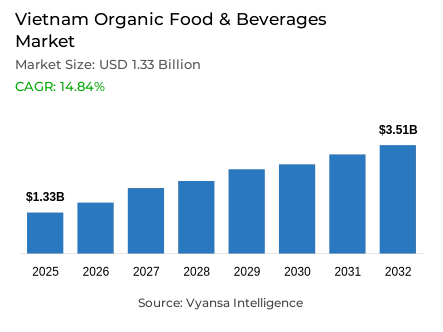
The organic food & beverages market covers certified organic fresh produce, dairy, grains, meat, tea, coffee, processed foods, and beverages sold through modern retail, specialist stores, foodservice, and digital channels. Unlike the broader “clean food” category, organic products depend on documented production and certification standards. The Vietnam organic food and beverage market is projected to reach USD 3.51 billion by 2032, representing a 14.84% CAGR during 2026–2032.
Key Highlights of the Vietnam Organic Food & Beverages Market
- The Vietnam organic food & beverages market increased from USD 1.33 billion in 2025 to USD 1.53 billion in 2026.
- Revenue is projected to reach USD 3.51 billion by 2032, representing a 14.84% CAGR during 2026–2032.
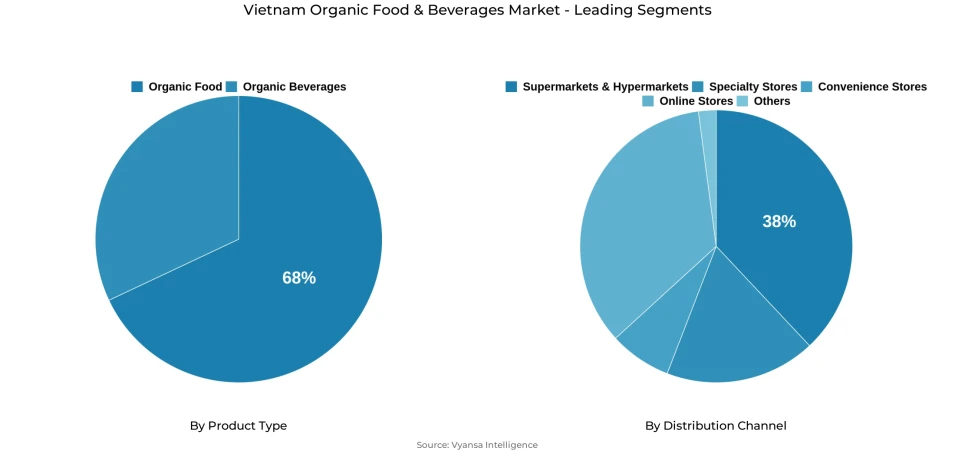
- Organic Food remains the leading product category with a 68% market share in 2026, while organic beverages are expected to grow faster through 2032.
- Supermarkets & hypermarkets remain the primary distribution channel, with a 38% share in the market, although Online Stores are gaining considerably faster.
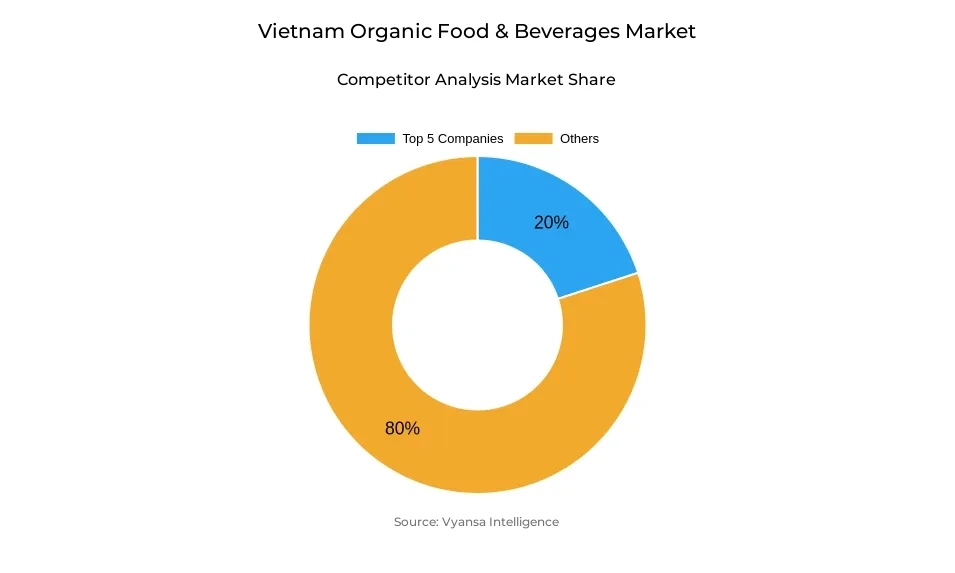
- Competition remains fragmented, with the top five participants accounting for approximately 20% of the market.
Vietnam’s organic food and beverage industry is gaining commercial relevance as consumers place greater emphasis on food safety, product origin, and transparent production practices. Organic certification provides a measurable point of differentiation from the broader clean-food segment by verifying compliance with defined production standards. For example, certified organic products can command premium prices when consumers associate recognized certification marks with greater product credibility and consistency.
Favorable economic conditions are also supporting market expansion. According to World Bank data, Vietnam’s economy grew by approximately 8% in 2025, strengthening household purchasing power and creating greater capacity for premium food purchases. This is particularly relevant because organic products typically carry a price premium over conventional alternatives.
Demand is also expanding across multiple end-use channels. Fresh produce and dairy remain important household categories, while organic ingredients are increasingly adopted by food manufacturers, cafés, hotels, restaurants, and export-oriented processors seeking differentiated product offerings. This diversification reduces reliance on individual consumer segments.
Distribution is becoming broader through supermarkets, specialty retailers, e-commerce platforms, food-delivery applications, and direct-to-consumer channels. By 2032, market growth will increasingly depend on suppliers’ ability to combine credible certification, consistent product quality, dependable supply, and wider retail availability, enabling organic products to move from niche purchases toward more mainstream consumption.
Government Regulations Shaping the Vietnam Organic Food & Beverages Market
Vietnam already has a formal foundation for organic production through the TCVN 11041 national organic standards and the country's organic agriculture framework introduced in 2018. These requirements establish how organic products are produced, processed, certified, and labelled, helping separate genuinely certified products from wider “green” or “clean” food claims. For suppliers, compliance is commercially important because credible certification supports retailer acceptance and consumer confidence.
Government support became more forward-looking in April 2026, when Vietnam's national agriculture action programme identified ecological, organic, and circular agriculture as development priorities through 2030. The programme connects these areas with stronger traceability and alignment with international standards. Rather than creating demand by itself, the policy should improve the environment in which the Vietnam organic food & beverages industry operates by encouraging better-organized production, clearer product verification, and stronger preparation for premium domestic and export channels.
Vietnam Organic Food & Beverages Market Drivers
Rising Health and Food-Safety Awareness Supports Regular Organic Purchasing
The strongest demand driver is the gradual shift from buying organic food as an occasional premium choice to buying it for health, food-safety, and quality reasons. Vietnamese households increasingly evaluate how food is produced and whether its claims can be trusted, making certification particularly valuable for frequently purchased categories such as vegetables, fruit, dairy, grains, and beverages. As purchasing power improves, more consumers can act on these preferences rather than choosing solely on price.
Consumer research supports this behaviour. The voice of the consumer research indicated that Vietnamese shoppers were willing to pay an average premium for organic and environmentally compliant products, while earlier consumer research also showed particularly strong organic purchasing in fruit and vegetables.
For the industry, the important point is not simply higher awareness. It is the conversion of awareness into repeat household purchasing. This encourages producers and retailers to treat organic ranges as permanent portfolio categories, supporting wider availability and recurring demand through 2032.
Vietnam Organic Food & Beverages Market Challenges
Certification Costs and Fragmented Production Limit Reliable Organic Supply
The biggest challenge is on the supply side. Organic certification requires farms to follow defined production practices, maintain documentation, undergo verification, and sustain compliance over time. These requirements can be difficult for Vietnam's large base of smaller producers, particularly when certification costs must be absorbed across relatively limited production volumes. A 2025 academic assessment highlighted continuing difficulties even under lower-cost participatory certification models designed for small farmers.
Fragmentation creates a second commercial problem. Modern retailers, processors, and foodservice buyers require dependable volumes, consistent quality, and predictable delivery. Small, dispersed organic farms can struggle to provide all three, restricting how quickly certified supply can expand into nationwide distribution.
Trust remains closely linked to this issue. When shoppers encounter products marketed as organic without clear certification, it weakens confidence across the wider category. The market therefore needs stronger producer aggregation, more affordable certification routes, and clearer verification if expanding consumer interest is to translate into sustained market growth rather than demand outpacing credible supply.
Vietnam Organic Food & Beverages Market Recent Trends
Organic Purchasing Is Moving into Mainstream Retail and Digital Shopping
Organic purchasing is gradually becoming part of normal grocery behaviour rather than remaining concentrated in specialist stores. The shift became increasingly visible during 2025 as health-oriented and “eat clean” consumption gained broader attention, particularly among younger urban households. More importantly, consumers can now encounter organic products during routine supermarket visits instead of having to make a separate trip to a dedicated organic retailer.
Large retailers are responding by increasing organic and environmentally positioned assortments, while e-commerce, supermarket delivery services, and marketplace storefronts are making repeat purchasing easier. AEON, for example, already carries produce positioned around restricted agricultural inputs alongside imported organic products, illustrating how mainstream retailers are giving these products more visible shelf space.
For the industry, this matters because easier access lowers one of the practical barriers to repeat consumption. Physical stores remain important for product discovery and trust, while online channels increasingly handle convenient replenishment. Suppliers able to maintain consistent products, certification information, and availability across both formats should therefore gain an advantage as the category becomes more mainstream.
Digital Traceability Is Becoming a Commercial Trust Tool
Traceability is becoming one of the most useful technical developments supporting organic and sustainability-focused food. During 2026, Vietnam began expanding the use of QR codes, blockchain, and connected traceability systems intended to provide clearer product histories from production through distribution. Although these systems extend beyond certified organic products, they directly address one of the category's biggest weaknesses: the difficulty consumers and buyers face in verifying how a product was actually produced.
The commercial value is straightforward. A shopper scanning a code, a retailer checking a supplier, or an overseas buyer reviewing production records can verify more information without depending only on the food and beverage packaging claim. Similar traceability systems are already being applied across Vietnamese agricultural supply chains, including export-oriented coffee operations.
For the Vietnam organic food & beverages market, digital traceability can therefore strengthen certification rather than replace it. Producers that combine recognized organic certification with accessible product records should be better positioned to build consumer confidence, meet retailer qualification requirements, and demonstrate compliance to export buyers through the forecast period.
Vietnam Organic Food & Beverages Market Future Opportunities
Export-Oriented Organic Products Offer Significant Premium Growth Potential
Vietnam's large agricultural export base creates one of the strongest longer-term opportunities for organic food and beverage suppliers. Ministry of Agriculture and Environment data shows agro-forestry-fishery exports reached USD 70.09 billion in 2025, while European and Japanese demand expanded strongly during the year. This provides an established international customer base into which certified organic products can increasingly be introduced.
The opportunity is particularly relevant because exporters are already investing in traceability, environmental compliance, lower-emission production, and documented sourcing to satisfy overseas buyers. These systems are not the same as organic certification, but they reduce the operational distance between conventional export agriculture and fully verified organic production.
Rather than building separate compliance structures from the beginning, exporters may be able to extend existing documentation and traceability systems toward organic certification. This creates an opportunity for the Vietnam organic food & beverages industry in rice, coffee, tea, coconut products, spices, fruit, and processed foods, especially where certification can support stronger pricing and access to premium international retail and foodservice customers.
Unlock Market Intelligence
Explore the market potential with our data-driven report
Vietnam Organic Food & Beverages Market Segmentation Analysis
By Product Type
- Organic Food
- Fruits & Vegetables
- Cereals, Grains & Pulses
- Meat, Poultry & Seafood
- Dairy Products & Eggs
- Packaged & Processed Foods
- Other Organic Foods
- Organic Beverages
- Fruit & Vegetable Juices
- Tea & Coffee
- Dairy Beverages
- Plant-Based Beverages
- Other Organic Beverages
Organic Food Retains Leadership While Organic Beverages Gain Ground
Organic Food accounted for 68% of the market in 2026, equivalent to approximately USD 1.04 billion. Its leadership reflects the importance of products bought frequently for household meals, particularly fresh produce, grains, dairy, eggs, and increasingly packaged organic foods. These categories also offer consumers the clearest everyday reason to choose certified alternatives, allowing Organic Food to retain the largest absolute revenue base.
Organic Beverages represented 32% in 2026 and are expected to expand more rapidly, with their share increasing to around 35% by 2032. Market value rises from approximately USD 0.49 billion to USD 1.23 billion, representing a 16.57% CAGR. Tea, coffee, juices, dairy beverages, and plant-based drinks fit conveniently into health-oriented lifestyles and provide relatively easy entry points for consumers experimenting with organic products.
Organic Food should therefore remain dominant through 2032, but beverage innovation and changing urban consumption habits are expected to gradually narrow the difference between the two categories.
By Distribution Channel
- Supermarkets & Hypermarkets
- Specialty Stores
- Convenience Stores
- Online Stores
- Others
Supermarkets Remain the Main Access Point While Online Stores Expand Faster
Supermarkets & Hypermarkets accounted for approximately 38% of distribution in 2026, representing about USD 0.58 billion. Their position is supported by product variety, trusted retail environments, established handling for fresh and refrigerated products, and the ability to place certified organic goods alongside consumers' normal grocery purchases. This makes large-format retail an important bridge between specialist organic consumption and mainstream household shopping.
Online Stores accounted for around 22% in 2026 but are expected to reach approximately 30% by 2032, with value rising from USD 0.34 billion to USD 1.05 billion at a 20.94% CAGR. Delivery applications, marketplaces, social commerce, and direct brand stores increasingly allow consumers to reorder products without depending on nearby specialist outlets.
Supermarkets & Hypermarkets are still projected to lead in 2032 with approximately 34%, but the Vietnam Organic Food & Beverage Industry is clearly moving toward an omnichannel structure in which physical retail builds familiarity while digital channels make repeat purchasing easier.
Unlock Market Intelligence
Explore the market potential with our data-driven report
Vietnam Organic Food & Beverages Market Competitive Landscape
The Vietnam organic food & beverages market remains fragmented, with the top five companies accounting for an estimated 20% combined share in 2026. The remaining demand is distributed among regional farms, specialist organic businesses, processors, retailers, importers, and smaller domestic suppliers.The top 5 companies in the market include, Vietnam Dairy Products Joint Stock Company (Green Farm), TH Food Chain Joint Stock Company (TH true MILK), Organica Investment Joint Stock Company, Vinamit Joint Stock Company and Saigon Union of Trading Co-operatives (Finelife).
Prominent Companies in the Vietnam Organic Food & Beverages Market
- Vietnam Dairy Products Joint Stock Company
- TH Food Chain Joint Stock Company (TH true MILK)
- Organica Investment Joint Stock Company
- Vinamit Joint Stock Company
- Saigon Union of Trading Co-operatives (Finelife)
- Ben Tre Import and Export Joint Stock Corporation (Cocoxim)
- Vietnam Star Aniseed Cassia Manufacturing and Exporting Joint Stock Company (VINASAMEX)
- Que Lam Group Joint Stock Company
- Thuy Thien Nhu Joint Stock Company (ORFARM)
- Vien Phu Trading & Production One Member Company Limited (Hoa Sua Foods)
Recent Developments in the Vietnam Organic Food & Beverages Market
- July 2026: Lam Dong reported that its 2020–2025 organic agriculture programme had expanded certified and semi-certified organic cultivation to more than 2,000 hectares from 233 hectares in 2020, involving 66 certified organizations and individuals. The expansion demonstrates how provincial programmes can convert policy support into a larger commercial supply base for organic food production.
- April 2026: Da Nang approved an Organic Agriculture Development Scheme for 2026–2030, with a longer-term vision to 2035 and planned funding of roughly USD 19.3 million. The programme adds provincial-level investment behind organic production, potentially supporting farm conversion, certification, supply development, and stronger availability of locally produced organic products.
- September 2025: Vietnam hosted the 8th Organic Asia Congress in Ninh Binh, attracting close to 600 delegates from 33 countries and territories. Beyond industry visibility, the event strengthened links between Vietnamese producers, organic associations, certification stakeholders, and international participants, supporting knowledge transfer and potential market access as the Vietnam organic food & beverages market develops.
Frequently Asked Questions
Related Report
- Market Segmentation
- Research Scope
- Research Methodology
- Definitions and Assumptions
- Executive Summary
- Vietnam Organic Food and Beverages Market Policies, Regulations, and Standards
- Vietnam Organic Food and Beverages Market Dynamics
- Growth Factors
- Challenges
- Trends
- Opportunities
- Vietnam Organic Food and Beverages Market Statistics, 2022-2032F
- Market Size & Growth Outlook
- By Revenues in USD Million
- Market Segmentation & Growth Outlook
- By Product Type
- Organic Food- Market Insights and Forecast 2022-2032, USD Million
- Fruits & Vegetables- Market Insights and Forecast 2022-2032, USD Million
- Cereals, Grains & Pulses- Market Insights and Forecast 2022-2032, USD Million
- Meat, Poultry & Seafood- Market Insights and Forecast 2022-2032, USD Million
- Dairy Products & Eggs- Market Insights and Forecast 2022-2032, USD Million
- Packaged & Processed Foods- Market Insights and Forecast 2022-2032, USD Million
- Other Organic Foods- Market Insights and Forecast 2022-2032, USD Million
- Organic Beverages- Market Insights and Forecast 2022-2032, USD Million
- Fruit & Vegetable Juices- Market Insights and Forecast 2022-2032, USD Million
- Tea & Coffee- Market Insights and Forecast 2022-2032, USD Million
- Dairy Beverages- Market Insights and Forecast 2022-2032, USD Million
- Plant-Based Beverages- Market Insights and Forecast 2022-2032, USD Million
- Other Organic Beverages- Market Insights and Forecast 2022-2032, USD Million
- Organic Food- Market Insights and Forecast 2022-2032, USD Million
- By Distribution Channel
- Supermarkets & Hypermarkets- Market Insights and Forecast 2022-2032, USD Million
- Specialty Stores- Market Insights and Forecast 2022-2032, USD Million
- Convenience Stores- Market Insights and Forecast 2022-2032, USD Million
- Online Stores- Market Insights and Forecast 2022-2032, USD Million
- Others- Market Insights and Forecast 2022-2032, USD Million
- By End Consumer
- Household Consumers- Market Insights and Forecast 2022-2032, USD Million
- HoReCa/ Foodservice- Market Insights and Forecast 2022-2032, USD Million
- Institutional & Other Commercial - Market Insights and Forecast 2022-2032, USD Million
- By Competitors
- Competition Characteristics
- Market Share & Analysis
- By Product Type
- Market Size & Growth Outlook
- Vietnam Organic Food Market Statistics, 2022-2032
- Market Size & Growth Outlook
- By Revenues in USD Million
- Market Segmentation & Growth Outlook
- By Distribution Channel- Market Insights and Forecast 2022-2032, USD Million
- By End Consumer- Market Insights and Forecast 2022-2032, USD Million
- Market Size & Growth Outlook
- Vietnam Organic Beverages Market Statistics, 2022-2032
- Market Size & Growth Outlook
- By Revenues in USD Million
- Market Segmentation & Growth Outlook
- By Distribution Channel- Market Insights and Forecast 2022-2032, USD Million
- By End Consumer- Market Insights and Forecast 2022-2032, USD Million
- Market Size & Growth Outlook
- Competitive Outlook
- Company Profiles
- Vietnam Dairy Products Joint Stock Company
- Business Description
- Product Portfolio
- Collaborations & Alliances
- Recent Developments
- Financial Details
- Others
- TH Food Chain Joint Stock Company (TH true MILK)
- Business Description
- Product Portfolio
- Collaborations & Alliances
- Recent Developments
- Financial Details
- Others
- Organica Investment Joint Stock Company
- Business Description
- Product Portfolio
- Collaborations & Alliances
- Recent Developments
- Financial Details
- Others
- Vinamit Joint Stock Company
- Business Description
- Product Portfolio
- Collaborations & Alliances
- Recent Developments
- Financial Details
- Others
- Saigon Union of Trading Co-operatives (Finelife)
- Business Description
- Product Portfolio
- Collaborations & Alliances
- Recent Developments
- Financial Details
- Others
- Ben Tre Import and Export Joint Stock Corporation (Cocoxim)
- Business Description
- Product Portfolio
- Collaborations & Alliances
- Recent Developments
- Financial Details
- Others
- Vietnam Star Aniseed Cassia Manufacturing and Exporting Joint Stock Company (VINASAMEX)
- Business Description
- Product Portfolio
- Collaborations & Alliances
- Recent Developments
- Financial Details
- Others
- Que Lam Group Joint Stock Company
- Business Description
- Product Portfolio
- Collaborations & Alliances
- Recent Developments
- Financial Details
- Others
- Thuy Thien Nhu Joint Stock Company (ORFARM)
- Business Description
- Product Portfolio
- Collaborations & Alliances
- Recent Developments
- Financial Details
- Others
- Vien Phu Trading & Production One Member Company Limited (Hoa Sua Foods)
- Business Description
- Product Portfolio
- Collaborations & Alliances
- Recent Developments
- Financial Details
- Others
- Vietnam Dairy Products Joint Stock Company
- Company Profiles
- Disclaimer
| Segment | Sub-Segment |
|---|---|
| By Product Type |
|
| By Distribution Channel |
|
| By End Consumer |
|
Research Methodology
This study followed a structured approach comprising four key phases to assess the size and scope of the electro-oxidation market. The process began with thorough secondary research to collect data on the target market, related markets, and broader industry context. These findings, along with preliminary assumptions and estimates, were then validated through extensive primary research involving industry experts from across the value chain. To calculate the overall market size, both top-down and bottom-up methodologies were employed. Finally, market segmentation and data triangulation techniques were applied to refine and validate segment-level estimations.
Secondary Research
The secondary research phase involved gathering data from a wide range of credible and published sources. This step helped in identifying industry trends, defining market segmentation, and understanding the market landscape and value chain.
Sources consulted during this phase included:
- Company annual reports, investor presentations, and press releases
- Industry white papers and certified publications
- Trade directories and market-recognized databases
- Articles from authoritative authors and reputable journals
- Gold and silver standard websites
Secondary research was critical in mapping out the industry's value chain and monetary flow, identifying key market segments, understanding regional variations, and tracking significant industry developments.
Other key sources:
- Financial disclosures
- Industry associations and trade bodies
- News outlets and business magazines
- Academic journals and research studies
- Paid industry databases
Primary Research
To validate secondary data and gain deeper market insights, primary research was conducted with key stakeholders across both the supply and demand sides of the market.
On the demand side, participants included decision-makers and influencers from end-user industries—such as CIOs, CTOs, and CSOs—who provided first-hand perspectives on market needs, product usage, and future expectations.
On the supply side, interviews were conducted with manufacturers, industry associations, and institutional participants to gather insights into current offerings, product pipelines, and market challenges.
Primary interviews provided critical inputs such as:
- Market size and revenue data
- Product and service breakdowns
- Market forecasts
- Regional and application-specific trends
Stakeholders consulted included:
- Leading OEM and solution providers
- Channel and distribution partners
- End users across various applications
- Independent consultants and industry specialists
Market Size Estimation and Data Triangulation
- Identifying Key Market Participants (Secondary Research)
- Goal: To identify the major players or companies in the target market. This typically involves using publicly available data sources such as industry reports, market research publications, and financial statements of companies.
- Tools: Reports from firms like Gartner, Forrester, Euromonitor, Statista, IBISWorld, and others. Public financial statements, news articles, and press releases from top market players.
- Extracting Earnings of Key Market Participants
- Goal: To estimate the earnings generated from the product or service being analyzed. This step helps in understanding the revenue potential of each market player in a specific geography.
- Methods: Earnings data can be gathered from:
- Publicly available financial reports (for listed companies).
- Interviews and primary data sources from professionals, such as Directors, VPs, SVPs, etc. This is especially useful for understanding more nuanced, internal data that isn't publicly disclosed.
- Annual reports and investor presentations of key players.
- Data Collation and Development of a Relevant Data Model
- Goal: To collate inputs from both primary and secondary sources into a structured, data-driven model for market estimation. This model will incorporate key market KPIs and any independent variables relevant to the market.
- Key KPIs: These could include:
- Market size, growth rate, and demand drivers.
- Industry-specific metrics like market share, average revenue per customer (ARPC), or average deal size.
- External variables, such as economic growth rates, inflation rates, or commodity prices, that could affect the market.
- Data Modeling: Based on this data, the market forecasts are developed for the next 5 years. A combination of trend analysis, scenario modeling, and statistical regression might be used to generate projections.
- Scenario Analysis
- Goal: To test different assumptions and validate how sensitive the market is to changes in key variables (e.g., market demand, regulatory changes, technological disruptions).
- Types of Scenarios:
- Base Case: Based on current assumptions and historical data.
- Best-Case Scenario: Assuming favorable market conditions, regulatory environments, and technological advancements.
- Worst-Case Scenario: Accounting for adverse factors, such as economic downturns, stricter regulations, or unexpected disruptions.












