Japan Swine Feed Market Report: Trends, Growth and Forecast (2027-2033)
By Life Stage (Piglet Feed, Grower Feed, Finisher Feed, Breeder Feed), By Feed Type (Complete Feed, Complementary Feed), By Form (Mash, Pellets, Crumbles, Liquid Feed, Others) ... Read more
|
Major Players
|
Japan Swine Feed Market Overview
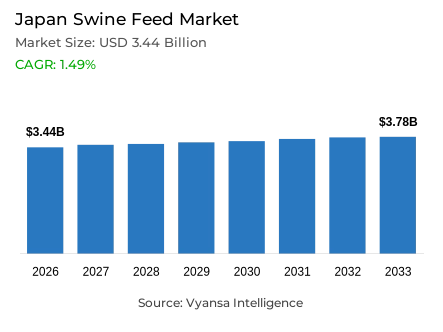
Swine feed in Japan is compound feed formulated for each stage of a pig's life and delivered mainly as mash and pellets. Commercial pig farms, integrated meat groups and cooperative-linked producers consume it daily across nursery, growing, finishing and sow housing. The Japan swine feed market is forecast to grow at a compound annual growth rate (CAGR) of 1.49% between 2027 and 2033.
Key Highlights of the Japan Swine Feed Market
- The Japan swine feed market was estimated at USD 3.44 billion in 2026 and estimated at USD 3.46 billion in 2027 and is projected to reach USD 3.78 billion by 2033.
- The market is forecast to expand at an overall CAGR of 1.49% across the 2027 to 2033 forecast period.
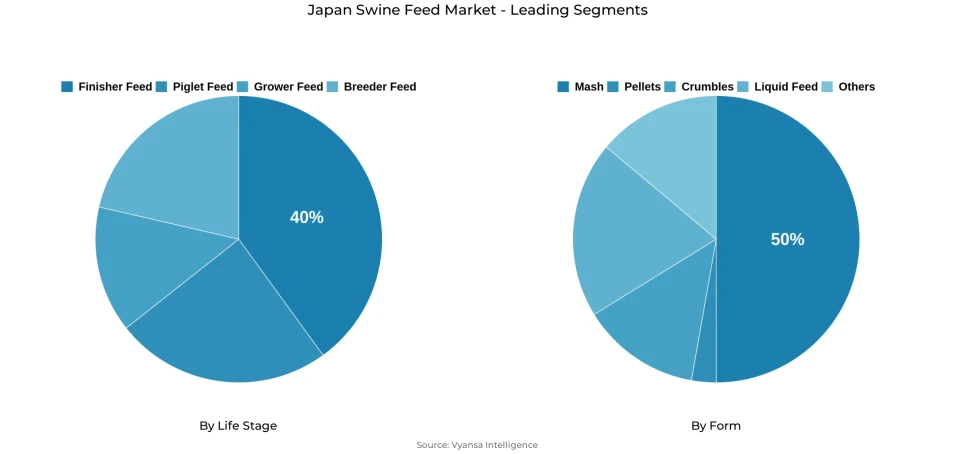
- By life stage, Finisher Feed is the leading segment, holding an estimated 40% value share in the 2026.
- Piglet Feed is the fastest-growing life stage, expanding at an estimated CAGR of 4.22% across the 2027 to 2033.
- By form, Mash is the leading segment, holding an estimated 50% value share in the 2026.
- Crumbles is the fastest-growing form, expanding at an estimated CAGR of 5.63% across the 2027 to 2033 forecast period from a small base among the five form segments.
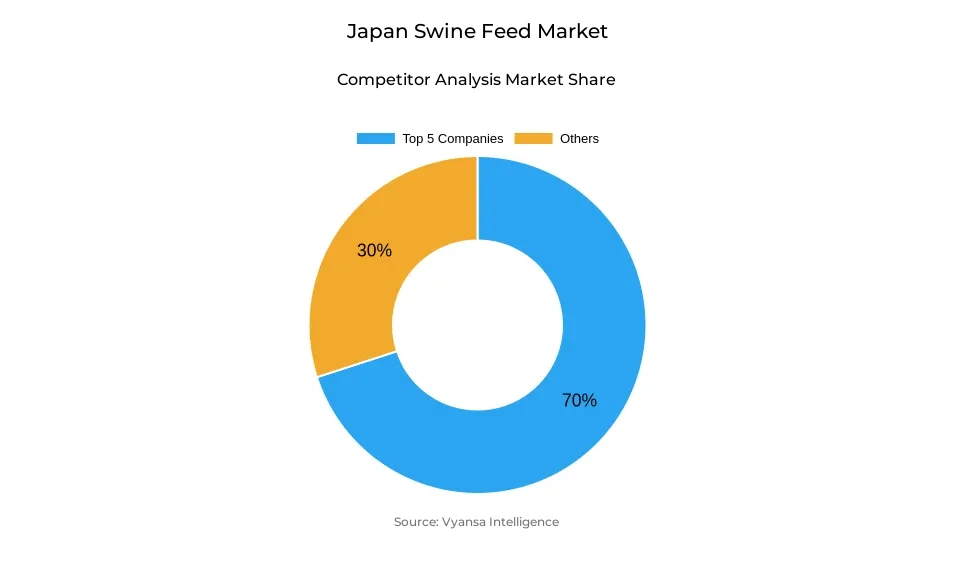
- The market structure is consolidated, with the five largest companies together holding an estimated combined value share of about 70% in the 2026.
Japan’s swine feed market is supported by recurring demand for nutritionally balanced diets across piglet, growing, finishing, and breeding stages. MAFF reported approximately 5.48 million tons of swine compound feed production in fiscal 2025, demonstrating the scale of the country’s established feeding requirements. Demand centers on formulations that maintain feed intake, support healthy growth, and improve feed conversion, creating opportunities for suppliers to increase product value through nutritional performance.
Pork consumption provides a relatively stable foundation for this demand. The Agriculture and Livestock Industries Corporation reported estimated pork consumption of 1,845,760 tons in fiscal 2025, down only 0.2%. The domestic-origin component increased 0.3% to 894,871 tons. These figures indicate a mature consumption base that continues to support Japanese pig production and its associated feed requirements. The domestic component is particularly relevant because imported finished pork does not generate feed demand on Japanese farms.
Product development increasingly addresses the conditions affecting feeding performance. Ehime Prefecture’s fiscal 2026–2028 research program examines regional resources for reducing heat stress in breeding pigs, reflecting demand for diets that protect intake and reproductive performance during hotter summers. Such work supports greater differentiation in swine nutrition. Through the forecast period, opportunities are therefore likely to concentrate on feed efficiency, seasonal formulations, and stage-specific nutrition, with product improvements contributing more to growth than substantial herd expansion.
Japan Swine Feed Market Government Compliance
The Compound Feed Price Stabilization System, run by the government and the National Federation of Agricultural Cooperative Associations (JA Zen-Noh), compensates farms when imported ingredient costs rise. Okinawa Prefecture confirmed on 18 May 2026 that its fiscal 2026 price-difference subsidy continues. Under the Feed Grain Stockpiling and Distribution Rationalisation Project, MAFF opened a second fiscal 2026 call from 13 July to 20 August 2026 for plant restructuring that cuts manufacturing cost.
Japan's Act on Domestic Animal Infectious Diseases Control was amended on 15 May 2026, with effect from 19 May 2026. On vaccinated farms in 46 prefectures, classical swine fever now leads to culling of at-risk pigs only, so more pigs stay on feed after an outbreak. Feed mills with multi-product plants and cooperative supply networks are best placed to meet these requirements, which protect swine feed volume in the Japan swine feed market.
Japan Swine Feed Market Driver
Household Substitution Toward Pork Supports Domestic Feeding Requirements
Pork’s position as an affordable everyday protein supports recurring swine feed demand as Japanese households adjust meat purchases. MAFF’s July 2026 livestock statistics placed the beef cattle population at 2.473 million head, down 4.7% and declining for the third consecutive year. Meanwhile, USDA reported that food prices increased 7.0% in 2025 and the household expenditure share allocated to food reached a 44-year high.
Actual purchasing data demonstrates pork’s resilience under this pressure. ALIC reported household pork purchases of 7.703 kilograms per person in 2025, up 1.7%, while beef purchases declined 2.3%. These household survey results support the shift toward pork, although poultry also competes for spending redirected from beef.
For feed manufacturers, sustained demand for domestically produced pork supports repeat orders across successive feeding stages. The benefit depends on Japanese producers retaining their share of pork supply, making feed conversion and consistent growth important purchasing criteria. Going forward, suppliers that help farms produce competitive pork at a lower feeding cost per kilogram of output should be better positioned to capture demand.
Japan Swine Feed Market Challenge
Imported Grain Exposure Raises Feed Costs and Complicates Formulation
Dependence on imported ingredients exposes Japan’s swine feed market to grain prices, freight costs, and exchange rate movements. JA Zen-Noh’s December 2025 announcement indicated a 5.1% increase in its average compound feed price for January–March 2026. This was an all-species average, demonstrating the broader cost pressure facing livestock feed buyers.
USDA’s March 2026 assessment reported that the United States had supplied 99% of Japan’s corn imports since February 2025. Corn’s share of compound feed formulations had exceeded 50% since October 2025, increasing exposure to a major imported ingredient. These figures describe the wider feed sector rather than every swine ration. Mills were also adjusting ingredient use: USDA estimated feed wheat consumption at 780,000 tons in 2025/26, up 6.8%.
Ingredient substitution can manage costs, but formulations must preserve digestibility, amino acid balance, and growth performance. Persistent cost pressure can restrict purchases of premium feeds or weaken farm production capacity. Future competitiveness will depend on flexible procurement and formulations that demonstrate an economical cost per kilogram of pig growth.
Japan Swine Feed Market Trends
Farm Consolidation Shifts Feed Procurement Toward Larger, Technically Supported Contracts
Japan’s pig production is concentrating in fewer farms, changing how feed is purchased and evaluated. MAFF counted 2,880 pig farms in February 2026, down 8.0% from 2024, alongside approximately 8.76 million pigs and an average of 3,040 pigs per farm. The comparison covers two years because the pig survey was not conducted in 2025.
Larger operating units create demand for dependable deliveries, consistent formulations, and technical support across substantial feeding volumes. At a MAFF symposium in October 2025, Marubeni Nisshin Feed emphasized feeding guidance and farm visits by technical staff, supported by its group swine operations and breeding farm.
This procurement model gives suppliers opportunities to combine feed with practical recommendations on diet selection and feeding performance. It also increases competition for a smaller number of larger customers. Through the forecast period, mills that demonstrate reliable supply and measurable feeding results should be better positioned to secure continuing contracts.
AI Weight Monitoring Connects Feed Selection with Measured Pig Growth
AI cameras and feed tank sensors are making feeding decisions more responsive to actual pig performance. Cameras estimate body weight without manual handling, while feed monitoring provides consumption data. Together, these systems can help farms assess growth, identify deviations, and decide when to change diets.
NARO’s 2025 smart agriculture research results described integration of Eco-Pork’s AI weight estimation with feed tank sensors to calculate daily feed conversion ratios automatically. JETRO’s July 2026 report stated that Eco-Pork’s Porker platform served approximately 15% of Japanese pig farms, according to company materials. The company also reported approximately 7% annual productivity improvement associated with its platform; this was a supplier-reported figure, rather than a result established by its Spanish pilot.
For feed suppliers, these tools create opportunities to demonstrate how formulations perform under commercial conditions and recommend timely diet adjustments. Future adoption could support closer integration of compound feed, farm records, and nutritional advice, with purchasing decisions increasingly informed by measured growth and feed use.
Japan Swine Feed Market Future Opportunity
Contracted Domestic Ingredients Could Expand Commercial Rice and Eco-Feed Formulations
Domestic feed rice and recycled food ingredients offer opportunities to diversify swine feed formulations, provided suppliers can establish consistent quality and competitive delivered costs. Their potential depends on reliable sourcing, processing, storage, and nutritional formulation. USDA’s March 2026 assessment reported that feed rice use across Japan’s livestock sector fell approximately 350,000 tons to around 900,000 tons in 2024/25. It projected a further 200,000-ton decline in 2025/26 before a recovery in 2026/27. These movements show why mills need contracted supply rather than assumptions of continuously available domestic grain. A study covering 45 Japanese eco-feed plants also identified potential efficiency gains, with the supplied research indicating modeled additional liquid-feed output of 12,981 tons per plant if inefficient operations improved. This represents production potential rather than commissioned capacity.
Commercial opportunities include agreements with food processors and rice growers, supported by suitable feeding equipment and controls for nutrient consistency and feed safety. MAFF’s planned fiscal 2027 paddy policy changes could influence ingredient availability, although they do not guarantee cheaper feed rice. Over time, suppliers that coordinate sourcing, processing, and farm delivery could expand sales of domestically sourced formulations. Adoption will depend on proven feeding performance and total delivered cost.
Unlock Market Intelligence
Explore the market potential with our data-driven report
Japan Swine Feed Market Segmentation Analysis
By Life stage:
- Piglet Feed
- Grower Feed
- Finisher Feed
- Breeder Swine Feed
Finisher Feed Takes 40% of Stage Demand on the Strength of the Fattening Phase
Two causes put Finisher Feed first. MAFF's fiscal 2025 data show meat-pig feed at 2.43 million tons, about 44% of swine compound feed volume, because finishing pigs eat the most feed over the longest period. The livestock statistics released by MAFF on 28 July 2026 add that 7.309 million fattening pigs, 83% of the national herd, were on farms at 1 February 2026. The lead holds unless the fattening herd falls faster than early-stage feed prices rise.
Piglet Feed is the fastest-growing stage at an estimated CAGR of 4.22% between 2027 and 2033. MAFF's 28 July 2026 statistics counted 681,500 feeder and other pigs at 1 February 2026, up 4.3%, while the fattening herd slipped 0.7%. In fiscal 2025, FEED ONE CO., LTD. reported the launch of Stomax, a gastrointestinal support feed for pigs from piglet to meat pig stages. Starter Feed outpaces Finisher Feed because its value rises with formulation sophistication for each ton, while finishing volume follows a flat herd.
By Form:
- Mash
- Pellets
- Crumbles
- Liquid Feed
- Others
Mash Keeps 50% of Form Demand While Pellets Cover Only Two Fifths of Tonnage
Two causes keep Mash first in the swine feed industry. MAFF's fiscal 2025 data record pellet production at 2.23 million tons, about 40.6% of swine compound feed volume, so most tonnage still moves in non-pelleted forms. Mash also avoids the pelleting step, which keeps cost for each ton down in the grow-finish rations that carry the most volume, and FEED ONE CO., LTD. lists mash among the granule, pellet, crumble and expander forms it supplies. Mash holds its lead while feed prices stay high, and loses it only if farms specify pellets.
Crumbles grow at an estimated CAGR of 5.63% between 2027 and 2033, the fastest of the five forms, from a small base. Crumbles suit young pigs, so they follow the higher-value nursery diets, which carry higher unit values than meat-pig finishing feed according to MAFF feed price data. FEED ONE CO., LTD. lists crumble among the forms it supplies for nursery diets. Crumbles outpace Mash because their volume is tied to piglet-stage value, whereas Mash volume follows flat tonnage in the growing and finishing stages.
Unlock Market Intelligence
Explore the market potential with our data-driven report
Japan Swine Feed Market Competitive Landscape
The Japan swine feed industry is consolidated, with the five largest companies holding an estimated combined value share of 70% in 2026. The top five companies are FEED ONE CO., LTD., National Federation of Agricultural Cooperative Associations, CHUBUSHIRYO CO., LTD., Marubeni Nisshin Feed Co.,Ltd. and Nosan Corporation. Share is stated on an estimated value basis for the 2027 base year.
Key Companies in the Japan Swine Feed Market
- FEED ONE CO., LTD.
- National Federation of Agricultural Cooperative Associations
- CHUBUSHIRYO CO., LTD.
- Marubeni Nisshin Feed Co.,Ltd.
- Nosan Corporation
- ITOCHU FEED MILLS CO., LTD.
- SHOWA SANGYO CO., LTD.
- TOYOHASHI FEED MILLS CO.,LTD.
- NICHIWA SANGYO CO., LTD.
- Hayashikane Sangyo Co.,Ltd.
Company Profiling
The following profiles cover the five leading companies in the swine feed industry, drawn from company and government disclosures.
FEED ONE CO., LTD.: FEED ONE, headquartered in Yokohama, supplies nursery, growing-finishing, and sow feeds. The supplied company information places its annual feed production at approximately 3.7 million tons across 13 plants, representing about 15% of national animal feed volume; these figures cover its broader feed business. Its November 2025 investor briefing identified the company as Japan’s leading pig feed supplier. In April 2026, FEED ONE published a technical update addressing nutrition and feed formulation during heat stress in pigs. The update reflects its focus on protecting feed intake and feeding performance under seasonal production pressures.
National Federation of Agricultural Cooperative Associations: The National Federation of Agricultural Cooperative Associations, commonly known as JA Zen-Noh, participates through its cooperative feed network and JA Zen-Noh Kumiai Feed. Its group portfolio includes Piglash piglet feeds using Hi-Processed Cereals technology, alongside fattening and sow diets. The supplied operating figures indicate annual compound feed supply exceeding 4.5 million tons across 43 prefectures, covering multiple livestock species. In April 2024, five regional feed companies were combined into JA Zen-Noh Kumiai Feed. This operating consolidation established a unified organization for feed manufacturing and supply, supporting coordinated service across its extensive agricultural customer network.
CHUBUSHIRYO CO., LTD.: CHUBUSHIRYO, headquartered in Nagoya, manufactures swine feeds through a production network extending from Hokkaido to Kagoshima. Its portfolio covers milk replacers, piglet feeds, finishing feeds, and breeding diets. The company uses heat treatment and granulation technologies and develops formulations containing ingredients such as potatoes and barley to support differentiated pork production. In its May 2026 operating presentation, CHUBUSHIRYO outlined the use of newly developed research facilities for new products and improvements to existing feeds. Its stated priorities included improving animal performance through measures addressing stress, connecting research activity with commercially relevant feeding outcomes.
Marubeni Nisshin Feed Co., Ltd.: Marubeni Nisshin Feed, headquartered in Tokyo, supplies swine diets spanning early creep feeding, starter nutrition, growing-finishing stages, and breeding animals. Its supplied fiscal 2024 operating figures indicate 2.479 million tons of livestock feed volume across 17 sites, covering its multi-species business. In October 2025, the company announced a circular supply model in northeastern Japan connecting composted pig manure, feed rice cultivation, grain storage, compound feed manufacturing, and delivery to livestock producers. Participants include Iwate Seiryu Farm and regional grain and feed businesses. The initiative demonstrates a practical route for incorporating locally produced rice into commercial feeding systems.
Nosan Corporation: Nosan Corporation, headquartered in Yokohama and part of the Mitsubishi Corporation group, supplies milk replacers, creep feeds, starter feeds, growing-finishing diets, and sow nutrition. Its Winnie product family addresses early piglet feeding, while later-stage formulations use amino acid and net energy design. Across its broader feed business, the company uses approximately 7,000 tons of dried eco-feed annually. Nosan’s current product information identifies renewed Winnie Mebius and Gattsuku Milk creep feeds designed to improve palatability and feed intake. The company also works with its Farmtech subsidiary to connect feed development with breeding and farm requirements.
Recent Developments in the Japan Swine Feed Market
- In March 2026, the USDA Foreign Agricultural Service in Tokyo reported that Japan produces about 24 million tonnes of formula feed yearly and that the agriculture ministry subsidises mills to hold up to one million tonnes of imported feed grain in contingency stock.
- In May 2026, Japan’s Ministry of Agriculture, Forestry and Fisheries confirmed its fourth classical swine fever outbreak of the year, in Shizuoka, with nearly 3,000 pigs culled, removing feed demand at the affected farm.
- In October 2026, the USDA Foreign Agricultural Service in Tokyo reported that feed makes up 66% of pig production costs, hog farms fell 8%, and about 70% of hogs sit on farms of 3,000 head or more.
Frequently Asked Questions
Related Report
- Market Segmentation
- Research Scope
- Research Methodology
- Definitions and Assumptions
- Executive Summary
- Japan Swine Feed Market Policies, Regulations, and Standards
- Japan Swine Feed Market Dynamics
- Growth Factors
- Challenges
- Trends
- Opportunities
- Japan Swine Feed Market Statistics, 2023-2033F
- Market Size & Growth Outlook
- By Revenues in USD Million
- Market Segmentation & Growth Outlook
- By Life Stage
- Piglet Feed- Market Insights and Forecast 2023-2033, USD Million
- Grower Feed- Market Insights and Forecast 2023-2033, USD Million
- Finisher Feed- Market Insights and Forecast 2023-2033, USD Million
- Breeder Feed- Market Insights and Forecast 2023-2033, USD Million
- By Feed Type
- Complete Feed- Market Insights and Forecast 2023-2033, USD Million
- Complementary Feed- Market Insights and Forecast 2023-2033, USD Million
- By Form
- Mash- Market Insights and Forecast 2023-2033, USD Million
- Pellets- Market Insights and Forecast 2023-2033, USD Million
- Crumbles- Market Insights and Forecast 2023-2033, USD Million
- Liquid Feed- Market Insights and Forecast 2023-2033, USD Million
- Others- Market Insights and Forecast 2023-2033, USD Million
- By Competitors
- Competition Characteristics
- Market Share & Analysis
- By Life Stage
- Market Size & Growth Outlook
- Japan Piglet Feed Market Statistics, 2023-2033
- Market Size & Growth Outlook
- By Revenues in USD Million
- Market Segmentation & Growth Outlook
- By Form- Market Insights and Forecast 2023-2033, USD Million
- Market Size & Growth Outlook
- Japan Grower Feed Market Statistics, 2023-2033
- Market Size & Growth Outlook
- By Revenues in USD Million
- Market Segmentation & Growth Outlook
- By Form- Market Insights and Forecast 2023-2033, USD Million
- Market Size & Growth Outlook
- Japan Finisher Feed Market Statistics, 2023-2033
- Market Size & Growth Outlook
- By Revenues in USD Million
- Market Segmentation & Growth Outlook
- By Form- Market Insights and Forecast 2023-2033, USD Million
- Market Size & Growth Outlook
- Japan Breeder Swine Feed Market Statistics, 2023-2033
- Market Size & Growth Outlook
- By Revenues in USD Million
- Market Segmentation & Growth Outlook
- By Form- Market Insights and Forecast 2023-2033, USD Million
- Market Size & Growth Outlook
- Competitive Outlook
- Company Profiles
- FEED ONE CO., LTD.
- Business Description
- Product Portfolio
- Collaborations & Alliances
- Recent Developments
- Financial Details
- Others
- National Federation of Agricultural Cooperative Associations
- Business Description
- Product Portfolio
- Collaborations & Alliances
- Recent Developments
- Financial Details
- Others
- CHUBUSHIRYO CO., LTD.
- Business Description
- Product Portfolio
- Collaborations & Alliances
- Recent Developments
- Financial Details
- Others
- Marubeni Nisshin Feed Co.,Ltd.
- Business Description
- Product Portfolio
- Collaborations & Alliances
- Recent Developments
- Financial Details
- Others
- Nosan Corporation
- Business Description
- Product Portfolio
- Collaborations & Alliances
- Recent Developments
- Financial Details
- Others
- ITOCHU FEED MILLS CO., LTD.
- Business Description
- Product Portfolio
- Collaborations & Alliances
- Recent Developments
- Financial Details
- Others
- SHOWA SANGYO CO., LTD.
- Business Description
- Product Portfolio
- Collaborations & Alliances
- Recent Developments
- Financial Details
- Others
- TOYOHASHI FEED MILLS CO.,LTD.
- Business Description
- Product Portfolio
- Collaborations & Alliances
- Recent Developments
- Financial Details
- Others
- NICHIWA SANGYO CO., LTD.
- Business Description
- Product Portfolio
- Collaborations & Alliances
- Recent Developments
- Financial Details
- Others
- Hayashikane Sangyo Co.,Ltd.
- Business Description
- Product Portfolio
- Collaborations & Alliances
- Recent Developments
- Financial Details
- Others
- FEED ONE CO., LTD.
- Company Profiles
- Disclaimer
| Segment | Sub-Segment |
|---|---|
| By Life Stage |
|
| By Feed Type |
|
| By Form |
|
Research Methodology
This study followed a structured approach comprising four key phases to assess the size and scope of the electro-oxidation market. The process began with thorough secondary research to collect data on the target market, related markets, and broader industry context. These findings, along with preliminary assumptions and estimates, were then validated through extensive primary research involving industry experts from across the value chain. To calculate the overall market size, both top-down and bottom-up methodologies were employed. Finally, market segmentation and data triangulation techniques were applied to refine and validate segment-level estimations.
Secondary Research
The secondary research phase involved gathering data from a wide range of credible and published sources. This step helped in identifying industry trends, defining market segmentation, and understanding the market landscape and value chain.
Sources consulted during this phase included:
- Company annual reports, investor presentations, and press releases
- Industry white papers and certified publications
- Trade directories and market-recognized databases
- Articles from authoritative authors and reputable journals
- Gold and silver standard websites
Secondary research was critical in mapping out the industry's value chain and monetary flow, identifying key market segments, understanding regional variations, and tracking significant industry developments.
Other key sources:
- Financial disclosures
- Industry associations and trade bodies
- News outlets and business magazines
- Academic journals and research studies
- Paid industry databases
Primary Research
To validate secondary data and gain deeper market insights, primary research was conducted with key stakeholders across both the supply and demand sides of the market.
On the demand side, participants included decision-makers and influencers from end-user industries—such as CIOs, CTOs, and CSOs—who provided first-hand perspectives on market needs, product usage, and future expectations.
On the supply side, interviews were conducted with manufacturers, industry associations, and institutional participants to gather insights into current offerings, product pipelines, and market challenges.
Primary interviews provided critical inputs such as:
- Market size and revenue data
- Product and service breakdowns
- Market forecasts
- Regional and application-specific trends
Stakeholders consulted included:
- Leading OEM and solution providers
- Channel and distribution partners
- End users across various applications
- Independent consultants and industry specialists
Market Size Estimation and Data Triangulation
- Identifying Key Market Participants (Secondary Research)
- Goal: To identify the major players or companies in the target market. This typically involves using publicly available data sources such as industry reports, market research publications, and financial statements of companies.
- Tools: Reports from firms like Gartner, Forrester, Euromonitor, Statista, IBISWorld, and others. Public financial statements, news articles, and press releases from top market players.
- Extracting Earnings of Key Market Participants
- Goal: To estimate the earnings generated from the product or service being analyzed. This step helps in understanding the revenue potential of each market player in a specific geography.
- Methods: Earnings data can be gathered from:
- Publicly available financial reports (for listed companies).
- Interviews and primary data sources from professionals, such as Directors, VPs, SVPs, etc. This is especially useful for understanding more nuanced, internal data that isn't publicly disclosed.
- Annual reports and investor presentations of key players.
- Data Collation and Development of a Relevant Data Model
- Goal: To collate inputs from both primary and secondary sources into a structured, data-driven model for market estimation. This model will incorporate key market KPIs and any independent variables relevant to the market.
- Key KPIs: These could include:
- Market size, growth rate, and demand drivers.
- Industry-specific metrics like market share, average revenue per customer (ARPC), or average deal size.
- External variables, such as economic growth rates, inflation rates, or commodity prices, that could affect the market.
- Data Modeling: Based on this data, the market forecasts are developed for the next 5 years. A combination of trend analysis, scenario modeling, and statistical regression might be used to generate projections.
- Scenario Analysis
- Goal: To test different assumptions and validate how sensitive the market is to changes in key variables (e.g., market demand, regulatory changes, technological disruptions).
- Types of Scenarios:
- Base Case: Based on current assumptions and historical data.
- Best-Case Scenario: Assuming favorable market conditions, regulatory environments, and technological advancements.
- Worst-Case Scenario: Accounting for adverse factors, such as economic downturns, stricter regulations, or unexpected disruptions.