Global Swine Feed Market Report: Trends, Growth and Forecast (2027-2033)
By Life Stage (Piglet Feed, Grower Feed, Finisher Feed, Breeder Feed), By Feed Type (Complete Feed, Complementary Feed), By Form (Pellets, Mash, Crumbles, Others), By Region (North America, South America, Europe, Middle East & Africa, Asia Pacific) ... Read more
|
Major Players
|
Swine Feed Market Overview
Swine feed is manufactured pig nutrition, formulated as complete rations or concentrates, that supplies the energy, protein, amino acids and minerals pigs need at each stage from weaning to slaughter. Integrated producers, contract farms and independent pig farmers consume it across piglet, grower, finisher and breeder diets. The Swine Feed market is forecast to grow at a compound annual growth rate (CAGR) of 2.5% between 2027 and 2033.
Key Highlights of the Swine Feed Market
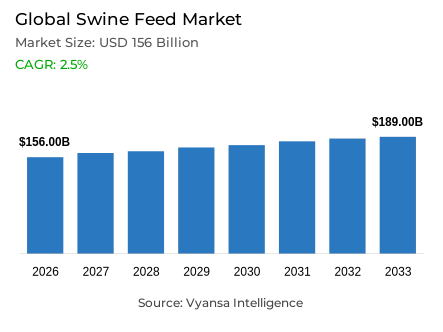
- The Swine Feed market is estimated at USD 156 billion in 2026 and USD 163 billion in 2027, and is forecast to reach USD 189 billion by 2033.
- The market is forecast to expand at a compound annual growth rate (CAGR) of 2.5% across the forecast period from 2027 to 2033.
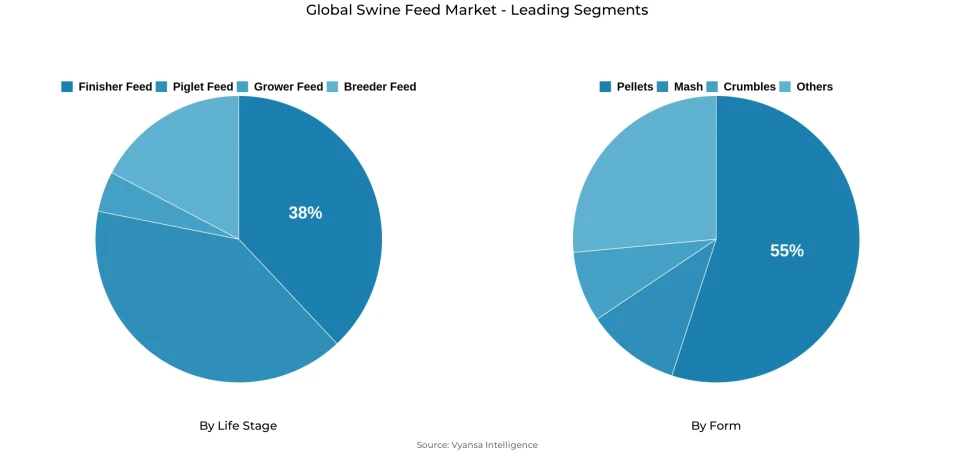
- Within life stage categories, Finisher Feed leads the market with an approximate 38% share in 2026.
- Piglet Feed is the fastest-growing life stage category, expanding at a CAGR of 7.17% across the 2027 to 2033 forecast period.
- Within form categories, Pellets lead the market with an approximate 55% share in 2026.
- Crumbles are the fastest-growing form category, expanding at a CAGR of 8.75% across the 2027 to 2033 forecast period.
- By region, Asia Pacific leads the market with an approximate 50% share in 2026.
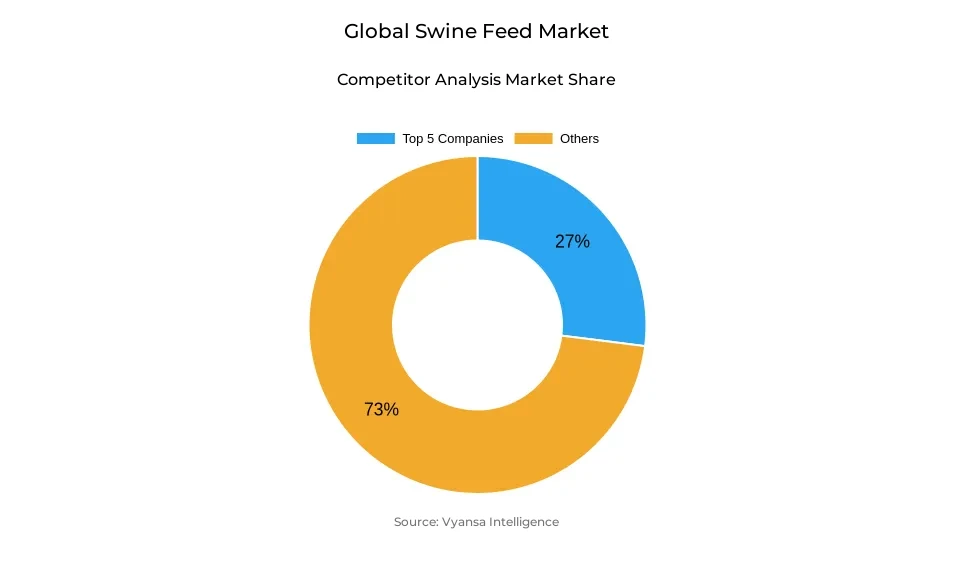
- The market is fragmented, with the top five companies holding a combined share of approximately 27% in 2026.
The Swine Feed market is expanding through pork production, longer finishing periods, and greater use of manufactured rations. Alltech’s 2026 survey estimated global pig feed production at 380.9 million tons in 2025, up 3% year over year. The OECD and FAO’s 2025–2034 outlook projected an additional 6.1 million tons of pigmeat output by 2034, supporting continued demand for diets used from weaning through finishing.
Feed growth varies across production regions. Latin American pig feed output increased 4% to approximately 43.0 million tons in 2025, while European output declined 0.5% to 76.5 million tons and North American output fell 2.2% to 63.1 million tons. These differences favor suppliers able to match local herd conditions with stage-specific energy, protein, amino acid, and mineral requirements. Procurement increasingly centers on consistent growth and feed conversion alongside dependable ration availability.
Supplier development is also strengthening formulation capabilities. In June 2026, ADM reported opening a Brazilian premix and feed-additive plant with approximately 40,000 tons of annual capacity serving its broader animal nutrition business. Ingredient efficiency remains important as the OECD and FAO project animal feed to absorb 33% of global cereal use by 2034. Through 2033, herd recovery and commercial feeding adoption should support volume growth, while specialized starter diets and precision formulations expand demand for higher-performance products.
Swine Feed Market Drivers
Higher Pork Production and Export Demand Support Feed Purchases
Growing pork output increases feeding requirements across breeding, nursery, growing, and finishing operations. Export-oriented producers and countries rebuilding domestic supply therefore provide important sources of demand for manufactured swine rations.
Brazil exported approximately 794,200 tons of pork in the first half of 2026, increasing 10% year over year. Mexico’s pork production reached 505,470 tons in the first quarter of 2026, up 15.3%. These gains support feed replenishment as producers maintain larger production flows and bring pigs through successive feeding stages.
Further expansion is anticipated. In July 2026, ABPA projected Brazilian pork production of approximately 6.05 million tons in 2027, increasing 3.1%. In the Philippines, the Bureau of Animal Industry projected that pork imports would decline by approximately 50,000 tons from the 851,760 tons imported in 2025 as domestic production recovered. Local recovery shifts part of the associated feeding requirement back toward Philippine farms and feed mills.
Through 2033, export growth and domestic herd rebuilding should support recurring feed purchases across several producing markets. Suppliers offering consistent growth performance and reliable deliveries should be better positioned to serve expanding production systems.
Swine Feed Market Challenges
African Swine Fever Disrupts Herd Recovery and Feed Procurement
African swine fever creates uneven feed demand by interrupting production, delaying restocking, and restricting pork trade. Even farms outside infected areas can face weaker market access, although restrictions differ according to destination-country rules and recognition of disease-free zones.
Spain’s initial November 2025 detections involved wild boar near Barcelona. By May 2026, Spanish feed traders estimated that national feed demand had declined 2%–8% since April, alongside an estimated 10%–20% reduction in Catalonia’s pig population. USDA FAS reported that Spain’s import suspension affected a supplier accounting for approximately 15% of Japan’s pork imports. These disruptions weaken the predictability of feeding schedules and mill orders.
Disease pressure also continues in Southeast Asia. FAO reported that 76 of the Philippines’ 82 provinces had experienced ASF outbreaks since 2019, rather than all being simultaneously infected. In September 2026, the country approved commercial sale of AVAC ASF LIVE for fattening pigs, while another vaccine candidate from South Korea remained under evaluation.
Through 2033, recovery will depend on disease control, farm management, and workable restocking programs. Feed suppliers with geographically diversified customers and flexible production schedules should be better positioned to manage sudden changes in herd demand.
Swine Feed Market Recent Trends
Commercial Feeding Expands Alongside Producer Integration
Larger production systems are increasing the use of standardized, stage-specific rations and centralized ingredient procurement. This shifts purchasing toward feed manufacturers and integrated mills capable of maintaining consistent nutrient specifications, processing quality, and technical support.
Alltech reported that Chinese pig feed production increased 7.2% in 2025. Approximately 12.2 million tons of additional recorded production reflected movement from self-mixed rations toward complete commercial feeds. This represents an expansion of the formal feed market, alongside underlying changes in pig production.
Supplier networks are also consolidating. In March 2026, De Heus completed its acquisition of CJ Feed & Care, incorporating 17 multi-species feed mills across Vietnam, Indonesia, Cambodia, South Korea, and the Philippines. The transaction expanded its operating network and introduced the company to two additional markets. Meanwhile, African pig feed output increased 8.6% to approximately 2.6 million tons in 2025 as commercial production developed from a smaller base.
Through 2033, commercial feeding adoption should increase the share of swine nutrition purchased through formal supply channels. Feed suppliers will increasingly compete on nutritional consistency, farm support, and procurement reliability.
Sensors and AI Improve Feed Availability and Delivery Planning
Feed-bin sensors and AI forecasting are connecting farm inventories with mill production and delivery schedules. These systems address both empty-bin events and interruptions caused by feed failing to move from storage into the feeding system.
In June 2026, BinSentry and Trouw Nutrition Canada announced nationwide deployment of the ProSense Feed platform across Trouw Nutrition’s Canadian facilities following an initial implementation. The expansion connects inventory visibility with logistics planning and customer service across a broader operating network.
A BinSentry case study published in 2025 monitored 100 HANOR hog barns across 28 U.S. sites using 200 sensors. Nearly 80% of recorded out-of-feed events were associated with manual bin-slide management. The study reported an adverse feed-conversion difference equivalent to approximately 0.07 for affected groups, demonstrating how interrupted feeding can weaken production efficiency even when feed remains available on-site.
Through 2033, sensor-linked services should become a stronger differentiator for suppliers serving large pig-production networks. More dependable replenishment and earlier detection of feeding interruptions can support customer retention while reducing avoidable feed-management losses.
Swine Feed Market Future Opportunities
Specialized Starter Programs Address Feeding Challenges After Zinc Restrictions
Restrictions on high-dose medicinal zinc oxide create opportunities for starter programs that maintain feed intake, digestive stability, and growth around weaning. The opportunity involves coordinated nutrition and farm management rather than a single ingredient replacement.
Danish research published in 2025 found that antimicrobial use in weaners increased approximately 17% more than five months after zinc oxide discontinuation on previously using farms. The findings demonstrate the difficulty of maintaining post-weaning performance and the need for feeding programs validated under commercial conditions.
Suppliers are developing products addressing this transition. In June 2026, Trouw Nutrition introduced Milkiwean ActiBar, a piglet training bar complementing creep-feed programs. Manufacturer-reported European trials showed up to 53% higher pre-weaning feed intake than creep feed alone and up to 50% less watery diarrhea during the first post-weaning week. The product is offered through the company’s global swine nutrition network.
Through 2033, suppliers that reproduce such benefits across different diets and production systems could expand premium starter-feed adoption. Commercial success will depend on consistent farm results, suitable formulation costs, and integration with veterinary and management programs.
Unlock Market Intelligence
Explore the market potential with our data-driven report
Swine Feed Market Segmentation Analysis
By Life Stage:
- Piglet Feed
- Grower Feed
- Finisher Feed
- Breeder Feed
Heavier Finishing Weights Give Finisher Feed 38% of Life Stage Demand
Finisher Feed leads because heavier slaughter weights make the final stage the largest ration in a pig's life. The USDA counted 12.878 million United States hogs of 180 pounds and above on 1 March 2026, up 2%, and forecasts 2026 pork output of 12.7 million tons on higher dressed weights. In January 2025, Godrej Agrovet Limited launched Pride Hog Finisher in India, giving pig farmers a dedicated finishing ration. The lead holds unless herd cuts outpace weight gains.
Piglet Feed grows at a 7.17% CAGR across 2027 to 2033 as larger litters raise the number of pigs needing high specification starter rations. USDA data show United States sows saving 11.96 pigs per litter in June to August 2026, against 11.82 a year earlier. In February 2026, Cargill, Incorporated added Neopigg Nutriplay, a diversified pre-starter feed that doubled the number of piglets eating at 11 and 19 days of age in field trials.
Piglet Feed outgrows Finisher Feed because its volume rises with litter size and ration specification, while finisher volume depends on heavier weights offsetting smaller herds. Finisher Feed therefore adds tons steadily from a larger base across the industry, and Piglet Feed adds value faster from a smaller one.
By Form:
- Pellets
- Mash
- Crumbles
- Others
Feed Efficiency Supports Pellets’ 55% Share of Form Demand
Pellets dominate the Swine Feed market by form, accounting for approximately 55% of market value in 2026. Their position reflects improved feed flow, reduced wastage, and suitability for standardized feeding systems. Kansas State University identifies better flowability and feed efficiency as advantages over meal diets, while emphasizing the importance of pellet quality. In a 2026 trial involving 800 nursery pigs, pelleted diets increased average daily gain by 5.26% during the first 21 days compared with a meal diet containing a crumble basemix. These benefits support continued procurement by producers seeking consistent feeding performance.
Crumbles are projected to be the fastest-growing form, expanding at a CAGR of 8.75% during 2027–2033. Their small particle size supports use in early feeding programs as piglets transition from milk to solid feed. In Kenya, De Heus offers Piglet Creep Crumble for use from 5–10 days of age through the early post-weaning period. In Australia, Riverina supplies Piglet Supastarter Crumbles for suckling and newly weaned piglets. These offerings illustrate the commercial role of crumbles in specialized starter nutrition across different production markets.
Pellets’ broader application supports their larger market share, while crumbles’ role in specialized early feeding provides a basis for faster growth from a smaller base. Through 2033, demand should favor suppliers that maintain consistent particle size, processing quality, and feeding performance.
Unlock Market Intelligence
Explore the market potential with our data-driven report
Swine Feed Market Regional Analysis
Asia Pacific Holds 50% of Regional Demand on Herd Scale and Mill Investment
Asia Pacific leads because Chinese herd scale and Southeast Asian restocking sit alongside active mill investment. China produced 720 million hogs in 2025, up 2.4%, according to the National Bureau of Statistics (NBS). In June 2025, Cargill, Incorporated partnered with Biotech Farms Inc., an integrated swine and poultry producer, to run a dedicated feed production line at Tantangan in the Philippines, adding commercial rations for Mindanao farms. The lead holds while Chinese output stays high.
Middle East and Africa grows at a 7.02% CAGR across 2027 to 2033 from a small base, with growth concentrated in Africa while Middle Eastern pig feed remains minimal. The Pig Farmers Association of Nigeria said in February 2025, citing FAO data, that Nigeria has more than 8 million pigs, over half of West Africa's herd. On 18 February 2026, De Heus Animal Nutrition opened a new Athi River feed plant in Kenya to serve poultry, swine, aquaculture and ruminant producers.
Middle East and Africa outgrows Asia Pacific because its commercial feed penetration starts from a lower base, so each new mill converts informally fed herds, while Asia Pacific adds tons from a base that is already commercialised.

Competitive Landscape
The Swine Feed industry is fragmented, with the top five companies holding a combined share of approximately 27% in 2026 across a field of integrated producers, regional feed makers and multinational suppliers. The five companies profiled in this report are Muyuan Foods Group Co., Ltd., Charoen Pokphand Group Company Limited, Wens Foodstuff Group Co., Ltd., New Hope Liuhe Co., LTD. and Guangdong HAID Group Co., Ltd.
Key Companies in the Swine Feed Market
- Muyuan Foods Group Co., Ltd.
- Charoen Pokphand Group Company Limited
- Wens Foodstuff Group Co., Ltd.
- New Hope Liuhe Co., LTD.
- Guangdong HAID Group Co., Ltd.
- Cargill, Incorporated
- WH Group Limited
- Beijing DBN Technology Group Co., Ltd.
- De Heus Voeders B.V.
- Nutreco N.V.
- Land O'Lakes, Inc.
- ForFarmers N.V.
- Archer Daniels Midland Company
Company Profiling
Muyuan Foods Group Co., Ltd.: Muyuan produces stage-specific feed for its integrated breeding and commercial hog operations, connecting formulation, ingredient procurement, and feeding management within a captive production system. It marketed approximately 77.98 million finished hogs in 2025, demonstrating the scale of its underlying feed requirements. In its March 2026 disclosure, Muyuan reported that soybean meal inclusion had declined to 7.3% in 2025 through low-soybean-meal diet technology, providing a product-relevant example of ingredient substitution and formulation optimization.
Charoen Pokphand Group Company Limited: Charoen Pokphand Group participates through Charoen Pokphand Foods and its regional feed and livestock businesses, supplying swine diets alongside integrated pig production. In November 2025, the Philippine Department of Agriculture outlined CPF Philippines’ plan to increase hog production capacity from approximately 1.3 million to 7 million head by 2030. Nine agro-industrial sites were under consideration, incorporating feed production and hog processing. The planned expansion would increase feeding requirements as facilities are developed and herds enter production.
Wens Foodstuff Group Co., Ltd.: Wens produces feed for its integrated livestock operations and contract-farm network, tailoring rations to animal type and growth stage. The company marketed approximately 3.89 million hogs and piglets in October 2025, illustrating the scale served by its feeding system. Its August 2026 interim report documented continued development of grain-saving, low-protein diets and soybean-meal substitution, alongside fermented feeds, enzymes, and microbial preparations intended to support digestibility and intestinal health.
New Hope Liuhe Co., Ltd.: New Hope Liuhe supplies compound feeds, concentrates, and premixes across China and overseas markets, including stage-specific swine nutrition. Its total feed volume reached approximately 29.74 million tons in 2025, with overseas volume increasing 21%; these figures cover its broader feed business. In August 2026, the company reported that digital formulation and diversified ingredient programs reduced its feed-grain inclusion share by two percentage points during the first half, saving approximately 300,000 tons of grain across feed operations.
Guangdong HAID Group Co., Ltd.: HAID supplies swine, poultry, aquaculture, and other feeds to commercial producers in China and overseas markets. Its broader feed volume reached approximately 14.7 million tons in the first half of 2025, increasing roughly 25%, while its stated medium-term target is 51.5 million tons by 2030. In its August 2026 interim report, HAID disclosed external swine-feed sales of approximately 3.91 million tons for the first half of 2026, up about 15%, linking its expansion directly to commercial pig-feed demand.
Recent Developments in the Swine Feed Market
- In March 2026, Royal De Heus completed its acquisition of CJ Feed & Care, adding 17 feed mills across Vietnam, Indonesia, South Korea, Cambodia and the Philippines to its Asian network.
- In April 2026, Alltech’s Agri-Food Outlook reported 2025 global pig feed production of 380.9 million tonnes, up 3.0%, making pig feed the second-largest feed segment after broiler feed.
- In October 2026, Thinh Phat-Muyuan Gia Lai Co., Ltd. began building a Vietnam complex with a 360,000-tonne feed plant and a pig farm for 16,200 breeding sows.
Frequently Asked Questions
Related Report
- Market Segmentation
- Research Scope
- Research Methodology
- Definitions and Assumptions
- Executive Summary
- Global Swine Feed Market Policies, Regulations, and Standards
- Global Swine Feed Market Dynamics
- Growth Factors
- Challenges
- Trends
- Opportunities
- Global Swine Feed Market Statistics, 2023-2033F
- Market Size & Growth Outlook
- By Revenues in USD Million
- Market Segmentation & Growth Outlook
- By Life Stage
- Piglet Feed- Market Insights and Forecast 2023-2033, USD Million
- Grower Feed- Market Insights and Forecast 2023-2033, USD Million
- Finisher Feed- Market Insights and Forecast 2023-2033, USD Million
- Breeder Feed- Market Insights and Forecast 2023-2033, USD Million
- By Feed Type
- Complete Feed- Market Insights and Forecast 2023-2033, USD Million
- Complementary Feed- Market Insights and Forecast 2023-2033, USD Million
- By Form
- Pellets- Market Insights and Forecast 2023-2033, USD Million
- Mash- Market Insights and Forecast 2023-2033, USD Million
- Crumbles- Market Insights and Forecast 2023-2033, USD Million
- Others- Market Insights and Forecast 2023-2033, USD Million
- By Region
- North America
- South America
- Europe
- Middle East & Africa
- Asia Pacific
- By Competitors
- Competition Characteristics
- Market Share & Analysis
- By Life Stage
- Market Size & Growth Outlook
- North America Swine Feed Market Statistics, 2023-2033F
- Market Size & Growth Outlook
- By Revenues in USD Million
- Market Segmentation & Growth Outlook
- By Life Stage- Market Insights and Forecast 2023-2033, USD Million
- By Feed Type- Market Insights and Forecast 2023-2033, USD Million
- By Form- Market Insights and Forecast 2023-2033, USD Million
- By Country
- The US
- Canada
- Mexico
- The US Swine Feed Market Statistics, 2023-2033F
- Market Size & Growth Outlook
- By Revenues in USD Million
- Market Segmentation & Growth Outlook
- By Life Stage- Market Insights and Forecast 2023-2033, USD Million
- By Feed Type- Market Insights and Forecast 2023-2033, USD Million
- By Form- Market Insights and Forecast 2023-2033, USD Million
- Market Size & Growth Outlook
- Canada Swine Feed Market Statistics, 2023-2033F
- Market Size & Growth Outlook
- By Revenues in USD Million
- Market Segmentation & Growth Outlook
- By Life Stage- Market Insights and Forecast 2023-2033, USD Million
- By Feed Type- Market Insights and Forecast 2023-2033, USD Million
- By Form- Market Insights and Forecast 2023-2033, USD Million
- Market Size & Growth Outlook
- Mexico Swine Feed Market Statistics, 2023-2033F
- Market Size & Growth Outlook
- By Revenues in USD Million
- Market Segmentation & Growth Outlook
- By Life Stage- Market Insights and Forecast 2023-2033, USD Million
- By Feed Type- Market Insights and Forecast 2023-2033, USD Million
- By Form- Market Insights and Forecast 2023-2033, USD Million
- Market Size & Growth Outlook
- Market Size & Growth Outlook
- South America Swine Feed Market Statistics, 2023-2033F
- Market Size & Growth Outlook
- By Revenues in USD Million
- Market Segmentation & Growth Outlook
- By Life Stage- Market Insights and Forecast 2023-2033, USD Million
- By Feed Type- Market Insights and Forecast 2023-2033, USD Million
- By Form- Market Insights and Forecast 2023-2033, USD Million
- By Country
- Brazil
- Argentina
- Chile
- Rest of South America
- Brazil Swine Feed Market Statistics, 2023-2033F
- Market Size & Growth Outlook
- By Revenues in USD Million
- Market Segmentation & Growth Outlook
- By Life Stage- Market Insights and Forecast 2023-2033, USD Million
- By Feed Type- Market Insights and Forecast 2023-2033, USD Million
- By Form- Market Insights and Forecast 2023-2033, USD Million
- Market Size & Growth Outlook
- Argentina Swine Feed Market Statistics, 2023-2033F
- Market Size & Growth Outlook
- By Revenues in USD Million
- Market Segmentation & Growth Outlook
- By Life Stage- Market Insights and Forecast 2023-2033, USD Million
- By Feed Type- Market Insights and Forecast 2023-2033, USD Million
- By Form- Market Insights and Forecast 2023-2033, USD Million
- Market Size & Growth Outlook
- Chile Swine Feed Market Statistics, 2023-2033F
- Market Size & Growth Outlook
- By Revenues in USD Million
- Market Segmentation & Growth Outlook
- By Life Stage- Market Insights and Forecast 2023-2033, USD Million
- By Feed Type- Market Insights and Forecast 2023-2033, USD Million
- By Form- Market Insights and Forecast 2023-2033, USD Million
- Market Size & Growth Outlook
- Market Size & Growth Outlook
- Europe Swine Feed Market Statistics, 2023-2033F
- Market Size & Growth Outlook
- By Revenues in USD Million
- Market Segmentation & Growth Outlook
- By Life Stage- Market Insights and Forecast 2023-2033, USD Million
- By Feed Type- Market Insights and Forecast 2023-2033, USD Million
- By Form- Market Insights and Forecast 2023-2033, USD Million
- By Country
- Germany
- The UK
- France
- Italy
- Spain
- BENELUX
- Nordics
- Rest of Europe
- Germany Swine Feed Market Statistics, 2023-2033F
- Market Size & Growth Outlook
- By Revenues in USD Million
- Market Segmentation & Growth Outlook
- By Life Stage- Market Insights and Forecast 2023-2033, USD Million
- By Feed Type- Market Insights and Forecast 2023-2033, USD Million
- By Form- Market Insights and Forecast 2023-2033, USD Million
- Market Size & Growth Outlook
- The UK Swine Feed Market Statistics, 2023-2033F
- Market Size & Growth Outlook
- By Revenues in USD Million
- Market Segmentation & Growth Outlook
- By Life Stage- Market Insights and Forecast 2023-2033, USD Million
- By Feed Type- Market Insights and Forecast 2023-2033, USD Million
- By Form- Market Insights and Forecast 2023-2033, USD Million
- Market Size & Growth Outlook
- France Swine Feed Market Statistics, 2023-2033F
- Market Size & Growth Outlook
- By Revenues in USD Million
- Market Segmentation & Growth Outlook
- By Life Stage- Market Insights and Forecast 2023-2033, USD Million
- By Feed Type- Market Insights and Forecast 2023-2033, USD Million
- By Form- Market Insights and Forecast 2023-2033, USD Million
- Market Size & Growth Outlook
- Italy Swine Feed Market Statistics, 2023-2033F
- Market Size & Growth Outlook
- By Revenues in USD Million
- Market Segmentation & Growth Outlook
- By Life Stage- Market Insights and Forecast 2023-2033, USD Million
- By Feed Type- Market Insights and Forecast 2023-2033, USD Million
- By Form- Market Insights and Forecast 2023-2033, USD Million
- Market Size & Growth Outlook
- Spain Swine Feed Market Statistics, 2023-2033F
- Market Size & Growth Outlook
- By Revenues in USD Million
- Market Segmentation & Growth Outlook
- By Life Stage- Market Insights and Forecast 2023-2033, USD Million
- By Feed Type- Market Insights and Forecast 2023-2033, USD Million
- By Form- Market Insights and Forecast 2023-2033, USD Million
- Market Size & Growth Outlook
- BENELUX Swine Feed Market Statistics, 2023-2033F
- Market Size & Growth Outlook
- By Revenues in USD Million
- Market Segmentation & Growth Outlook
- By Life Stage- Market Insights and Forecast 2023-2033, USD Million
- By Feed Type- Market Insights and Forecast 2023-2033, USD Million
- By Form- Market Insights and Forecast 2023-2033, USD Million
- Market Size & Growth Outlook
- Nordics Swine Feed Market Statistics, 2023-2033F
- Market Size & Growth Outlook
- By Revenues in USD Million
- Market Segmentation & Growth Outlook
- By Life Stage- Market Insights and Forecast 2023-2033, USD Million
- By Feed Type- Market Insights and Forecast 2023-2033, USD Million
- By Form- Market Insights and Forecast 2023-2033, USD Million
- Market Size & Growth Outlook
- Market Size & Growth Outlook
- Middle East & Africa Swine Feed Market Statistics, 2023-2033F
- Market Size & Growth Outlook
- By Revenues in USD Million
- Market Segmentation & Growth Outlook
- By Life Stage- Market Insights and Forecast 2023-2033, USD Million
- By Feed Type- Market Insights and Forecast 2023-2033, USD Million
- By Form- Market Insights and Forecast 2023-2033, USD Million
- By Country
- UAE
- Saudi Arabia
- South Africa
- Turkey
- Rest of Middle East & Africa
- UAE Swine Feed Market Statistics, 2023-2033F
- Market Size & Growth Outlook
- By Revenues in USD Million
- Market Segmentation & Growth Outlook
- By Life Stage- Market Insights and Forecast 2023-2033, USD Million
- By Feed Type- Market Insights and Forecast 2023-2033, USD Million
- By Form- Market Insights and Forecast 2023-2033, USD Million
- Market Size & Growth Outlook
- Saudi Arabia Swine Feed Market Statistics, 2023-2033F
- Market Size & Growth Outlook
- By Revenues in USD Million
- Market Segmentation & Growth Outlook
- By Life Stage- Market Insights and Forecast 2023-2033, USD Million
- By Feed Type- Market Insights and Forecast 2023-2033, USD Million
- By Form- Market Insights and Forecast 2023-2033, USD Million
- Market Size & Growth Outlook
- South Africa Swine Feed Market Statistics, 2023-2033F
- Market Size & Growth Outlook
- By Revenues in USD Million
- Market Segmentation & Growth Outlook
- By Life Stage- Market Insights and Forecast 2023-2033, USD Million
- By Feed Type- Market Insights and Forecast 2023-2033, USD Million
- By Form- Market Insights and Forecast 2023-2033, USD Million
- Market Size & Growth Outlook
- Turkey Swine Feed Market Statistics, 2023-2033F
- Market Size & Growth Outlook
- By Revenues in USD Million
- Market Segmentation & Growth Outlook
- By Life Stage- Market Insights and Forecast 2023-2033, USD Million
- By Feed Type- Market Insights and Forecast 2023-2033, USD Million
- By Form- Market Insights and Forecast 2023-2033, USD Million
- Market Size & Growth Outlook
- Market Size & Growth Outlook
- Asia Pacific Swine Feed Market Statistics, 2023-2033F
- Market Size & Growth Outlook
- By Revenues in USD Million
- Market Segmentation & Growth Outlook
- By Life Stage- Market Insights and Forecast 2023-2033, USD Million
- By Feed Type- Market Insights and Forecast 2023-2033, USD Million
- By Form- Market Insights and Forecast 2023-2033, USD Million
- By Country
- China
- India
- Japan
- South Korea
- Australia
- Southeast Asia
- Rest of Asia Pacific
- China Swine Feed Market Statistics, 2023-2033F
- Market Size & Growth Outlook
- By Revenues in USD Million
- Market Segmentation & Growth Outlook
- By Life Stage- Market Insights and Forecast 2023-2033, USD Million
- By Feed Type- Market Insights and Forecast 2023-2033, USD Million
- By Form- Market Insights and Forecast 2023-2033, USD Million
- Market Size & Growth Outlook
- India Swine Feed Market Statistics, 2023-2033F
- Market Size & Growth Outlook
- By Revenues in USD Million
- Market Segmentation & Growth Outlook
- By Life Stage- Market Insights and Forecast 2023-2033, USD Million
- By Feed Type- Market Insights and Forecast 2023-2033, USD Million
- By Form- Market Insights and Forecast 2023-2033, USD Million
- Market Size & Growth Outlook
- Japan Swine Feed Market Statistics, 2023-2033F
- Market Size & Growth Outlook
- By Revenues in USD Million
- Market Segmentation & Growth Outlook
- By Life Stage- Market Insights and Forecast 2023-2033, USD Million
- By Feed Type- Market Insights and Forecast 2023-2033, USD Million
- By Form- Market Insights and Forecast 2023-2033, USD Million
- Market Size & Growth Outlook
- South Korea Swine Feed Market Statistics, 2023-2033F
- Market Size & Growth Outlook
- By Revenues in USD Million
- Market Segmentation & Growth Outlook
- By Life Stage- Market Insights and Forecast 2023-2033, USD Million
- By Feed Type- Market Insights and Forecast 2023-2033, USD Million
- By Form- Market Insights and Forecast 2023-2033, USD Million
- Market Size & Growth Outlook
- Australia Swine Feed Market Statistics, 2023-2033F
- Market Size & Growth Outlook
- By Revenues in USD Million
- Market Segmentation & Growth Outlook
- By Life Stage- Market Insights and Forecast 2023-2033, USD Million
- By Feed Type- Market Insights and Forecast 2023-2033, USD Million
- By Form- Market Insights and Forecast 2023-2033, USD Million
- Market Size & Growth Outlook
- Southeast Asia Swine Feed Market Statistics, 2023-2033F
- Market Size & Growth Outlook
- By Revenues in USD Million
- Market Segmentation & Growth Outlook
- By Life Stage- Market Insights and Forecast 2023-2033, USD Million
- By Feed Type- Market Insights and Forecast 2023-2033, USD Million
- By Form- Market Insights and Forecast 2023-2033, USD Million
- Market Size & Growth Outlook
- Market Size & Growth Outlook
- Competitive Outlook
- Company Profiles
- Muyuan Foods Group Co., Ltd.
- Business Description
- Product Portfolio
- Collaborations & Alliances
- Recent Developments
- Financial Details
- Others
- East Hope Group Co., Ltd.
- Business Description
- Product Portfolio
- Collaborations & Alliances
- Recent Developments
- Financial Details
- Others
- Charoen Pokphand Group Company Limited
- Business Description
- Product Portfolio
- Collaborations & Alliances
- Recent Developments
- Financial Details
- Others
- Wens Foodstuff Group Co., Ltd.
- Business Description
- Product Portfolio
- Collaborations & Alliances
- Recent Developments
- Financial Details
- Others
- New Hope Liuhe Co., LTD.
- Business Description
- Product Portfolio
- Collaborations & Alliances
- Recent Developments
- Financial Details
- Others
- Guangdong HAID Group Co., Ltd.
- Business Description
- Product Portfolio
- Collaborations & Alliances
- Recent Developments
- Financial Details
- Others
- Cargill, Incorporated
- Business Description
- Product Portfolio
- Collaborations & Alliances
- Recent Developments
- Financial Details
- Others
- WH Group Limited
- Business Description
- Product Portfolio
- Collaborations & Alliances
- Recent Developments
- Financial Details
- Others
- Beijing DBN Technology Group Co., Ltd.
- Business Description
- Product Portfolio
- Collaborations & Alliances
- Recent Developments
- Financial Details
- Others
- De Heus Voeders B.V.
- Business Description
- Product Portfolio
- Collaborations & Alliances
- Recent Developments
- Financial Details
- Others
- Nutreco N.V.
- Business Description
- Product Portfolio
- Collaborations & Alliances
- Recent Developments
- Financial Details
- Others
- Land O’Lakes, Inc. (Purina)
- Business Description
- Product Portfolio
- Collaborations & Alliances
- Recent Developments
- Financial Details
- Others
- Wellhope Foods Co., Ltd.
- Business Description
- Product Portfolio
- Collaborations & Alliances
- Recent Developments
- Financial Details
- Others
- ForFarmers N.V.
- Business Description
- Product Portfolio
- Collaborations & Alliances
- Recent Developments
- Financial Details
- Others
- Archer Daniels Midland Company
- Business Description
- Product Portfolio
- Collaborations & Alliances
- Recent Developments
- Financial Details
- Others
- Muyuan Foods Group Co., Ltd.
- Company Profiles
- Disclaimer
| Segment | Sub-Segment |
|---|---|
| By Life Stage |
|
| By Feed Type |
|
| By Form |
|
| By Region |
|
Research Methodology
This study followed a structured approach comprising four key phases to assess the size and scope of the electro-oxidation market. The process began with thorough secondary research to collect data on the target market, related markets, and broader industry context. These findings, along with preliminary assumptions and estimates, were then validated through extensive primary research involving industry experts from across the value chain. To calculate the overall market size, both top-down and bottom-up methodologies were employed. Finally, market segmentation and data triangulation techniques were applied to refine and validate segment-level estimations.
Secondary Research
The secondary research phase involved gathering data from a wide range of credible and published sources. This step helped in identifying industry trends, defining market segmentation, and understanding the market landscape and value chain.
Sources consulted during this phase included:
- Company annual reports, investor presentations, and press releases
- Industry white papers and certified publications
- Trade directories and market-recognized databases
- Articles from authoritative authors and reputable journals
- Gold and silver standard websites
Secondary research was critical in mapping out the industry's value chain and monetary flow, identifying key market segments, understanding regional variations, and tracking significant industry developments.
Other key sources:
- Financial disclosures
- Industry associations and trade bodies
- News outlets and business magazines
- Academic journals and research studies
- Paid industry databases
Primary Research
To validate secondary data and gain deeper market insights, primary research was conducted with key stakeholders across both the supply and demand sides of the market.
On the demand side, participants included decision-makers and influencers from end-user industries—such as CIOs, CTOs, and CSOs—who provided first-hand perspectives on market needs, product usage, and future expectations.
On the supply side, interviews were conducted with manufacturers, industry associations, and institutional participants to gather insights into current offerings, product pipelines, and market challenges.
Primary interviews provided critical inputs such as:
- Market size and revenue data
- Product and service breakdowns
- Market forecasts
- Regional and application-specific trends
Stakeholders consulted included:
- Leading OEM and solution providers
- Channel and distribution partners
- End users across various applications
- Independent consultants and industry specialists
Market Size Estimation and Data Triangulation
- Identifying Key Market Participants (Secondary Research)
- Goal: To identify the major players or companies in the target market. This typically involves using publicly available data sources such as industry reports, market research publications, and financial statements of companies.
- Tools: Reports from firms like Gartner, Forrester, Euromonitor, Statista, IBISWorld, and others. Public financial statements, news articles, and press releases from top market players.
- Extracting Earnings of Key Market Participants
- Goal: To estimate the earnings generated from the product or service being analyzed. This step helps in understanding the revenue potential of each market player in a specific geography.
- Methods: Earnings data can be gathered from:
- Publicly available financial reports (for listed companies).
- Interviews and primary data sources from professionals, such as Directors, VPs, SVPs, etc. This is especially useful for understanding more nuanced, internal data that isn't publicly disclosed.
- Annual reports and investor presentations of key players.
- Data Collation and Development of a Relevant Data Model
- Goal: To collate inputs from both primary and secondary sources into a structured, data-driven model for market estimation. This model will incorporate key market KPIs and any independent variables relevant to the market.
- Key KPIs: These could include:
- Market size, growth rate, and demand drivers.
- Industry-specific metrics like market share, average revenue per customer (ARPC), or average deal size.
- External variables, such as economic growth rates, inflation rates, or commodity prices, that could affect the market.
- Data Modeling: Based on this data, the market forecasts are developed for the next 5 years. A combination of trend analysis, scenario modeling, and statistical regression might be used to generate projections.
- Scenario Analysis
- Goal: To test different assumptions and validate how sensitive the market is to changes in key variables (e.g., market demand, regulatory changes, technological disruptions).
- Types of Scenarios:
- Base Case: Based on current assumptions and historical data.
- Best-Case Scenario: Assuming favorable market conditions, regulatory environments, and technological advancements.
- Worst-Case Scenario: Accounting for adverse factors, such as economic downturns, stricter regulations, or unexpected disruptions.