US Sustainable Building Material Market Report: Trends, Growth and Forecast (2026-2032)
By Product Type (Structural & Framing Materials, Insulation Materials, Roofing & Waterproofing Materials, Exterior Cladding & Siding, Energy-Efficient Windows, Doors & Glazing, Flooring & Carpet, Paints & Coatings, Adhesives & Sealants, Interior Finishing Materials, Others), By End Use (Residential, Non-Residential), By Construction Type (New Construction, Renovation & Retrofit), By Region (Northeast, Midwest, South, West) ... Read more
|
Major Players
|
US Sustainable Building Material Market Overview
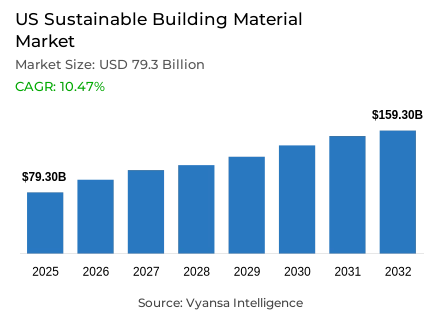
Sustainable building materials are construction products designed to lower environmental impact through responsible sourcing, reduced emissions, efficient resource use, recyclability, durability, and improved building performance. In the United States, demand is rising as builders, developers, businesses, and homeowners choose materials that support greener construction, lower operating costs, and longer-lasting buildings. As a result, the US Sustainable Building Material Market is projected to grow at a CAGR of 10.47% during 2026-2032.
Key Highlights of the US Sustainable Building Material Market
- The United States sustainable building material market grew from 79.30 billion in 2025 to 87.63 billion in 2026.
- Moreover, it is projected to reach 159.30 billion by 2032 at a CAGR of 10.47%.
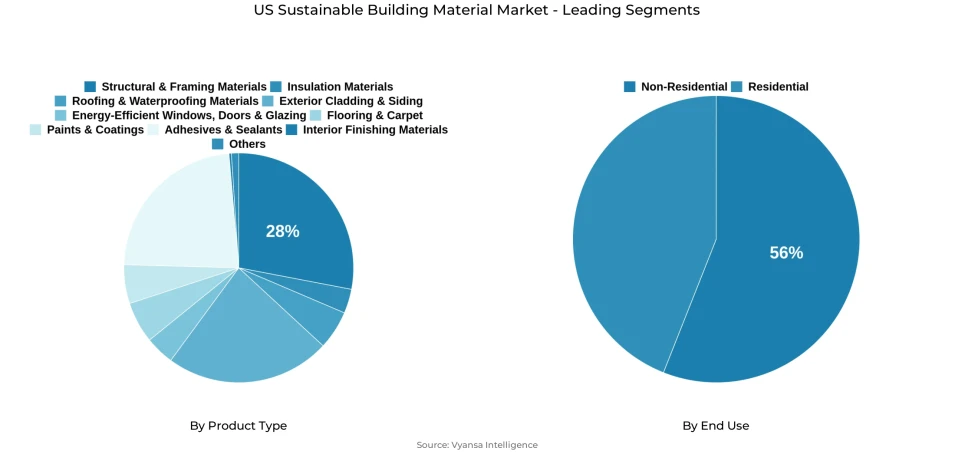
- Structural & framing materials led the product type with a 28% share in 2026.
- However, insulation materials are expected to grow fastest at a CAGR of 13.51% during 2026-2032.
- Non-residential applications dominated End Use with a 56% share in 2026.
- Meanwhile, residential applications are projected to expand at a CAGR of 9.62%.
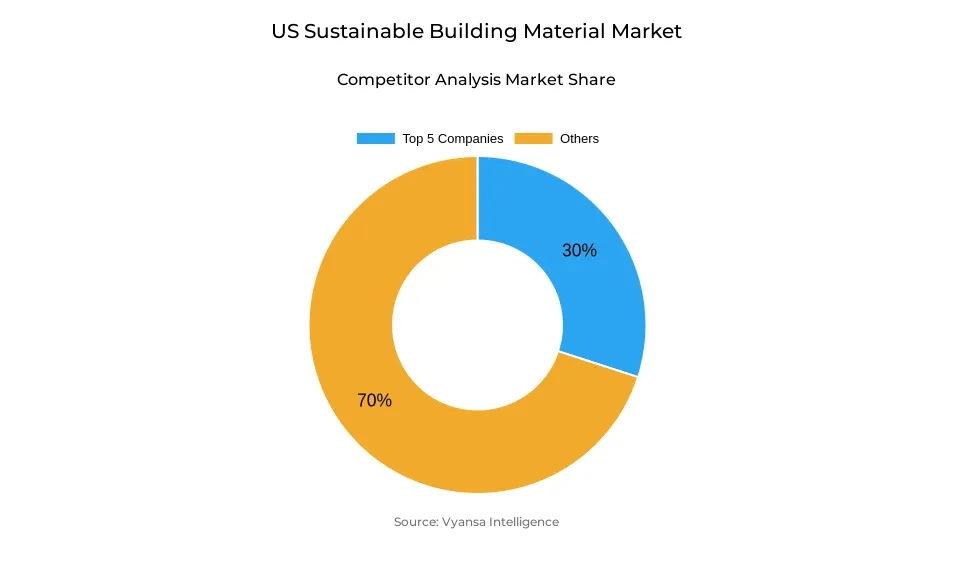
- The top five companies held 30% of revenue, indicating a moderately fragmented market.
The sustainable building material market in the United States is witnessing robust growth, driven by increasing investments in low-carbon building construction, circular economy practices, and energy-efficient building development. The adoption of recycled steel, reclaimed wood, recycled concrete, engineered timber, and other sustainable materials is accelerating as developers seek to reduce embodied carbon, minimize construction waste, and improve lifecycle performance. According to the U.S. Environmental Protection Agency (EPA), the United States generated approximately 600.3 million tons of construction and demolition (C&D) debri, more than twice the amount of municipal solid waste. The EPA updated these statistics in October 2025, reinforcing the growing need for material recovery, recycling, and circular construction practices across the U.S. building industry. This has significantly increased the demand for recycled and reusable construction materials in both new developments and renovation projects.
Another major factor supporting market expansion is the country's high building energy consumption. According to the U.S. General Services Administration (GSA), based on U.S. Department of Energy (DOE) data and updated in March 2026, buildings account for approximately 40% of total U.S. energy consumption and nearly 74% of the nation's electricity consumption. As electricity prices and operating costs continue to rise, developers are increasingly adopting high-performance insulation, low-emissivity glazing, cool roofing systems, insulated concrete forms, and other sustainable materials that reduce heating and cooling loads while improving overall building efficiency.
Government-led decarbonization initiatives are further accelerating market adoption. The U.S. Department of Energy's Final Rule for Federal Buildings, effective for projects beginning in FY2025, requires new federal buildings and major renovations to achieve a 90% reduction in on-site fossil fuel energy use during FY2025–FY2029, with 100% elimination of on-site fossil fuel use from FY2030 onward. These regulations are encouraging greater use of low-carbon concrete, sustainable steel, engineered wood products, and other environmentally preferable building materials across public construction projects.
Overall, increasing construction waste management requirements, stringent building decarbonization policies, and growing demand for energy-efficient buildings are accelerating the adoption of sustainable building materials throughout the United States. As public agencies, commercial developers, and homeowners continue to prioritize lower lifecycle emissions, resource efficiency, and long-term operating cost savings, sustainable building materials are expected to witness strong adoption, supporting continued market growth through 2032.
Government Regulations Shaping the Market Growth
Resource Conservation and Recovery Act (RCRA) Section 6002 continues to support the U.S. Sustainable Building Material Market by requiring federal, state, and local agencies using appropriated federal funds to procure EPA-designated products containing recovered materials when purchases exceed USD 10,000, provided the products meet cost, availability, competition, and performance requirements. Administered through the EPA's Comprehensive Procurement Guideline (CPG) Program, the regulation covers several construction materials, including building insulation, cement and concrete, carpeting, floor tiles, roofing materials, and structural fiberboard. By creating consistent public-sector demand for recycled-content products, the regulation encourages manufacturers to increase recycled material content, obtain environmental certifications, and expand production of sustainable construction materials, thereby supporting long-term market growth in the United States.
US Sustainable Building Material Market Drivers
High Building Energy Consumption Is Accelerating Demand for Energy-Efficient Construction Materials
Rising energy consumption across U.S. residential and commercial buildings is driving demand for high-performance construction materials that improve building efficiency and reduce operating costs. Developers, building owners, and facility managers are increasingly adopting advanced insulation, energy-efficient glazing, reflective roofing, air barriers, and thermally optimized wall systems to enhance energy performance while meeting stricter sustainability objectives and occupant comfort requirements.
According to the U.S. Department of Energy, buildings account for approximately 74% of the nation's electricity consumption and nearly USD 370 billion in annual energy expenditures. The Department's Better Buildings Solution Centre further estimates that building-envelope components, including walls, roofs, windows, and foundations, influence nearly 30% of the primaryenergy consumed in residential and commercial buildings.
As energy efficiency becomes a strategic investment priority, demand continues to grow for advanced envelope materials offering superior thermal insulation, airtightness, moisture resistance, and solar heat management. This transition is accelerating the adoption of sustainable construction materials across both new developments and large-scale building renovation projects.
US Sustainable Building Material Market Restraint
Inconsistent Environmental Product Declaration Data Limits Material Comparability
The increasing use of Environmental Product Declarations (EPDs) has improved transparency in evaluating the environmental performance of sustainable building materials. However, inconsistencies in reporting methodologies, product category rules (PCRs), lifecycle assessment boundaries, data quality, and calculation approaches continue to limit direct comparability between products. As a result, architects, engineers, contractors, and procurement teams often require additional technical reviews and third-party verification before selecting materials, delaying specification and purchasing decisions for sustainable construction projects.
This challenge is evident in a 2025 National Institute of Standards and Technology (NIST) assessment of 4,048 asphalt Environmental Product Declarations, which found that only 2,126 EPDs (52.5%) contained complete datasets, while 1,922 EPDs (47.5%) had one or more data gaps that required caution during interpretation. Although the study focused on asphalt products, it highlights the broader industry challenge of inconsistent environmental reporting, reducing confidence in comparative assessments and limiting the effectiveness of EPDs as procurement tools.
Consequently, manufacturers, designers, and project developers incur higher verification costs, longer material approval timelines, and greater administrative effort during procurement. Smaller manufacturers are particularly affected, as developing and maintaining third-party verified EPDs requires significant technical expertise and financial investment. Until reporting methodologies and product category rules become more harmonized, inconsistent EPD data will continue to slow procurement decisions, increase compliance costs, and restrict broader adoption of sustainable building materials, thereby constraining the growth of the U.S. Sustainable Building Material Market.
US Sustainable Building Material Market Trends
Low-Clinker Cement Technologies Are Advancing Commercial De-carbonization
Cement manufacturers are accelerating investments in low-clinker formulations, calcined clay, supplementary cementitious materials, and alternative production technologies to reduce carbon emissions while maintaining structural performance. These innovations are supporting the industry's transition toward lower-carbon construction materials without compromising durability, strength, or long-term reliability.
The U.S. Department of Energy has identified a proposed multi-state low-carbon calcined-clay cement project across facilities in Maryland, Georgia, and Texas, with a potential federal investment of up to USD 215.6 million. Once operational, the project could reduce approximately 1.1 million metric tons of carbon emissions annually while producing material equivalent to nearly 2% of projected U.S. cement demand by 2030.
Although commercial deployment remains under development, successful demonstration projects are expected to accelerate market acceptance of alternative cement technologies. Growing investments in low-carbon manufacturing are creating demand for specialized raw materials, advanced processing technologies, quality testing services, and innovative production capabilities across the construction materials value chain.
US Sustainable Building Material Market Future Opportunity
Industrialized Retrofit Systems Are Creating Long-Term Growth Opportunities
The extensive installed base of aging U.S. buildings presents significant long-term opportunities for industrialized retrofit solutions that improve energy efficiency while reducing installation complexity. Prefabricated envelope systems integrating insulation, air barriers, windows, and façade components enable faster project execution, lower labour requirements, reduced material waste, and minimal disruption for building occupants.
According to the U.S. Energy Information Administration, the 2024 Residential Energy Consumption Survey represents approximately 132.5 million occupied U.S. householdsbased on responses from nearly 17,000 households, highlighting the substantial retrofit potential across the country's residential building stock. The U.S. Department of Energy's Advanced Building Construction Initiativeis further supporting industrialized approaches for high-performance building retrofits.
Growing investment in modular retrofit technologies is creating opportunities for manufacturers to expand standardized envelope systems, integrated façade solutions, regional manufacturing facilities, and contractor partnerships. These innovations are expected to improve renovation economics, accelerate energy-efficiency upgrades, and strengthen long-term demand across the U.S. sustainable building material market.
Unlock Market Intelligence
Explore the market potential with our data-driven report
Segmentation Analysis
By Product Type
- Structural & Framing Materials
- Cement, Concrete & Masonry Materials
- Insulation Materials
- Roofing Materials
- Flooring Materials
- Wall, Ceiling & Interior Finish Materials
- Windows, Doors & Glazing Materials
- Others
Structural & Framing Materials Lead, While Insulation Materials Record the Fastest Growth
Structural & Framing Materials led with 28% of revenue in 2026 because every building requires load-bearing systems before envelope and interior products are installed. Engineered wood, responsibly sourced timber, recycled-content steel, structural panels, and lower-impact masonry serve residential, commercial, institutional, and industrial projects. Census reported that 96% of owner-built homes completed in 2025 used wood framing, illustrating the category’s embedded role. High material value, code acceptance, established distribution, and conventional installation workflows sustain leadership across construction and major renovation activity.
Insulation Materials are forecast to record the fastest 13.51% CAGR during 2026–2032 as building owners seek lower heating and cooling loads, improved moisture management, and stronger envelope performance. The US Sustainable Building Material Industry benefits from wider use of fiberglass, mineral wool, cellulose, rigid foam, cellular glass, and insulated panel systems in retrofits and new projects. Compared with framing, insulation gains faster from energy codes, utility costs, prefabricated assemblies, and upgrades that can be installed without structural replacement work.
By End Use
- Residential
- New Construction
- Renovation & Retrofit
- Non-Residential
- Commercial
- Institutional
- Industrial
- Infrastructure & Public Buildings
Non-Residential Leads, While Residential Records Faster Growth
Non-Residential applications led with 56% of revenue in 2026 because offices, schools, hospitals, warehouses, factories, data centers, public buildings, and infrastructure-linked facilities consume broad material portfolios. These projects typically involve larger floor areas, stricter performance specifications, professional procurement, and extensive structural, envelope, roofing, flooring, glazing, and interior requirements. Public construction and recurring commercial renovations further support demand. Greater project values, documentation requirements, and multi-product purchasing consequently give non-residential work a larger revenue contribution than individual household construction activity nationally.
Residential applications are projected to grow at a 9.62% CAGR during 2026–2032, supported by housing construction, reroofing, insulation upgrades, siding replacement, window installation, and energy-focused renovation. The US Sustainable Building Material Industry gains from repeatable product formats, retail and dealer availability, contractor networks, and homeowner interest in comfort, durability, resilience, and operating costs. Although non-residential projects retain greater scale, residential demand expands faster because the installed housing base creates recurring replacement cycles and widespread retrofit opportunities across regions nationwide.
Unlock Market Intelligence
Explore the market potential with our data-driven report
Competitive Landscape
The US sustainable building material industry is moderately fragmented. Saint-Gobain Corporation, CRH Americas, Inc., Amrize Ltd, Owens Corning, and Carlisle Companies Incorporated collectively account for 30% of market revenue nationally.
Major Sustainable Building Material Companies Worldwide
- Saint-Gobain Corporation
- CRH Americas, Inc.
- Amrize Ltd
- Owens Corning
- Carlisle Companies Incorporated
- The Sherwin-Williams Company
- James Hardie Industries plc
- Louisiana-Pacific Corporation (LP Building Solutions)
- Kingspan Insulated Panels, Inc.
- Armstrong World Industries, Inc.
Company Profiling
The profiles assess relevant products, technical capability, manufacturing scale, geographic reach, documentation strength, and competitive positioning.
Saint-Gobain Corporation
Saint-Gobain Corporation, based in Malvern, Pennsylvania, is the U.S. operating company of Compagnie de Saint-Gobain S.A. and includes affiliates such as CertainTeed LLC. Its relevant portfolio spans gypsum wallboard, insulation, roofing, siding, ceilings, construction fabrics, and glass solutions serving residential and non-residential projects. Saint-Gobain North America operates at more than 160 sites, while CertainTeed maintains over 60 manufacturing facilities across the US and Canada. Broad product coverage, environmental transparency resources, and regional manufacturing position the company as a sustainability-focused, technically supported supplier.
CRH Americas, Inc.
CRH Americas, Inc., headquartered in Atlanta, Georgia, is a U.S. holding and operating platform of CRH plc. Through CRH Americas Materials and local businesses, it supplies aggregates, asphalt, ready-mixed concrete, paving, and construction services for infrastructure, commercial, and residential projects. Its Americas Materials operations employ about 29,000 people across 1,704 locations in 45 U.S. states and two Canadian provinces. Vertically integrated reserves, production, logistics, and contracting capabilities support local delivery and specification compliance, positioning CRH as a scale-driven materials supplier with extensive regional market access.
Amrize Ltd
Amrize Ltd is a Swiss-incorporated North American building solutions company with principal offices in Zug and operational headquarters in Chicago. Its U.S. portfolio extends from cement, aggregates, ready-mix concrete, and asphalt to Elevate, Duro-Last, Malarkey, Gaco, Enverge, and OX building-envelope products. Amrize serves every U.S. state and operates about 600 domestic sites with more than 11,000 employees. Its foundation-to-rooftop coverage, local production network, and integrated distribution position the company as a large-scale supplier addressing infrastructure, commercial, residential, repair, and refurbishment demand.
Owens Corning
Owens Corning, headquartered in Toledo, Ohio, is a branded building-products company focused on roofing, insulation, and doors. Its sustainable-material portfolio includes PINK Next Gen fiberglass, Thermafiber mineral wool, FOAMULAR NGX extruded-polystyrene insulation, FOAMGLAS cellular glass, cool-roof shingles, and complete roofing systems. The company operates numerous U.S. manufacturing facilities and serves residential, commercial, and industrial applications through distributors, retailers, contractors, and specification channels. Product transparency, building-science support, recognized brands, and broad envelope coverage position Owens Corning as a material-innovation and documentation-led supplier.
Carlisle Companies Incorporated
Carlisle Companies Incorporated, headquartered in Scottsdale, Arizona, supplies energy-efficient building-envelope systems through Carlisle Construction Materials and Carlisle Weatherproofing Technologies. Its portfolio includes EPDM and TPO roofing membranes, polyiso insulation, air and vapor barriers, waterproofing, sealants, and related accessories for commercial and institutional buildings. Product-specific EPDs, technical design resources, contractor support, and established distribution strengthen specification and installation confidence. Carlisle’s focused building-products portfolio and labor-reducing systems position it as a technically specialized supplier serving reroofing, renovation, and new-construction demand.
US Sustainable Building Material Industry Recent Developments and Updates
- In June 2026, Holcim completed the acquisition of Xella, a leading manufacturer of sustainable walling systems, including autoclaved aerated concrete (AAC), calcium silicate products, and mineral insulation solutions. The acquisition expands Holcim's Building Solutions portfolio with energy-efficient walling technologies, strengthening its position in sustainable construction, circular building solutions, and building renovation markets while accelerating its NextGen Growth 2030 strategy.
- In March 2026, Amrize launched its EVERtect™ high-performance concrete portfolio at CONEXPO-CON/AGG 2026, introducing ECOtect™, a low-carbon concrete with at least a 30% lower carbon footprint than conventional Type I/GU concrete while maintaining comparable structural performance. The launch broadens the availability of sustainable structural materials for residential, commercial, infrastructure, and data center construction, supporting the global transition toward lower-embodied-carbon buildings.
Frequently Asked Questions
Related Report
- Market Segmentation
- Research Scope
- Research Methodology
- Definitions and Assumptions
- Executive Summary
- US Sustainable Building Materials Market Policies, Regulations, and Standards
- US Sustainable Building Materials Market Pricing Analysis & Price Trend Forecasts
- US Sustainable Building Materials Market Primary Voice-of-Customer/Buyer Survey Insights
- US Sustainable Building Materials Market Import-Export/Trade Flow Analysis
- US Sustainable Building Materials Market Regulatory & Compliance Deep-Dive (state-by-state)
- US Sustainable Building Materials Market Patent Landscape/Technology Roadmap Analysis
- US Sustainable Building Materials Market Demand-Supply Gap/Capacity Utilization Analysis
- US Sustainable Building Materials Market Dynamics
- Growth Factors
- Challenges
- Trends
- Opportunities
- US Sustainable Building Materials Market Statistics, 2022-2032F
- Market Size & Growth Outlook
- By Revenues in USD Million
- Market Segmentation & Growth Outlook
- By Product Type
- Structural & Framing Materials- Market Insights and Forecast 2022-2032, USD Million
- Insulation Materials- Market Insights and Forecast 2022-2032, USD Million
- Roofing & Waterproofing Materials- Market Insights and Forecast 2022-2032, USD Million
- Exterior Cladding & Siding- Market Insights and Forecast 2022-2032, USD Million
- Energy-Efficient Windows, Doors & Glazing- Market Insights and Forecast 2022-2032, USD Million
- Flooring & Carpet- Market Insights and Forecast 2022-2032, USD Million
- Paints & Coatings- Market Insights and Forecast 2022-2032, USD Million
- Adhesives & Sealants- Market Insights and Forecast 2022-2032, USD Million
- Interior Finishing Materials- Market Insights and Forecast 2022-2032, USD Million
- Others- Market Insights and Forecast 2022-2032, USD Million
- By End Use
- Residential- Market Insights and Forecast 2022-2032, USD Million
- Non-Residential- Market Insights and Forecast 2022-2032, USD Million
- By Construction Type
- New Construction- Market Insights and Forecast 2022-2032, USD Million
- Renovation & Retrofit- Market Insights and Forecast 2022-2032, USD Million
- By Region
- Northeast- Market Insights and Forecast 2022-2032, USD Million
- Midwest- Market Insights and Forecast 2022-2032, USD Million
- South- Market Insights and Forecast 2022-2032, USD Million
- West- Market Insights and Forecast 2022-2032, USD Million
- By Competitors
- Competition Characteristics
- Market Share & Analysis
- By Product Type
- Market Size & Growth Outlook
- US Structural & Framing Materials Market Statistics, 2022-2032
- Market Size & Growth Outlook
- By Revenues in USD Million
- Market Segmentation & Growth Outlook
- By End Use- Market Insights and Forecast 2022-2032, USD Million
- By Construction Type- Market Insights and Forecast 2022-2032, USD Million
- By Region- Market Insights and Forecast 2022-2032, USD Million
- Market Size & Growth Outlook
- US Insulation Materials Market Statistics, 2022-2032
- Market Size & Growth Outlook
- By Revenues in USD Million
- Market Segmentation & Growth Outlook
- By End Use- Market Insights and Forecast 2022-2032, USD Million
- By Construction Type- Market Insights and Forecast 2022-2032, USD Million
- By Region- Market Insights and Forecast 2022-2032, USD Million
- Market Size & Growth Outlook
- US Roofing & Waterproofing Materials Market Statistics, 2022-2032
- Market Size & Growth Outlook
- By Revenues in USD Million
- Market Segmentation & Growth Outlook
- By End Use- Market Insights and Forecast 2022-2032, USD Million
- By Construction Type- Market Insights and Forecast 2022-2032, USD Million
- By Region- Market Insights and Forecast 2022-2032, USD Million
- Market Size & Growth Outlook
- US Exterior Cladding & Siding Market Statistics, 2022-2032
- Market Size & Growth Outlook
- By Revenues in USD Million
- Market Segmentation & Growth Outlook
- By End Use- Market Insights and Forecast 2022-2032, USD Million
- By Construction Type- Market Insights and Forecast 2022-2032, USD Million
- By Region- Market Insights and Forecast 2022-2032, USD Million
- Market Size & Growth Outlook
- US Energy-Efficient Windows, Doors & Glazing Market Statistics, 2022-2032
- Market Size & Growth Outlook
- By Revenues in USD Million
- Market Segmentation & Growth Outlook
- By End Use- Market Insights and Forecast 2022-2032, USD Million
- By Construction Type- Market Insights and Forecast 2022-2032, USD Million
- By Region- Market Insights and Forecast 2022-2032, USD Million
- Market Size & Growth Outlook
- US Flooring & Carpet Market Statistics, 2022-2032
- Market Size & Growth Outlook
- By Revenues in USD Million
- Market Segmentation & Growth Outlook
- By End Use- Market Insights and Forecast 2022-2032, USD Million
- By Construction Type- Market Insights and Forecast 2022-2032, USD Million
- By Region- Market Insights and Forecast 2022-2032, USD Million
- Market Size & Growth Outlook
- US Paints & Coatings Market Statistics, 2022-2032
- Market Size & Growth Outlook
- By Revenues in USD Million
- Market Segmentation & Growth Outlook
- By End Use- Market Insights and Forecast 2022-2032, USD Million
- By Construction Type- Market Insights and Forecast 2022-2032, USD Million
- By Region- Market Insights and Forecast 2022-2032, USD Million
- Market Size & Growth Outlook
- US Adhesives & Sealants Market Statistics, 2022-2032
- Market Size & Growth Outlook
- By Revenues in USD Million
- Market Segmentation & Growth Outlook
- By End Use- Market Insights and Forecast 2022-2032, USD Million
- By Construction Type- Market Insights and Forecast 2022-2032, USD Million
- By Region- Market Insights and Forecast 2022-2032, USD Million
- Market Size & Growth Outlook
- US Interior Finishing Materials Market Statistics, 2022-2032
- Market Size & Growth Outlook
- By Revenues in USD Million
- Market Segmentation & Growth Outlook
- By End Use- Market Insights and Forecast 2022-2032, USD Million
- By Construction Type- Market Insights and Forecast 2022-2032, USD Million
- By Region- Market Insights and Forecast 2022-2032, USD Million
- Market Size & Growth Outlook
- US Others Market Statistics, 2022-2032
- Market Size & Growth Outlook
- By Revenues in USD Million
- Market Segmentation & Growth Outlook
- By End Use- Market Insights and Forecast 2022-2032, USD Million
- By Construction Type- Market Insights and Forecast 2022-2032, USD Million
- By Region- Market Insights and Forecast 2022-2032, USD Million
- Market Size & Growth Outlook
- Competitive Outlook
- Company Profiles
- Saint-Gobain Corporation
- Business Description
- Product Portfolio
- Collaborations & Alliances
- Recent Developments
- Financial Details
- Others
- CRH Americas, Inc.
- Business Description
- Product Portfolio
- Collaborations & Alliances
- Recent Developments
- Financial Details
- Others
- Amrize Ltd
- Business Description
- Product Portfolio
- Collaborations & Alliances
- Recent Developments
- Financial Details
- Others
- Owens Corning
- Business Description
- Product Portfolio
- Collaborations & Alliances
- Recent Developments
- Financial Details
- Others
- Carlisle Companies Incorporated
- Business Description
- Product Portfolio
- Collaborations & Alliances
- Recent Developments
- Financial Details
- Others
- The Sherwin-Williams Company
- Business Description
- Product Portfolio
- Collaborations & Alliances
- Recent Developments
- Financial Details
- Others
- James Hardie Industries plc
- Business Description
- Product Portfolio
- Collaborations & Alliances
- Recent Developments
- Financial Details
- Others
- Louisiana-Pacific Corporation (LP Building Solutions)
- Business Description
- Product Portfolio
- Collaborations & Alliances
- Recent Developments
- Financial Details
- Others
- Kingspan Insulated Panels, Inc.
- Business Description
- Product Portfolio
- Collaborations & Alliances
- Recent Developments
- Financial Details
- Others
- Armstrong World Industries, Inc.
- Business Description
- Product Portfolio
- Collaborations & Alliances
- Recent Developments
- Financial Details
- Others
- Saint-Gobain Corporation
- Company Profiles
- Disclaimer
| Segment | Sub-Segment |
|---|---|
| By Product Type |
|
| By End Use |
|
| By Construction Type |
|
| By Region |
|
Research Methodology
This study followed a structured approach comprising four key phases to assess the size and scope of the electro-oxidation market. The process began with thorough secondary research to collect data on the target market, related markets, and broader industry context. These findings, along with preliminary assumptions and estimates, were then validated through extensive primary research involving industry experts from across the value chain. To calculate the overall market size, both top-down and bottom-up methodologies were employed. Finally, market segmentation and data triangulation techniques were applied to refine and validate segment-level estimations.
Secondary Research
The secondary research phase involved gathering data from a wide range of credible and published sources. This step helped in identifying industry trends, defining market segmentation, and understanding the market landscape and value chain.
Sources consulted during this phase included:
- Company annual reports, investor presentations, and press releases
- Industry white papers and certified publications
- Trade directories and market-recognized databases
- Articles from authoritative authors and reputable journals
- Gold and silver standard websites
Secondary research was critical in mapping out the industry's value chain and monetary flow, identifying key market segments, understanding regional variations, and tracking significant industry developments.
Other key sources:
- Financial disclosures
- Industry associations and trade bodies
- News outlets and business magazines
- Academic journals and research studies
- Paid industry databases
Primary Research
To validate secondary data and gain deeper market insights, primary research was conducted with key stakeholders across both the supply and demand sides of the market.
On the demand side, participants included decision-makers and influencers from end-user industries—such as CIOs, CTOs, and CSOs—who provided first-hand perspectives on market needs, product usage, and future expectations.
On the supply side, interviews were conducted with manufacturers, industry associations, and institutional participants to gather insights into current offerings, product pipelines, and market challenges.
Primary interviews provided critical inputs such as:
- Market size and revenue data
- Product and service breakdowns
- Market forecasts
- Regional and application-specific trends
Stakeholders consulted included:
- Leading OEM and solution providers
- Channel and distribution partners
- End users across various applications
- Independent consultants and industry specialists
Market Size Estimation and Data Triangulation
- Identifying Key Market Participants (Secondary Research)
- Goal: To identify the major players or companies in the target market. This typically involves using publicly available data sources such as industry reports, market research publications, and financial statements of companies.
- Tools: Reports from firms like Gartner, Forrester, Euromonitor, Statista, IBISWorld, and others. Public financial statements, news articles, and press releases from top market players.
- Extracting Earnings of Key Market Participants
- Goal: To estimate the earnings generated from the product or service being analyzed. This step helps in understanding the revenue potential of each market player in a specific geography.
- Methods: Earnings data can be gathered from:
- Publicly available financial reports (for listed companies).
- Interviews and primary data sources from professionals, such as Directors, VPs, SVPs, etc. This is especially useful for understanding more nuanced, internal data that isn't publicly disclosed.
- Annual reports and investor presentations of key players.
- Data Collation and Development of a Relevant Data Model
- Goal: To collate inputs from both primary and secondary sources into a structured, data-driven model for market estimation. This model will incorporate key market KPIs and any independent variables relevant to the market.
- Key KPIs: These could include:
- Market size, growth rate, and demand drivers.
- Industry-specific metrics like market share, average revenue per customer (ARPC), or average deal size.
- External variables, such as economic growth rates, inflation rates, or commodity prices, that could affect the market.
- Data Modeling: Based on this data, the market forecasts are developed for the next 5 years. A combination of trend analysis, scenario modeling, and statistical regression might be used to generate projections.
- Scenario Analysis
- Goal: To test different assumptions and validate how sensitive the market is to changes in key variables (e.g., market demand, regulatory changes, technological disruptions).
- Types of Scenarios:
- Base Case: Based on current assumptions and historical data.
- Best-Case Scenario: Assuming favorable market conditions, regulatory environments, and technological advancements.
- Worst-Case Scenario: Accounting for adverse factors, such as economic downturns, stricter regulations, or unexpected disruptions.












