US Landscaping Market Report: Trends, Growth and Forecast (2027-2033)
By Service Type (Landscape Design & Planning, Landscape Installation & Development, Landscape Maintenance), By Landscaping Type (Softscape (Trees, Shrubs & Planting, Turf & Groundcover), Hardscape (Paving, Walkways & Built Surfaces, Walls, Water Features & Decorative Structures)), By End User (Residential (Villas & Townhouses, Apartments & Residential Communities), Commercial (Hospitality, Retail, Offices & Business Parks), Public & Infrastructure (Parks & Public Open Spaces, Roads & Streetscapes, Government Properties & Facilities)) ... Read more
|
Major Players
|
US Landscaping Market Overview
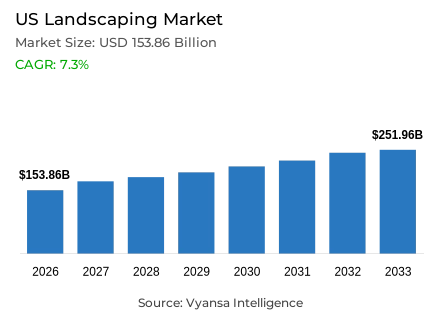
Landscaping services in the United States span residential and commercial grounds maintenance, hardscape and softscape installation, tree care, and irrigation, delivered by professional contractors. Homeowners, commercial property operators, and municipal and institutional end users consume these services for outdoor living upgrades, recurring lawn and plant upkeep, and public grounds maintenance. The US Landscaping market is forecast to grow at a CAGR of 7.3% between 2027 and 2033.
Key Highlights of the US Landscaping Market
- The United States Landscaping market was valued at USD 153.86 billion in 2026, estimated at USD 165.10 billion in 2027, and forecast to reach USD 251.96 billion by 2033.
- The market is forecast to expand at a compound annual growth rate, CAGR of 7.3% between 2027 and 2033.
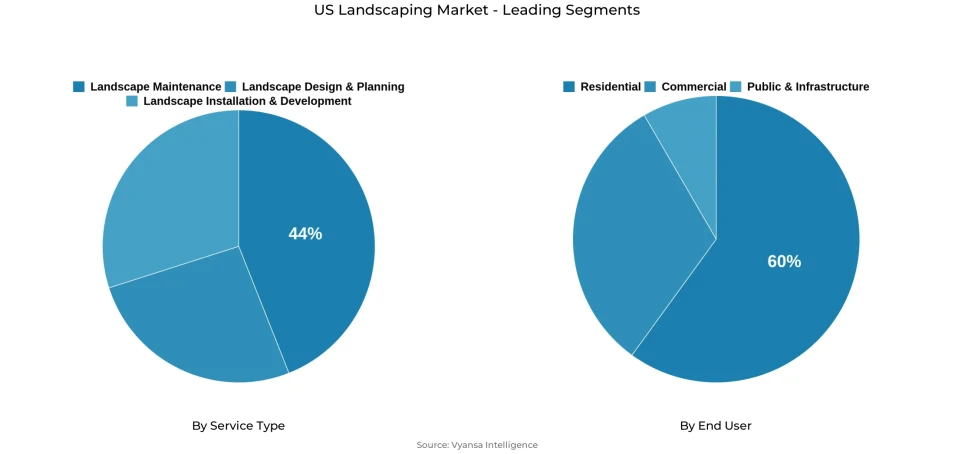
- By service type, Landscape maintenance led the market with a 44% share in 2026.
- While, Landscape installation & development is the fastest-growing service type, expanding at a CAGR of 5% between 2027 and 2033.
- By end user, residential led the market with a 60% share in 2026.
- Additionally, public & infrastructure is the fastest-growing end-user segment, expanding at a CAGR of 9.45% between 2027 and 2033.
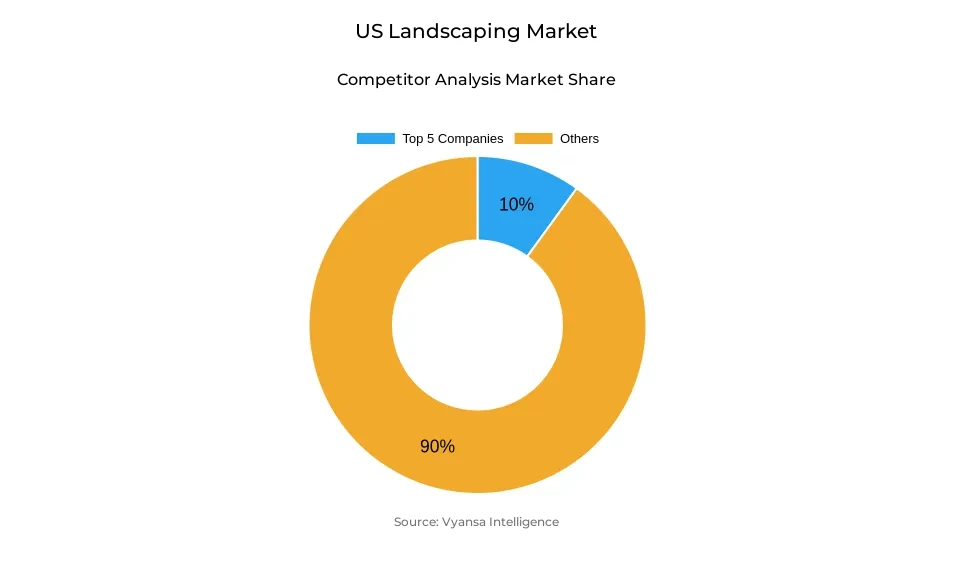
- The market is fragmented, with the top five companies holding a combined 10% share in 2026.
The US Landscaping market benefits from a substantial base of established properties and continued additions to the housing stock. EIA data recorded 82.5 million occupied single-family detached homes in 2024, providing a broad potential customer base for lawn care, tree maintenance and Landscaping renewal. Approximately 1.01 million single-family homes were completed in 2025, creating further opportunities for planting, irrigation and outdoor installation. As these properties mature, initial landscaping can develop into ongoing service requirements, supporting demand beyond the construction phase.
Homeowners are also investing in how outdoor spaces function. The 2026 Houzz outdoor trends study found that 83% of renovating homeowners incorporated lounge or seating areas, while 71% hired professional assistance. Creating usable outdoor environments requires planting, drainage and Landscaping work that complements patios and seating areas. This gives contractors opportunities to undertake more comprehensive projects and maintain the resulting Landscapes, connecting discretionary improvements with continuing care rather than relying solely on individual installation jobs.
Public-space renewal adds another source of demand. The 2026 NRPA report found that the typical park and recreation agency allocated 87% of capital expenditure to improvements, supporting opportunities where upgrades include grounds and Landscaped areas. Through the forecast period, the combination of existing-property upkeep, newly completed homes and outdoor-space renewal should sustain market expansion. Contractors that turn installation and improvement projects into lasting maintenance relationships will be better positioned to capture this demand, with public-sector opportunities depending on local budgets and procurement decisions.
US Landscaping Market Driver
Growing Investment in Outdoor Living Is Expanding Professional Landscaping Demand
US homeowners increasingly treat yards, patios and gardens as usable living environments rather than purely decorative areas. This broadens landscaping expenditure beyond routine mowing into planting design, hardscape, lighting, irrigation and outdoor amenity development. Larger projects also create downstream maintenance requirements, allowing an initial renovation to generate continuing service revenue after installation is completed.
The 2026 Houzz outdoor trends study found that 83% of homeowners renovating outdoor space included lounge or seating areas, 55% included dining areas and 48% incorporated outdoor cooking space. Professional participation also rose, with 71% hiring professional assistance compared with 65% in 2024. These projects require substantially more Landscaping design and installation input than conventional lawn maintenance.
Planting preferences are expanding the opportunity further rather than simply increasing hardscape spending. Around 73% of renovating homeowners selected low-maintenance plants, 55% chose native varieties and 49% selected drought-resistant plants, creating additional demand for professional planting design suited to local climates. Outdoor-living investment therefore supports both immediate project revenue and continuing Landscaping-maintenance demand.
US Landscaping Market Challenge
Skilled-Labor Shortages Are Limiting Contractor Service Capacity
Landscaping remains labor-intensive across mowing, planting, irrigation, tree care and hardscape work, leaving contractors exposed when experienced crew members are difficult to recruit and retain. The commercial problem is not weak underlying customer demand but the ability of contractors to add enough trained workers to service new accounts without reducing quality or delaying projects.
A 2026 commercial landscaping industry survey found that 54% of contractors identified recruiting and retaining employees as a major business risk. Around 70% planned wage increases, including 44% expecting increases of at least 4%, demonstrating how workforce scarcity is translating directly into higher operating costs.
Larger Landscaping businesses can respond through stronger recruitment programs, equipment investment and more standardized operating systems, while smaller contractors have less flexibility to absorb higher labor costs. The constraint therefore limits how rapidly service capacity can expand and increases the appeal of automation for repetitive work, even while underlying residential and commercial landscaping demand remains healthy.
US Landscaping Market Trends
Multi-Service Landscaping Platforms Are Expanding Across Regional Markets
US landscaping companies are increasingly expanding beyond single-market operations by building broader regional platforms that combine maintenance, design, installation, tree care and enhancement services. This allows operators to serve customers across a wider geographic footprint while offering more services through one relationship, particularly for commercial properties, HOAs and premium residential clients that prefer fewer contractors managing multiple landscaping requirements.
Mariani premier group illustrates this expansion strategy. During 2026, the company added Florida-based Lopez gardening and Arizona-based Mitschele's, extending its premium residential landscaping presence into additional high-value markets while retaining the local customer relationships and market knowledge of the acquired businesses.
This model creates a stronger recurring-revenue base because maintenance customers can also be served with planting upgrades, irrigation work, tree care and Landscaping enhancements over time. Through 2033, regional platform expansion should allow larger operators to capture more value from each customer while improving geographic reach, service breadth and the ability to compete for larger multi-property contracts.
Autonomous Mowing Is Moving Toward Commercial Landscaping Deployment
Autonomous mowing technology is beginning to move beyond residential robotic equipment toward machines designed specifically for commercial contractors. These systems combine AI-based vision, positioning technology and remote monitoring to mow large repetitive areas with less direct operator involvement, allowing crews to concentrate on trimming, planting, irrigation and other tasks that remain harder to automate.
PANDAG's commercial autonomous mower combines LiDAR, AI vision and positioning technology and is designed to cover up to 12 acres per day, targeting parks, sports fields, golf courses and other large Landscapes. John Deere is also conducting real-world field validation of its autonomous commercial mower during 2026 after introducing the technology at CES, confirming that major equipment suppliers are actively developing contractor-focused autonomy.
The technology directly addresses the industry's labor constraint because mowing consumes substantial recurring crew hours but follows comparatively predictable routes. Adoption should initially concentrate among larger commercial contractors managing extensive campuses, municipal grounds and HOAs where equipment utilization can justify the investment. As reliability improves, autonomy can allow contractors to service more acreage without proportional increases in mowing labor.
US Landscaping Market Opportunity
Wildfire-Resilient Landscaping Creates a Specialized Vegetation-Management Opportunity
Wildfire-prone properties increasingly require landscaping designed around risk reduction rather than conventional appearance alone. Vegetation clearance, plant spacing, tree maintenance and ember-resistant areas around structures create specialized work that sits between traditional Landscaping maintenance and arboriculture, opening an additional service category for contractors operating across western US wildfire markets.
California has strengthened this opportunity through its Zone 0 defensible-space framework, which establishes a more restrictive ember-resistant area immediately surrounding structures in high-risk areas. The California Board of Forestry approved its first statewide Zone 0 policy in August 2026, while implementation for existing structures is designed to phase in over several years rather than occur through a single immediate deadline.
Landscaping contractors with tree-care and vegetation-management capabilities can capture this opportunity by adding defensible-space assessment, fuel reduction and ongoing vegetation management to existing residential, HOA and commercial contracts. Unlike a one-time Landscaping renovation, wildfire mitigation requires continued vegetation control as plants regrow, creating the potential for recurring specialist revenue in markets where fire exposure increasingly affects property-management decisions.
Unlock Market Intelligence
Explore the market potential with our data-driven report
US Landscaping Industry Segmentation Analysis
By Service Type:
- Landscape Design & Planning
- Landscape Maintenance
- Landscape Installation & Development
Landscape Maintenance Commands 44% of Service Type Demand
Landscape Maintenance accounts for 44% of US Landscaping market demand in 2026 because every established residential, commercial or institutional Landscaping creates recurring requirements for mowing, pruning, irrigation servicing, tree care and plant replacement. This recurring structure gives maintenance a substantially broader installed customer base than installation work, which depends more heavily on new construction and discretionary renovation.
BrightView's fiscal third quarter of 2026 demonstrates the resilience of recurring maintenance demand. The company reported Landscaping maintenance revenue of USD 514.5 million for the quarter, increasing 2.3% year over year even as development services revenue declined over the first nine months of the fiscal year.
Landscape installation & development is the fastest-growing service type, expanding at a 5.00% CAGR during 2027 to 2033, supported by continued spending on outdoor-living upgrades, hardscaping, planting and irrigation across residential and commercial properties. Growth is also supported by property owners investing in more functional outdoor spaces, including seating, dining and recreational areas, which require professional Landscaping design and installation. The segment grows faster than Maintenance because these higher-value improvement projects generate larger incremental spending per property beyond routine recurring upkeep.
By End User:
- Residential
- Commercial
- Public & Infrastructure
Residential Properties Anchor 60% of End-User Demand
Residential accounts for 60% of US Landscaping market demand in 2026 because the country's large housing stock generates recurring lawn care, tree work, irrigation and outdoor-renovation expenditure across millions of properties. Outdoor-living investment is strengthening this position as homeowners spend on functional landscaping rather than only basic curb appeal.
The 2026 Houzz study found professional participation in outdoor renovations reached 71%, while landscaping contractors were the most frequently hired specialist category. This demonstrates that residential expenditure increasingly extends beyond do-it-yourself maintenance into professionally delivered Landscaping design and construction.
Public & infrastructure is the fastest-growing end user segment at a 9.45% CAGR during 2027 to 2033 as municipal parks, government facilities and public grounds support recurring maintenance and vegetation-management contracts. These projects are less dependent on household discretionary spending and can provide larger multi-year contracts for contractors capable of serving institutional properties at scale.
Unlock Market Intelligence
Explore the market potential with our data-driven report
US Landscaping Industry Competitive Landscaping
The US Landscaping Market is fragmented. The top five companies account for a combined 10% share in 2026. Major companies include BrightView Landscapes LLC, The Davey Tree Expert Company, TruGreen Limited Partnership, Mariani Enterprises LLC, and Yellowstone Landscapes Inc.
Key Companies in the US Landscaping Market
- BrightView Landscapes, LLC
- The Davey Tree Expert Company
- TruGreen Limited Partnership
- Mariani Enterprises, LLC (Mariani Premier Group)
- Yellowstone Landscape, Inc.
- HeartLand LLC
- Bartlett Tree Experts
- Monarch Landscapes Companies
- SavATree LLC
- Gothic Landscape Inc.
Company Profiling
The following profiles cover the five leading companies shaping service delivery, consolidation and technology adoption across the US Landscaping industry.
BrightView Landscapes LLC: BrightView operates one of the country's largest commercial landscaping networks, providing recurring maintenance, Landscaping development and enhancement services to commercial, HOA and institutional properties. In its fiscal third quarter of 2026, the company generated USD 717.6 million in service revenue, with Landscaping Maintenance revenue increasing 2.3% year over year. This recurring maintenance scale gives BrightView significant exposure to large multi-site commercial accounts.
The Davey Tree Expert Company: Davey participates across tree care, grounds maintenance and vegetation management for residential, commercial and utility customers. During March 2026, the company expanded its residential and commercial operations into five additional US markets. In May, its Hartney Greymont division added Massachusetts-based Green Trees Arborcare, further extending Davey's tree-care and plant-health operations in the Northeast.
TruGreen Limited Partnership: TruGreen specializes in recurring lawn, tree and shrub care across residential and commercial properties, giving it direct exposure to the market's largest service category. In August 2026, TruGreen partnered with Catholic Purchasing Services, allowing schools, universities, healthcare facilities, parishes and other institutional members to access its commercial grounds-care services through a national procurement network.
Mariani Enterprises LLC: Mariani Premier Group operates a growing network of premium residential Landscaping businesses offering design, installation, maintenance and enhancement services. During July 2026, the group expanded further into Florida through Lopez Gardening and into Arizona through Mitschele's, demonstrating its continuing acquisition-led strategy for building a national premium residential landscaping platform.
Yellowstone Landscape Inc.: Yellowstone focuses primarily on commercial Landscaping maintenance, irrigation, tree care and enhancement work for HOAs, office properties, municipalities and institutional customers. The company currently serves customers through more than 80 operating locations across 22 states, giving it a large regional delivery network suited to multi-property commercial accounts. Its growth model continues to combine local operating expertise with a broader national service platform.
Recent Developments in the US Landscaping Market
- 2026: Autonomous mowing advanced toward commercial-scale adoption in the U.S. landscaping sector. PANDAG introduced its G1 commercial autonomous mower, integrating LiDAR, RTK, 4G, and AI Vision for large-area applications, with coverage of up to 12 acres per day. Meanwhile, John Deere continued real-world field validation of its autonomous commercial mower, incorporating landscape-contractor feedback and testing safety, reliability, and integration into existing commercial workflows ahead of commercialization.
Frequently Asked Questions
Related Report
- Market Segmentation
- Research Scope
- Research Methodology
- Definitions and Assumptions
- Executive Summary
- US Landscaping Market Policies, Regulations, and Standards
- US Landscaping Market Dynamics
- Growth Factors
- Challenges
- Trends
- Opportunities
- US Landscaping Market Statistics, 2023-2033F
- Market Size & Growth Outlook
- By Revenues in USD Million
- Market Segmentation & Growth Outlook
- By Service Type
- Landscape Design & Planning- Market Insights and Forecast 2023-2033, USD Million
- Landscape Installation & Development- Market Insights and Forecast 2023-2033, USD Million
- Landscape Maintenance- Market Insights and Forecast 2023-2033, USD Million
- By Landscaping Type
- Softscape- Market Insights and Forecast 2023-2033, USD Million
- Trees, Shrubs & Planting- Market Insights and Forecast 2023-2033, USD Million
- Turf & Groundcover- Market Insights and Forecast 2023-2033, USD Million
- Hardscape- Market Insights and Forecast 2023-2033, USD Million
- Paving, Walkways & Built Surfaces- Market Insights and Forecast 2023-2033, USD Million
- Walls, Water Features & Decorative Structures- Market Insights and Forecast 2023-2033, USD Million
- Softscape- Market Insights and Forecast 2023-2033, USD Million
- By End User
- Residential- Market Insights and Forecast 2023-2033, USD Million
- Villas & Townhouses- Market Insights and Forecast 2023-2033, USD Million
- Apartments & Residential Communities- Market Insights and Forecast 2023-2033, USD Million
- Commercial- Market Insights and Forecast 2023-2033, USD Million
- Hospitality- Market Insights and Forecast 2023-2033, USD Million
- Retail- Market Insights and Forecast 2023-2033, USD Million
- Offices & Business Parks- Market Insights and Forecast 2023-2033, USD Million
- Public & Infrastructure- Market Insights and Forecast 2023-2033, USD Million
- Parks & Public Open Spaces- Market Insights and Forecast 2023-2033, USD Million
- Roads & Streetscapes- Market Insights and Forecast 2023-2033, USD Million
- Government Properties & Facilities- Market Insights and Forecast 2023-2033, USD Million
- Residential- Market Insights and Forecast 2023-2033, USD Million
- By Competitors
- Competition Characteristics
- Market Share & Analysis
- By Service Type
- Market Size & Growth Outlook
- US Landscape Design & Planning Market Statistics, 2023-2033
- Market Size & Growth Outlook
- By Revenues in USD Million
- Market Segmentation & Growth Outlook
- By Landscaping Type- Market Insights and Forecast 2023-2033, USD Million
- By End User- Market Insights and Forecast 2023-2033, USD Million
- Market Size & Growth Outlook
- US Landscape Installation & Development Market Statistics, 2023-2033
- Market Size & Growth Outlook
- By Revenues in USD Million
- Market Segmentation & Growth Outlook
- By Landscaping Type- Market Insights and Forecast 2023-2033, USD Million
- By End User- Market Insights and Forecast 2023-2033, USD Million
- Market Size & Growth Outlook
- US Landscape Maintenance Market Statistics, 2023-2033
- Market Size & Growth Outlook
- By Revenues in USD Million
- Market Segmentation & Growth Outlook
- By Landscaping Type- Market Insights and Forecast 2023-2033, USD Million
- By End User- Market Insights and Forecast 2023-2033, USD Million
- Market Size & Growth Outlook
- Competitive Outlook
- Company Profiles
- BrightView Landscapes, LLC
- Business Description
- Product Portfolio
- Collaborations & Alliances
- Recent Developments
- Financial Details
- Others
- The Davey Tree Expert Company
- Business Description
- Product Portfolio
- Collaborations & Alliances
- Recent Developments
- Financial Details
- Others
- TruGreen Limited Partnership
- Business Description
- Product Portfolio
- Collaborations & Alliances
- Recent Developments
- Financial Details
- Others
- Mariani Enterprises, LLC (including brands)
- Business Description
- Product Portfolio
- Collaborations & Alliances
- Recent Developments
- Financial Details
- Others
- Yellowstone Landscape, Inc.
- Business Description
- Product Portfolio
- Collaborations & Alliances
- Recent Developments
- Financial Details
- Others
- HeartLand, LLC (including brands)
- Business Description
- Product Portfolio
- Collaborations & Alliances
- Recent Developments
- Financial Details
- Others
- The F. A. Bartlett Tree Expert Company (Bartlett Tree Experts)
- Business Description
- Product Portfolio
- Collaborations & Alliances
- Recent Developments
- Financial Details
- Others
- Monarch Landscape Companies (including brands)
- Business Description
- Product Portfolio
- Collaborations & Alliances
- Recent Developments
- Financial Details
- Others
- SavATree LLC (including brands)
- Business Description
- Product Portfolio
- Collaborations & Alliances
- Recent Developments
- Financial Details
- Others
- Gothic Landscape, Inc
- Business Description
- Product Portfolio
- Collaborations & Alliances
- Recent Developments
- Financial Details
- Others
- BrightView Landscapes, LLC
- Company Profiles
- Disclaimer
| Segment | Sub-Segment |
|---|---|
| By Service Type |
|
| By Landscaping Type |
|
| By End User |
|
Research Methodology
This study followed a structured approach comprising four key phases to assess the size and scope of the electro-oxidation market. The process began with thorough secondary research to collect data on the target market, related markets, and broader industry context. These findings, along with preliminary assumptions and estimates, were then validated through extensive primary research involving industry experts from across the value chain. To calculate the overall market size, both top-down and bottom-up methodologies were employed. Finally, market segmentation and data triangulation techniques were applied to refine and validate segment-level estimations.
Secondary Research
The secondary research phase involved gathering data from a wide range of credible and published sources. This step helped in identifying industry trends, defining market segmentation, and understanding the market landscape and value chain.
Sources consulted during this phase included:
- Company annual reports, investor presentations, and press releases
- Industry white papers and certified publications
- Trade directories and market-recognized databases
- Articles from authoritative authors and reputable journals
- Gold and silver standard websites
Secondary research was critical in mapping out the industry's value chain and monetary flow, identifying key market segments, understanding regional variations, and tracking significant industry developments.
Other key sources:
- Financial disclosures
- Industry associations and trade bodies
- News outlets and business magazines
- Academic journals and research studies
- Paid industry databases
Primary Research
To validate secondary data and gain deeper market insights, primary research was conducted with key stakeholders across both the supply and demand sides of the market.
On the demand side, participants included decision-makers and influencers from end-user industries—such as CIOs, CTOs, and CSOs—who provided first-hand perspectives on market needs, product usage, and future expectations.
On the supply side, interviews were conducted with manufacturers, industry associations, and institutional participants to gather insights into current offerings, product pipelines, and market challenges.
Primary interviews provided critical inputs such as:
- Market size and revenue data
- Product and service breakdowns
- Market forecasts
- Regional and application-specific trends
Stakeholders consulted included:
- Leading OEM and solution providers
- Channel and distribution partners
- End users across various applications
- Independent consultants and industry specialists
Market Size Estimation and Data Triangulation
- Identifying Key Market Participants (Secondary Research)
- Goal: To identify the major players or companies in the target market. This typically involves using publicly available data sources such as industry reports, market research publications, and financial statements of companies.
- Tools: Reports from firms like Gartner, Forrester, Euromonitor, Statista, IBISWorld, and others. Public financial statements, news articles, and press releases from top market players.
- Extracting Earnings of Key Market Participants
- Goal: To estimate the earnings generated from the product or service being analyzed. This step helps in understanding the revenue potential of each market player in a specific geography.
- Methods: Earnings data can be gathered from:
- Publicly available financial reports (for listed companies).
- Interviews and primary data sources from professionals, such as Directors, VPs, SVPs, etc. This is especially useful for understanding more nuanced, internal data that isn't publicly disclosed.
- Annual reports and investor presentations of key players.
- Data Collation and Development of a Relevant Data Model
- Goal: To collate inputs from both primary and secondary sources into a structured, data-driven model for market estimation. This model will incorporate key market KPIs and any independent variables relevant to the market.
- Key KPIs: These could include:
- Market size, growth rate, and demand drivers.
- Industry-specific metrics like market share, average revenue per customer (ARPC), or average deal size.
- External variables, such as economic growth rates, inflation rates, or commodity prices, that could affect the market.
- Data Modeling: Based on this data, the market forecasts are developed for the next 5 years. A combination of trend analysis, scenario modeling, and statistical regression might be used to generate projections.
- Scenario Analysis
- Goal: To test different assumptions and validate how sensitive the market is to changes in key variables (e.g., market demand, regulatory changes, technological disruptions).
- Types of Scenarios:
- Base Case: Based on current assumptions and historical data.
- Best-Case Scenario: Assuming favorable market conditions, regulatory environments, and technological advancements.
- Worst-Case Scenario: Accounting for adverse factors, such as economic downturns, stricter regulations, or unexpected disruptions.












