Global Smart Street Lights Market Report: Trends, Growth and Forecast (2027-2033)
By Component (Hardware, Software, Services), By Connectivity (Wired, Wireless), By Installation Type (New Installations, Retrofit Installations), By Power Source (Grid-Powered, Off-Grid Solar-Powered, Hybrid Solar and Grid-Powered), By Region (North America, South America, Europe, Middle East & Africa, Asia Pacific) ... Read more
|
Major Players
|
Smart Street Lights Market Overview
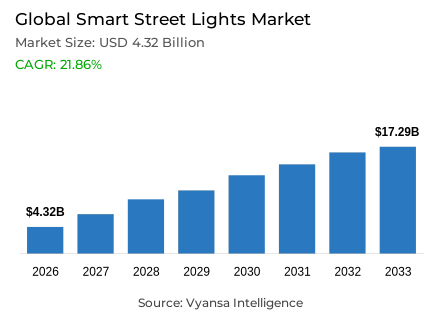
Smart street lighting is the networked form of road lighting: light-emitting diode (LED) luminaires fitted with controller nodes that report faults, dim by schedule or traffic and feed a central management system. Municipalities, road agencies, utilities and concession partners consume it across urban streets and highways. The Smart Street Lights market is forecast to grow at a compound annual growth rate (CAGR) of 21.86% between 2027 and 2033.
Key Highlights of the Smart Street Lights Market
- The market is estimated at USD 4.32 billion in 2026 and USD 5.28 billion in 2027, reaching USD 17.29 billion by 2033.
- The market is projected to expand at a CAGR of 21.86% between 2027 and 2033.
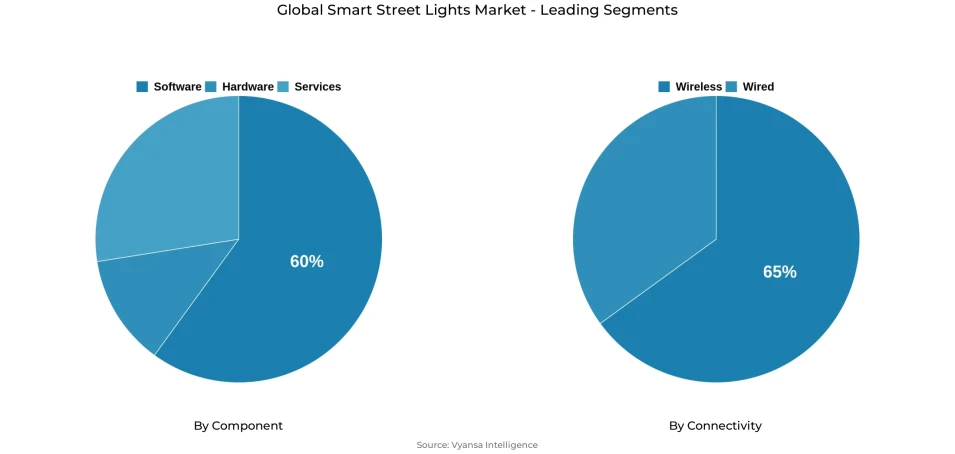
- Hardware accounts for approximately 60% of the market in 2026.
- Software is the fastest-growing component, with a projected CAGR of 23.53% during 2027–2033.
- Wireless connectivity accounts for approximately 65% of the market in 2026.
- Wired connectivity is the fastest-growing connectivity segment, with a projected CAGR of 22.06% during 2027–2033.
- Europe has the dominant share in the market with over 32% market share.
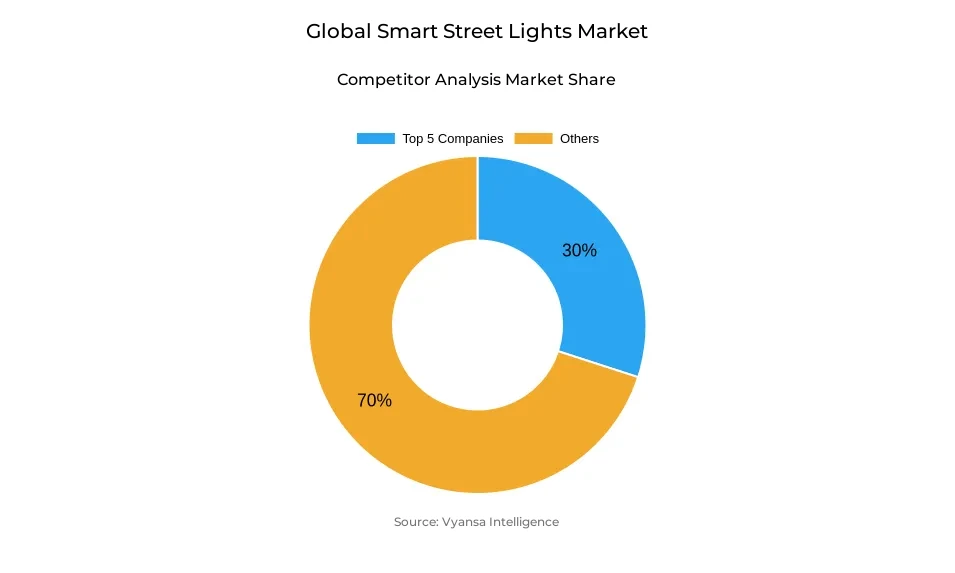
- The top five companies account for a combined market share of approximately 30% in 2026.
Globally, smart street lighting is expanding through connected-luminaire installations and the addition of controls to existing LED networks. These systems combine light-point controllers, communications, and central management software for remote dimming, energy measurement, and fault alerts. Flashnet reported more than one million smart lamps under management in March 2025. By August 2026, its inteliLIGHT platform managed more than 1.5 million connected streetlights across over 150 cities in more than 60 countries, illustrating the growing operating scale of connected lighting.
Demand also extends to managing lighting equipment after installation. Itron’s July 2025 managed-services brochure reported approximately 4.7 million streetlights under management. Such fleets require continuing device supervision, software updates, communications support, and system maintenance. Municipalities and utilities therefore purchase both the physical lighting network and the capabilities needed to keep it functioning. This creates recurring expenditure on connected-lighting operation alongside purchases for new installations and network extensions.
The product’s value increasingly depends on controlling individual light points throughout their operating life. Remote adjustment lets operators change schedules, identify failures, and maintain asset records across geographically dispersed networks without inspecting every lamp in person. Through 2033, expanding connected fleets should support additional controller installations, management-software subscriptions, and technical support. Suppliers combining compatible equipment, dependable remote operation, and local maintenance capabilities should be best positioned to capture this demand.
Smart Street Lights Market Drivers
Energy and Maintenance Savings Support Global Adoption
Reducing electricity consumption and maintenance requirements is a fundamental reason municipalities purchase smart street lighting. Efficient luminaires reduce the electricity required for illumination, while connected controllers enable dimming, operating schedules, and automatic fault alerts. Combining these functions allows buyers to assess lighting modernization against measurable operating benefits.
Projects in Spain and Germany demonstrate this purchasing mechanism. In May 2025, Burriana announced the replacement of 6,536 luminaires with LED equipment and individual remote management. The municipality projected energy savings of 43.57%, equivalent to approximately 609,721 kilowatt-hours annually. In Germany, Konstanz installed 52 connected luminaires on the Europabrücke in 2025, integrating traffic and weather sensors with adaptive controls. The supplier projected annual electricity reductions of nearly 46,000 kilowatt-hours, approximately 75% below the previous system’s consumption. These savings relate to combined lighting and control upgrades.
These projects show how lower operating requirements can support purchases of luminaires, controllers, sensors, and management software. Through 2033, suppliers that document achieved savings and demonstrate reliable fault detection should be better positioned to convert municipal efficiency targets into connected-lighting orders.
Smart Street Lights Market Challenges
Controller Obsolescence and Operating Costs Complicate Long-Term Ownership
Smart street lighting requires municipalities to maintain communications equipment, software, and technical support alongside the luminaires. When controllers become unsupported or replacement devices are incompatible, authorities can face additional engineering work and restricted supplier choice. These obligations can delay connectivity upgrades even when LED replacement remains commercially attractive.
A February 2026 procurement notice from Wales stated that existing street-lighting communication nodes had reached the end of their supported life. The manufacturer-specific protocol meant that compatible replacements could only be obtained from the original supplier; changing suppliers would require redesign, reconfiguration, and testing of the wider communications platform. In Canada, Vancouver’s June 2026 council report proposed replacing approximately 14,000 fixtures over an initial two-year contract. It identified insufficient internal installation capacity and described intelligent lighting controls as a future capability enabled by the LED conversion.
For market growth, these constraints can separate luminaire replacement from subsequent purchases of controllers and software. Through 2033, uncertain support periods, replacement compatibility, and municipal staffing capacity are likely to extend purchasing decisions and limit the speed of full connected-lighting deployment.
Smart Street Lights Market Recent Trends
Performance-Based Contracts Bundle Lighting Upgrades with Long-Term Operation
Municipal buyers are increasingly procuring lighting modernization together with continuing operation and maintenance. These arrangements combine equipment delivery with responsibilities for system availability, repairs, and operating performance. For connected-lighting suppliers, this creates demand for complete systems that can be supported throughout a multiyear contract.
In April 2026, Veolia announced an Umbrete project in Spain covering 2,368 light points, improvements to 40 control centers, and remote-management upgrades under a 15-year energy-services agreement extending to 2041. In Brazil, Joinville’s 22-year public-lighting concession covers approximately 62,000 light points and includes intelligent remote management. Payments are linked to performance, including failure rates and response times. By June 2026, the municipality reported that 14,400 light points had been modernized, demonstrating that the concession had progressed into equipment deployment.
Bundled contracts can translate modernization plans into coordinated purchases of luminaires, controls, software, installation, and continuing support. Through 2033, manufacturers working with capable infrastructure operators and local maintenance partners should gain opportunities where municipalities seek both connected equipment and dependable long-term service delivery.
Standardized Interfaces Expand the Global Market for Modular Controls
Standardized connections and software interfaces are expanding the equipment choices available for smart street-lighting projects. Compatible components allow buyers to add controllers, sensors, and management capabilities to suitable existing luminaires, increasing the addressable market for connectivity upgrades.
In October 2025, the TALQ Consortium reported 74 certified products from 47 vendors worldwide, comprising 31 central management software products and 43 gateways. This international supplier base gives municipalities more options when connecting field networks with management platforms. During 2025, the Zhaga Consortium also released Book 18 Edition 4, extending its outdoor connectivity framework to heritage and decorative luminaires. The extension makes standardized connected-lighting components relevant to a broader range of street fixtures.
These developments support retrofit demand by widening the range of compatible products and reducing dependence on a single equipment configuration. Through 2033, suppliers offering certified interfaces and clearly documented capabilities should gain access to more municipal projects, particularly where buyers intend to expand connectivity in stages.
Smart Street Lights Market Future Opportunities
Monitored Solar Lighting Expands Demand Beyond Reliable Grid Infrastructure
Remotely monitored solar streetlights create opportunities on rural roads, expanding urban corridors, and sites where grid connections are difficult or unreliable. Buyers purchase an integrated combination of solar generation, batteries, LED luminaires, controllers, and monitoring capabilities. Connectivity allows operators to supervise dispersed installations and identify maintenance requirements.
In November 2025, a Lagos legislative review reported approximately 5,000 installations against an approved first phase of 22,000 solar streetlights, alongside a further 20,000-unit smart solar project. In India, Uttar Pradesh’s renewable energy agency sought 5,000 solar street-lighting systems with remote monitoring in June 2026, including five years of operation and maintenance. These programs demonstrate demand for monitored solar lighting across African and Asian markets, although procurement pipelines and approved quantities remain distinct from completed installations.
Supplier portfolios are also developing around this requirement. In April 2026, Schreder designated Photinus as its dedicated solar competence center, building on the integration of solar lighting with EXEDRA connected management. Through 2033, suppliers combining reliable battery performance, remote diagnostics, replacement components, and local servicing should be better positioned to turn solar-lighting programs into sustained equipment and maintenance demand.
Unlock Market Intelligence
Explore the market potential with our data-driven report
Smart Street Lights Market Segmentation Analysis
By Component
- Hardware
- Software
- Services
Hardware Leads with Approximately 60% Market Share in 2026 And Software Records The Fastest Component Growth
Hardware accounts for approximately 60% of the market in 2026 because connected projects require luminaires, controllers, and supporting electrical or communications equipment before network operation begins. Tijuana’s official 2025 procurement records included a tender for 7,692 LED luminaires, illustrating the scale of public-sector lighting equipment demand. Such purchases establish the physical foundation for modernization, although connectivity depends on the final specification. Hardware suppliers benefit when buyers incorporate compatible controls interfaces and replacement flexibility into initial procurement decisions.
Software is projected to grow at a CAGR of 23.53% during 2027–2033 as connected fleets require monitoring, scheduling, reporting, and asset-management capabilities. Helsingborg’s March 2025 collaboration with Itron covered an initial 670 controllers within a city lighting network of approximately 30,000 points. Separately, the November 2025 introduction of EXEDRA Genius combined advisory support with proactive monitoring. These developments show how software and related services can deepen customer relationships as authorities expand their connected installations and operational requirements.
By Connectivity
- Wired
- Wireless
Wireless Connectivity Leads with Approximately 65% Market Share in 2026 And Wired Records the Fastest Connectivity Growth
Wireless connectivity accounts for approximately 65% of the market in 2026 because controllers can communicate without dedicated data cabling to each light point. Burriana’s May 2025 modernization announcement covered 6,536 luminaires with individual remote management and projected energy savings of approximately 43.5%. The project demonstrates the appeal of combining LED replacement with networked operation. Wireless solutions are particularly relevant to retrofits where installing additional communications cabling would complicate work across existing streets and increase the scope of installation.
Wired connectivity is projected to expand at a CAGR of 22.06% during 2027–2033, supported by retrofit demand and the availability of cellular and dedicated low-power communications options. Growth depends on selecting networks suited to coverage, ownership, and maintenance requirements rather than assuming one architecture fits every city. Suppliers that simplify activation, device management, and communications continuity can reduce deployment complexity. Wired solutions retain relevance where existing infrastructure or local operating requirements support their use within the lighting system.
Unlock Market Intelligence
Explore the market potential with our data-driven report
Smart Street Lights Market Regional Analysis
Europe Dominates the Market with 32% Market Share
Europe represents an important market with over 32% market share for connected street lighting because established public-lighting networks provide substantial opportunities for modernization and operational upgrades. In October 2026, the Flemish utility operator Fluvius reached one million public LED lights across Flanders. The milestone includes both interactive and noninteractive installations and should not be interpreted as a count of individually connected streetlights. It nevertheless demonstrates the scale of the region’s modern lighting infrastructure and the potential for further controls integration where technically appropriate.
Devon’s February 2026 lighting decision illustrates the operational value of an established connected network. The authority reported central management coverage exceeding 66,000 streetlights and more than one million kilowatt-hours in annual energy reductions associated with revised lighting arrangements. Remote control allows operating schedules to change without replacing the installed fleet. This supports regional demand for management software, technical support, and ongoing optimization alongside new equipment, particularly as municipalities seek additional benefits from networks already converted to efficient lighting.
Europe’s opportunity therefore includes both new connected installations and improvements to systems already in service. Buyers with established LED fleets can prioritize selective controller deployment, software functionality, and maintenance efficiency, while other authorities continue broader replacement programs. The regional market should support suppliers capable of working with varied legacy equipment and public procurement structures. Through 2033, the ability to upgrade installed infrastructure economically will remain central to expanding connected-lighting adoption across municipalities of different sizes.

Smart Street Lights Market Competitive Landscape
The market is fragmented, with the top five companies accounting for a combined share of approximately 30% in 2026. The top five companies in the Smart Street Lights market are Signify N.V., Itron Inc., Schreder SA, Ubicquia Inc., and Acuity Inc.
Key Companies in the Smart Street Lights Market
- Signify N.V.
- Itron Inc.
- Schreder SA
- Ubicquia Inc.
- Acuity Inc.
- Current Lighting Solutions LLC
- Lucy Group Ltd
- Singapore Technologies Engineering Ltd
- Zumtobel Group AG
- LED Roadway Lighting Ltd.
- Vectanor Group Inc.
- MinebeaMitsumi Inc.
- Trilliant Holdings Inc.
Company Profiling
Signify N.V.: Signify supplies professional lighting equipment and connected management systems for municipalities, utilities, and infrastructure operators. Its outdoor portfolio combines LED luminaires, controls, and the Interact platform to support monitoring, dimming, and maintenance coordination. In March 2026, the company introduced Interact EasyConnect as part of its updated connected-lighting offering, supporting outdoor deployment through cellular and hybrid connectivity. The development addresses implementation complexity and gives public-lighting customers additional options for connecting equipment according to local network and project requirements.
Itron Inc.: Itron provides connected infrastructure technology for utilities and cities, including networked lighting controllers and CityEdge software for public-lighting management. Its offering supports remote operation, asset visibility, and integration with wider municipal networks. In November 2025, Connected Lighting Solutions joined the Itron Engage channel partner program in Australia. The collaboration added local technical support and a simpler procurement route for Itron’s street-lighting technology, improving access for customers seeking on-site assistance during deployment and operation of connected public-lighting infrastructure.
Schreder SA: Schreder supplies outdoor luminaires and connected management technology for streets, public spaces, and transport infrastructure. Its EXEDRA platform supports lighting control and integration with complementary urban services. In June 2026, the company acquired EdgeMachines, bringing low-power urban sensing and edge-processing capabilities into its portfolio. The combination supports traffic, occupancy, parking, and environmental information through existing lighting infrastructure, extending the operational uses available to municipalities while reducing the need to establish entirely separate networks for selected urban sensing applications.
Ubicquia Inc.: Ubicquia develops connected infrastructure products that use streetlights as deployment points for lighting control and related municipal or utility applications. Its UbiCell controllers and UbiVu management platform support remote visibility and operation of lighting assets. In December 2025, the company launched UbiCell Micro within an updated intelligent-streetlighting offering, introducing a compact controller with a single modem and embedded SIM support. The product gives customers additional flexibility when deploying compatible controls across public and private cellular networks in different operating environments.
Acuity Inc.: Acuity supplies lighting equipment, controls, and related technology through brands serving roadway, municipal, commercial, and architectural applications. Its outdoor portfolio includes American Electric Lighting and Cyclone Lighting, addressing different public-space requirements. In August 2026, Cyclone introduced the Oblo luminaire with optical configurations for pedestrian comfort and roadway performance. The launch expands Acuity’s street and public-space equipment offering, giving specifiers additional flexibility in balancing visual comfort, illumination requirements, and maintenance access when selecting fixtures for urban lighting projects.
Recent Developments in the Smart Street Lights Market
- In October 2026, Delhi launched a smart street-lighting project covering approximately 96,000 lights managed by its Public Works Department, following approvals and tender activity earlier in the year. The program combines LED modernization with centralized monitoring and remote operation, addressing dependence on complaint-based fault identification. Its relevance extends beyond luminaire replacement because the operating model requires communications, system integration, and maintenance coordination. The project strengthens the public-sector pipeline for complete connected-lighting solutions in a major urban market.
- In 2026, Umbrete’s energy-services project advanced the replacement of 2,368 light points, modernization of 40 control centers, and upgrades to remote-management systems under an agreement extending to 2041. The supplier’s responsibilities combine implementation with ongoing management and maintenance. For the market, the project demonstrates how smaller municipalities can procure integrated lighting modernization through a long-term service arrangement. It creates opportunities for equipment and controls providers working with operators able to sustain local delivery and performance obligations.
- In July 2026, Punta Arenas announced a funded project to modernize 600 downtown luminaires and introduce remote-management nodes. The planned system supports monitoring and adjustment of lighting intensity, adding an operational control layer to the equipment replacement. The initiative illustrates how targeted municipal projects can generate demand for connected lighting without requiring a citywide rollout. It also creates opportunities for integrators capable of coordinating luminaires, communications, commissioning, and operator training within a defined urban project area.
Frequently Asked Questions
Related Report
- Market Segmentation
- Research Scope
- Research Methodology
- Definitions and Assumptions
- Executive Summary
- Global Smart Street Lights Market Policies, Regulations, and Standards
- Global Smart Street Lights Market Dynamics
- Growth Factors
- Challenges
- Trends
- Opportunities
- Global Smart Street Lights Market Statistics, 2023-2033F
- Market Size & Growth Outlook
- By Revenues in USD Million
- Market Segmentation & Growth Outlook
- By Component
- Hardware- Market Insights and Forecast 2023-2033, USD Million
- Software- Market Insights and Forecast 2023-2033, USD Million
- Services- Market Insights and Forecast 2023-2033, USD Million
- By Connectivity
- Wired- Market Insights and Forecast 2023-2033, USD Million
- Wireless- Market Insights and Forecast 2023-2033, USD Million
- By Installation Type
- New Installations- Market Insights and Forecast 2023-2033, USD Million
- Retrofit Installations- Market Insights and Forecast 2023-2033, USD Million
- By Power Source
- Grid-Powered- Market Insights and Forecast 2023-2033, USD Million
- Off-Grid Solar-Powered- Market Insights and Forecast 2023-2033, USD Million
- Hybrid Solar and Grid-Powered- Market Insights and Forecast 2023-2033, USD Million
- By Region
- North America
- South America
- Europe
- Middle East & Africa
- Asia Pacific
- By Competitors
- Competition Characteristics
- Market Share & Analysis
- By Component
- Market Size & Growth Outlook
- North America Smart Street Lights Market Statistics, 2023-2033F
- Market Size & Growth Outlook
- By Revenues in USD Million
- Market Segmentation & Growth Outlook
- By Component- Market Insights and Forecast 2023-2033, USD Million
- By Connectivity- Market Insights and Forecast 2023-2033, USD Million
- By Installation Type- Market Insights and Forecast 2023-2033, USD Million
- By Power Source- Market Insights and Forecast 2023-2033, USD Million
- By Country
- The US
- Canada
- The US Smart Street Lights Market Statistics, 2023-2033F
- Market Size & Growth Outlook
- By Revenues in USD Million
- Market Segmentation & Growth Outlook
- By Component- Market Insights and Forecast 2023-2033, USD Million
- By Connectivity- Market Insights and Forecast 2023-2033, USD Million
- By Installation Type- Market Insights and Forecast 2023-2033, USD Million
- By Power Source- Market Insights and Forecast 2023-2033, USD Million
- Market Size & Growth Outlook
- Canada Smart Street Lights Market Statistics, 2023-2033F
- Market Size & Growth Outlook
- By Revenues in USD Million
- Market Segmentation & Growth Outlook
- By Component- Market Insights and Forecast 2023-2033, USD Million
- By Connectivity- Market Insights and Forecast 2023-2033, USD Million
- By Installation Type- Market Insights and Forecast 2023-2033, USD Million
- By Power Source- Market Insights and Forecast 2023-2033, USD Million
- Market Size & Growth Outlook
- Mexico Smart Street Lights Market Statistics, 2023-2033F
- Market Size & Growth Outlook
- By Revenues in USD Million
- Market Segmentation & Growth Outlook
- By Component- Market Insights and Forecast 2023-2033, USD Million
- By Connectivity- Market Insights and Forecast 2023-2033, USD Million
- By Installation Type- Market Insights and Forecast 2023-2033, USD Million
- By Power Source- Market Insights and Forecast 2023-2033, USD Million
- Market Size & Growth Outlook
- Market Size & Growth Outlook
- South America Smart Street Lights Market Statistics, 2023-2033F
- Market Size & Growth Outlook
- By Revenues in USD Million
- Market Segmentation & Growth Outlook
- By Component- Market Insights and Forecast 2023-2033, USD Million
- By Connectivity- Market Insights and Forecast 2023-2033, USD Million
- By Installation Type- Market Insights and Forecast 2023-2033, USD Million
- By Power Source- Market Insights and Forecast 2023-2033, USD Million
- By Country
- Brazil
- Argentina
- Chile
- Rest of South America
- Brazil Smart Street Lights Market Statistics, 2023-2033F
- Market Size & Growth Outlook
- By Revenues in USD Million
- Market Segmentation & Growth Outlook
- By Component- Market Insights and Forecast 2023-2033, USD Million
- By Connectivity- Market Insights and Forecast 2023-2033, USD Million
- By Installation Type- Market Insights and Forecast 2023-2033, USD Million
- By Power Source- Market Insights and Forecast 2023-2033, USD Million
- Market Size & Growth Outlook
- Argentina Smart Street Lights Market Statistics, 2023-2033F
- Market Size & Growth Outlook
- By Revenues in USD Million
- Market Segmentation & Growth Outlook
- By Component- Market Insights and Forecast 2023-2033, USD Million
- By Connectivity- Market Insights and Forecast 2023-2033, USD Million
- By Installation Type- Market Insights and Forecast 2023-2033, USD Million
- By Power Source- Market Insights and Forecast 2023-2033, USD Million
- Market Size & Growth Outlook
- Chile Smart Street Lights Market Statistics, 2023-2033F
- Market Size & Growth Outlook
- By Revenues in USD Million
- Market Segmentation & Growth Outlook
- By Component- Market Insights and Forecast 2023-2033, USD Million
- By Connectivity- Market Insights and Forecast 2023-2033, USD Million
- By Installation Type- Market Insights and Forecast 2023-2033, USD Million
- By Power Source- Market Insights and Forecast 2023-2033, USD Million
- Market Size & Growth Outlook
- Market Size & Growth Outlook
- Europe Smart Street Lights Market Statistics, 2023-2033F
- Market Size & Growth Outlook
- By Revenues in USD Million
- Market Segmentation & Growth Outlook
- By Component- Market Insights and Forecast 2023-2033, USD Million
- By Connectivity- Market Insights and Forecast 2023-2033, USD Million
- By Installation Type- Market Insights and Forecast 2023-2033, USD Million
- By Power Source- Market Insights and Forecast 2023-2033, USD Million
- By Country
- Germany
- The UK
- France
- Italy
- Spain
- BENELUX
- Nordics
- Rest of Europe
- Germany Smart Street Lights Market Statistics, 2023-2033F
- Market Size & Growth Outlook
- By Revenues in USD Million
- Market Segmentation & Growth Outlook
- By Component- Market Insights and Forecast 2023-2033, USD Million
- By Connectivity- Market Insights and Forecast 2023-2033, USD Million
- By Installation Type- Market Insights and Forecast 2023-2033, USD Million
- By Power Source- Market Insights and Forecast 2023-2033, USD Million
- Market Size & Growth Outlook
- The UK Smart Street Lights Market Statistics, 2023-2033F
- Market Size & Growth Outlook
- By Revenues in USD Million
- Market Segmentation & Growth Outlook
- By Component- Market Insights and Forecast 2023-2033, USD Million
- By Connectivity- Market Insights and Forecast 2023-2033, USD Million
- By Installation Type- Market Insights and Forecast 2023-2033, USD Million
- By Power Source- Market Insights and Forecast 2023-2033, USD Million
- Market Size & Growth Outlook
- France Smart Street Lights Market Statistics, 2023-2033F
- Market Size & Growth Outlook
- By Revenues in USD Million
- Market Segmentation & Growth Outlook
- By Component- Market Insights and Forecast 2023-2033, USD Million
- By Connectivity- Market Insights and Forecast 2023-2033, USD Million
- By Installation Type- Market Insights and Forecast 2023-2033, USD Million
- By Power Source- Market Insights and Forecast 2023-2033, USD Million
- Market Size & Growth Outlook
- Italy Smart Street Lights Market Statistics, 2023-2033F
- Market Size & Growth Outlook
- By Revenues in USD Million
- Market Segmentation & Growth Outlook
- By Component- Market Insights and Forecast 2023-2033, USD Million
- By Connectivity- Market Insights and Forecast 2023-2033, USD Million
- By Installation Type- Market Insights and Forecast 2023-2033, USD Million
- By Power Source- Market Insights and Forecast 2023-2033, USD Million
- Market Size & Growth Outlook
- Spain Smart Street Lights Market Statistics, 2023-2033F
- Market Size & Growth Outlook
- By Revenues in USD Million
- Market Segmentation & Growth Outlook
- By Component- Market Insights and Forecast 2023-2033, USD Million
- By Connectivity- Market Insights and Forecast 2023-2033, USD Million
- By Installation Type- Market Insights and Forecast 2023-2033, USD Million
- By Power Source- Market Insights and Forecast 2023-2033, USD Million
- Market Size & Growth Outlook
- BENELUX Smart Street Lights Market Statistics, 2023-2033F
- Market Size & Growth Outlook
- By Revenues in USD Million
- Market Segmentation & Growth Outlook
- By Component- Market Insights and Forecast 2023-2033, USD Million
- By Connectivity- Market Insights and Forecast 2023-2033, USD Million
- By Installation Type- Market Insights and Forecast 2023-2033, USD Million
- By Power Source- Market Insights and Forecast 2023-2033, USD Million
- Market Size & Growth Outlook
- Nordics Smart Street Lights Market Statistics, 2023-2033F
- Market Size & Growth Outlook
- By Revenues in USD Million
- Market Segmentation & Growth Outlook
- By Component- Market Insights and Forecast 2023-2033, USD Million
- By Connectivity- Market Insights and Forecast 2023-2033, USD Million
- By Installation Type- Market Insights and Forecast 2023-2033, USD Million
- By Power Source- Market Insights and Forecast 2023-2033, USD Million
- Market Size & Growth Outlook
- Market Size & Growth Outlook
- Middle East & Africa Smart Street Lights Market Statistics, 2023-2033F
- Market Size & Growth Outlook
- By Revenues in USD Million
- Market Segmentation & Growth Outlook
- By Component- Market Insights and Forecast 2023-2033, USD Million
- By Connectivity- Market Insights and Forecast 2023-2033, USD Million
- By Installation Type- Market Insights and Forecast 2023-2033, USD Million
- By Power Source- Market Insights and Forecast 2023-2033, USD Million
- By Country
- UAE
- Saudi Arabia
- South Africa
- Turkey
- Rest of Middle East & Africa
- UAE Smart Street Lights Market Statistics, 2023-2033F
- Market Size & Growth Outlook
- By Revenues in USD Million
- Market Segmentation & Growth Outlook
- By Component- Market Insights and Forecast 2023-2033, USD Million
- By Connectivity- Market Insights and Forecast 2023-2033, USD Million
- By Installation Type- Market Insights and Forecast 2023-2033, USD Million
- By Power Source- Market Insights and Forecast 2023-2033, USD Million
- Market Size & Growth Outlook
- Saudi Arabia Smart Street Lights Market Statistics, 2023-2033F
- Market Size & Growth Outlook
- By Revenues in USD Million
- Market Segmentation & Growth Outlook
- By Component- Market Insights and Forecast 2023-2033, USD Million
- By Connectivity- Market Insights and Forecast 2023-2033, USD Million
- By Installation Type- Market Insights and Forecast 2023-2033, USD Million
- By Power Source- Market Insights and Forecast 2023-2033, USD Million
- Market Size & Growth Outlook
- South Africa Smart Street Lights Market Statistics, 2023-2033F
- Market Size & Growth Outlook
- By Revenues in USD Million
- Market Segmentation & Growth Outlook
- By Component- Market Insights and Forecast 2023-2033, USD Million
- By Connectivity- Market Insights and Forecast 2023-2033, USD Million
- By Installation Type- Market Insights and Forecast 2023-2033, USD Million
- By Power Source- Market Insights and Forecast 2023-2033, USD Million
- Market Size & Growth Outlook
- Turkey Smart Street Lights Market Statistics, 2023-2033F
- Market Size & Growth Outlook
- By Revenues in USD Million
- Market Segmentation & Growth Outlook
- By Component- Market Insights and Forecast 2023-2033, USD Million
- By Connectivity- Market Insights and Forecast 2023-2033, USD Million
- By Installation Type- Market Insights and Forecast 2023-2033, USD Million
- By Power Source- Market Insights and Forecast 2023-2033, USD Million
- Market Size & Growth Outlook
- Market Size & Growth Outlook
- Asia Pacific Smart Street Lights Market Statistics, 2023-2033F
- Market Size & Growth Outlook
- By Revenues in USD Million
- Market Segmentation & Growth Outlook
- By Component- Market Insights and Forecast 2023-2033, USD Million
- By Connectivity- Market Insights and Forecast 2023-2033, USD Million
- By Installation Type- Market Insights and Forecast 2023-2033, USD Million
- By Power Source- Market Insights and Forecast 2023-2033, USD Million
- By Country
- China
- India
- Japan
- South Korea
- Australia
- Southeast Asia
- Rest of Asia Pacific
- China Smart Street Lights Market Statistics, 2023-2033F
- Market Size & Growth Outlook
- By Revenues in USD Million
- Market Segmentation & Growth Outlook
- By Component- Market Insights and Forecast 2023-2033, USD Million
- By Connectivity- Market Insights and Forecast 2023-2033, USD Million
- By Installation Type- Market Insights and Forecast 2023-2033, USD Million
- By Power Source- Market Insights and Forecast 2023-2033, USD Million
- Market Size & Growth Outlook
- India Smart Street Lights Market Statistics, 2023-2033F
- Market Size & Growth Outlook
- By Revenues in USD Million
- Market Segmentation & Growth Outlook
- By Component- Market Insights and Forecast 2023-2033, USD Million
- By Connectivity- Market Insights and Forecast 2023-2033, USD Million
- By Installation Type- Market Insights and Forecast 2023-2033, USD Million
- By Power Source- Market Insights and Forecast 2023-2033, USD Million
- Market Size & Growth Outlook
- Japan Smart Street Lights Market Statistics, 2023-2033F
- Market Size & Growth Outlook
- By Revenues in USD Million
- Market Segmentation & Growth Outlook
- By Component- Market Insights and Forecast 2023-2033, USD Million
- By Connectivity- Market Insights and Forecast 2023-2033, USD Million
- By Installation Type- Market Insights and Forecast 2023-2033, USD Million
- By Power Source- Market Insights and Forecast 2023-2033, USD Million
- Market Size & Growth Outlook
- South Korea Smart Street Lights Market Statistics, 2023-2033F
- Market Size & Growth Outlook
- By Revenues in USD Million
- Market Segmentation & Growth Outlook
- By Component- Market Insights and Forecast 2023-2033, USD Million
- By Connectivity- Market Insights and Forecast 2023-2033, USD Million
- By Installation Type- Market Insights and Forecast 2023-2033, USD Million
- By Power Source- Market Insights and Forecast 2023-2033, USD Million
- Market Size & Growth Outlook
- Australia Smart Street Lights Market Statistics, 2023-2033F
- Market Size & Growth Outlook
- By Revenues in USD Million
- Market Segmentation & Growth Outlook
- By Component- Market Insights and Forecast 2023-2033, USD Million
- By Connectivity- Market Insights and Forecast 2023-2033, USD Million
- By Installation Type- Market Insights and Forecast 2023-2033, USD Million
- By Power Source- Market Insights and Forecast 2023-2033, USD Million
- Market Size & Growth Outlook
- Southeast Asia Smart Street Lights Market Statistics, 2023-2033F
- Market Size & Growth Outlook
- By Revenues in USD Million
- Market Segmentation & Growth Outlook
- By Component- Market Insights and Forecast 2023-2033, USD Million
- By Connectivity- Market Insights and Forecast 2023-2033, USD Million
- By Installation Type- Market Insights and Forecast 2023-2033, USD Million
- By Power Source- Market Insights and Forecast 2023-2033, USD Million
- Market Size & Growth Outlook
- Market Size & Growth Outlook
- Competitive Outlook
- Company Profiles
- Signify N.V.
- Business Description
- Product Portfolio
- Collaborations & Alliances
- Recent Developments
- Financial Details
- Others
- Itron, Inc.
- Business Description
- Product Portfolio
- Collaborations & Alliances
- Recent Developments
- Financial Details
- Others
- Schréder SA
- Business Description
- Product Portfolio
- Collaborations & Alliances
- Recent Developments
- Financial Details
- Others
- Ubicquia, Inc.
- Business Description
- Product Portfolio
- Collaborations & Alliances
- Recent Developments
- Financial Details
- Others
- Acuity Inc.
- Business Description
- Product Portfolio
- Collaborations & Alliances
- Recent Developments
- Financial Details
- Others
- Current Lighting Solutions, LLC (Current)
- Business Description
- Product Portfolio
- Collaborations & Alliances
- Recent Developments
- Financial Details
- Others
- Lucy Group Ltd
- Business Description
- Product Portfolio
- Collaborations & Alliances
- Recent Developments
- Financial Details
- Others
- Singapore Technologies Engineering Ltd
- Business Description
- Product Portfolio
- Collaborations & Alliances
- Recent Developments
- Financial Details
- Others
- Zumtobel Group AG (Thorn)
- Business Description
- Product Portfolio
- Collaborations & Alliances
- Recent Developments
- Financial Details
- Others
- LED Roadway Lighting Ltd. (Liveable Cities)
- Business Description
- Product Portfolio
- Collaborations & Alliances
- Recent Developments
- Financial Details
- Others
- Vectanor Group Inc. (Dimonoff)
- Business Description
- Product Portfolio
- Collaborations & Alliances
- Recent Developments
- Financial Details
- Others
- MinebeaMitsumi Inc. (Paradox Engineering)
- Business Description
- Product Portfolio
- Collaborations & Alliances
- Recent Developments
- Financial Details
- Others
- Trilliant Holdings Inc.
- Business Description
- Product Portfolio
- Collaborations & Alliances
- Recent Developments
- Financial Details
- Others
- Telensa Limited
- Business Description
- Product Portfolio
- Collaborations & Alliances
- Recent Developments
- Financial Details
- Others
- FLASHNET S.A. (inteliLIGHT)
- Business Description
- Product Portfolio
- Collaborations & Alliances
- Recent Developments
- Financial Details
- Others
- Signify N.V.
- Company Profiles
- Disclaimer
| Segment | Sub-Segment |
|---|---|
| By Component |
|
| By Connectivity |
|
| By Installation Type |
|
| By Power Source |
|
| By Region |
|
Research Methodology
This study followed a structured approach comprising four key phases to assess the size and scope of the electro-oxidation market. The process began with thorough secondary research to collect data on the target market, related markets, and broader industry context. These findings, along with preliminary assumptions and estimates, were then validated through extensive primary research involving industry experts from across the value chain. To calculate the overall market size, both top-down and bottom-up methodologies were employed. Finally, market segmentation and data triangulation techniques were applied to refine and validate segment-level estimations.
Secondary Research
The secondary research phase involved gathering data from a wide range of credible and published sources. This step helped in identifying industry trends, defining market segmentation, and understanding the market landscape and value chain.
Sources consulted during this phase included:
- Company annual reports, investor presentations, and press releases
- Industry white papers and certified publications
- Trade directories and market-recognized databases
- Articles from authoritative authors and reputable journals
- Gold and silver standard websites
Secondary research was critical in mapping out the industry's value chain and monetary flow, identifying key market segments, understanding regional variations, and tracking significant industry developments.
Other key sources:
- Financial disclosures
- Industry associations and trade bodies
- News outlets and business magazines
- Academic journals and research studies
- Paid industry databases
Primary Research
To validate secondary data and gain deeper market insights, primary research was conducted with key stakeholders across both the supply and demand sides of the market.
On the demand side, participants included decision-makers and influencers from end-user industries—such as CIOs, CTOs, and CSOs—who provided first-hand perspectives on market needs, product usage, and future expectations.
On the supply side, interviews were conducted with manufacturers, industry associations, and institutional participants to gather insights into current offerings, product pipelines, and market challenges.
Primary interviews provided critical inputs such as:
- Market size and revenue data
- Product and service breakdowns
- Market forecasts
- Regional and application-specific trends
Stakeholders consulted included:
- Leading OEM and solution providers
- Channel and distribution partners
- End users across various applications
- Independent consultants and industry specialists
Market Size Estimation and Data Triangulation
- Identifying Key Market Participants (Secondary Research)
- Goal: To identify the major players or companies in the target market. This typically involves using publicly available data sources such as industry reports, market research publications, and financial statements of companies.
- Tools: Reports from firms like Gartner, Forrester, Euromonitor, Statista, IBISWorld, and others. Public financial statements, news articles, and press releases from top market players.
- Extracting Earnings of Key Market Participants
- Goal: To estimate the earnings generated from the product or service being analyzed. This step helps in understanding the revenue potential of each market player in a specific geography.
- Methods: Earnings data can be gathered from:
- Publicly available financial reports (for listed companies).
- Interviews and primary data sources from professionals, such as Directors, VPs, SVPs, etc. This is especially useful for understanding more nuanced, internal data that isn't publicly disclosed.
- Annual reports and investor presentations of key players.
- Data Collation and Development of a Relevant Data Model
- Goal: To collate inputs from both primary and secondary sources into a structured, data-driven model for market estimation. This model will incorporate key market KPIs and any independent variables relevant to the market.
- Key KPIs: These could include:
- Market size, growth rate, and demand drivers.
- Industry-specific metrics like market share, average revenue per customer (ARPC), or average deal size.
- External variables, such as economic growth rates, inflation rates, or commodity prices, that could affect the market.
- Data Modeling: Based on this data, the market forecasts are developed for the next 5 years. A combination of trend analysis, scenario modeling, and statistical regression might be used to generate projections.
- Scenario Analysis
- Goal: To test different assumptions and validate how sensitive the market is to changes in key variables (e.g., market demand, regulatory changes, technological disruptions).
- Types of Scenarios:
- Base Case: Based on current assumptions and historical data.
- Best-Case Scenario: Assuming favorable market conditions, regulatory environments, and technological advancements.
- Worst-Case Scenario: Accounting for adverse factors, such as economic downturns, stricter regulations, or unexpected disruptions.