Philippines Almond Milk Market Report: Trends, Growth and Forecast (2026-2032)
By Product (Sweetened, Unsweetened), By Flavour (Flavoured, Unflavoured), By Nature (Conventional, Organic), By Storage Format (Refrigerated Almond Milk, Shelf-Stable Almond Milk), By Packaging Type (Cartons, Bottles, Flexible Packaging, Others), By End Use (Household, Foodservice, Food & Beverage Manufacturing), By Distribution Channel (Supermarkets & Grocery Stores, Mass Merchandisers & Warehouse Clubs, Specialty Stores, Convenience Stores, Online Retail, Direct/B2B), By Region (Luzon, Visayas, Mindanao) ... Read more
|
Major Players
|
Philippines Almond Milk Market Overview
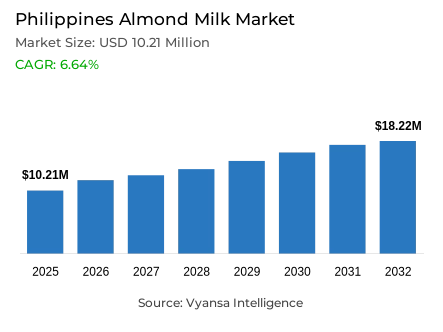
Almond milk is a plant-based dairy alternative made by blending ground almonds with water, sold in the Philippines chiefly as a shelf-stable, single-serve or multi-serve carton beverage. Filipino end users consume it as a direct drink, a coffee whitener, and a cereal or baking substitute, driven by lactose-intolerant households, flexitarian consumers, and the foodservice and cafe channel seeking barista-grade dairy alternatives. The Philippines almond milk market is forecast to grow at a CAGR of 6.64% between 2026 and 2032.
Key Highlights of the Philippines Almond Milk Market
- The Philippines almond milk market was valued at USD 10.21 million in 2025, is estimated at USD 12.39 million in 2026, and is projected to reach USD 18.22 million by 2032.
- The market is forecast to expand at a CAGR of 6.64% between 2026 and 2032.
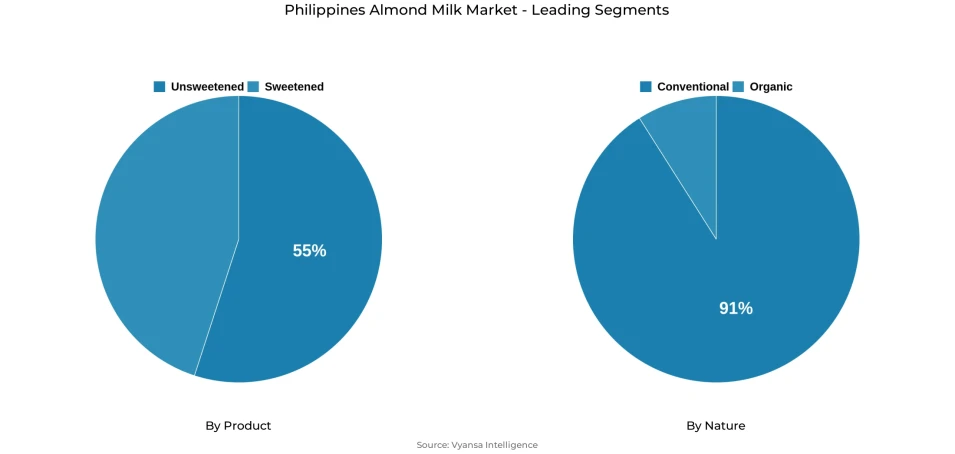
- By product, Unsweetened almond milk led the market with a 55% share in 2026.
- Additionally, by product, sweetened is the fastest-growing sub-category, expanding at a CAGR of 7.8% between 2026 and 2032.
- By nature, conventional formulations held a 91% share of the market in 2026.
- By nature, organic is the fastest-growing sub-category, expanding at a CAGR of 13.38% between 2026 and 2032.
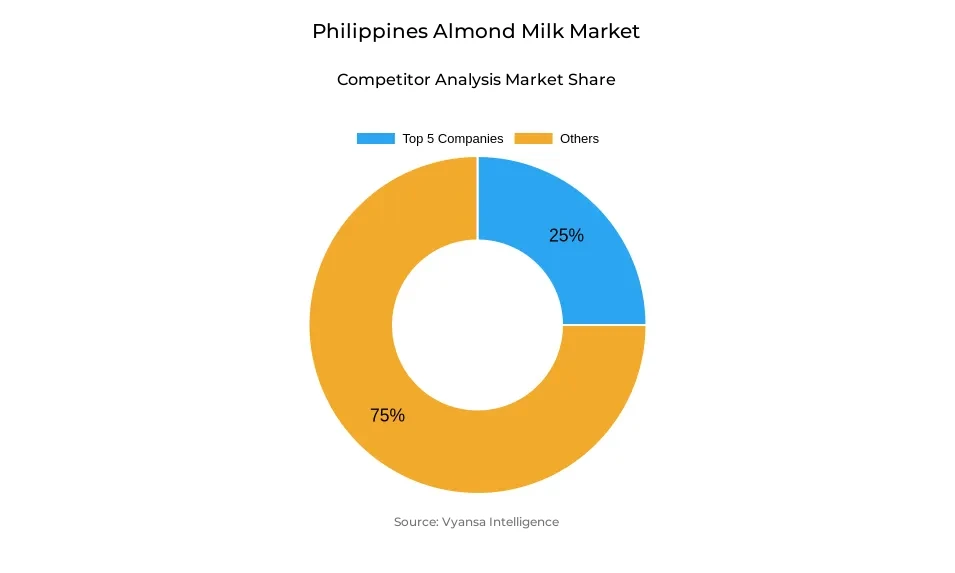
- The market structure is fragmented, with the top five companies holding a combined 25% share as of 2026.
The Philippines almond milk market is gaining momentum as demographic expansion, urbanization, changing dietary preferences, and rising health awareness broaden the consumer base for plant-based dairy alternatives. The country had 112.73 million people in 2024, with 66.7% (74.95 million) in the working-age 15–64 demographic, creating a sizeable consumer pool with purchasing power and exposure to modern food and beverage trends. Moreover, 55.2% of the population, equivalent to 62.22 million people, lived in urban barangays, particularly supporting demand in Metro Manila, Cebu, and other metropolitan centers where supermarkets, cafés, and online channels provide greater access to premium dairy alternatives.
Lactose intolerance represents another structural demand driver. Philippine nutrition authorities note that lactose intolerance is very common among Filipinos, while earlier local studies found evidence of lactase deficiency in 50% of 200 Filipino children tested, strengthening the addressable market for lactose-free alternatives such as almond milk. Meanwhile, plant-based consumption is moving beyond niche vegan communities: a 2021 Rakuten survey found 77% of Filipino consumers had tried plant-based milk, with health cited as the leading motivation by 56%, followed by animal welfare (41%) and environmental concerns (28%).
This momentum is reinforced by expanding café culture and product availability. Additionally, foodservice partnerships, particularly cafés and specialist coffee shops, as an important route for building awareness of almond and other plant-based milks, while growing interest in healthier and sustainable diets is expected to support continued category expansion.
Philippines Almond Milk Market Drivers
Structural Lactose Intolerance Among Filipinos
Structural lactose intolerance provides a durable underlying demand base for almond milk in the Philippines. The National Nutrition Council of the Republic of the Philippines stated in May 2025 that most Filipinos are genetically lactose intolerant, increasing the relevance of dairy-free beverages for consumers who experience difficulty digesting conventional milk. This gives almond milk a functional role in recurring consumption occasions such as breakfast, coffee and other everyday beverages, rather than limiting demand to consumers purchasing plant-based products primarily for lifestyle reasons.
Supplier activity supports the view that this demand is sufficiently established to justify continued portfolio investment. In its FY2024/25 results released on June 24 2025, Vitasoy international holdings reported continued investment across its almond, oat and soy beverage portfolio in both single-serve and multi-serve formats. Through the forecast period, the large lactose-intolerant consumer base should continue to support repeat purchasing and wider use of almond milk across households and foodservice, particularly as cafés and beverage operators make plant-based milk options more routinely available.
Philippines Almond Milk Market Challenges
Documented Affordability Barrier Facing Plant-Based Products
The single biggest constraint on almond milk consumption in the Philippines is cost, and it is structural rather than temporary. Almost the entire branded almond milk supply on Philippine shelves is either wholly imported or, for the one locally assembled line, dependent on imported almond raw material. That import dependence carries through to shelf pricing, which across the brands observed runs at roughly USD 1.92 to USD 4.55 per litre equivalent pack, a level that sits structurally above both conventional dairy milk and the category's nearest plant based substitute. The companies carrying this cost are the importers and distributors themselves, who absorb currency and freight exposure before a single carton reaches a shelf.
Peer reviewed consumer research finds that plant-based alternatives generally carry a higher cost per gram of protein than animal-based equivalents locally, a concrete, income linked barrier to broader adoption. The same research finds that monthly household income is significantly associated with plant-based dietary patterns, meaning affordability, not awareness, is the binding constraint on who can sustain the purchase. The commercial effect is a narrower addressable base: companies pricing almond milk as an everyday dairy replacement are, in practice, selling into a premium, income-gated segment of the market.
Companies are responding less by cutting the price on almond milk itself, which its import dependence makes difficult, and more by widening format and flavour variety to justify the premium, while a portion of price-sensitive demand shifts toward the lower-priced oat milk tier of the plant-based category instead. That redirection concentrates near-term almond milk consumption toward higher-income, urban end users, while leaving a longer-term opening for any company able to localize production or otherwise break the import cost structure.
Philippines Almond Milk Market Recent Trends
Flavour and Format Line Extension Beyond Plain and Unsweetened
Philippine almond milk brands are widening their shelf presence beyond the plain and unsweetened formats that anchor the category, adding flavoured variants that previously had no local equivalent. Where the assortment was once limited to original and unsweetened cartons aimed at direct dairy substitution, brands are now stocking matcha and vanilla variants alongside the core range, a shift that replaces a narrow, functional shelf set with a broader, occasion-led one closer to how flavored dairy milk is merchandised.
Blue Diamond Growers' Almond Breeze range carries vanilla and matcha variants in Philippine retail listings alongside its original range. Vitasoy-URC Inc. has mirrored the move with a Milky Almond Matcha variant promoted across its official Philippine social channels. Both moves show companies using flavour as the primary lever to widen almond milk's appeal beyond the lactose-intolerant core base and toward occasional, flavour-motivated buyers.
Through the forecast period, this flavour and format extension should lift per-capita consumption frequency among existing buyers more than it draws in entirely new end users, since flavored variants tend to be purchased as an addition to, rather than a replacement for, an unsweetened staple carton. Companies that hold the widest flavour range are best placed to capture repeat purchase across multiple consumption occasions rather than a single daily-replacement use case.
AI-Driven Retail Personalization and Demand Forecasting
Because almond milk sold in the Philippines is almost entirely imported, distributors carry meaningful inventory and currency risk on every shipment, and mismatched stock between fast and slow-moving variants is a direct margin problem rather than a shelf inconvenience. Retail personalization and demand forecasting tools address this by using consumer purchase data to predict which pack sizes, flavours, and locations will move, allowing distributors to plan imported container volumes against actual, rather than assumed, local demand.
The department of science and technology, through its Philippine council for industry, energy and emerging technology research and development, inaugurated the as project ARTIC, at Saint Mary's university in Bayombong on October 9, 2025, establishing a dedicated research hub for artificial intelligence, robotics and intelligent computing applications inside Philippine food processing and post-harvest handling, with named industry partners including Bayombong public market and café Gumorning. The centre is a general food-industry capability rather than an almond milk-specific deployment, and no company operating in this market has yet disclosed a measurable throughput, forecasting accuracy, or inventory gain tied to its use.
Adoption inside the almond milk category itself remains early: applying these tools requires a distributor to hold structured, SKU-level sales data across its retail and e-grocery accounts before a forecasting model has anything useful to learn from. Companies that build this data discipline first stand to differentiate on shelf availability and freshness dating relative to distributors still ordering imported stock on a fixed, calendar-based cycle.
Philippines Almond Milk Market Future Opportunities
Affordable Nutritionally Fortified Almond Milk
Philippine almond milk on shelf today is nutritionally thin relative to the dairy milk it aims to replace, and no brand in the market has yet closed that gap with a fortified, value-priced option built specifically for it. Because the category's growth base is health-motivated rather than purely lifestyle-driven, this is a real gap rather than a cosmetic one: a lactose intolerant buyer choosing almond milk as a genuine dairy substitute is, on current formulations, accepting a meaningfully lower protein and calcium intake in the swap, which the category has not addressed at accessible price points.
A 2025 peer reviewed nutritional profile of plant based milk alternatives sold in Metro Manila found that nut-based milk, the category that includes almond, averaged only 0.50 grams of protein per 100 milliliters against 3.35 grams for dairy milk, alongside materially lower calcium unless fortified. The same body of Philippine research finds affordability itself, not just awareness, is the binding constraint on adoption, meaning a fortified product priced above the existing range would only narrow, not close, the gap it is meant to solve.
Capturing this opening takes a company willing to reformulate with added protein and calcium sources without pushing shelf price materially above the existing plain unsweetened tier, since the target buyer is the same cost sensitive, health motivated household the affordability barrier already constrains. A locally assembling operator, such as the market's existing joint venture manufacturing line, carries a structural cost advantage over a pure importer in absorbing that reformulation without a proportional price increase, and stands to capture share from health-conscious buyers currently unconvinced that almond milk matches dairy on nutrition.
Unlock Market Intelligence
Explore the market potential with our data-driven report
Philippines Almond Milk Market Segmentation Analysis
By Type:
- Sweetened
- Unsweetened
Unsweetened Holds Approximately 55% of Product Demand While Sweetened is the Fastest-Growing
Unsweetened almond milk leads the Philippines product segment as health-conscious consumers increasingly seek plant-based beverages with lower sugar content and greater suitability for everyday consumption. Its positioning as a dairy alternative supports use in coffee, cereal, smoothies and cooking, while expanding digital grocery access is improving product availability beyond traditional retail. In March 2024, Glico Philippines Inc.'s Almond Koka Unsweetened Almond Milk 1L was listed on foodpanda's pandamart platform, supporting greater convenience and household accessibility for the unsweetened category.
Sweetened almond milk is expected to expand faster as the category reaches consumers who prioritize taste and familiarity alongside interest in plant-based beverages. Its milder sweetness can make almond milk more approachable for first-time users and support direct consumption, breakfast occasions, and beverage applications. The Philippines' expanding modern retail and digital grocery ecosystem is also improving consumer access to differentiated almond milk products. This combination of broader consumer adoption and greater taste familiarity is expected to support sweetened almond milk at approximately a 7.8% CAGR during 2026 to 2032, making it the fastest-growing product segment.
By Nature:
- Conventional
- Organic
Conventional Formulations Account for 91% of Nature-Based Demand, While Organic Is the Fastest-Growing Segment
By nature, the Philippines almond milk market is segmented into conventional and organic. Conventional formulations lead with a 91% share in 2026, primarily because they offer a more commercially accessible price point in a market where almond milk already carries a premium over conventional dairy and other plant-based alternatives. Avoiding the additional sourcing and certification costs associated with organic ingredients allows suppliers to keep products within reach of price-sensitive consumers and support broader supermarket and e-grocery distribution. This dominance is reflected in the availability of Vitasoy-URC Inc.'s Vitasoy Plus Milky Almond Milk Drink 1L on foodpanda's pandamart platform during 2025–2026, strengthening access to conventionally formulated almond milk through a major digital grocery channel. Conventional products are therefore expected to retain their dominant position through the forecast period as affordability and mass-market availability remain central purchasing considerations.
Organic is the fastest-growing sub-category, expanding at a CAGR of 13.38% between 2026 and 2032, although from a comparatively small base. Growth is being supported by higher-income, ingredient-conscious urban consumers who increasingly use organic certification as a signal of sourcing quality and cleaner product positioning and are more willing to absorb the associated price premium. Supplier portfolios are beginning to provide a foundation for this demand: Califia Farms offers USDA Certified Organic Unsweetened Almond milk, while S & L Fine Foods Inc. serves as the brand's distributor in the Philippines. Although a dated Philippines-specific launch or retail listing for this particular organic SKU has not been identified, the distributor relationship and Califia Farms' certified organic portfolio indicate a viable route for expanding organic almond milk availability as premium demand develops.
Unlock Market Intelligence
Explore the market potential with our data-driven report
Philippines Almond Milk Market Competitive Landscape
The Philippines almond milk market is fragmented. The top five companies, Vitasoy International Holdings Limited, Blue Diamond Growers, Sanitarium Health Food Company, Glico Philippines Inc., and S & L Fine Foods Inc., held a combined 25% share of the market as of 2026.
Key Companies in the Philippines Almond Milk Market
- Vitasoy-URC Inc.
- Goodway International Trading Corporation
- Glico Philippines Inc.
- Nature's Harvest Corporation
- Rockport Patterson Market Supply Inc.
- S & L Fine Foods Inc.
- Federated Distributors Inc.
- Nextrade Philippines Inc.
- McAsia Foodtrade Corporation
- GNP TRADING CORPORATION
Recent Developments in the Philippines Almond Milk Market
- July-August 2025: Oatside reduced suggested retail prices in the Philippines by up to 25%, taking its 1-liter Barista Blend to approximately USD 1.95 and its 200-milliliter Original to approximately USD 0.47. The move increased price pressure on almond milk brands by widening the affordability gap with oat milk and strengthening the need for differentiation through formulation, flavor and nutrition positioning.
Frequently Asked Questions
Related Report
- Market Segmentation
- Research Scope
- Research Methodology
- Definitions and Assumptions
- Executive Summary
- Philippines Almond Milk Market Policies, Regulations, and Standards
- Philippines Almond Milk Market Dynamics
- Growth Factors
- Challenges
- Trends
- Opportunities
- Philippines Almond Milk Market Statistics, 2022-2032F
- Market Size & Growth Outlook
- By Revenues in USD Million
- Market Segmentation & Growth Outlook
- By Product
- Sweetened- Market Insights and Forecast 2022-2032, USD Million
- Unsweetened- Market Insights and Forecast 2022-2032, USD Million
- By Flavour
- Flavoured- Market Insights and Forecast 2022-2032, USD Million
- Unflavoured- Market Insights and Forecast 2022-2032, USD Million
- By Nature
- Conventional- Market Insights and Forecast 2022-2032, USD Million
- Organic- Market Insights and Forecast 2022-2032, USD Million
- By Storage Format
- Refrigerated Almond Milk- Market Insights and Forecast 2022-2032, USD Million
- Shelf-Stable Almond Milk- Market Insights and Forecast 2022-2032, USD Million
- By Packaging Type
- Cartons- Market Insights and Forecast 2022-2032, USD Million
- Bottles- Market Insights and Forecast 2022-2032, USD Million
- Flexible Packaging- Market Insights and Forecast 2022-2032, USD Million
- Others- Market Insights and Forecast 2022-2032, USD Million
- By End Use
- Household- Market Insights and Forecast 2022-2032, USD Million
- Foodservice- Market Insights and Forecast 2022-2032, USD Million
- Food & Beverage Manufacturing- Market Insights and Forecast 2022-2032, USD Million
- By Distribution Channel
- Supermarkets & Grocery Stores- Market Insights and Forecast 2022-2032, USD Million
- Mass Merchandisers & Warehouse Clubs- Market Insights and Forecast 2022-2032, USD Million
- Specialty Stores- Market Insights and Forecast 2022-2032, USD Million
- Convenience Stores- Market Insights and Forecast 2022-2032, USD Million
- Online Retail- Market Insights and Forecast 2022-2032, USD Million
- Direct/B2B- Market Insights and Forecast 2022-2032, USD Million
- By Region
- Luzon- Market Insights and Forecast 2022-2032, USD Million
- Visayas- Market Insights and Forecast 2022-2032, USD Million
- Mindanao- Market Insights and Forecast 2022-2032, USD Million
- By Competitors
- Competition Characteristics
- Market Share & Analysis
- By Product
- Market Size & Growth Outlook
- Philippines Sweetened Almond Milk Market Statistics, 2022-2032
- Market Size & Growth Outlook
- By Revenues in USD Million
- Market Segmentation & Growth Outlook
- By Nature- Market Insights and Forecast 2022-2032, USD Million
- By Storage Format- Market Insights and Forecast 2022-2032, USD Million
- By Packaging Type- Market Insights and Forecast 2022-2032, USD Million
- By End Use- Market Insights and Forecast 2022-2032, USD Million
- By Distribution Channel- Market Insights and Forecast 2022-2032, USD Million
- By Region- Market Insights and Forecast 2022-2032, USD Million
- Market Size & Growth Outlook
- Philippines Unsweetened Almond Milk Market Statistics, 2022-2032
- Market Size & Growth Outlook
- By Revenues in USD Million
- Market Segmentation & Growth Outlook
- By Nature- Market Insights and Forecast 2022-2032, USD Million
- By Storage Format- Market Insights and Forecast 2022-2032, USD Million
- By Packaging Type- Market Insights and Forecast 2022-2032, USD Million
- By End Use- Market Insights and Forecast 2022-2032, USD Million
- By Distribution Channel- Market Insights and Forecast 2022-2032, USD Million
- By Region- Market Insights and Forecast 2022-2032, USD Million
- Market Size & Growth Outlook
- Competitive Outlook
- Company Profiles
- Vitasoy-URC, Inc. (Vitasoy)
- Business Description
- Product Portfolio
- Collaborations & Alliances
- Recent Developments
- Financial Details
- Others
- Goodway International Trading Corporation (Almond Breeze)
- Business Description
- Product Portfolio
- Collaborations & Alliances
- Recent Developments
- Financial Details
- Others
- Glico Philippines, Inc. (Glico Almond Koka)
- Business Description
- Product Portfolio
- Collaborations & Alliances
- Recent Developments
- Financial Details
- Others
- Nature's Harvest Corporation (So Good)
- Business Description
- Product Portfolio
- Collaborations & Alliances
- Recent Developments
- Financial Details
- Others
- Rockport Patterson Market Supply, Inc.
- Business Description
- Product Portfolio
- Collaborations & Alliances
- Recent Developments
- Financial Details
- Others
- S & L Fine Foods, Inc. (Califia Farms)
- Business Description
- Product Portfolio
- Collaborations & Alliances
- Recent Developments
- Financial Details
- Others
- Federated Distributors, Inc. (Australia's Own)
- Business Description
- Product Portfolio
- Collaborations & Alliances
- Recent Developments
- Financial Details
- Others
- Nextrade Philippines, Inc. (PureHarvest)
- Business Description
- Product Portfolio
- Collaborations & Alliances
- Recent Developments
- Financial Details
- Others
- McAsia Foodtrade Corporation (Bonsoy)
- Business Description
- Product Portfolio
- Collaborations & Alliances
- Recent Developments
- Financial Details
- Others
- GNP TRADING CORPORATION (Coles)
- Business Description
- Product Portfolio
- Collaborations & Alliances
- Recent Developments
- Financial Details
- Others
- Vitasoy-URC, Inc. (Vitasoy)
- Company Profiles
- Disclaimer
| Segment | Sub-Segment |
|---|---|
| By Product |
|
| By Flavour |
|
| By Nature |
|
| By Storage Format |
|
| By Packaging Type |
|
| By End Use |
|
| By Distribution Channel |
|
| By Region |
|
Research Methodology
This study followed a structured approach comprising four key phases to assess the size and scope of the electro-oxidation market. The process began with thorough secondary research to collect data on the target market, related markets, and broader industry context. These findings, along with preliminary assumptions and estimates, were then validated through extensive primary research involving industry experts from across the value chain. To calculate the overall market size, both top-down and bottom-up methodologies were employed. Finally, market segmentation and data triangulation techniques were applied to refine and validate segment-level estimations.
Secondary Research
The secondary research phase involved gathering data from a wide range of credible and published sources. This step helped in identifying industry trends, defining market segmentation, and understanding the market landscape and value chain.
Sources consulted during this phase included:
- Company annual reports, investor presentations, and press releases
- Industry white papers and certified publications
- Trade directories and market-recognized databases
- Articles from authoritative authors and reputable journals
- Gold and silver standard websites
Secondary research was critical in mapping out the industry's value chain and monetary flow, identifying key market segments, understanding regional variations, and tracking significant industry developments.
Other key sources:
- Financial disclosures
- Industry associations and trade bodies
- News outlets and business magazines
- Academic journals and research studies
- Paid industry databases
Primary Research
To validate secondary data and gain deeper market insights, primary research was conducted with key stakeholders across both the supply and demand sides of the market.
On the demand side, participants included decision-makers and influencers from end-user industries—such as CIOs, CTOs, and CSOs—who provided first-hand perspectives on market needs, product usage, and future expectations.
On the supply side, interviews were conducted with manufacturers, industry associations, and institutional participants to gather insights into current offerings, product pipelines, and market challenges.
Primary interviews provided critical inputs such as:
- Market size and revenue data
- Product and service breakdowns
- Market forecasts
- Regional and application-specific trends
Stakeholders consulted included:
- Leading OEM and solution providers
- Channel and distribution partners
- End users across various applications
- Independent consultants and industry specialists
Market Size Estimation and Data Triangulation
- Identifying Key Market Participants (Secondary Research)
- Goal: To identify the major players or companies in the target market. This typically involves using publicly available data sources such as industry reports, market research publications, and financial statements of companies.
- Tools: Reports from firms like Gartner, Forrester, Euromonitor, Statista, IBISWorld, and others. Public financial statements, news articles, and press releases from top market players.
- Extracting Earnings of Key Market Participants
- Goal: To estimate the earnings generated from the product or service being analyzed. This step helps in understanding the revenue potential of each market player in a specific geography.
- Methods: Earnings data can be gathered from:
- Publicly available financial reports (for listed companies).
- Interviews and primary data sources from professionals, such as Directors, VPs, SVPs, etc. This is especially useful for understanding more nuanced, internal data that isn't publicly disclosed.
- Annual reports and investor presentations of key players.
- Data Collation and Development of a Relevant Data Model
- Goal: To collate inputs from both primary and secondary sources into a structured, data-driven model for market estimation. This model will incorporate key market KPIs and any independent variables relevant to the market.
- Key KPIs: These could include:
- Market size, growth rate, and demand drivers.
- Industry-specific metrics like market share, average revenue per customer (ARPC), or average deal size.
- External variables, such as economic growth rates, inflation rates, or commodity prices, that could affect the market.
- Data Modeling: Based on this data, the market forecasts are developed for the next 5 years. A combination of trend analysis, scenario modeling, and statistical regression might be used to generate projections.
- Scenario Analysis
- Goal: To test different assumptions and validate how sensitive the market is to changes in key variables (e.g., market demand, regulatory changes, technological disruptions).
- Types of Scenarios:
- Base Case: Based on current assumptions and historical data.
- Best-Case Scenario: Assuming favorable market conditions, regulatory environments, and technological advancements.
- Worst-Case Scenario: Accounting for adverse factors, such as economic downturns, stricter regulations, or unexpected disruptions.












