US Almond Milk Market Report: Trends, Growth and Forecast (2026-2032)
By Product (Sweetened, Unsweetened), By Flavour (Flavoured, Unflavoured), By Nature (Conventional, Organic), By Storage Format (Refrigerated Almond Milk, Shelf-Stable Almond Milk), By Packaging Type (Cartons, Bottles, Flexible Packaging, Others), By End Use (Household, Foodservice, Food & Beverage Manufacturing), By Distribution Channel (Supermarkets & Grocery Stores, Mass Merchandisers & Warehouse Clubs, Specialty Stores, Convenience Stores, Online Retail, Direct/B2B), By Region (West, Midwest, South, North, Northeast) ... Read more
|
Major Players
|
US Almond Milk Market Overview
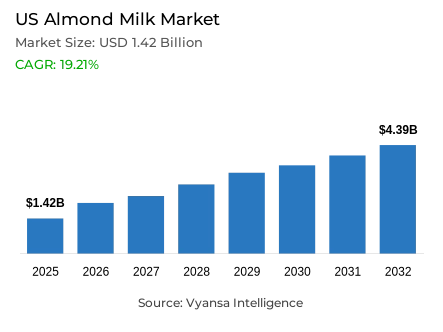
US almond milk is a plant-based beverage produced from almonds and water, commonly fortified or formulated for drinking, cereal, smoothies, coffee, and cooking. The US almond milk market serves households, foodservice operators, and retailers seeking dairy-free, lactose-free, lower-sugar, or plant-based choices. The market is projected to expand at a 19.21% CAGR during 2026–2032.
Key Highlights of the US Almond Milk Market
- The market stood at USD 1.42 billion in 2025 and rose to USD 1.53 billion in 2026.
- The market is forecast to reach USD 4.39 billion by 2032, showcasing a CAGR of 19.21% in the forecasted period of 2026-2032.
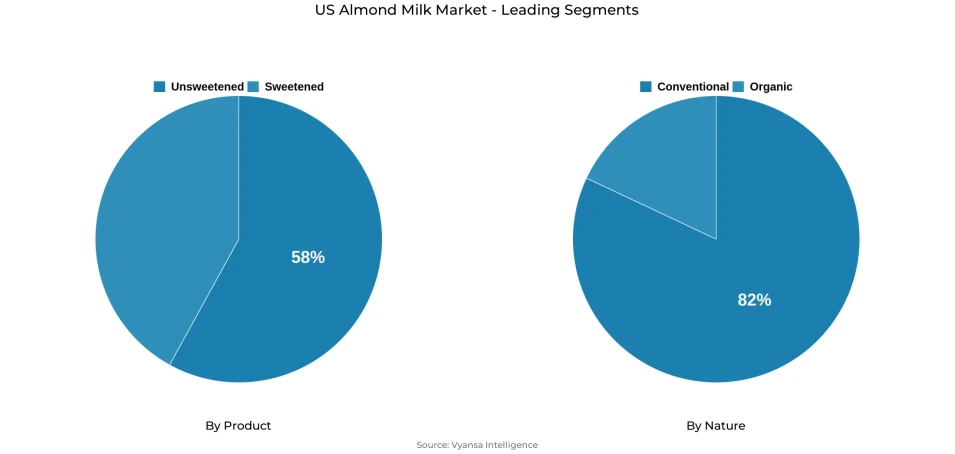
- Unsweetened led the formulation segment with a 58% market share in 2026.
- However, sweetened is the fastest-growing formulation at a 4.8% CAGR during 2026–2032.
- Conventional dominated the nature segment with an 82% market share in 2026.
- Meanwhile, organic accounted for an 18% market share in 2026 and is projected to grow fastest at a 25.06% CAGR during 2026–2032.
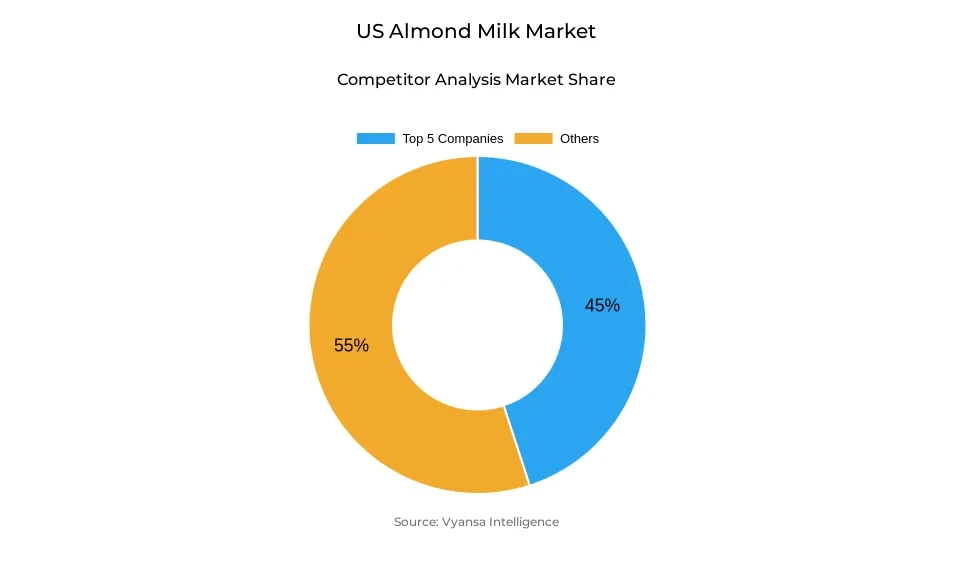
- The top five companies collectively held a 45% market share in 2026, indicating a moderately fragmented competitive landscape.
The United States almond milk market is supported by a large and increasingly health-conscious consumer base, with the country’s population reaching 341.8 million in 2025, providing a substantial addressable market for dairy alternatives. Demand is further strengthened by the prevalence of lactose malabsorption, which affects approximately 36% of the U.S. population, encouraging consumers to seek naturally lactose-free alternatives to conventional dairy milk. This opportunity is particularly relevant across the country’s diverse ethnic population, as lactose intolerance is estimated to affect 60–80% of African Americans and 50–80% of Hispanics, according to U.S. health authorities.
At the same time, the growing adoption of vegan, vegetarian, and flexitarian eating patterns is expanding almond milk consumption beyond consumers with dietary restrictions. Current estimates indicate that around 3% of U.S. adults follow a vegan diet, while plant-based foods have achieved mainstream household penetration, with 60% of U.S. households purchasing plant-based foods in 2025.
Additionally, Plant-based dairy adoption in the U.S. is becoming increasingly mainstream, supported by the expanding scale of the category and strong consumer penetration. The U.S. plant-based dairy market was valued at approximately US$4.32 billion in 2025 and is projected to reach US$4.84 billion by 2030, representing a 1.91% CAGR during 2025–2030. Importantly, plant-based milk accounts for around 80% of the U.S. plant-based dairy market, demonstrating that dairy alternatives have moved beyond niche consumption and that milk alternatives are the primary entry point for consumers adopting plant-based products.
For the U.S. almond milk market, this established and repeat-oriented adoption of plant-based dairy provides a strong consumer base, particularly as almond milk remains the leading plant-based milk type in the country.
Government Regulations Shaping the US Almond Milk Market
The U.S. almond milk industry operates within a comprehensive regulatory framework covering food safety, allergen control, product labeling, and organic claims. These requirements influence almond milk manufacturers’ production processes, packaging, ingredient sourcing, and compliance costs.
Food Allergen Labeling Requirements: Under the Food Allergen Labeling and Consumer Protection Act (FALCPA), almonds are recognized as a major tree-nut allergen, requiring products containing almonds to identify the specific tree nut, such as “almond,” on the label rather than relying only on a generic tree-nut declaration. This makes accurate ingredient and allergen labeling particularly important for almond milk manufacturers.
FDA Food Safety and Preventive Controls: The FDA’s Current Good Manufacturing Practice, Hazard Analysis, and Risk-Based Preventive Controls for Human Food rule, finalized in 2015, requires applicable food facilities to develop food safety plans, conduct hazard analyses, and establish risk-based preventive controls. The requirements also address allergen cross-contact and undeclared allergens, directly affecting almond milk processing, sanitation, packaging, and quality-control procedures.
FDA Labeling Requirements: Packaged almond milk must comply with FDA requirements for ingredient declarations and Nutrition Facts labeling. Ingredients must generally be listed in descending order of predominance by weight, while Nutrition Facts panels include information such as serving size, calories, and applicable nutrient disclosures, including added sugars.
USDA Organic Regulations: Almond milk marketed as “Organic” must contain at least 95% certified-organic ingredients, excluding water and salt, and meet USDA National Organic Program requirements. Qualifying products may use the USDA Organic seal, while products containing 70%–95% organic ingredients can use the more limited “Made with Organic” claim but cannot display the USDA Organic seal. These standards increase certification, sourcing, segregation, and documentation requirements for organic almond milk producers.
US Almond Milk Market Drivers
Multi-Occasion Dairy Substitution Sustains Recurring Household Demand
Routine substitution is the strongest structural demand mechanism because almond milk can replace dairy across cereal, coffee, smoothies, baking, and direct drinking without requiring consumers to change routines. The US almond milk industry therefore benefits when households adopt the product for several occasions rather than a single dietary need. Repeat use increases replenishment frequency, supports larger pack purchases, and gives retailers a reason to maintain almond milk within core refrigerated and shelf-stable milk-alternative assortments across value and premium price tiers.
FDA’s 2023 plant-based milk guidance cited consumer evidence showing that more than one-third of respondents had purposely used plant-based milk alternatives as a substitute for milk during the previous year. The same guidance notes that consumers purchase these beverages for allergies, intolerances, religious practices, and lifestyle choices, and use them in cereal, coffee, and smoothies. For the US almond milk market, this multi-reason substitution base converts directly into repeat household purchasing and broader national addressable demand beyond vegan consumers alone.
US Almond Milk Market Challenges
Price Premiums and Promotion Dependence Limit Broader Household Conversion
Price remains a material barrier because almond milk competes with premium plant-based beverages and conventional dairy milk that many households view as an everyday staple. When budgets tighten, shoppers can switch between milk types with little purchasing friction. The US almond milk market is therefore exposed to trade-down behaviour, promotional dependence, and retailer scrutiny of slower-moving premium SKUs. Higher shelf prices can limit trial among consumers who are curious about plant-based options but lack a dietary requirement to switch completely.
Supermarket News reported in October 2025, citing Circana, that alternative milk carried roughly an 11% shelf-price premium over dairy milk while 50% of shoppers were actively seeking promotions. That combination increases the risk that value-conscious households delay purchase, move to private label, or return to dairy. For the national almond milk industry, the effect is tighter pricing flexibility, greater promotional pressure, and stronger retailer incentives to rationalize redundant SKUs in favour of products consistently delivering clearer differentiation or faster turnover.
US Almond Milk Market Recent Trends
Clean-Label Formulations Are Reframing Premium Almond Milk
Ingredient simplicity is reshaping purchase decisions nationwide as consumers increasingly compare almond milk on taste, calories, and the length and familiarity of ingredient lists. This favours products positioned around fewer additives, recognizable inputs, and straightforward sweetness choices. The US almond milk market is consequently shifting from broad “plant-based” messaging toward specific clean-label propositions. The trend is commercially important because simpler formulations can justify premium pricing while helping brands rebuild trust among shoppers concerned about heavily processed food and beverage products.
In February 2026, Blue Diamond Growers launched Blue Diamond Almond Milk with four 48-ounce varieties, including an Unsweetened Simple formula made from water, almonds, and sea salt and a Sweetened Simple formula with four ingredients. Califia Farms also markets organic unsweetened Almond milk made from water, organic almonds, and sea salt. These products show how the US Almond Milk Industry uses formulation transparency as a competitive tool, expanding choice for consumers who prioritize recognizable ingredients without abandoning convenience or familiar usage occasions.
AI-Ready Smart Manufacturing Is Advancing Production Control
Almond milk production is moving toward sensor-rich, automated manufacturing that gives processors continuous visibility into equipment condition, filling accuracy, quality control, and line performance. These systems do not mean factories are running autonomous AI, but they create the data layer needed for machine-learning anomaly detection and predictive maintenance. For the US almond milk industry, the commercial value lies in reducing unplanned downtime, limiting product loss, improving batch consistency, and increasing throughput without relying on manual inspection or reactive maintenance practices.
California financing documentation from 2022 described Califia Farms’ Bakersfield upgrades using operating sensors whose data were screened for irregularities to help prevent machinery failure, within a project listing USD 23.5 million of qualified property. In 2024, Food Processing reported Califia added a V31 vision-inspection system capable of inspecting packages at speeds up to 1,000 bottles per minute. Together, these developments show how the US almond milk market can use connected production data to support predictive, AI-ready quality and maintenance workflows.
US Almond Milk Market Future Opportunities
WIC Eligibility Creates a New Nutrition-Assistance Access Route
Nutrition-assistance eligibility creates an opportunity for almond milk suppliers that can meet federal nutrient criteria rather than competing only for discretionary retail spending. USDA’s revised WIC framework allows state agencies to authorize qualifying plant-based milk alternatives, including almond products, when they satisfy nutritional standards. For the US almond milk market, this opens a pathway into a needs-based purchasing channel where compliant formulations can reach lower-income households, support recurring redemption, and create demand that is less dependent on premium lifestyle positioning.
USDA finalized the revised WIC food packages in April 2024, and subsequent food and nutrition service guidance states that eligible plant-based alternatives may include almond, soy, or oat milk if they meet federal requirements. Suppliers can capture this opportunity through targeted fortification, compliant labelling, state-level authorization work, and retailer distribution in WIC-participating outlets. The US almond milk industry can therefore convert nutritional equivalence and program qualification into broader household access, especially for consumers seeking non-dairy substitutes within constrained food budgets.
Unlock Market Intelligence
Explore the market potential with our data-driven report
US Almond Milk Market Segmentation Analysis
By Product
- Sweetened
- Unsweetened
Plain Unsweetened Leads While Flavoured Unsweetened Accelerates
Unsweetened almond milk leads the US product segment because demand is concentrated among younger, health conscious and relatively affluent households that place greater emphasis on sugar control, ingredient transparency and everyday versatility. Plant based food purchases over index among US consumers aged 35 to 44, households earning above USD 100,000 and post college educated households, supporting demand for unsweetened formats. The product's neutral profile also allows households to use one carton across cereal, smoothies, coffee, cooking and direct consumption.
Sweetened almond milk is expected to record the fastest growth as younger consumers and families seek more approachable taste profiles while maintaining interest in plant based alternatives. Gen Z already shows meaningful adoption of almond milk in breakfast occasions, while US research indicates that flexitarian households, which are more likely to include young children, are an important consumer group for plant based beverages. This broadening beyond strictly health driven consumers is expected to support Sweetened almond milk at approximately a 4.8% CAGR during 2026 to 2032, making it the fastest growing Product segment
By Nature
- Conventional
- Organic
Conventional Retains Scale While Organic Captures Premium Growth
Conventional almond milk accounted for an 82% share in 2026, supported by mass-market availability, established branded ranges, private-label participation, and lower sourcing and certification complexity than organic products. Its scale gives retailers flexibility across value and mainstream price points while allowing manufacturers to source almonds and ingredients from larger conventional supply pools. In the US almond milk market, these economics help conventional products maintain wider household reach, stronger promotional flexibility, and extensive shelf presence across grocery, club, and mass-merchandise channels.
Organic almond milk is forecast to expand fastest at a 25.06% CAGR during 2026–2032 as consumers seeking cleaner ingredient narratives increasingly pair plant-based purchasing with certified sourcing. Organic products can command differentiated shelf positioning, particularly when combined with unsweetened recipes, minimal additives, and premium packaging. Growth remains faster than conventional because the segment starts from a smaller base and can gain distribution as retailers widen natural and organic assortments, while suppliers use certification to support trust, premiumization, and product distinction.
Unlock Market Intelligence
Explore the market potential with our data-driven report
US Almond Milk Market Competitive Landscape
The market is moderately fragmented at the top but remains competitive across national brands, specialist plant-based suppliers, and powerful retailer private labels. The five largest companies, i.e., Blue Diamond Growers (Almond Breeze), Danone USA, A Public Benefit Corporation (Silk), Califia Farms, LLC, Walmart Inc. (Great Value), and Costco Wholesale Corporation (Kirkland Signature), account for 45% of market value, leaving substantial room for mid-sized and niche participants.
Prominent Companies in the US Almond Milk Market
- Blue Diamond Growers (Almond Breeze)
- Danone USA, A Public Benefit Corporation (Silk)
- Califia Farms, LLC
- Walmart Inc. (Great Value)
- Costco Wholesale Corporation (Kirkland Signature)
- Whole Foods Market Services LLC (365 by Whole Foods Market)
- MALK Organics LLC (MALK)
- Mooala Brands, LLC (Mooala)
- ELMHURST MILKED DIRECT, LLC. (Elmhurst 1925)
- The Campbell’s Company (Pacific Foods)
Company Profiling
These profiles assess legal presence, almond milk portfolios, production or sourcing strength, retail reach, channel influence, and each company’s competitive role in the U.S. category.
Blue Diamond Growers (Almond Breeze): Blue Diamond Growers is a Sacramento-headquartered, grower-owned almond cooperative established in 1910 and representing nearly 3,000 California almond growers. Its Almond Breeze brand gives the cooperative direct participation in U.S. almond milk through consumer beverages positioned around almond expertise and broad everyday use. Vertical connection to growers supports ingredient knowledge and supply-chain visibility, while national brand recognition and retail distribution provide scale beyond specialist natural-food channels. Blue Diamond competes through almond provenance, branded innovation, and the credibility of a producer-owned agricultural base.
Danone USA, A Public Benefit Corporation (Silk): Danone USA, A Public Benefit Corporation participates through Silk, one of the country’s most established plant-based beverage brands. Danone reports approximately 5,000 U.S. employees and 13 production locations, supported by headquarters in White Plains, New York, and Louisville, Colorado. Silk spans plant-based milks and related dairy-free products, giving Danone cross-category merchandising and innovation capability. Its manufacturing network and national retail relationships support broad availability, while the company’s scale allows Silk to compete across mainstream nutrition, flavor, and functional beverage propositions rather than relying on a single almond milk format.
Califia Farms, LLC; Califia Farms, LLC is a Los Angeles-based plant-based beverage company founded in 2010. The company expanded from juices into plant-based milks, creamers, coffees, barista products, and culinary items, creating a portfolio built around dairy-free consumption occasions. Almond milk remains central to its retail presence, while its distinctive bottle design and barista-oriented range strengthen shelf and foodservice recognition. Califia competes as an innovation-led independent brand, using product breadth and channel-specific formats to serve both household consumption and coffee-led use cases without depending on private-label economics.
Walmart Inc. (Great Value): Walmart Inc. participates directly through Great Value, its flagship private label, including a 64-fluid-ounce Original Unsweetened Almond Milk. Walmart U.S. operated 4,611 stores at fiscal year-end 2026 across all 50 states, Washington, D.C., and Puerto Rico, with substantially all stores offering same-day pickup and delivery. That footprint gives Great Value exceptional physical and digital access for routine grocery replenishment. Walmart’s competitive role is value-led: it can combine private-label pricing, national store coverage, and omnichannel convenience to pressure branded almond milk on everyday affordability and availability.
Costco Wholesale Corporation (Kirkland Signature): Costco Wholesale Corporation participates through Kirkland Signature, including an Organic Unsweetened Vanilla Almond Beverage sold in six 32-fluid-ounce cartons. In July 2026, Costco operated 641 warehouses across the United States and Puerto Rico and also maintained U.S. e-commerce. The club format supports pantry-loading and larger multipack purchases, while Kirkland Signature combines private-label control with organic positioning. Costco’s competitive relevance lies in concentrated member traffic, bulk-pack economics, and a differentiated shelf-stable format that can serve households seeking value per unit without sacrificing certified organic credentials.
Recent Developments in the US Almond Milk Market
- In May 2026, Danone North America confirmed that its Bridgeton, New Jersey plant would close in August, affecting approximately 114 employees. The facility produced Silk and So Delicious dairy-free beverages, and production was reassigned to other U.S. sites. The move represents a direct manufacturing-footprint reset for a major plant-based beverage portfolio.
- In January 2026, Blue Diamond Growers launched a new Almond Breeze campaign with the Jonas Brothers under the “Really Good, No AI Needed” theme. The initiative emphasized authentic celebrity participation and gave Almond Breeze a renewed national engagement platform as established almond milk brands defend consumer attention against private labels and competing plant-based beverages.
Frequently Asked Questions
Related Report
- Market Segmentation
- Research Scope
- Research Methodology
- Definitions and Assumptions
- Executive Summary
- US Almond Milk Market Policies, Regulations, and Standards
- US Almond Milk Market Dynamics
- Growth Factors
- Challenges
- Trends
- Opportunities
- US Almond Milk Market Statistics, 2022-2032F
- Market Size & Growth Outlook
- By Revenues in USD Million
- Market Segmentation & Growth Outlook
- By Product
- Sweetened- Market Insights and Forecast 2022-2032, USD Million
- Unsweetened- Market Insights and Forecast 2022-2032, USD Million
- By Flavour
- Flavoured- Market Insights and Forecast 2022-2032, USD Million
- Unflavoured- Market Insights and Forecast 2022-2032, USD Million
- By Nature
- Conventional- Market Insights and Forecast 2022-2032, USD Million
- Organic- Market Insights and Forecast 2022-2032, USD Million
- By Storage Format
- Refrigerated Almond Milk- Market Insights and Forecast 2022-2032, USD Million
- Shelf-Stable Almond Milk- Market Insights and Forecast 2022-2032, USD Million
- By Packaging Type
- Cartons- Market Insights and Forecast 2022-2032, USD Million
- Bottles- Market Insights and Forecast 2022-2032, USD Million
- Flexible Packaging- Market Insights and Forecast 2022-2032, USD Million
- Others- Market Insights and Forecast 2022-2032, USD Million
- By End Use
- Household- Market Insights and Forecast 2022-2032, USD Million
- Foodservice- Market Insights and Forecast 2022-2032, USD Million
- Food & Beverage Manufacturing- Market Insights and Forecast 2022-2032, USD Million
- By Distribution Channel
- Supermarkets & Grocery Stores- Market Insights and Forecast 2022-2032, USD Million
- Mass Merchandisers & Warehouse Clubs- Market Insights and Forecast 2022-2032, USD Million
- Specialty Stores- Market Insights and Forecast 2022-2032, USD Million
- Convenience Stores- Market Insights and Forecast 2022-2032, USD Million
- Online Retail- Market Insights and Forecast 2022-2032, USD Million
- Direct/B2B- Market Insights and Forecast 2022-2032, USD Million
- By Region
- West- Market Insights and Forecast 2022-2032, USD Million
- Midwest- Market Insights and Forecast 2022-2032, USD Million
- South- Market Insights and Forecast 2022-2032, USD Million
- North- Market Insights and Forecast 2022-2032, USD Million
- Northeast- Market Insights and Forecast 2022-2032, USD Million
- By Competitors
- Competition Characteristics
- Market Share & Analysis
- By Product
- Market Size & Growth Outlook
- US Sweetened Market Statistics, 2022-2032
- Market Size & Growth Outlook
- By Revenues in USD Million
- Market Segmentation & Growth Outlook
- By Nature- Market Insights and Forecast 2022-2032, USD Million
- By Storage Format- Market Insights and Forecast 2022-2032, USD Million
- By Packaging Type- Market Insights and Forecast 2022-2032, USD Million
- By End Use- Market Insights and Forecast 2022-2032, USD Million
- By Distribution Channel- Market Insights and Forecast 2022-2032, USD Million
- By Region- Market Insights and Forecast 2022-2032, USD Million
- Market Size & Growth Outlook
- US Unsweetened Market Statistics, 2022-2032
- Market Size & Growth Outlook
- By Revenues in USD Million
- Market Segmentation & Growth Outlook
- By Nature- Market Insights and Forecast 2022-2032, USD Million
- By Storage Format- Market Insights and Forecast 2022-2032, USD Million
- By Packaging Type- Market Insights and Forecast 2022-2032, USD Million
- By End Use- Market Insights and Forecast 2022-2032, USD Million
- By Distribution Channel- Market Insights and Forecast 2022-2032, USD Million
- By Region- Market Insights and Forecast 2022-2032, USD Million
- Market Size & Growth Outlook
- Competitive Outlook
- Company Profiles
- Blue Diamond Growers (Almond Breeze)
- Business Description
- Product Portfolio
- Collaborations & Alliances
- Recent Developments
- Financial Details
- Others
- Danone USA, A Public Benefit Corporation (Silk)
- Business Description
- Product Portfolio
- Collaborations & Alliances
- Recent Developments
- Financial Details
- Others
- Califia Farms, LLC
- Business Description
- Product Portfolio
- Collaborations & Alliances
- Recent Developments
- Financial Details
- Others
- Walmart Inc. (Great Value)
- Business Description
- Product Portfolio
- Collaborations & Alliances
- Recent Developments
- Financial Details
- Others
- Costco Wholesale Corporation (Kirkland Signature)
- Business Description
- Product Portfolio
- Collaborations & Alliances
- Recent Developments
- Financial Details
- Others
- Whole Foods Market Services LLC
- Business Description
- Product Portfolio
- Collaborations & Alliances
- Recent Developments
- Financial Details
- Others
- MALK Organics LLC
- Business Description
- Product Portfolio
- Collaborations & Alliances
- Recent Developments
- Financial Details
- Others
- Mooala Brands, LLC
- Business Description
- Product Portfolio
- Collaborations & Alliances
- Recent Developments
- Financial Details
- Others
- ELMHURST MILKED DIRECT, LLC.
- Business Description
- Product Portfolio
- Collaborations & Alliances
- Recent Developments
- Financial Details
- Others
- The Campbell’s Company (Pacific Foods)
- Business Description
- Product Portfolio
- Collaborations & Alliances
- Recent Developments
- Financial Details
- Others
- Blue Diamond Growers (Almond Breeze)
- Company Profiles
- Disclaimer
| Segment | Sub-Segment |
|---|---|
| By Product |
|
| By Flavour |
|
| By Nature |
|
| By Storage Format |
|
| By Packaging Type |
|
| By End Use |
|
| By Distribution Channel |
|
| By Region |
|
Research Methodology
This study followed a structured approach comprising four key phases to assess the size and scope of the electro-oxidation market. The process began with thorough secondary research to collect data on the target market, related markets, and broader industry context. These findings, along with preliminary assumptions and estimates, were then validated through extensive primary research involving industry experts from across the value chain. To calculate the overall market size, both top-down and bottom-up methodologies were employed. Finally, market segmentation and data triangulation techniques were applied to refine and validate segment-level estimations.
Secondary Research
The secondary research phase involved gathering data from a wide range of credible and published sources. This step helped in identifying industry trends, defining market segmentation, and understanding the market landscape and value chain.
Sources consulted during this phase included:
- Company annual reports, investor presentations, and press releases
- Industry white papers and certified publications
- Trade directories and market-recognized databases
- Articles from authoritative authors and reputable journals
- Gold and silver standard websites
Secondary research was critical in mapping out the industry's value chain and monetary flow, identifying key market segments, understanding regional variations, and tracking significant industry developments.
Other key sources:
- Financial disclosures
- Industry associations and trade bodies
- News outlets and business magazines
- Academic journals and research studies
- Paid industry databases
Primary Research
To validate secondary data and gain deeper market insights, primary research was conducted with key stakeholders across both the supply and demand sides of the market.
On the demand side, participants included decision-makers and influencers from end-user industries—such as CIOs, CTOs, and CSOs—who provided first-hand perspectives on market needs, product usage, and future expectations.
On the supply side, interviews were conducted with manufacturers, industry associations, and institutional participants to gather insights into current offerings, product pipelines, and market challenges.
Primary interviews provided critical inputs such as:
- Market size and revenue data
- Product and service breakdowns
- Market forecasts
- Regional and application-specific trends
Stakeholders consulted included:
- Leading OEM and solution providers
- Channel and distribution partners
- End users across various applications
- Independent consultants and industry specialists
Market Size Estimation and Data Triangulation
- Identifying Key Market Participants (Secondary Research)
- Goal: To identify the major players or companies in the target market. This typically involves using publicly available data sources such as industry reports, market research publications, and financial statements of companies.
- Tools: Reports from firms like Gartner, Forrester, Euromonitor, Statista, IBISWorld, and others. Public financial statements, news articles, and press releases from top market players.
- Extracting Earnings of Key Market Participants
- Goal: To estimate the earnings generated from the product or service being analyzed. This step helps in understanding the revenue potential of each market player in a specific geography.
- Methods: Earnings data can be gathered from:
- Publicly available financial reports (for listed companies).
- Interviews and primary data sources from professionals, such as Directors, VPs, SVPs, etc. This is especially useful for understanding more nuanced, internal data that isn't publicly disclosed.
- Annual reports and investor presentations of key players.
- Data Collation and Development of a Relevant Data Model
- Goal: To collate inputs from both primary and secondary sources into a structured, data-driven model for market estimation. This model will incorporate key market KPIs and any independent variables relevant to the market.
- Key KPIs: These could include:
- Market size, growth rate, and demand drivers.
- Industry-specific metrics like market share, average revenue per customer (ARPC), or average deal size.
- External variables, such as economic growth rates, inflation rates, or commodity prices, that could affect the market.
- Data Modeling: Based on this data, the market forecasts are developed for the next 5 years. A combination of trend analysis, scenario modeling, and statistical regression might be used to generate projections.
- Scenario Analysis
- Goal: To test different assumptions and validate how sensitive the market is to changes in key variables (e.g., market demand, regulatory changes, technological disruptions).
- Types of Scenarios:
- Base Case: Based on current assumptions and historical data.
- Best-Case Scenario: Assuming favorable market conditions, regulatory environments, and technological advancements.
- Worst-Case Scenario: Accounting for adverse factors, such as economic downturns, stricter regulations, or unexpected disruptions.












