Uzbekistan Juice Market Report: Trends, Growth and Forecast (2026-2032)
By Category (100% Juice (Not from Concentrate, Reconstituted), Juice Drinks (up to 24% Juice), Nectars (High Concentration (40% to 50% fruit content), Medium Concentration (30% to 39% fruit content), Low Concentration (25% to 29% fruit content)), Vegetable Juice, Fruit and Vegetable Blends), By Nature (Conventional, Organic), By Packaging Material (Plastic, Glass, Metal, Others), By Packaging Type (PET Bottles, Aseptic Packages (Cartons), Glass Bottles, Metal Cans, Disposable Cups & Pouches), By Sales Channel (Off-Trade (Hypermarkets/ Supermarkets, Retail Outlets, Convenience Stores, Online Platforms), On-Trade) ... Read more
|
Major Players
|
Uzbekistan Juice Market Statistics and Insights, 2026
- Market Size Statistics
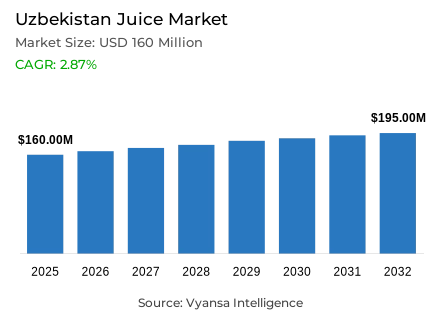
- Juice market size in Uzbekistan was estimated at USD 160 million in 2025.
- The market size is expected to grow to USD 195 million by 2032.
- Market to register a CAGR of around 2.87% during 2026-32.
- Category Shares
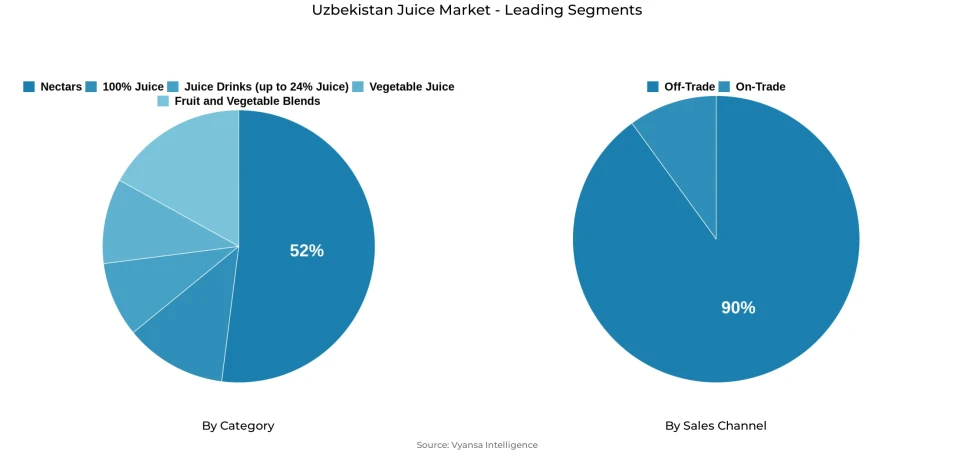
- Nectars grabbed market share of 52%.
- Competition
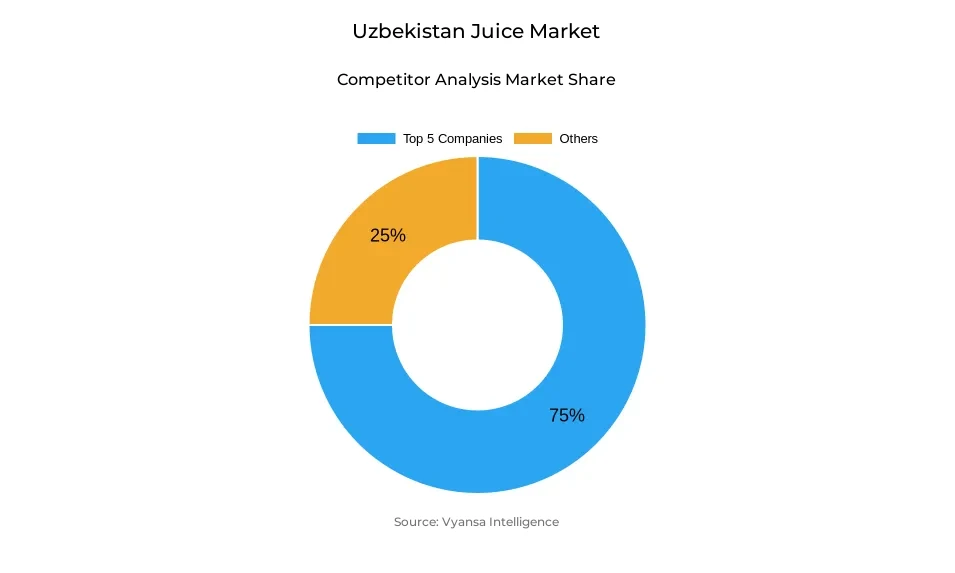
- More than 15 companies are actively engaged in producing juice in Uzbekistan.
- Top 5 companies acquired around 75% of the market share.
- Galanz Bottlers AO, Garmoniya Food Trade OOO, Master Global Plyus OOO, Marwin Brands OOO, Ricomel Beverages LLC etc., are few of the top companies.
- Sales Channel
- Off-trade grabbed 90% of the market.
Uzbekistan Juice Market Outlook
The Uzbekistan juice market is estimated to grow to USD 160 million in 2025 and USD 195 million in 2032, with a compound annual growth rate (CAGR) of about 2.87% in the 2026-32 forecast period. Though the growth is good, it is still restrained by the established local tradition of making fresh juices at home using the fruits that are readily available in the market and thus the branded juice is more of a luxury or a celebratory drink than a daily household item.
Seasonality plays a central role in influencing industry performance. The peak consumption is usually in the autumn, winter and early spring, especially around the major festive events and holidays. On the other hand, the demand is often low in the summer seasons, as consumers shift to lighter beverages like carbonates and bottled water to counter the high temperatures. This seasonal variation presents a structural burden to manufacturers, who have to depend on innovation and strategic pricing to maintain consistent year-round activity.
There is also a major regulatory change in sight. Since 2025, the Uzbek government is planning to increase the scope of excise taxation to include all sweetened non-alcoholic drinks, even those that contain high fruit content. Although lower prices are expected to be charged on low-sugar versions, this policy has raised a lot of concern among manufacturers. In reaction, major brands are already seeking health-based reformulations; however, the buying behaviour is still largely driven by price and flavour range, as opposed to nutritional assertions.
The competitive environment is a tight competition between long-established local giants. Marwin Brands OOO is a company that was established in 2007 and it has been leading the market with its main brand Dena, which is famous due to a wide variety of traditional and exotic flavours. Nevertheless, Ricomel Beverages LLC is closing the gap with its Dinay brand, focusing on the on-the-go market with innovative PET bottles and canned products. With the expansion of supermarkets and discounters like Korzinka and Havas into residential neighborhoods, the availability of branded juice products will grow, thus contributing to the gradual development of the sector towards the USD 195 million mark.
Uzbekistan Juice Market Growth DriverAffordable Nectars Anchor Demand
There is a growing trend of consumers seeking healthier and more natural soft drinks, thus maintaining the applicability of juice in daily hydration events. A more pronounced movement towards beverages that are seen as more natural and have fewer additives and sugar as the basis of flavour underlies a greater trend in the consumption of juices by 2026.
This behavioural pattern is further supported by the recent public attention to the quality of drinking water. The state water utility of Uruguay, OSE, issues current indicators of the metropolitan system; on 13 February 2026 it reported an average chloride level of 44 to 45 milligrams per litre and a sodium level of 89 to 90 milligrams per litre, as well as a daily system consumption of 635,565 cubic metres.
Uzbekistan Juice Market ChallengeHome-Made Juice Habit Limits Routine Buying
The category is under pressure due to the volatility of citrus input that compromises the price competitiveness of juices that heavily rely on oranges and lemons. Unpredictable weather conditions may limit the harvest of oranges and lemons, and the rising prices of oranges may squeeze the competitiveness of higher-quality juices against cheaper substitutes. This is a material risk considering that the supply of citrus has a significant economic value in Uruguay.
The 2024 citrus survey by the Ministry of Livestock, Agriculture and Fisheries through DIEA shows that the total citrus production is 304,839 tonnes, with 117,429 tonnes of oranges and 104,679 tonnes of lemons. As the supply of citrus becomes limited or prices rise, the ability of brands to maintain pricing without losing a natural positioning reduces.
Unlock Market Intelligence
Explore the market potential with our data-driven report
Uzbekistan Juice Market TrendModern Retail and E-Commerce Expand Reach
The retail e-commerce tide is transforming the way consumers learn about and buy juice, supported by a strong digital infrastructure and retailer investment in omnichannel shopping. The fast increase in online sales, driven by supermarket platforms, direct-to-consumer websites, and last-mile delivery apps, expands access to traditional proximity shopping.
This transformation is based on connectivity data. The communications regulator of Uruguay, URSEC, in its June 2025 telecommunications market report, reports 1,065,935 fixed broadband services delivered over fibre-optic access, and 1,062,392 fixed broadband services with speeds over 100 Mbps. Such a high-speed connection makes it easier to order groceries online, coordinate delivery faster, and make more frequent purchases based on promotions via online platforms.
Uzbekistan Juice Market OpportunityLow-Sugar Reformulation Ahead of Excise Expansion
Vegetable-fruit mixes represent a unique innovation prospect, with the growing interest in beetroot-apple or carrot-citrus mixes (first in health-conscious stores) having a significant potential to grow as wellness-oriented consumption grows. These combinations allow brands to indicate functionality and naturalness and distinguish themselves among the regular fruit-only products.
This opening is supported by a wider health context. According to PAHO, 67.5% of adults in the Americas are overweight or obese, and Uruguay is among nine countries involved in PAHO program to intensify efforts against obesity. This setting enhances consumer responsiveness to juices placed in cleaner labels, less sugar, and added nutritional indicators, features that vegetable blends can provide in a convenient form.
Unlock Market Intelligence
Explore the market potential with our data-driven report
Uzbekistan Juice Market Segmentation Analysis
By Category
- 100% Juice
- Not from Concentrate
- Reconstituted
- Juice Drinks (up to 24% Juice)
- Nectars
- High Concentration (40% to 50% fruit content)
- Medium Concentration (30% to 39% fruit content)
- Low Concentration (25% to 29% fruit content)
- Vegetable Juice
- Fruit and Vegetable Blends
The market share of nectars in the Uzbekistan juice market is the largest in the category, with 52% of the market. This dominance can be largely explained by the fact that the segment can offer a balance between rich fruit flavour and a price point that is more affordable than the one of 100% juices. Nectars are especially favoured at festive events and as gifts, where their perceived superiority to juice beverages places them in the occasional indulgence segment which defines much of the local market.
Although nectars still hold the largest share, they are faced with a two-way pressure in the market. On the one hand, 100% juices are gaining popularity among the growing elite in the cities like Tashkent. Juice drinks (maximum 24% juice content) on the other are the most dynamic growth segment due to their outstanding affordability and flavour innovation. In order to protect their 52% stake, nectar producers are now focusing on local favourites that are traditionally local, such as quince, apricot and pear, and thus they are able to retain a close cultural relationship with the consumer base.
By Sales Channel
- Off-Trade
- Hypermarkets/ Supermarkets
- Retail Outlets
- Convenience Stores
- Online Platforms
- On-Trade
Off-trade is the largest segment of the sales channel, which occupies 90% of the market. This is indicative of the essential nature of home consumption in Uzbekistan where juice is mostly bought to serve at family events or to store during winter seasons. Small local grocers continue to be the main point of contact with these purchases, especially in rural and inaccessible locations where they are the community lifeline of daily and festive products.
The 90% off-trade share is however experiencing a fast internal migration to modern retail formats. Large supermarket chains like Korzinka and Makro are spending heavily on logistics and digital infrastructure, which are attracting shoppers to leave traditional markets with standardised prices and a broader product range. Moreover, the emergence of e-commerce websites like Uzum is creating a new horizon of at-home delivery, especially with the younger generations who are more technologically inclined and value the convenience of online shopping of large household products.
List of Companies Covered in Uzbekistan Juice Market
The companies listed below are highly influential in the Uzbekistan juice market, with a significant market share and a strong impact on industry developments.
- Galanz Bottlers AO
- Garmoniya Food Trade OOO
- Master Global Plyus OOO
- Marwin Brands OOO
- Ricomel Beverages LLC
- Navruz International Corp OOO SP
- Intersok SP OOO
- Agromir Food MChJ QK
- RG Brands AO
- Zulya Baraka Biznes SP
Competitive Landscape
Uzbekistan juice market is led by Marwin Brands (Dena), leveraging a broad flavour portfolio, established presence since 2007 and strong distribution across modern and traditional trade, while Ricomel Beverages (Dinay) is a close challenger, gaining share through aggressive flavour expansion and on-the-go PET and canned formats. Family Group’s elRio is the fastest-growing player, intensifying competitive pressure. The market remains price-driven and seasonal, with juice drinks (up to 24% juice) dominating due to affordability and variety, while 100% juice and nectars face slower uptake. Key gaps include limited health-led positioning, children-focused segmentation and premium differentiation. Upcoming excise expansion on sweetened beverages creates opportunity for low-sugar reformulation, smaller pack innovation and clearer value positioning to defend margins and stimulate everyday consumption.
Frequently Asked Questions
Related Report
- Market Segmentation
- Research Scope
- Research Methodology
- Definitions and Assumptions
- Executive Summary
- Uzbekistan Juice Market Policies, Regulations, and Standards
- Uzbekistan Juice Market Dynamics
- Growth Factors
- Challenges
- Trends
- Opportunities
- Uzbekistan Juice Market Statistics, 2022-2032F
- Market Size & Growth Outlook
- By Revenues in USD Million
- By Quantity Sold in Million Litres
- Market Segmentation & Growth Outlook
- By Category
- 100% Juice- Market Insights and Forecast 2022-2032, USD Million
- Not from Concentrate- Market Insights and Forecast 2022-2032, USD Million
- Reconstituted- Market Insights and Forecast 2022-2032, USD Million
- Juice Drinks (up to 24% Juice)- Market Insights and Forecast 2022-2032, USD Million
- Nectars- Market Insights and Forecast 2022-2032, USD Million
- High Concentration (40% to 50% fruit content)- Market Insights and Forecast 2022-2032, USD Million
- Medium Concentration (30% to 39% fruit content)- Market Insights and Forecast 2022-2032, USD Million
- Low Concentration (25% to 29% fruit content)- Market Insights and Forecast 2022-2032, USD Million
- Vegetable Juice- Market Insights and Forecast 2022-2032, USD Million
- Fruit and Vegetable Blends- Market Insights and Forecast 2022-2032, USD Million
- 100% Juice- Market Insights and Forecast 2022-2032, USD Million
- By Nature
- Conventional- Market Insights and Forecast 2022-2032, USD Million
- Organic- Market Insights and Forecast 2022-2032, USD Million
- By Packaging Material
- Plastic- Market Insights and Forecast 2022-2032, USD Million
- Glass- Market Insights and Forecast 2022-2032, USD Million
- Metal- Market Insights and Forecast 2022-2032, USD Million
- Others- Market Insights and Forecast 2022-2032, USD Million
- By Packaging Type
- PET Bottles- Market Insights and Forecast 2022-2032, USD Million
- Aseptic Packages (Cartons)- Market Insights and Forecast 2022-2032, USD Million
- Glass Bottles- Market Insights and Forecast 2022-2032, USD Million
- Metal Cans- Market Insights and Forecast 2022-2032, USD Million
- Disposable Cups & Pouches- Market Insights and Forecast 2022-2032, USD Million
- By Sales Channel
- Off-Trade- Market Insights and Forecast 2022-2032, USD Million
- Hypermarkets/ Supermarkets - Market Insights and Forecast 2022-2032, USD Million
- Retail Outlets - Market Insights and Forecast 2022-2032, USD Million
- Convenience Stores- Market Insights and Forecast 2022-2032, USD Million
- Online Platforms- Market Insights and Forecast 2022-2032, USD Million
- On-Trade- Market Insights and Forecast 2022-2032, USD Million
- Off-Trade- Market Insights and Forecast 2022-2032, USD Million
- By Competitors
- Competition Characteristics
- Market Share & Analysis
- By Category
- Market Size & Growth Outlook
- Uzbekistan 100% Juice Market Statistics, 2022-2032
- Market Size & Growth Outlook
- By Revenues in USD Million
- By Quantity Sold in Million Litres
- Market Segmentation & Growth Outlook
- By Nature- Market Insights and Forecast 2022-2032, USD Million
- By Packaging Material- Market Insights and Forecast 2022-2032, USD Million
- By Packaging Type- Market Insights and Forecast 2022-2032, USD Million
- By Sales Channel- Market Insights and Forecast 2022-2032, USD Million
- Market Size & Growth Outlook
- Uzbekistan Juice Drinks (up to 24% Juice) Market Statistics, 2022-2032
- Market Size & Growth Outlook
- By Revenues in USD Million
- By Quantity Sold in Million Litres
- Market Segmentation & Growth Outlook
- By Nature- Market Insights and Forecast 2022-2032, USD Million
- By Packaging Material- Market Insights and Forecast 2022-2032, USD Million
- By Packaging Type- Market Insights and Forecast 2022-2032, USD Million
- By Sales Channel- Market Insights and Forecast 2022-2032, USD Million
- Market Size & Growth Outlook
- Uzbekistan Nectars Market Statistics, 2022-2032
- Market Size & Growth Outlook
- By Revenues in USD Million
- By Quantity Sold in Million Litres
- Market Segmentation & Growth Outlook
- By Nature- Market Insights and Forecast 2022-2032, USD Million
- By Packaging Material- Market Insights and Forecast 2022-2032, USD Million
- By Packaging Type- Market Insights and Forecast 2022-2032, USD Million
- By Sales Channel- Market Insights and Forecast 2022-2032, USD Million
- Market Size & Growth Outlook
- Uzbekistan Vegetable Juice Market Statistics, 2022-2032
- Market Size & Growth Outlook
- By Revenues in USD Million
- By Quantity Sold in Million Litres
- Market Segmentation & Growth Outlook
- By Nature- Market Insights and Forecast 2022-2032, USD Million
- By Packaging Material- Market Insights and Forecast 2022-2032, USD Million
- By Packaging Type- Market Insights and Forecast 2022-2032, USD Million
- By Sales Channel- Market Insights and Forecast 2022-2032, USD Million
- Market Size & Growth Outlook
- Uzbekistan Fruit and Vegetable Blends Market Statistics, 2022-2032
- Market Size & Growth Outlook
- By Revenues in USD Million
- By Quantity Sold in Million Litres
- Market Segmentation & Growth Outlook
- By Nature- Market Insights and Forecast 2022-2032, USD Million
- By Packaging Material- Market Insights and Forecast 2022-2032, USD Million
- By Packaging Type- Market Insights and Forecast 2022-2032, USD Million
- By Sales Channel- Market Insights and Forecast 2022-2032, USD Million
- Market Size & Growth Outlook
- Competitive Outlook
- Company Profiles
- Marwin Brands OOO
- Business Description
- Product Portfolio
- Collaborations & Alliances
- Recent Developments
- Financial Details
- Others
- Ricomel Beverages LLC
- Business Description
- Product Portfolio
- Collaborations & Alliances
- Recent Developments
- Financial Details
- Others
- Navruz International Corp OOO SP
- Business Description
- Product Portfolio
- Collaborations & Alliances
- Recent Developments
- Financial Details
- Others
- Intersok SP OOO
- Business Description
- Product Portfolio
- Collaborations & Alliances
- Recent Developments
- Financial Details
- Others
- Agromir Food MChJ QK
- Business Description
- Product Portfolio
- Collaborations & Alliances
- Recent Developments
- Financial Details
- Others
- Galanz Bottlers AO
- Business Description
- Product Portfolio
- Collaborations & Alliances
- Recent Developments
- Financial Details
- Others
- Garmoniya Food Trade OOO
- Business Description
- Product Portfolio
- Collaborations & Alliances
- Recent Developments
- Financial Details
- Others
- Master Global Plyus OOO
- Business Description
- Product Portfolio
- Collaborations & Alliances
- Recent Developments
- Financial Details
- Others
- RG Brands AO
- Business Description
- Product Portfolio
- Collaborations & Alliances
- Recent Developments
- Financial Details
- Others
- Zulya Baraka Biznes SP
- Business Description
- Product Portfolio
- Collaborations & Alliances
- Recent Developments
- Financial Details
- Others
- Marwin Brands OOO
- Company Profiles
- Disclaimer
| Segment | Sub-Segment |
|---|---|
| By Category |
|
| By Nature |
|
| By Packaging Material |
|
| By Packaging Type |
|
| By Sales Channel |
|
Research Methodology
This study followed a structured approach comprising four key phases to assess the size and scope of the electro-oxidation market. The process began with thorough secondary research to collect data on the target market, related markets, and broader industry context. These findings, along with preliminary assumptions and estimates, were then validated through extensive primary research involving industry experts from across the value chain. To calculate the overall market size, both top-down and bottom-up methodologies were employed. Finally, market segmentation and data triangulation techniques were applied to refine and validate segment-level estimations.
Secondary Research
The secondary research phase involved gathering data from a wide range of credible and published sources. This step helped in identifying industry trends, defining market segmentation, and understanding the market landscape and value chain.
Sources consulted during this phase included:
- Company annual reports, investor presentations, and press releases
- Industry white papers and certified publications
- Trade directories and market-recognized databases
- Articles from authoritative authors and reputable journals
- Gold and silver standard websites
Secondary research was critical in mapping out the industry's value chain and monetary flow, identifying key market segments, understanding regional variations, and tracking significant industry developments.
Other key sources:
- Financial disclosures
- Industry associations and trade bodies
- News outlets and business magazines
- Academic journals and research studies
- Paid industry databases
Primary Research
To validate secondary data and gain deeper market insights, primary research was conducted with key stakeholders across both the supply and demand sides of the market.
On the demand side, participants included decision-makers and influencers from end-user industries—such as CIOs, CTOs, and CSOs—who provided first-hand perspectives on market needs, product usage, and future expectations.
On the supply side, interviews were conducted with manufacturers, industry associations, and institutional participants to gather insights into current offerings, product pipelines, and market challenges.
Primary interviews provided critical inputs such as:
- Market size and revenue data
- Product and service breakdowns
- Market forecasts
- Regional and application-specific trends
Stakeholders consulted included:
- Leading OEM and solution providers
- Channel and distribution partners
- End users across various applications
- Independent consultants and industry specialists
Market Size Estimation and Data Triangulation
- Identifying Key Market Participants (Secondary Research)
- Goal: To identify the major players or companies in the target market. This typically involves using publicly available data sources such as industry reports, market research publications, and financial statements of companies.
- Tools: Reports from firms like Gartner, Forrester, Euromonitor, Statista, IBISWorld, and others. Public financial statements, news articles, and press releases from top market players.
- Extracting Earnings of Key Market Participants
- Goal: To estimate the earnings generated from the product or service being analyzed. This step helps in understanding the revenue potential of each market player in a specific geography.
- Methods: Earnings data can be gathered from:
- Publicly available financial reports (for listed companies).
- Interviews and primary data sources from professionals, such as Directors, VPs, SVPs, etc. This is especially useful for understanding more nuanced, internal data that isn't publicly disclosed.
- Annual reports and investor presentations of key players.
- Data Collation and Development of a Relevant Data Model
- Goal: To collate inputs from both primary and secondary sources into a structured, data-driven model for market estimation. This model will incorporate key market KPIs and any independent variables relevant to the market.
- Key KPIs: These could include:
- Market size, growth rate, and demand drivers.
- Industry-specific metrics like market share, average revenue per customer (ARPC), or average deal size.
- External variables, such as economic growth rates, inflation rates, or commodity prices, that could affect the market.
- Data Modeling: Based on this data, the market forecasts are developed for the next 5 years. A combination of trend analysis, scenario modeling, and statistical regression might be used to generate projections.
- Scenario Analysis
- Goal: To test different assumptions and validate how sensitive the market is to changes in key variables (e.g., market demand, regulatory changes, technological disruptions).
- Types of Scenarios:
- Base Case: Based on current assumptions and historical data.
- Best-Case Scenario: Assuming favorable market conditions, regulatory environments, and technological advancements.
- Worst-Case Scenario: Accounting for adverse factors, such as economic downturns, stricter regulations, or unexpected disruptions.












