U.S. Vegan Cheese Market Report: Trends, Growth and Forecast (2026-2032)
By Product Type (Mozzarella Cheese, Cheddar Cheese, Cream Cheese, Parmesan Cheese, Ricotta Cheese, Other Vegan Cheese Types), By Primary Source (Cashew, Soy, Coconut, Almond, Oat & Other Grain-Based, Other Plant Sources), By Form (Shreds & Grated, Slices, Blocks & Wedges, Spreads / Creamy, Other Forms), By Distribution Channel (Supermarkets & Hypermarkets, Convenience Stores, Specialty Stores, Online Stores, Direct / B2B Distribution, Others), By End Use (Household Consumers, Foodservice, Food Processing, Other Commercial & Institutional Users), By Region (Northeast, Midwest, South, West) ... Read more

|
Major Players
|
U.S. Vegan Cheese Market Overview
Vegan cheese is a plant-based alternative to dairy cheese made from bases such as cashew, coconut, soy, and almond, formulated to replicate the melt, stretch, and flavour of mozzarella, cheddar, parmesan, ricotta, and cream cheese. Home cooks, foodservice operators and retailers consume it across pizza, sandwiches, snacking and dairy-free meal occasions. The U.S. vegan cheese market is projected to grow at a CAGR of 6.36% between 2026 and 2032.
Key Highlights of the U.S. Vegan Cheese Market
- The United States vegan cheese market was valued at USD 890 million in 2025 and is estimated at USD 912 million in 2026 and is forecast to reach USD 1.32 billion by 2032.
- The market is forecast to expand at a compound annual growth rate of 6.36% between 2026 and 2032.
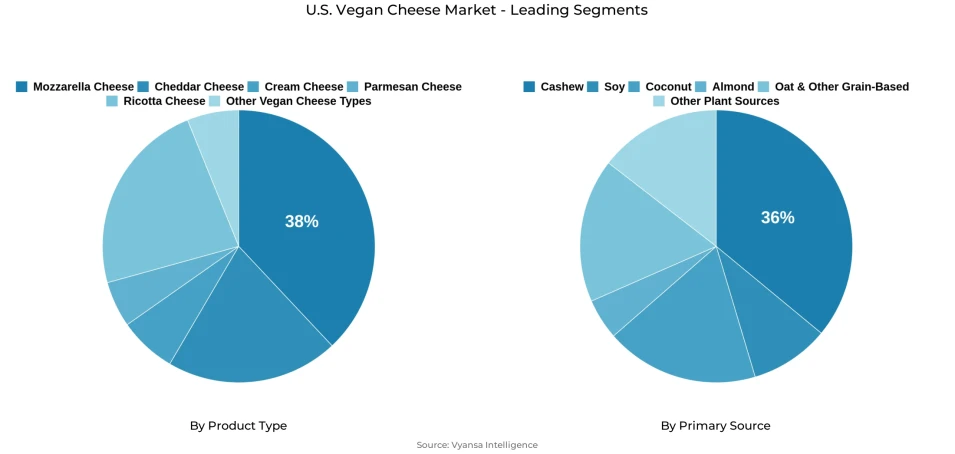
- By product type, mozzarella led the market with a 38% share in 2026.
- While, ricotta is the fastest-growing product type, expanding at a CAGR of 14.20% between 2026 and 2032.
- By source, cashew-based formulations led the market with a 36% share in 2026.
- Additionally, coconut-based formulations are the fastest-growing source category, expanding at a CAGR of 14.20% between 2026 and 2032.
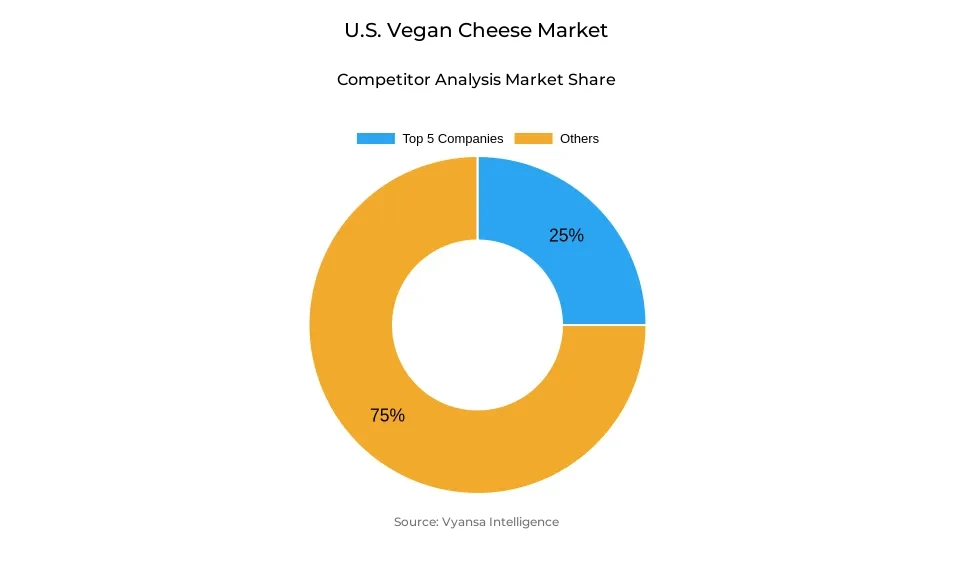
- The market is fragmented, with the top five companies holding a combined 25% share in 2026.
The U.S. vegan cheese market is expanding beyond the traditional vegan population as dietary preferences, demographic diversity, lactose malabsorption, and growing health concerns increase demand for plant-based dairy. This is the reason behind the growing US plant-based dairy market, with approx. 1.91% CAGR during 2025-30.
The U.S. population reached approximately 341.8 million in 2025, with 20.5% identifying as Hispanic or Latino, while Asian Americans and other population groups with higher rates of lactose malabsorption represent additional addressable consumers. The National Institute of Diabetes and Digestive and Kidney Diseases (NIDDK) estimates that approximately 36% of people in the U.S. have lactose malabsorption, with higher prevalence among African American, American Indian, Asian American, and Hispanic/Latino populations. This creates a substantial consumer base seeking dairy-free alternatives, particularly for products such as cheese that are consumed frequently.
The shift toward plant-based eating is also broadening the market beyond strict vegans. A 2025 survey of 3,009 U.S. adults found that 3% identified as vegan, 2% as vegetarian, and 11% as flexitarian, meaning approximately 16% of adults followed a meat-reducing or meat/dairy-excluding dietary pattern across these categories. This indicates that vegan cheese increasingly competes for consumption occasions among consumers who selectively reduce animal-based foods rather than completely eliminate them.
Rising metabolic-health concerns further strengthen interest in alternative food choices. During 2021–2023, 40.3% of U.S. adults aged 20 and above had obesity, while 72.4% were overweight or had obesity. In addition, 15.8% of U.S. adults had total diabetes, including diagnosed and undiagnosed cases. These conditions are increasing consumer attention toward dietary composition and healthier eating patterns, although vegan cheese products themselves vary considerably in calories, sodium, saturated fat, and protein and therefore should not automatically be positioned as healthier than dairy cheese.
Consequently, lactose-related dietary restrictions, demographic diversification, flexitarian adoption, and heightened health awareness are expanding the addressable consumer pool, while improvements in melt, stretch, texture and protein content are helping vegan cheese penetrate high-frequency applications such as pizza, sandwiches, snacks and home cooking.
U.S. Vegan Cheese Market Drivers
Lactose/Dairy Avoidance Expands the Addressable Consumer Base
Vegan cheese gains a structural demand driver from lactose malabsorption, a digestive condition affecting a meaningful share of United States. adults that occurs independent of any vegan or vegetarian lifestyle choice. Consumers who experience discomfort after dairy cheese have a physiological reason to substitute plant-based formats, widening the addressable base beyond committed vegans to flexitarians and lactose-sensitive shoppers who continue consuming dairy elsewhere but avoid it specifically in cheese.
According to the national institute of diabetes and digestive and kidney diseases, about 36% of people in the United States have lactose malabsorption. A 2025-updated clinical review confirms primary lactose intolerance is significantly more prevalent among White Americans, and cheese is typically the highest-frequency dairy occasion households replace.
Through 2032, flexitarian and lactose-sensitive households remain a durable share of demand rather than a promotional segment tied to plant-based trend cycles. Cheddar and mozzarella formats used in everyday cooking gain the most, since they substitute directly into existing meal routines. Lactose malabsorption prevalence stays stable across the population, so it anchors vegan cheese as a recurring grocery purchase rather than a discretionary one in the US vegan cheese industry.
U.S. Vegan Cheese Market Challenges
Difficulty Matching Dairy Cheese Taste, Texture, and Melt Performance
Vegan cheese continues to fall short of dairy cheese on melt, stretch, mouthfeel and protein content, and the gap sits at the level of protein chemistry rather than recipe adjustment. Dairy casein forms an elastic, heat-responsive protein network that starch- and oil-based plant formulations cannot fully replicate, which is why sticking, uneven melting and limited stretch persist across multiple manufacturers rather than any single brand's recipe, making the constraint structural rather than temporary.
A food-technology assessment, identifying sticking, uneven melting, limited stretch and low protein as recurring shortcomings of existing plant-based cheeses, and Daiya continued reformulating its cream cheese and mac & cheese lines in 2025 specifically to improve taste, texture and creaminess. Each reformulation cycle requires new consumer taste testing and retailer requalification, lengthening the time between product concept and shelf placement compared with a simple flavour extension.
Manufacturers in the vegan cheese industry are responding by targeting applications least dependent on stretch, such as cream cheese, shredded blends and cooking cheeses, where flavour and spreadability matter more than fibrous pull. This concentrates near-term demand toward format categories that already perform acceptably, including cream cheese and mac & cheese, while melt-critical formats such as mozzarella pizza cheese see slower conversion until protein-engineering solutions mature. The effect moderates the pace of category-wide adoption without reducing total addressable demand for dairy-free cheese.
U.S. Vegan Cheese Market Recent Trends
Flexitarian Eating Broadens Vegan Cheese Beyond Strict Vegans
Vegan cheese consumption is shifting from a vegan-identity purchase to a flexible, occasion-based one, replacing the earlier assumption that only strict vegans or vegetarians buy the category. This shift moves purchase decisions from identity-driven avoidance of all animal products to selective substitution within specific meals, such as swapping cheese on a pizza night while continuing to consume dairy in other forms.
A November 2025 survey of 3,009 U.S. adults found that 11% identified as flexitarian. Another 2025 survey covering 3,000 Americans found that 5% had followed a flexitarian eating pattern during the previous year. Manufacturers working in the vegan cheese industry are responding by introducing familiar flavours and formats designed for everyday consumption. In May 2025, Daiya Foods Inc. launched Chipotle Cheddar Shreds and Pepper Jack Slices, extending its portfolio into flavour-forward options suited to routine cooking and snacking occasions
This flexitarian-first framing lowers the entry barrier for occasional consumers who would not otherwise shop a dedicated vegan or dairy-free aisle, and grocers are increasingly stocking vegan cheese alongside conventional cheese rather than segregating it in a specialty freezer section. Through 2032, this broadens the addressable household base well beyond the Americans who identify as vegan, supporting sustained volume growth. Overall, occasion-based flexitarian buying converts vegan cheese from a niche identity purchase into a mainstream grocery staple.
AI-Enabled Protein Engineering Advances Dairy-Like Cheese Performance
Vegan cheese development is increasingly moving beyond conventional starch-and-oil formulations toward data-led protein engineering designed to replicate the functional behaviour of dairy casein. Computational modelling and advanced protein-selection techniques are helping developers identify plant proteins with stronger heat response, elasticity and structural performance. This approach directly targets persistent limitations in melt, stretch and protein density that have restricted wider adoption of vegan cheese in demanding applications such as pizza, grilled sandwiches and commercial foodservice.
Recent ingredient innovation done in the industry, illustrates how quickly functional performance is improving. In 2025, Bettani Farms introduced Caseed, a seed-derived protein engineered to reproduce the melt and stretch characteristics of dairy casein while enabling dairy-free cheese formulations to deliver approximately 80% to 100% of the protein content found in conventional cheese. Cultured-legume platforms are progressing in parallel, with Stockeld reporting that its cultured cheese can melt around twice as fast as competing plant-based alternatives.
These technologies are raising product-development standards across the market. Manufacturers adopting next-generation proteins must evaluate formulations against measurable melt, stretch, texture and nutritional benchmarks rather than relying primarily on flavour reformulation. As performance improves, advanced protein engineering could accelerate acceptance in foodservice and other melt-intensive applications, while strengthening the competitive position of manufacturers with dedicated food-science and formulation capabilities.
U.S. Vegan Cheese Market Future Opportunities
High-Performance Vegan Mozzarella for Pizza and Foodservice
Foodservice represents a major expansion opportunity for vegan mozzarella, particularly across pizza, baked dishes and other high-heat applications where cheese performance directly affects the consumer experience. Mozzarella remains one of the most widely consumed cheese varieties in the United States, while away-from-home dining contributes significantly to overall cheese consumption. However, vegan alternatives still face limitations in melt, stretch, browning and consistency under commercial oven conditions, restricting broader adoption by pizza chains and large foodservice operators.
The opportunity is increasingly shifting toward products engineered specifically for professional kitchens rather than retail formulations adapted for institutional use. In May 2025, Daiya Foods Inc. introduced dairy-free cream cheese packets developed specifically for foodservice operators, demonstrating growing manufacturer focus on channel-specific formats and operational requirements. A similar approach in mozzarella could enable suppliers to address portion consistency, preparation speed, heat tolerance and performance standards required by restaurants and quick-service chains.
Capturing this opportunity in the vegan cheese industry, will require purpose-built mozzarella formulations supported by strong distributor relationships and foodservice qualification capabilities. Manufacturers able to combine advanced protein technologies with reliable commercial-scale supply could gain an early advantage as operators seek dairy-free alternatives that perform closer to conventional cheese. Successful development of foodservice-grade vegan mozzarella could therefore open a high-volume demand channel and establish longer-term partnerships across pizza chains, restaurants and institutional foodservice.
Unlock Market Intelligence
Explore the market potential with our data-driven report
U.S. Vegan Cheese Market Segmentation Analysis
By Product Type:
- Mozzarella
- Cheddar
- Parmesan
- Ricotta
- Cream Cheese
- Others
Mozzarella Leads While Ricotta Grows Fastest
Mozzarella leads product type demand with 38% market share in 2026, because it maps directly onto the two largest vegan cheese occasions, pizza and melted sandwich applications, where consumers evaluate the product primarily on stretch and browning rather than flavour complexity. It also benefits from processing compatibility: mozzarella-style formulations were among the first to achieve acceptable melt using coconut-oil and starch bases, giving manufacturers a head start on shelf distribution and foodservice listings that newer formats have not caught up to. This position should hold through the forecast period provided melt performance keeps improving, though a faster breakthrough in casein-mimicking proteins applied first to cheddar or cream cheese could narrow the gap.
Ricotta is forecast to grow at a CAGR of 14.20% between 2026 and 2032, the fastest of any product type, as cultured cashew-based formulations extend the category into baking, pasta filling and dessert applications that mozzarella and cheddar formats do not serve. Growth is driven by foodservice and bakery end users adopting ricotta as a functional ingredient rather than a standalone cheese, a use case with less exposure to melt-performance limitations. Ricotta grows faster than mozzarella precisely because its primary applications reward creaminess and cultured flavour rather than stretch, sidestepping the technical constraint that caps mozzarella's near-term upside.
By Source:
- Cashew
- Soy
- Almond
- Coconut
- Others
Cashew Leads While Coconut Grows Fastest
Cashew leads source-based demand with 36% market share in 2026, because its neutral, buttery flavour and smooth fat structure make it the most versatile base for cultured, aged formats such as cream cheese and ricotta, letting manufacturers extend a single ingredient platform across multiple product types. Cashew also processes into a firmer, cuttable texture more easily than soy or coconut bases, supporting block and wheel formats that command premium retail pricing. This leadership should hold through the forecast period as long as tree-nut allergen labelling does not push mainstream retailers toward nut-free reformulation at scale.
Coconut-based formulations are forecast to grow at a CAGR of 14.20% between 2026 and 2032, matching ricotta as the fastest-growing segment, driven by their compatibility with fermented, umami-forward flavour profiles used in shredded and sliced formats favoured by mainstream grocery and club retailers. Coconut grows faster than cashew because it supports large-scale slice and shred manufacturing at lower input cost, letting producers expand distribution into value-tier retail rather than only the premium natural-food channels where cashew-based formats concentrate.
Unlock Market Intelligence
Explore the market potential with our data-driven report
U.S. Vegan Cheese Market Competitive Landscape
The U.S. vegan cheese market is fragmented, with the five largest companies holding a combined 25% share in 2026 and numerous regional and artisan producers competing for the remainder. Flora Food US Inc. (Violife) holds the leading position among branded competitors, followed by Daiya Foods Inc., Greenleaf Foods, SPC (Field Roast, Chao Creamery), Follow Your Heart and Kite Hill. The remaining share is distributed across smaller specialty and artisan producers, including cashew-cheese specialists and newer aged-cheese entrants, sustaining active competitive entry alongside large branded-food-group ownership at the top of the market.
Key Companies in the U.S. Vegan Cheese Market
- Flora Food US Inc. (Violife)
- Daiya Foods Inc.
- Greenleaf Foods, SPC (Field Roast, Chao Creamery)
- Follow Your Heart
- Kite Hill
- Miyoko's Creamery
- Bel Brands USA Inc. (Babybel Plant-Based)
- The Kraft Heinz Not Company LLC (KRAFT NotCheese)
- GOOD PLANeT Foods
- Stockeld Dreamery
Recent Developments in the U.S. Vegan Cheese Market
- June 2026: Formo Foods Inc.’s recombinant casein protein GRAS notice (GRN 1312) was made public, advancing a precision-fermented casein ingredient designed to replicate dairy-like melt, stretch and structure for potential use by U.S. food manufacturers. This ingredient does not itself manufacture cheese, but if cleared, it would let vegan cheese manufacturers formulate closer to dairy-equivalent melt and stretch performance, intensifying competitive pressure on plant-protein-only formulations and reshaping product development priorities across the market
- November 2025: Prosperity Organic Foods Inc. acquired Miyoko's Creamery, bringing the cashew-based cheese and butter brand under an established plant-based dairy manufacturer and supporting its return to retail distribution. The acquisition returns Miyoko's cashew-based cheese and butter line to retail distribution under new ownership following a period of supply disruption, restoring competitive supply in the premium artisan cashew-cheese segment and consolidating share among fewer independent producers.
Frequently Asked Questions
Related Report
- Market Segmentation
- Research Scope
- Research Methodology
- Definitions and Assumptions
- Executive Summary
- U.S. Vegan Cheese Market Policies, Regulations, and Standards
- U.S. Vegan Cheese Market Dynamics
- Growth Factors
- Challenges
- Trends
- Opportunities
- U.S. Vegan Cheese Market Statistics, 2022-2032F
- Market Size & Growth Outlook
- By Revenues in USD Million
- By Quantity Sold in Thousand Tons
- Market Segmentation & Growth Outlook
- By Product Type
- Mozzarella Cheese- Market Insights and Forecast 2022-2032, USD Million & Thousand Tons
- Cheddar Cheese- Market Insights and Forecast 2022-2032, USD Million & Thousand Tons
- Cream Cheese- Market Insights and Forecast 2022-2032, USD Million & Thousand Tons
- Parmesan Cheese- Market Insights and Forecast 2022-2032, USD Million & Thousand Tons
- Ricotta Cheese- Market Insights and Forecast 2022-2032, USD Million & Thousand Tons
- Other Vegan Cheese Types- Market Insights and Forecast 2022-2032, USD Million & Thousand Tons
- By Primary Source
- Cashew- Market Insights and Forecast 2022-2032, USD Million & Thousand Tons
- Soy- Market Insights and Forecast 2022-2032, USD Million & Thousand Tons
- Coconut- Market Insights and Forecast 2022-2032, USD Million & Thousand Tons
- Almond- Market Insights and Forecast 2022-2032, USD Million & Thousand Tons
- Oat & Other Grain-Based- Market Insights and Forecast 2022-2032, USD Million & Thousand Tons
- Other Plant Sources- Market Insights and Forecast 2022-2032, USD Million & Thousand Tons
- By Form
- Shreds & Grated- Market Insights and Forecast 2022-2032, USD Million & Thousand Tons
- Slices- Market Insights and Forecast 2022-2032, USD Million & Thousand Tons
- Blocks & Wedges- Market Insights and Forecast 2022-2032, USD Million & Thousand Tons
- Spreads / Creamy- Market Insights and Forecast 2022-2032, USD Million & Thousand Tons
- Other Forms- Market Insights and Forecast 2022-2032, USD Million & Thousand Tons
- By Distribution Channel
- Supermarkets & Hypermarkets- Market Insights and Forecast 2022-2032, USD Million & Thousand Tons
- Convenience Stores- Market Insights and Forecast 2022-2032, USD Million & Thousand Tons
- Specialty Stores- Market Insights and Forecast 2022-2032, USD Million & Thousand Tons
- Online Stores- Market Insights and Forecast 2022-2032, USD Million & Thousand Tons
- Direct / B2B Distribution- Market Insights and Forecast 2022-2032, USD Million & Thousand Tons
- Others- Market Insights and Forecast 2022-2032, USD Million & Thousand Tons
- By End Use
- Household Consumers- Market Insights and Forecast 2022-2032, USD Million & Thousand Tons
- Foodservice- Market Insights and Forecast 2022-2032, USD Million & Thousand Tons
- Food Processing- Market Insights and Forecast 2022-2032, USD Million & Thousand Tons
- Other Commercial & Institutional Users- Market Insights and Forecast 2022-2032, USD Million & Thousand Tons
- By Region
- Northeast- Market Insights and Forecast 2022-2032, USD Million & Thousand Tons
- Midwest- Market Insights and Forecast 2022-2032, USD Million & Thousand Tons
- South- Market Insights and Forecast 2022-2032, USD Million & Thousand Tons
- West- Market Insights and Forecast 2022-2032, USD Million & Thousand Tons
- By Competitors
- Competition Characteristics
- Market Share & Analysis
- By Product Type
- Market Size & Growth Outlook
- U.S. Mozzarella Cheese Market Statistics, 2022-2032
- Market Size & Growth Outlook
- By Revenues in USD Million
- By Quantity Sold in Thousand Tons
- Market Segmentation & Growth Outlook
- By Primary Source- Market Insights and Forecast 2022-2032, USD Million & Thousand Tons
- By Form- Market Insights and Forecast 2022-2032, USD Million & Thousand Tons
- By Distribution Channel- Market Insights and Forecast 2022-2032, USD Million & Thousand Tons
- By End Use- Market Insights and Forecast 2022-2032, USD Million & Thousand Tons
- By Region- Market Insights and Forecast 2022-2032, USD Million & Thousand Tons
- Market Size & Growth Outlook
- U.S. Cheddar Cheese Market Statistics, 2022-2032
- Market Size & Growth Outlook
- By Revenues in USD Million
- By Quantity Sold in Thousand Tons
- Market Segmentation & Growth Outlook
- By Primary Source- Market Insights and Forecast 2022-2032, USD Million & Thousand Tons
- By Form- Market Insights and Forecast 2022-2032, USD Million & Thousand Tons
- By Distribution Channel- Market Insights and Forecast 2022-2032, USD Million & Thousand Tons
- By End Use- Market Insights and Forecast 2022-2032, USD Million & Thousand Tons
- By Region- Market Insights and Forecast 2022-2032, USD Million & Thousand Tons
- Market Size & Growth Outlook
- U.S. Cream Cheese Market Statistics, 2022-2032
- Market Size & Growth Outlook
- By Revenues in USD Million
- By Quantity Sold in Thousand Tons
- Market Segmentation & Growth Outlook
- By Primary Source- Market Insights and Forecast 2022-2032, USD Million & Thousand Tons
- By Form- Market Insights and Forecast 2022-2032, USD Million & Thousand Tons
- By Distribution Channel- Market Insights and Forecast 2022-2032, USD Million & Thousand Tons
- By End Use- Market Insights and Forecast 2022-2032, USD Million & Thousand Tons
- By Region- Market Insights and Forecast 2022-2032, USD Million & Thousand Tons
- Market Size & Growth Outlook
- U.S. Parmesan Cheese Market Statistics, 2022-2032
- Market Size & Growth Outlook
- By Revenues in USD Million
- By Quantity Sold in Thousand Tons
- Market Segmentation & Growth Outlook
- By Primary Source- Market Insights and Forecast 2022-2032, USD Million & Thousand Tons
- By Form- Market Insights and Forecast 2022-2032, USD Million & Thousand Tons
- By Distribution Channel- Market Insights and Forecast 2022-2032, USD Million & Thousand Tons
- By End Use- Market Insights and Forecast 2022-2032, USD Million & Thousand Tons
- By Region- Market Insights and Forecast 2022-2032, USD Million & Thousand Tons
- Market Size & Growth Outlook
- U.S. Ricotta Cheese Market Statistics, 2022-2032
- Market Size & Growth Outlook
- By Revenues in USD Million
- By Quantity Sold in Thousand Tons
- Market Segmentation & Growth Outlook
- By Primary Source- Market Insights and Forecast 2022-2032, USD Million & Thousand Tons
- By Form- Market Insights and Forecast 2022-2032, USD Million & Thousand Tons
- By Distribution Channel- Market Insights and Forecast 2022-2032, USD Million & Thousand Tons
- By End Use- Market Insights and Forecast 2022-2032, USD Million & Thousand Tons
- By Region- Market Insights and Forecast 2022-2032, USD Million & Thousand Tons
- Market Size & Growth Outlook
- U.S. Other Vegan Cheese Types Market Statistics, 2022-2032
- Market Size & Growth Outlook
- By Revenues in USD Million
- By Quantity Sold in Thousand Tons
- Market Segmentation & Growth Outlook
- By Primary Source- Market Insights and Forecast 2022-2032, USD Million & Thousand Tons
- By Form- Market Insights and Forecast 2022-2032, USD Million & Thousand Tons
- By Distribution Channel- Market Insights and Forecast 2022-2032, USD Million & Thousand Tons
- By End Use- Market Insights and Forecast 2022-2032, USD Million & Thousand Tons
- By Region- Market Insights and Forecast 2022-2032, USD Million & Thousand Tons
- Market Size & Growth Outlook
- Competitive Outlook
- Company Profiles
- Flora Food US Inc. (Violife)
- Business Description
- Product Portfolio
- Collaborations & Alliances
- Recent Developments
- Financial Details
- Others
- Daiya Foods Inc.
- Business Description
- Product Portfolio
- Collaborations & Alliances
- Recent Developments
- Financial Details
- Others
- Danone USA PBC (Follow Your Heart)
- Business Description
- Product Portfolio
- Collaborations & Alliances
- Recent Developments
- Financial Details
- Others
- Miyoko's Kitchen (Miyoko's Creamery)
- Business Description
- Product Portfolio
- Collaborations & Alliances
- Recent Developments
- Financial Details
- Others
- Kite Hill
- Business Description
- Product Portfolio
- Collaborations & Alliances
- Recent Developments
- Financial Details
- Others
- Greenleaf Foods SPC (Chao Creamery)
- Business Description
- Product Portfolio
- Collaborations & Alliances
- Recent Developments
- Financial Details
- Others
- GOOD PLANeT Foods Inc.
- Business Description
- Product Portfolio
- Collaborations & Alliances
- Recent Developments
- Financial Details
- Others
- Tofutti Brands Inc.
- Business Description
- Product Portfolio
- Collaborations & Alliances
- Recent Developments
- Financial Details
- Others
- Bel Brands USA Inc.
- Business Description
- Product Portfolio
- Collaborations & Alliances
- Recent Developments
- Financial Details
- Others
- The Gardener Cheese Company Inc. (Treeline)
- Business Description
- Product Portfolio
- Collaborations & Alliances
- Recent Developments
- Financial Details
- Others
- Flora Food US Inc. (Violife)
- Company Profiles
- Disclaimer
| Segment | Sub-Segment |
|---|---|
| By Product Type |
|
| By Primary Source |
|
| By Form |
|
| By Distribution Channel |
|
| By End Use |
|
| By Region |
|
Research Methodology
This study followed a structured approach comprising four key phases to assess the size and scope of the electro-oxidation market. The process began with thorough secondary research to collect data on the target market, related markets, and broader industry context. These findings, along with preliminary assumptions and estimates, were then validated through extensive primary research involving industry experts from across the value chain. To calculate the overall market size, both top-down and bottom-up methodologies were employed. Finally, market segmentation and data triangulation techniques were applied to refine and validate segment-level estimations.
Secondary Research
The secondary research phase involved gathering data from a wide range of credible and published sources. This step helped in identifying industry trends, defining market segmentation, and understanding the market landscape and value chain.
Sources consulted during this phase included:
- Company annual reports, investor presentations, and press releases
- Industry white papers and certified publications
- Trade directories and market-recognized databases
- Articles from authoritative authors and reputable journals
- Gold and silver standard websites
Secondary research was critical in mapping out the industry's value chain and monetary flow, identifying key market segments, understanding regional variations, and tracking significant industry developments.
Other key sources:
- Financial disclosures
- Industry associations and trade bodies
- News outlets and business magazines
- Academic journals and research studies
- Paid industry databases
Primary Research
To validate secondary data and gain deeper market insights, primary research was conducted with key stakeholders across both the supply and demand sides of the market.
On the demand side, participants included decision-makers and influencers from end-user industries—such as CIOs, CTOs, and CSOs—who provided first-hand perspectives on market needs, product usage, and future expectations.
On the supply side, interviews were conducted with manufacturers, industry associations, and institutional participants to gather insights into current offerings, product pipelines, and market challenges.
Primary interviews provided critical inputs such as:
- Market size and revenue data
- Product and service breakdowns
- Market forecasts
- Regional and application-specific trends
Stakeholders consulted included:
- Leading OEM and solution providers
- Channel and distribution partners
- End users across various applications
- Independent consultants and industry specialists
Market Size Estimation and Data Triangulation
- Identifying Key Market Participants (Secondary Research)
- Goal: To identify the major players or companies in the target market. This typically involves using publicly available data sources such as industry reports, market research publications, and financial statements of companies.
- Tools: Reports from firms like Gartner, Forrester, Euromonitor, Statista, IBISWorld, and others. Public financial statements, news articles, and press releases from top market players.
- Extracting Earnings of Key Market Participants
- Goal: To estimate the earnings generated from the product or service being analyzed. This step helps in understanding the revenue potential of each market player in a specific geography.
- Methods: Earnings data can be gathered from:
- Publicly available financial reports (for listed companies).
- Interviews and primary data sources from professionals, such as Directors, VPs, SVPs, etc. This is especially useful for understanding more nuanced, internal data that isn't publicly disclosed.
- Annual reports and investor presentations of key players.
- Data Collation and Development of a Relevant Data Model
- Goal: To collate inputs from both primary and secondary sources into a structured, data-driven model for market estimation. This model will incorporate key market KPIs and any independent variables relevant to the market.
- Key KPIs: These could include:
- Market size, growth rate, and demand drivers.
- Industry-specific metrics like market share, average revenue per customer (ARPC), or average deal size.
- External variables, such as economic growth rates, inflation rates, or commodity prices, that could affect the market.
- Data Modeling: Based on this data, the market forecasts are developed for the next 5 years. A combination of trend analysis, scenario modeling, and statistical regression might be used to generate projections.
- Scenario Analysis
- Goal: To test different assumptions and validate how sensitive the market is to changes in key variables (e.g., market demand, regulatory changes, technological disruptions).
- Types of Scenarios:
- Base Case: Based on current assumptions and historical data.
- Best-Case Scenario: Assuming favorable market conditions, regulatory environments, and technological advancements.
- Worst-Case Scenario: Accounting for adverse factors, such as economic downturns, stricter regulations, or unexpected disruptions.












