Japan Vegan Cheese Market Report: Trends, Growth and Forecast (2026-2032)
By Product Type (Mozzarella Cheese, Cheddar Cheese, Cream Cheese, Parmesan Cheese, Ricotta Cheese, Other Vegan Cheese Types), By Primary Source (Cashew, Soy, Coconut, Almond, Oat & Other Grain-Based, Other Plant Sources), By Form (Shreds & Grated, Slices, Blocks & Wedges, Spreads / Creamy, Other Forms), By Distribution Channel (Supermarkets & Hypermarkets, Convenience Stores, Specialty Stores, Online Stores, Direct / B2B Distribution, Others), By End Use (Household Consumers, Foodservice, Food Processing, Other Commercial & Institutional Users), By Region (Hokkaido, Kanto, Chubu, Kansai, Kyushu & Okinawa) ... Read more

|
Major Players
|
Japan Vegan Cheese Market Overview
Vegan cheese in Japan is a dairy-free alternative used across pizza, toast, gratin, sandwiches, bakery products, prepared meals and foodservice menus. Demand extends beyond committed vegans to lactose-sensitive consumers, flexitarian households, inbound travellers and professional kitchens requiring plant-based menu options. The Japan vegan cheese market is projected to grow at a CAGR of 3.96% between 2026 and 2032.
Key Highlights of the Japan Vegan Cheese Market
- The Japan vegan cheese market was valued at USD 57 million in 2025 and is estimated at USD 61 million in 2026, reaching USD 77 million by 2032.
- The market is forecast to expand at a compound annual growth rate of 3.96% between 2026 and 2032.
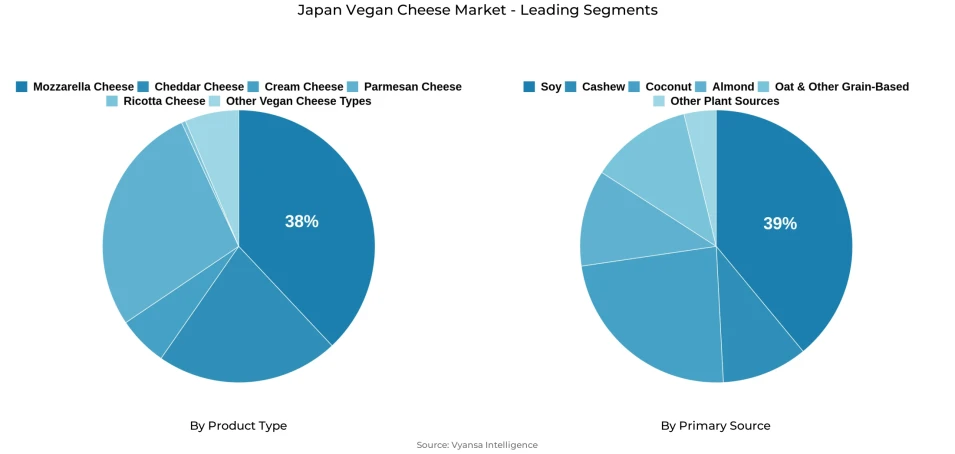
- By product type, mozzarella cheese led the market with a 38% share in 2026.
- Ricotta Cheese is the fastest-growing product type, expanding at a CAGR of 9.95% between 2026 and 2032.
- By primary source, soy led the market with a 39% share in 2026.
- Coconut is the fastest-growing primary source, expanding at a CAGR of 6.15% between 2026 and 2032.
- The market is fragmented, with the five leading companies holding a combined 24% share in 2026.
The demand for vegan cheese in Japan is extended across committed vegan consumers, supported by the country’s high prevalence of lactose malabsorption and growing interest in health-oriented food choices. An earlier clinical study found lactose malabsorption in approximately 89% of Japanese adults, highlighting a structural limitation in conventional dairy tolerance. More recent research involving 843 Japanese adults also links self-reported lactose intolerance with dairy avoidance and lower calcium intake, reinforcing the importance of suitable dairy alternatives.
Additionally, Japan’s broader plant-based dairy market is estimated at USD 805 million, with approximately 90% represented by plant-based milk, leaving vegan cheese relatively underpenetrated but with room for expansion. The category is projected to reach USD 850 million by 2032, implying a 0.78% CAGR during 2026–2032.
Vegan cheese can capture this opportunity by addressing familiar consumption occasions—pizza, toast, pasta, sandwiches and prepared foods, rather than requiring consumers to adopt fully plant-based diets. Consequently, meltability, texture, flavour and cooking performance will be critical to repeat adoption. Growing availability through supermarkets, foodservice and prepared foods can further move vegan cheese from a specialist dietary substitute toward an everyday dairy-alternative ingredient, particularly among flexitarian and lactose-sensitive consumers.
Japan Vegan Cheese Market Drivers
Selective Dairy Avoidance Broadens the Addressable Consumer Base
Vegan cheese gains a structural demand base from consumers who actively reduce dairy even when they do not follow vegan diets. The commercial importance lies in selective substitution. A household can replace conventional cheese on pizza, toast, or gratin while continuing to consume other animal-derived foods, allowing plant-based cheese to participate in existing meal routines rather than depending on consumers making a complete lifestyle change.
A 2025 peer-reviewed study covering 843 healthy Japanese adults found that 22.7% reported lactose-intolerance symptoms. Participants reporting these symptoms also consumed significantly less milk than participants without them. The study does not measure vegan cheese consumption directly and lactose sensitivity does not translate one-for-one into cheese avoidance, but it provides clear evidence that a meaningful group of Japanese consumers already adjusts dairy consumption in response to digestive tolerance.
That behavioural base creates room for dairy-free cheese when products fit familiar consumption occasions. Shreds, slices and spreads can substitute into dishes consumers already prepare instead of requiring new eating habits. Through 2032, this favours products positioned around direct replacement, cooking usability and dairy-free formulation, giving the Japan vegan cheese industry a recurring demand pool that extends well beyond consumers identifying specifically as vegan.
Japan Vegan Cheese Market Challenges
Established Dairy Cheese Performance Raises the Qualification Bar for Vegan Alternatives
The central challenge for vegan cheese in Japan is not basic cheese availability, but persuading consumers to replace a familiar dairy product with an alternative expected to perform in the same meal. Conventional cheese sets established benchmarks for richness, melt, stretch and texture across pizza, toast, gratin and other high-frequency applications. Vegan cheese therefore needs to provide a clear dietary or formulation advantage while reducing the functional compromise associated with substitution.
The challenge is visible in how manufacturers are developing products. In October 2024, Kagome Co. Ltd. and TWO Inc. launched Ever Cheese after specifically targeting the melting stretch, richness and cheese-like flavour expected from conventional products. The companies developed the product for applications including gratin and other heated dishes, while Kagome now also supplies a 500 g frozen professional format positioned for pizza and gratin. The product demonstrates how plant-based cheese development is being engineered around conventional-cheese performance rather than dairy-free positioning alone.
This raises the development threshold for manufacturers because improved formulation must translate into performance under real cooking conditions. Products that melt, portion, and integrate into recipes more naturally require less behavioural change from households and professional kitchens. The challenge therefore moderates conversion where taste or functionality remains visibly different, while concentrating consumption toward vegan cheese that can substitute convincingly into established Japanese cheese occasions.
Japan Vegan Cheese Market Recent Trends
AI Assisted Ordering Can Lower the Shelf Access Barrier for Emerging Plant Based SKUs
Artificial intelligence is becoming relevant to vegan cheese through retail assortment decisions rather than through the cheese formulation itself. Convenience stores operate with limited shelf space, which tends to favour products with established turnover. Smaller categories can therefore struggle to secure initial listings because an individual store has little local performance history showing that a new plant-based SKU will generate sufficient demand.
In June 2025, FamilyMart began operating its AI Recommend Ordering system across 500 stores nationwide. The system analyses one year of item-level sales alongside surrounding foot traffic, demographic information, weather and calendar data. It can recommend products that a store has not previously carried by comparing the location with similar higher-performing stores. FamilyMart also reported that the system reduced ordering work by approximately six hours per week at participating outlets.
The system was not developed specifically for vegan cheese, so it should not be treated as proof of category demand. Its relevance is distribution access. Once a plant-based cheese SKU demonstrates performance in comparable outlets, data-led assortment can reduce dependence on an individual store manager's prior familiarity with the category. This creates a potential route for emerging products to gain trial across higher-frequency retail channels where availability itself can support repeat consumption.
Japan Vegan Cheese Market Future Opportunities
Inbound Foodservice Creates Contract Demand for Dairy Free Cheese Formats
Hotels, restaurants, cafés and tourism-linked foodservice represent one of the clearest opportunities for vegan cheese because these operators increasingly need to accommodate consumers with different dietary requirements without creating a completely separate menu for each group. Vegan cheese provides a reusable ingredient across pizza, sandwiches, breakfast dishes, bakery items, sauces and Western-style prepared meals, making it operationally more useful than a single-purpose specialist product.
Japan recorded 3,466,700 international visitor arrivals in February 2026, 6.4% above February 2025 and the highest February total recorded at that point. In March 2026, Japan's tourism authorities also updated guidance for restaurants and accommodation providers serving vegetarian, vegan, Muslim and other dietary groups, with the programme designed to make practical accommodation easier for hospitality operators.
The commercial opening is therefore stronger in professional formats than in simply adding more small retail packs. Manufacturers can develop larger shredded packs, spreadable formats, neutral cooking bases and clearly communicated dairy-free products supported by foodservice distributors and menu-development guidance. Companies capable of maintaining consistent professional supply can convert dietary accommodation from an occasional special request into recurring procurement, creating a higher-frequency business-to-business demand channel for the Japan vegan cheese industry.
Unlock Market Intelligence
Explore the market potential with our data-driven report
Japan Vegan Cheese Market Segmentation Analysis
By Product Type
- Mozzarella Cheese
- Cheddar Cheese
- Cream Cheese
- Parmesan Cheese
- Ricotta Cheese
- Other Vegan Cheese Types
Mozzarella Leads While Ricotta Grows Fastest
Mozzarella Cheese leads product-type demand with a 38% market share in 2026 because it maps directly onto some of the most repeatable applications available to vegan cheese. Pizza, toast, gratin and baked dishes require a mild cheese format that can be shredded, portioned and heated while leaving the underlying recipe largely unchanged. This gives mozzarella-style products relevance across both household cooking and professional kitchens, while the frequency of these meal occasions provides a larger consumption base than more specialised vegan cheese formats.
Ricotta Cheese is forecast to expand at a CAGR of 9.95% between 2026 and 2032, making it the fastest-growing product type. Its opportunity lies in pasta fillings, bakery products, desserts and creamy prepared foods where smoothness, richness and cultured flavour matter more than long stretch. This allows ricotta-style products to enter applications that are less exposed to the most difficult technical requirement facing mozzarella alternatives. Ricotta therefore grows faster from a smaller base while mozzarella retains leadership through the larger frequency of its established cooking occasions.
By Primary Source
- Soy
- Cashew
- Coconut
- Almond
- Oat & Other Grain-Based
- Other Plant Sources
Soy Leads While Coconut Grows Fastest
Soy leads source-based demand with a 39% market share in 2026 because it combines formulation flexibility with strong ingredient familiarity in Japan. Soy can be processed into shredded, sliced and fermented cheese-style products while drawing on an established domestic ecosystem of soy milk and soy-based foods. This reduces ingredient unfamiliarity and gives manufacturers a material platform that can be adapted across several vegan cheese formats.
Coconut is forecast to grow at a CAGR of 6.15% between 2026 and 2032, making it the fastest-growing primary source. Coconut-derived fats are well suited to formulations where richness, mouthfeel and melting behaviour are more important than protein density, particularly in slices and shreds. Coconut also allows manufacturers to diversify beyond soy and build products with different sensory and allergen profiles. Soy should retain leadership through its wider established formulation base, while coconut gains faster from a smaller position as manufacturers broaden the ingredient systems used to replicate dairy-like texture.
Unlock Market Intelligence
Explore the market potential with our data-driven report
Japan Vegan Cheese Market Competitive Landscape
The Japan vegan cheese market is fragmented, with the five leading companies holding a combined 24% share in 2026 and most category value distributed across other food manufacturers, plant-based specialists, ingredient companies and private-label products. Marinfood Co. Ltd. holds the leading position among the supplied competitive set, followed by Rokko Butter Co. Ltd., J-Oil Mills Inc., Marusan-Ai Co. Ltd. and AEON Co. Ltd. Competition increasingly centres on cooking functionality, mainstream distribution, foodservice access and the ability to position plant-based products within familiar cheese occasions rather than relying solely on vegan identity.
Key Companies in the Japan Vegan Cheese Market
- Marinfood Co. Ltd. (My Vegan)
- Rokko Butter Co. Ltd. (QBB PLANT MADE)
- J-Oil Mills Inc. (Violife)
- Marusan-Ai Co. Ltd. (Soy Cheese)
- AEON Co. Ltd. (TOPVALU)
- Fuji Oil Co. Ltd.
- Sagamiya Foods Co. Ltd. (BEYOND TOFU)
- Kagome Co. Ltd. (Ever Cheese)
- TERRA FOODS Co. Ltd. (marude)
- MOCHI CREAM JAPAN Co. Ltd.
Recent Developments in the Japan Vegan Cheese Market
- April 2026: Fuji Oil Co. Ltd. launched DEAli, a professional-use fermented plant-milk ingredient range based on soy and oats. The range includes DEAli creamy, a 500 g plant-milk cheese product, alongside plant cream and fermented plant butter. Fuji Oil developed the platform using in-house plant-milk extraction and a fermentation process refined over approximately ten years to create a dairy-like aroma and smooth texture. The development expands vegan cheese beyond finished retail alternatives into ingredients that bakeries, confectionery manufacturers and prepared-food producers can incorporate directly into their own products, creating a deeper business-to-business layer within the market.
- March 2025: Rokko Butter Co. Ltd. expanded QBB PLANT MADE with P Stretch Shreds, a household product designed to reproduce the milky taste and stretching behaviour associated with mozzarella cheese. The company also expanded its professional plant-based offering with creamy and shredded formats. The development reflects a shift from simply providing dairy-free products toward engineering individual plant-based formats around specific conventional-cheese functions, increasing the number of applications in which professional kitchens and households can use vegan alternatives without changing the underlying dish.
Frequently Asked Questions
Related Report
- Market Segmentation
- Research Scope
- Research Methodology
- Definitions and Assumptions
- Executive Summary
- Japan Vegan Cheese Market Policies, Regulations, and Standards
- Japan Vegan Cheese Market Dynamics
- Growth Factors
- Challenges
- Trends
- Opportunities
- Japan Vegan Cheese Market Statistics, 2022-2032
- Market Size & Growth Outlook
- By Revenues in USD Million
- By Quantity Sold in Thousand Tons
- Market Segmentation & Growth Outlook
- By Product Type
- Mozzarella Cheese- Market Insights and Forecast 2022-2032, USD Million & Thousand Tons
- Cheddar Cheese- Market Insights and Forecast 2022-2032, USD Million & Thousand Tons
- Cream Cheese- Market Insights and Forecast 2022-2032, USD Million & Thousand Tons
- Parmesan Cheese- Market Insights and Forecast 2022-2032, USD Million & Thousand Tons
- Ricotta Cheese- Market Insights and Forecast 2022-2032, USD Million & Thousand Tons
- Other Vegan Cheese Types- Market Insights and Forecast 2022-2032, USD Million & Thousand Tons
- By Primary Source
- Cashew- Market Insights and Forecast 2022-2032, USD Million & Thousand Tons
- Soy- Market Insights and Forecast 2022-2032, USD Million & Thousand Tons
- Coconut- Market Insights and Forecast 2022-2032, USD Million & Thousand Tons
- Almond- Market Insights and Forecast 2022-2032, USD Million & Thousand Tons
- Oat & Other Grain-Based- Market Insights and Forecast 2022-2032, USD Million & Thousand Tons
- Other Plant Sources- Market Insights and Forecast 2022-2032, USD Million & Thousand Tons
- By Form
- Shreds & Grated- Market Insights and Forecast 2022-2032, USD Million & Thousand Tons
- Slices- Market Insights and Forecast 2022-2032, USD Million & Thousand Tons
- Blocks & Wedges- Market Insights and Forecast 2022-2032, USD Million & Thousand Tons
- Spreads / Creamy- Market Insights and Forecast 2022-2032, USD Million & Thousand Tons
- Other Forms- Market Insights and Forecast 2022-2032, USD Million & Thousand Tons
- By Distribution Channel
- Supermarkets & Hypermarkets- Market Insights and Forecast 2022-2032, USD Million & Thousand Tons
- Convenience Stores- Market Insights and Forecast 2022-2032, USD Million & Thousand Tons
- Specialty Stores- Market Insights and Forecast 2022-2032, USD Million & Thousand Tons
- Online Stores- Market Insights and Forecast 2022-2032, USD Million & Thousand Tons
- Direct / B2B Distribution- Market Insights and Forecast 2022-2032, USD Million & Thousand Tons
- Others- Market Insights and Forecast 2022-2032, USD Million & Thousand Tons
- By End Use
- Household Consumers- Market Insights and Forecast 2022-2032, USD Million & Thousand Tons
- Foodservice- Market Insights and Forecast 2022-2032, USD Million & Thousand Tons
- Food Processing- Market Insights and Forecast 2022-2032, USD Million & Thousand Tons
- Other Commercial & Institutional Users- Market Insights and Forecast 2022-2032, USD Million & Thousand Tons
- By Region
- Hokkaido- Market Insights and Forecast 2022-2032, USD Million & Thousand Tons
- Kanto- Market Insights and Forecast 2022-2032, USD Million & Thousand Tons
- Chubu- Market Insights and Forecast 2022-2032, USD Million & Thousand Tons
- Kansai- Market Insights and Forecast 2022-2032, USD Million & Thousand Tons
- Kyushu & Okinawa- Market Insights and Forecast 2022-2032, USD Million & Thousand Tons
- By Competitors
- Competition Characteristics
- Market Share & Analysis
- By Product Type
- Market Size & Growth Outlook
- Japan Mozzarella Cheese Market Statistics, 2022-2032
- Market Size & Growth Outlook
- By Revenues in USD Million
- By Quantity Sold in Thousand Tons
- Market Segmentation & Growth Outlook
- By Primary Source- Market Insights and Forecast 2022-2032, USD Million & Thousand Tons
- By Form- Market Insights and Forecast 2022-2032, USD Million & Thousand Tons
- By Distribution Channel- Market Insights and Forecast 2022-2032, USD Million & Thousand Tons
- By End Use- Market Insights and Forecast 2022-2032, USD Million & Thousand Tons
- By Region- Market Insights and Forecast 2022-2032, USD Million & Thousand Tons
- Market Size & Growth Outlook
- Japan Cheddar Cheese Market Statistics, 2022-2032
- Market Size & Growth Outlook
- By Revenues in USD Million
- By Quantity Sold in Thousand Tons
- Market Segmentation & Growth Outlook
- By Primary Source- Market Insights and Forecast 2022-2032, USD Million & Thousand Tons
- By Form- Market Insights and Forecast 2022-2032, USD Million & Thousand Tons
- By Distribution Channel- Market Insights and Forecast 2022-2032, USD Million & Thousand Tons
- By End Use- Market Insights and Forecast 2022-2032, USD Million & Thousand Tons
- By Region- Market Insights and Forecast 2022-2032, USD Million & Thousand Tons
- Market Size & Growth Outlook
- Japan Cream Cheese Market Statistics, 2022-2032
- Market Size & Growth Outlook
- By Revenues in USD Million
- By Quantity Sold in Thousand Tons
- Market Segmentation & Growth Outlook
- By Primary Source- Market Insights and Forecast 2022-2032, USD Million & Thousand Tons
- By Form- Market Insights and Forecast 2022-2032, USD Million & Thousand Tons
- By Distribution Channel- Market Insights and Forecast 2022-2032, USD Million & Thousand Tons
- By End Use- Market Insights and Forecast 2022-2032, USD Million & Thousand Tons
- By Region- Market Insights and Forecast 2022-2032, USD Million & Thousand Tons
- Market Size & Growth Outlook
- Japan Parmesan Cheese Market Statistics, 2022-2032
- Market Size & Growth Outlook
- By Revenues in USD Million
- By Quantity Sold in Thousand Tons
- Market Segmentation & Growth Outlook
- By Primary Source- Market Insights and Forecast 2022-2032, USD Million & Thousand Tons
- By Form- Market Insights and Forecast 2022-2032, USD Million & Thousand Tons
- By Distribution Channel- Market Insights and Forecast 2022-2032, USD Million & Thousand Tons
- By End Use- Market Insights and Forecast 2022-2032, USD Million & Thousand Tons
- By Region- Market Insights and Forecast 2022-2032, USD Million & Thousand Tons
- Market Size & Growth Outlook
- Japan Ricotta Cheese Market Statistics, 2022-2032
- Market Size & Growth Outlook
- By Revenues in USD Million
- By Quantity Sold in Thousand Tons
- Market Segmentation & Growth Outlook
- By Primary Source- Market Insights and Forecast 2022-2032, USD Million & Thousand Tons
- By Form- Market Insights and Forecast 2022-2032, USD Million & Thousand Tons
- By Distribution Channel- Market Insights and Forecast 2022-2032, USD Million & Thousand Tons
- By End Use- Market Insights and Forecast 2022-2032, USD Million & Thousand Tons
- By Region- Market Insights and Forecast 2022-2032, USD Million & Thousand Tons
- Market Size & Growth Outlook
- Japan Other Vegan Cheese Types Market Statistics, 2022-2032
- Market Size & Growth Outlook
- By Revenues in USD Million
- By Quantity Sold in Thousand Tons
- Market Segmentation & Growth Outlook
- By Primary Source- Market Insights and Forecast 2022-2032, USD Million & Thousand Tons
- By Form- Market Insights and Forecast 2022-2032, USD Million & Thousand Tons
- By Distribution Channel- Market Insights and Forecast 2022-2032, USD Million & Thousand Tons
- By End Use- Market Insights and Forecast 2022-2032, USD Million & Thousand Tons
- By Region- Market Insights and Forecast 2022-2032, USD Million & Thousand Tons
- Market Size & Growth Outlook
- Competitive Outlook
- Company Profiles
- Marinfood Co. Ltd. (My Vegan)
- Business Description
- Product Portfolio
- Collaborations & Alliances
- Recent Developments
- Financial Details
- Others
- Rokko Butter Co. Ltd. (QBB PLANT MADE)
- Business Description
- Product Portfolio
- Collaborations & Alliances
- Recent Developments
- Financial Details
- Others
- J-Oil Mills Inc. (Violife)
- Business Description
- Product Portfolio
- Collaborations & Alliances
- Recent Developments
- Financial Details
- Others
- Marusan-Ai Co. Ltd. (Soy Cheese)
- Business Description
- Product Portfolio
- Collaborations & Alliances
- Recent Developments
- Financial Details
- Others
- AEON Co. Ltd. (TOPVALU)
- Business Description
- Product Portfolio
- Collaborations & Alliances
- Recent Developments
- Financial Details
- Others
- Fuji Oil Co. Ltd.
- Business Description
- Product Portfolio
- Collaborations & Alliances
- Recent Developments
- Financial Details
- Others
- Sagamiya Foods Co. Ltd. (BEYOND TOFU)
- Business Description
- Product Portfolio
- Collaborations & Alliances
- Recent Developments
- Financial Details
- Others
- Kagome Co. Ltd. (Ever Cheese)
- Business Description
- Product Portfolio
- Collaborations & Alliances
- Recent Developments
- Financial Details
- Others
- TERRA FOODS Co. Ltd. (marude)
- Business Description
- Product Portfolio
- Collaborations & Alliances
- Recent Developments
- Financial Details
- Others
- MOCHI CREAM JAPAN Co. Ltd.
- Business Description
- Product Portfolio
- Collaborations & Alliances
- Recent Developments
- Financial Details
- Others
- Marinfood Co. Ltd. (My Vegan)
- Company Profiles
- Disclaimer
| Segment | Sub-Segment |
|---|---|
| By Product Type |
|
| By Primary Source |
|
| By Form |
|
| By Distribution Channel |
|
| By End Use |
|
| By Region |
|
Research Methodology
This study followed a structured approach comprising four key phases to assess the size and scope of the electro-oxidation market. The process began with thorough secondary research to collect data on the target market, related markets, and broader industry context. These findings, along with preliminary assumptions and estimates, were then validated through extensive primary research involving industry experts from across the value chain. To calculate the overall market size, both top-down and bottom-up methodologies were employed. Finally, market segmentation and data triangulation techniques were applied to refine and validate segment-level estimations.
Secondary Research
The secondary research phase involved gathering data from a wide range of credible and published sources. This step helped in identifying industry trends, defining market segmentation, and understanding the market landscape and value chain.
Sources consulted during this phase included:
- Company annual reports, investor presentations, and press releases
- Industry white papers and certified publications
- Trade directories and market-recognized databases
- Articles from authoritative authors and reputable journals
- Gold and silver standard websites
Secondary research was critical in mapping out the industry's value chain and monetary flow, identifying key market segments, understanding regional variations, and tracking significant industry developments.
Other key sources:
- Financial disclosures
- Industry associations and trade bodies
- News outlets and business magazines
- Academic journals and research studies
- Paid industry databases
Primary Research
To validate secondary data and gain deeper market insights, primary research was conducted with key stakeholders across both the supply and demand sides of the market.
On the demand side, participants included decision-makers and influencers from end-user industries—such as CIOs, CTOs, and CSOs—who provided first-hand perspectives on market needs, product usage, and future expectations.
On the supply side, interviews were conducted with manufacturers, industry associations, and institutional participants to gather insights into current offerings, product pipelines, and market challenges.
Primary interviews provided critical inputs such as:
- Market size and revenue data
- Product and service breakdowns
- Market forecasts
- Regional and application-specific trends
Stakeholders consulted included:
- Leading OEM and solution providers
- Channel and distribution partners
- End users across various applications
- Independent consultants and industry specialists
Market Size Estimation and Data Triangulation
- Identifying Key Market Participants (Secondary Research)
- Goal: To identify the major players or companies in the target market. This typically involves using publicly available data sources such as industry reports, market research publications, and financial statements of companies.
- Tools: Reports from firms like Gartner, Forrester, Euromonitor, Statista, IBISWorld, and others. Public financial statements, news articles, and press releases from top market players.
- Extracting Earnings of Key Market Participants
- Goal: To estimate the earnings generated from the product or service being analyzed. This step helps in understanding the revenue potential of each market player in a specific geography.
- Methods: Earnings data can be gathered from:
- Publicly available financial reports (for listed companies).
- Interviews and primary data sources from professionals, such as Directors, VPs, SVPs, etc. This is especially useful for understanding more nuanced, internal data that isn't publicly disclosed.
- Annual reports and investor presentations of key players.
- Data Collation and Development of a Relevant Data Model
- Goal: To collate inputs from both primary and secondary sources into a structured, data-driven model for market estimation. This model will incorporate key market KPIs and any independent variables relevant to the market.
- Key KPIs: These could include:
- Market size, growth rate, and demand drivers.
- Industry-specific metrics like market share, average revenue per customer (ARPC), or average deal size.
- External variables, such as economic growth rates, inflation rates, or commodity prices, that could affect the market.
- Data Modeling: Based on this data, the market forecasts are developed for the next 5 years. A combination of trend analysis, scenario modeling, and statistical regression might be used to generate projections.
- Scenario Analysis
- Goal: To test different assumptions and validate how sensitive the market is to changes in key variables (e.g., market demand, regulatory changes, technological disruptions).
- Types of Scenarios:
- Base Case: Based on current assumptions and historical data.
- Best-Case Scenario: Assuming favorable market conditions, regulatory environments, and technological advancements.
- Worst-Case Scenario: Accounting for adverse factors, such as economic downturns, stricter regulations, or unexpected disruptions.












