China Vegan Cheese Market Report: Trends, Growth and Forecast (2026-2032)
By Product Type (Mozzarella Cheese, Cheddar Cheese, Cream Cheese, Parmesan Cheese, Ricotta Cheese, Other Vegan Cheese Types), By Primary Source (Cashew, Soy, Coconut, Almond, Oat & Other Grain-Based, Other Plant Sources), By Form (Shreds & Grated, Slices, Blocks & Wedges, Spreads / Creamy, Other Forms), By Distribution Channel (Supermarkets & Hypermarkets, Convenience Stores, Specialty Stores, Online Stores, Direct / B2B Distribution, Others), By End Use (Household Consumers, Foodservice, Food Processing, Other Commercial & Institutional Users), By Region (North, East, Southwest, Northwest, North East, South) ... Read more

|
Major Players
|
China Vegan Cheese Market Overview
Vegan cheese refers to dairy-free cheese alternatives made from plant-derived ingredients such as nuts, soy, coconut, seeds, starches, and vegetable oils. These products are formulated to replicate the taste, texture, creaminess, melting, and stretching properties of conventional cheese, providing suitable alternatives for household and foodservice applications. The China vegan cheese market is projected to grow at a CAGR of 13.12% during the forecast period.
Key Highlights of the China Vegan Cheese Market
- The China vegan cheese market was valued at USD 277.80 million in 2025.
- The market reached USD 316 million in 2026 and is projected to reach USD 662 million by 2032.
- The industry is forecast to expand at a CAGR of 13.12% during 2026-2032.
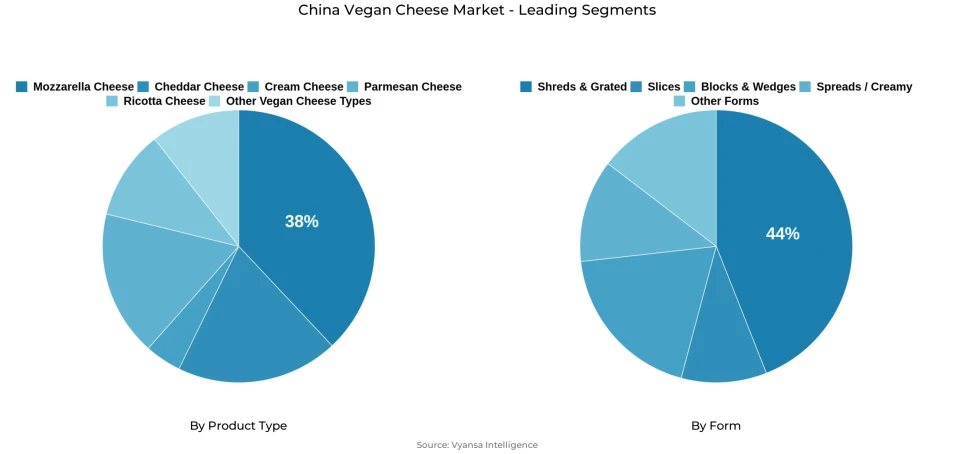
- Mozzarella is the leading product type with 38% in 2026.
- However, ricotta is projected to be the fastest-growing product type at a CAGR of 22.5% during 2026-2032
- Shreds & grated is the leading the industry with 44.0% in 2026.
- Meanwhile, spreads / creamy is forecast to grow fastest at a CAGR of 18.67% during 2026-2032.
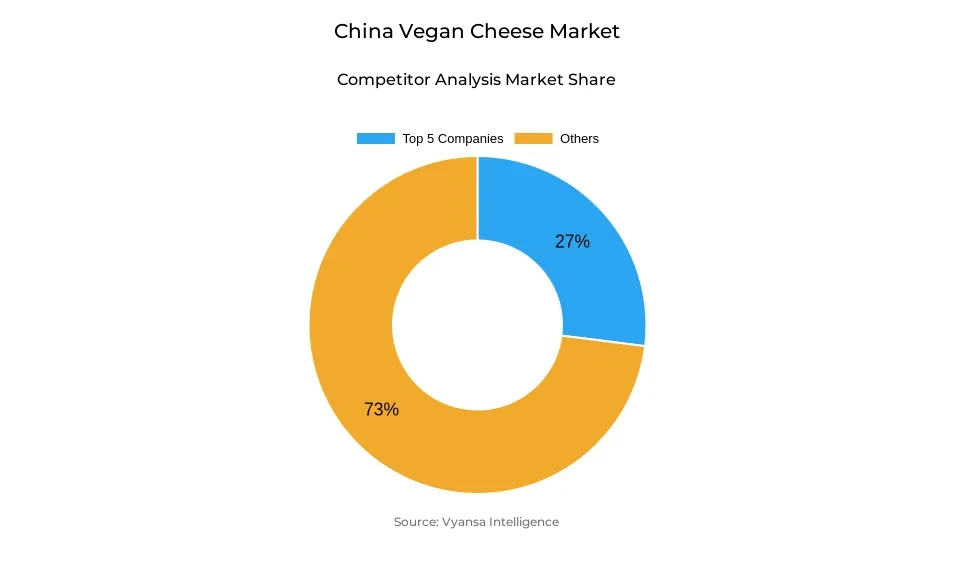
- Competition remains fragmented, with the top five participants accounting for approximately 27% of the market.
The vegan cheese market in China is gaining momentum as consumers increasingly explore plant-based dairy alternatives, supported by growing awareness of healthy eating, animal welfare, and sustainable food choices. Rising lactose intolerance and dairy sensitivity also create demand for non-dairy alternatives, while expanding urbanization and exposure to Western-style foods are increasing familiarity with cheese-based applications such as pizza, burgers, sandwiches, and pasta. Growth in vegan restaurants, plant-based cafés, foodservice chains, and online grocery platforms is improving further product accessibility.
In addition, improvements in plant-based formulations are enhancing taste, melting, stretchability, texture, and nutritional profiles, addressing key barriers to consumer adoption. The expansion of China's broader plant-based food ecosystem, product innovation using soy, nuts, coconut, and other proteins, and increasing premiumization are expected to support market growth. Foodservice adoption, retail distribution expansion, local product development, and competitive pricing are likely to become increasingly important growth factors in the coming years.
Government Regulations Shaping the Vegan Cheese Industry in China
China’s evolving food-labeling framework is expected to shape the development and market-entry strategies of the vegan cheese industry, rather than directly drive market demand. The Food Labeling Supervision and Administration Measures, issued in 2025 and effective from March 2027, require plant-source foods designed to resemble animal-source foods to clearly communicate their plant-based nature through appropriate product naming. For vegan cheese manufacturers, this makes compliant naming and front-of-pack communication important considerations when positioning products that replicate conventional cheese.
The revised framework for pre-packaged food and nutrition labeling, also taking effect in March 2027, further increases the importance of accurate product names, ingredient declarations, nutrition information, and compliant packaging. These requirements may raise compliance and relabeling costs in the near term, particularly for smaller brands, but could improve consumer transparency and confidence as the category develops. Companies with China-ready packaging, regulatory expertise, and disciplined product claims are therefore better positioned to expand without compliance-related launch delays.
China Vegan Cheese Market Drivers
Health-Led Flexitarian Demand and Dairy-Free Consumption
Health-oriented eating is broadening China’s plant-based consumer base beyond strict vegans toward flexitarian and plant-curious consumers, creating a larger addressable demand for vegan cheese industry. A 2024 Kantar survey commissioned by ProVeg, covering 1,000 consumers across Beijing, Shanghai, and Guangzhou, found that only 49% were aware of the health benefits of plant-based diets before receiving further information, highlighting a substantial awareness gap. However, after being presented with scientifically supported health and environmental benefits, 98% said they were willing to increase plant-based food consumption or try a more plant-based diet.
Adoption is also extending beyond strict veganism. An earlier ProVeg survey of young Chinese consumers found 19.3% identified as flexitarian, compared with 1.0% vegetarian and 0.6% vegan, indicating that dietary reduction rather than complete animal-product avoidance is the larger consumer opportunity. This creates a strong pathway for vegan cheese because consumers can substitute dairy cheese selectively in familiar foods such as pizza, sandwiches, baked dishes, and snacks. Over the coming years, health education, wider plant-based awareness, product availability, improved taste and texture, and flexible dietary adoption are expected to support category penetration beyond the relatively small strict-vegan population.
China Vegan Cheese Market Challenges
Low Cheese Familiarity and Limited Domestic Market Development
A key structural challenge for the China vegan cheese market is that the category is developing alongside a conventional cheese market that still has relatively low household penetration. As a result, consumers must first become familiar with cheese as an everyday food before understanding the value proposition of a dairy-free alternative. This increases the consumer education burden, making factors such as taste, texture, usage familiarity, and price particularly important for adoption.
According to the USDA’s 2025 China dairy outlook, cheese consumption in China is growing gradually, while household penetration remains relatively low. The report also indicates that domestic cheese production is largely focused on mainstream, easier-to-produce varieties rather than specialty formats. This creates a narrower established consumer base for vegan cheese to target and increases the importance of familiar formats, clear usage occasions, and accessible pricing.
The relatively limited pool of dedicated domestic vegan-cheese suppliers further constrains product availability, manufacturing depth, and local distribution capabilities. Consequently, market development is likely to remain progressive rather than driven by rapid mass adoption, with manufacturers needing to build consumer familiarity through recognizable applications, consistent product quality, and wider retail and foodservice availability.
China Vegan Cheese Market Recent Trends
Shift Toward Advanced Plant-Protein and Precision-Fermentation Technologies
The China vegan cheese market is gradually moving beyond conventional starch-and-oil formulations toward advanced combinations of plant proteins, functional fats, hydrocolloids, and fermentation technologies that can improve protein content, texture, meltability, stretch, creaminess, and flavour. This innovation is particularly important because achieving sensory and functional similarity with conventional cheese remains a major barrier to wider adoption.
The development of precision-fermentation technologies is creating an additional pathway for improving cheese functionality. In 2024, New Culture partnered with CJ CheilJedang to scale production of animal-free casein produced through precision fermentation, targeting lower-cost applications including mozzarella. While this technology is not yet mainstream in China’s vegan cheese market, the partnership demonstrates growing commercial interest in fermentation-derived proteins for achieving cheese-like functionality.
In the coming years, conventional plant-based formulations are likely to remain the dominant commercial route because of their established ingredients and production infrastructure. However, precision fermentation could gain importance where it delivers measurable improvements in stretch, melt, creaminess, flavour, or nutritional value. Companies able to combine improved sensory performance with scalable production, cost efficiency, and regulatory readiness are likely to gain stronger differentiation.
China Vegan Cheese Market Future Opportunities
Foodservice Expansion and Next-Generation Dairy-Alternative Proteins
Foodservice is emerging as a significant opportunity for the China vegan cheese market because prepared dishes provide consumers with an easy way to experience plant-based cheese without purchasing and learning to use a standalone product. Applications across pizza, bakery products, sandwiches, cafés, hotels, and restaurants can therefore accelerate product trial while creating recurring B2B demand. Meltability, stretch, portion control, storage stability, and consistent supply are particularly important for foodservice adoption.
China’s catering industry generated approximately USD 856.7 billion in revenue in 2025, representing 3.2% year-on-year growth, expanding the addressable customer base for plant-based cheese suppliers. In addition, Shanghai’s 2026–2030 food-technology development plan supports research and commercialization in areas including alternative proteins, synthetic biology, and next-generation dairy alternatives. This creates an ecosystem for both near-term foodservice adoption and longer-term ingredient innovation.
The opportunity extends beyond traditional plant-based formulations. Higher-protein, fortified, and fermentation-derived dairy alternatives could create premium applications as technology improves. Suppliers that develop partnerships with restaurant chains, distributors, central kitchens, bakeries, and food manufacturers can establish repeat B2B demand while reducing consumer education costs. Over time, stronger functionality, competitive pricing, regulatory readiness, and reliable local supply will determine whether foodservice adoption translates into broader household penetration.
Unlock Market Intelligence
Explore the market potential with our data-driven report
China Vegan Cheese Market Segmentation Analysis
By Product Type
- Mozzarella Cheese
- Cheddar Cheese
- Cream Cheese
- Parmesan Cheese
- Ricotta Cheese
- Other Vegan Cheese
Mozzarella Cheese Leads on Meltability and Foodservice Compatibility
Mozzarella Cheese accounted for 38% of the China vegan cheese market in 2026, making it the leading product type. Its position is supported by its suitability for familiar cooked applications where meltability, stretchability, coverage, and texture are important, particularly across pizza, baked dishes, sandwiches, and prepared foods. This reduces the need for consumers and foodservice operators to change established preparation and consumption habits.
Ricotta is projected to be the fastest-growing product type, with a 22.5% CAGR during 2026–2032. Its softer texture creates opportunities across pasta fillings, bakery products, desserts, spreads, and lighter meals, enabling manufacturers to diversify consumption occasions.
Mozzarella is therefore expected to remain the volume anchor, while faster-growing formats such as ricotta can broaden the category as consumer familiarity increases.
By Form
- Shreds & Grated
- Slices
- Blocks & Wedges
- Spreads / Creamy
- Other Forms
Shreds & Grated Leads Through Convenience and Application Versatility
Shreds & Grated accounted for 44.0% of the China vegan cheese market in 2026, making it the leading product form. Its dominance is closely linked to convenience, consistent portioning, and broad application flexibility. The format can be distributed evenly across pizza, baked foods, pasta, sandwiches, and toppings, reducing preparation requirements for both consumers and foodservice operators. Its compatibility with mozzarella and other melt-focused products further strengthens demand in prepared-food applications.
Spreads / Creamy is projected to be the fastest-growing form, registering an 18.67% CAGR during 2026–2032. Unlike shredded products, creamy formats rely less on stretch and browning performance and can address a wider range of consumption occasions, including breakfast, bakery products, dips, sandwiches, snacks, and café foods. This creates opportunities to expand vegan cheese beyond traditional cooked applications and into everyday snacking and spreading occasions.
Form preferences are therefore expected to increasingly reflect specific usage occasions. Shreds are likely to remain the high-volume workhorse for prepared foods, while creamy formats can broaden category penetration through spreading, filling, dipping, and snacking. Slices and blocks will continue serving consumers seeking conventional cheese presentation, but their success will depend more heavily on achieving familiar texture and bite.
Unlock Market Intelligence
Explore the market potential with our data-driven report
China Vegan Cheese Market Competitive Landscape
The China vegan cheese market is fragmented, with the top five companies accounting for 27% of market revenue. Competition is shaped less by scale alone than by the ability to deliver acceptable taste and functionality at workable prices, support China-ready labelling, maintain consistent supply and secure relevant distribution. International brands bring broader vegan-cheese product development experience, while China-focused participants can compete through local channel knowledge and closer customer support. The competitive field remains open to new entrants, but weak local verification for many global brands means product relevance should not be confused with established China penetration.
Prominent Companies in the China Vegan Cheese Market
- Flora Food Group B.V. (Violife)
- Usourcegroup (Grassroots)
- Daiya Foods Inc.
- Miyoko’s Creamery
- Fujian Green Power Biotechnology Co. Ltd.
- Guangdong Beary Foodstuff Co., Ltd.
- Bel S.A. (Bel Group)
- Saputo Inc.
- Danone S.A.
- Hochland SE
- Others
Recent Developments in the China Vegan Cheese Market
- August 2024: Grassroots Launches Commercial Sales of Vegan Cheese in China. Beijing-based Grassroots, a 100% plant-based creamery, launched commercial sales in August 2024, marking the entry of a dedicated domestic vegan-cheese producer into the Chinese market. The company was founded by four partners, including Chinese co-founder Dandan Yang, and focuses specifically on vegan cheese. By June 2025, the company reported that revenue was growing and was preparing to introduce a cream-cheese product, indicating continued portfolio expansion beyond its initial products.
- September 2024: Chinese Researchers Advance Plant-Protein Applications in Vegan Cheese. Researchers from Shanghai University of Engineering Science and other Chinese institutions published a review in Transactions of the Chinese Society of Agricultural Engineering examining the application of plant proteins in plant-based cheese. The study reviewed approaches for improving flavour, texture, quality, and functionality, highlighting the growing domestic research focus on addressing the sensory limitations of plant-based cheese.
Frequently Asked Questions
Related Report
- Market Segmentation
- Research Scope
- Research Methodology
- Definitions and Assumptions
- Executive Summary
- China Vegan Cheese Market Policies, Regulations, and Standards
- China Vegan Cheese Market Dynamics
- Growth Factors
- Challenges
- Trends
- Opportunities
- China Vegan Cheese Market Statistics, 2022-2032F
- Market Size & Growth Outlook
- By Revenues in USD Million
- By Quantity Sold in Thousand Tons
- Market Segmentation & Growth Outlook
- By Product Type
- Mozzarella Cheese- Market Insights and Forecast 2022-2032, USD Million & Thousand Tons
- Cheddar Cheese- Market Insights and Forecast 2022-2032, USD Million & Thousand Tons
- Cream Cheese- Market Insights and Forecast 2022-2032, USD Million & Thousand Tons
- Parmesan Cheese- Market Insights and Forecast 2022-2032, USD Million & Thousand Tons
- Ricotta Cheese- Market Insights and Forecast 2022-2032, USD Million & Thousand Tons
- Other Vegan Cheese Types- Market Insights and Forecast 2022-2032, USD Million & Thousand Tons
- By Primary Source
- Cashew- Market Insights and Forecast 2022-2032, USD Million & Thousand Tons
- Soy- Market Insights and Forecast 2022-2032, USD Million & Thousand Tons
- Coconut- Market Insights and Forecast 2022-2032, USD Million & Thousand Tons
- Almond- Market Insights and Forecast 2022-2032, USD Million & Thousand Tons
- Oat & Other Grain-Based- Market Insights and Forecast 2022-2032, USD Million & Thousand Tons
- Other Plant Sources- Market Insights and Forecast 2022-2032, USD Million & Thousand Tons
- By Form
- Shreds & Grated- Market Insights and Forecast 2022-2032, USD Million & Thousand Tons
- Slices- Market Insights and Forecast 2022-2032, USD Million & Thousand Tons
- Blocks & Wedges- Market Insights and Forecast 2022-2032, USD Million & Thousand Tons
- Spreads / Creamy- Market Insights and Forecast 2022-2032, USD Million & Thousand Tons
- Other Forms- Market Insights and Forecast 2022-2032, USD Million & Thousand Tons
- By Distribution Channel
- Supermarkets & Hypermarkets- Market Insights and Forecast 2022-2032, USD Million & Thousand Tons
- Convenience Stores- Market Insights and Forecast 2022-2032, USD Million & Thousand Tons
- Specialty Stores- Market Insights and Forecast 2022-2032, USD Million & Thousand Tons
- Online Stores- Market Insights and Forecast 2022-2032, USD Million & Thousand Tons
- Direct / B2B Distribution- Market Insights and Forecast 2022-2032, USD Million & Thousand Tons
- Others- Market Insights and Forecast 2022-2032, USD Million & Thousand Tons
- By End Use
- Household Consumers- Market Insights and Forecast 2022-2032, USD Million & Thousand Tons
- Foodservice- Market Insights and Forecast 2022-2032, USD Million & Thousand Tons
- Food Processing- Market Insights and Forecast 2022-2032, USD Million & Thousand Tons
- Other Commercial & Institutional Users- Market Insights and Forecast 2022-2032, USD Million & Thousand Tons
- By Region
- North- Market Insights and Forecast 2022-2032, USD Million & Thousand Tons
- East- Market Insights and Forecast 2022-2032, USD Million & Thousand Tons
- Southwest- Market Insights and Forecast 2022-2032, USD Million & Thousand Tons
- Northwest- Market Insights and Forecast 2022-2032, USD Million & Thousand Tons
- North East- Market Insights and Forecast 2022-2032, USD Million & Thousand Tons
- South- Market Insights and Forecast 2022-2032, USD Million & Thousand Tons
- By Competitors
- Competition Characteristics
- Market Share & Analysis
- By Product Type
- Market Size & Growth Outlook
- China Mozzarella Cheese Market Statistics, 2022-2032
- Market Size & Growth Outlook
- By Revenues in USD Million
- By Quantity Sold in Thousand Tons
- Market Segmentation & Growth Outlook
- By Primary Source- Market Insights and Forecast 2022-2032, USD Million & Thousand Tons
- By Form- Market Insights and Forecast 2022-2032, USD Million & Thousand Tons
- By Distribution Channel- Market Insights and Forecast 2022-2032, USD Million & Thousand Tons
- By End Use- Market Insights and Forecast 2022-2032, USD Million & Thousand Tons
- By Region- Market Insights and Forecast 2022-2032, USD Million & Thousand Tons
- Market Size & Growth Outlook
- China Cheddar Cheese Market Statistics, 2022-2032
- Market Size & Growth Outlook
- By Revenues in USD Million
- By Quantity Sold in Thousand Tons
- Market Segmentation & Growth Outlook
- By Primary Source- Market Insights and Forecast 2022-2032, USD Million & Thousand Tons
- By Form- Market Insights and Forecast 2022-2032, USD Million & Thousand Tons
- By Distribution Channel- Market Insights and Forecast 2022-2032, USD Million & Thousand Tons
- By End Use- Market Insights and Forecast 2022-2032, USD Million & Thousand Tons
- By Region- Market Insights and Forecast 2022-2032, USD Million & Thousand Tons
- Market Size & Growth Outlook
- China Cream Cheese Market Statistics, 2022-2032
- Market Size & Growth Outlook
- By Revenues in USD Million
- By Quantity Sold in Thousand Tons
- Market Segmentation & Growth Outlook
- By Primary Source- Market Insights and Forecast 2022-2032, USD Million & Thousand Tons
- By Form- Market Insights and Forecast 2022-2032, USD Million & Thousand Tons
- By Distribution Channel- Market Insights and Forecast 2022-2032, USD Million & Thousand Tons
- By End Use- Market Insights and Forecast 2022-2032, USD Million & Thousand Tons
- By Region- Market Insights and Forecast 2022-2032, USD Million & Thousand Tons
- Market Size & Growth Outlook
- China Parmesan Cheese Market Statistics, 2022-2032
- Market Size & Growth Outlook
- By Revenues in USD Million
- By Quantity Sold in Thousand Tons
- Market Segmentation & Growth Outlook
- By Primary Source- Market Insights and Forecast 2022-2032, USD Million & Thousand Tons
- By Form- Market Insights and Forecast 2022-2032, USD Million & Thousand Tons
- By Distribution Channel- Market Insights and Forecast 2022-2032, USD Million & Thousand Tons
- By End Use- Market Insights and Forecast 2022-2032, USD Million & Thousand Tons
- By Region- Market Insights and Forecast 2022-2032, USD Million & Thousand Tons
- Market Size & Growth Outlook
- China Ricotta Cheese Market Statistics, 2022-2032
- Market Size & Growth Outlook
- By Revenues in USD Million
- By Quantity Sold in Thousand Tons
- Market Segmentation & Growth Outlook
- By Primary Source- Market Insights and Forecast 2022-2032, USD Million & Thousand Tons
- By Form- Market Insights and Forecast 2022-2032, USD Million & Thousand Tons
- By Distribution Channel- Market Insights and Forecast 2022-2032, USD Million & Thousand Tons
- By End Use- Market Insights and Forecast 2022-2032, USD Million & Thousand Tons
- By Region- Market Insights and Forecast 2022-2032, USD Million & Thousand Tons
- Market Size & Growth Outlook
- China Other Vegan Cheese Types Market Statistics, 2022-2032
- Market Size & Growth Outlook
- By Revenues in USD Million
- By Quantity Sold in Thousand Tons
- Market Segmentation & Growth Outlook
- By Primary Source- Market Insights and Forecast 2022-2032, USD Million & Thousand Tons
- By Form- Market Insights and Forecast 2022-2032, USD Million & Thousand Tons
- By Distribution Channel- Market Insights and Forecast 2022-2032, USD Million & Thousand Tons
- By End Use- Market Insights and Forecast 2022-2032, USD Million & Thousand Tons
- By Region- Market Insights and Forecast 2022-2032, USD Million & Thousand Tons
- Market Size & Growth Outlook
- Competitive Outlook
- Company Profiles
- Flora Food Group B.V. (Violife)
- Business Description
- Product Portfolio
- Collaborations & Alliances
- Recent Developments
- Financial Details
- Others
- Usourcegroup (Grassroots)
- Business Description
- Product Portfolio
- Collaborations & Alliances
- Recent Developments
- Financial Details
- Others
- Daiya Foods Inc.
- Business Description
- Product Portfolio
- Collaborations & Alliances
- Recent Developments
- Financial Details
- Others
- Miyoko's Creamery
- Business Description
- Product Portfolio
- Collaborations & Alliances
- Recent Developments
- Financial Details
- Others
- Fujian Green Power Biotechnology Co. Ltd.
- Business Description
- Product Portfolio
- Collaborations & Alliances
- Recent Developments
- Financial Details
- Others
- Guangdong Beary Foodstuff Co., Ltd.
- Business Description
- Product Portfolio
- Collaborations & Alliances
- Recent Developments
- Financial Details
- Others
- Bel S.A. (Bel Group)
- Business Description
- Product Portfolio
- Collaborations & Alliances
- Recent Developments
- Financial Details
- Others
- Saputo Inc.
- Business Description
- Product Portfolio
- Collaborations & Alliances
- Recent Developments
- Financial Details
- Others
- Danone S.A.
- Business Description
- Product Portfolio
- Collaborations & Alliances
- Recent Developments
- Financial Details
- Others
- Hochland SE.
- Business Description
- Product Portfolio
- Collaborations & Alliances
- Recent Developments
- Financial Details
- Others
- Flora Food Group B.V. (Violife)
- Company Profiles
- Disclaimer
| Segment | Sub-Segment |
|---|---|
| By Product Type |
|
| By Primary Source |
|
| By Form |
|
| By Distribution Channel |
|
| By End Use |
|
| By Region |
|
Research Methodology
This study followed a structured approach comprising four key phases to assess the size and scope of the electro-oxidation market. The process began with thorough secondary research to collect data on the target market, related markets, and broader industry context. These findings, along with preliminary assumptions and estimates, were then validated through extensive primary research involving industry experts from across the value chain. To calculate the overall market size, both top-down and bottom-up methodologies were employed. Finally, market segmentation and data triangulation techniques were applied to refine and validate segment-level estimations.
Secondary Research
The secondary research phase involved gathering data from a wide range of credible and published sources. This step helped in identifying industry trends, defining market segmentation, and understanding the market landscape and value chain.
Sources consulted during this phase included:
- Company annual reports, investor presentations, and press releases
- Industry white papers and certified publications
- Trade directories and market-recognized databases
- Articles from authoritative authors and reputable journals
- Gold and silver standard websites
Secondary research was critical in mapping out the industry's value chain and monetary flow, identifying key market segments, understanding regional variations, and tracking significant industry developments.
Other key sources:
- Financial disclosures
- Industry associations and trade bodies
- News outlets and business magazines
- Academic journals and research studies
- Paid industry databases
Primary Research
To validate secondary data and gain deeper market insights, primary research was conducted with key stakeholders across both the supply and demand sides of the market.
On the demand side, participants included decision-makers and influencers from end-user industries—such as CIOs, CTOs, and CSOs—who provided first-hand perspectives on market needs, product usage, and future expectations.
On the supply side, interviews were conducted with manufacturers, industry associations, and institutional participants to gather insights into current offerings, product pipelines, and market challenges.
Primary interviews provided critical inputs such as:
- Market size and revenue data
- Product and service breakdowns
- Market forecasts
- Regional and application-specific trends
Stakeholders consulted included:
- Leading OEM and solution providers
- Channel and distribution partners
- End users across various applications
- Independent consultants and industry specialists
Market Size Estimation and Data Triangulation
- Identifying Key Market Participants (Secondary Research)
- Goal: To identify the major players or companies in the target market. This typically involves using publicly available data sources such as industry reports, market research publications, and financial statements of companies.
- Tools: Reports from firms like Gartner, Forrester, Euromonitor, Statista, IBISWorld, and others. Public financial statements, news articles, and press releases from top market players.
- Extracting Earnings of Key Market Participants
- Goal: To estimate the earnings generated from the product or service being analyzed. This step helps in understanding the revenue potential of each market player in a specific geography.
- Methods: Earnings data can be gathered from:
- Publicly available financial reports (for listed companies).
- Interviews and primary data sources from professionals, such as Directors, VPs, SVPs, etc. This is especially useful for understanding more nuanced, internal data that isn't publicly disclosed.
- Annual reports and investor presentations of key players.
- Data Collation and Development of a Relevant Data Model
- Goal: To collate inputs from both primary and secondary sources into a structured, data-driven model for market estimation. This model will incorporate key market KPIs and any independent variables relevant to the market.
- Key KPIs: These could include:
- Market size, growth rate, and demand drivers.
- Industry-specific metrics like market share, average revenue per customer (ARPC), or average deal size.
- External variables, such as economic growth rates, inflation rates, or commodity prices, that could affect the market.
- Data Modeling: Based on this data, the market forecasts are developed for the next 5 years. A combination of trend analysis, scenario modeling, and statistical regression might be used to generate projections.
- Scenario Analysis
- Goal: To test different assumptions and validate how sensitive the market is to changes in key variables (e.g., market demand, regulatory changes, technological disruptions).
- Types of Scenarios:
- Base Case: Based on current assumptions and historical data.
- Best-Case Scenario: Assuming favorable market conditions, regulatory environments, and technological advancements.
- Worst-Case Scenario: Accounting for adverse factors, such as economic downturns, stricter regulations, or unexpected disruptions.












