India Ready to Drink Coffee Market Research Report: Size, Share, Trends & Forecast (2027-2033)
Rising café culture, growing preference for milk-based cold coffee and expanding quick-commerce networks are accelerating packaged coffee adoption in India, creating opportunities for ready to drink brands through affordable single-serve formats, wider flavor choices and protein-enriched beverages through 2033.
|
Major Companies of India Ready to Drink Coffee Market
|
India Ready to Drink Coffee Market Overview
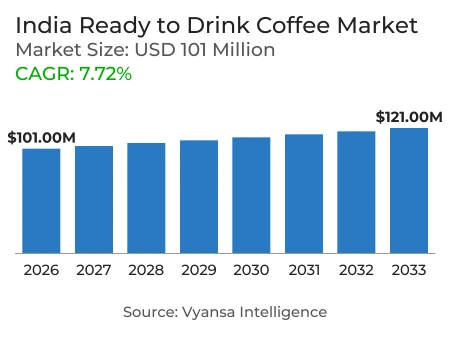
Ready to drink coffee comprises packaged coffee-based beverages consumed directly without brewing or mixing. The India ready to drink coffee market includes milk-based coffee, black coffee, and plant-based coffee beverages sold in bottles, cans, cartons, and other single-serve formats. Consumers purchase these products through physical retail outlets, online grocery platforms, and quick-commerce services. The market is projected to grow at a compound annual growth rate (CAGR) of 7.72% during 2027–2033.
Key Highlights of the India Ready to Drink Coffee Market
- The India ready to drink coffee market is estimated at USD 101 million in 2026 and USD 121 million in 2027, and is forecast to reach USD 189 million by 2033.
- The market is forecast to expand at a CAGR of 7.72% between 2027 and 2033.
- By packaging type, Bottles led the market with a 57% share in 2026.
- Cans are the fastest-growing packaging type, expanding at a CAGR of 8.89% between 2027 and 2033.
- By distribution channel, Supermarkets and Hypermarkets led the market with a 26% share in 2026.
- Online Retail is the fastest-growing distribution channel, expanding at a CAGR of 11.85% between 2027 and 2033.
- The market is fragmented, with the top five companies holding an approximate combined share of 39% in 2026.
India’s ready to drink coffee market is expanding through adoption of packaged formats within a relatively small coffee-consumption base. The commerce ministry reported in January 2025 that domestic consumption rose from 84,000 to 91,000 tons over eleven years. An October 2026 survey of 1,000 respondents found that 55% consumed iced latte or cold coffee, 37.5% had first tried bottled or canned ready to drink coffee during the preceding year, and 25.2% reported repurchasing it.
Supply and product choice support this shift. Government data released in September 2025 put milk production at 239 million tons, approximately 24% of global output. MoSPI’s January 2025 household survey identified beverages, refreshments, and processed food as the largest food-spending category, representing 9.84% of rural and 11.09% of urban household expenditure. Supplier offerings span Cothas’s 250 ml milk coffee, Only Earth’s 165 ml oat coffee, and Blue Tokai’s 250 ml cold-brew cans made with 100% Arabica coffee and offered in packs of two or six. Milk availability supports production scale, while recipe and pack variety widen the potential buyer base.
In April 2026, Swiggy Instamart reported nearly tenfold growth in cold coffee during a summer demand spike. Through 2033, affordable packs, broader choice, and repeat purchases should expand demand across age groups, particularly as MoSPI projects people aged 15–29 to represent 22.7% of India’s population by 2036.
India Ready to Drink Coffee Market Government Compliance
Tax treatment directly affects the retail affordability of milk-based ready to drink coffee. Following the September 2025 GST Council meeting, GST on products classified as beverages containing milk declined from 12% to 5%, effective September 22, 2025. At an unchanged pretax price, complete pass-through would reduce the tax-inclusive selling price by 6.25%. This provides room for qualifying products to improve affordability or maintain established retail price points while offering additional value.
Labeling compliance also affects market access and packaging decisions. In October 2026, FSSAI issued notices concerning coffee-flavored dairy beverages described as “Flavoured Milk” on the front but “Proprietary Food” on the back. The regulator identified the products as falling within the standardized flavored-milk category and sought explanations from manufacturers. Brands consequently need consistent product classification, pack declarations, and online descriptions to reduce the risk of packaging rework or advertising restrictions as distribution expands.
India Ready to Drink Coffee Market Drivers
Café Expansion and Familiar Flavors Support Packaged Cold Coffee Adoption
Expanding café networks are increasing exposure to milk-based and flavored coffee, creating a larger potential audience for packaged equivalents. Barista Coffee Company Limited opened its 500th café in Patna in January 2026, with a network spanning more than 160 cities, and targeted 800–900 outlets by 2030. Third Wave Coffee entered Kolkata with three cafés in June 2026 and targeted 320 cafés by the end of fiscal 2027, from more than 240 outlets. This expansion introduces café-style coffee experiences across more locations, increasing familiarity with recipes that manufacturers can offer through ready to drink products.
Consumer preferences strengthen the connection between coffee exposure and packaged-product demand. The Coffee Board of India’s 2023 study found that 80% of surveyed coffee consumers preferred adding milk. Among flavoring preferences, chocolate and vanilla recorded responses of 70% and 61%, respectively. Ready to drink brands address this demand through familiar, finished beverages: Sleepy Owl’s canned-coffee offering includes Classic, Hazelnut, and Salted Caramel flavors. Such products allow consumers to purchase a consistent coffee experience without brewing equipment or preparation, extending consumption opportunities beyond café visits.
Through 2033, wider café exposure and familiar packaged recipes should support product trials across established and emerging urban markets. Manufacturers that combine these recipes with accessible pack prices and dependable retail availability should be better positioned to convert familiarity into repeat purchases.
India Ready to Drink Coffee Market Challenges
Per-Serve Pricing Limits Routine Packaged Coffee Consumption
Ready to drink coffee embeds ingredients, processing, packaging, and distribution into every serving. This creates an affordability challenge when consumers consider purchasing the product frequently, particularly for premium cans positioned above mainstream milk-coffee cartons.
Retail listings show a 180 ml NESCAFÉ Chilled Latte carton at an approximate listed maximum retail price of USD 0.47, compared with USD 1.89 for a 220 ml Blue Tokai Mocha Cold Coffee. The premium product therefore costs approximately four times as much per pack and 3.3 times as much per 100 ml. Purchasing one mainstream carton daily for 30 days would cost approximately USD 14.19. For context, this equals around 19% of the average urban monthly per capita consumption expenditure reported in the 2023–24 household survey.
The price range can encourage occasional trial while restricting everyday consumption, especially for premium products. Through 2033, purchase frequency is likely to remain sensitive to pack price, promotions, and the perceived benefit of convenience relative to preparing coffee at home.
India Ready to Drink Coffee Market Recent Trends
Packaged Cold Coffee Develops Beyond Peak-Summer Consumption
Packaged cold coffee is gaining relevance beyond its traditional summer-refreshment occasion. More consistent consumption across seasons can support longer retail stocking periods and regular replenishment, improving the commercial case for maintaining dedicated cold-coffee assortments.
In June 2026, Sleepy Owl’s co-founder reported that the brand’s winter sales decline relative to peak summer had narrowed to approximately 20%, compared with 60–70% before the pandemic. This indicates a less pronounced seasonal pattern within the brand’s business and supports its assessment that cold coffee is becoming a more regular consumption occasion.
Through 2033, a smaller seasonal demand gap should help suppliers sustain distribution and production planning across more months of the year. Brands that retain consumers after summer promotions end should be better positioned to increase annual purchases per customer.
Aseptic Carton Production Expands Ambient Distribution Potential
Aseptic processing and packaging allow suitable coffee formulations to remain shelf-stable before opening for a validated storage period. This reduces dependence on continuous refrigerated transportation and warehousing, making it easier to supply outlets with limited chilled-storage capacity.
SIG opened its Ahmedabad aseptic-carton plant in February 2025 with initial annual capacity of up to four billion packs and reported that the facility was fully operational in December 2025. The plant supplies packaging for dairy and non-carbonated beverages, providing a larger domestic supply base that ready to drink coffee manufacturers can use alongside other beverage producers. Local production can shorten packaging delivery timelines and support more responsive replenishment.
Manufacturers still require suitable filling equipment, validated processing, and pack-integrity controls. Through 2033, broader access to aseptic packaging should help coffee brands expand ambient distribution while retaining the option to chill products before sale or consumption.
India Ready to Drink Coffee Market Future Opportunities
Protein-Enriched Coffee Creates Additional Everyday Consumption Occasions
Protein-enriched ready to drink coffee gives dairy and nutrition suppliers an opportunity to serve consumers seeking both coffee refreshment and a convenient source of protein. The commercial proposition is a finished beverage that can fit into work breaks, travel, or a nutrition-focused daily routine without mixing powders or preparing coffee separately.
In May 2026, Parag Milk Foods launched Avvatar Protein Cold Coffee in a 250 ml aseptic carton containing 15 g of protein. The product was introduced in Classic and Vanilla variants, with no added sugar or artificial sweeteners, at a launch price equivalent to approximately USD 1.26. Its formulation and packaging demonstrate how manufacturers can combine coffee with a differentiated nutritional proposition in a portable retail product.
Suppliers need heat-stable formulations, consistent taste, substantiated nutrition claims, and distribution that keeps the product available for repeat purchase. Through 2033, growth opportunities should come from extending availability and offering suitable pack-price combinations, with repeat demand determined by everyday taste and affordability alongside the declared protein content.
India Ready to Drink Coffee Market Segmentation Analysis
By Packaging Type
- Bottles
- Cans
- Cartons
- Other Packaging Formats
Bottles Anchor 57% of Packaging Demand as Cans Record the Fastest Growth
- Dominant segment
- Bottles are estimated to account for 57% of the India ready to drink coffee market in 2026. Glass and plastic bottles provide familiar retail presentation, while capped formats offer convenient handling and resealing. The Coffee Board’s 2023 study found that 54% of surveyed cold-coffee consumers included bottles or jars among their preferred packaging options when purchasing coffee for home consumption. This familiarity supports bottled ready to drink coffee, particularly where suppliers combine recognizable packaging with suitable single-serve sizes.
- Fastest-growing segment
- Cans benefit from portable single-serve formats and expanding domestic packaging supply. In September 2026, Crown broke ground on its Unnao plant, which is planned to contain two production lines with annual capacity of approximately 2.2 billion beverage cans. Operations are scheduled to begin in the second half of 2027. The capacity will serve multiple beverage categories, widening potential sourcing options for canned-coffee manufacturers. Supported by product differentiation and additional packaging availability, cans are projected to grow during 2027–2033 at a CAGR of 8.89%.
By Distribution Channel
- Supermarkets and Hypermarkets
- Convenience Stores
- Traditional Grocery Stores
- Online Retail
- Other Offline Channels
Supermarkets and Hypermarkets Anchor 26% of Channel Demand
- Dominant segment
- Supermarkets and hypermarkets are estimated to account for 26% of the market in 2026. Their multi-brand assortments, beverage displays, and grocery-shopping traffic support product discovery and comparison across coffee flavors, formats, and price points. Physical distribution opportunities are also expanding: DMart reported 500 stores at March 2026, compared with 415 a year earlier. Such expansion creates additional potential stocking points for packaged-coffee suppliers that secure listings and maintain effective shelf availability.
- Fastest-growing segment
- Online retail includes website, app, and quick-commerce orders, regardless of where fulfillment occurs. It supports immediate replenishment, targeted product discovery, and access to a wider assortment than an individual store may carry. In June 2026, Flipkart Minutes reported that cold-coffee consumption had increased nearly fivefold by May, alongside a 4.6-fold increase in searches. These platform-level results show strong online purchasing momentum. Supported by expanding delivery coverage and repeat ordering, online retail is projected to grow during 2027–2033 at a CAGR of 11.85%.
India Ready to Drink Coffee Market Competitive Landscape
The India ready to drink coffee market is fragmented, with the top five companies estimated to hold a combined share of approximately 39% in 2026. The leading participants are Nestlé India Limited, Gujarat Co-operative Milk Marketing Federation Limited, Parle Agro Pvt Ltd, Tata Consumer Products Limited, and Britannia Industries Limited.
Key Companies in the India Ready to Drink Coffee Market
- Nestlé India Limited (NESCAFÉ)
- Gujarat Co-operative Milk Marketing Federation Limited (Amul)
- Sleepy Owl Coffee Private Limited
- Hindustan Unilever Limited (Bru)
- Muhavra Enterprises Private Limited (Blue Tokai)
- Parle Agro Pvt Ltd (Smoodh)
- Tata Consumer Products Limited (Tata Coffee Grand)
- Britannia Industries Limited (Winkin’ Cow)
- Cothas Coffee Co.
- Naturise Consumer Products Pvt Ltd (Only Earth)
Company Profiling
Nestlé India Limited (NESCAFÉ): Nestlé participates through milk-based ready to drink coffee in cartons and cans, combining familiar coffee branding with multiple flavor and strength options. Its portfolio addresses convenient at-home and on-the-go consumption. In its FY2025–26 update, Nestlé India reported the launch of Vietnamese Latte and Iced Cappuccino variants, broadening its ready to drink coffee offering.
Gujarat Co-operative Milk Marketing Federation Limited (Amul): Amul supplies packaged milk coffee through its Kool Café range and competes through dairy sourcing, processing capabilities, and multiple retail formats. Its portfolio also extends into protein-enriched coffee. AmulFed Dairy’s 2024–25 report documented the launch of protein-rich coffee-flavored milk, while the current Arabica Coffee product provides 10 g of protein in a 180 ml pack with no added sugar.
Parle Agro Pvt Ltd (Smoodh): Parle Agro participates through Smoodh Coffee Frappé, positioning coffee-flavored milk within a small-pack dairy-beverage portfolio. Its approach emphasizes familiar taste and compact serving sizes suitable for individual consumption. Current retail listings verify Coffee Frappé in a 150 ml UHT-treated PET bottle, providing a coffee-specific offering that can be stored under the labeled ambient conditions before opening.
Tata Consumer Products Limited (Tata Coffee Grand): Tata Consumer supplies flavored ready to drink coffee under Tata Coffee Grand, including French Vanilla, Belgian Chocolate, and Swiss Caramel offerings. Its competitive position combines coffee-brand recognition with packaged-beverage distribution. During FY2025–26, the company reported Tata Coffee Grand Cold Coffee in PET packaging containing 40% recycled PET, extending its ready to drink packaging options.
Britannia Industries Limited (Winkin’ Cow): Britannia participates through Winkin’ Cow Café Frappé cold coffee, using its dairy-beverage platform to serve convenient single-serve consumption. Its manufacturing capabilities support product and bottle-format flexibility. In February 2026, Sidel reported that Britannia’s Winkin’ Cow aseptic PET line operated at 24,000 bottles per hour and had supported the portfolio since 2023, demonstrating an established production platform rather than a newly started 2026 operation.
Recent Developments in the India Ready to Drink Coffee Market
- April 2025
- Nestlé expanded its NESCAFÉ ready to drink cold-coffee range in India, offering café-style varieties and flavors for convenient consumption. Nestlé India’s annual report documented five canned variants, including Iced Latte, Iced Frappé, Choco Latte, Caramel Latte, and Classic Latte. The expansion increased flavor choice within an established packaged-coffee brand.
- April 2025
- Hindustan Unilever reported that it had introduced Bru cold coffee in carton packaging in southern India, following its canned offering, with plans for further expansion. The additional format broadened the brand’s routes to packaged-coffee consumption and supported its stated objective of improving accessibility.
- July 2026
- AGI Greenpac announced the start of construction of its Hathras aluminum beverage-can plant. The facility is planned to have annual capacity of 1.6 billion cans, with operations expected in the first half of 2027. It will serve multiple beverage categories, including ready to drink products, adding a potential domestic packaging source for canned-coffee manufacturers.
Frequently Asked Questions
Related Report
- India Ready to Drink Coffee Market Segmentation
- India Ready to Drink Coffee Market Introduction
- Product Definition
- Research Process
- Assumptions
- India Ready to Drink Coffee Market Executive Summary
- India Ready to Drink Coffee Market Trends & Developments
- India Ready to Drink Coffee Market Dynamics
- Growth Factors
- Challenges
- Impact Analysis
- India Ready to Drink Coffee Market Hotspot & Opportunities
- India Ready to Drink Coffee Market Outlook (2023-2033)
- Market Size & Outlook
- By Revenues (USD Million)
- Market Segmentation & Outlook
- By Product Formulation - USD Million (2023-2033)
- Dairy-Based Ready to Drink Coffee
- Plant-Based Ready to Drink Coffee
- Black Ready to Drink Coffee
- By Packaging Type - USD Million (2023-2033)
- Bottles
- Glass Bottles
- Plastic Bottles
- Cans
- Cartons
- Other Packaging Formats
- By Flavor Profile - USD Million (2023-2033)
- Unflavored
- Flavored
- Chocolate and Mocha
- Vanilla
- Caramel
- Hazelnut
- Other Flavors
- By Distribution Channel - USD Million (2023-2033)
- Supermarkets and Hypermarkets
- Convenience Stores
- Traditional Grocery Stores
- Online Retail
- Other Offline Channels
- By Geography
- South India
- East India
- West India
- By Company
- Competition Characteristics
- Market Shares & Analysis
- By Product Formulation - USD Million (2023-2033)
- India Dairy-Based Ready to Drink Coffee Market Outlook (2023-2033)
- Market Size & Outlook
- By Revenues (USD Million)
- Market Segmentation & Outlook
- By Product Formulation - USD Million (2023-2033)
- By Packaging Type - USD Million (2023-2033)
- By Flavor Profile - USD Million (2023-2033)
- By Distribution Channel - USD Million (2023-2033)
- Market Size & Outlook
- India Plant-Based Ready to Drink Coffee Market Outlook (2023-2033)
- Market Size & Outlook
- By Revenues (USD Million)
- Market Segmentation & Outlook
- By Product Formulation - USD Million (2023-2033)
- By Packaging Type - USD Million (2023-2033)
- By Flavor Profile - USD Million (2023-2033)
- By Distribution Channel - USD Million (2023-2033)
- Market Size & Outlook
- India Black Ready to Drink Coffee Market Outlook (2023-2033)
- Market Size & Outlook
- By Revenues (USD Million)
- Market Segmentation & Outlook
- By Product Formulation - USD Million (2023-2033)
- By Packaging Type - USD Million (2023-2033)
- By Flavor Profile - USD Million (2023-2033)
- By Distribution Channel - USD Million (2023-2033)
- Market Size & Outlook
- Market Size & Outlook
- India Ready to Drink Coffee Market Key Strategic Imperatives for Success & Growth
- India Ready to Drink Coffee Market Competitive Outlook
- Nestlé India Limited (NESCAFÉ)
- Business Description
- Product Portfolio
- Collaborations & Alliances
- Recent Developments
- Financial Details
- Others
- Gujarat Co-operative Milk Marketing Federation Limited (Amul)
- Business Description
- Product Portfolio
- Collaborations & Alliances
- Recent Developments
- Financial Details
- Others
- Sleepy Owl Coffee Private Limited
- Business Description
- Product Portfolio
- Collaborations & Alliances
- Recent Developments
- Financial Details
- Others
- Hindustan Unilever Limited (Bru)
- Business Description
- Product Portfolio
- Collaborations & Alliances
- Recent Developments
- Financial Details
- Others
- Muhavra Enterprises Private Limited (Blue Tokai)
- Business Description
- Product Portfolio
- Collaborations & Alliances
- Recent Developments
- Financial Details
- Others
- Parle Agro Pvt Ltd (Smoodh)
- Business Description
- Product Portfolio
- Collaborations & Alliances
- Recent Developments
- Financial Details
- Others
- Tata Consumer Products Limited (Tata Coffee Grand)
- Business Description
- Product Portfolio
- Collaborations & Alliances
- Recent Developments
- Financial Details
- Others
- Britannia Industries Limited (Winkin’ Cow)
- Business Description
- Product Portfolio
- Collaborations & Alliances
- Recent Developments
- Financial Details
- Others
- Cothas Coffee Co.
- Business Description
- Product Portfolio
- Collaborations & Alliances
- Recent Developments
- Financial Details
- Others
- Naturise Consumer Products Pvt Ltd (Only Earth)
- Business Description
- Product Portfolio
- Collaborations & Alliances
- Recent Developments
- Financial Details
- Others
- Nestlé India Limited (NESCAFÉ)
- Disclaimer
| Segment | Sub-Segment |
|---|---|
| By Product Formulation |
|
| By Packaging Type |
|
| By Flavor Profile |
|
| By Distribution Channel |
|
| By Region | |
| By North India | |
| By South India |
|
| By East India |
|
| By West India |
|
| By Himachal Pradesh | |
| By Punjab | |
| By Haryana | |
| By Uttar Pradesh | |
| By Others |
Research Methodology
This study followed a structured approach comprising four key phases to assess the size and scope of the electro-oxidation market. The process began with thorough secondary research to collect data on the target market, related markets, and broader industry context. These findings, along with preliminary assumptions and estimates, were then validated through extensive primary research involving industry experts from across the value chain. To calculate the overall market size, both top-down and bottom-up methodologies were employed. Finally, market segmentation and data triangulation techniques were applied to refine and validate segment-level estimations.
Secondary Research
The secondary research phase involved gathering data from a wide range of credible and published sources. This step helped in identifying industry trends, defining market segmentation, and understanding the market landscape and value chain.
Sources consulted during this phase included:
- Company annual reports, investor presentations, and press releases
- Industry white papers and certified publications
- Trade directories and market-recognized databases
- Articles from authoritative authors and reputable journals
- Gold and silver standard websites
Secondary research was critical in mapping out the industry's value chain and monetary flow, identifying key market segments, understanding regional variations, and tracking significant industry developments.
Other key sources:
- Financial disclosures
- Industry associations and trade bodies
- News outlets and business magazines
- Academic journals and research studies
- Paid industry databases
Primary Research
To validate secondary data and gain deeper market insights, primary research was conducted with key stakeholders across both the supply and demand sides of the market.
On the demand side, participants included decision-makers and influencers from end-user industries—such as CIOs, CTOs, and CSOs—who provided first-hand perspectives on market needs, product usage, and future expectations.
On the supply side, interviews were conducted with manufacturers, industry associations, and institutional participants to gather insights into current offerings, product pipelines, and market challenges.
Primary interviews provided critical inputs such as:
- Market size and revenue data
- Product and service breakdowns
- Market forecasts
- Regional and application-specific trends
Stakeholders consulted included:
- Leading OEM and solution providers
- Channel and distribution partners
- End users across various applications
- Independent consultants and industry specialists
Market Size Estimation and Data Triangulation
- Identifying Key Market Participants (Secondary Research)
- Goal: To identify the major players or companies in the target market. This typically involves using publicly available data sources such as industry reports, market research publications, and financial statements of companies.
- Tools: Reports from firms like Gartner, Forrester, Euromonitor, Statista, IBISWorld, and others. Public financial statements, news articles, and press releases from top market players.
- Extracting Earnings of Key Market Participants
- Goal: To estimate the earnings generated from the product or service being analyzed. This step helps in understanding the revenue potential of each market player in a specific geography.
- Methods: Earnings data can be gathered from:
- Publicly available financial reports (for listed companies).
- Interviews and primary data sources from professionals, such as Directors, VPs, SVPs, etc. This is especially useful for understanding more nuanced, internal data that isn't publicly disclosed.
- Annual reports and investor presentations of key players.
- Data Collation and Development of a Relevant Data Model
- Goal: To collate inputs from both primary and secondary sources into a structured, data-driven model for market estimation. This model will incorporate key market KPIs and any independent variables relevant to the market.
- Key KPIs: These could include:
- Market size, growth rate, and demand drivers.
- Industry-specific metrics like market share, average revenue per customer (ARPC), or average deal size.
- External variables, such as economic growth rates, inflation rates, or commodity prices, that could affect the market.
- Data Modeling: Based on this data, the market forecasts are developed for the next 5 years. A combination of trend analysis, scenario modeling, and statistical regression might be used to generate projections.
- Scenario Analysis
- Goal: To test different assumptions and validate how sensitive the market is to changes in key variables (e.g., market demand, regulatory changes, technological disruptions).
- Types of Scenarios:
- Base Case: Based on current assumptions and historical data.
- Best-Case Scenario: Assuming favorable market conditions, regulatory environments, and technological advancements.
- Worst-Case Scenario: Accounting for adverse factors, such as economic downturns, stricter regulations, or unexpected disruptions.