Dairy Market Research Report: Size, Share, Trends & Forecast (2027-2033)
India’s organized dairy sector accounts for approximately 32% of marketable milk surplus, while the unorganized segment handles the remaining 68%, representing a substantial opportunity for organized dairy players to expand branded distribution, strengthen procurement networks and capture value-added product demand through 2033.
|
Major Companies in Dairy Market
|
Dairy Market Overview
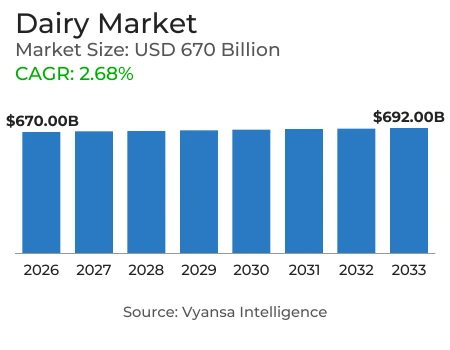
Dairy encompasses milk and milk-derived products, including fresh and processed milk, yogurt, cheese, butter, cream and dairy-based nutrition formats, consumed as everyday food, beverage and functional-nutrition items. Households, foodservice operators and nutrition-focused consumers drive consumption across breakfast, cooking, snacking and protein-supplementation occasions worldwide. The Dairy Market is forecast to grow at a CAGR of 2.68% between 2027 and 2033.
Key Highlights of the Dairy Market
- The Dairy Market was valued at USD 670 billion in 2025 and is estimated at USD 692 billion in 2027, forecast to reach USD 811 billion by 2033.
- The market is forecast to expand at a compound annual growth rate of 2.68% between 2027 and 2033.
- By product type, milk led the market with a 59% share in 2026.
- Yogurt is the fastest-growing product type, expanding at a CAGR of 13.13% between 2027 and 2033.
- By distribution channel, supermarkets and hypermarkets led the market with a 45% share in 2026.
- Online retail is the fastest-growing distribution channel, expanding at a CAGR of 25.70% between 2027 and 2033.
- Europe dominates the global dairy market, accounting for approximately 40% of the market share in 2026.
- The market is highly fragmented, with the top five companies holding a combined 28% share in 2026.
Dairy is moving away from a commodity, volume-led business built primarily on liquid milk sold through mature Western retail systems. Processors in established dairy economies are contending with abundant milk supply and softer commodity pricing, while capital is shifting toward higher-value, protein-rich and functional products. At the same time, consumption growth is increasingly concentrated in emerging Asian markets, where rising incomes and urbanization are pulling loose, informal dairy consumption toward packaged and branded formats.
Three forces are shaping how the category develops. Consumers are prioritizing protein density and satiety, pushing processors to reformulate everyday products into higher-margin functional variants rather than compete purely on commodity volume. Farm labor shortages and rising compliance costs are pushing producers toward automation and precision production to protect margins as milk supply outpaces near-term demand growth. Retail itself is fragmenting further, as private-label ranges and faster digital delivery reshape how frequently and through which channel dairy products reach the end user.
By the end of the forecast period, the Dairy Market should look less dependent on undifferentiated liquid milk and more shaped by functional nutrition, Organized emerging-market demand and automated production. That trajectory holds only if protein-led reformulation keeps outpacing commodity price weakness and if Organized retail and cold-chain infrastructure in emerging Asia continues to expand fast enough to absorb rising branded consumption.
Dairy Market Drivers
Protein and Satiety Demand Reshapes Everyday Dairy Consumption
Consumers across developed dairy markets are shifting purchasing toward products with higher protein density and stronger satiety value, moving spend away from conventional milk, butter and standard yogurt toward high-protein, cultured and functional formats. Health-conscious shoppers and users of appetite-management treatments select dairy specifically because animal-milk proteins deliver a nutrient density that plant-based and conventional snack alternatives do not match at comparable cost.
US dairy executives identify protein as the leading demand trend in the category, cited by 88% of respondents in 2025, while Western Europe's high-protein dairy segment expanded at approximately 17% CAGR between 2019 and 2024. This pattern converts directly into reformulation, as processors redirect existing milk supply into higher-protein yogurt, cottage cheese and cultured product lines rather than standard liquid milk and butter.
Through 2033, satiety-oriented and protein-fortified formats should keep gaining share of category value as GLP-1 treatment adoption widens the pool of consumers prioritising nutrient density over volume. The driver stays commercially live for the dairy industry because it is anchored in dietary behaviour rather than a promotional cycle. Protein-led demand is lifting consumption of high-protein yogurt and cottage cheese while easing reliance on undifferentiated liquid milk.
Dairy Market Challenges
Milk Oversupply Compresses Commodity Dairy Economics
Milk output across major exporting regions is expanding faster than incremental commodity demand, leaving commodity processors and farmers exposed to weak pricing for undifferentiated milk, butter and powder. The imbalance is structural rather than seasonal, since expanded herd and processing capacity in the United States, Europe, New Zealand and South America cannot be withdrawn quickly once milk volumes exceed what conventional dairy demand absorbs.
Fat markets declined roughly 40% and whole milk powder fell around 30% year on year, while US all-milk prices dropped below USD 20 per hundredweight during late 2025, concrete signs of the pricing pressure moving through the value chain. This moderates the pace at which commodity-focused processors can sustain margin on standard milk, butter and powder lines, raising the incentive to requalify production toward higher-value cheese, whey and protein formats instead.
Processors with heavy exposure to butter, powder and commodity milk are redirecting capital toward cheese, whey protein and functional dairy lines that carry pricing power the commodity segment currently lacks. This shifts consumption weight in the dairy industry toward value-added categories through 2033, concentrating near-term demand growth away from undifferentiated liquid milk and powder toward higher-margin, protein-dense formats.
Dairy Market Recent Trends
Dairy Retail Shifts Toward Private Label and Rapid Digital Delivery
Dairy distribution is moving away from a structure built around national brands, large weekly grocery trips and conventional in-store replenishment cycles. Retailer-owned private-label ranges, online grocery and quick-commerce delivery are increasingly replacing that model, shifting dairy purchasing toward smaller, more frequent transactions across milk, yogurt, cheese and butter rather than a single dominant weekly shop.
Retailers and processors are responding with expanded store-brand ranges and faster fulfilment infrastructure to meet this shift. Store-brand grocery sales in the United States reached USD 282.8 billion in 2025, including approximately USD 9.9 billion of private-label natural cheese and USD 9.2 billion of private-label milk, while India's quick-commerce operators were expected to add approximately 2,000 to 2,500 dark stores during 2026 to support faster replenishment of milk, yogurt and butter.
Through 2033, this restructuring should keep lifting the frequency of dairy purchase occasions while transferring category value from national brands toward retailer-owned ranges and digitally fulfilled orders. Overall, distribution is moving demand toward smaller basket sizes bought more often across the dairy category, favouring processors able to supply both branded and private-label formats at speed.
AI and Robotics Automate Dairy Farm Production Decisions
Robotic milking systems, connected sensors and computer-vision tools are automating tasks that dairy farms previously performed through manual observation, including milking, animal identification, health monitoring, body-condition scoring and feeding decisions. This removes the labour-intensive, inconsistent visual assessment that limited how many animals a single farm worker could reliably monitor for early signs of illness or declining productivity.
The USDA Economic Research Service found that farms using robotic milking or at least two precision technologies achieved approximately 13% higher net returns on average, while computer-vision systems have demonstrated more than 0.80 correlation with expert body-condition scoring and roughly 94.6% accuracy identifying individual cows. A 2026 dairy-processing artificial-intelligence platform is separately targeting a 0.5 to 1.5 percentage-point yield improvement and 5% to 10% lower energy intensity downstream.
Adoption requires farms to invest in sensor and camera infrastructure and processors to integrate yield and energy-optimisation software into existing plants, a capital commitment that favours larger, better-financed operations. As labor availability tightens across the dairy industry in major producing economies, this technology shift is lifting demand for automated milking and monitoring equipment while widening the productivity gap between automated and manually operated farms.
Dairy Market Future Opportunities
India's Informal Milk Consumption Converts into Organized Branded Demand
India remains one of the world's largest milk-producing and consuming countries, yet a large share of that consumption still moves through informal, unbranded channels rather than Organized processors and packaged retail. This leaves a substantial pool of existing milk consumption that established dairy processors and branded product lines have not yet converted, a gap that has persisted because informal supply remains cheaper and more locally accessible than packaged alternatives in many regions.
Approximately 75% of India's milk continues to flow through informal channels even as organized-channel milk volumes are projected to expand around 10.3% during 2025 to 2030, considerably faster than national milk-production growth. Processors can capture this gap through packaged-milk conversion, e-commerce expansion, foodservice distribution and deeper penetration of secondary cities, turning existing loose-milk consumption into organized, branded revenue rather than requiring new demand creation.
Capturing this opening favors established cooperatives and processors with large farmer-sourcing networks, cold-chain capacity and existing retail distribution, since converting informal buyers requires trust and logistics reach more than product innovation alone. If Organized players execute, formal dairy industry revenue in India should grow faster than total milk volume through 2033, lifting branded consumption well beyond current packaged-retail levels.
Dairy Market Segmentation Analysis
By Product Type:
- Butter
- Cheese
- Cream
- Dairy Desserts
- Milk
- Yogurt
- Sour & Fermented Milk Drinks
Milk Holds 59% of Product Type Demand
Milk leads product-type demand because it is the most universally consumed dairy format and the raw material other dairy categories are processed from, and because established cold-chain and UHT infrastructure keeps its distribution cost below more processed formats. China Mengniu Dairy Company Limited's fresh milk business posted double-digit growth for 2025, per results announced in March 2026, while Royal FrieslandCampina N.V. reported milk deliveries of approximately 9,268 million kilograms in 2025, per its February 2026 annual results. This position should hold provided protein-fortified categories keep growing from a smaller base.
Yogurt is forecast to grow at a 13.13% CAGR between 2027 and 2033, the fastest of any product type, as protein-led reformulation pulls in health-conscious and GLP-1-medication consumers. Danone North America launched Oikos Fusion in August 2025, a 23-gram-protein cultured dairy drink for weight-loss consumers, while Müller Yoghurt & Desserts introduced its Müller x Myprotein Mixers high-protein range into UK retail in May 2026. It grows faster than milk because its buyer base expands on a health motivation independent of prior dairy use, while milk is near-universally consumed, keeping the industry's overall product mix tilting toward higher-protein formats.
By Distribution Channel:
- Traditional Grocery & Convenience Retailers
- Supermarkets & Hypermarkets
- Direct Sales & Milk Agents
- Foodservice & Institutional
- Online Retail
- Others
Supermarkets and Hypermarkets Hold 45% of Distribution Channel Demand
Supermarkets and hypermarkets lead distribution because large-format stores provide refrigerated infrastructure, broad SKU assortment and rapid replenishment across milk, yogurt, cheese and butter, while private-label programs let retailers control price and supply. Walmart Inc. opened a third dedicated milk-processing facility in Robinson, Texas, in 2026, a USD 350 million investment supplying Great Value and Sam's Club private-label milk to more than 650 stores, while The Kroger Co. added protein-focused products to its Simple Truth private-label line in September 2025. This channel should hold its lead provided private-label investment keeps pace with digital competition.
Online retail is forecast to grow at a 25.70% CAGR between 2027 and 2033, the fastest distribution channel, as rapid-delivery networks and cold-chain fulfilment extend dairy into digital channels that previously could not handle perishables reliably. Amazon.com Inc. confirmed in December 2025 that its same-day perishable-grocery delivery, including milk, now reaches more than 2,300 US cities, while DoorDash Inc. partnered with Empire Company Limited in April 2026, bringing more than 1,000 Canadian grocery stores onto its marketplace. It grows faster than supermarkets because it is scaling from a smaller base as cold-chain delivery only recently became reliable.
Dairy Market Regional Analysis
Europe dominates the global dairy market, accounting for approximately 40% of the market share in 2026, supported by its established dairy-processing industry, high per-capita consumption of milk and cheese, strong cooperative structures and extensive cold-chain infrastructure. The region's competitive position is reinforced by major dairy producers investing in processing capacity, value-added products and international distribution.
The region's dominance is further supported by recent investments and consolidation among major European dairy companies. In June 2026, Arla Foods amba and DMK Group officially completed their merger, bringing together approximately 11,200 farmers, 28,800 employees and an annual milk pool of 19.4 billion kg, strengthening large-scale dairy sourcing and processing capabilities across Europe. In May 2026, Royal FrieslandCampina N.V. announced an investment exceeding EUR 90 million in its Dutch production facilities to expand high-value whey protein manufacturing for sports, medical and early-life nutrition applications. Further reinforcing the region's shift toward value-added dairy, Arla Foods announced investments exceeding EUR 63 million in October 2026 to expand skyr and cottage cheese production in Germany and Sweden, responding to rising demand for protein-rich dairy products. These developments strengthen Europe's position through cooperative consolidation, advanced processing capacity and continued investment in premium dairy categories.
Competitive Landscape
The Dairy Market is highly fragmented, with the top five companies, Groupe Lactalis, Nestlé S.A., Dairy Farmers of America Inc., Arla Foods amba and Danone S.A., together holding a combined 28% share in 2026. Competitive position in the industry increasingly depends on milk-sourcing scale, protein and functional innovation, acquisition capability and access to Organized retail and digital distribution.
Key Companies in the Global Dairy Market
- Groupe Lactalis
- Nestlé S.A.
- Dairy Farmers of America Inc.
- Arla Foods amba
- Danone S.A.
- Inner Mongolia Yili Industrial Group Co. Ltd.
- Royal FrieslandCampina N.V.
- Saputo Inc.
- China Mengniu Dairy Company Limited
- Fonterra Co-operative Group Limited
- The Magnum Ice Cream Company N.V.
- Gujarat Cooperative Milk Marketing Federation Limited
- SAVENCIA SA
- Unternehmensgruppe Theo Müller S.e.c.s.
- Schreiber Foods Inc.
Company Profiling
The following profiles cover the five leading companies shaping product development, distribution and competitive positioning across the industry.
- Groupe Lactalis
- Groupe Lactalis, headquartered in Laval, France, is the world's largest dairy group, participating across cheese, fluid milk, yogurt, butter, cream, dairy ingredients and nutrition under brands including Président, Galbani and Parmalat. The company reported EUR 31.2 billion in 2025 revenue, approximately 23.1 billion litres of milk collected and 266 production sites across 49 countries, employing around 85,500 people. In June 2026, Lactalis acquired Protein Works, extending its reach into high-protein nutrition, following a July 2026 agreement to purchase Agropur's specialty-cheese division in Canada. Lactalis operates as the scale-led global category leader.
Nestlé S.A.: Nestlé S.A., headquartered in Vevey, Switzerland, participates in dairy through milk-based beverages, milk powders, nutrition products and regionally established dairy brands, leveraging its global distribution and R&D infrastructure to scale nutrition-led products. During H1 2026, the company reported continued growth across emerging markets, including double-digit real internal growth in India and Central and West Africa. In June 2026, Nestlé announced it would fully acquire yfood Labs GmbH after holding a 49% stake since 2023; yfood generated approximately EUR 150 million of 2025 sales across 30 countries. Nestlé operates as a scale-led, protein-focused nutrition supplier.
Dairy Farmers of America Inc.: Dairy Farmers of America Inc., a US farmer-owned dairy cooperative, has approximately 9,000 farmer owners and a vertically integrated presence spanning milk collection, processing and branded products. Its manufacturing scale includes Jasper Products in Missouri, an aseptic beverage facility producing more than one billion beverages annually and shipping more than 120 truckloads of product daily. In February 2026, DFA received up to USD 46 million from the USDA's Advancing Markets for Producers program to support conservation adoption and value-added market access. DFA operates as a volume-scale, farmer-owned cooperative.
- Arla Foods amba
- Arla Foods amba, a farmer-owned cooperative headquartered in Aarhus, Denmark, holds strong positions across milk, butter, cheese, whey proteins and branded dairy. The company completed its merger with DMK Group on June 1, 2026, creating Europe's leading dairy cooperative with approximately 11,200 farmers, 28,800 employees and an annual milk pool of around 19.4 billion kilograms, alongside pro forma revenue above EUR 20 billion. During H1 2026, Arla separately reported EUR 7.6 billion in revenue, with strategic branded revenue up 6.7%. Arla operates as a farmer-owned, sourcing-scale cooperative leader.
Danone S.A.: Danone S.A., headquartered in Paris, France, participates through its Essential Dairy & Plant-Based, Specialized Nutrition and functional-health portfolios. The company generated EUR 6.71 billion in Q1 2026 sales, up 2.7% on a like-for-like basis with positive volume and mix across all categories. In March 2026, Danone announced an agreement to acquire Huel, expanding into nutritionally complete meal solutions and strengthening its Functional Nutrition portfolio, with the acquisition completed later in 2026. Danone operates as a protein- and functional-nutrition-focused global dairy and nutrition group.
Recent Developments in the Global Dairy Market
- December 2025: Royal FrieslandCampina N.V. and Belgian dairy cooperative Milcobel announced an agreement in December 2025 to merge, forming a combined cooperative with pro forma revenue of approximately EUR 14 billion. The merger consolidates raw milk sourcing and processing scale in Northwest Europe at a time when smaller regional co-operatives face weaker commodity pricing, strengthening the combined entity's ability to invest in higher-value cheese and specialised nutrition lines rather than compete purely on conventional milk volume.
- April 2026: Walmart Inc. announced in April 2026 a brand refresh of its Great Value private-label portfolio spanning nearly 10,000 products across more than 100 categories, its largest such update in seven years. Because dairy staples including milk, cheese and yogurt sit among Great Value's highest-frequency categories, the refresh signals continued retailer investment in private-label dairy quality and packaging, intensifying competitive pressure on national dairy brands sold through the same supermarket shelves.
- June 2026: Fonterra Co-operative Group Limited launched a new cream formulated for professional bakeries at Bakery China 2026 in Shanghai in June 2026, strengthening its foodservice presence in the country. The launch extends Fonterra's ingredients business beyond bulk commodity supply into channel-specific, higher-margin foodservice formats, positioning the cooperative to capture growing demand from China's bakery and foodservice operators rather than competing solely on bulk dairy-ingredient pricing.
Frequently Asked Questions
Related Report
- Global Dairy Market Segmentation
- Global Dairy Market Introduction
- Product Definition
- Research Process
- Assumptions
- Global Dairy Market Executive Summary
- Global Dairy Market Trends & Developments
- Global Dairy Market Dynamics
- Growth Factors
- Challenges
- Impact Analysis
- Global Dairy Market Hotspot & Opportunities
- Global Dairy Market Outlook (2023-2033)
- Market Size & Outlook
- By Revenues (USD Million)
- Market Segmentation & Outlook
- By Product Type - USD Million (2023-2033)
- Butter
- Salted Butter
- Unsalted Butter
- Others
- Cheese
- Natural Cheese
- Processed Cheese
- Cream
- Fresh Cream
- Cooking Cream
- Whipping Cream
- Others
- Dairy Desserts
- Ice Cream
- Other Frozen Dairy Desserts
- Chilled Dairy Desserts
- Others
- Milk
- Fresh & Pasteurized Milk
- UHT Milk
- Flavored Milk
- Condensed Milk
- Powdered Milk
- Yogurt
- Drinkable Yogurt
- Spoonable Yogurt
- Sour & Fermented Milk Drinks
- Kefir & Other Fermented Milk Drinks
- Buttermilk
- Others
- Others
- Butter
- By Distribution Channel - USD Million (2023-2033)
- Traditional Grocery & Convenience Retailers
- Supermarkets & Hypermarkets
- Direct Sales & Milk Agents
- Foodservice & Institutional
- Online Retail
- Others
- By Geography
- North America
- South America
- Europe
- Middle East and Africa
- Asia-Pacific
- By Company
- Competition Characteristics
- Market Shares & Analysis
- By Product Type - USD Million (2023-2033)
- Market Size & Outlook
- North America Dairy Market Outlook (2023-2033)
- Market Size & Outlook
- By Revenues (USD Million)
- Market Segmentation & Outlook
- By Product Type - USD Million (2023-2033)
- By Distribution Channel - USD Million (2023-2033)
- The US Dairy Market Outlook (2023-2033)
- Market Size & Outlook
- By Revenues (USD Million)
- Market Segmentation & Outlook
- By Product Type - USD Million (2023-2033)
- By Distribution Channel - USD Million (2023-2033)
- Market Size & Outlook
- Canada Dairy Market Outlook (2023-2033)
- Market Size & Outlook
- By Revenues (USD Million)
- Market Segmentation & Outlook
- By Product Type - USD Million (2023-2033)
- By Distribution Channel - USD Million (2023-2033)
- Market Size & Outlook
- Mexico Dairy Market Outlook (2023-2033)
- Market Size & Outlook
- By Revenues (USD Million)
- Market Segmentation & Outlook
- By Product Type - USD Million (2023-2033)
- By Distribution Channel - USD Million (2023-2033)
- Market Size & Outlook
- Market Size & Outlook
- South America Dairy Market Outlook (2023-2033)
- Market Size & Outlook
- By Revenues (USD Million)
- Market Segmentation & Outlook
- By Product Type - USD Million (2023-2033)
- By Distribution Channel - USD Million (2023-2033)
- Brazil Dairy Market Outlook (2023-2033)
- Market Size & Outlook
- By Revenues (USD Million)
- Market Segmentation & Outlook
- By Product Type - USD Million (2023-2033)
- By Distribution Channel - USD Million (2023-2033)
- Market Size & Outlook
- Argentina Dairy Market Outlook (2023-2033)
- Market Size & Outlook
- By Revenues (USD Million)
- Market Segmentation & Outlook
- By Product Type - USD Million (2023-2033)
- By Distribution Channel - USD Million (2023-2033)
- Market Size & Outlook
- Chile Dairy Market Outlook (2023-2033)
- Market Size & Outlook
- By Revenues (USD Million)
- Market Segmentation & Outlook
- By Product Type - USD Million (2023-2033)
- By Distribution Channel - USD Million (2023-2033)
- Market Size & Outlook
- Colombia Dairy Market Outlook (2023-2033)
- Market Size & Outlook
- By Revenues (USD Million)
- Market Segmentation & Outlook
- By Product Type - USD Million (2023-2033)
- By Distribution Channel - USD Million (2023-2033)
- Market Size & Outlook
- Peru Dairy Market Outlook (2023-2033)
- Market Size & Outlook
- By Revenues (USD Million)
- Market Segmentation & Outlook
- By Product Type - USD Million (2023-2033)
- By Distribution Channel - USD Million (2023-2033)
- Market Size & Outlook
- Ecuador Dairy Market Outlook (2023-2033)
- Market Size & Outlook
- By Revenues (USD Million)
- Market Segmentation & Outlook
- By Product Type - USD Million (2023-2033)
- By Distribution Channel - USD Million (2023-2033)
- Market Size & Outlook
- Market Size & Outlook
- Europe Dairy Market Outlook (2023-2033)
- Market Size & Outlook
- By Revenues (USD Million)
- Market Segmentation & Outlook
- By Product Type - USD Million (2023-2033)
- By Distribution Channel - USD Million (2023-2033)
- The UK Dairy Market Outlook (2023-2033)
- Market Size & Outlook
- By Revenues (USD Million)
- Market Segmentation & Outlook
- By Product Type - USD Million (2023-2033)
- By Distribution Channel - USD Million (2023-2033)
- Market Size & Outlook
- Germany Dairy Market Outlook (2023-2033)
- Market Size & Outlook
- By Revenues (USD Million)
- Market Segmentation & Outlook
- By Product Type - USD Million (2023-2033)
- By Distribution Channel - USD Million (2023-2033)
- Market Size & Outlook
- France Dairy Market Outlook (2023-2033)
- Market Size & Outlook
- By Revenues (USD Million)
- Market Segmentation & Outlook
- By Product Type - USD Million (2023-2033)
- By Distribution Channel - USD Million (2023-2033)
- Market Size & Outlook
- Italy Dairy Market Outlook (2023-2033)
- Market Size & Outlook
- By Revenues (USD Million)
- Market Segmentation & Outlook
- By Product Type - USD Million (2023-2033)
- By Distribution Channel - USD Million (2023-2033)
- Market Size & Outlook
- Spain Dairy Market Outlook (2023-2033)
- Market Size & Outlook
- By Revenues (USD Million)
- Market Segmentation & Outlook
- By Product Type - USD Million (2023-2033)
- By Distribution Channel - USD Million (2023-2033)
- Market Size & Outlook
- Russia Dairy Market Outlook (2023-2033)
- Market Size & Outlook
- By Revenues (USD Million)
- Market Segmentation & Outlook
- By Product Type - USD Million (2023-2033)
- By Distribution Channel - USD Million (2023-2033)
- Market Size & Outlook
- Nordic Dairy Market Outlook (2023-2033)
- Market Size & Outlook
- By Revenues (USD Million)
- Market Segmentation & Outlook
- By Product Type - USD Million (2023-2033)
- By Distribution Channel - USD Million (2023-2033)
- Market Size & Outlook
- Benelux Dairy Market Outlook (2023-2033)
- Market Size & Outlook
- By Revenues (USD Million)
- Market Segmentation & Outlook
- By Product Type - USD Million (2023-2033)
- By Distribution Channel - USD Million (2023-2033)
- Market Size & Outlook
- Market Size & Outlook
- Middle East and Africa Dairy Market Outlook (2023-2033)
- Market Size & Outlook
- By Revenues (USD Million)
- Market Segmentation & Outlook
- By Product Type - USD Million (2023-2033)
- By Distribution Channel - USD Million (2023-2033)
- Saudi Arabia Dairy Market Outlook (2023-2033)
- Market Size & Outlook
- By Revenues (USD Million)
- Market Segmentation & Outlook
- By Product Type - USD Million (2023-2033)
- By Distribution Channel - USD Million (2023-2033)
- Market Size & Outlook
- The UAE Dairy Market Outlook (2023-2033)
- Market Size & Outlook
- By Revenues (USD Million)
- Market Segmentation & Outlook
- By Product Type - USD Million (2023-2033)
- By Distribution Channel - USD Million (2023-2033)
- Market Size & Outlook
- Egypt Dairy Market Outlook (2023-2033)
- Market Size & Outlook
- By Revenues (USD Million)
- Market Segmentation & Outlook
- By Product Type - USD Million (2023-2033)
- By Distribution Channel - USD Million (2023-2033)
- Market Size & Outlook
- Qatar Dairy Market Outlook (2023-2033)
- Market Size & Outlook
- By Revenues (USD Million)
- Market Segmentation & Outlook
- By Product Type - USD Million (2023-2033)
- By Distribution Channel - USD Million (2023-2033)
- Market Size & Outlook
- Kuwait Dairy Market Outlook (2023-2033)
- Market Size & Outlook
- By Revenues (USD Million)
- Market Segmentation & Outlook
- By Product Type - USD Million (2023-2033)
- By Distribution Channel - USD Million (2023-2033)
- Market Size & Outlook
- Oman Dairy Market Outlook (2023-2033)
- Market Size & Outlook
- By Revenues (USD Million)
- Market Segmentation & Outlook
- By Product Type - USD Million (2023-2033)
- By Distribution Channel - USD Million (2023-2033)
- Market Size & Outlook
- South Africa Dairy Market Outlook (2023-2033)
- Market Size & Outlook
- By Revenues (USD Million)
- Market Segmentation & Outlook
- By Product Type - USD Million (2023-2033)
- By Distribution Channel - USD Million (2023-2033)
- Market Size & Outlook
- Nigeria Dairy Market Outlook (2023-2033)
- Market Size & Outlook
- By Revenues (USD Million)
- Market Segmentation & Outlook
- By Product Type - USD Million (2023-2033)
- By Distribution Channel - USD Million (2023-2033)
- Market Size & Outlook
- Market Size & Outlook
- Asia-Pacific Dairy Market Outlook (2023-2033)
- Market Size & Outlook
- By Revenues (USD Million)
- Market Segmentation & Outlook
- By Product Type - USD Million (2023-2033)
- By Distribution Channel - USD Million (2023-2033)
- China Dairy Market Outlook (2023-2033)
- Market Size & Outlook
- By Revenues (USD Million)
- Market Segmentation & Outlook
- By Product Type - USD Million (2023-2033)
- By Distribution Channel - USD Million (2023-2033)
- Market Size & Outlook
- Japan Dairy Market Outlook (2023-2033)
- Market Size & Outlook
- By Revenues (USD Million)
- Market Segmentation & Outlook
- By Product Type - USD Million (2023-2033)
- By Distribution Channel - USD Million (2023-2033)
- Market Size & Outlook
- India Dairy Market Outlook (2023-2033)
- Market Size & Outlook
- By Revenues (USD Million)
- Market Segmentation & Outlook
- By Product Type - USD Million (2023-2033)
- By Distribution Channel - USD Million (2023-2033)
- Market Size & Outlook
- South Korea Dairy Market Outlook (2023-2033)
- Market Size & Outlook
- By Revenues (USD Million)
- Market Segmentation & Outlook
- By Product Type - USD Million (2023-2033)
- By Distribution Channel - USD Million (2023-2033)
- Market Size & Outlook
- Australia & New Zealand Dairy Market Outlook (2023-2033)
- Market Size & Outlook
- By Revenues (USD Million)
- Market Segmentation & Outlook
- By Product Type - USD Million (2023-2033)
- By Distribution Channel - USD Million (2023-2033)
- Market Size & Outlook
- Indonesia Dairy Market Outlook (2023-2033)
- Market Size & Outlook
- By Revenues (USD Million)
- Market Segmentation & Outlook
- By Product Type - USD Million (2023-2033)
- By Distribution Channel - USD Million (2023-2033)
- Market Size & Outlook
- Thailand Dairy Market Outlook (2023-2033)
- Market Size & Outlook
- By Revenues (USD Million)
- Market Segmentation & Outlook
- By Product Type - USD Million (2023-2033)
- By Distribution Channel - USD Million (2023-2033)
- Market Size & Outlook
- Vietnam Dairy Market Outlook (2023-2033)
- Market Size & Outlook
- By Revenues (USD Million)
- Market Segmentation & Outlook
- By Product Type - USD Million (2023-2033)
- By Distribution Channel - USD Million (2023-2033)
- Market Size & Outlook
- Market Size & Outlook
- Global Dairy Market Key Strategic Imperatives for Success & Growth
- Global Dairy Market Competitive Outlook
- Groupe Lactalis
- Business Description
- Product Portfolio
- Collaborations & Alliances
- Recent Developments
- Financial Details
- Others
- Nestlé S.A.
- Business Description
- Product Portfolio
- Collaborations & Alliances
- Recent Developments
- Financial Details
- Others
- Dairy Farmers of America Inc.
- Business Description
- Product Portfolio
- Collaborations & Alliances
- Recent Developments
- Financial Details
- Others
- Arla Foods amba
- Business Description
- Product Portfolio
- Collaborations & Alliances
- Recent Developments
- Financial Details
- Others
- Danone S.A.
- Business Description
- Product Portfolio
- Collaborations & Alliances
- Recent Developments
- Financial Details
- Others
- Inner Mongolia Yili Industrial Group Co. Ltd.
- Business Description
- Product Portfolio
- Collaborations & Alliances
- Recent Developments
- Financial Details
- Others
- Royal FrieslandCampina N.V.
- Business Description
- Product Portfolio
- Collaborations & Alliances
- Recent Developments
- Financial Details
- Others
- Saputo Inc.
- Business Description
- Product Portfolio
- Collaborations & Alliances
- Recent Developments
- Financial Details
- Others
- China Mengniu Dairy Company Limited
- Business Description
- Product Portfolio
- Collaborations & Alliances
- Recent Developments
- Financial Details
- Others
- Fonterra Co-operative Group Limited
- Business Description
- Product Portfolio
- Collaborations & Alliances
- Recent Developments
- Financial Details
- Others
- The Magnum Ice Cream Company N.V.
- Business Description
- Product Portfolio
- Collaborations & Alliances
- Recent Developments
- Financial Details
- Others
- Gujarat Cooperative Milk Marketing Federation Limited
- Business Description
- Product Portfolio
- Collaborations & Alliances
- Recent Developments
- Financial Details
- Others
- SAVENCIA SA
- Business Description
- Product Portfolio
- Collaborations & Alliances
- Recent Developments
- Financial Details
- Others
- Unternehmensgruppe Theo Müller S.e.c.s.
- Business Description
- Product Portfolio
- Collaborations & Alliances
- Recent Developments
- Financial Details
- Others
- Schreiber Foods Inc.
- Business Description
- Product Portfolio
- Collaborations & Alliances
- Recent Developments
- Financial Details
- Others
- Groupe Lactalis
- Disclaimer
| Segment | Sub-Segment |
|---|---|
| By Product Type |
|
| By Distribution Channel |
|
| By Region |
|
Research Methodology
This study followed a structured approach comprising four key phases to assess the size and scope of the electro-oxidation market. The process began with thorough secondary research to collect data on the target market, related markets, and broader industry context. These findings, along with preliminary assumptions and estimates, were then validated through extensive primary research involving industry experts from across the value chain. To calculate the overall market size, both top-down and bottom-up methodologies were employed. Finally, market segmentation and data triangulation techniques were applied to refine and validate segment-level estimations.
Secondary Research
The secondary research phase involved gathering data from a wide range of credible and published sources. This step helped in identifying industry trends, defining market segmentation, and understanding the market landscape and value chain.
Sources consulted during this phase included:
- Company annual reports, investor presentations, and press releases
- Industry white papers and certified publications
- Trade directories and market-recognized databases
- Articles from authoritative authors and reputable journals
- Gold and silver standard websites
Secondary research was critical in mapping out the industry's value chain and monetary flow, identifying key market segments, understanding regional variations, and tracking significant industry developments.
Other key sources:
- Financial disclosures
- Industry associations and trade bodies
- News outlets and business magazines
- Academic journals and research studies
- Paid industry databases
Primary Research
To validate secondary data and gain deeper market insights, primary research was conducted with key stakeholders across both the supply and demand sides of the market.
On the demand side, participants included decision-makers and influencers from end-user industries—such as CIOs, CTOs, and CSOs—who provided first-hand perspectives on market needs, product usage, and future expectations.
On the supply side, interviews were conducted with manufacturers, industry associations, and institutional participants to gather insights into current offerings, product pipelines, and market challenges.
Primary interviews provided critical inputs such as:
- Market size and revenue data
- Product and service breakdowns
- Market forecasts
- Regional and application-specific trends
Stakeholders consulted included:
- Leading OEM and solution providers
- Channel and distribution partners
- End users across various applications
- Independent consultants and industry specialists
Market Size Estimation and Data Triangulation
- Identifying Key Market Participants (Secondary Research)
- Goal: To identify the major players or companies in the target market. This typically involves using publicly available data sources such as industry reports, market research publications, and financial statements of companies.
- Tools: Reports from firms like Gartner, Forrester, Euromonitor, Statista, IBISWorld, and others. Public financial statements, news articles, and press releases from top market players.
- Extracting Earnings of Key Market Participants
- Goal: To estimate the earnings generated from the product or service being analyzed. This step helps in understanding the revenue potential of each market player in a specific geography.
- Methods: Earnings data can be gathered from:
- Publicly available financial reports (for listed companies).
- Interviews and primary data sources from professionals, such as Directors, VPs, SVPs, etc. This is especially useful for understanding more nuanced, internal data that isn't publicly disclosed.
- Annual reports and investor presentations of key players.
- Data Collation and Development of a Relevant Data Model
- Goal: To collate inputs from both primary and secondary sources into a structured, data-driven model for market estimation. This model will incorporate key market KPIs and any independent variables relevant to the market.
- Key KPIs: These could include:
- Market size, growth rate, and demand drivers.
- Industry-specific metrics like market share, average revenue per customer (ARPC), or average deal size.
- External variables, such as economic growth rates, inflation rates, or commodity prices, that could affect the market.
- Data Modeling: Based on this data, the market forecasts are developed for the next 5 years. A combination of trend analysis, scenario modeling, and statistical regression might be used to generate projections.
- Scenario Analysis
- Goal: To test different assumptions and validate how sensitive the market is to changes in key variables (e.g., market demand, regulatory changes, technological disruptions).
- Types of Scenarios:
- Base Case: Based on current assumptions and historical data.
- Best-Case Scenario: Assuming favorable market conditions, regulatory environments, and technological advancements.
- Worst-Case Scenario: Accounting for adverse factors, such as economic downturns, stricter regulations, or unexpected disruptions.