Sri Lanka Tire Market Report: Trends, Growth and Forecast (2026-2032)
By Type of Vehicle (Passenger Car (Hatchback, Sedan, SUV), Light Commercial Vehicle (Light Trucks, Light Buses, Pick-up Trucks and Vans), Medium and Heavy Commercial Vehicles (Buses, Trucks), Off the Road (OTR) (Earthmoving Equipment, Agricultural Vehicles, Material Handling Vehicles), Two Wheelers (Scooters and Mopeds, Motorcycles)), By Demand Category (OEM, Aftermarket), By Type of Tire (Radial, Bias), By Sales Channel (Direct Sales, Exclusive Outlets & Multi-brand Stores, Online), By Price Category (Budget, Economy, Premium), By Tire Size (Up to 12 Inches, 13–15 Inches, 16–18 Inches, 19–21 Inches, Above 21 Inches) ... Read more

|
Major Players
|
Sri Lanka Tire Market Overview
The tire industry covers pneumatic, radial, bias, solid, and specialized tires used across motorcycles, passenger cars, commercial vehicles, agricultural machinery, and off-road equipment. The market is entering a different growth phase as vehicle availability improves, local assembly develops, and manufacturers expand beyond conventional road tires into higher-value agricultural, construction, and industrial applications. The Sri Lanka tire industry is projected to witness steady growth at a CAGR of 3.99% during the forecast period.
Key Highlights of the Sri Lanka Tire Market
- The Sri Lanka tire market increased from 320 million in 2025 to 340 million in 2026.
- The market is projected to reach 430 million by 2032, representing a 3.99% CAGR during 2026–2032.
- Two-wheelers remained the leading vehicle-type segment in 2026.
- Meanwhile, passenger cars are expected to be the fastest-growing vehicle segment through 2032.
- Radial tires remained the dominant tire type in 2026.
- However, bias tires are projected to be the fastest-growing segment in the upcoming years.
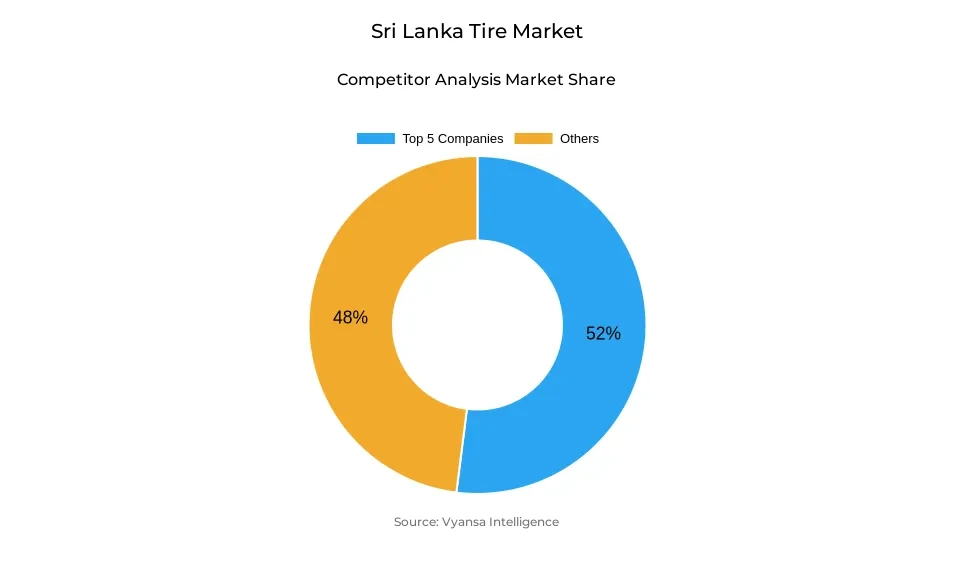
- Competition combines large domestic manufacturers accounting for 52% of the market.
The tire market in Sri Lanka benefits from a significant domestic manufacturing and export base, particularly in specialty applications. According to the Export Development Board, tires account for more than 60% of the country's rubber export value, while the country supplies nearly one-quarter of global industrial solid-tire demand. This established position gives local manufacturers stronger opportunities in material handling, agriculture, construction and other off-highway applications, where technical performance and OEM relationships can generate higher-value business than conventional replacement tires alone.
Domestic demand is strengthening following the reopening of vehicle imports and the recovery in new registrations through 2025 and 2026. The expanding vehicle parc gradually increases the number of vehicles entering future tire-replacement cycles, supporting demand across passenger cars, motorcycles and commercial fleets. Importantly, this creates a multi-year replacement opportunity rather than a one-time sales boost, as newly added vehicles progressively require first and subsequent tire changes.
Export momentum is showing signs of recovery alongside domestic market normalization. Sri Lanka Export Development Board data reported an 18.61% year-on-year increase in exports of pneumatic and retreaded tires and tubes in January 2026, reversing the weakness recorded during 2025. This combination of recovering export demand and a growing domestic replacement base creates a more balanced outlook for the Sri Lanka tire industry, favoring manufacturers with specialized products, scalable local production, and access to international OEM and distribution networks.
Sri Lanka Tire Trade Records USD 127 Million in Exports Against USD 57 Million in Imports in 2025
Sri Lanka’s tire trade remained structurally export-oriented in 2025, with exports of tires reaching approximately USD 127 million, more than twice the USD 57 million value of imports. This generated a trade surplus of around USD 70 million, highlighting the country’s established manufacturing and export base. However, export performance weakened from USD 169 million in 2022 to USD 127 million in 2025, representing a decline of approximately 25%, indicating softer external demand and/or changes in export pricing and product mix.
On the import side, tire purchases increased from USD 36 million in 2022 to USD 57 million in 2025, a rise of approximately 58%, while remaining broadly unchanged from USD 57 million in 2024. China was the largest import source at USD 24 million in 2025, accounting for approximately 42% of total import value, followed by India at USD 12 million (21%) and Thailand at USD 6.1 million (11%). Together, these three suppliers represented approximately 74% of Sri Lanka’s tire import value, indicating a highly concentrated sourcing structure.
Sri Lanka’s export destinations were comparatively diversified, although the United States alone absorbed USD 45 million, or about 35% of total exports, followed by Brazil at USD 9.8 million and Germany at USD 7.8 million. The top three markets therefore accounted for approximately 49% of export value, giving Sri Lankan manufacturers substantial exposure to U.S. and European demand while maintaining access to emerging markets.
Sri Lanka Tire Market Drivers
Vehicle Import Liberalization Reactivates Tire Replacement and Fitment Demand
Sri Lanka’s reopening of vehicle imports is creating a broader demand base for tires by accelerating vehicle additions, replacement requirements, and OEM fitment opportunities. Department of Motor Traffic data recorded approximately 362,100 new vehicle registrations in 2025, lifting the registered vehicle population to 8.82 million. Each additional vehicle expands the future replacement pool, while newly imported cars, motorcycles, hybrids, and electric vehicles generate immediate demand for compatible tire sizes, specifications, and replacement inventories across dealers and distributors.
Local vehicle assembly provides a second demand channel. The Ceylon Chamber of Commerce’s Motor Vehicle Industry Report 2025/26 identified more than 15 operating vehicle assembly plants, creating opportunities for tire manufacturers to secure OEM fitment contracts. Rising assembly activity can therefore generate recurring tire demand linked to vehicle production, complementing the replacement market.
Infrastructure reconstruction adds a further commercial opportunity, particularly for commercial and specialty tire segments. Road, bridge, and infrastructure projects increase utilization of trucks, construction equipment, and off-road machinery, supporting demand for heavy-duty, high-load, and specialized tires. This broadens market growth beyond passenger vehicles and two-wheelers.
Overall, the combination of 362,100 new registrations, 8.82 million vehicles in the fleet, and 15+ assembly plants strengthens both near-term tire consumption and the longer-term replacement opportunity.
Sri Lanka Tire Market Challenges
Currency Volatility and Limited Purchasing Power Constrain Sri Lanka’s Tire Replacement Demand
Sri Lanka’s tire market continues to face purchasing-power constraints, which can encourage consumers and commercial fleet operators to postpone replacement or select lower-priced products. Although the registered vehicle population reached 8.82 million in 2025, higher operating and maintenance costs can extend tire replacement cycles, particularly among price-sensitive passenger-car, motorcycle, and small-commercial-vehicle owners. This limits the conversion of a growing vehicle base into proportional tire demand.
Exchange-rate volatility and elevated operating costs also create challenges for tire distributors and manufacturers. Tires require rubber, chemicals, steel, textiles, energy, and logistics inputs, making manufacturers and distributors sensitive to changes in production and financing costs. Sustained cost pressure can compress distributor margins or force price increases that weaken replacement demand.
The market also faces limited domestic production flexibility across tire categories. Local manufacturing is concentrated in selected product segments, while demand spans passenger vehicles, motorcycles, trucks, buses, agricultural equipment, and specialized applications. This can create supply gaps when specific sizes, load ratings, or performance specifications are required.
Finally, road conditions and vehicle operating environments can accelerate tire wear while simultaneously increasing demand for durable products. Manufacturers therefore face the challenge of balancing durability and safety with affordability, particularly in a market where consumers remain highly price-conscious.
Sri Lanka Tire Market Recent Trends
Crossovers and SUVs are Shifting Fitment Toward Larger Rim Diameters
Sri Lanka’s recovery in vehicle imports is accompanied by a changing passenger-vehicle mix, with SUVs and crossovers gaining prominence relative to conventional passenger cars. J B Securities’ analysis of Department of Motor Traffic data recorded 5,813 SUV and crossover registrations in September 2025, compared with 4,268 car registrations, highlighting the growing contribution of higher-riding vehicle segments to new-vehicle demand.
This shift has direct implications for the tire market. SUVs and crossovers generally require larger rim diameters, wider tire profiles, higher load ratings, and application-specific tread designs than smaller hatchbacks and sedans. Consequently, increasing penetration of these vehicles is expected to strengthen demand for 16-inch-and-above radial tires, while also supporting requirements for tires offering enhanced wet grip, handling stability, durability, mileage, and load-carrying performance.
The changing vehicle mix is also influencing inventory and product portfolio requirements across tire distributors and dealers. As the range of vehicle platforms expands, suppliers need to maintain a broader selection of tire sizes, load indices, speed ratings, and tread patterns to serve both new-vehicle fitment and subsequent replacement demand.
As Sri Lanka’s newer SUV and crossover fleet enters its replacement cycle, suppliers with comprehensive radial portfolios and broad size coverage are positioned to capture a larger share of emerging replacement demand.
Unlock Market Intelligence
Explore the market potential with our data-driven report
Sri Lanka Tire Market Segmentation Analysis
By Type of Vehicle
- Passenger Car
- Hatchback
- Sedan
- SUV
- Light Commercial Vehicle
- Light Trucks
- Light Buses
- Pick-up Trucks and Vans
- Medium and Heavy Commercial Vehicles
- Buses
- Trucks
- Off the Road (OTR)
- Earthmoving Equipment
- Agricultural Vehicles
- Material Handling Vehicles
- Two Wheelers
- Scooters and Mopeds
- Motorcycles
Two-Wheelers Lead the Sri Lanka Tire Market While Passenger Cars Record the Fastest Growth
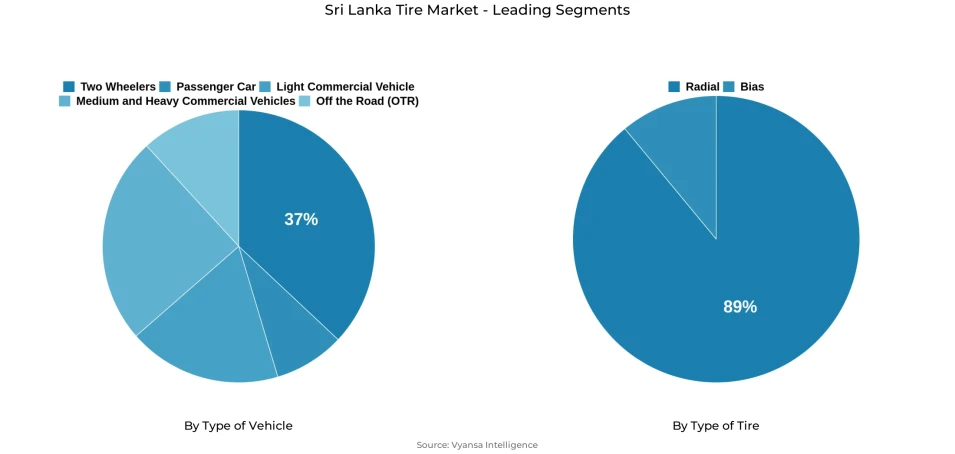
Two Wheelers accounted for 37% of the market in 2026, making them the largest vehicle-type segment. The position is supported by the scale of the installed motorcycle base and the economics of personal mobility. The Department of Motor Traffic 2025 data recorded 5.18 million motorcycles, representing 58.7% of the country's vehicle parc, while motorcycles contributed 70.4% of new registrations during the year.
This large operating base creates repeat replacement demand because two-wheeler tires experience relatively frequent wear and are generally replaced at lower absolute cost than passenger-vehicle tires. Availability across mass-market sizes and broad dealer coverage therefore remain important competitive advantages.
Passenger Car is projected to be the fastest-growing segment at a 5.08% CAGR during 2026–2032. Its expansion reflects renewed access to imported vehicles and the gradual rebuilding of Sri Lanka's passenger-car parc, creating fresh demand across OEM-equivalent and aftermarket fitments.
By Type of Tire
- Radial
- Bias
Radial Tires Dominate the Sri Lanka Tire Market While Bias Tires Maintain Growth in Specialized Applications
Radial tires accounted for 89% of market value in 2026. Their dominance reflects widespread application across passenger cars, SUVs and road-going commercial vehicles, where improved road contact, heat management, ride quality and lower rolling resistance make radial construction the preferred choice.
The category should remain commercially important as newer vehicles enter Sri Lanka because modern passenger and crossover platforms are overwhelmingly designed around radial fitments. Suppliers with broad size coverage and reliable availability are therefore positioned to benefit from both first replacement and subsequent replacement cycles.
Bias tires are identified in the supplied dataset as the fastest-growing tire type, with a 0.5% CAGR during 2026–2032. Although their overall expansion remains modest, bias construction retains practical advantages in selected agricultural, construction, industrial and off-road applications where sidewall rigidity, load resistance and operation on uneven surfaces can matter more than high-speed road performance.
Unlock Market Intelligence
Explore the market potential with our data-driven report
Sri Lanka Tire Market Competitive Landscape
The Sri Lanka tire industry is moderately consolidated, with the top five companies accounting for 52% of the market in the supplied dataset. Competition differs sharply by application with the top companies in the market being, Bridgestone Corporation, CEAT Kelani Holdings, Global Rubber Industries (GRI), Goodyear Tire & Rubber Company and Michelin Group.
Prominent Companies in the Sri Lanka Tire Market
- Bridgestone Corporation
- CEAT Kelani Holdings
- Global Rubber Industries (GRI)
- Goodyear Tire & Rubber Company
- Michelin Group
- Continental AG
- DSI Tires
- Yokohama Rubber Company Limited
- Hankook Tire Co., Ltd.
- Apollo Tires
Recent Developments in the Sri Lanka Tire Market
- July 2026: CEAT Kelani expanded its Sri Lankan SUV portfolio with the SecuraDrive SUV and CrossDrive AT ranges, including 16-inch fitments designed for popular SUV and utility models. The expansion broadens the company's ability to address the growing requirement for larger radial fitments as imported crossovers and SUVs enter the replacement cycle.
- During 2026, GRI expanded distribution for its agricultural tire portfolio in European markets including Ireland and Italy. The development strengthens overseas market access for Sri Lankan-made specialty tires and illustrates how local manufacturers are extending beyond production capability into deeper international distribution relationships.
- April 2025: CEAT Kelani approved a Rs. 4.0 billion machinery and equipment investment aimed at upgrading production to platforms suitable for European and US export markets. The programme strengthens manufacturing capability and supports a shift toward higher-specification tires capable of meeting international customer requirements.
Frequently Asked Questions
Related Report
- Market Segmentation
- Research Scope
- Research Methodology
- Definitions and Assumptions
- Executive Summary
- Sri-Lanka Tire Market Policies, Regulations, and Standards
- Sri-Lanka Tire Market Dynamics
- Growth Factors
- Challenges
- Trends
- Opportunities
- Sri-Lanka Tire Market Statistics, 2022-2032F
- Market Size & Growth Outlook
- By Revenues in USD Million
- By Quantity Sold (Thousand Units)
- Market Segmentation & Growth Outlook
- By Type of Vehicle
- Passenger Car- Market Insights and Forecast 2022-2032, USD Million
- Hatchback- Market Insights and Forecast 2022-2032, USD Million
- Sedan- Market Insights and Forecast 2022-2032, USD Million
- SUV- Market Insights and Forecast 2022-2032, USD Million
- Light Commercial Vehicle- Market Insights and Forecast 2022-2032, USD Million
- Light Trucks- Market Insights and Forecast 2022-2032, USD Million
- Light Buses- Market Insights and Forecast 2022-2032, USD Million
- Pick-up Trucks and Vans- Market Insights and Forecast 2022-2032, USD Million
- Medium and Heavy Commercial Vehicles- Market Insights and Forecast 2022-2032, USD Million
- Buses- Market Insights and Forecast 2022-2032, USD Million
- Trucks- Market Insights and Forecast 2022-2032, USD Million
- Off the Road (OTR)- Market Insights and Forecast 2022-2032, USD Million
- Earthmoving Equipment- Market Insights and Forecast 2022-2032, USD Million
- Agricultural Vehicles- Market Insights and Forecast 2022-2032, USD Million
- Material Handling Vehicles- Market Insights and Forecast 2022-2032, USD Million
- Two Wheelers- Market Insights and Forecast 2022-2032, USD Million
- Scooters and Mopeds- Market Insights and Forecast 2022-2032, USD Million
- Motorcycles- Market Insights and Forecast 2022-2032, USD Million
- Passenger Car- Market Insights and Forecast 2022-2032, USD Million
- By Demand Category
- OEM- Market Insights and Forecast 2022-2032, USD Million
- Aftermarket- Market Insights and Forecast 2022-2032, USD Million
- By Type of Tire
- Radial- Market Insights and Forecast 2022-2032, USD Million
- Bias- Market Insights and Forecast 2022-2032, USD Million
- By Sales Channel
- Direct Sales- Market Insights and Forecast 2022-2032, USD Million
- Exclusive Outlets & Multi-brand Stores- Market Insights and Forecast 2022-2032, USD Million
- Online- Market Insights and Forecast 2022-2032, USD Million
- By Price Category
- Budget- Market Insights and Forecast 2022-2032, USD Million
- Economy- Market Insights and Forecast 2022-2032, USD Million
- Premium- Market Insights and Forecast 2022-2032, USD Million
- By Tire Size
- Up to 12 Inches- Market Insights and Forecast 2022-2032, USD Million
- 13–15 Inches- Market Insights and Forecast 2022-2032, USD Million
- 16–18 Inches- Market Insights and Forecast 2022-2032, USD Million
- 19–21 Inches- Market Insights and Forecast 2022-2032, USD Million
- Above 21 Inches- Market Insights and Forecast 2022-2032, USD Million
- By Competitors
- Competition Characteristics
- Market Share & Analysis
- By Type of Vehicle
- Market Size & Growth Outlook
- Sri-Lanka Passenger Car Market Statistics, 2022-2032
- Market Size & Growth Outlook
- By Revenues in USD Million
- By Quantity Sold (Thousand Units)
- Market Segmentation & Growth Outlook
- By Demand Category- Market Insights and Forecast 2022-2032, USD Million
- By Type of Tire- Market Insights and Forecast 2022-2032, USD Million
- By Sales Channel- Market Insights and Forecast 2022-2032, USD Million
- By Price Category- Market Insights and Forecast 2022-2032, USD Million
- By Tire Size- Market Insights and Forecast 2022-2032, USD Million
- Market Size & Growth Outlook
- Sri-Lanka Light Commercial Vehicle Market Statistics, 2022-2032
- Market Size & Growth Outlook
- By Revenues in USD Million
- By Quantity Sold (Thousand Units)
- Market Segmentation & Growth Outlook
- By Demand Category- Market Insights and Forecast 2022-2032, USD Million
- By Type of Tire- Market Insights and Forecast 2022-2032, USD Million
- By Sales Channel- Market Insights and Forecast 2022-2032, USD Million
- By Price Category- Market Insights and Forecast 2022-2032, USD Million
- By Tire Size- Market Insights and Forecast 2022-2032, USD Million
- Market Size & Growth Outlook
- Sri-Lanka Medium and Heavy Commercial Vehicles Market Statistics, 2022-2032
- Market Size & Growth Outlook
- By Revenues in USD Million
- By Quantity Sold (Thousand Units)
- Market Segmentation & Growth Outlook
- By Demand Category- Market Insights and Forecast 2022-2032, USD Million
- By Type of Tire- Market Insights and Forecast 2022-2032, USD Million
- By Sales Channel- Market Insights and Forecast 2022-2032, USD Million
- By Price Category- Market Insights and Forecast 2022-2032, USD Million
- By Tire Size- Market Insights and Forecast 2022-2032, USD Million
- Market Size & Growth Outlook
- Sri-Lanka Off the Road (OTR) Market Statistics, 2022-2032
- Market Size & Growth Outlook
- By Revenues in USD Million
- By Quantity Sold (Thousand Units)
- Market Segmentation & Growth Outlook
- By Demand Category- Market Insights and Forecast 2022-2032, USD Million
- By Type of Tire- Market Insights and Forecast 2022-2032, USD Million
- By Sales Channel- Market Insights and Forecast 2022-2032, USD Million
- By Price Category- Market Insights and Forecast 2022-2032, USD Million
- By Tire Size- Market Insights and Forecast 2022-2032, USD Million
- Market Size & Growth Outlook
- Sri-Lanka Two Wheelers Market Statistics, 2022-2032
- Market Size & Growth Outlook
- By Revenues in USD Million
- By Quantity Sold (Thousand Units)
- Market Segmentation & Growth Outlook
- By Demand Category- Market Insights and Forecast 2022-2032, USD Million
- By Type of Tire- Market Insights and Forecast 2022-2032, USD Million
- By Sales Channel- Market Insights and Forecast 2022-2032, USD Million
- By Price Category- Market Insights and Forecast 2022-2032, USD Million
- By Tire Size- Market Insights and Forecast 2022-2032, USD Million
- Market Size & Growth Outlook
- Competitive Outlook
- Company Profiles
- Bridgestone Corporation
- Business Description
- Product Portfolio
- Collaborations & Alliances
- Recent Developments
- Financial Details
- Others
- CEAT Kelani Holdings
- Business Description
- Product Portfolio
- Collaborations & Alliances
- Recent Developments
- Financial Details
- Others
- Global Rubber Industries (GRI)
- Business Description
- Product Portfolio
- Collaborations & Alliances
- Recent Developments
- Financial Details
- Others
- Goodyear Tire & Rubber Company
- Business Description
- Product Portfolio
- Collaborations & Alliances
- Recent Developments
- Financial Details
- Others
- Michelin Group
- Business Description
- Product Portfolio
- Collaborations & Alliances
- Recent Developments
- Financial Details
- Others
- Continental AG
- Business Description
- Product Portfolio
- Collaborations & Alliances
- Recent Developments
- Financial Details
- Others
- DSI Tires
- Business Description
- Product Portfolio
- Collaborations & Alliances
- Recent Developments
- Financial Details
- Others
- Yokohama Rubber Company Limited
- Business Description
- Product Portfolio
- Collaborations & Alliances
- Recent Developments
- Financial Details
- Others
- Hankook Tire Co., Ltd.
- Business Description
- Product Portfolio
- Collaborations & Alliances
- Recent Developments
- Financial Details
- Others
- Apollo Tires
- Business Description
- Product Portfolio
- Collaborations & Alliances
- Recent Developments
- Financial Details
- Others
- Bridgestone Corporation
- Company Profiles
- Disclaimer
| Segment | Sub-Segment |
|---|---|
| By Type of Vehicle |
|
| By Demand Category |
|
| By Type of Tire |
|
| By Sales Channel |
|
| By Price Category |
|
| By Tire Size |
|
Research Methodology
This study followed a structured approach comprising four key phases to assess the size and scope of the electro-oxidation market. The process began with thorough secondary research to collect data on the target market, related markets, and broader industry context. These findings, along with preliminary assumptions and estimates, were then validated through extensive primary research involving industry experts from across the value chain. To calculate the overall market size, both top-down and bottom-up methodologies were employed. Finally, market segmentation and data triangulation techniques were applied to refine and validate segment-level estimations.
Secondary Research
The secondary research phase involved gathering data from a wide range of credible and published sources. This step helped in identifying industry trends, defining market segmentation, and understanding the market landscape and value chain.
Sources consulted during this phase included:
- Company annual reports, investor presentations, and press releases
- Industry white papers and certified publications
- Trade directories and market-recognized databases
- Articles from authoritative authors and reputable journals
- Gold and silver standard websites
Secondary research was critical in mapping out the industry's value chain and monetary flow, identifying key market segments, understanding regional variations, and tracking significant industry developments.
Other key sources:
- Financial disclosures
- Industry associations and trade bodies
- News outlets and business magazines
- Academic journals and research studies
- Paid industry databases
Primary Research
To validate secondary data and gain deeper market insights, primary research was conducted with key stakeholders across both the supply and demand sides of the market.
On the demand side, participants included decision-makers and influencers from end-user industries—such as CIOs, CTOs, and CSOs—who provided first-hand perspectives on market needs, product usage, and future expectations.
On the supply side, interviews were conducted with manufacturers, industry associations, and institutional participants to gather insights into current offerings, product pipelines, and market challenges.
Primary interviews provided critical inputs such as:
- Market size and revenue data
- Product and service breakdowns
- Market forecasts
- Regional and application-specific trends
Stakeholders consulted included:
- Leading OEM and solution providers
- Channel and distribution partners
- End users across various applications
- Independent consultants and industry specialists
Market Size Estimation and Data Triangulation
- Identifying Key Market Participants (Secondary Research)
- Goal: To identify the major players or companies in the target market. This typically involves using publicly available data sources such as industry reports, market research publications, and financial statements of companies.
- Tools: Reports from firms like Gartner, Forrester, Euromonitor, Statista, IBISWorld, and others. Public financial statements, news articles, and press releases from top market players.
- Extracting Earnings of Key Market Participants
- Goal: To estimate the earnings generated from the product or service being analyzed. This step helps in understanding the revenue potential of each market player in a specific geography.
- Methods: Earnings data can be gathered from:
- Publicly available financial reports (for listed companies).
- Interviews and primary data sources from professionals, such as Directors, VPs, SVPs, etc. This is especially useful for understanding more nuanced, internal data that isn't publicly disclosed.
- Annual reports and investor presentations of key players.
- Data Collation and Development of a Relevant Data Model
- Goal: To collate inputs from both primary and secondary sources into a structured, data-driven model for market estimation. This model will incorporate key market KPIs and any independent variables relevant to the market.
- Key KPIs: These could include:
- Market size, growth rate, and demand drivers.
- Industry-specific metrics like market share, average revenue per customer (ARPC), or average deal size.
- External variables, such as economic growth rates, inflation rates, or commodity prices, that could affect the market.
- Data Modeling: Based on this data, the market forecasts are developed for the next 5 years. A combination of trend analysis, scenario modeling, and statistical regression might be used to generate projections.
- Scenario Analysis
- Goal: To test different assumptions and validate how sensitive the market is to changes in key variables (e.g., market demand, regulatory changes, technological disruptions).
- Types of Scenarios:
- Base Case: Based on current assumptions and historical data.
- Best-Case Scenario: Assuming favorable market conditions, regulatory environments, and technological advancements.
- Worst-Case Scenario: Accounting for adverse factors, such as economic downturns, stricter regulations, or unexpected disruptions.












