India Base Oil Market Report: Trends, Growth and Forecast (2027-2033)
By Base Oil Group (Group I, Group II, Group III, Group IV, Group V), By Application (Automotive Oils, Industrial Oils, Process Oils, Metalworking Fluids, Greases, Marine Oils, Other Applications) ... Read more
|
Major Players
|
India Base Oil Market Overview
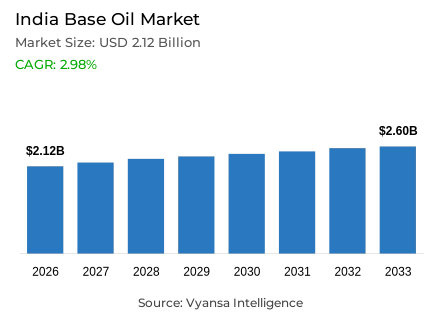
Base oil in India is the refined mineral or synthetic stock that makes up most of a finished lubricant, supplied by domestic refiners and importers to lubricant blenders. Blenders mix it with additives for engine oils, industrial fluids, greases and marine oils consumed by vehicle owners, fleets, factories and ports. The India base oil market is forecast to grow at a CAGR of 2.98% between 2027 and 2033.
Key Highlights of the India Base Oil Market
- The India base oil market was valued at USD 2.12 billion in 2026. The market is estimated at USD 2.18 billion in 2027 and is projected to reach USD 2.60 billion by 2033.
- The market is forecast to expand at an overall CAGR of 2.98% over the forecasted period from 2027 to 2033.
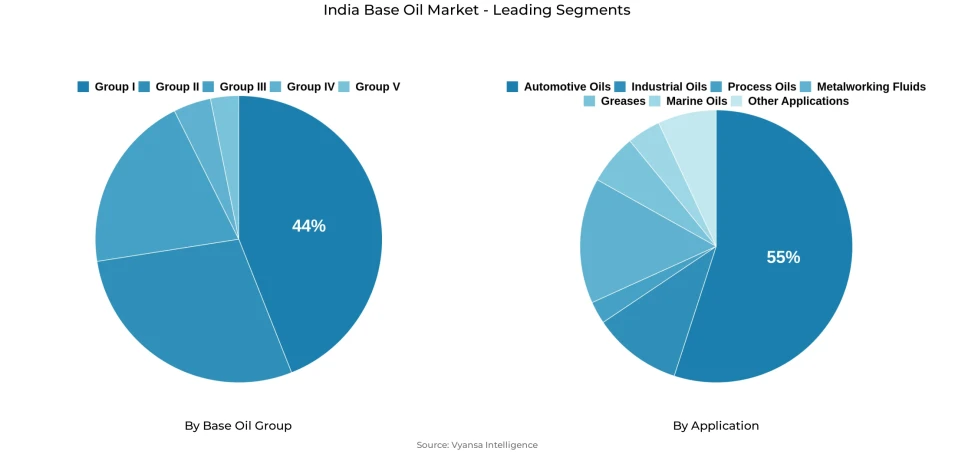
- By base oil group, Group I led the market with a 44% share in 2026.
- Group III is the fastest-growing base oil group, expanding at a CAGR of 5.36% between 2027 and 2033.
- By application, automotive oils led the market with a 55% share in 2026.
- Metalworking fluids is the fastest-growing application, expanding at a CAGR of 8.36% between 2027 and 2033.
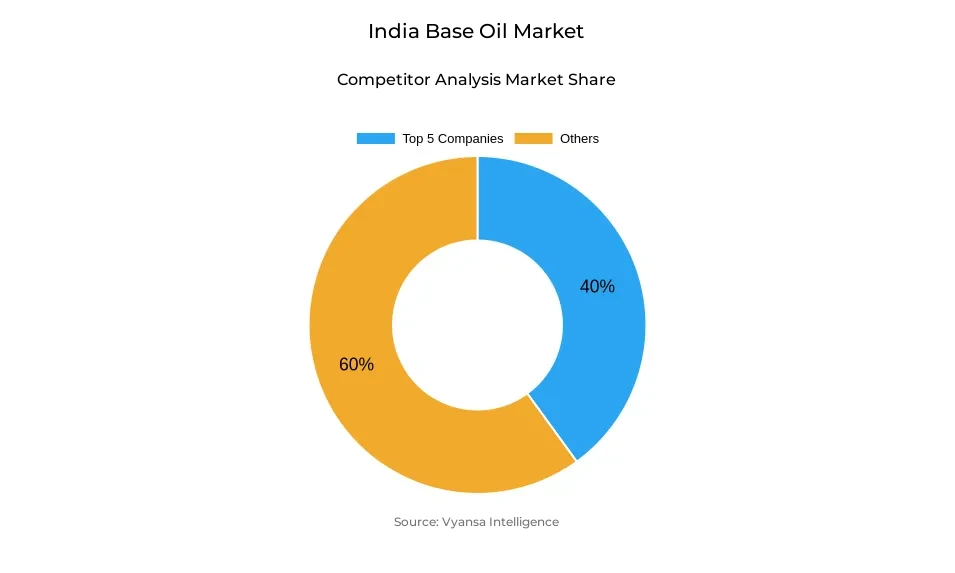
- The market is moderately consolidated, with the top five companies holding a combined 40% share in 2026.
India’s base oil industry is supported by lubricant consumption that is already expanding across transportation, manufacturing and industrial equipment. The country consumed 4.83 million tons of lubricants and greases in 2025, an increase of 9.4% from the previous year. Domestic production has not fully met this requirement across every grade, and base oil imports exceeded 3 million tons during the year, rising by 11%. This combination provides an established demand base while leaving room for additional domestic supply.
The commercial requirement is also becoming more varied. Conventional grades remain important for industrial oils, process oils, greases and price-sensitive lubricant formulations. At the same time, newer engines, extended oil-change intervals and demanding industrial equipment require base stocks with better viscosity stability, oxidation resistance and low-temperature performance. Suppliers must therefore serve both large-volume conventional applications and the expanding requirement for higher-performance grades.
Future growth should come from a combination of recurring lubricant consumption, domestic substitution of imported premium grades and a gradual increase in formally re-refined base oil. New production capacity can shorten supply chains for Indian blenders, while better collection of used lubricants can create an additional domestic feedstock source. Companies capable of maintaining consistent specifications across conventional, premium and re-refined grades will be best positioned to benefit as India’s base oil market becomes more locally supplied and technically differentiated.
India Base Oil Market Drivers
Expanding Vehicle Parc Sustains Lubricant Consumption
Vehicle sales create continuing base oil demand because every internal-combustion vehicle moves from factory fill into a recurring maintenance cycle. Passenger vehicles require engine and transmission oils, while two-wheelers create a broad replacement market through workshops, dealerships and retail lubricant outlets. Commercial vehicles add further demand because of their larger lubricant requirements and intensive operating schedules.
India sold 4.64 million passenger vehicles during 2025–26, an increase of 7.9%, while two-wheeler sales reached approximately 21.7 million units, rising 10.7%. These volumes expand the installed vehicle parc rather than generating only a one-time requirement. Vehicles sold during the year will continue consuming lubricants through scheduled servicing and routine oil changes over several years.
Continued parc expansion should therefore support demand for the base oils used in passenger-car motor oils, motorcycle oils, transmission fluids and heavy-duty diesel lubricants. The effect will become more valuable as newer engines require higher-performance formulations, allowing base oil suppliers to benefit from both additional lubricant volume and a gradual movement toward premium grades.
India Base Oil Market Challenges
Electric Two-Wheeler Adoption Limits Engine-Oil Demand
Electric vehicles remove the need for conventional engine oil because they do not use internal-combustion powertrains. The effect is particularly relevant in India’s two-wheeler market, where engine oils are consumed in large volumes through frequent servicing and replacement. Each electric scooter or motorcycle entering the parc reduces the future oil-change demand that an equivalent petrol vehicle would have generated.
Electric models accounted for 10.6% of India’s two-wheeler retail registrations in June 2026. The share remains below that of conventional vehicles, but it is sufficiently large to moderate the conversion of rising two-wheeler sales into engine-oil consumption.
Electric drivetrains still require greases, coolants and selected transmission or thermal-management fluids, but their lubricant requirement is generally lower and follows different replacement cycles. Base oil producers and blenders must consequently broaden their exposure toward passenger vehicles, commercial fleets and industrial applications. Through the forecast period, electrification is unlikely to eliminate automotive base oil demand, but it can reduce growth in one of India’s largest lubricant-consuming vehicle categories.
India Base Oil Market Recent Trends
Blenders Move from Spot Import Cargoes Toward Domestic and Term Contracted Premium Supply
Indian blenders have long covered premium grade needs with imported cargoes, bought on term contracts or spot, because domestic refineries mostly produced conventional stock. State refiners are now adding premium units, so blenders can secure volumes closer to their filling sites. India imported more than 3 million tons of base oil in 2025, up 11%, with South Korea supplying 1.32 million tons.
Indian Oil Corporation Limited reported that its Koyali refinery expansion in Gujarat, which includes a 235,000 tons per year lube base stock unit, was 89.2% complete at 30 June 2026, with start-up planned for November 2026. Western India hosts much of the country's blending, so the unit gives blenders a domestic source of premium grades that can be contracted on term rather than bought cargo by cargo.
Through the forecast period, domestic term volumes should take a rising share of premium grade consumption from spot imports, and equipment maker approval of domestic stock becomes a qualification step alongside price. Conventional stock keeps its place in industrial oils, metalworking fluids and greases, so the base oil industry reallocates supply by grade rather than by volume. Domestic term contracts become the main route for premium base oil.
AI Optimization and Digital Twins Enter Refinery Units That Feed Premium Base Oil
Premium base oil plants in India take their feed from upstream hydrocrackers, as the second catalytic dewaxing unit at Haldia does with unconverted oil. Hydrocracker severity and uptime therefore set how much premium stock a lube unit can make. Refiners are adding digital twins and artificial intelligence (AI) optimisers that update operating targets in real time, replacing operator-set targets and calendar-based maintenance.
In January 2026, Hindustan Petroleum Corporation Limited commissioned a 3.55 million tons per year residue upgradation unit at its Visakh refinery with a digital suite that combines real-time monitoring, predictive analytics and AI-driven optimisation. The company cites a distillate yield gain of up to 10% over pre-modernisation levels for the refinery as a whole, not for the digital suite alone. No company has yet disclosed a measured gain from these tools at an Indian base oil unit.
Adoption requires structured process data across hydrocracking and dewaxing units, maintained plant models and engineers who can act on the recommendations, which favours refiners already running large integrated sites. As these tools mature, supplier differentiation will rest on yield consistency and unit uptime of premium grades, which gives blenders steadier supply.
India Base Oil Market Future Opportunities
Formal Used-Oil Collection Expands Re-Refining Potential
India generates approximately 1.3 million tons of used lubricating oil annually, but only about 0.2 million tons is recovered through formal recycling channels. The difference represents a substantial feedstock pool that could be collected, processed and returned to lubricant manufacturing as re-refined base oil.
In March 2026, Indian Oil Corporation Limited and Re Sustainability Limited agreed to develop a nationwide used-oil collection and recycling ecosystem. The proposed re-refining facility is expected to process between 50,000 and 100,000 tons annually and produce group II+ re-refined base oil that meets Indian and international specifications.
Capturing this opportunity requires traceable collection from workshops, fleets and industrial users, followed by controlled storage and transportation to authorized facilities. Re-refiners must also produce material with sufficiently consistent viscosity, purity and performance for lubricant blenders to approve it. Companies that combine established lubricant demand with collection infrastructure and re-refining expertise can convert an underused waste stream into an additional domestic source of base oil.
Unlock Market Intelligence
Explore the market potential with our data-driven report
India Base Oil Market Segmentation Analysis
By Base Oil Group:
- Group I
- Group II
- Group III
- Group IV
- Group V
Group I Commands 44% of Base Oil Demand While Group III Gains Fastest
Group I is projected to lead the India base oil market with a 44% share in 2026. Its established domestic availability and suitability for industrial oils, process oils, greases and conventional lubricant formulations sustain its position. Price also remains important in applications where reformulating a lubricant with a different base stock would require additional testing and customer approval. In the week ending 18 July 2025, imported group I SN500 was assessed at USD 45 per tonne below group II N500, reinforcing its commercial relevance in cost-sensitive applications.
Group III is projected to be the fastest-growing base oil group, at a CAGR of 5.36% during 2027–2033. Its high viscosity index, oxidation stability and low-temperature performance make it suitable for lower-viscosity engine oils, extended oil-change intervals and other demanding formulations. Growth should be supported by tighter lubricant specifications and the increasing availability of domestically produced premium stock, although group III is unlikely to displace group I in applications where price remains the main purchasing consideration.
By Application:
- Automotive Oils
- Industrial Oils
- Process Oils
- Metalworking Fluids
- Greases
- Marine Oils
- Other Applications
Automotive Oils Command 55% of Application Demand While Metalworking Fluids Gain Fastest
Automotive oils are projected to account for 55% of the India base oil market in 2026. The segment benefits from recurring demand across motorcycles, passenger cars, commercial vehicles and agricultural machinery. Engine oils represent repeat purchases throughout the operating life of a vehicle, while transmission fluids and heavy-duty lubricants widen the base oil requirement beyond routine passenger-car servicing.
Metalworking fluids are projected to be the fastest-growing application, at a CAGR of 8.36% during 2027–2033. Capital-goods production increased 14.2% year on year in June 2026, indicating stronger activity in equipment-intensive manufacturing where cutting, grinding, forming and machining fluids are consumed. Press Information Bureau Quaker Houghton also demonstrated digitally monitored fluid-management solutions at IMTEX 2025, including real-time concentration measurement and automated dosing. These systems can improve fluid consistency and encourage manufacturers to manage metalworking fluids as a controlled production input rather than an occasional consumable.
Unlock Market Intelligence
Explore the market potential with our data-driven report
India Base Oil Market Competitive Landscape
The base oil industry is moderately consolidated, with the top five companies holding a combined 40% share in 2026. The leading five, in the order profiled in this report, are Hindustan Petroleum Corporation Limited, Indian Oil Corporation Limited, Bharat Petroleum Corporation Limited, APAR Industries Limited and Chennai Petroleum Corporation Limited. The remaining share is spread across five further listed companies and smaller participants.
Key Companies in the India Base Oil Market
- Hindustan Petroleum Corporation Limited
- Indian Oil Corporation Limited
- Bharat Petroleum Corporation Limited (MAK BASE)
- APAR Industries Limited (POWEROIL)
- Chennai Petroleum Corporation Limited
- Gandhar Oil Refinery (India) Limited (Divyol)
- ExxonMobil Lubricants Private Limited
- GS Caltex India Private Limited (Kixx LUBO)
- Nynas Naphthenics Private Ltd
- Eastern Petroleum Private Limited (EASTTO)
Company Profiling
The following profiles cover the five leading companies in the industry, each described through its base oil participation, capacity, latest development and competitive role.
Hindustan Petroleum Corporation Limited: Hindustan Petroleum Corporation Limited operates the Mumbai lube refinery and supplies base stocks and finished lubricants to automotive and industrial customers. In May 2026, the company signed a memorandum of understanding with LANXESS to expand access to premium aviation and industrial lubricant solutions across India and other South Asian markets. The collaboration strengthens its position in technically demanding lubricant applications.
Indian Oil Corporation Limited: Indian Oil Corporation Limited participates through domestic base oil production, refinery expansion and its Servo lubricant business. In September 2026, the company said the Gujarat refinery expansion, which incorporates lube oil base-stock production under the LuPech project, was expected to reach expanded operation by the end of 2026–27. This project will broaden IndianOil’s premium-grade supply in western India.
Bharat Petroleum Corporation Limited (MAK BASE): Bharat Petroleum Corporation Limited produces base oil at its Mumbai refinery and supplies automotive, industrial and specialty lubricants through the MAK portfolio. In July 2026, the company signed a memorandum of understanding with Oemeta to explore local manufacturing and distribution of metalworking fluids and industrial manufacturing solutions. The arrangement extends its participation in specialised factory applications.
APAR Industries Limited (POWEROIL): APAR Industries Limited converts purchased base oils into transformer oils, white oils, process oils and industrial lubricants marketed under brands including POWEROIL. In June 2026, its Middle Eastern subsidiary signed a supply agreement with Saudi Aramco Base Oil Company (Luberef) for base oil at the Yanbu LubeHub Value Park. The agreement provides a directly connected feedstock source for local specialty-oil manufacturing.
Chennai Petroleum Corporation Limited: Chennai Petroleum Corporation Limited produces lube base stocks at its Manali refinery and serves the southern Indian lubricant market as part of the IndianOil group. In September 2026, procurement advanced for equipment required by its group II and group III base oil project at Manali. The project is designed to add up to 256,000 tons of higher-grade base oil capacity annually.
Recent Developments in the India Base Oil Market
- September 2026: Shell Lubricants India introduced Shell Rimula R4 Plus for construction and mining equipment. The synthetic-technology product targets machinery operating under high loads and difficult conditions, supporting demand for higher-performance base stocks in the off-highway sector.
- August 2026: Gulf Oil Lubricants India announced plans to expand production capacity at its Chennai and Silvassa facilities by approximately 70%, taking total capacity to around 240 million litres. The investment indicates expectations of sustained lubricant demand across automotive and industrial applications and will increase the company’s requirement for base oil feedstock.
- July 2026: GS Caltex India introduced the updated global identity of its Kixx lubricant brand in the Indian market. The repositioning focuses on higher-efficiency formulations for changing vehicle architectures and industrial machinery, increasing competition within premium automotive and industrial lubricants.
Frequently Asked Questions
Related Report
- Market Segmentation
- Research Scope
- Research Methodology
- Definitions and Assumptions
- Executive Summary
- India Base Oil Market Policies, Regulations, and Standards
- India Base Oil Market Dynamics
- Growth Factors
- Challenges
- Trends
- Opportunities
- India Base Oil Market Statistics, 2023-2033F
- Market Size & Growth Outlook
- By Revenues in USD Million
- Market Segmentation & Growth Outlook
- By Base Oil Group
- Group I- Market Insights and Forecast 2023-2033, USD Million
- Group II- Market Insights and Forecast 2023-2033, USD Million
- Group III- Market Insights and Forecast 2023-2033, USD Million
- Group IV- Market Insights and Forecast 2023-2033, USD Million
- Group V- Market Insights and Forecast 2023-2033, USD Million
- By Application
- Automotive Oils- Market Insights and Forecast 2023-2033, USD Million
- Industrial Oils- Market Insights and Forecast 2023-2033, USD Million
- Process Oils- Market Insights and Forecast 2023-2033, USD Million
- Metalworking Fluids- Market Insights and Forecast 2023-2033, USD Million
- Greases- Market Insights and Forecast 2023-2033, USD Million
- Marine Oils- Market Insights and Forecast 2023-2033, USD Million
- Other Applications- Market Insights and Forecast 2023-2033, USD Million
- By Competitors
- Competition Characteristics
- Market Share & Analysis
- By Base Oil Group
- Market Size & Growth Outlook
- India Group I Base Oil Market Statistics, 2023-2033
- Market Size & Growth Outlook
- By Revenues in USD Million
- Market Segmentation & Growth Outlook
- By Application- Market Insights and Forecast 2023-2033, USD Million
- Market Size & Growth Outlook
- India Group II Base Oil Market Statistics, 2023-2033
- Market Size & Growth Outlook
- By Revenues in USD Million
- Market Segmentation & Growth Outlook
- By Application- Market Insights and Forecast 2023-2033, USD Million
- Market Size & Growth Outlook
- India Group III Base Oil Market Statistics, 2023-2033
- Market Size & Growth Outlook
- By Revenues in USD Million
- Market Segmentation & Growth Outlook
- By Application- Market Insights and Forecast 2023-2033, USD Million
- Market Size & Growth Outlook
- India Group IV Base Oil Market Statistics, 2023-2033
- Market Size & Growth Outlook
- By Revenues in USD Million
- Market Segmentation & Growth Outlook
- By Application- Market Insights and Forecast 2023-2033, USD Million
- Market Size & Growth Outlook
- India Group V Base Oil Market Statistics, 2023-2033
- Market Size & Growth Outlook
- By Revenues in USD Million
- Market Segmentation & Growth Outlook
- By Application- Market Insights and Forecast 2023-2033, USD Million
- Market Size & Growth Outlook
- Competitive Outlook
- Company Profiles
- Hindustan Petroleum Corporation Limited
- Business Description
- Product Portfolio
- Collaborations & Alliances
- Recent Developments
- Financial Details
- Others
- Indian Oil Corporation Limited
- Business Description
- Product Portfolio
- Collaborations & Alliances
- Recent Developments
- Financial Details
- Others
- Bharat Petroleum Corporation Limited (MAK BASE)
- Business Description
- Product Portfolio
- Collaborations & Alliances
- Recent Developments
- Financial Details
- Others
- APAR Industries Limited (POWEROIL)
- Business Description
- Product Portfolio
- Collaborations & Alliances
- Recent Developments
- Financial Details
- Others
- Chennai Petroleum Corporation Limited
- Business Description
- Product Portfolio
- Collaborations & Alliances
- Recent Developments
- Financial Details
- Others
- Gandhar Oil Refinery (India) Limited (Divyol)
- Business Description
- Product Portfolio
- Collaborations & Alliances
- Recent Developments
- Financial Details
- Others
- ExxonMobil Lubricants Private Limited
- Business Description
- Product Portfolio
- Collaborations & Alliances
- Recent Developments
- Financial Details
- Others
- GS Caltex India Private Limited (Kixx LUBO)
- Business Description
- Product Portfolio
- Collaborations & Alliances
- Recent Developments
- Financial Details
- Others
- Nynas Naphthenics Private Ltd
- Business Description
- Product Portfolio
- Collaborations & Alliances
- Recent Developments
- Financial Details
- Others
- Eastern Petroleum Private Limited (EASTTO)
- Business Description
- Product Portfolio
- Collaborations & Alliances
- Recent Developments
- Financial Details
- Others
- Hindustan Petroleum Corporation Limited
- Company Profiles
- Disclaimer
| Segment | Sub-Segment |
|---|---|
| By Base Oil Group |
|
| By Application |
|
Research Methodology
This study followed a structured approach comprising four key phases to assess the size and scope of the electro-oxidation market. The process began with thorough secondary research to collect data on the target market, related markets, and broader industry context. These findings, along with preliminary assumptions and estimates, were then validated through extensive primary research involving industry experts from across the value chain. To calculate the overall market size, both top-down and bottom-up methodologies were employed. Finally, market segmentation and data triangulation techniques were applied to refine and validate segment-level estimations.
Secondary Research
The secondary research phase involved gathering data from a wide range of credible and published sources. This step helped in identifying industry trends, defining market segmentation, and understanding the market landscape and value chain.
Sources consulted during this phase included:
- Company annual reports, investor presentations, and press releases
- Industry white papers and certified publications
- Trade directories and market-recognized databases
- Articles from authoritative authors and reputable journals
- Gold and silver standard websites
Secondary research was critical in mapping out the industry's value chain and monetary flow, identifying key market segments, understanding regional variations, and tracking significant industry developments.
Other key sources:
- Financial disclosures
- Industry associations and trade bodies
- News outlets and business magazines
- Academic journals and research studies
- Paid industry databases
Primary Research
To validate secondary data and gain deeper market insights, primary research was conducted with key stakeholders across both the supply and demand sides of the market.
On the demand side, participants included decision-makers and influencers from end-user industries—such as CIOs, CTOs, and CSOs—who provided first-hand perspectives on market needs, product usage, and future expectations.
On the supply side, interviews were conducted with manufacturers, industry associations, and institutional participants to gather insights into current offerings, product pipelines, and market challenges.
Primary interviews provided critical inputs such as:
- Market size and revenue data
- Product and service breakdowns
- Market forecasts
- Regional and application-specific trends
Stakeholders consulted included:
- Leading OEM and solution providers
- Channel and distribution partners
- End users across various applications
- Independent consultants and industry specialists
Market Size Estimation and Data Triangulation
- Identifying Key Market Participants (Secondary Research)
- Goal: To identify the major players or companies in the target market. This typically involves using publicly available data sources such as industry reports, market research publications, and financial statements of companies.
- Tools: Reports from firms like Gartner, Forrester, Euromonitor, Statista, IBISWorld, and others. Public financial statements, news articles, and press releases from top market players.
- Extracting Earnings of Key Market Participants
- Goal: To estimate the earnings generated from the product or service being analyzed. This step helps in understanding the revenue potential of each market player in a specific geography.
- Methods: Earnings data can be gathered from:
- Publicly available financial reports (for listed companies).
- Interviews and primary data sources from professionals, such as Directors, VPs, SVPs, etc. This is especially useful for understanding more nuanced, internal data that isn't publicly disclosed.
- Annual reports and investor presentations of key players.
- Data Collation and Development of a Relevant Data Model
- Goal: To collate inputs from both primary and secondary sources into a structured, data-driven model for market estimation. This model will incorporate key market KPIs and any independent variables relevant to the market.
- Key KPIs: These could include:
- Market size, growth rate, and demand drivers.
- Industry-specific metrics like market share, average revenue per customer (ARPC), or average deal size.
- External variables, such as economic growth rates, inflation rates, or commodity prices, that could affect the market.
- Data Modeling: Based on this data, the market forecasts are developed for the next 5 years. A combination of trend analysis, scenario modeling, and statistical regression might be used to generate projections.
- Scenario Analysis
- Goal: To test different assumptions and validate how sensitive the market is to changes in key variables (e.g., market demand, regulatory changes, technological disruptions).
- Types of Scenarios:
- Base Case: Based on current assumptions and historical data.
- Best-Case Scenario: Assuming favorable market conditions, regulatory environments, and technological advancements.
- Worst-Case Scenario: Accounting for adverse factors, such as economic downturns, stricter regulations, or unexpected disruptions.