UAE Robotaxi Market Report: Trends, Growth and Forecast (2026-2032)
By Level of Autonomy (Level 4, Level 5), By Vehicle Type (Cars, Shuttles/Vans, Purpose-Built Pods, Others), By Propulsion Type (Electric Vehicles (BEV), Hybrid Electric Vehicles (HEV), Fuel Cell Vehicles (FCV)), By Application (Passenger Transportation, Goods Transportation, Others), By Service Type (Ride-Hailing (On-Demand), Station-Based Shuttles, Goods Delivery, Others), By Component Type (LiDAR, Radar (mmWave), Camera, Ultrasonic Sensors, Sensor Fusion Systems, Others), By Region (Dubai, Abu Dhabi, Sharjah, Northern Emirates) ... Read more
|
Major Players
|
UAE Robotaxi Market Statistics and Insights, 2026
- Market Size Statistics
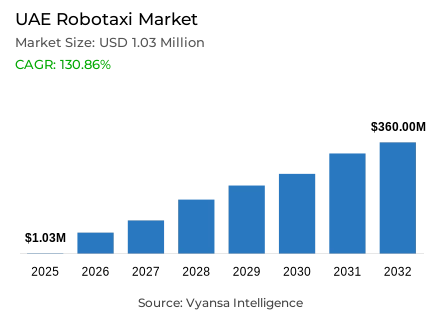
- Robotaxi market size in UAE was valued at USD 1.03 million in 2025 and is estimated at USD 4.21 million in 2026.
- The market size is expected to grow to USD 48.28 million by 2032.
- Market to register a CAGR of around 50.17% during 2026-32.
- Application Shares
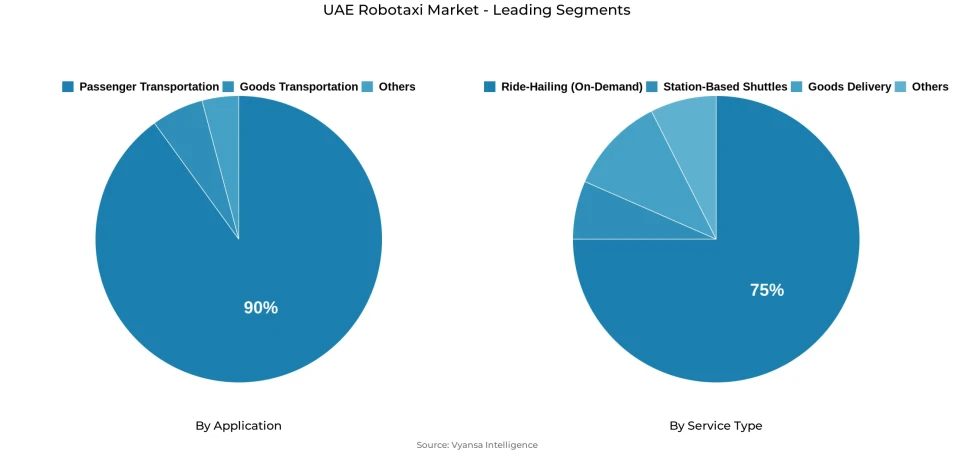
- Passenger transportation grabbed market share of 90%.
- Competition
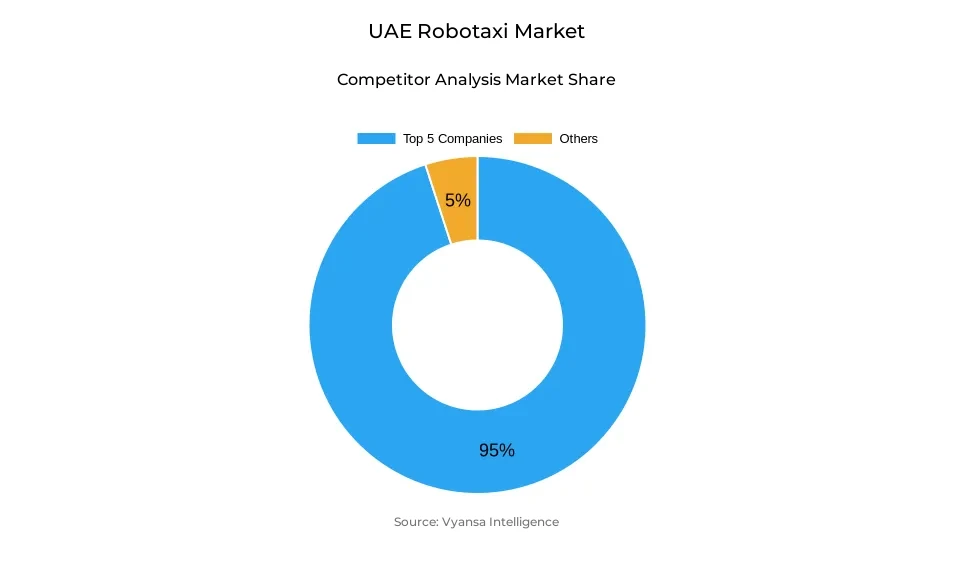
- Robotaxi in UAE is currently being catered to by more than 10 companies.
- Top 5 companies acquired around 95% of the market share in 2026.
- K2 – L.L.C – S.P.C, Pony.ai Inc., Lumo (K2), Guangzhou WeRide Technologies Co. Ltd., Space42 PLC (TXAI) etc., are few of the top companies.
- Service Type
- Ride-hailing (on-demand) grabbed 75% of the market.
UAE Robotaxi Market Outlook
The UAE robotaxi market covers autonomous passenger vehicles, fleet platforms, remote supervision, mapping, booking systems, and supporting mobility infrastructure. Primary users include residents, tourists, business travellers, transport authorities, and ride-hailing operators. Valued at USD 1.03 million in 2025, the UAE robotaxi market reaches USD 4.21 million in 2026 and is projected to attain USD 48.28 million by 2032, reflecting a CAGR of 50.17%. The UAE robotaxi industry remains early-stage but commercially significant.
Commercial momentum is being built through Level 4 autonomy, geofenced mobility service models, electric autonomous vehicles, and ride-hailing platform integration. Dubai and Abu Dhabi are combining smart mobility infrastructure with staged permits, operational trials, and digital oversight. These conditions allow the UAE robotaxi market to progress from demonstration fleets toward scalable services while giving technology suppliers, fleet operators, and mobility platforms clearer pathways for testing, deployment, and regulatory compliance. The UAE robotaxi industry benefits from coordinated public-private execution.
Economic impact extends beyond fare collection because robotaxi deployment stimulates demand for sensors, vehicle integration, charging, maintenance, cybersecurity, teleoperations, insurance, mapping, and data services. The UAE robotaxi market can improve fleet utilisation, expand first-mile and last-mile connectivity, and reduce dependence on driver availability across high-demand corridors. It also strengthens procurement visibility for component suppliers and creates localization opportunities around testing, servicing, and autonomous fleet management. The UAE robotaxi industry therefore supports a broader intelligent-transport ecosystem.
Commercial launches, denser service areas, and operator partnerships shape the 2026 trajectory. Baidu, Inc. (Apollo Go) and a local taxi operator launched fully driverless commercial ride-hailing in April 2026, beginning with 50 vehicles and planning expansion beyond 1,000 units. This advances app-based mobility and competitive fleet scaling in the UAE robotaxi market. The UAE robotaxi industry is moving toward multi-operator deployment, while suppliers compete on safety validation, service reliability, cost discipline, and local operating partnerships.
UAE Robotaxi Market Growth Driver
Policy-Backed Autonomy Targets Accelerate Deployment
Government-backed autonomous transport targets are accelerating procurement, permitting, and platform investment. Dubai’s mobility strategy creates an adoption pathway, while Abu Dhabi’s phased licensing supports commercial validation. These policy signals reduce uncertainty for technology developers and fleet operators, encouraging capital allocation toward Level 4 vehicles, charging infrastructure, mapping, and control systems. As service areas widen, the UAE robotaxi market gains demand visibility, and the UAE robotaxi industry attracts partnerships linking global autonomous-driving specialists with mobility operators.
Dubai’s Roads and Transport Authority reported in 2025 that its Smart Self-Driving Transport Strategy targets converting 25% of all trips into autonomous journeys by 2030. The objective strengthens tender pipelines, operational trials, and fleet planning because authorities require scalable systems rather than isolated demonstrations. It also supports road safety, multimodal integration, and commercial robotaxi services in UAE cities, improving the business case for vehicle platforms, remote supervision, high-definition mapping, and on-demand mobility across urban corridors.
UAE Robotaxi Market Challenge
Validation and Oversight Raise the Commercialization Threshold
Multi-layer approval, safety validation, data governance, insurance, and operational-design-domain limits can slow fleet expansion. Robotaxis must demonstrate perception, braking, steering, connectivity, cybersecurity, and incident response under dense traffic and extreme weather. These requirements raise testing costs and extend commercialization timelines, particularly for entrants without local operating partners. The UAE robotaxi market therefore faces a scale-versus-assurance tension: operators must expand service availability while regulators preserve traceability, passenger confidence, and interoperability across emirate-level licensing and monitoring systems.
Abu Dhabi Mobility launched AViTOMS in November 2025 to manage registration, applications, permitting, four testing phases, analysis, tracking, incident dashboards, and instant shutdown capability. The platform shows that commercial entry requires continuous evidence, not one vehicle approval. Compliance intensity can disadvantage smaller developers, increase integration expenditure, and delay fleet procurement. However, standardized digital supervision can lower approval ambiguity, strengthen autonomous vehicle cybersecurity in UAE operations, and create clear performance benchmarks for suppliers and service providers.
Unlock Market Intelligence
Explore the market potential with our data-driven report
UAE Robotaxi Market Trend
Driverless Operations Shift From Pilots to Scaled Mobility
Fully driverless operations are replacing supervised pilots as the defining commercialization trend. Service models combine Level 4 autonomy, geofenced coverage, remote supervision, and established ride-hailing applications instead of relying on booking channels. This shift improves vehicle utilization, reduces customer-acquisition friction, and supports repeatable fleet deployment. The UAE robotaxi market is consequently moving toward integrated mobility networks, while the UAE robotaxi industry differentiates through operational reliability, coverage density, and scalable partnerships rather than demonstration visibility alone.
Abu Dhabi Mobility reported that robotaxis supplied by Guangzhou WeRide Technologies Co., Ltd. had exceeded 800,000 kilometres by October 2025, with each vehicle completing up to 20 trips per 12-hour shift across 50% of Abu Dhabi’s core area. The operating intensity validates Level 4 deployment in UAE traffic and provides regulators with data for wider permits. It improves asset-productivity assumptions, informs maintenance scheduling, and strengthens supplier positioning around sensors, connectivity, remote assistance, and fleet-orchestration systems.
UAE Robotaxi Market Opportunity
Fleet Expansion Opens a Localized Supply Ecosystem
Fleet scaling creates an underpenetrated opportunity for local assemblers, charging providers, mapping specialists, maintenance networks, cybersecurity vendors, insurers, and remote-assistance operators. Large deployments require standardized hardware, rapid servicing, spare-parts availability, and interoperable control systems, creating recurring business beyond vehicle supply. The UAE robotaxi market can capture more value by localizing testing, component integration, operations centres, and technician training. Suppliers that align with regulatory reporting and fleet-performance requirements can secure earlier access to operator procurement pipelines.
Guangzhou WeRide Technologies Co., Ltd. and Uber Technologies, Inc. announced in February 2026 that at least 1,200 robotaxis would be deployed across Abu Dhabi, Dubai, and Riyadh as soon as 2027, with vehicles available through the Uber app. Approvals and performance milestones will govern expansion. The commitment enlarges demand for charging, cleaning, diagnostics, connectivity, teleoperations, and autonomous fleet management in UAE cities, while giving vendors a clearer route to service contracts and local operating partnerships.
Unlock Market Intelligence
Explore the market potential with our data-driven report
UAE Robotaxi Market Segmentation Analysis
By Application
- Passenger Transportation
- Goods Transportation
- Others
Passenger transportation commands a 90% share under application because deployments concentrate on urban mobility, airport access, tourism corridors, and daily point-to-point journeys. Passenger services offer utilization patterns, established fare collection, and integration with taxi and ride-hailing networks. The UAE robotaxi market therefore scales first through robotaxi passenger mobility rather than goods movement. The UAE robotaxi industry also benefits from visible public use, which generates operational data, supports confidence, and strengthens regulator oversight of commercial performance.
Abu Dhabi Mobility reported 30,000 autonomous vehicle service trips and more than 430,000 kilometres by March 2025 before expanding operations to access roads serving Zayed International Airport. The extension beyond Yas and Saadiyat Islands demonstrates demand for airport connectivity and urban coverage. Passenger-led routes create predictable origin-destination patterns, support higher fleet utilization, and improve service-area economics. They also encourage accessible autonomous transport, tourism mobility, and integration with taxi applications, reinforcing procurement for passenger-focused autonomous fleets.
By Service Type
- Ride-Hailing (On-Demand)
- Station-Based Shuttles
- Goods Delivery
- Others
Ride-Hailing (On-Demand) holds a 75% share under service type because digital booking platforms aggregate demand, process payments, allocate vehicles, and provide route visibility. Platform integration reduces the need to build separate customer-acquisition systems and enables robotaxis to operate beside conventional taxis. On-demand robotaxi services in UAE cities also support flexible dispatch across varying trip volumes, helping operators improve fleet utilization, collect service data, and expand coverage according to demonstrated passenger demand rather than fixed schedules.
Dubai’s Roads and Transport Authority stated in December 2025 that robotaxi vehicles became bookable through the Uber app in Umm Suqeim and Jumeirah under an Autonomous service option. The authority also reported that shared-mobility demand increased 28% during 2024, while public transport, taxis, and shared mobility exceeded 153 million trips. These indicators support app-based robotaxi booking in UAE cities, strengthen platform-led demand aggregation, and position operators as central commercialization channels for scalable autonomous passenger services.
List of Companies Covered in UAE Robotaxi Market
The companies listed below are highly influential in the UAE robotaxi market, with a significant market share and a strong impact on industry developments.
- K2 – L.L.C – S.P.C
- Pony.ai Inc.
- Lumo (K2)
- Guangzhou WeRide Technologies Co. Ltd.
- Space42 PLC (TXAI)
- Uber Technologies Inc.
- Tawasul Transport L.L.C
- Baidu Inc. (Apollo Go)
- Mercedes-Benz AG
- Momenta Global Limited
Market News & Updates
- Pony.ai Inc., 2026:
Pony.ai began driverless Robotaxi trials in Dubai after completing earlier on-road validation. The vehicles are operating without an onboard safety driver as the company prepares to introduce a public, fare-charging service with hundreds of vehicles later in 2026. The deployment adds another Level 4 operator to Dubai’s autonomous mobility network and supports wider competition among robotaxi fleets.
- Guangzhou WeRide Technologies Co. Ltd., 2025:
WeRide launched Robotaxi GXR and Robobus pilot operations in Ras Al Khaimah. The Robobus began serving nine stops on Al Marjan Island, while the Robotaxi started operating in the city centre. The deployment extends autonomous passenger services into a third UAE emirate and supports future integration with Ras Al Khaimah’s public transport system.
Frequently Asked Questions
Related Report
- Market Segmentation
- Research Scope
- Research Methodology
- Definitions and Assumptions
- Executive Summary
- The UAE Robotaxi Market Policies, Regulations, and Standards
- The UAE Robotaxi Market Dynamics
- Growth Factors
- Challenges
- Trends
- Opportunities
- The UAE Robotaxi Market Statistics, 2022-2032F
- Market Size & Growth Outlook
- By Revenues in USD Million
- Market Segmentation & Growth Outlook
- By Level of Autonomy
- Level 4- Market Insights and Forecast 2022-2032, USD Million
- Level 5- Market Insights and Forecast 2022-2032, USD Million
- By Vehicle Type
- Cars- Market Insights and Forecast 2022-2032, USD Million
- Shuttles/Vans- Market Insights and Forecast 2022-2032, USD Million
- Purpose-Built Pods- Market Insights and Forecast 2022-2032, USD Million
- Others- Market Insights and Forecast 2022-2032, USD Million
- By Propulsion Type
- Electric Vehicles (BEV)- Market Insights and Forecast 2022-2032, USD Million
- Hybrid Electric Vehicles (HEV)- Market Insights and Forecast 2022-2032, USD Million
- Fuel Cell Vehicles (FCV)- Market Insights and Forecast 2022-2032, USD Million
- By Application
- Passenger Transportation- Market Insights and Forecast 2022-2032, USD Million
- Goods Transportation- Market Insights and Forecast 2022-2032, USD Million
- Others- Market Insights and Forecast 2022-2032, USD Million
- By Service Type
- Ride-Hailing (On-Demand)- Market Insights and Forecast 2022-2032, USD Million
- Station-Based Shuttles- Market Insights and Forecast 2022-2032, USD Million
- Goods Delivery- Market Insights and Forecast 2022-2032, USD Million
- Others- Market Insights and Forecast 2022-2032, USD Million
- By Component Type
- LiDAR- Market Insights and Forecast 2022-2032, USD Million
- Radar (mmWave)- Market Insights and Forecast 2022-2032, USD Million
- Camera- Market Insights and Forecast 2022-2032, USD Million
- Ultrasonic Sensors- Market Insights and Forecast 2022-2032, USD Million
- Sensor Fusion Systems- Market Insights and Forecast 2022-2032, USD Million
- Others- Market Insights and Forecast 2022-2032, USD Million
- By Region
- Dubai- Market Insights and Forecast 2022-2032, USD Million
- Abu Dhabi- Market Insights and Forecast 2022-2032, USD Million
- Sharjah- Market Insights and Forecast 2022-2032, USD Million
- Northern Emirates- Market Insights and Forecast 2022-2032, USD Million
- By Competitors
- Competition Characteristics
- Market Share & Analysis
- By Level of Autonomy
- Market Size & Growth Outlook
- The UAE Ride-Hailing (On-Demand) Market Statistics, 2022-2032
- Market Size & Growth Outlook
- By Revenues in USD Million
- Market Segmentation & Growth Outlook
- By Vehicle Type- Market Insights and Forecast 2022-2032, USD Million
- By Propulsion Type- Market Insights and Forecast 2022-2032, USD Million
- By Application- Market Insights and Forecast 2022-2032, USD Million
- By Service Type- Market Insights and Forecast 2022-2032, USD Million
- By Component Type- Market Insights and Forecast 2022-2032, USD Million
- By Region- Market Insights and Forecast 2022-2032, USD Million
- Market Size & Growth Outlook
- The UAE Station-Based Shuttles Market Statistics, 2022-2032
- Market Size & Growth Outlook
- By Revenues in USD Million
- Market Segmentation & Growth Outlook
- By Vehicle Type- Market Insights and Forecast 2022-2032, USD Million
- By Propulsion Type- Market Insights and Forecast 2022-2032, USD Million
- By Application- Market Insights and Forecast 2022-2032, USD Million
- By Service Type- Market Insights and Forecast 2022-2032, USD Million
- By Component Type- Market Insights and Forecast 2022-2032, USD Million
- By Region- Market Insights and Forecast 2022-2032, USD Million
- Market Size & Growth Outlook
- The UAE Goods Delivery Market Statistics, 2022-2032
- Market Size & Growth Outlook
- By Revenues in USD Million
- Market Segmentation & Growth Outlook
- By Vehicle Type- Market Insights and Forecast 2022-2032, USD Million
- By Propulsion Type- Market Insights and Forecast 2022-2032, USD Million
- By Application- Market Insights and Forecast 2022-2032, USD Million
- By Service Type- Market Insights and Forecast 2022-2032, USD Million
- By Component Type- Market Insights and Forecast 2022-2032, USD Million
- By Region- Market Insights and Forecast 2022-2032, USD Million
- Market Size & Growth Outlook
- Competitive Outlook
- Company Profiles
- Guangzhou WeRide Technologies Co. Ltd.
- Business Description
- Product Portfolio
- Collaborations & Alliances
- Recent Developments
- Financial Details
- Others
- Space42 PLC (TXAI)
- Business Description
- Product Portfolio
- Collaborations & Alliances
- Recent Developments
- Financial Details
- Others
- Uber Technologies Inc.
- Business Description
- Product Portfolio
- Collaborations & Alliances
- Recent Developments
- Financial Details
- Others
- Tawasul Transport L.L.C
- Business Description
- Product Portfolio
- Collaborations & Alliances
- Recent Developments
- Financial Details
- Others
- Baidu Inc. (Apollo Go)
- Business Description
- Product Portfolio
- Collaborations & Alliances
- Recent Developments
- Financial Details
- Others
- K2 – L.L.C – S.P.C
- Business Description
- Product Portfolio
- Collaborations & Alliances
- Recent Developments
- Financial Details
- Others
- Pony.ai Inc.
- Business Description
- Product Portfolio
- Collaborations & Alliances
- Recent Developments
- Financial Details
- Others
- Lumo (K2)
- Business Description
- Product Portfolio
- Collaborations & Alliances
- Recent Developments
- Financial Details
- Others
- Mercedes-Benz AG
- Business Description
- Product Portfolio
- Collaborations & Alliances
- Recent Developments
- Financial Details
- Others
- Momenta Global Limited
- Business Description
- Product Portfolio
- Collaborations & Alliances
- Recent Developments
- Financial Details
- Others
- Guangzhou WeRide Technologies Co. Ltd.
- Company Profiles
- Disclaimer
| Segment | Sub-Segment |
|---|---|
| By Level of Autonomy |
|
| By Vehicle Type |
|
| By Propulsion Type |
|
| By Application |
|
| By Service Type |
|
| By Component Type |
|
| By Region |
|
Research Methodology
This study followed a structured approach comprising four key phases to assess the size and scope of the electro-oxidation market. The process began with thorough secondary research to collect data on the target market, related markets, and broader industry context. These findings, along with preliminary assumptions and estimates, were then validated through extensive primary research involving industry experts from across the value chain. To calculate the overall market size, both top-down and bottom-up methodologies were employed. Finally, market segmentation and data triangulation techniques were applied to refine and validate segment-level estimations.
Secondary Research
The secondary research phase involved gathering data from a wide range of credible and published sources. This step helped in identifying industry trends, defining market segmentation, and understanding the market landscape and value chain.
Sources consulted during this phase included:
- Company annual reports, investor presentations, and press releases
- Industry white papers and certified publications
- Trade directories and market-recognized databases
- Articles from authoritative authors and reputable journals
- Gold and silver standard websites
Secondary research was critical in mapping out the industry's value chain and monetary flow, identifying key market segments, understanding regional variations, and tracking significant industry developments.
Other key sources:
- Financial disclosures
- Industry associations and trade bodies
- News outlets and business magazines
- Academic journals and research studies
- Paid industry databases
Primary Research
To validate secondary data and gain deeper market insights, primary research was conducted with key stakeholders across both the supply and demand sides of the market.
On the demand side, participants included decision-makers and influencers from end-user industries—such as CIOs, CTOs, and CSOs—who provided first-hand perspectives on market needs, product usage, and future expectations.
On the supply side, interviews were conducted with manufacturers, industry associations, and institutional participants to gather insights into current offerings, product pipelines, and market challenges.
Primary interviews provided critical inputs such as:
- Market size and revenue data
- Product and service breakdowns
- Market forecasts
- Regional and application-specific trends
Stakeholders consulted included:
- Leading OEM and solution providers
- Channel and distribution partners
- End users across various applications
- Independent consultants and industry specialists
Market Size Estimation and Data Triangulation
- Identifying Key Market Participants (Secondary Research)
- Goal: To identify the major players or companies in the target market. This typically involves using publicly available data sources such as industry reports, market research publications, and financial statements of companies.
- Tools: Reports from firms like Gartner, Forrester, Euromonitor, Statista, IBISWorld, and others. Public financial statements, news articles, and press releases from top market players.
- Extracting Earnings of Key Market Participants
- Goal: To estimate the earnings generated from the product or service being analyzed. This step helps in understanding the revenue potential of each market player in a specific geography.
- Methods: Earnings data can be gathered from:
- Publicly available financial reports (for listed companies).
- Interviews and primary data sources from professionals, such as Directors, VPs, SVPs, etc. This is especially useful for understanding more nuanced, internal data that isn't publicly disclosed.
- Annual reports and investor presentations of key players.
- Data Collation and Development of a Relevant Data Model
- Goal: To collate inputs from both primary and secondary sources into a structured, data-driven model for market estimation. This model will incorporate key market KPIs and any independent variables relevant to the market.
- Key KPIs: These could include:
- Market size, growth rate, and demand drivers.
- Industry-specific metrics like market share, average revenue per customer (ARPC), or average deal size.
- External variables, such as economic growth rates, inflation rates, or commodity prices, that could affect the market.
- Data Modeling: Based on this data, the market forecasts are developed for the next 5 years. A combination of trend analysis, scenario modeling, and statistical regression might be used to generate projections.
- Scenario Analysis
- Goal: To test different assumptions and validate how sensitive the market is to changes in key variables (e.g., market demand, regulatory changes, technological disruptions).
- Types of Scenarios:
- Base Case: Based on current assumptions and historical data.
- Best-Case Scenario: Assuming favorable market conditions, regulatory environments, and technological advancements.
- Worst-Case Scenario: Accounting for adverse factors, such as economic downturns, stricter regulations, or unexpected disruptions.












