Saudi Arabia Proptech Market Report: Trends, Growth and Forecast (2027-2033)
By Property Type (Residential, Commercial, Industrial & Logistics, Hospitality), By Solution (Software, Services), By Deployment (Cloud, On-Premise), By End User (Property Owners & Developers, Real Estate Agents & Brokerages, Facility & Property Managers, Property Investors & REITs), By Technology (IoT & Smart Sensor Networks, AI & Big Data Analytics, AR, VR & Digital Twins, Blockchain & Distributed Ledger Technology), By Region (Riyadh, Jeddah, Makkah, Dammam, Madinah, Other Regions) ... Read more
|
Major Players
|
Saudi Arabia Proptech Market Overview
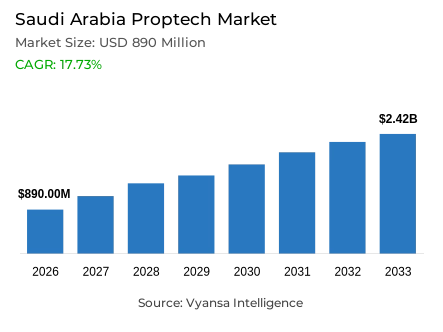
Proptech in Saudi Arabia refers to the digital platforms and software that manage property search, brokerage, rental registration, off-plan sales, financing, and facility operations across residential, commercial, industrial, and hospitality real estate. Brokers, landlords, developers, property managers and foreign investors rely on it to search, list, finance, register and manage property. The Saudi Arabia proptech market is forecast to grow at a CAGR of 17.73% between 2027 and 2033.
Key Highlights of the Saudi Arabia Proptech Market
- The Saudi Arabia proptech market was valued at USD 0.89 billion in 2026 and is estimated at USD 0.91 billion in 2027, forecast to reach USD 2.42 billion by 2033.
- The market is forecast to expand at a compound annual growth rate of 17.73% between 2027 and 2033.
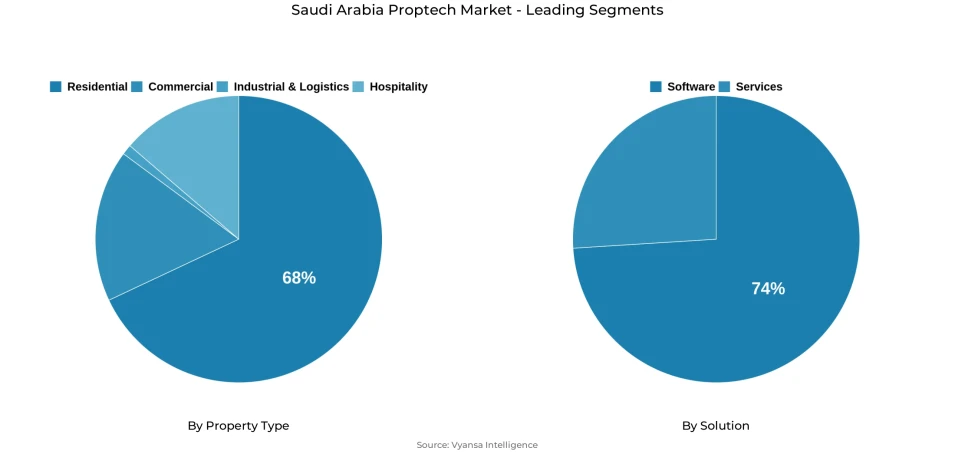
- By property type, residential leads the market with a 68% share in 2026.
- Industrial & logistics is the fastest-growing property type, expanding at a 21.80% CAGR between 2027 and 2033.
- By solution, software commands the market with a 74% share in 2026 across core digital real estate workflows.
- Services are the fastest-growing solution category, expanding at an 18.90% CAGR between 2027 and 2033.
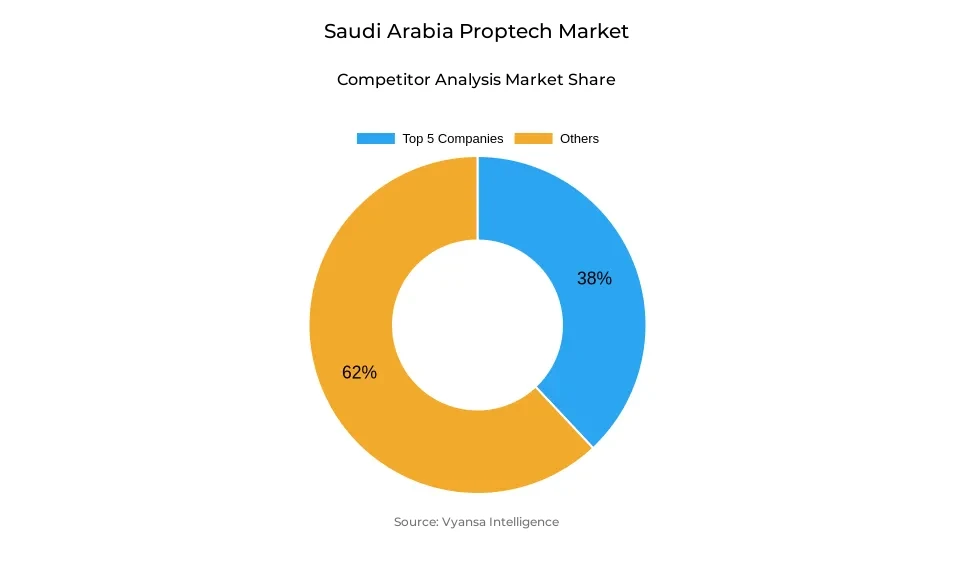
- The market is fragmented, with the top five companies holding a combined 38% share in 2026.
The Saudi Arabia proptech market is developing around a large and increasingly formalized real estate transaction base. REGA reported more than 8 million real estate transactions worth approximately USD 320 billion during the first two years of the real estate brokerage law, between July 2023 and July 2025. The same period saw more than 86,000 licensed real estate practitioners, 75 licensed electronic real estate platforms and over 685,000 licensed advertisements, creating a substantial operating base for property-search, brokerage, transaction-management and real estate analytics solutions.
Digital infrastructure is also making property information more accessible across the market. REGA's real estate indicators platform provides regularly updated sales and rental information covering the Kingdom, individual cities and major neighborhoods, with filtering by geography, property type and period. Saudi Arabia is further developing a formal proptech ecosystem through the Saudi proptech hub, regulatory sandbox and proptech business accelerator, allowing technology companies to test new business models and connect with investors. This is expanding proptech beyond property listings toward pricing intelligence, transaction management, investment analysis and asset operations.
However, persistent geopolitical instability across the Middle East is creating near-term pressure on Saudi Arabia’s construction and real estate environment. The country’s construction cost index rose 2.7% year-over-year in June 2026, with residential construction costs increasing 2.6% and non-residential costs rising 3.1%. Regional disruptions to key shipping and energy routes are further contributing to logistics uncertainty, potentially increasing transportation costs and extending project timelines. Meanwhile, Saudi Arabia’s residential real estate market recorded weaker transaction activity, with transaction values declining 26.9% year-over-year in Q2 2026 to approximately USD 10.05 billion, while transaction volumes decreased 14.2%. If geopolitical disruptions persist, elevated construction and logistics costs could prompt developers to reassess project schedules and investment priorities, while softer residential transaction activity may constrain transaction-linked revenues for certain proptech platforms.
Despite these pressures, Saudi Arabia continues to advance large housing, infrastructure and urban-development programs, while the formalization and digitalization of real estate transactions provide a broader structural base for technology adoption. Through 2033, the proptech market should increasingly move toward platforms combining transactions, financing, property intelligence, digital brokerage and asset operations rather than isolated listing tools. Wider access to government property data, a growing technology-provider base and regulatory support for new business models should support deeper software penetration across the property lifecycle, although construction-cost pressures and regional uncertainty could periodically moderate the pace of expansion.
Saudi Arabia Proptech Market Drivers
Expanding Homeownership is Increasing Digital Property Transaction Activity
Saudi Arabia's housing expansion is creating a larger addressable base for property-search, mortgage, brokerage, and transaction platforms. Homeownership among Saudi households increased to 65.4% in 2024 and continues to move toward the national target of 70% by 2030. As more households enter the ownership market, digital platforms gain additional transaction opportunities across property discovery, financing, valuation, and documentation.
Government-supported housing programs are reinforcing this demand. In January 2026, 8,427 Saudi families benefited from Sakani housing-support services, indicating continued activity across digitally enabled housing and financing channels. This expands the number of consumers interacting with real estate technology beyond property search alone and increases demand for platforms that can support multiple stages of the purchasing process.
Through 2033, continued housing delivery and financing activity should strengthen the role of proptech across residential transactions. Platforms capable of connecting search, mortgage support, documentation, and post-purchase services can capture a larger share of each customer journey as homeownership expands.
Saudi Arabia Proptech Market Challenge
Increasing Regulatory Requirements are Raising Platform Operating Costs
Saudi Arabia's more structured digital real estate environment is increasing the technical and compliance requirements placed on proptech companies. Electronic property platforms must increasingly manage advertiser verification, licensing controls, local data hosting, and integration with government systems before listings and transactions can be processed at scale. These requirements improve market transparency but also increase the fixed cost of operating a compliant platform.
The regulatory burden is supported by active enforcement. In July 2026, REGA conducted more than 22,500 electronic scans across digital channels and real estate platforms as part of its market-monitoring activities. This increases the importance of automated verification and controlled listing workflows rather than allowing platforms to function as largely open marketplaces.
Larger operators are better positioned to absorb these costs across broader user and transaction bases, while smaller platforms may require additional compliance investment or partnerships with licensed intermediaries. The result is a higher entry threshold for new proptech companies and greater pressure to build regulatory integration directly into the platform architecture.
Saudi Arabia Proptech Market Trends
Property Platforms are Expanding into Embedded Rental Finance
Saudi proptech platforms are increasingly extending beyond property discovery into financing and payment services. Rental platforms can now address one of the market's practical transaction frictions by allowing tenants to spread annual rental commitments into monthly payments while landlords continue receiving their rent upfront. This allows proptech companies to remain involved after the property-search stage and participate more directly in transaction value.
Rize reflects this shift. In January 2025, the company raised approximately USD 35 million to strengthen its technology and support expansion beyond Riyadh. Its rent-now-pay-later model is integrated with the Ejar rental framework, showing how financing is becoming embedded within the digital rental journey rather than being handled entirely through a separate financial provider.
The model is also gaining commercial scale, with Rize reporting more than 200,000 tenants on its platform. As similar financial products expand, proptech providers can generate revenue from payment and financing activity in addition to listings and subscriptions, increasing the value of each customer relationship and supporting a broader transaction-based business model.
Artificial Intelligence is Strengthening Property Valuation and Decision Support
Artificial intelligence is becoming increasingly relevant to Saudi real estate as the country's wider data and computing infrastructure expands. Government spending on AI and emerging technologies increased 56.25% in 2024, creating a stronger domestic technology environment for data-intensive applications such as automated valuation, property recommendations and geospatial analysis.
Saudi proptech platforms are beginning to convert this capability into real estate-specific products. Suhail analyses approximately 3 million recorded property transactions, allowing valuation and market indicators to be based on historical transaction data rather than relying primarily on advertised asking prices. This improves the quality of pricing, neighbourhood comparison and investment analysis available to brokers, developers and investors.
The trend should strengthen as more real estate data becomes structured and locally processed. Greater use of AI can move proptech platforms beyond property discovery toward decision-support tools that assist users with pricing, investment assessment and asset management, increasing the strategic value of proprietary data and analytics capability.
Saudi Arabia Proptech Market Opportunity
Foreign Property Ownership Creates a New Digital Customer Segment
Saudi Arabia's revised property-ownership framework creates a new addressable market for proptech providers by opening defined ownership opportunities to eligible non-Saudi residents, foreign individuals and international companies. These buyers require more support than domestic users because they must navigate eligibility conditions, permitted locations, documentation and remote transaction processes before completing a purchase.
The framework entered into force in January 2026, with the Saudi Properties platform serving as the official digital gateway for applications and eligibility verification. This creates a structured transaction pathway around which private platforms can build additional services rather than attempting to replicate the government's regulatory function.
The opportunity therefore lies in simplifying the foreign-buyer journey through multilingual property discovery, ownership-zone filters, remote onboarding, valuation and transaction support. Regional proptech platforms with existing international user bases are particularly well positioned to channel cross-border demand into the Saudi market, creating an incremental customer segment alongside the established domestic residential base.
Unlock Market Intelligence
Explore the market potential with our data-driven report
Saudi Arabia Proptech Market Segmentation Analysis
By Property Type:
- Residential
- Commercial
- Industrial & Logistics
- Hospitality
Residential Property Leads Saudi Proptech Adoption with 68% Share Across Digital Housing and Transaction Platforms
Residential accounts for 68% of Saudi Arabia proptech market demand in 2026 because home purchases and rentals generate the country's largest pool of repeat digital interactions across search, brokerage, financing, and contract administration. Saudi Arabia's housing strategy has also expanded homeownership considerably, increasing from approximately 47% in 2016 to 65.4% in 2024 against a national target of 70% by 2030.
This expanding ownership base provides a large addressable market for digital property search, mortgage support and transaction software. Residential users also interact with Proptech across several stages of a property journey, including discovery, rental administration, financing and property management, giving the segment considerably broader software exposure than many specialized property categories.
Industrial & Logistics is the fastest-growing Property Type at a 21.80% CAGR during 2027 to 2033. Its growth reflects the expansion of logistics parks, warehouses, and industrial developments requiring digital leasing, asset-management, and facility-operation systems from a relatively small existing Proptech base.
By Solution:
- Software
- Services
Software Commands Saudi Proptech Spending with 74% Share Across Core Digital Real Estate Workflows
Software holds a 74% share of Saudi Arabia proptech market spending in 2026 because listing platforms, rental systems, valuation engines, analytics tools and transaction software form the digital layer through which users interact directly with the property market. Government-linked workflows further strengthen the installed software base because companies increasingly need technology compatible with regulated real estate processes.
Technology functionality is also expanding. Property Finder introduced Credit Optimizer, an AI-based predictive tool that analyzes live market signals and recommends how agencies should allocate listing-upgrade spending. Early testing reported higher lead generation and lower lead-acquisition costs, illustrating how Proptech software is progressing from property discovery toward operational decision support.
Services are the fastest-growing Solution segment at an 18.90% CAGR during 2027 to 2033. Growth comes from implementation, customization and integration requirements as property companies connect standardized software with their own workflows and Saudi government systems.
Unlock Market Intelligence
Explore the market potential with our data-driven report
Saudi Arabia Proptech Market Competitive Landscape
The market is fragmented, with the top five companies holding a combined 38% share in 2026. Aqar App Company holds a leading position among consumer platforms, followed by Bayut Web Saudi for Communications and Information Technology Company, Property Finder Real Estate Company, Ulum AlBayanat for IT SPC and Al Olou Financial Company.
Key Companies in the Saudi Arabia Proptech Market
- Aqar App Company
- Property Finder Real Estate Company
- Bayut Web Saudi for Communications and Information Technology Company
- Al Olou Financial Company (Rize)
- Ulum AlBayanat for IT S.P.C. (Suhail)
- Wasalt Real Estate Services
- Ajras Information Technology Company
- Ejari Financial Company
- Munjz LLC
- Deal Real Estate Application Company
Company Profiling
The following profiles cover the five leading companies shaping product development and competitive positioning in the market.
Aqar App Company: Aqar operates one of Saudi Arabia's largest digital property-search and rental platforms across residential and commercial real estate. The platform reports more than 12 million downloads, approximately 2 million monthly active users and more than 400 million monthly property searches. Its current offering extends beyond listings into licensed-property verification, Ejar rental management, neighborhood pricing insights and embedded Rent Now, Pay Later services, positioning Aqar as a broad consumer transaction platform rather than a standalone listing portal.
Bayut Web Saudi for Communications and Information Technology Company: Bayut Saudi Arabia provides residential and commercial property search alongside new-project discovery, mortgage support and brokerage tools. Its current technology offering includes AI-assisted property search, drive-time-based discovery, verified listings and interactive property experiences. This moves Bayut beyond standard location and price filters toward more personalized property matching and strengthens its position as a technology-led consumer property portal.
Property Finder Real Estate Company: Property Finder participates through its Saudi property portal and broader agency-focused software ecosystem. In late 2025, the company introduced Credit Optimizer, a predictive AI engine that analyzes market signals and recommends where agencies should allocate listing-upgrade expenditure. Initial testing reported a 26% increase in leads from upgraded listings and a 30% reduction in average cost per lead, adding measurable agency productivity functionality beyond consumer property search.
Al Olou Financial Company: Operating under the Rize brand, Al Olou Financial Company combines Proptech with rental financing through its Rent Now, Pay Later platform. Rize allows tenants to pay annual rent through monthly installments while landlords receive payment upfront. The company raised SAR 132 million, approximately USD 35 million, in January 2025 to strengthen its technology and expand beyond Riyadh into additional Saudi regions, positioning it as a financing-led Proptech participant rather than a conventional listing platform.
Ulum AlBayanat for IT SPC: Ulum AlBayanat operates the Suhail platform, combining AI-based property analytics, automated valuation, land and building information, real estate indicators and digital transaction functionality. Its dataset covers approximately 3 million transactions across around 3.2 million properties, providing a substantial base for market analysis and valuation. Suhail also supports secure digital payment through SADAD, giving the platform exposure across both property intelligence and transaction execution.
Recent Developments in the Saudi Arabia Proptech Market
- 2026: REGA announced the third Global PropTech Summit in Riyadh with more than 200 speakers from 85 countries, over 100 exhibiting organizations, more than 50 discussion sessions and 40 specialized workshops. The agenda includes AI-based asset management, digital twins, smart assets and digital property marketplaces, increasing Saudi Arabia's exposure to international PropTech suppliers, investors and technology developers.
Frequently Asked Questions
Related Report
- Market Segmentation
- Research Scope
- Research Methodology
- Definitions and Assumptions
- Executive Summary
- Saudi Arabia Proptech Market Policies, Regulations, and Standards
- Saudi Arabia Proptech Market Dynamics
- Growth Factors
- Challenges
- Trends
- Opportunities
- Saudi Arabia Proptech Market Statistics, 2023-2033F
- Market Size & Growth Outlook
- By Revenues in USD Million
- Market Segmentation & Growth Outlook
- By Property Type
- Residential- Market Insights and Forecast 2023-2033, USD Million
- Commercial- Market Insights and Forecast 2023-2033, USD Million
- Industrial & Logistics- Market Insights and Forecast 2023-2033, USD Million
- Hospitality- Market Insights and Forecast 2023-2033, USD Million
- By Solution
- Software- Market Insights and Forecast 2023-2033, USD Million
- Services- Market Insights and Forecast 2023-2033, USD Million
- By Deployment
- Cloud- Market Insights and Forecast 2023-2033, USD Million
- On-Premise- Market Insights and Forecast 2023-2033, USD Million
- By End User
- Property Owners & Developers- Market Insights and Forecast 2023-2033, USD Million
- Real Estate Agents & Brokerages- Market Insights and Forecast 2023-2033, USD Million
- Facility & Property Managers- Market Insights and Forecast 2023-2033, USD Million
- Property Investors & REITs- Market Insights and Forecast 2023-2033, USD Million
- By Technology
- IoT & Smart Sensor Networks- Market Insights and Forecast 2023-2033, USD Million
- AI & Big Data Analytics- Market Insights and Forecast 2023-2033, USD Million
- AR, VR & Digital Twins- Market Insights and Forecast 2023-2033, USD Million
- Blockchain & Distributed Ledger Technology- Market Insights and Forecast 2023-2033, USD Million
- By Region
- Riyadh- Market Insights and Forecast 2023-2033, USD Million
- Jeddah- Market Insights and Forecast 2023-2033, USD Million
- Makkah- Market Insights and Forecast 2023-2033, USD Million
- Dammam- Market Insights and Forecast 2023-2033, USD Million
- Madinah- Market Insights and Forecast 2023-2033, USD Million
- Other Regions- Market Insights and Forecast 2023-2033, USD Million
- By Competitors
- Competition Characteristics
- Market Share & Analysis
- By Property Type
- Market Size & Growth Outlook
- Saudi Arabia Residential Market Statistics, 2023-2033
- Market Size & Growth Outlook
- By Revenues in USD Million
- Market Segmentation & Growth Outlook
- By Solution- Market Insights and Forecast 2023-2033, USD Million
- By Deployment- Market Insights and Forecast 2023-2033, USD Million
- By End User- Market Insights and Forecast 2023-2033, USD Million
- By Technology- Market Insights and Forecast 2023-2033, USD Million
- By Region- Market Insights and Forecast 2023-2033, USD Million
- Market Size & Growth Outlook
- Saudi Arabia Commercial Market Statistics, 2023-2033
- Market Size & Growth Outlook
- By Revenues in USD Million
- Market Segmentation & Growth Outlook
- By Solution- Market Insights and Forecast 2023-2033, USD Million
- By Deployment- Market Insights and Forecast 2023-2033, USD Million
- By End User- Market Insights and Forecast 2023-2033, USD Million
- By Technology- Market Insights and Forecast 2023-2033, USD Million
- By Region- Market Insights and Forecast 2023-2033, USD Million
- Market Size & Growth Outlook
- Saudi Arabia Industrial & Logistics Market Statistics, 2023-2033
- Market Size & Growth Outlook
- By Revenues in USD Million
- Market Segmentation & Growth Outlook
- By Solution- Market Insights and Forecast 2023-2033, USD Million
- By Deployment- Market Insights and Forecast 2023-2033, USD Million
- By End User- Market Insights and Forecast 2023-2033, USD Million
- By Technology- Market Insights and Forecast 2023-2033, USD Million
- By Region- Market Insights and Forecast 2023-2033, USD Million
- Market Size & Growth Outlook
- Saudi Arabia Hospitality Market Statistics, 2023-2033
- Market Size & Growth Outlook
- By Revenues in USD Million
- Market Segmentation & Growth Outlook
- By Solution- Market Insights and Forecast 2023-2033, USD Million
- By Deployment- Market Insights and Forecast 2023-2033, USD Million
- By End User- Market Insights and Forecast 2023-2033, USD Million
- By Technology- Market Insights and Forecast 2023-2033, USD Million
- By Region- Market Insights and Forecast 2023-2033, USD Million
- Market Size & Growth Outlook
- Competitive Outlook
- Company Profiles
- Aqar App Company (Aqar)
- Business Description
- Product Portfolio
- Collaborations & Alliances
- Recent Developments
- Financial Details
- Others
- Property Finder Real Estate Company (Property Finder)
- Business Description
- Product Portfolio
- Collaborations & Alliances
- Recent Developments
- Financial Details
- Others
- Bayut Web Saudi for Communications and Information Technology Company (Bayut)
- Business Description
- Product Portfolio
- Collaborations & Alliances
- Recent Developments
- Financial Details
- Others
- Al Olou Financial Company (Rize)
- Business Description
- Product Portfolio
- Collaborations & Alliances
- Recent Developments
- Financial Details
- Others
- Ulum AlBayanat for IT S.P.C. (Suhail)
- Business Description
- Product Portfolio
- Collaborations & Alliances
- Recent Developments
- Financial Details
- Others
- Wasalt Real Estate Services
- Business Description
- Product Portfolio
- Collaborations & Alliances
- Recent Developments
- Financial Details
- Others
- Ajras Information Technology Company
- Business Description
- Product Portfolio
- Collaborations & Alliances
- Recent Developments
- Financial Details
- Others
- Ejari Financial Company (Ejari)
- Business Description
- Product Portfolio
- Collaborations & Alliances
- Recent Developments
- Financial Details
- Others
- Munjz LLC
- Business Description
- Product Portfolio
- Collaborations & Alliances
- Recent Developments
- Financial Details
- Others
- Deal Real Estate Application Company (Deal)
- Business Description
- Product Portfolio
- Collaborations & Alliances
- Recent Developments
- Financial Details
- Others
- Aqar App Company (Aqar)
- Company Profiles
- Disclaimer
| Segment | Sub-Segment |
|---|---|
| By Property Type |
|
| By Solution |
|
| By Deployment |
|
| By End User |
|
| By Technology |
|
| By Region |
|
Research Methodology
This study followed a structured approach comprising four key phases to assess the size and scope of the electro-oxidation market. The process began with thorough secondary research to collect data on the target market, related markets, and broader industry context. These findings, along with preliminary assumptions and estimates, were then validated through extensive primary research involving industry experts from across the value chain. To calculate the overall market size, both top-down and bottom-up methodologies were employed. Finally, market segmentation and data triangulation techniques were applied to refine and validate segment-level estimations.
Secondary Research
The secondary research phase involved gathering data from a wide range of credible and published sources. This step helped in identifying industry trends, defining market segmentation, and understanding the market landscape and value chain.
Sources consulted during this phase included:
- Company annual reports, investor presentations, and press releases
- Industry white papers and certified publications
- Trade directories and market-recognized databases
- Articles from authoritative authors and reputable journals
- Gold and silver standard websites
Secondary research was critical in mapping out the industry's value chain and monetary flow, identifying key market segments, understanding regional variations, and tracking significant industry developments.
Other key sources:
- Financial disclosures
- Industry associations and trade bodies
- News outlets and business magazines
- Academic journals and research studies
- Paid industry databases
Primary Research
To validate secondary data and gain deeper market insights, primary research was conducted with key stakeholders across both the supply and demand sides of the market.
On the demand side, participants included decision-makers and influencers from end-user industries—such as CIOs, CTOs, and CSOs—who provided first-hand perspectives on market needs, product usage, and future expectations.
On the supply side, interviews were conducted with manufacturers, industry associations, and institutional participants to gather insights into current offerings, product pipelines, and market challenges.
Primary interviews provided critical inputs such as:
- Market size and revenue data
- Product and service breakdowns
- Market forecasts
- Regional and application-specific trends
Stakeholders consulted included:
- Leading OEM and solution providers
- Channel and distribution partners
- End users across various applications
- Independent consultants and industry specialists
Market Size Estimation and Data Triangulation
- Identifying Key Market Participants (Secondary Research)
- Goal: To identify the major players or companies in the target market. This typically involves using publicly available data sources such as industry reports, market research publications, and financial statements of companies.
- Tools: Reports from firms like Gartner, Forrester, Euromonitor, Statista, IBISWorld, and others. Public financial statements, news articles, and press releases from top market players.
- Extracting Earnings of Key Market Participants
- Goal: To estimate the earnings generated from the product or service being analyzed. This step helps in understanding the revenue potential of each market player in a specific geography.
- Methods: Earnings data can be gathered from:
- Publicly available financial reports (for listed companies).
- Interviews and primary data sources from professionals, such as Directors, VPs, SVPs, etc. This is especially useful for understanding more nuanced, internal data that isn't publicly disclosed.
- Annual reports and investor presentations of key players.
- Data Collation and Development of a Relevant Data Model
- Goal: To collate inputs from both primary and secondary sources into a structured, data-driven model for market estimation. This model will incorporate key market KPIs and any independent variables relevant to the market.
- Key KPIs: These could include:
- Market size, growth rate, and demand drivers.
- Industry-specific metrics like market share, average revenue per customer (ARPC), or average deal size.
- External variables, such as economic growth rates, inflation rates, or commodity prices, that could affect the market.
- Data Modeling: Based on this data, the market forecasts are developed for the next 5 years. A combination of trend analysis, scenario modeling, and statistical regression might be used to generate projections.
- Scenario Analysis
- Goal: To test different assumptions and validate how sensitive the market is to changes in key variables (e.g., market demand, regulatory changes, technological disruptions).
- Types of Scenarios:
- Base Case: Based on current assumptions and historical data.
- Best-Case Scenario: Assuming favorable market conditions, regulatory environments, and technological advancements.
- Worst-Case Scenario: Accounting for adverse factors, such as economic downturns, stricter regulations, or unexpected disruptions.












