Malaysia Juice Market Report: Trends, Growth and Forecast (2026-2032)
By Category (100% Juice (Not from Concentrate, Reconstituted), Juice Drinks (up to 24% Juice), Nectars (High Concentration (40% to 50% fruit content), Medium Concentration (30% to 39% fruit content), Low Concentration (25% to 29% fruit content)), Vegetable Juice, Fruit and Vegetable Blends), By Nature (Conventional, Organic), By Packaging Material (Plastic, Glass, Metal, Others), By Packaging Type (PET Bottles, Aseptic Packages (Cartons), Glass Bottles, Metal Cans, Disposable Cups & Pouches), By Sales Channel (Off-Trade (Hypermarkets/ Supermarkets, Retail Outlets, Convenience Stores, Online Platforms), On-Trade) ... Read more
|
Major Players
|
Malaysia Juice Market Statistics and Insights, 2026
- Market Size Statistics
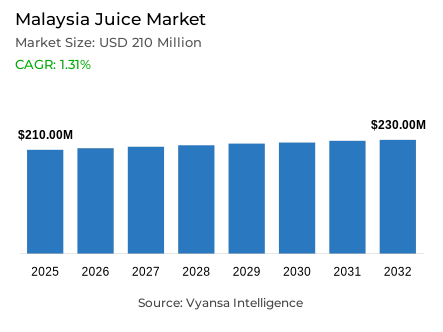
- Juice market size in Malaysia was estimated at USD 210 million in 2025.
- The market size is expected to grow to USD 230 million by 2032.
- Market to register a CAGR of around 1.31% during 2026-32.
- Category Shares
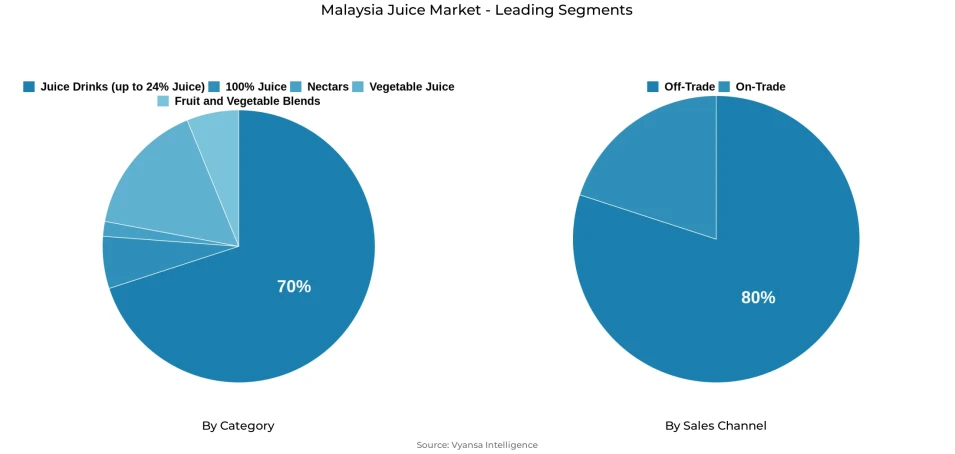
- Juice drinks (up to 24% juice) grabbed market share of 70%.
- Competition
- More than 10 companies are actively engaged in producing juice in Malaysia.
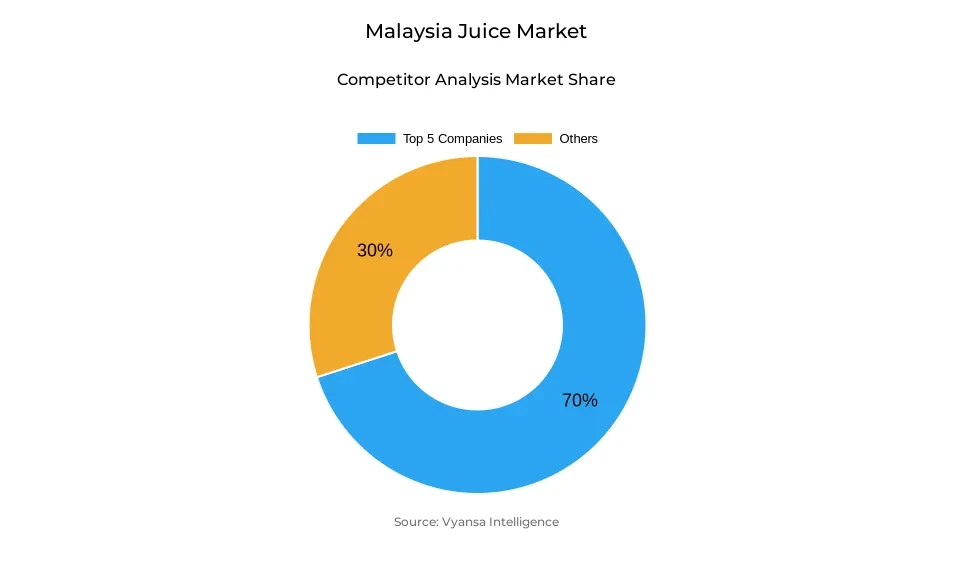
- Top 5 companies acquired around 70% of the market share.
- Yeo Hiap Seng (M) Bhd, Suntory Beverage & Food (M) Sdn Bhd, Amoy Canning (Beverages) Sdn Bhd, Malaysia Milk Sdn Bhd, Etika Beverages Sdn Bhd etc., are few of the top companies.
- Sales Channel
- Off-trade grabbed 80% of the market.
Malaysia Juice Market Outlook
The Malaysia juice market is going through a low growth phase, which is largely affected by the rise in taxation and a major change in end user health awareness. It is projected to be USD 210 million in 2025 and is estimated to be USD 230 million in 2032 with a CAGR of about 1.31% in the 2026–32 forecast period. Although price sensitivity is a significant challenge because of the introduction of higher sugar taxes and Sales and Service Tax (SST), the market is supported by the mass appeal of low-end products, with Juice Drinks (up to 24% Juice) having a market share of 70%.
The main driver of change is health trends, which have led to an increase in the demand of coconut and other plant waters. These are becoming popular as natural and low-sugar hydration products in the Malaysian tropical climate. On the other hand, the 100% juice segment is experiencing a downturn because of the increasing cost of raw materials that are making the products unaffordable to the middle-income earners. To this, manufacturers are re-packaging products to contain less sugar than the tax limits and launching functional lines with multivitamins and minerals to stay relevant.
Malaysia Milk Sdn Bhd leads the competitive environment and sustains its leadership by ensuring that Marigold and Peel Fresh have strong brand loyalty. But local competitors like Kara Marketing are expanding at a high rate by using locally obtained ingredients to maintain low production costs. In order to spur future growth, businesses are embracing technology, and they intend to use Artificial Intelligence (AI) to streamline supply chains and enhance operational efficiency in a difficult economic climate.
Sales channel is predominantly centered on home and impulse consumption, with Off-Trade channels grabbing 80% of the market. Hypermarkets remain the volume leaders due to their extensive chiller space and promotional activities, but convenience stores like 99 Speedmart and Family Mart are the most dynamic. These small-format stores are particularly popular among younger end users for "grab-and-go" purchases, ensuring that juice remains accessible despite the broader trend of trading down to more economical beverage concentrates.
Malaysia Juice Market Growth DriverExcise-Driven Sugar Reduction Accelerating the Shift Toward Plant-Based Hydration
The Malaysian juice market is undergoing a strong trend towards reduced sugar content refreshment products. Packaged juice is becoming more discretionary to end users, which raises the level of concern about coconut and other plant waters that are viewed as lighter and more hydrating. The trend is supported by government policy, which increases the cost of high-sugar formulations, which establishes structural incentives to reformulate to naturally lower-sugar formulations.
The Royal Customs of Malaysia has issued the Excise Duties Amendment No.2 Order of 2024, which will take effect on 1 January 2025 and replaces the duty rate of RM 0.50 with RM 0.90 on sweetened beverages in HS headings 20.09 and 22.02. This financial strain promotes reformulation and functional propositions like multivitamin and mineral blends. It reinforces the need to have naturally placed hydration products that provide convenience via the contemporary retailing outlets. As a result, coconut water is re-framed as an alternative to sugary juice in everyday on-the-go drinking situations, thus radically redefining the category mix in favor of plant-based hydration formats that are in line with the health-conscious end user behavior and positive regulatory treatment.
Malaysia Juice Market ChallengeLayered Taxation and Food Inflation Intensifying Price Sensitivity and Constraining Premiumisation
The packaged juice market in Malaysia is experiencing long term affordability pressure that restrains volume momentum and increases substitution to fresh blends and concentrates. When the budgets become tight, end users will switch to less expensive brands or not purchase packaged juice at all, especially when it is considered to be rich in sugar and non-essential. This price elasticity puts structural restrictions on premium positioning and restricts the capacity of manufacturers to transmit cost rises without losing volume.
According to Department of Statistics Malaysia, the inflation of Food and Beverages is 2.1% per annum in September 2025. Royal Customs imposed an excise duty of RM 0.90 per liter as of 1 January 2025, which exerts direct pressure on shelf prices. The Ministry of Finance affirmed that Sales Tax of 5% or 10% on discretionary and non-essential goods would be imposed on 1 July 2025. These fixed costs restrict the ability to price and invest in innovation. This dynamic promotes promotion-based selling and keeps manufacturers cautious about new product launches, thus limiting category evolution and premiumisation strategies in the Malaysian cost-conscious end user market.
Unlock Market Intelligence
Explore the market potential with our data-driven report
Malaysia Juice Market TrendModern Retail Expansion Consolidating Shelf Power and Shaping Juice Competition Dynamics
The path to shelf visibility of packaged juice is dominated by modern grocery retail, where retailers determine chiller space and promotions influence end user buying decisions. This is in line with the current channel trends where hypermarkets still enjoy the benefits of scale as convenience stores are gaining momentum with impulse and grab-and-go missions. The density of contemporary retail generates strategic demands of brand presence, promotional quality and format innovation that are consistent with retailer interests and end user shopping patterns.
According to the Department of Statistics Malaysia, the value of wholesale and retail trade sales is projected to be RM 154.0 billion in March 2025, increasing by 5.7% per annum, with retail trade increasing by 6.6% per annum. Wholesale and retail trade volume index increases 5.0% annually to 162.8 points. This growth helps in the listing of more products, weekend activations, and small-pack formats, which reinforce modern retailers as the main frontier of value and healthier positioning in juice. These outlets are the priority of the brands, which allows them to rotate quickly, have a stronger visibility, and weekly price promotion, which makes modern retail the key strategic channel of market-share development.
Malaysia Juice Market OpportunityAI-Enabled Supply Chain Optimisation Unlocking Cost Efficiency and Availability Gains
Artificial intelligence as a means of operational efficiency is a clear value lever to juice manufacturers that have to deal with chilled logistics, short shelf-life products, and frequent price changes. Better forecasting and replenishment will minimize stock-outs, markdowns, and waste in hypermarkets and convenience stores, which will generate competitive advantages by providing better operational execution. The need to optimise supply-chain using AI is more urgent as manufacturers have to cope with multi-channel distribution needs and unstable demand trends.
Malaysia Digital Economy Corporation reinforces this channel. On 8 July 2025, the MDEC announced two grants of RM 2.9 million to speed up the process of artificial intelligence and manufacturing digitalisation. MDEC estimates RM 54.13 billion of approved Malaysia Digital investments in Q3 2025, creating 21,815 high-value jobs in 402 digital firms. This ecosystem will assist juice players who use AI to sense demand, plan promotions, and optimise routes to ensure the availability of coconut water and juice packs in the right outlets. The high availability is maintained by technology investment and affordability is maintained by shoppers who switch channels fast, thus operational excellence is maintained as a sustainable competitive differentiator in the dynamic retail environment in Malaysia.
Unlock Market Intelligence
Explore the market potential with our data-driven report
Malaysia Juice Market Segmentation Analysis
By Category
- 100% Juice
- Not from Concentrate
- Reconstituted
- Juice Drinks (up to 24% Juice)
- Nectars
- High Concentration (40% to 50% fruit content)
- Medium Concentration (30% to 39% fruit content)
- Low Concentration (25% to 29% fruit content)
- Vegetable Juice
- Fruit and Vegetable Blends
The segment has the highest share around the category in the Malaysian juice market, where Juice Drinks (up to 24% Juice) grabbed a market share of 70%. This segment’s dominance is largely due to its superior affordability, making it the primary choice for budget-conscious households during times of rising retail prices. While more premium categories like 100% juice struggle with high costs, juice drinks remain a staple for mass consumption, often purchased for their refreshing qualities rather than purely for nutritional value.
To stay competitive under new sugar tax regulations, manufacturers in this segment are focusing on product reformulation and functional additions. By reducing sugar content to stay below tax thresholds and adding multivitamins, brands can maintain their low price points while appealing to health-conscious shoppers. Despite the slow overall growth of the market, the sheer volume and accessibility of juice drinks ensure they will remain the backbone of the Malaysian juice market through 2032.
By Sales Channel
- Off-Trade
- Hypermarkets/ Supermarkets
- Retail Outlets
- Convenience Stores
- Online Platforms
- On-Trade
The segment has the highest share around the Sales Channel is Off-Trade, which grabbed 85% of the market. This channel's strength is supported by the extensive reach of hypermarkets, which cater to middle-to-high-income families with broad product ranges and dedicated chiller spaces. The off-trade dominance is further reinforced by the rapid expansion of convenience store chains, which have become the most dynamic sub-channel for impulse purchases among younger, tech-savvy end users who value speed and proximity.
The growth of off-trade sales is also being fueled by the evolution of the retail landscape, where grocery chains are investing in outlet expansion to reach more residential areas. While hypermarkets remain the traditional leaders for planned household shopping, convenience stores and forecourt retailers are successfully capturing a larger share of the "on-the-go" market. This robust retail infrastructure ensures that packaged juice remains highly visible and accessible to end users across all income brackets throughout Malaysia.
List of Companies Covered in Malaysia Juice Market
The companies listed below are highly influential in the Malaysia juice market, with a significant market share and a strong impact on industry developments.
- Yeo Hiap Seng (M) Bhd
- Suntory Beverage & Food (M) Sdn Bhd
- Amoy Canning (Beverages) Sdn Bhd
- Malaysia Milk Sdn Bhd
- Etika Beverages Sdn Bhd
- Fraser & Neave Holdings Bhd
- Ace Canning Corp Sdn Bhd
- Coca-Cola Bottlers (M) Sdn Bhd
- Pokka Ace (M) Sdn Bhd
- Kara Marketing (M) Sdn Bhd
Competitive Landscape
Malaysia’s juice market in 2025 is led by Malaysia Milk Sdn Bhd, which sustains its leadership through strong brands such as Marigold and Peel Fresh, wide hypermarket presence, competitive pricing, and promotional intensity targeting price sensitive consumers. Kara Marketing is the most dynamic challenger, capitalising on rapid growth in coconut and other plant waters through local sourcing advantages, expanded convenience store distribution, and strong brand activation. Etika Beverages and Fraser & Neave compete via functional extensions such as multivitamin enriched juices. Indirect competition from freshly blended juices, concentrates, and RTD tea is intensifying amid sugar tax pressures and health concerns. Differentiation opportunities centre on sugar reduction reformulation, functional hydration positioning, AI driven operational efficiency, and deeper penetration of modern and convenience retail channels.
Frequently Asked Questions
Related Report
- Market Segmentation
- Research Scope
- Research Methodology
- Definitions and Assumptions
- Executive Summary
- Malaysia Juice Market Policies, Regulations, and Standards
- Malaysia Juice Market Dynamics
- Growth Factors
- Challenges
- Trends
- Opportunities
- Malaysia Juice Market Statistics, 2022-2032F
- Market Size & Growth Outlook
- By Revenues in USD Million
- By Quantity Sold in Million Litres
- Market Segmentation & Growth Outlook
- By Category
- 100% Juice- Market Insights and Forecast 2022-2032, USD Million
- Not from Concentrate- Market Insights and Forecast 2022-2032, USD Million
- Reconstituted- Market Insights and Forecast 2022-2032, USD Million
- Juice Drinks (up to 24% Juice)- Market Insights and Forecast 2022-2032, USD Million
- Nectars- Market Insights and Forecast 2022-2032, USD Million
- High Concentration (40% to 50% fruit content)- Market Insights and Forecast 2022-2032, USD Million
- Medium Concentration (30% to 39% fruit content)- Market Insights and Forecast 2022-2032, USD Million
- Low Concentration (25% to 29% fruit content)- Market Insights and Forecast 2022-2032, USD Million
- Vegetable Juice- Market Insights and Forecast 2022-2032, USD Million
- Fruit and Vegetable Blends- Market Insights and Forecast 2022-2032, USD Million
- 100% Juice- Market Insights and Forecast 2022-2032, USD Million
- By Nature
- Conventional- Market Insights and Forecast 2022-2032, USD Million
- Organic- Market Insights and Forecast 2022-2032, USD Million
- By Packaging Material
- Plastic- Market Insights and Forecast 2022-2032, USD Million
- Glass- Market Insights and Forecast 2022-2032, USD Million
- Metal- Market Insights and Forecast 2022-2032, USD Million
- Others- Market Insights and Forecast 2022-2032, USD Million
- By Packaging Type
- PET Bottles- Market Insights and Forecast 2022-2032, USD Million
- Aseptic Packages (Cartons)- Market Insights and Forecast 2022-2032, USD Million
- Glass Bottles- Market Insights and Forecast 2022-2032, USD Million
- Metal Cans- Market Insights and Forecast 2022-2032, USD Million
- Disposable Cups & Pouches- Market Insights and Forecast 2022-2032, USD Million
- By Sales Channel
- Off-Trade- Market Insights and Forecast 2022-2032, USD Million
- Hypermarkets/ Supermarkets - Market Insights and Forecast 2022-2032, USD Million
- Retail Outlets - Market Insights and Forecast 2022-2032, USD Million
- Convenience Stores- Market Insights and Forecast 2022-2032, USD Million
- Online Platforms- Market Insights and Forecast 2022-2032, USD Million
- On-Trade- Market Insights and Forecast 2022-2032, USD Million
- Off-Trade- Market Insights and Forecast 2022-2032, USD Million
- By Competitors
- Competition Characteristics
- Market Share & Analysis
- By Category
- Market Size & Growth Outlook
- Malaysia 100% Juice Market Statistics, 2022-2032
- Market Size & Growth Outlook
- By Revenues in USD Million
- By Quantity Sold in Million Litres
- Market Segmentation & Growth Outlook
- By Nature- Market Insights and Forecast 2022-2032, USD Million
- By Packaging Material- Market Insights and Forecast 2022-2032, USD Million
- By Packaging Type- Market Insights and Forecast 2022-2032, USD Million
- By Sales Channel- Market Insights and Forecast 2022-2032, USD Million
- Market Size & Growth Outlook
- Malaysia Juice Drinks (up to 24% Juice) Market Statistics, 2022-2032
- Market Size & Growth Outlook
- By Revenues in USD Million
- By Quantity Sold in Million Litres
- Market Segmentation & Growth Outlook
- By Nature- Market Insights and Forecast 2022-2032, USD Million
- By Packaging Material- Market Insights and Forecast 2022-2032, USD Million
- By Packaging Type- Market Insights and Forecast 2022-2032, USD Million
- By Sales Channel- Market Insights and Forecast 2022-2032, USD Million
- Market Size & Growth Outlook
- Malaysia Nectars Market Statistics, 2022-2032
- Market Size & Growth Outlook
- By Revenues in USD Million
- By Quantity Sold in Million Litres
- Market Segmentation & Growth Outlook
- By Nature- Market Insights and Forecast 2022-2032, USD Million
- By Packaging Material- Market Insights and Forecast 2022-2032, USD Million
- By Packaging Type- Market Insights and Forecast 2022-2032, USD Million
- By Sales Channel- Market Insights and Forecast 2022-2032, USD Million
- Market Size & Growth Outlook
- Malaysia Vegetable Juice Market Statistics, 2022-2032
- Market Size & Growth Outlook
- By Revenues in USD Million
- By Quantity Sold in Million Litres
- Market Segmentation & Growth Outlook
- By Nature- Market Insights and Forecast 2022-2032, USD Million
- By Packaging Material- Market Insights and Forecast 2022-2032, USD Million
- By Packaging Type- Market Insights and Forecast 2022-2032, USD Million
- By Sales Channel- Market Insights and Forecast 2022-2032, USD Million
- Market Size & Growth Outlook
- Malaysia Fruit and Vegetable Blends Market Statistics, 2022-2032
- Market Size & Growth Outlook
- By Revenues in USD Million
- By Quantity Sold in Million Litres
- Market Segmentation & Growth Outlook
- By Nature- Market Insights and Forecast 2022-2032, USD Million
- By Packaging Material- Market Insights and Forecast 2022-2032, USD Million
- By Packaging Type- Market Insights and Forecast 2022-2032, USD Million
- By Sales Channel- Market Insights and Forecast 2022-2032, USD Million
- Market Size & Growth Outlook
- Competitive Outlook
- Company Profiles
- Malaysia Milk Sdn Bhd
- Business Description
- Product Portfolio
- Collaborations & Alliances
- Recent Developments
- Financial Details
- Others
- Etika Beverages Sdn Bhd
- Business Description
- Product Portfolio
- Collaborations & Alliances
- Recent Developments
- Financial Details
- Others
- Fraser & Neave Holdings Bhd
- Business Description
- Product Portfolio
- Collaborations & Alliances
- Recent Developments
- Financial Details
- Others
- Ace Canning Corp Sdn Bhd
- Business Description
- Product Portfolio
- Collaborations & Alliances
- Recent Developments
- Financial Details
- Others
- Coca-Cola Bottlers (M) Sdn Bhd
- Business Description
- Product Portfolio
- Collaborations & Alliances
- Recent Developments
- Financial Details
- Others
- Yeo Hiap Seng (M) Bhd
- Business Description
- Product Portfolio
- Collaborations & Alliances
- Recent Developments
- Financial Details
- Others
- Suntory Beverage & Food (M) Sdn Bhd
- Business Description
- Product Portfolio
- Collaborations & Alliances
- Recent Developments
- Financial Details
- Others
- Amoy Canning (Beverages) Sdn Bhd
- Business Description
- Product Portfolio
- Collaborations & Alliances
- Recent Developments
- Financial Details
- Others
- Pokka Ace (M) Sdn Bhd
- Business Description
- Product Portfolio
- Collaborations & Alliances
- Recent Developments
- Financial Details
- Others
- Kara Marketing (M) Sdn Bhd
- Business Description
- Product Portfolio
- Collaborations & Alliances
- Recent Developments
- Financial Details
- Others
- Malaysia Milk Sdn Bhd
- Company Profiles
- Disclaimer
| Segment | Sub-Segment |
|---|---|
| By Category |
|
| By Nature |
|
| By Packaging Material |
|
| By Packaging Type |
|
| By Sales Channel |
|
Research Methodology
This study followed a structured approach comprising four key phases to assess the size and scope of the electro-oxidation market. The process began with thorough secondary research to collect data on the target market, related markets, and broader industry context. These findings, along with preliminary assumptions and estimates, were then validated through extensive primary research involving industry experts from across the value chain. To calculate the overall market size, both top-down and bottom-up methodologies were employed. Finally, market segmentation and data triangulation techniques were applied to refine and validate segment-level estimations.
Secondary Research
The secondary research phase involved gathering data from a wide range of credible and published sources. This step helped in identifying industry trends, defining market segmentation, and understanding the market landscape and value chain.
Sources consulted during this phase included:
- Company annual reports, investor presentations, and press releases
- Industry white papers and certified publications
- Trade directories and market-recognized databases
- Articles from authoritative authors and reputable journals
- Gold and silver standard websites
Secondary research was critical in mapping out the industry's value chain and monetary flow, identifying key market segments, understanding regional variations, and tracking significant industry developments.
Other key sources:
- Financial disclosures
- Industry associations and trade bodies
- News outlets and business magazines
- Academic journals and research studies
- Paid industry databases
Primary Research
To validate secondary data and gain deeper market insights, primary research was conducted with key stakeholders across both the supply and demand sides of the market.
On the demand side, participants included decision-makers and influencers from end-user industries—such as CIOs, CTOs, and CSOs—who provided first-hand perspectives on market needs, product usage, and future expectations.
On the supply side, interviews were conducted with manufacturers, industry associations, and institutional participants to gather insights into current offerings, product pipelines, and market challenges.
Primary interviews provided critical inputs such as:
- Market size and revenue data
- Product and service breakdowns
- Market forecasts
- Regional and application-specific trends
Stakeholders consulted included:
- Leading OEM and solution providers
- Channel and distribution partners
- End users across various applications
- Independent consultants and industry specialists
Market Size Estimation and Data Triangulation
- Identifying Key Market Participants (Secondary Research)
- Goal: To identify the major players or companies in the target market. This typically involves using publicly available data sources such as industry reports, market research publications, and financial statements of companies.
- Tools: Reports from firms like Gartner, Forrester, Euromonitor, Statista, IBISWorld, and others. Public financial statements, news articles, and press releases from top market players.
- Extracting Earnings of Key Market Participants
- Goal: To estimate the earnings generated from the product or service being analyzed. This step helps in understanding the revenue potential of each market player in a specific geography.
- Methods: Earnings data can be gathered from:
- Publicly available financial reports (for listed companies).
- Interviews and primary data sources from professionals, such as Directors, VPs, SVPs, etc. This is especially useful for understanding more nuanced, internal data that isn't publicly disclosed.
- Annual reports and investor presentations of key players.
- Data Collation and Development of a Relevant Data Model
- Goal: To collate inputs from both primary and secondary sources into a structured, data-driven model for market estimation. This model will incorporate key market KPIs and any independent variables relevant to the market.
- Key KPIs: These could include:
- Market size, growth rate, and demand drivers.
- Industry-specific metrics like market share, average revenue per customer (ARPC), or average deal size.
- External variables, such as economic growth rates, inflation rates, or commodity prices, that could affect the market.
- Data Modeling: Based on this data, the market forecasts are developed for the next 5 years. A combination of trend analysis, scenario modeling, and statistical regression might be used to generate projections.
- Scenario Analysis
- Goal: To test different assumptions and validate how sensitive the market is to changes in key variables (e.g., market demand, regulatory changes, technological disruptions).
- Types of Scenarios:
- Base Case: Based on current assumptions and historical data.
- Best-Case Scenario: Assuming favorable market conditions, regulatory environments, and technological advancements.
- Worst-Case Scenario: Accounting for adverse factors, such as economic downturns, stricter regulations, or unexpected disruptions.












