Japan Almond Milk Market Report: Trends, Growth and Forecast (2026-2032)
By Product (Sweetened, Unsweetened), By Flavour (Flavoured, Unflavoured), By Nature (Conventional, Organic), By Storage Format (Refrigerated Almond Milk, Shelf-Stable Almond Milk), By Packaging Type (Cartons, Bottles, Flexible Packaging, Others), By End Use (Household, Foodservice, Food & Beverage Manufacturing), By Distribution Channel (On-Trade, Off-Trade (Convenience Stores, Specialty Retailers, Convenience Stores, Online Retail, Supermarkets and Hypermarkets)), By Region (Hokkaido, Tohoku, Kanto, Chubu, Kinki, Chugoku, Shikoku, Kyushu/Okinawa) ... Read more

|
Major Players
|
Japan Almond Milk Market Overview
Almond milk in Japan is a shelf-stable, plant-based beverage made from ground almonds and water, used as a dairy alternative in breakfast, coffee, and everyday cooking. End-users span health-conscious consumers, lactose-intolerant households, and foodservice operators preparing lattes, desserts, and barista-style drinks. The demand for almond milk in Japan is forecast to grow at a CAGR of 2.54% between 2026 and 2032.
Key Highlights of the Japan Almond Milk Market
- The Japan almond milk market was valued at USD 489 million in 2025, is estimated at USD 498 million in 2026, and is projected to reach USD 579 million by 2032.
- The market is forecast to expand at an overall CAGR of 2.54% across the 2026 to 2032 forecast period.
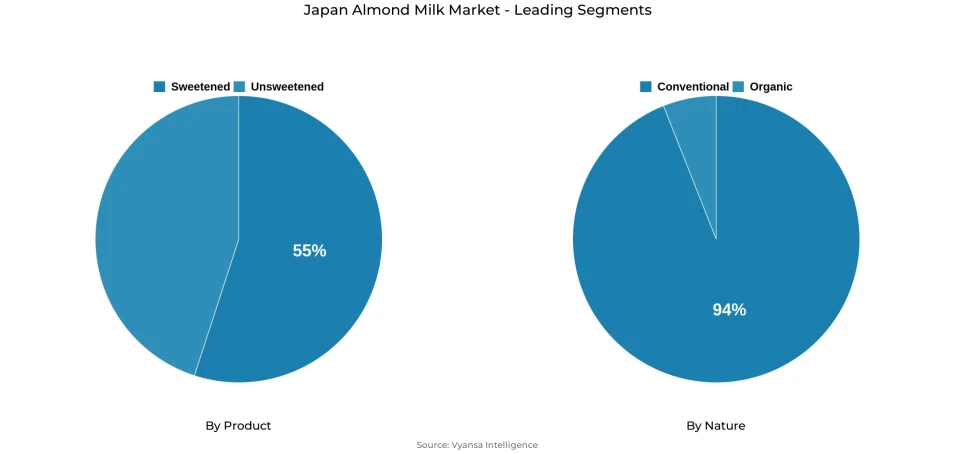
- Under product, sweetened is the leading segment with a 55% share in 2026.
- Moreover, unsweetened is the fastest-growing product segment, expanding at a 4.27% CAGR across the 2026 to 2032 forecast period.
- Under Nature, conventional almond milk holds a dominant 94% share in 2026.
- Additionally, organic is the fastest-growing Nature segment, posting a 9.71% CAGR across the 2026 to 2032 forecast period.
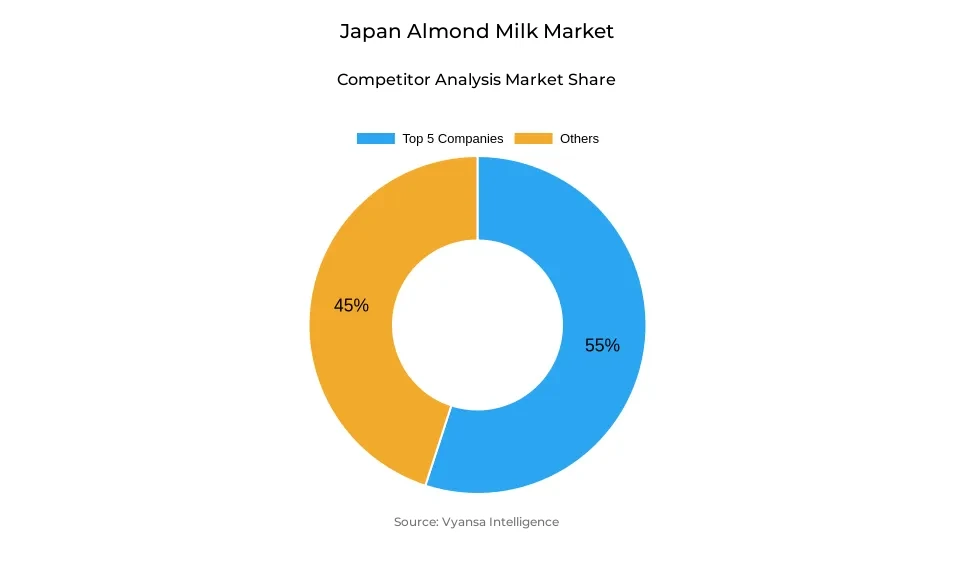
- The market structure is moderately consolidated overall, with the top five companies together holding a combined 55% share of total industry revenue as of 2026.
The Japan almond milk market is supported by demographic changes, growing health awareness, and demand for alternatives to conventional dairy beverages. Japan's population reached 123.05 million in October 2025, while the country continues to experience population ageing, creating greater demand for convenient foods and beverages aligned with healthy ageing. In 2024, 36.24 million people, or 29.3% of Japan's population, were aged 65 years or above, highlighting a substantial consumer base increasingly concerned with nutrition and bone health.
Nutritional considerations are particularly relevant because Japan's health authorities identify calcium deficiency as a modifiable risk factor for osteoporosis, while calcium requirements remain significant among older adults. The recommended daily calcium intake is 750 mg for men and 650 mg for women aged 65–74, and 700 mg for men and 600 mg for women aged 75 years and above. This supports demand for calcium-fortified plant-based beverages that can complement daily diets.
Additionally, the industry is benefiting from the broader expansion of plant-based dairy consumption, supported by changing dietary preferences, health awareness, and demand for lactose-free alternatives. Japan's plant-based dairy market is estimated at USD 805 million in 2026 and is projected to reach USD 850 million by 2032, representing a CAGR of approximately 0.78% during 2026–2032. This gradual expansion indicates a steadily developing consumer base for plant-based milk alternatives.
Health concerns are also strengthening the case for dairy alternatives. Japan's Ministry of Health reported approximately 11 million people strongly suspected of having diabetes in 2024, reinforcing consumer interest in healthier dietary choices. Against this backdrop, almond milk is gaining relevance as a plant-based, lactose-free, and often fortified beverage, particularly among health-conscious consumers, older adults, and individuals seeking dairy alternatives.
Japan Almond Milk Market Drivers
Rising Health and Wellness Awareness
Health and wellness awareness is repositioning the almond milk industry from a niche plant-based beverage into a more routine grocery purchase. Health-conscious adults, younger consumers, and households seeking lighter dairy alternatives are most affected, as almond milk fits diets focused on plant-based ingredients, lower saturated fat intake, and reduced reliance on conventional dairy. Consumers increasingly shift from dairy milk or other traditional beverages toward almond milk because it can serve the same role in coffee, cereal, smoothies and everyday cooking.
Unsweetened almond milk is particularly aligned with this shift, as consumers seeking lower-sugar beverage options increasingly compare nutritional labels before purchase. Retailers are consequently expanding shelf space for plain unsweetened and fortified almond milk alongside soy and oat alternatives, making the category easier to incorporate into regular household consumption rather than occasional health-focused purchasing.
Through the forecast period, increasing attention to preventive wellness, balanced diets and plant-based nutrition is expected to widen the buyer base beyond dedicated vegan or lactose-intolerant consumers. General grocery shoppers gain relative importance as almond milk becomes associated with everyday healthier eating rather than a specialized dietary requirement. The driver stays commercially active because health-oriented purchasing habits increasingly influence routine beverage choices across supermarkets, convenience stores and online retail.
Japan Almond Milk Market Challenges
Soy Milk's Retail Scale Limits Almond Milk's Shelf and Manufacturing Ceiling
Almond milk manufacturers compete for shelf space against a soy milk category built on a mature domestic soybean-processing and tofu-industry supply base. Almond milk industry producers depend on imported almonds, mostly from California, while soy milk producers draw on decades of integrated domestic processing capacity. This asymmetry concentrates retail buying decisions toward the category with the deeper, lower-cost domestic supply chain, moderating the pace at which almond milk adds shelf facings.
According to the Japan Soymilk Association, domestic soy milk production reached 444,552 kilolitres in 2025, a record high and 8.2% above the prior year. That volume base gives soy milk retailers far greater negotiating weight for shelf space and promotional pricing, raising the qualification threshold new almond milk formats must clear to win comparable retail placement.
Manufacturers are responding by narrowing almond milk's positioning to occasions soy milk does not own outright: barista-grade foodservice formats, dessert applications and low-sugar formulations aimed at consumers actively avoiding soy.
Japan Almond Milk Recent Trends
Barista-Focused Almond Milk Becomes a Distinct Foodservice Category
Almond milk development in Japan is shifting from a single household-format product toward application-specific formulations built for professional beverage preparation. This replaces the earlier approach of offering one recipe across both retail and foodservice use, since coffee-shop performance, including foam stability and flavour interaction with espresso, requires a different formulation than a product meant to be poured straight from the carton at home into a glass.
In June 2026, Ezaki Glico Co., Ltd. formulated “Almond Koka for barista and chef” specifically for compatibility with coffee flavour and foam performance, distributing it through cafes and restaurants nationwide as well as its own direct sales channel, positioning the product as a distinct professional-grade line rather than a repackaged retail item.
As foodservice-grade formulations spread, cafes, bakeries and hotel kitchens become a distinct and growing outlet for almond milk alongside retail, giving manufacturers a channel where taste performance, not shelf price, decides the purchase. Through the forecast period, this pulls incremental demand toward business-to-business supply contracts and widens the almond milk industry’s addressable use occasions beyond the breakfast table into the wider foodservice menu, from espresso bars to dessert kitchens.
AI-Based Sensory Profiling Advances Data-Led Almond Milk Innovation
AI-based sensory analysis is emerging as a technical trend in Japan’s almond milk market by converting subjective taste attributes into measurable product data. In March 2025, Japan’s Almond Milk Research Association used OISSY’s AI-equipped “Leo” taste sensor to evaluate almond milk across sweetness, saltiness, acidity, bitterness, and umami, together with aftertaste and aroma characteristics. The analysis identified a balanced sweetness-umami profile and a relatively clean finish. An accompanying survey of 600 Japanese consumers also found that while 77% had consumed almond milk directly, 7.3% could not clearly identify its taste, indicating room for manufacturers to improve product positioning and sensory communication.
For the wider market, quantitative taste profiling can support more consistent benchmarking between formulations, help brands differentiate products by flavour intensity and mouthfeel, and provide a stronger basis for developing unsweetened, flavoured and premium variants. As competition increases, manufacturers that integrate sensory data into product assessment can respond more precisely to changing consumer preferences. Consequently, AI-assisted sensory profiling is expected to strengthen product differentiation and data-led innovation across Japan’s almond milk market.
Japan Almond Milk Market Future Opportunities
Recurring Foodservice Supply Contracts Beyond Packaged Retail
Almond milk is already broadly available across Japanese supermarkets and convenience stores, but its use as a standard, recurring foodservice ingredient remains comparatively underdeveloped. Cafes, bakeries, hotels, restaurants and institutional kitchens still largely treat almond milk as an occasional menu substitution rather than a stocked ingredient, leaving a gap between how available the product is at retail and how embedded it is in commercial food and beverage preparation nationwide.
Ezaki Glico Co., Ltd.'s third annual almond milk fair reached a record 130 outlets across 47 foodservice operators nationwide, its largest edition to date, according to the company's own newsroom release, confirming that commercial foodservice adoption has moved from isolated trials toward a coordinated, repeatable industry-wide campaign rather than a one-off promotion.
Capturing this gap requires manufacturers to secure recurring business-to-business supply agreements rather than one-off promotional placements, typically through dedicated barista-grade product lines, foodservice sales teams, and bulk-format packaging suited to commercial kitchens. Companies already running dedicated barista lines and multi-operator foodservice campaigns, rather than single-SKU retail manufacturers, are best positioned to convert this gap into contracted volume, lifting the almond milk industry’s addressable demand well beyond what packaged retail alone can deliver.
Unlock Market Intelligence
Explore the market potential with our data-driven report
Japan Almond Milk Market Segmentation Analysis
By Type:
- Sweetened
- Unsweetened
Sweetened Holds Approximately 55% of Product Demand while Unsweetened is the Fastest-Growing
Sweetened almond milk leads the market because mainstream consumers continue to prefer a mild, familiar sweetness that makes almond milk easier to consume directly and alongside breakfast foods, coffee and other beverages. Japanese manufacturers continue to support this positioning through established products and reduced sugar variants. In September 2025, Glico launched Almond Koka Original Lightly Sweetened, reinforcing demand for mildly sweetened almond beverages in everyday consumption occasions.
Unsweetened almond milk is gaining faster as Japanese consumers increasingly associate plant based beverages with lower sugar intake and functional nutrition. The segment is particularly suited to cereal, coffee and cooking applications because it provides almond flavour without additional sweetness. Kagome's Almond Breeze Sugar Free supports this positioning, while Japanese manufacturers continue expanding sugar free alternatives. This health oriented demand is expected to support Unsweetened almond milk at a 4.27% CAGR during 2026 to 2032, making it the fastest growing Product segment.
By Nature:
- Conventional
- Organic
Conventional Almond Milk Dominates with 94% Share in 2026, While Organic Almond Milk Records the Fastest 9.71% CAGR Through 2032
Conventional leads nature because it is priced and manufactured for the mass grocery channel, carrying most of Japan's almond milk volume, using standard-grade imported almonds rather than certified-organic supply, which keeps unit costs and shelf prices low for everyday end users. It also draws on an established domestic co-packing and dairy-adjacent processing base already geared to conventional plant-based beverages, giving it wider retail distribution than certified-organic supply chains currently match; in October 2025, Tsukuba Dairy Products Co. Ltd. updated its "Rich Almond Milk, High in Fibre" conventional line through its official direct-to-consumer shop, reinforcing that shelf presence via a dedicated, non-organic dairy-adjacent processor. Conventional should hold its lead through the forecast period unless organic-certified almond supply becomes materially more available at competitive cost.
Organic is the fastest-growing Nature segment, expanding at a 9.71% CAGR across 2026 to 2032 from a small base built mainly on imported, certified-organic almond milk, with growth concentrated among premium, clean-label-oriented consumers who form a distinct end-user group from the price-driven mass-grocery shopper sustaining Conventional demand. That import pipeline is being actively maintained: in July 2025, Almatierra Co. Ltd. updated the specification of its imported "Vitasi Organic Almond Milk" line, distributed under official Japan Agricultural Standards (JAS) organic certification, keeping certified-organic supply current for Japanese specialty and online retail. Organic grows faster because it is expanding from a near-zero starting point as new imported organic lines enter specialty and online retail channels, while Conventional's growth is constrained by the far larger, more mature volume base it must scale from each year.
Unlock Market Intelligence
Explore the market potential with our data-driven report
Japan Almond Milk Market Competitive Landscape
The Japan almond milk market is moderately consolidated, with the top five companies together holding a combined 55% share of industry revenue as of 2026. Ranked by market presence, the leading participants are Ezaki Glico Co., Ltd., Kagome Co., Ltd., MARUSAN-AI Co., Ltd., AEON CO., LTD. and TSUKUBA dairy products CO. LTD. No single company holds a majority share, and competitive position is shaped by channel reach, spanning confectionery-led retail brands, a retailer-owned private label, a beverage-focused food manufacturer and a specialist dairy-adjacent processor, rather than by scale in any one distribution channel alone.
Key Companies in the Japan Almond Milk Market
- Ezaki Glico Co., Ltd. (Almond Koka)
- Kagome Co., Ltd. (Almond Breeze)
- MARUSAN-AI Co., Ltd.
- TSUKUBA DAIRY PRODUCTS CO. LTD.
- AEON CO., LTD. (TOPVALU)
- HARUNA Co., Ltd. (137degrees)
- Bio c' Bon Japan Co., Ltd. (Isola BIO)
- MITOKU CO., LTD. (The Bridge)
- Almatierra Co., Ltd. (Vitasi)
- MIE PROJECT Co., Ltd. (Rude Health)
Company Profiling
The following five companies represent the leading participants in the Japan almond milk market.
Ezaki Glico Co., Ltd.: Ezaki Glico Co., Ltd. is headquartered in Osaka, Japan, and participates through its “Almond Koka” brand, sold in plain, flavoured and foodservice-grade formats across retail and cafe channels nationwide. Manufacturing capacity is not publicly disclosed; the company's nearest verified metric is distribution across dozens of restaurant and cafe operators. In June 2026, Glico added a mixed-nut formulation to Almond Koka, extending the brand beyond its original single-almond recipe. Glico is the technology-led, share-leading supplier, having launched Almond Koka in 2014.
Kagome Co., Ltd.: Kagome Co., Ltd. is headquartered in Nagoya, Aichi, Japan, and distributes “Almond Breeze” under licence from Blue Diamond Growers of California, having taken over local manufacturing and sales in September 2024. Kagome sells through grocery, drugstore and online retail nationwide. In April 2026, Kagome launched “Almond Breeze Protein,” a protein-fortified addition to its line-up. Kagome is a volume-focused distribution specialist, leveraging its existing beverage retail network.
MARUSAN-AI Co., Ltd.: MARUSAN-AI Co., Ltd. is headquartered in Okazaki, Aichi, Japan, and participates through its “Roasted Almond Milk” range in original and unsweetened variants under its own brand. Capacity is not publicly disclosed; the company is a long-established soy milk and miso manufacturer applying its existing processing base to almond milk. It is a regional manufacturing specialist.
TSUKUBA DAIRY PRODUCTS CO. LTD.: TSUKUBA DAIRY PRODUCTS CO. LTD. is headquartered in Tsukuba, Ibaraki, Japan, and participates through its “Rich Almond Milk” range, formulated with 8 to 10% almond content, above typical retail levels. Capacity is not publicly disclosed; its nearest verified metric is over 80 years of aseptic-filling dairy-processing experience. In August 2026, it changed the packaging of its foodservice-format Rich Almond Milk. It is a compliance-focused, quality-led specialist supplier.
AEON CO., LTD.: AEON CO., LTD. is headquartered in Chiba, Japan, and participates through its “TOPVALU” private-label almond milk, sold in plain, unsweetened and flavoured 200ml and 1000ml formats exclusively through AEON Group banners. Capacity is not publicly disclosed, as TOPVALU is contract-manufactured; AEON's nearest verified metric is its nationwide supermarket and convenience network. Its TOPVALU range includes a Cafe Chocolat flavoured variant alongside plain and unsweetened lines. AEON is a distribution-led participant competing primarily on price.
Recent Developments in the Japan Almond Milk Market
- In April 2026, Kagome Co., Ltd. launched “Almond Breeze Protein,” a protein-fortified addition to its Almond Breeze range in Japan, alongside a renewal of its unsweetened and lightly-sweetened lines announced the same month. The launch extends Almond Breeze beyond taste-and-sugar positioning into functional nutrition, targeting fitness- and protein-conscious consumers who had not previously been a core almond milk buyer group, and signals that branded manufacturers are starting to compete on formulation function rather than price alone against private-label almond milk.
- In August 2026, TSUKUBA DAIRY PRODUCTS CO. LTD. announced a packaging change to the foodservice-format version of its Rich Almond Milk range, continuing its business-to-business product line without altering the underlying formulation. The update signals continued manufacturer investment in dedicated foodservice packaging formats, reinforcing that business-to-business almond milk supply is being treated as a distinct, ongoing product line rather than a repackaged retail item, consistent with the broader shift toward foodservice-specific formulation.
Frequently Asked Questions
Related Report
- Market Segmentation
- Research Scope
- Research Methodology
- Definitions and Assumptions
- Executive Summary
- Japan Almond Milk Market Policies, Regulations, and Standards
- Japan Almond Milk Market Dynamics
- Growth Factors
- Challenges
- Trends
- Opportunities
- Japan Almond Milk Market Statistics, 2022-2032F
- Market Size & Growth Outlook
- By Revenues in USD Million
- Market Segmentation & Growth Outlook
- By Product
- Sweetened- Market Insights and Forecast 2022-2032, USD Million
- Unsweetened- Market Insights and Forecast 2022-2032, USD Million
- By Flavour
- Flavoured- Market Insights and Forecast 2022-2032, USD Million
- Unflavoured- Market Insights and Forecast 2022-2032, USD Million
- By Nature
- Conventional- Market Insights and Forecast 2022-2032, USD Million
- Organic- Market Insights and Forecast 2022-2032, USD Million
- By Storage Format
- Refrigerated Almond Milk- Market Insights and Forecast 2022-2032, USD Million
- Shelf-Stable Almond Milk- Market Insights and Forecast 2022-2032, USD Million
- By Packaging Type
- Cartons- Market Insights and Forecast 2022-2032, USD Million
- Bottles- Market Insights and Forecast 2022-2032, USD Million
- Flexible Packaging- Market Insights and Forecast 2022-2032, USD Million
- Others- Market Insights and Forecast 2022-2032, USD Million
- By End Use
- Household- Market Insights and Forecast 2022-2032, USD Million
- Foodservice- Market Insights and Forecast 2022-2032, USD Million
- Food & Beverage Manufacturing- Market Insights and Forecast 2022-2032, USD Million
- By Distribution Channel
- On-Trade
- Off-Trade
- Convenience Stores- Market Insights and Forecast 2022-2032, USD Million
- Specialty Retailers- Market Insights and Forecast 2022-2032, USD Million
- Convenience Stores- Market Insights and Forecast 2022-2032, USD Million
- Online Retail- Market Insights and Forecast 2022-2032, USD Million
- Supermarkets and Hypermarkets- Market Insights and Forecast 2022-2032, USD Million
- By Region
- Hokkaido- Market Insights and Forecast 2022-2032, USD Million
- Tohoku- Market Insights and Forecast 2022-2032, USD Million
- Kanto- Market Insights and Forecast 2022-2032, USD Million
- Chubu- Market Insights and Forecast 2022-2032, USD Million
- Kinki- Market Insights and Forecast 2022-2032, USD Million
- Chugoku- Market Insights and Forecast 2022-2032, USD Million
- Shikoku- Market Insights and Forecast 2022-2032, USD Million
- Kyushu/Okinawa- Market Insights and Forecast 2022-2032, USD Million
- By Competitors
- Competition Characteristics
- Market Share & Analysis
- By Product
- Market Size & Growth Outlook
- Japan Sweetened Market Statistics, 2022-2032
- Market Size & Growth Outlook
- By Revenues in USD Million
- Market Segmentation & Growth Outlook
- By Nature- Market Insights and Forecast 2022-2032, USD Million
- By Storage Format- Market Insights and Forecast 2022-2032, USD Million
- By Packaging Type- Market Insights and Forecast 2022-2032, USD Million
- By End Use- Market Insights and Forecast 2022-2032, USD Million
- By Distribution Channel- Market Insights and Forecast 2022-2032, USD Million
- By Region- Market Insights and Forecast 2022-2032, USD Million
- Market Size & Growth Outlook
- Japan Unsweetened Market Statistics, 2022-2032
- Market Size & Growth Outlook
- By Revenues in USD Million
- Market Segmentation & Growth Outlook
- By Nature- Market Insights and Forecast 2022-2032, USD Million
- By Storage Format- Market Insights and Forecast 2022-2032, USD Million
- By Packaging Type- Market Insights and Forecast 2022-2032, USD Million
- By End Use- Market Insights and Forecast 2022-2032, USD Million
- By Distribution Channel- Market Insights and Forecast 2022-2032, USD Million
- By Region- Market Insights and Forecast 2022-2032, USD Million
- Market Size & Growth Outlook
- Competitive Outlook
- Company Profiles
- Ezaki Glico Co., Ltd. (Almond Koka)
- Business Description
- Product Portfolio
- Collaborations & Alliances
- Recent Developments
- Financial Details
- Others
- Kagome Co., Ltd. (Almond Breeze)
- Business Description
- Product Portfolio
- Collaborations & Alliances
- Recent Developments
- Financial Details
- Others
- MARUSAN-AI Co., Ltd.
- Business Description
- Product Portfolio
- Collaborations & Alliances
- Recent Developments
- Financial Details
- Others
- TSUKUBA DAIRY PRODUCTS CO., LTD.
- Business Description
- Product Portfolio
- Collaborations & Alliances
- Recent Developments
- Financial Details
- Others
- AEON CO., LTD. (TOPVALU)
- Business Description
- Product Portfolio
- Collaborations & Alliances
- Recent Developments
- Financial Details
- Others
- HARUNA Co., Ltd. (137degrees)
- Business Description
- Product Portfolio
- Collaborations & Alliances
- Recent Developments
- Financial Details
- Others
- Bio c' Bon Japan Co., Ltd. (Isola BIO)
- Business Description
- Product Portfolio
- Collaborations & Alliances
- Recent Developments
- Financial Details
- Others
- MITOKU CO., LTD. (The Bridge)
- Business Description
- Product Portfolio
- Collaborations & Alliances
- Recent Developments
- Financial Details
- Others
- Almatierra Co., Ltd. (Vitasi)
- Business Description
- Product Portfolio
- Collaborations & Alliances
- Recent Developments
- Financial Details
- Others
- MIE PROJECT Co., Ltd. (Rude Health)
- Business Description
- Product Portfolio
- Collaborations & Alliances
- Recent Developments
- Financial Details
- Others
- Ezaki Glico Co., Ltd. (Almond Koka)
- Company Profiles
- Disclaimer
| Segment | Sub-Segment |
|---|---|
| By Product |
|
| By Flavour |
|
| By Nature |
|
| By Storage Format |
|
| By Packaging Type |
|
| By End Use |
|
| By Distribution Channel |
|
| By Region |
|
Research Methodology
This study followed a structured approach comprising four key phases to assess the size and scope of the electro-oxidation market. The process began with thorough secondary research to collect data on the target market, related markets, and broader industry context. These findings, along with preliminary assumptions and estimates, were then validated through extensive primary research involving industry experts from across the value chain. To calculate the overall market size, both top-down and bottom-up methodologies were employed. Finally, market segmentation and data triangulation techniques were applied to refine and validate segment-level estimations.
Secondary Research
The secondary research phase involved gathering data from a wide range of credible and published sources. This step helped in identifying industry trends, defining market segmentation, and understanding the market landscape and value chain.
Sources consulted during this phase included:
- Company annual reports, investor presentations, and press releases
- Industry white papers and certified publications
- Trade directories and market-recognized databases
- Articles from authoritative authors and reputable journals
- Gold and silver standard websites
Secondary research was critical in mapping out the industry's value chain and monetary flow, identifying key market segments, understanding regional variations, and tracking significant industry developments.
Other key sources:
- Financial disclosures
- Industry associations and trade bodies
- News outlets and business magazines
- Academic journals and research studies
- Paid industry databases
Primary Research
To validate secondary data and gain deeper market insights, primary research was conducted with key stakeholders across both the supply and demand sides of the market.
On the demand side, participants included decision-makers and influencers from end-user industries—such as CIOs, CTOs, and CSOs—who provided first-hand perspectives on market needs, product usage, and future expectations.
On the supply side, interviews were conducted with manufacturers, industry associations, and institutional participants to gather insights into current offerings, product pipelines, and market challenges.
Primary interviews provided critical inputs such as:
- Market size and revenue data
- Product and service breakdowns
- Market forecasts
- Regional and application-specific trends
Stakeholders consulted included:
- Leading OEM and solution providers
- Channel and distribution partners
- End users across various applications
- Independent consultants and industry specialists
Market Size Estimation and Data Triangulation
- Identifying Key Market Participants (Secondary Research)
- Goal: To identify the major players or companies in the target market. This typically involves using publicly available data sources such as industry reports, market research publications, and financial statements of companies.
- Tools: Reports from firms like Gartner, Forrester, Euromonitor, Statista, IBISWorld, and others. Public financial statements, news articles, and press releases from top market players.
- Extracting Earnings of Key Market Participants
- Goal: To estimate the earnings generated from the product or service being analyzed. This step helps in understanding the revenue potential of each market player in a specific geography.
- Methods: Earnings data can be gathered from:
- Publicly available financial reports (for listed companies).
- Interviews and primary data sources from professionals, such as Directors, VPs, SVPs, etc. This is especially useful for understanding more nuanced, internal data that isn't publicly disclosed.
- Annual reports and investor presentations of key players.
- Data Collation and Development of a Relevant Data Model
- Goal: To collate inputs from both primary and secondary sources into a structured, data-driven model for market estimation. This model will incorporate key market KPIs and any independent variables relevant to the market.
- Key KPIs: These could include:
- Market size, growth rate, and demand drivers.
- Industry-specific metrics like market share, average revenue per customer (ARPC), or average deal size.
- External variables, such as economic growth rates, inflation rates, or commodity prices, that could affect the market.
- Data Modeling: Based on this data, the market forecasts are developed for the next 5 years. A combination of trend analysis, scenario modeling, and statistical regression might be used to generate projections.
- Scenario Analysis
- Goal: To test different assumptions and validate how sensitive the market is to changes in key variables (e.g., market demand, regulatory changes, technological disruptions).
- Types of Scenarios:
- Base Case: Based on current assumptions and historical data.
- Best-Case Scenario: Assuming favorable market conditions, regulatory environments, and technological advancements.
- Worst-Case Scenario: Accounting for adverse factors, such as economic downturns, stricter regulations, or unexpected disruptions.












