China Sodium-Ion Battery Market Report: Trends, Growth and Forecast (2027-2033)
By Battery Chemistry (Prussian Blue/White, Layered Oxide, Polyanionic, Organic, Others), By Form Factor (Cylindrical, Prismatic, Pouch), By Application (Stationary Energy Storage, Transportation, Consumer Electronics, Industrial Backup Power, Marine, Other Applications), By Region (North, East, Southwest, Northwest, North East, South) ... Read more
|
Major Players
|
China Sodium-Ion Battery Market Overview
Sodium-ion batteries are rechargeable cells that replace lithium with sodium-based cathode and electrolyte chemistries, delivering long cycle life, wide-temperature stability and lower raw-material exposure for stationary storage, transportation and backup-power use. Utilities, EV manufacturers, telecom operators and industrial-vehicle producers consume the technology as a cost-stable, cold-tolerant complement to lithium iron phosphate and lead-acid cells. The China sodium-ion battery market is forecast to grow at a CAGR of 18.83% between 2027 and 2033.
Key Highlights of the China Sodium-Ion Battery Market
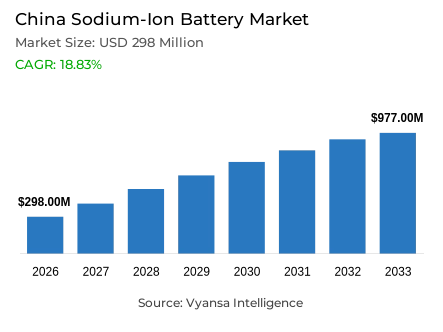
- The China sodium-ion battery market was valued at USD 298 million in 2026 and is estimated at USD 347 million in 2027. The market is forecast to reach USD 977 million by 2033.
- The market is forecast to grow at a CAGR of 18.83% between 2027 and 2033.
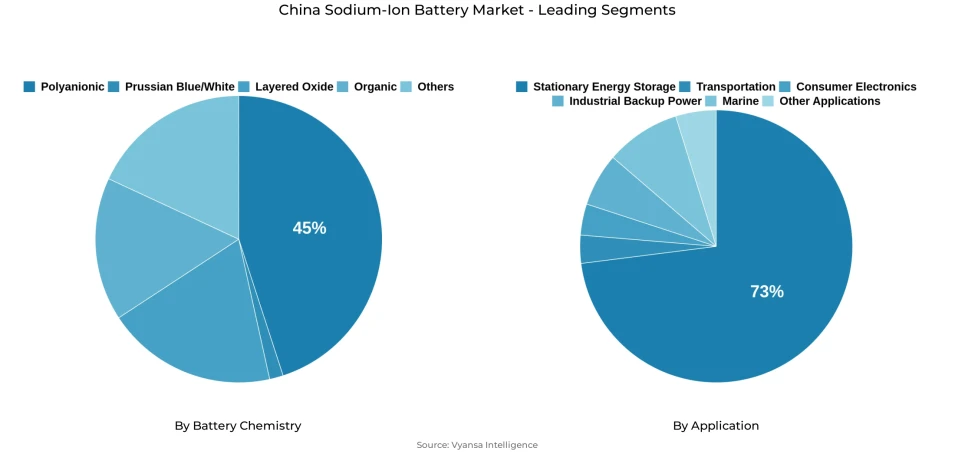
- By battery chemistry, polyanionic formulations led the market with a 45% share in 2026.
- Prussian blue is the fastest-growing chemistry segment, expanding at a CAGR of 29% between 2027 and 2033.
- By application, stationary energy storage led the market with a 73% share in 2026.
- Transportation is the fastest-growing application segment, expanding at a CAGR of 46.20% between 2027 and 2033.
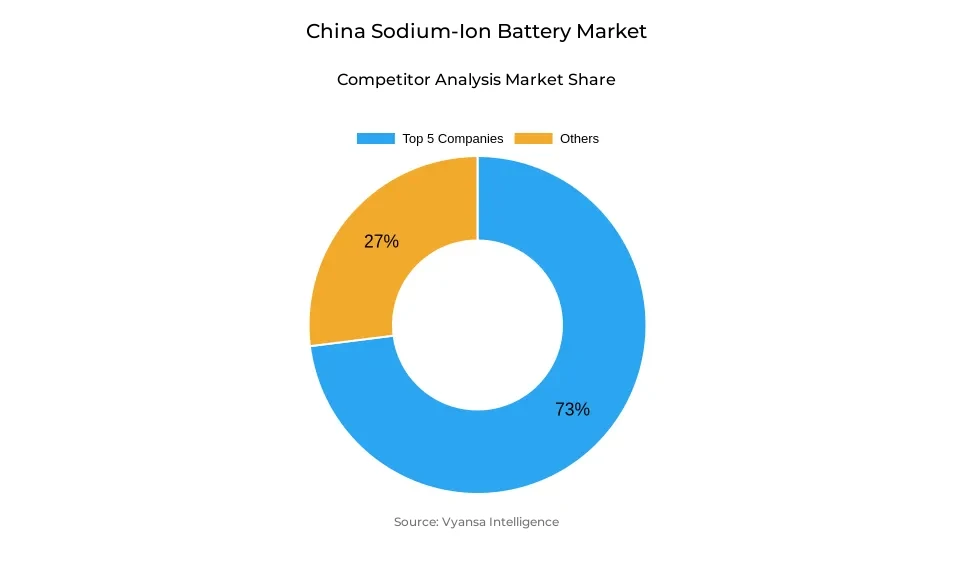
- The market is consolidated, with the top five companies holding a combined 73% share in 2026.
China's sodium-ion battery industry is moving into a broader industrialization phase as commercial output rises and the manufacturing ecosystem becomes more established. Domestic sodium-ion battery production reached approximately 3.45 GWh in 2025, increasing 96% year over year. This growth indicates that the market is progressing beyond limited validation batches toward recurring cell and pack production, giving downstream buyers greater confidence that sodium-ion products can be sourced at commercially relevant volumes.
The supporting industrial footprint is also widening. By July 2026, CNESA identified 45 sodium-ion cell manufacturing bases distributed across 20 Chinese provinces and involving 34 companies. The presence of established battery manufacturers, specialist sodium-ion developers and material companies within the same ecosystem is creating a more complete domestic value chain. Allowing product development, manufacturing and downstream integration to progress within China's existing battery-industry infrastructure.
Through 2033, the market should develop around increasingly standardized commercial products serving distinct battery requirements rather than a single universal replacement chemistry. China's established battery manufacturing network gives suppliers the ability to commercialize sodium-ion alongside existing technologies while building dedicated customer relationships around its operating characteristics. The market should therefore become more diversified in supplier participation, product formats and commercial use cases as sodium-ion becomes an established component of China's wider battery industry.
China Sodium-Ion Battery Market Government Compliance
China is establishing dedicated technical pathways for sodium-ion batteries as the technology moves into larger commercial projects. Technical requirements for sodium-ion batteries used in energy-storage stations became effective in 2025, giving manufacturers and system integrators a standardized basis for evaluating safety, efficiency and operating performance rather than depending primarily on project-specific qualification.
Vehicle applications are following the same direction. Updated national traction-battery safety requirements became mandatory in July 2026, and CATL's Naxtra became the first sodium-ion battery to receive certification under the new framework. This gives automotive manufacturers a formal route for qualifying sodium-ion cells for production vehicles rather than treating them as experimental battery systems.
Standardized qualification reduces uncertainty for utilities, system integrators and vehicle manufacturers evaluating a comparatively new chemistry. Companies capable of meeting recognized safety and performance requirements are better positioned to move from demonstrations into larger procurement programs, while manufacturers without certified products face a higher commercial entry threshold.
China Sodium-Ion Battery Market Drivers
Rapid Grid-Scale Energy Storage Expansion Is Accelerating Sodium-Ion Battery Adoption
China's expanding grid-scale energy storage systems requirement is creating a large downstream demand pool for sodium-ion batteries. During 2025, the country commissioned approximately 66.43 GW/189.48 GWh of new-type energy storage, with annual additions increasing 52% in power capacity and 73% in energy capacity. As renewable generation expands and grids require greater flexibility, storage developers are procuring increasingly large battery systems where safety, cycle life and lifecycle economics carry greater importance than maximum energy density.
This wider storage requirement is already translating into dedicated sodium-ion procurement. In April 2026, CATL and HyperStrong signed a three-year agreement covering 60 GWh of sodium-ion energy-storage batteries, demonstrating that the chemistry is moving into multi-year commercial supply rather than remaining limited to demonstration projects. During 2026, CNESA also recorded eight sodium-ion storage tenders totaling 170 MW/512 MWh, providing further evidence that utility and system-integrator demand is broadening.
The demand pipeline remains substantial. Energy-storage-system tenders in China reached approximately 148.1 GWh during the first half of 2026, increasing 88.3% year over year. This creates continued room for sodium-ion suppliers to qualify products across a growing volume of grid projects without depending on displacement of existing battery installations. As sodium-ion secures a larger share of new storage procurement, grid-scale energy storage should remain one of the strongest growth drivers for the China sodium-ion battery market through 2033.
China Sodium-Ion Battery Market Challenge
Planned Manufacturing Capacity Is Expanding Faster than Operational Commercial Output
China has attracted substantial sodium-ion manufacturing investment, but the industry still needs to convert this capacity pipeline into consistently operating production. By July 2026, planned sodium-ion cell capacity had reached approximately 293.7 GWh, while only 25.2 GWh was operational, equivalent to about 8.6% of the announced total. The difference reflects an industry building ahead of expected demand as manufacturers position themselves for future commercial volumes.
For producers, commissioning capacity is only the first step. New lines must achieve stable yields, complete customer qualification, and secure sufficient recurring orders to operate efficiently. Until production volumes become more consistent, fixed manufacturing costs are distributed across a smaller shipment base, making it harder for newly commissioned facilities to capture the full economics associated with large-scale battery production.
The challenge through the early forecast period is therefore converting announced manufacturing assets into sustained commercial throughput. Suppliers with repeat contracts and established downstream customers can increase utilization more quickly, while companies dependent on intermittent projects may take longer to reach efficient production levels. This should increasingly differentiate manufacturers on execution and delivery capability rather than announced capacity alone.
China Sodium-Ion Battery Industry Trends
Commercial Demand is Expanding into Multiple Purchasing Channels
Sodium-ion batteries in China are increasingly being commercialized through channels beyond large energy-storage projects. Consumer mobility, telecom infrastructure and industrial applications involve different buyers, sales cycles and product formats, broadening the market beyond utility and system-integrator procurement. This gives manufacturers more routes to generate commercial volumes and allows specialist suppliers to compete within applications suited to their individual product strengths.
Light mobility provides one example. In September 2025, TAILG expanded its sodium-ion strategy through cooperation with Chaowei and Huayou and continued commercializing a broader range of sodium-powered electric two-wheelers. This brings sodium-ion directly into a consumer product category rather than relying on project-based battery deployment alone.
Infrastructure procurement is opening another channel. In May 2026, China Tower's Tibet subsidiary launched procurement for 1,100 sets of 100Ah sodium-ion batteries for deployment across seven cities and prefectures. The development demonstrates sodium-ion moving into institutional backup-power purchasing alongside its growing mobility presence. As these channels develop independently, manufacturers gain a broader commercial base rather than relying on one application to support market growth.
Fast-Charging and Wide-Temperature Cell Designs Are Strengthening Mobility Performance
Technology development is increasingly focused on improving the operating characteristics that determine whether sodium-ion can be used effectively in mobility applications. Manufacturers are combining faster charging with wider usable temperature ranges rather than concentrating exclusively on higher energy density. This approach is particularly relevant in China, where vehicle operating conditions vary significantly between northern cold-climate regions and warmer southern markets.
BAIC demonstrated this direction in March 2026 with a sodium-ion cell exceeding 170 Wh/kg and supporting 4C charging, allowing a full recharge in approximately 11 minutes under specified conditions. The technology operates across temperatures from -40°C to 60°C and retains more than 92% output at -20°C, combining fast charging with stable cold-weather operation in the same cell platform.
These improvements expand the range of vehicle designs for which sodium-ion can be commercially considered. Faster charging reduces the practical disadvantage of smaller battery packs, while low-temperature stability supports more predictable vehicle operation across colder regions. The technology trend therefore strengthens sodium-ion's mobility proposition through usable operating performance rather than relying solely on lower battery cost.
China Sodium-Ion Battery Market Opportunities
AI Data Centre Expansion Creates an Emerging High-Performance Backup-Power Opportunity
China's rapid build-out of computing infrastructure is creating a new battery-demand pool with requirements that differ from conventional grid storage. The country's three major telecom operators had approximately 938,000 externally serving data-centre racks at the end of 2025, adding around 108,000 during the year, while their available intelligent-computing capacity increased 87.6%. Increasing computing density raises the importance of fast-response and highly reliable battery backup within data center power architecture.
Sodium-ion suppliers are beginning to develop products around this requirement. Highstar showcased sodium-ion cells in 2026 for computing-centre backup, telecom backup and related infrastructure applications, including prismatic and cylindrical formats designed for high-safety and wide-temperature operation. The company has also developed sodium-ion concepts for high-voltage AI data-centre power systems, indicating that suppliers are beginning to treat computing infrastructure as a dedicated battery application rather than generic backup power.
The opportunity lies in supplying battery backup units, UPS-linked systems and outdoor power infrastructure as AI computing capacity expands. Data centres place a high value on safety, rapid power response and operational reliability, allowing sodium-ion suppliers to compete on attributes beyond energy density. Companies establishing early relationships with computing-infrastructure operators and power-system integrators can develop a new commercial channel alongside the market's established storage and mobility applications.
Unlock Market Intelligence
Explore the market potential with our data-driven report
China Sodium-Ion Battery Market Segmentation Analysis
By Battery Chemistry:
- Prussian Blue/White
- Layered Oxide
- Polyanionic
- Organic
- Others
Polyanionic Chemistry Commands 45% of Battery Demand
Polyanionic chemistry accounts for approximately 45% of China sodium-ion battery demand in 2026, supported by strong structural stability, cycle performance and suitability for stationary storage and other applications where long operating life is prioritized over maximum energy density. Existing commercial production by domestic manufacturers has also given the chemistry an early scale advantage.
Prussian blue is the fastest-growing chemistry segment, expanding at a CAGR of 29% during 2027–2033. Growth is supported by increasing development for backup power, starter batteries and other cost-sensitive applications, allowing the chemistry to expand from a smaller commercial base as manufacturers broaden sodium-ion product portfolios.
By Application:
- Stationary Energy Storage
- Transportation
- Consumer Electronics
- Industrial Backup Power
- Marine
- Other Applications
Stationary Storage Commands 73% of Application Demand
Stationary energy storage accounts for approximately 73% of China sodium-ion battery demand in 2026 because fixed installations allow buyers to prioritize cycle life, safety and operating economics without the same weight constraints faced by vehicle batteries. China commissioned 189.48 GWh of new energy-storage capacity during 2025, providing a large downstream market into which sodium-ion products can increasingly be deployed.
Transportation is the fastest-growing application, expanding at a CAGR of 46.20% during 2027–2033 as sodium-ion moves into passenger vehicles, electric two-wheelers and starter batteries. China sold 16.49 million new-energy vehicles in 2025, while commercial sodium-ion vehicle programs from domestic battery and automotive manufacturers are creating a pathway for the chemistry to move from storage-focused deployment into higher-volume mobility applications.
Unlock Market Intelligence
Explore the market potential with our data-driven report
China Sodium-Ion Battery Market Competitive Landscape
The China sodium-ion battery market is consolidated, with the top five companies holding a combined 73% share in 2026. Veken Technology Co., Ltd. holds a leading position among specialist sodium-ion manufacturers, followed by Guangdong Highstar NaStar Technology Co., Ltd., Contemporary Amperex Technology Co., Limited, FinDreams Battery Co., Ltd. and Pylon Technologies Co., Ltd.
Key Companies in the China Sodium-Ion Battery Market
- Veken Technology Co., Ltd.
- Guangdong Highstar NaStar Technology Co., Ltd.
- Contemporary Amperex Technology Co., Limited (CATL)
- FinDreams Battery Co., Ltd.
- Pylon Technologies Co., Ltd.
- Chaowei Power Group Co., Ltd.
- EAST Sodium-ion Technology (Guangdong) Co., Ltd.
- Shenzhen Jinna Technology Co., Ltd.
- Shenzhen Weifang Energy Technology Co., Ltd.
- Tianneng Battery Group Co., Ltd.
Company Profiling
The following profiles cover the five leading manufacturers shaping the market's chemistry, capacity and channel positioning.
Veken Technology Co. Ltd.: Veken participates primarily through polyanionic sodium-ion cells and packs targeting stationary storage, telecom backup and household energy systems. Its dedicated Nanchang sodium-ion production facility provides approximately 2 GWh of annual capacity and began operations in December 2025. The plant gives Veken a meaningful commercial manufacturing base as sodium-ion transitions from demonstration projects toward larger storage deployments.
Guangdong Highstar NaStar Technology Co. Ltd.: Highstar NaStar develops sodium-ion cells for industrial vehicles, backup power and household storage. Its Zhuhai production project targets approximately 6 GWh of combined sodium-ion and lithium-ion capacity. During 2025 and 2026, the company continued expanding commercially qualified sodium-ion products, including storage batteries and direct lead-acid replacement formats designed for backup and off-grid applications.
Contemporary Amperex Technology Co. Limited: CATL participates through its Naxtra sodium-ion technology and is pushing commercialization into passenger vehicles alongside its established battery business. In February 2026, CATL and Changan Automobile unveiled a mass-production passenger vehicle using sodium-ion batteries, with deployment planned across several Changan brands. The development gives sodium-ion access to automotive volumes beyond its earlier concentration in stationary storage.
FinDreams Battery Co. Ltd.: FinDreams is developing sodium-ion batteries primarily for lower-cost mobility applications through its manufacturing partnership with Huaihai Holding Group. The planned production base targets approximately 30 GWh of annual capacity, providing one of the largest announced manufacturing footprints associated with sodium-ion mobility. In 2026, the company also reported progress on a newer-generation sodium-ion cell designed for substantially longer operating life.
Pylon Technologies Co. Ltd.: Pylon participates through sodium-ion starter batteries and energy-storage products serving residential, commercial and utility applications. The company reported more than 150 MWh of sodium-ion starter-battery shipments in 2025 and stated in 2026 that it intended to accelerate integration of its sodium-ion industrial chain and expand commercial deployment across multiple applications.
Recent Developments in the China Sodium-Ion Battery Market
- August 2026: Highstar Sodium launched its NA-LESS-12160S 12V160Ah sodium-ion battery pack, with 1.92 kWh nominal capacity, specifically designed to directly replace conventional lead-acid or lithium-ion batteries. The product targets residential backup power, RV energy storage, and off-grid photovoltaic systems, opening sodium-ion technology to established replacement and distributed-energy applications.
- February 2026: CATL and CHANGAN unveiled a mass-production sodium-ion passenger vehicle using CATL's Naxtra sodium-ion batteries. CATL also announced plans to expand its Choco-Swap network to more than 3,000 battery-swap stations across 140 Chinese cities during 2026, providing standardized infrastructure that can support wider sodium-ion deployment in mobility applications.
Frequently Asked Questions
Related Report
- Market Segmentation
- Research Scope
- Research Methodology
- Definitions and Assumptions
- Executive Summary
- China Sodium Ion Battery Market Policies, Regulations, and Standards
- China Sodium Ion Battery Market Dynamics
- Growth Factors
- Challenges
- Trends
- Opportunities
- China Sodium Ion Battery Market Statistics, 2023-2033F
- Market Size & Growth Outlook
- By Revenues in USD Million
- Market Segmentation & Growth Outlook
- By Battery Chemistry
- Prussian Blue/White- Market Insights and Forecast 2023-2033, USD Million
- Layered Oxide- Market Insights and Forecast 2023-2033, USD Million
- Polyanionic- Market Insights and Forecast 2023-2033, USD Million
- Organic- Market Insights and Forecast 2023-2033, USD Million
- Others- Market Insights and Forecast 2023-2033, USD Million
- By Form Factor
- Cylindrical- Market Insights and Forecast 2023-2033, USD Million
- Prismatic- Market Insights and Forecast 2023-2033, USD Million
- Pouch- Market Insights and Forecast 2023-2033, USD Million
- By Application
- Stationary Energy Storage- Market Insights and Forecast 2023-2033, USD Million
- Transportation- Market Insights and Forecast 2023-2033, USD Million
- Consumer Electronics- Market Insights and Forecast 2023-2033, USD Million
- Industrial Backup Power- Market Insights and Forecast 2023-2033, USD Million
- Marine- Market Insights and Forecast 2023-2033, USD Million
- Other Applications- Market Insights and Forecast 2023-2033, USD Million
- By Region
- North- Market Insights and Forecast 2023-2033, USD Million
- East- Market Insights and Forecast 2023-2033, USD Million
- Southwest- Market Insights and Forecast 2023-2033, USD Million
- Northwest- Market Insights and Forecast 2023-2033, USD Million
- North East- Market Insights and Forecast 2023-2033, USD Million
- South- Market Insights and Forecast 2023-2033, USD Million
- By Competitors
- Competition Characteristics
- Market Share & Analysis
- By Battery Chemistry
- Market Size & Growth Outlook
- China Prussian Blue/White Market Statistics, 2023-2033
- Market Size & Growth Outlook
- By Revenues in USD Million
- Market Segmentation & Growth Outlook
- By Form Factor- Market Insights and Forecast 2023-2033, USD Million
- By Application- Market Insights and Forecast 2023-2033, USD Million
- By Region- Market Insights and Forecast 2023-2033, USD Million
- Market Size & Growth Outlook
- China Layered Oxide Market Statistics, 2023-2033
- Market Size & Growth Outlook
- By Revenues in USD Million
- Market Segmentation & Growth Outlook
- By Form Factor- Market Insights and Forecast 2023-2033, USD Million
- By Application- Market Insights and Forecast 2023-2033, USD Million
- By Region- Market Insights and Forecast 2023-2033, USD Million
- Market Size & Growth Outlook
- China Polyanionic Market Statistics, 2023-2033
- Market Size & Growth Outlook
- By Revenues in USD Million
- Market Segmentation & Growth Outlook
- By Form Factor- Market Insights and Forecast 2023-2033, USD Million
- By Application- Market Insights and Forecast 2023-2033, USD Million
- By Region- Market Insights and Forecast 2023-2033, USD Million
- Market Size & Growth Outlook
- China Organic Market Statistics, 2023-2033
- Market Size & Growth Outlook
- By Revenues in USD Million
- Market Segmentation & Growth Outlook
- By Form Factor- Market Insights and Forecast 2023-2033, USD Million
- By Application- Market Insights and Forecast 2023-2033, USD Million
- By Region- Market Insights and Forecast 2023-2033, USD Million
- Market Size & Growth Outlook
- Competitive Outlook
- Company Profiles
- Veken Technology Co., Ltd.
- Business Description
- Product Portfolio
- Collaborations & Alliances
- Recent Developments
- Financial Details
- Others
- Guangdong Highstar NaStar Technology Co., Ltd.
- Business Description
- Product Portfolio
- Collaborations & Alliances
- Recent Developments
- Financial Details
- Others
- Contemporary Amperex Technology Co., Limited
- Business Description
- Product Portfolio
- Collaborations & Alliances
- Recent Developments
- Financial Details
- Others
- FinDreams Battery Co., Ltd.
- Business Description
- Product Portfolio
- Collaborations & Alliances
- Recent Developments
- Financial Details
- Others
- Pylon Technologies Co., Ltd.
- Business Description
- Product Portfolio
- Collaborations & Alliances
- Recent Developments
- Financial Details
- Others
- Chaowei Power Group Co., Ltd.
- Business Description
- Product Portfolio
- Collaborations & Alliances
- Recent Developments
- Financial Details
- Others
- EAST Sodium-ion Technology (Guangdong) Co., Ltd.
- Business Description
- Product Portfolio
- Collaborations & Alliances
- Recent Developments
- Financial Details
- Others
- Shenzhen Jinna Technology Co., Ltd.
- Business Description
- Product Portfolio
- Collaborations & Alliances
- Recent Developments
- Financial Details
- Others
- Shenzhen Weifang Energy Technology Co., Ltd.
- Business Description
- Product Portfolio
- Collaborations & Alliances
- Recent Developments
- Financial Details
- Others
- Tianneng Battery Group Co., Ltd.
- Business Description
- Product Portfolio
- Collaborations & Alliances
- Recent Developments
- Financial Details
- Others
- Veken Technology Co., Ltd.
- Company Profiles
- Disclaimer
| Segment | Sub-Segment |
|---|---|
| By Battery Chemistry |
|
| By Form Factor |
|
| By Application |
|
| By Region |
|
Research Methodology
This study followed a structured approach comprising four key phases to assess the size and scope of the electro-oxidation market. The process began with thorough secondary research to collect data on the target market, related markets, and broader industry context. These findings, along with preliminary assumptions and estimates, were then validated through extensive primary research involving industry experts from across the value chain. To calculate the overall market size, both top-down and bottom-up methodologies were employed. Finally, market segmentation and data triangulation techniques were applied to refine and validate segment-level estimations.
Secondary Research
The secondary research phase involved gathering data from a wide range of credible and published sources. This step helped in identifying industry trends, defining market segmentation, and understanding the market landscape and value chain.
Sources consulted during this phase included:
- Company annual reports, investor presentations, and press releases
- Industry white papers and certified publications
- Trade directories and market-recognized databases
- Articles from authoritative authors and reputable journals
- Gold and silver standard websites
Secondary research was critical in mapping out the industry's value chain and monetary flow, identifying key market segments, understanding regional variations, and tracking significant industry developments.
Other key sources:
- Financial disclosures
- Industry associations and trade bodies
- News outlets and business magazines
- Academic journals and research studies
- Paid industry databases
Primary Research
To validate secondary data and gain deeper market insights, primary research was conducted with key stakeholders across both the supply and demand sides of the market.
On the demand side, participants included decision-makers and influencers from end-user industries—such as CIOs, CTOs, and CSOs—who provided first-hand perspectives on market needs, product usage, and future expectations.
On the supply side, interviews were conducted with manufacturers, industry associations, and institutional participants to gather insights into current offerings, product pipelines, and market challenges.
Primary interviews provided critical inputs such as:
- Market size and revenue data
- Product and service breakdowns
- Market forecasts
- Regional and application-specific trends
Stakeholders consulted included:
- Leading OEM and solution providers
- Channel and distribution partners
- End users across various applications
- Independent consultants and industry specialists
Market Size Estimation and Data Triangulation
- Identifying Key Market Participants (Secondary Research)
- Goal: To identify the major players or companies in the target market. This typically involves using publicly available data sources such as industry reports, market research publications, and financial statements of companies.
- Tools: Reports from firms like Gartner, Forrester, Euromonitor, Statista, IBISWorld, and others. Public financial statements, news articles, and press releases from top market players.
- Extracting Earnings of Key Market Participants
- Goal: To estimate the earnings generated from the product or service being analyzed. This step helps in understanding the revenue potential of each market player in a specific geography.
- Methods: Earnings data can be gathered from:
- Publicly available financial reports (for listed companies).
- Interviews and primary data sources from professionals, such as Directors, VPs, SVPs, etc. This is especially useful for understanding more nuanced, internal data that isn't publicly disclosed.
- Annual reports and investor presentations of key players.
- Data Collation and Development of a Relevant Data Model
- Goal: To collate inputs from both primary and secondary sources into a structured, data-driven model for market estimation. This model will incorporate key market KPIs and any independent variables relevant to the market.
- Key KPIs: These could include:
- Market size, growth rate, and demand drivers.
- Industry-specific metrics like market share, average revenue per customer (ARPC), or average deal size.
- External variables, such as economic growth rates, inflation rates, or commodity prices, that could affect the market.
- Data Modeling: Based on this data, the market forecasts are developed for the next 5 years. A combination of trend analysis, scenario modeling, and statistical regression might be used to generate projections.
- Scenario Analysis
- Goal: To test different assumptions and validate how sensitive the market is to changes in key variables (e.g., market demand, regulatory changes, technological disruptions).
- Types of Scenarios:
- Base Case: Based on current assumptions and historical data.
- Best-Case Scenario: Assuming favorable market conditions, regulatory environments, and technological advancements.
- Worst-Case Scenario: Accounting for adverse factors, such as economic downturns, stricter regulations, or unexpected disruptions.












