Global Sodium-Ion Battery Market Report: Trends, Growth and Forecast (2027-2033)
By Battery Chemistry (Prussian Blue/White, Layered Oxide, Polyanionic, Organic, Others), By Form Factor (Cylindrical, Prismatic, Pouch), By Application (Stationary Energy Storage, Transportation, Consumer Electronics, Industrial Backup Power, Marine, Other Applications), By Region (North America, South America, Europe, Middle East & Africa, Asia Pacific) ... Read more
|
Major Players
|
Sodium-Ion Battery Market Overview
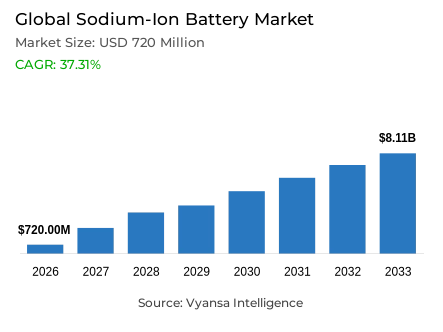
A Sodium-Ion battery is a rechargeable cell that stores and releases energy using Sodium-Ions instead of lithium, drawing on more abundant raw materials and aluminum current collectors on both electrodes. Utility storage developers, vehicle manufacturers and industrial backup operators deploy it across stationary energy storage, electric vehicles and light mobility. The Sodium-Ion battery market is forecast to grow at a CAGR of 37.31% between 2027 and 2033.
Key Highlights of the Sodium-Ion Battery Market
- The sodium-ion battery market was valued at USD 0.72 billion in 2026. The market is estimated at USD 1.21 billion in 2027 and is forecast to reach USD 8.11 billion by 2033.
- The market is forecast to expand at an overall compound annual growth rate of 37.31% across the 2027 to 2033 forecast period.
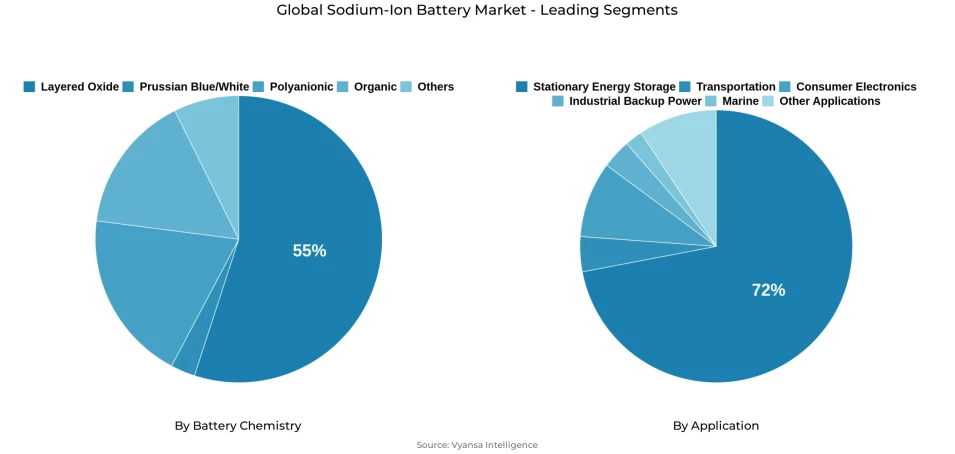
- By battery chemistry, layered oxide is the leading segment with a 55.00% share in 2026.
- Polyanionic chemistry is the fastest-growing segment under battery chemistry, expanding at a 37.70% CAGR between 2027 and 2033.
- By application, stationary energy storage is the leading segment with a 72.00% share in 2026.
- Transportation is the fastest-growing segment under application, expanding at a 42.55% CAGR between 2027 and 2033.
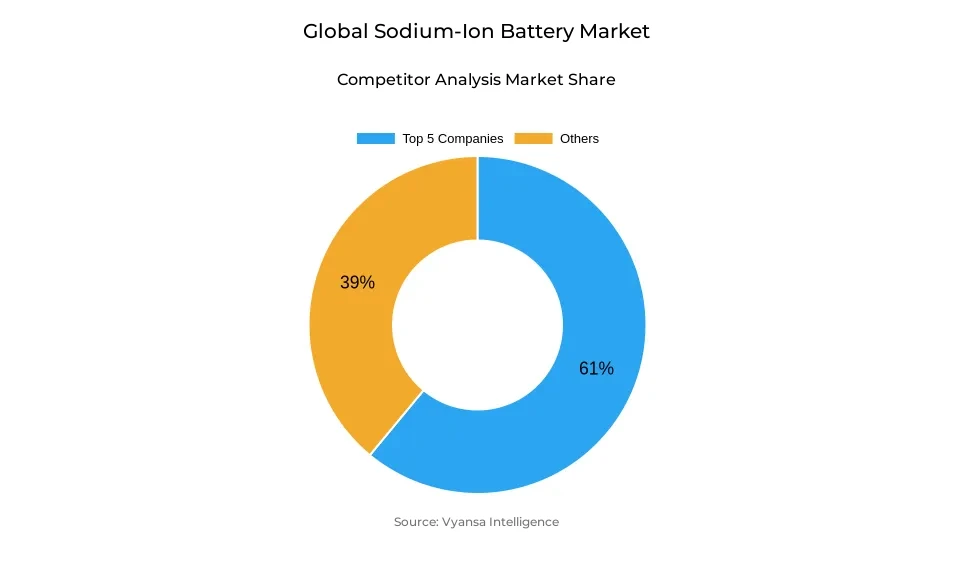
- The market is moderately consolidated, with the top five companies holding a combined 61.00% share of total industry revenue in 2026.
The global sodium-ion battery market is progressing toward commercial-scale manufacturing and deployment as battery producers, energy-storage companies and automotive suppliers move beyond technology validation into standardized products and contracted supply. Commercial activity accelerated during 2026, with sodium-ion systems entering stationary storage, passenger vehicles, industrial backup and selected mobility applications. In China alone, approximately 25.2 GWh of sodium-ion cell manufacturing capacity was already operational by mid-2026, while planned capacity reached around 293.7 GWh, indicating substantial preparation for larger-volume deployment.
Commercialization is also becoming geographically broader. In June 2026, Netherlands-based Moonwatt commissioned a commercial-scale sodium-ion storage system for a solar facility in Arnhem and began accepting orders for 2027 delivery. In Europe, Clarios, Swedish battery developer Altris and InoBat advanced sodium-ion technology toward pilot-scale and small-series production during 2026 following automotive and heavy-duty customer validation, including cold-temperature testing down to -40°C.
India is building another part of the emerging supply chain. In April 2026, the country's technology development board provided financial support for commercial-scale production of bio-waste-derived hard carbon for sodium-ion batteries, strengthening domestic availability of a key anode material. European investment is also extending upstream, with the EU-backed NASCALE program beginning in June 2026 to scale sodium-ion cathode material production through Swedish developer Altris. These developments show that market formation is expanding beyond cell manufacturing into raw materials, system integration and application-specific production capacity.
Through 2033, sodium-ion batteries should establish a stronger complementary position alongside lithium-based chemistries across stationary storage, urban and short-range mobility, industrial equipment and backup power. Growth should increasingly be supported by larger manufacturing platforms, multi-year supply agreements and repeat commercial deployment rather than isolated product introductions. Applications that value safety, long operating life, low-temperature performance and diversified raw-material supply are likely to provide the strongest pathways for sodium-ion technology to achieve sustained commercial scale.
Sodium-Ion Battery Market Driver
Rapid Global Electrification is Expanding Addressable Demand Pool for Sodium-Ion Batteries
Global electrification is creating a substantially larger requirement for rechargeable batteries across power systems, mobility and critical infrastructure, allowing multiple battery chemistries to scale alongside each other. Electricity demand is forecast to increase by 3.6% globally in 2026 and 3.8% in 2027, supported by electric vehicles, data centers, industrial activity and greater electrification of end-use sectors. This increases the volume of applications requiring economical and scalable battery capacity rather than concentrating demand around a single technology.
Battery deployment is already reflecting this shift. Global battery-storage additions reached 108 GW in 2025, increasing around 40% year over year, while approximately 80% of new capacity was deployed at utility scale. More than 90% of newly commissioned storage projects were primarily designed for energy shifting, compared with around 40% a decade earlier, indicating that batteries are increasingly becoming a core part of electricity-system capacity rather than being used mainly for short-duration grid support.
This expansion creates commercial space for sodium-ion batteries because future battery demand is growing across applications with different performance requirements. Buyers increasingly require chemistry options suited to long-duration operation, frequent cycling, backup power and cost-sensitive electrification rather than one battery specification for every use case. As the overall battery requirement expands, sodium-ion manufacturers gain a larger addressable market in which to establish commercially differentiated products without depending on direct replacement of existing lithium-ion demand.
Sodium-Ion Battery Market Challenge
Low Production Utilization is Delaying Sodium-Ion Cost Reduction
Sodium-ion manufacturers have announced substantial production expansion, but commercial shipments are still developing from a much smaller base. When factories operate below their designed output, fixed manufacturing and qualification costs are spread across fewer cells, delaying the scale economics needed to compete consistently with highly optimized lithium iron phosphate production.
The problem is therefore not insufficient announced capacity but insufficient utilization of that capacity. Manufacturers need repeatable orders large enough to keep production lines running efficiently rather than relying on demonstrations or irregular project demand. This is why large contracted volumes are becoming increasingly important to sodium-ion commercialization.
The market began addressing this constraint in 2026. CATL and HyperStrong signed a three-year sodium-ion storage agreement covering 60 GWh, which CATL described as the largest sodium-ion battery cooperation announced to date. Agreements of this scale can convert manufacturing assets into sustained commercial output and help reduce unit costs through higher utilization.
Sodium-Ion Battery Market Trends
Lower Raw-Material Costs and Lithium Price Volatility Are Strengthening Sodium-Ion Battery Economics
Sodium-ion batteries are gaining commercial relevance because their core raw materials are more abundant and less exposed to the price volatility affecting lithium-based batteries. Sodium carbonate is substantially cheaper and more widely available than battery-grade lithium carbonate, reducing exposure to mining concentration and commodity-price spikes. This cost structure is particularly important for stationary storage, light mobility and other price-sensitive applications where buyers prioritize lifecycle economics and supply stability over maximum energy density.
The cost advantage becomes more valuable when lithium prices rise. Chinese battery-grade lithium carbonate moved above USD 25000 per tons in early 2026, while industry forecasts pointed to continued elevated pricing through 2027. Sodium-ion order activity strengthened as lithium costs increased because buyers with chemistry flexibility could redirect incremental procurement toward a less lithium-dependent alternative. China is also reinforcing this difference through temporary tax exemptions for sodium-ion batteries while lithium-ion products face phased consumption taxes.
Through the forecast period, sodium-ion adoption should therefore benefit from both its structurally lower exposure to scarce battery materials and the recurring risk of lithium-price volatility. The effect extends globally because battery and storage developers across Europe, Asia and North America compare chemistries on delivered system cost before committing to multi-year projects. As sodium-ion production scales, this more stable material-cost base should increasingly convert into competitive pricing and higher commercial order volumes.
AI and Machine Learning Are Accelerating Sodium-Ion Battery Material Development
Sodium-ion battery development is increasingly moving from conventional trial-and-error research toward data-driven material discovery. Artificial intelligence and machine-learning models can screen large numbers of cathode and anode combinations before extensive laboratory testing, allowing researchers to identify promising structures, material compositions and performance trade-offs more quickly than through purely experimental development.
Research published in 2026 shows machine-learning approaches being applied directly to layered oxide, polyanionic and other sodium-ion cathode materials, as well as hard-carbon and alternative anodes. Separate generative-AI research has also demonstrated the ability to screen thousands of sodium-containing material structures and narrow them into smaller sets of candidates for detailed validation.
The commercial importance is shorter development cycles for improving energy density, cycle life and material cost, three of the main factors still separating sodium-ion from mature lithium technologies. AI will not immediately determine battery sales, but it can accelerate the chemistry improvements required for broader commercialization. Through 2032, data-driven material design should therefore become an increasingly important R&D capability for sodium-ion developers competing to improve performance without materially increasing cell cost.
Sodium-Ion Battery Market Opportunity
Lead-Acid Replacement in Light Mobility Creates a Large Emerging-Market Opportunity
Two-wheelers, three-wheelers, and low-cost electric vehicles across emerging Asian markets represent a strong sodium-ion opportunity because many still depend on lead-acid batteries or imported lithium-ion cells. Lead-acid offers low upfront cost but generally carries shorter life and greater weight, while imported lithium batteries can increase vehicle cost and expose manufacturers to external supply dependence.
Sodium-ion can occupy the gap where manufacturers need a lower-cost rechargeable chemistry with better cycle performance than lead-acid but do not require premium automotive energy density. India is particularly attractive because domestic battery manufacturing is expanding while demand for electric two- and three-wheelers continues to scale.
Capturing this opportunity requires local cell or pack assembly, compatibility with existing vehicle and battery-swap architectures, and partnerships with established mobility manufacturers. Companies that combine sodium-ion technology with existing two-wheeler distribution and servicing networks can convert a large incumbent lead-acid replacement base into recurring battery demand.
Unlock Market Intelligence
Explore the market potential with our data-driven report
Sodium-Ion Battery Market Segmentation Analysis
By Battery Chemistry:
- Prussian Blue/White
- Layered Oxide
- Polyanionic
- Organic
- Others
Layered Oxide Leads Sodium-Ion Battery Chemistry with 55% Share Through Commercial Cell Adoption
Layered Oxide accounts for the largest battery chemistry share at 55.00% in 2026 because it provides a strong balance between energy density and power capability. These characteristics become increasingly important as sodium-ion moves beyond stationary storage into passenger vehicles and other mobility applications, where battery weight and available energy directly influence commercial feasibility.
CATL's Naxtra platform demonstrates the progress being made within this chemistry. The company's mass-production sodium-ion battery reaches energy density of up to approximately 175 Wh/kg and is being deployed with Changan across passenger vehicle platforms beginning in 2026. This brings sodium-ion materially closer to mainstream vehicle requirements than earlier generations of the chemistry.
Polyanionic chemistry is the fastest-growing segment at a 37.70% CAGR during 2027 to 2033. Growth is being driven primarily by stationary storage and light-mobility applications where structural stability, long cycle life and safety can carry greater commercial importance than maximum energy density. It expands faster than Layered Oxide because it is gaining new applications from a smaller commercial base while Layered Oxide already accounts for the majority of current chemistry demand.
By Application:
- Stationary Energy Storage
- Transportation
- Consumer Electronics
- Industrial Backup Power
- Marine
- Other Applications
Stationary Energy Storage Dominates Sodium-Ion Battery Demand with 72% Share as Utility-Scale Deployment Expands
Stationary Energy Storage accounts for 72.00% of market demand in 2026 because fixed installations do not face the same weight and volume constraints as electric vehicles. Utilities and storage developers can instead prioritize lifecycle economics, safety, raw-material availability and long operating life, allowing sodium-ion's current performance characteristics to fit the application more naturally.
Commercial deployment is also scaling rapidly. CATL unveiled its TENER Sodium storage system in June 2026 and expects cumulative shipments to reach 1 GWh by the end of the year, with international deliveries planned from 2027. The company has also expanded dedicated sodium-ion manufacturing capacity to support larger storage deployments.
Transportation is the fastest-growing Application at a 42.55% CAGR during 2027 to 2033 as sodium-ion moves into passenger vehicles and light mobility. CATL and Changan unveiled a mass-production sodium-ion passenger vehicle in February 2026, providing one of the clearest signals that the chemistry is moving beyond stationary systems into commercially produced vehicles.
Unlock Market Intelligence
Explore the market potential with our data-driven report
Sodium-Ion Battery Market Regional Analysis
Asia Pacific Anchors Sodium-Ion Battery Manufacturing with 54% Regional Share in 2026
Asia Pacific dominates the sodium-ion battery market with a 54.00% share in 2026, primarily because China contains the deepest commercial battery manufacturing ecosystem, the largest concentration of sodium-ion developers and the strongest current pipeline of grid-storage and mobility deployments. The region benefits from existing battery-material processing, cell manufacturing and downstream integration capabilities that allow sodium-ion production to scale using an industrial base originally built around lithium technologies.
China's wider battery industry illustrates the magnitude of this manufacturing advantage. The country accounted for more than 80% of global battery-cell production in 2025 and even larger shares of cathode and anode material manufacturing. Sodium-ion investment is developing inside this same supplier ecosystem, giving Chinese companies access to established production engineering, equipment suppliers and vehicle and energy-storage customers that newer markets must build from the ground up.
The commercial pipeline reinforces this leadership. CATL has already signed a 60 GWh sodium-ion storage agreement with HyperStrong and is commissioning substantial dedicated sodium-ion production capacity, while companies including Veken operate commercial GWh-scale sodium-ion lines. Asia Pacific should therefore retain leadership as long as regional manufacturers continue converting production capacity into contracted domestic and export shipments.

Sodium-Ion Battery Market Competitive Landscape
The Sodium-Ion battery market is moderately consolidated, with the top five companies holding a combined 61.00% share of industry revenue in 2026. Veken Technology Co Ltd, Jiangsu Highstar Battery Manufacturing Co Ltd, Contemporary Amperex Technology Co Limited, FinDreams Battery Co Ltd and Chaowei Power Holdings Limited hold the leading positions.
Key Companies in the Sodium-Ion Battery Market
- Veken Technology Co Ltd
- Jiangsu Highstar Battery Manufacturing Co Ltd
- Contemporary Amperex Technology Co Limited
- FinDreams Battery Co Ltd
- Chaowei Power Holdings Limited
- Pylon Technologies Co Ltd
- East Group Co Ltd
- Shenzhen Jinna Technology Co Ltd
- Shenzhen Weifang Energy Technology Co Ltd
- Tianneng Battery Group Co LTD
- Namey New Energy Technology Luoyang Co Ltd
- Xiamen HiTHIUM Energy Storage Technology Co Ltd
- Shanxi Huana Xinneng Technology Co Ltd
- Jiangsu Zoolnasm Energy Technology Co Ltd
- Beijing Xibei Power Technology Co Ltd
Company Profiling
The following profiles cover the five leading manufacturers shaping commercial-scale sodium-ion cell production across the industry.
Veken Technology Co. Ltd.: Veken develops sodium-ion cells and packs for stationary storage, starter batteries and other power applications. Its Nanchang manufacturing base operates two automated sodium-ion production lines with approximately 2 GWh of annual capacity, while a separate Ningbo operation supports cylindrical sodium-ion products. This existing commercial capacity positions Veken among the earlier manufacturers to move sodium-ion beyond pilot production into large-scale supply.
Jiangsu Highstar Battery Manufacturing Co. Ltd.: Highstar participates through sodium-ion batteries targeting industrial vehicles, backup power and other specialized applications. Its strategy increasingly focuses on expanding sodium-ion beyond conventional storage toward high-power and infrastructure uses. In July 2026, the company introduced a sodium-ion battery solution targeted at AI data-center applications, extending its technology portfolio toward the rapidly growing computing-power infrastructure market.
Contemporary Amperex Technology Co. Limited: CATL is scaling sodium-ion across both energy storage and transportation through its Naxtra and TENER platforms. In April 2026, the company signed a three-year 60 GWh sodium-ion storage agreement with HyperStrong, while its passenger-vehicle partnership with Changan moved sodium-ion into mass-produced automotive applications. CATL has also invested in dedicated sodium-ion production capacity, giving it one of the industry's strongest routes from product development to commercial deployment.
FinDreams Battery Co. Ltd.: FinDreams is developing sodium-ion technology within BYD's broader battery manufacturing ecosystem, targeting stationary storage and lower-cost mobility applications. Its manufacturing strategy benefits from BYD's established cell-production, system-integration and vehicle supply infrastructure, allowing sodium-ion products to be developed alongside an existing large-scale battery platform rather than through a standalone startup manufacturing base.
Chaowei Power Holdings Limited: Chaowei is extending its established light-electric-vehicle battery business from lead-acid toward sodium-ion products. Its existing relationships with electric two-wheeler manufacturers provide a ready commercial route for sodium-ion adoption in applications where lower cost, cycle life and cold-weather operation can support replacement of conventional lead-acid batteries. During 2026, the company continued expanding sodium-ion cooperation with major Chinese two-wheeler brands.
Recent Developments in the Sodium-Ion Battery Market
- July 2026: CATL and Alfen announced plans to deploy 5 GWh of sodium-ion energy storage systems across Europe beginning in 2027. The agreement represents one of the clearest signs that sodium-ion storage procurement is expanding beyond China into large international commercial programs.
- July 2026: CATL and Solarpro signed a 2 GWh sodium-ion storage agreement targeting Central and Eastern Europe, including development of the region's first large sodium-ion projects. The agreement strengthens Europe's role as an emerging export market for commercially qualified sodium-ion storage systems.
- July 2026: Peak Energy selected Sacramento, California for its first U.S. giga-scale sodium-ion grid-storage factory, supporting diversification of commercial sodium-ion manufacturing outside China and providing North American storage developers with a future domestic supply option.
Frequently Asked Questions
Related Report
- Market Segmentation
- Research Scope
- Research Methodology
- Definitions and Assumptions
- Executive Summary
- Global Sodium Ion Battery Market Policies, Regulations, and Standards
- Global Sodium Ion Battery Market Dynamics
- Growth Factors
- Challenges
- Trends
- Opportunities
- Global Sodium Ion Battery Market Statistics, 2023-2033F
- Market Size & Growth Outlook
- By Revenues in USD Million
- Market Segmentation & Growth Outlook
- By Battery Chemistry
- Prussian Blue/White- Market Insights and Forecast 2023-2033, USD Million
- Layered Oxide- Market Insights and Forecast 2023-2033, USD Million
- Polyanionic- Market Insights and Forecast 2023-2033, USD Million
- Organic- Market Insights and Forecast 2023-2033, USD Million
- Others- Market Insights and Forecast 2023-2033, USD Million
- By Form Factor
- Cylindrical- Market Insights and Forecast 2023-2033, USD Million
- Prismatic- Market Insights and Forecast 2023-2033, USD Million
- Pouch- Market Insights and Forecast 2023-2033, USD Million
- By Application
- Stationary Energy Storage- Market Insights and Forecast 2023-2033, USD Million
- Transportation- Market Insights and Forecast 2023-2033, USD Million
- Consumer Electronics- Market Insights and Forecast 2023-2033, USD Million
- Industrial Backup Power- Market Insights and Forecast 2023-2033, USD Million
- Marine- Market Insights and Forecast 2023-2033, USD Million
- Other Applications- Market Insights and Forecast 2023-2033, USD Million
- By Region
- North America
- South America
- Europe
- Middle East & Africa
- Asia Pacific
- By Competitors
- Competition Characteristics
- Market Share & Analysis
- By Battery Chemistry
- Market Size & Growth Outlook
- North America Sodium Ion Battery Market Statistics, 2023-2033F
- Market Size & Growth Outlook
- By Revenues in USD Million
- Market Segmentation & Growth Outlook
- By Battery Chemistry- Market Insights and Forecast 2023-2033, USD Million
- By Form Factor- Market Insights and Forecast 2023-2033, USD Million
- By Application- Market Insights and Forecast 2023-2033, USD Million
- By Country
- The US
- Canada
- Mexico
- The US Sodium Ion Battery Market Statistics, 2023-2033F
- Market Size & Growth Outlook
- By Revenues in USD Million
- Market Segmentation & Growth Outlook
- By Battery Chemistry- Market Insights and Forecast 2023-2033, USD Million
- By Form Factor- Market Insights and Forecast 2023-2033, USD Million
- By Application- Market Insights and Forecast 2023-2033, USD Million
- Market Size & Growth Outlook
- Canada Sodium Ion Battery Market Statistics, 2023-2033F
- Market Size & Growth Outlook
- By Revenues in USD Million
- Market Segmentation & Growth Outlook
- By Battery Chemistry- Market Insights and Forecast 2023-2033, USD Million
- By Form Factor- Market Insights and Forecast 2023-2033, USD Million
- By Application- Market Insights and Forecast 2023-2033, USD Million
- Market Size & Growth Outlook
- Mexico Sodium Ion Battery Market Statistics, 2023-2033F
- Market Size & Growth Outlook
- By Revenues in USD Million
- Market Segmentation & Growth Outlook
- By Battery Chemistry- Market Insights and Forecast 2023-2033, USD Million
- By Form Factor- Market Insights and Forecast 2023-2033, USD Million
- By Application- Market Insights and Forecast 2023-2033, USD Million
- Market Size & Growth Outlook
- Market Size & Growth Outlook
- South America Sodium Ion Battery Market Statistics, 2023-2033F
- Market Size & Growth Outlook
- By Revenues in USD Million
- Market Segmentation & Growth Outlook
- By Battery Chemistry- Market Insights and Forecast 2023-2033, USD Million
- By Form Factor- Market Insights and Forecast 2023-2033, USD Million
- By Application- Market Insights and Forecast 2023-2033, USD Million
- By Country
- Brazil
- Argentina
- Chile
- Rest of South America
- Brazil Sodium Ion Battery Market Statistics, 2023-2033F
- Market Size & Growth Outlook
- By Revenues in USD Million
- Market Segmentation & Growth Outlook
- By Battery Chemistry- Market Insights and Forecast 2023-2033, USD Million
- By Form Factor- Market Insights and Forecast 2023-2033, USD Million
- By Application- Market Insights and Forecast 2023-2033, USD Million
- Market Size & Growth Outlook
- Argentina Sodium Ion Battery Market Statistics, 2023-2033F
- Market Size & Growth Outlook
- By Revenues in USD Million
- Market Segmentation & Growth Outlook
- By Battery Chemistry- Market Insights and Forecast 2023-2033, USD Million
- By Form Factor- Market Insights and Forecast 2023-2033, USD Million
- By Application- Market Insights and Forecast 2023-2033, USD Million
- Market Size & Growth Outlook
- Chile Sodium Ion Battery Market Statistics, 2023-2033F
- Market Size & Growth Outlook
- By Revenues in USD Million
- Market Segmentation & Growth Outlook
- By Battery Chemistry- Market Insights and Forecast 2023-2033, USD Million
- By Form Factor- Market Insights and Forecast 2023-2033, USD Million
- By Application- Market Insights and Forecast 2023-2033, USD Million
- Market Size & Growth Outlook
- Market Size & Growth Outlook
- Europe Sodium Ion Battery Market Statistics, 2023-2033F
- Market Size & Growth Outlook
- By Revenues in USD Million
- Market Segmentation & Growth Outlook
- By Battery Chemistry- Market Insights and Forecast 2023-2033, USD Million
- By Form Factor- Market Insights and Forecast 2023-2033, USD Million
- By Application- Market Insights and Forecast 2023-2033, USD Million
- By Country
- Germany
- The UK
- France
- Italy
- Spain
- BENELUX
- Nordics
- Rest of Europe
- Germany Sodium Ion Battery Market Statistics, 2023-2033F
- Market Size & Growth Outlook
- By Revenues in USD Million
- Market Segmentation & Growth Outlook
- By Battery Chemistry- Market Insights and Forecast 2023-2033, USD Million
- By Form Factor- Market Insights and Forecast 2023-2033, USD Million
- By Application- Market Insights and Forecast 2023-2033, USD Million
- Market Size & Growth Outlook
- The UK Sodium Ion Battery Market Statistics, 2023-2033F
- Market Size & Growth Outlook
- By Revenues in USD Million
- Market Segmentation & Growth Outlook
- By Battery Chemistry- Market Insights and Forecast 2023-2033, USD Million
- By Form Factor- Market Insights and Forecast 2023-2033, USD Million
- By Application- Market Insights and Forecast 2023-2033, USD Million
- Market Size & Growth Outlook
- France Sodium Ion Battery Market Statistics, 2023-2033F
- Market Size & Growth Outlook
- By Revenues in USD Million
- Market Segmentation & Growth Outlook
- By Battery Chemistry- Market Insights and Forecast 2023-2033, USD Million
- By Form Factor- Market Insights and Forecast 2023-2033, USD Million
- By Application- Market Insights and Forecast 2023-2033, USD Million
- Market Size & Growth Outlook
- Italy Sodium Ion Battery Market Statistics, 2023-2033F
- Market Size & Growth Outlook
- By Revenues in USD Million
- Market Segmentation & Growth Outlook
- By Battery Chemistry- Market Insights and Forecast 2023-2033, USD Million
- By Form Factor- Market Insights and Forecast 2023-2033, USD Million
- By Application- Market Insights and Forecast 2023-2033, USD Million
- Market Size & Growth Outlook
- Spain Sodium Ion Battery Market Statistics, 2023-2033F
- Market Size & Growth Outlook
- By Revenues in USD Million
- Market Segmentation & Growth Outlook
- By Battery Chemistry- Market Insights and Forecast 2023-2033, USD Million
- By Form Factor- Market Insights and Forecast 2023-2033, USD Million
- By Application- Market Insights and Forecast 2023-2033, USD Million
- Market Size & Growth Outlook
- BENELUX Sodium Ion Battery Market Statistics, 2023-2033F
- Market Size & Growth Outlook
- By Revenues in USD Million
- Market Segmentation & Growth Outlook
- By Battery Chemistry- Market Insights and Forecast 2023-2033, USD Million
- By Form Factor- Market Insights and Forecast 2023-2033, USD Million
- By Application- Market Insights and Forecast 2023-2033, USD Million
- Market Size & Growth Outlook
- Nordics Sodium Ion Battery Market Statistics, 2023-2033F
- Market Size & Growth Outlook
- By Revenues in USD Million
- Market Segmentation & Growth Outlook
- By Battery Chemistry- Market Insights and Forecast 2023-2033, USD Million
- By Form Factor- Market Insights and Forecast 2023-2033, USD Million
- By Application- Market Insights and Forecast 2023-2033, USD Million
- Market Size & Growth Outlook
- Market Size & Growth Outlook
- Middle East & Africa Sodium Ion Battery Market Statistics, 2023-2033F
- Market Size & Growth Outlook
- By Revenues in USD Million
- Market Segmentation & Growth Outlook
- By Battery Chemistry- Market Insights and Forecast 2023-2033, USD Million
- By Form Factor- Market Insights and Forecast 2023-2033, USD Million
- By Application- Market Insights and Forecast 2023-2033, USD Million
- By Country
- UAE
- Saudi Arabia
- South Africa
- Turkey
- Rest of Middle East & Africa
- UAE Sodium Ion Battery Market Statistics, 2023-2033F
- Market Size & Growth Outlook
- By Revenues in USD Million
- Market Segmentation & Growth Outlook
- By Battery Chemistry- Market Insights and Forecast 2023-2033, USD Million
- By Form Factor- Market Insights and Forecast 2023-2033, USD Million
- By Application- Market Insights and Forecast 2023-2033, USD Million
- Market Size & Growth Outlook
- Saudi Arabia Sodium Ion Battery Market Statistics, 2023-2033F
- Market Size & Growth Outlook
- By Revenues in USD Million
- Market Segmentation & Growth Outlook
- By Battery Chemistry- Market Insights and Forecast 2023-2033, USD Million
- By Form Factor- Market Insights and Forecast 2023-2033, USD Million
- By Application- Market Insights and Forecast 2023-2033, USD Million
- Market Size & Growth Outlook
- South Africa Sodium Ion Battery Market Statistics, 2023-2033F
- Market Size & Growth Outlook
- By Revenues in USD Million
- Market Segmentation & Growth Outlook
- By Battery Chemistry- Market Insights and Forecast 2023-2033, USD Million
- By Form Factor- Market Insights and Forecast 2023-2033, USD Million
- By Application- Market Insights and Forecast 2023-2033, USD Million
- Market Size & Growth Outlook
- Turkey Sodium Ion Battery Market Statistics, 2023-2033F
- Market Size & Growth Outlook
- By Revenues in USD Million
- Market Segmentation & Growth Outlook
- By Battery Chemistry- Market Insights and Forecast 2023-2033, USD Million
- By Form Factor- Market Insights and Forecast 2023-2033, USD Million
- By Application- Market Insights and Forecast 2023-2033, USD Million
- Market Size & Growth Outlook
- Market Size & Growth Outlook
- Asia Pacific Sodium Ion Battery Market Statistics, 2023-2033F
- Market Size & Growth Outlook
- By Revenues in USD Million
- Market Segmentation & Growth Outlook
- By Battery Chemistry- Market Insights and Forecast 2023-2033, USD Million
- By Form Factor- Market Insights and Forecast 2023-2033, USD Million
- By Application- Market Insights and Forecast 2023-2033, USD Million
- By Country
- China
- India
- Japan
- South Korea
- Australia
- Southeast Asia
- Rest of Asia Pacific
- China Sodium Ion Battery Market Statistics, 2023-2033F
- Market Size & Growth Outlook
- By Revenues in USD Million
- Market Segmentation & Growth Outlook
- By Battery Chemistry- Market Insights and Forecast 2023-2033, USD Million
- By Form Factor- Market Insights and Forecast 2023-2033, USD Million
- By Application- Market Insights and Forecast 2023-2033, USD Million
- Market Size & Growth Outlook
- India Sodium Ion Battery Market Statistics, 2023-2033F
- Market Size & Growth Outlook
- By Revenues in USD Million
- Market Segmentation & Growth Outlook
- By Battery Chemistry- Market Insights and Forecast 2023-2033, USD Million
- By Form Factor- Market Insights and Forecast 2023-2033, USD Million
- By Application- Market Insights and Forecast 2023-2033, USD Million
- Market Size & Growth Outlook
- Japan Sodium Ion Battery Market Statistics, 2023-2033F
- Market Size & Growth Outlook
- By Revenues in USD Million
- Market Segmentation & Growth Outlook
- By Battery Chemistry- Market Insights and Forecast 2023-2033, USD Million
- By Form Factor- Market Insights and Forecast 2023-2033, USD Million
- By Application- Market Insights and Forecast 2023-2033, USD Million
- Market Size & Growth Outlook
- South Korea Sodium Ion Battery Market Statistics, 2023-2033F
- Market Size & Growth Outlook
- By Revenues in USD Million
- Market Segmentation & Growth Outlook
- By Battery Chemistry- Market Insights and Forecast 2023-2033, USD Million
- By Form Factor- Market Insights and Forecast 2023-2033, USD Million
- By Application- Market Insights and Forecast 2023-2033, USD Million
- Market Size & Growth Outlook
- Australia Sodium Ion Battery Market Statistics, 2023-2033F
- Market Size & Growth Outlook
- By Revenues in USD Million
- Market Segmentation & Growth Outlook
- By Battery Chemistry- Market Insights and Forecast 2023-2033, USD Million
- By Form Factor- Market Insights and Forecast 2023-2033, USD Million
- By Application- Market Insights and Forecast 2023-2033, USD Million
- Market Size & Growth Outlook
- Southeast Asia Sodium Ion Battery Market Statistics, 2023-2033F
- Market Size & Growth Outlook
- By Revenues in USD Million
- Market Segmentation & Growth Outlook
- By Battery Chemistry- Market Insights and Forecast 2023-2033, USD Million
- By Form Factor- Market Insights and Forecast 2023-2033, USD Million
- By Application- Market Insights and Forecast 2023-2033, USD Million
- Market Size & Growth Outlook
- Market Size & Growth Outlook
- Competitive Outlook
- Company Profiles
- Veken Technology Co., Ltd.
- Business Description
- Product Portfolio
- Collaborations & Alliances
- Recent Developments
- Financial Details
- Others
- Jiangsu Highstar Battery Manufacturing Co.,Ltd.
- Business Description
- Product Portfolio
- Collaborations & Alliances
- Recent Developments
- Financial Details
- Others
- Contemporary Amperex Technology Co., Limited
- Business Description
- Product Portfolio
- Collaborations & Alliances
- Recent Developments
- Financial Details
- Others
- FinDreams Battery Co. Ltd
- Business Description
- Product Portfolio
- Collaborations & Alliances
- Recent Developments
- Financial Details
- Others
- Chaowei Power Holdings Limited
- Business Description
- Product Portfolio
- Collaborations & Alliances
- Recent Developments
- Financial Details
- Others
- Pylon Technologies Co., Ltd.
- Business Description
- Product Portfolio
- Collaborations & Alliances
- Recent Developments
- Financial Details
- Others
- East Group Co., Ltd.
- Business Description
- Product Portfolio
- Collaborations & Alliances
- Recent Developments
- Financial Details
- Others
- Shenzhen Jinna Technology Co Ltd
- Business Description
- Product Portfolio
- Collaborations & Alliances
- Recent Developments
- Financial Details
- Others
- Shenzhen Weifang Energy Technology Co Ltd
- Business Description
- Product Portfolio
- Collaborations & Alliances
- Recent Developments
- Financial Details
- Others
- Tianneng Battery Group Co. LTD
- Business Description
- Product Portfolio
- Collaborations & Alliances
- Recent Developments
- Financial Details
- Others
- Namey New Energy Technology (Luoyang) Co., Ltd
- Business Description
- Product Portfolio
- Collaborations & Alliances
- Recent Developments
- Financial Details
- Others
- Xiamen HiTHIUM Energy Storage Technology Co. Ltd.
- Business Description
- Product Portfolio
- Collaborations & Alliances
- Recent Developments
- Financial Details
- Others
- Shanxi Huana Xinneng Technology Co Ltd
- Business Description
- Product Portfolio
- Collaborations & Alliances
- Recent Developments
- Financial Details
- Others
- Jiangsu Zoolnasm Energy Technology Co., Ltd.
- Business Description
- Product Portfolio
- Collaborations & Alliances
- Recent Developments
- Financial Details
- Others
- Beijing Xibei Power Technology Co Ltd
- Business Description
- Product Portfolio
- Collaborations & Alliances
- Recent Developments
- Financial Details
- Others
- Veken Technology Co., Ltd.
- Company Profiles
- Disclaimer
| Segment | Sub-Segment |
|---|---|
| By Battery Chemistry |
|
| By Form Factor |
|
| By Application |
|
| By Region |
|
Research Methodology
This study followed a structured approach comprising four key phases to assess the size and scope of the electro-oxidation market. The process began with thorough secondary research to collect data on the target market, related markets, and broader industry context. These findings, along with preliminary assumptions and estimates, were then validated through extensive primary research involving industry experts from across the value chain. To calculate the overall market size, both top-down and bottom-up methodologies were employed. Finally, market segmentation and data triangulation techniques were applied to refine and validate segment-level estimations.
Secondary Research
The secondary research phase involved gathering data from a wide range of credible and published sources. This step helped in identifying industry trends, defining market segmentation, and understanding the market landscape and value chain.
Sources consulted during this phase included:
- Company annual reports, investor presentations, and press releases
- Industry white papers and certified publications
- Trade directories and market-recognized databases
- Articles from authoritative authors and reputable journals
- Gold and silver standard websites
Secondary research was critical in mapping out the industry's value chain and monetary flow, identifying key market segments, understanding regional variations, and tracking significant industry developments.
Other key sources:
- Financial disclosures
- Industry associations and trade bodies
- News outlets and business magazines
- Academic journals and research studies
- Paid industry databases
Primary Research
To validate secondary data and gain deeper market insights, primary research was conducted with key stakeholders across both the supply and demand sides of the market.
On the demand side, participants included decision-makers and influencers from end-user industries—such as CIOs, CTOs, and CSOs—who provided first-hand perspectives on market needs, product usage, and future expectations.
On the supply side, interviews were conducted with manufacturers, industry associations, and institutional participants to gather insights into current offerings, product pipelines, and market challenges.
Primary interviews provided critical inputs such as:
- Market size and revenue data
- Product and service breakdowns
- Market forecasts
- Regional and application-specific trends
Stakeholders consulted included:
- Leading OEM and solution providers
- Channel and distribution partners
- End users across various applications
- Independent consultants and industry specialists
Market Size Estimation and Data Triangulation
- Identifying Key Market Participants (Secondary Research)
- Goal: To identify the major players or companies in the target market. This typically involves using publicly available data sources such as industry reports, market research publications, and financial statements of companies.
- Tools: Reports from firms like Gartner, Forrester, Euromonitor, Statista, IBISWorld, and others. Public financial statements, news articles, and press releases from top market players.
- Extracting Earnings of Key Market Participants
- Goal: To estimate the earnings generated from the product or service being analyzed. This step helps in understanding the revenue potential of each market player in a specific geography.
- Methods: Earnings data can be gathered from:
- Publicly available financial reports (for listed companies).
- Interviews and primary data sources from professionals, such as Directors, VPs, SVPs, etc. This is especially useful for understanding more nuanced, internal data that isn't publicly disclosed.
- Annual reports and investor presentations of key players.
- Data Collation and Development of a Relevant Data Model
- Goal: To collate inputs from both primary and secondary sources into a structured, data-driven model for market estimation. This model will incorporate key market KPIs and any independent variables relevant to the market.
- Key KPIs: These could include:
- Market size, growth rate, and demand drivers.
- Industry-specific metrics like market share, average revenue per customer (ARPC), or average deal size.
- External variables, such as economic growth rates, inflation rates, or commodity prices, that could affect the market.
- Data Modeling: Based on this data, the market forecasts are developed for the next 5 years. A combination of trend analysis, scenario modeling, and statistical regression might be used to generate projections.
- Scenario Analysis
- Goal: To test different assumptions and validate how sensitive the market is to changes in key variables (e.g., market demand, regulatory changes, technological disruptions).
- Types of Scenarios:
- Base Case: Based on current assumptions and historical data.
- Best-Case Scenario: Assuming favorable market conditions, regulatory environments, and technological advancements.
- Worst-Case Scenario: Accounting for adverse factors, such as economic downturns, stricter regulations, or unexpected disruptions.












