Portugal Diesel Generator Market Report: Trends, Growth and Forecast (2026-2032)
By Power Rating (Upto 75KVA, 75.1 KVA to 375 KVA, 375.1 to 750 KVA, 750.1 KVA to 1000 KVA, Above 1000 KVA), By Type (Stand By, Prime & Continuous Power, Peak Shaving), By End Users (Residential, Commercial, Healthcare, Government & Transport, Equipment Rental Companies, Industrial, Others) ... Read more
|
Major Players
|
Portugal Diesel Generator Market Overview
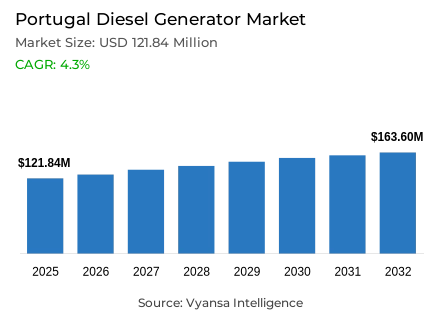
The diesel generator market covers standby, prime, and continuous diesel-powered generator systems used to provide electricity during grid outages, supply constraints, or off-grid operations. These systems support industrial facilities, commercial buildings, healthcare infrastructure, public services, construction sites, data centers, and other critical applications requiring reliable backup power. The diesel generator market in Portugal is forecast to grow at a CAGR of 4.3% during 2026–2032.
Key Highlights of the Portugal Diesel Generator Market
- The Portugal diesel generator market was valued at USD 121.84 million in 2025 and reached USD 127.08 million in 2026.
- The market is projected to reach USD 163.60 million by 2032, expanding at a CAGR of 4.3% during 2026–2032.
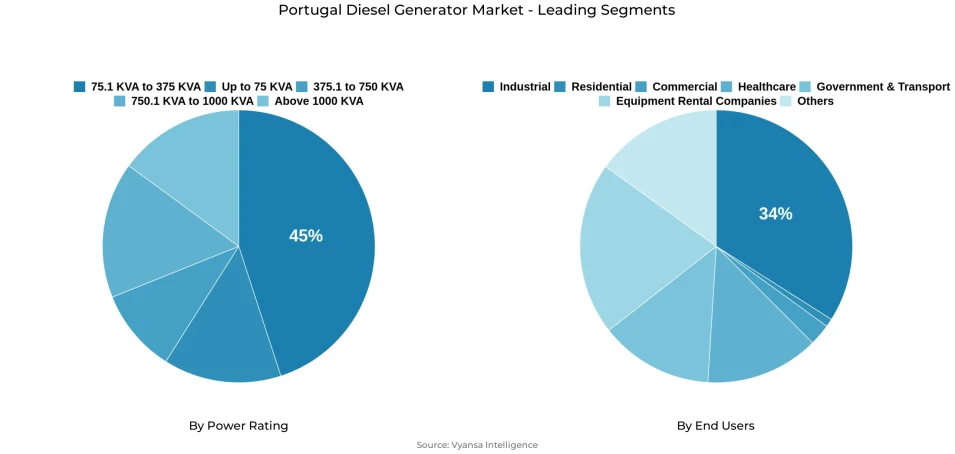
- By power rating, 75.1 KVA to 375 KVA segment accounted for approximately 45% share, while Above 1000 KVA is expected to record the strongest growth.
- By end user, the industrial segment represents the largest demand segment of 34%, while Commercial is expected to expand fastest through 2032.
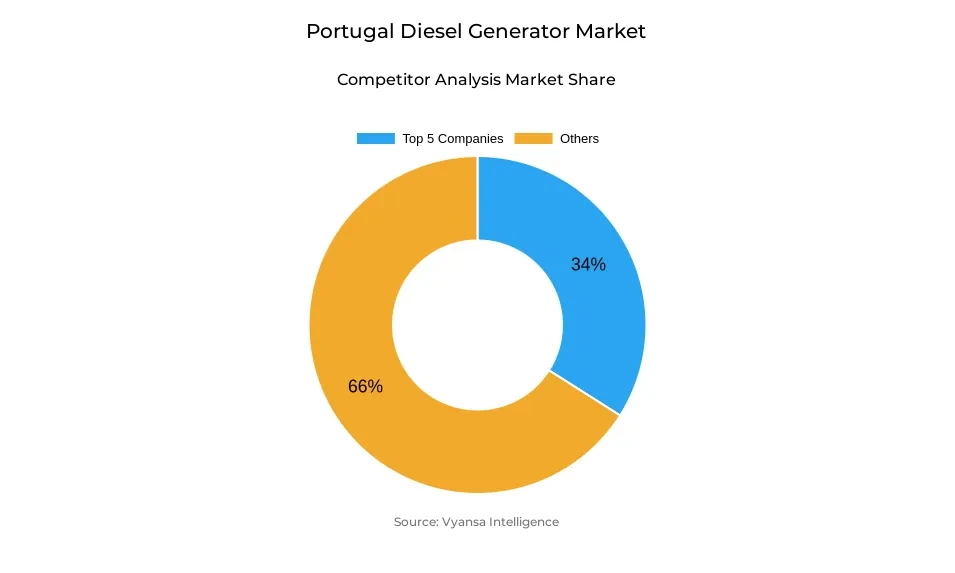
- The leading five companies collectively account for approximately 34% of the market.
Portugal's diesel generator market has moved into a more resilience-focused phase following major disruptions to the country's electricity system. The April 2025 Iberian blackout demonstrated how quickly electricity-dependent operations can be interrupted, while storm Kristin in January 2026 again left a large number of Portuguese customers without supply and required generators to support hospitals, water systems, telecommunications and other essential services. These events have pushed backup power higher on infrastructure and business-continuity agendas.
Demand is also being supported by a steadily larger electricity system. Portugal's public-grid electricity consumption reached a record 53.1 TWh in 2025, increasing 3.2% from 2024. Higher electricity use does not automatically translate into generator sales, but it raises the economic cost of outages as more commercial activity, industrial processes, and digital services become dependent on uninterrupted power. For generator suppliers, reliability and rapid service response therefore become increasingly important purchasing criteria.
The strongest longer-term opportunity comes from digital infrastructure. In 2026, Start Campus has secured permission for a large-scale Sines data-center campus, while additional investment announced in May 2026 is planned around AI and high-performance computing infrastructure. Large data centers require highly redundant standby-power architectures, creating demand for high-capacity generators, controls, switchgear and long-term maintenance. This should progressively shift part of Portugal's generator opportunity toward larger ratings and more sophisticated integrated power systems.
Portugal Diesel Generator Market Drivers
Grid Connection Queue Congestion and the High Demand Zone Designation
Portugal's electricity system is facing rapidly rising demand from large power consumers. Mainland Portugal was designated a high-demand zone in January 2026 as authorities sought to manage approximately 41 GW of connection requests. The IEA has highlighted that grid capacity and lengthy connection queues are becoming constraints for both electricity supply and major demand-side projects.
The impact is particularly relevant for data centers, industrial facilities, construction projects, and other electricity-intensive developments where delays in grid energization can affect commissioning schedules. Developers may therefore include diesel generators earlier in project planning, either as backup systems or temporary power before permanent connections are secured. This can support demand for larger generator sets, rental power, switchgear, and integrated power solutions rather than limiting generators to traditional emergency-only applications.
Portugal’s 2026–2027 national data center plan provides a more positive short-term view by supporting coordinated infrastructure and grid access for new data-center projects. However, the scale of the 2026 connection queue shows that electricity availability remains an important planning consideration. As more high-load projects enter development, generator procurement should increasingly be linked to project resilience, commissioning certainty, and continuity requirements, strengthening demand for dependable on-site power systems.
Portugal Diesel Generator Market Restraints
Global Gensets Capacity Constraints Increase Procurement Pressure in Portugal
Global demand for high-capacity generator sets is placing pressure on manufacturers as data-center development accelerates. In 2026, Cummins increased investment in power-generation capacity, with approximately USD 450 million planned to add around 20 GW of capacity by 2030, reflecting sustained demand for high-horsepower power-generation equipment. The expansion indicates that manufacturers are increasing production capacity in response to strong data-center-related demand, although additional capacity will take time to become available.
For Portugal, these global supply conditions increase procurement risk for large data centers and other mission-critical facilities that require high-capacity standby generation before testing and commissioning. Portuguese projects are exposed to the same international manufacturing constraints affecting major data-center markets, particularly North America, where hyperscale developments are generating substantial demand for large power-generation equipment. As a result, developers may need to place generator orders earlier, secure manufacturing slots in advance, and prioritize suppliers with established European production and distribution networks. Any delay in generator delivery, installation, or commissioning could in turn affect the broader project schedule and postpone commercial operations.
Portugal Diesel Generator Market Recent Trends
Diesel-Battery Hybrid Gensets with Integrated Energy Management
Diesel-battery hybrid generator sets are emerging as a significant trend in Portugal as end users increasingly seek backup and temporary-power systems that reduce fuel consumption, emissions, engine runtime, and operating costs without sacrificing the reliability of diesel generation. The trend is particularly relevant in applications where electricity demand fluctuates significantly, such as construction sites, equipment rental, temporary power, and remote operations. Integrating battery storage and intelligent energy-management systems allows generators to operate closer to their optimal load rather than continuously running at low or partial loads.
This trend is influencing the Portugal diesel generator industry by shifting demand from conventional diesel-only units toward higher-value hybrid systems that combine an engine, battery storage, power electronics, and automated controls. For rental companies and contractors, lower fuel consumption and reduced engine runtime can improve equipment economics over repeated operating cycles, while lower noise and emissions can make hybrid units more suitable for urban construction and temporary-power applications. The trend is therefore expected to expand the technology mix within the diesel generator market rather than eliminate diesel generators, as diesel engines continue to provide high-power output and extended operating capability when battery capacity is insufficient.
A notable supporting instance is Atlas Copco’s QHS Integrated Hybrid Generator range, introduced in 2026. The system integrates a diesel generator, onboard battery storage, and intelligent energy management in a single unit. According to Atlas Copco, the system can reduce fuel consumption and CO₂ emissions by up to 80% and reduce generator-engine runtime by more than 95% under suitable operating conditions. Its controller automatically manages the available power sources and can use surplus generator output to recharge the battery, allowing the engine to shut down during periods of lower demand.
For Portugal, the growing availability of such integrated hybrid systems could encourage rental companies, construction contractors, and temporary-power providers to upgrade portions of their fleets, particularly where generators experience prolonged periods of partial loading. This creates incremental demand for hybrid generator systems, battery modules, energy-management controls, and related service capabilities while maintaining demand for conventional diesel generators in applications requiring emergency standby, long-duration operation, or consistently high loads.
Portugal Diesel Generator Market Future Opportunities
Legislated Minimum Autonomy Would Create a Compliance-Driven Replacement and Upsizing Cycle
One of the clearest future opportunities comes from Portugal's review of backup-power preparedness following the April 2025 blackout. A parliamentary working group has recommended minimum energy-autonomy requirements for critical infrastructure, including longer autonomy for the most important facilities and regular verification of preparedness. The proposal has not yet become a binding requirement, so its market effect must remain conditional.
If adopted, the impact on generator demand could be significant because consumers would need to assess whether existing systems can support required loads for longer periods. Facilities with undersized generators, insufficient fuel storage or ageing systems could require replacement, additional units or upgraded fuel and control infrastructure.
Healthcare illustrates the potential gap. Evidence submitted to Portugal's parliamentary Environment and Energy Committee indicated that, at the time of the 2025 blackout, practically no hospital had fuel available for three days of autonomous operation. A formal autonomy standard could therefore convert resilience from a discretionary investment into a recurring compliance requirement, supporting procurement across hospitals, emergency services, public infrastructure, care facilities and potentially food and pharmaceutical networks.
Unlock Market Intelligence
Explore the market potential with our data-driven report
Portugal Diesel Generator Market Segmentation Analysis
By Power Rating
- Upto 75 KVA
- 75.1 KVA to 375 KVA
- 375.1 KVA to 750 KVA
- 750.1 KVA to 1000 KVA
- Above 1000 KVA
75.1 KVA to 375 KVA Leads, While Above 1000 KVA Gains Momentum
The 75.1 KVA to 375 KVA segment accounted for approximately 45% shares in Portugal diesel generator industry in 2026, making it the leading power-rating category. Its strength comes from versatility. Units within this range can support a wide mix of commercial buildings, industrial operations, public facilities, construction activities and distributed backup applications without the cost or infrastructure requirements associated with very large generator installations.
Above 1000 KVA is forecast to expand at the fastest CAGR of 8.25% during 2026–2032. The strongest reason is Portugal's developing data-center pipeline. Large digital facilities require multiple high-capacity generators arranged in redundant configurations, meaning relatively few projects can create substantial generator capacity demand. Manufacturer portfolios are already extending well into multi-megavolt-ampere ratings, aligning with this shift toward larger critical-power installations.
By End Users
- Residential
- Commercial
- Healthcare
- Government & Transport
- Equipment Rental Companies
- Industrial
- Others
Industrial Leads Demand, While Commercial Applications Expand Fastest
Industrial accounted for approximately 34% of Portugal diesel generator market value in 2026. Industrial users typically place a high value on continuity because outages can interrupt production processes, damage work-in-progress, stop machinery and delay customer deliveries. Diesel generators therefore remain part of risk-management and continuity planning even as Portugal increases renewable electricity generation.
Commercial is expected to record the fastest CAGR of 5.65% through 2032. Data centers are the most important reason. These facilities require standby-power capacity closely aligned with critical IT loads and normally operate with redundancy, creating substantially higher generator requirements than conventional offices or retail buildings.
Healthcare and public infrastructure also represent increasingly important demand pools. The 2025 blackout exposed limited fuel autonomy at a number of Portuguese healthcare facilities, while subsequent resilience reviews have increased attention on regular generator testing and emergency fuel arrangements.
Commercial growth should therefore gradually reduce the historical dependence of the market on conventional industrial demand and increase the importance of high-specification, mission-critical generator systems.
Unlock Market Intelligence
Explore the market potential with our data-driven report
Portugal Diesel Generator Market Competitive Landscape
The Portugal diesel generator industry remains moderately fragmented, with the leading five companies accounting for approximately 34% of total market value. The top companies include, Caterpillar Inc., Cummins Inc., Kohler Co., Generac Power Systems, and Rolls-Royce Power Systems.
Key Companies in the Portugal Diesel Generator Market
- Caterpillar Inc.
- Cummins Inc.
- Kohler Co.
- Generac Power Systems
- Rolls-Royce Power Systems
- Atlas Copco
- HIMOINSA
- FG Wilson
- SDMO Industries
- Mitsubishi Heavy Industries
Recent Developments in the Portugal Diesel Generator Market
- July 2026: Portugal advanced a public generator procurement programme valued at approximately USD 10.7 million for municipalities and essential public-service organizations, including 25 kVA and 100 kVA units, strengthening emergency electricity supply capacity and creating direct procurement demand for diesel generators across public infrastructure.
- February 2026: Start Campus and EDP announced a strategic partnership on 25 February to support next-generation data-center development in Portugal, strengthening the country's digital infrastructure pipeline and indirectly supporting demand for redundant standby generators, switchgear, controls, and other critical-power systems required by large data-center facilities.
Frequently Asked Questions
Related Report
- Market Segmentation
- Research Scope
- Research Methodology
- Definitions and Assumptions
- Executive Summary
- Portugal Diesel Generator Market Policies, Regulations, and Standards
- Portugal Diesel Generator Market Dynamics
- Growth Factors
- Challenges
- Trends
- Opportunities
- Portugal Diesel Generator Market Statistics, 2022-2032F
- Market Size & Growth Outlook
- By Revenues in USD Million
- By Quantity Sold (Thousand Units)
- Market Segmentation & Growth Outlook
- By Power Rating
- Upto 75KVA- Market Insights and Forecast 2022-2032, USD Million
- 75.1 KVA to 375 KVA- Market Insights and Forecast 2022-2032, USD Million
- 375.1 to 750 KVA- Market Insights and Forecast 2022-2032, USD Million
- 750.1 KVA to 1000 KVA- Market Insights and Forecast 2022-2032, USD Million
- Above 1000 KVA- Market Insights and Forecast 2022-2032, USD Million
- By Type
- Stand By- Market Insights and Forecast 2022-2032, USD Million
- Prime & Continuous Power- Market Insights and Forecast 2022-2032, USD Million
- Peak Shaving- Market Insights and Forecast 2022-2032, USD Million
- By End Users
- Residential- Market Insights and Forecast 2022-2032, USD Million
- Commercial- Market Insights and Forecast 2022-2032, USD Million
- Healthcare- Market Insights and Forecast 2022-2032, USD Million
- Government & Transport- Market Insights and Forecast 2022-2032, USD Million
- Equipment Rental Companies- Market Insights and Forecast 2022-2032, USD Million
- Industrial- Market Insights and Forecast 2022-2032, USD Million
- Others- Market Insights and Forecast 2022-2032, USD Million
- By Competitors
- Competition Characteristics
- Market Share & Analysis
- By Power Rating
- Market Size & Growth Outlook
- Portugal Upto 75KVA Power Rating Market Statistics, 2022-2032
- Market Size & Growth Outlook
- By Revenues in USD Million
- By Quantity Sold (Thousand Units)
- Market Segmentation & Growth Outlook
- By Type- Market Insights and Forecast 2022-2032, USD Million
- By End Users- Market Insights and Forecast 2022-2032, USD Million
- Market Size & Growth Outlook
- Portugal 75.1 KVA to 375 KVA Power Rating Market Statistics, 2022-2032
- Market Size & Growth Outlook
- By Revenues in USD Million
- By Quantity Sold (Thousand Units)
- Market Segmentation & Growth Outlook
- By Type- Market Insights and Forecast 2022-2032, USD Million
- By End Users- Market Insights and Forecast 2022-2032, USD Million
- Market Size & Growth Outlook
- Portugal 375.1 to 750 KVA Power Rating Market Statistics, 2022-2032
- Market Size & Growth Outlook
- By Revenues in USD Million
- By Quantity Sold (Thousand Units)
- Market Segmentation & Growth Outlook
- By Type- Market Insights and Forecast 2022-2032, USD Million
- By End Users- Market Insights and Forecast 2022-2032, USD Million
- Market Size & Growth Outlook
- Portugal 750.1 KVA to 1000 KVA Power Rating Market Statistics, 2022-2032
- Market Size & Growth Outlook
- By Revenues in USD Million
- By Quantity Sold (Thousand Units)
- Market Segmentation & Growth Outlook
- By Type- Market Insights and Forecast 2022-2032, USD Million
- By End Users- Market Insights and Forecast 2022-2032, USD Million
- Market Size & Growth Outlook
- Portugal Above 1000 KVA Power Rating Market Statistics, 2022-2032
- Market Size & Growth Outlook
- By Revenues in USD Million
- By Quantity Sold (Thousand Units)
- Market Segmentation & Growth Outlook
- By Type- Market Insights and Forecast 2022-2032, USD Million
- By End Users- Market Insights and Forecast 2022-2032, USD Million
- Market Size & Growth Outlook
- Competitive Outlook
- Company Profiles
- Caterpillar Inc.
- Business Description
- Product Portfolio
- Collaborations & Alliances
- Recent Developments
- Financial Details
- Others
- Cummins Inc.
- Business Description
- Product Portfolio
- Collaborations & Alliances
- Recent Developments
- Financial Details
- Others
- Kohler Co.
- Business Description
- Product Portfolio
- Collaborations & Alliances
- Recent Developments
- Financial Details
- Others
- Generac Power Systems
- Business Description
- Product Portfolio
- Collaborations & Alliances
- Recent Developments
- Financial Details
- Others
- Rolls-Royce Power Systems
- Business Description
- Product Portfolio
- Collaborations & Alliances
- Recent Developments
- Financial Details
- Others
- Atlas Copco
- Business Description
- Product Portfolio
- Collaborations & Alliances
- Recent Developments
- Financial Details
- Others
- HIMOINSA
- Business Description
- Product Portfolio
- Collaborations & Alliances
- Recent Developments
- Financial Details
- Others
- FG Wilson
- Business Description
- Product Portfolio
- Collaborations & Alliances
- Recent Developments
- Financial Details
- Others
- SDMO Industries
- Business Description
- Product Portfolio
- Collaborations & Alliances
- Recent Developments
- Financial Details
- Others
- Mitsubishi Heavy Industries
- Business Description
- Product Portfolio
- Collaborations & Alliances
- Recent Developments
- Financial Details
- Others
- Caterpillar Inc.
- Company Profiles
- Disclaimer
| Segment | Sub-Segment |
|---|---|
| By Power Rating |
|
| By Type |
|
| By End Users |
|
Research Methodology
This study followed a structured approach comprising four key phases to assess the size and scope of the electro-oxidation market. The process began with thorough secondary research to collect data on the target market, related markets, and broader industry context. These findings, along with preliminary assumptions and estimates, were then validated through extensive primary research involving industry experts from across the value chain. To calculate the overall market size, both top-down and bottom-up methodologies were employed. Finally, market segmentation and data triangulation techniques were applied to refine and validate segment-level estimations.
Secondary Research
The secondary research phase involved gathering data from a wide range of credible and published sources. This step helped in identifying industry trends, defining market segmentation, and understanding the market landscape and value chain.
Sources consulted during this phase included:
- Company annual reports, investor presentations, and press releases
- Industry white papers and certified publications
- Trade directories and market-recognized databases
- Articles from authoritative authors and reputable journals
- Gold and silver standard websites
Secondary research was critical in mapping out the industry's value chain and monetary flow, identifying key market segments, understanding regional variations, and tracking significant industry developments.
Other key sources:
- Financial disclosures
- Industry associations and trade bodies
- News outlets and business magazines
- Academic journals and research studies
- Paid industry databases
Primary Research
To validate secondary data and gain deeper market insights, primary research was conducted with key stakeholders across both the supply and demand sides of the market.
On the demand side, participants included decision-makers and influencers from end-user industries—such as CIOs, CTOs, and CSOs—who provided first-hand perspectives on market needs, product usage, and future expectations.
On the supply side, interviews were conducted with manufacturers, industry associations, and institutional participants to gather insights into current offerings, product pipelines, and market challenges.
Primary interviews provided critical inputs such as:
- Market size and revenue data
- Product and service breakdowns
- Market forecasts
- Regional and application-specific trends
Stakeholders consulted included:
- Leading OEM and solution providers
- Channel and distribution partners
- End users across various applications
- Independent consultants and industry specialists
Market Size Estimation and Data Triangulation
- Identifying Key Market Participants (Secondary Research)
- Goal: To identify the major players or companies in the target market. This typically involves using publicly available data sources such as industry reports, market research publications, and financial statements of companies.
- Tools: Reports from firms like Gartner, Forrester, Euromonitor, Statista, IBISWorld, and others. Public financial statements, news articles, and press releases from top market players.
- Extracting Earnings of Key Market Participants
- Goal: To estimate the earnings generated from the product or service being analyzed. This step helps in understanding the revenue potential of each market player in a specific geography.
- Methods: Earnings data can be gathered from:
- Publicly available financial reports (for listed companies).
- Interviews and primary data sources from professionals, such as Directors, VPs, SVPs, etc. This is especially useful for understanding more nuanced, internal data that isn't publicly disclosed.
- Annual reports and investor presentations of key players.
- Data Collation and Development of a Relevant Data Model
- Goal: To collate inputs from both primary and secondary sources into a structured, data-driven model for market estimation. This model will incorporate key market KPIs and any independent variables relevant to the market.
- Key KPIs: These could include:
- Market size, growth rate, and demand drivers.
- Industry-specific metrics like market share, average revenue per customer (ARPC), or average deal size.
- External variables, such as economic growth rates, inflation rates, or commodity prices, that could affect the market.
- Data Modeling: Based on this data, the market forecasts are developed for the next 5 years. A combination of trend analysis, scenario modeling, and statistical regression might be used to generate projections.
- Scenario Analysis
- Goal: To test different assumptions and validate how sensitive the market is to changes in key variables (e.g., market demand, regulatory changes, technological disruptions).
- Types of Scenarios:
- Base Case: Based on current assumptions and historical data.
- Best-Case Scenario: Assuming favorable market conditions, regulatory environments, and technological advancements.
- Worst-Case Scenario: Accounting for adverse factors, such as economic downturns, stricter regulations, or unexpected disruptions.












