India Diesel Generator Market Report: Trends, Growth and Forecast (2026-2032)
By Power Rating (Up to 75 KVA, 75.1 KVA to 375 KVA, 375.1 to 750 KVA, 750.1 KVA to 1000 KVA, Above 1000 KVA), By Type (Standby, Prime & Continuous Power, Peak Shaving), By End User (Residential, Commercial (Hospitality, Retail, Educational Institutions, etc.), Healthcare, Government & Transport (Airports, Metro Stations, Government Buildings, Religious Centers, etc.), Equipment Rental Companies, Industrial, Others), By Region (North, East, West, South) ... Read more
|
Major Players
|
India Diesel Generator Market Overview
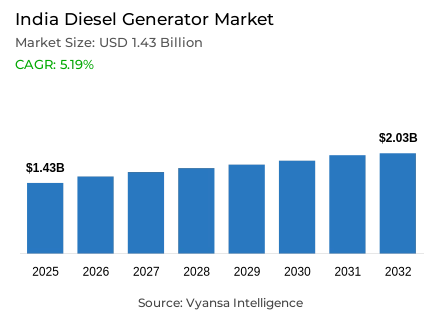
Diesel generator sets are engine-driven power systems that provide standby, prime, continuous, and peak-shaving electricity across commercial, industrial, institutional, and residential applications, ensuring uninterrupted operations during grid outages and power disruptions. The diesel generator market in India is projected to grow at a CAGR of 5.19% during 2026–2032, driven by rising demand for reliable backup power across diverse end-user sectors.
Key Highlights of the India Diesel Generator Market
- The India diesel generator market was valued at USD 1.43 billion in 2025 and is estimated to reach USD 1.50 billion in 2026. Furthermore, the market is projected to attain USD 2.03 billion by 2032, reflecting sustained expansion over the forecast period.
- The market is expected to register a CAGR of 5.19% during the 2026–2032 forecast period.
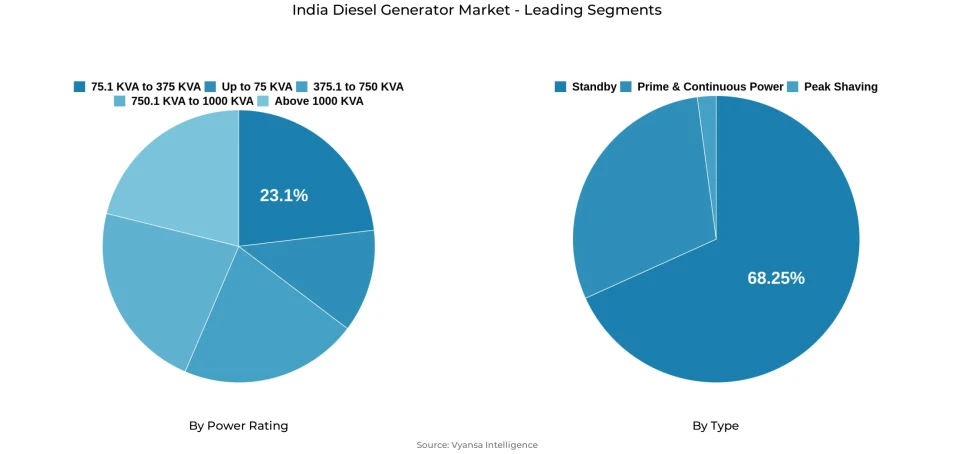
- Based on power rating, the 76 KVA to 375 KVA segment dominated the market, accounting for 23.10% of the total market share in 2026.
- However, the 375.1 KVA to 750 KVA segment is projected to record the fastest growth, expanding at a CAGR of 7.08% during 2026–2032.
- By type, standby diesel generators held the largest market share of 68.25% in 2026.
- Meanwhile, the prime and continuous power segment is anticipated to witness the highest growth, registering a CAGR of 7.56% over the forecast period.
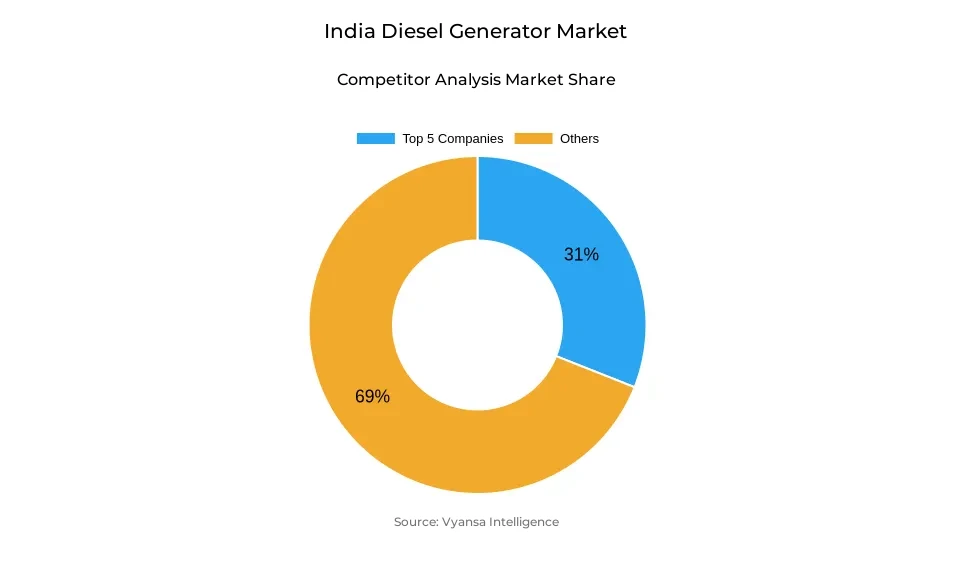
- The top five companies collectively accounted for approximately 55% of the market in 2025, indicating that the industry remains moderately fragmented.
The India diesel generator industry is projected to witness steady growth over the forecast period, supported by increasing electricity consumption and the growing dependence of commercial, industrial, and institutional facilities on uninterrupted power supply. According to the Ministry of Power, India's per capita electricity consumption reached 1,460 kWh in FY2024–25, while the Draft National Electricity Policy 2026 targets 2,000 kWh by 2030 and more than 4,000 kWh by 2047. As electricity demand continues to rise, diesel generators are expected to remain an essential backup power solution across sectors where operational continuity is critical.
The expanding footprint of healthcare, hospitality, organised retail, cold-chain logistics, mining, and educational institutions is expected to broaden the customer base for the India diesel generator market. Under the Pradhan Mantri Ayushman Bharat Health Infrastructure Mission, the Government of India has allocated USD 7,380 million to establish 602 Critical Care Hospital Blocks and 730 Integrated Public Health Laboratories across the country. The increasing development of such infrastructure is expected to generate sustained demand for reliable backup power systems to support critical operations, temperature-controlled storage, and essential medical equipment.
Overall, the outlook for the diesel generator industry in India remains positive, driven by rising electricity consumption, expanding social and industrial infrastructure, and the growing number of facilities where uninterrupted power has become an operational necessity. As investments continue across infrastructure, healthcare, manufacturing, logistics, and digital industries, demand is expected to remain diversified across multiple end-user segments. This evolving demand landscape is anticipated to support stable procurement of diesel generators, technological product upgrades, and long-term market growth throughout the forecast period.
India Diesel Generator Market Drivers
Rapid Infrastructure Development Driving Demand for Reliable Backup Power
Rapid infrastructure and industrial development are major growth drivers for the India diesel generator market, as large-scale construction, manufacturing, logistics, and transportation projects require uninterrupted power during construction and commissioning phases where grid connectivity may be limited. These projects continue to create consistent demand for diesel generators across temporary and standby power applications.
According to the Union Budget 2025–26, the Government of India increased capital expenditure for infrastructure to USD 128,850 million, maintaining one of the world's largest public infrastructure investment programs. In addition, the National Highways Authority of India (NHAI) constructed 6,644 km of national highways during FY2023–24, reflecting sustained infrastructure development across the country.
As infrastructure investments continue through highways, railways, industrial corridors, metro networks, logistics parks, and smart cities, demand for dependable on-site power solutions is expected to remain strong. This is expected to increase the deployment of diesel generators across construction sites, manufacturing facilities, and industrial projects, supporting the long-term growth of the India diesel generator market.
India Diesel Generator Market Restraints
Stringent CPCB IV+ Emission Standards Increasing Compliance Costs
The implementation of CPCB IV+ emission standards has emerged as a major challenge for the India diesel generator industry. The new emission regulations require diesel generator manufacturers to incorporate advanced technologies such as diesel particulate filters (DPF), selective catalytic reduction (SCR), upgraded fuel injection systems, and electronic engine controls. These additional technologies increase manufacturing costs, product certification expenses, and equipment prices, making diesel generators more expensive for commercial and industrial customers.
To reduce emissions from diesel generator sets, the Commission for Air Quality Management (CAQM) and the Ministry of Environment, Forest and Climate Change introduced stricter operational requirements for diesel generators up to 800 kW, including the adoption of dual-fuel systems and retrofit emission control devices in applicable regions. These measures are intended to reduce pollution from DG sets, which have been identified as a significant contributor to urban air pollution.
As manufacturers invest in cleaner engine technologies and emission-control systems to comply with CPCB IV+ regulations, production costs continue to increase. Consequently, higher equipment prices may delay procurement among price-sensitive industries and increase project costs, creating a short-term challenge for the India diesel generator market.
India Diesel Generator Market Recent Trends
Data Centre Operators Shifting Preference Toward High-Capacity Backup Power Systems
A significant trend shaping the India diesel generator market is the shift in purchasing preferences among end users, particularly data centre operators, toward high-capacity diesel generator systems. As cloud computing, artificial intelligence, and digital services expand, data centres are increasingly prioritizing uninterrupted power availability and operational reliability. Unlike conventional commercial users that primarily purchase generators for occasional backup, hyperscale and enterprise data centres are installing multiple high-capacity diesel generators as an integral part of their power infrastructure, driving demand for larger-capacity generator sets.
According to the Ministry of Electronics and Information Technology (MeitY), India's installed data centre capacity increased from approximately 375 MW in 2020 to around 1,500 MW by 2025, reflecting rapid expansion of digital infrastructure across the country. At the same time, the International Energy Agency (IEA) projects global electricity demand from data centres to nearly double to approximately 945 TWh by 2030, supported by increasing AI and cloud computing workloads.
This shift in customer preference is changing the product mix within the India diesel generator market. Demand is increasingly moving from conventional low-capacity diesel generators toward 350 kVA to 1,000+ kVA systems capable of supporting hyperscale data centres. As more data centre projects are announced and constructed, manufacturers are expanding their high-capacity product portfolios, creating sustained demand and higher-value revenue opportunities across the market.
Commercial and Industrial Users Increasingly Adopting Hybrid and Smart Diesel Generator Systems
A key technical trend in the India diesel generator market is the growing preference among commercial and industrial users for hybrid diesel generator systems integrated with battery storage and IoT-based monitoring technologies. End users are increasingly seeking backup power solutions that reduce fuel consumption, improve operational efficiency, enable remote monitoring, and support sustainability goals. As a result, manufacturers are moving beyond conventional diesel generators by integrating battery energy storage systems (BESS), digital controllers, and cloud-based monitoring platforms into their product offerings.
According to the Ministry of Power, the Government of India approved a 30 GWh Battery Energy Storage System (BESS) initiative in 2025 with USD 621 million in Viability Gap Funding (VGF), while the Advanced Chemistry Cell (ACC) Production Linked Incentive (PLI) Scheme supports 50 GWh of domestic battery manufacturing capacity. These initiatives are strengthening India's battery ecosystem and improving the commercial viability of hybrid power solutions.
As battery technologies become more accessible and digital monitoring capabilities continue to improve, commercial and industrial customers are increasingly choosing intelligent hybrid diesel generator systems over conventional standalone generators. This shift is encouraging manufacturers to introduce IoT-enabled, fuel-efficient, and battery-integrated products, driving product innovation, expanding premium product adoption, and creating new long-term growth opportunities for the India diesel generator market.
India Diesel Generator Market Opportunities
Expanding Rural Telecom Infrastructure Creating Long-Term Demand for Prime Power Diesel Generators
The continued expansion of telecom infrastructure across rural and semi-urban India is creating significant growth opportunities for the India diesel generator market. As telecom operators extend mobile connectivity into remote and underserved locations, the need for reliable and continuous power is increasing where electricity supply remains limited or unreliable. Unlike urban telecom sites that primarily require standby backup, rural telecom towers often depend on diesel generators as a primary power source, driving sustained demand for mid-capacity generator sets and long-term maintenance services.
According to the Department of Telecommunications (DoT), India had approximately 8.43 lakh mobile towers supporting 3.144 million Base Transceiver Stations (BTSs) as of 31 October 2025. The department also reported that USD 0.00595 million 5G BTSs had been deployed across the country by 31 December 2025, including installations in USD 0.00129 millionvillages, highlighting the rapid expansion of telecom infrastructure into rural and remote regions.
As telecom coverage continues to expand beyond urban centres, demand for reliable prime power solutions is expected to increase across off-grid and weak-grid locations. This is anticipated to drive the adoption of 75 kVA to 375 kVA diesel generators, while creating long-term opportunities for manufacturers through equipment sales, rural distribution expansion, annual maintenance contracts, and lifecycle service offerings, supporting the sustained growth of the India diesel generator market.
Unlock Market Intelligence
Explore the market potential with our data-driven report
India Diesel Generator Market Segmentation Analysis
By Power Rating
- Upto 75 KVA
- 75.1KVA to 375 KVA
- 375.1 to 750 KVA
- 750.1 KVA to 1000 KVA
- Above 1000 KVA
Mid-Range Ratings Lead, While Higher-Capacity Gensets Accelerate
By power rating, 75.1 KVA to 375 KVA diesel generators lead with 23.10% share in 2026 because they fit medium-load requirements across commercial buildings, clinics, hotels, warehouses, telecom rooms, schools, petrol pumps, and small manufacturing facilities. The segment benefits from balanced load coverage, manageable installation space, lower fuel consumption than larger units, strong dealer availability, and suitability for commercial power backup across mid-load facilities in India’s commercial and industrial clusters supported by organized channels, service networks, and standard specifications nationwide.
The 375.1 KVA to 750 KVA diesel generators segment is expected to grow fastest, recording 7.08% CAGR during 2026-2032. Demand is rising from larger hospitals, warehousing parks, industrial plants, construction sites, and data centers that require higher load blocks and stronger uptime protection. Compared with the leading mid-range band, these high-capacity diesel gensets need stronger engines, advanced emission systems, cooling efficiency, remote monitoring, and better service planning for users across large, uptime-sensitive commercial and industrial assets requiring dependable backup capacity.
By Type
- Stand By
- Prime & Continuous Power
- Peak Shaving
Standby Diesel Generators Dominate, While Prime and Continuous Power Expands
By type, standby diesel generators lead with 68.25% share in 2026 because most buyers deploy diesel gensets as backup power systems, not primary generation assets. Offices, hospitals, residential complexes, retail outlets, telecom rooms, factories, and public buildings use standby power for outage protection, emergency power supply, business continuity, and protection of elevators, pumps, chillers, medical equipment, safety systems, and IT loads during disruptions, maintenance windows, and emergency operating events nationwide reliably.
Prime & Continuous Power is projected to grow fastest, with 7.56% CAGR during 2026-2032, as construction sites, mines, infrastructure projects, logistics parks, remote facilities, and rental providers need longer operating hours. Prime diesel generators and continuous power generators require stronger cooling, fuel systems, duty-cycle durability, and preventive maintenance. This supports demand from temporary power generators, rental diesel gensets, and project-led applications beyond conventional standby use across India’s infrastructure economy and remote-site operating environments today across India’s infrastructure economy nationwide reliably.
Unlock Market Intelligence
Explore the market potential with our data-driven report
Competitive Landscape
The India diesel power generator market is moderately competitive, with the top-five companies accounting for 55% share. Competition is shaped by CPCB IV+ readiness, kVA coverage, fuel efficiency, acoustic performance, dealer reach, installation support, rental suitability, spare-parts availability, and service uptime. Multinational brands remain strong in higher-capacity and mission-critical applications, while Indian manufacturers compete through localized pricing, service access, engines designed for local conditions, and distribution depth across commercial, industrial, institutional, and infrastructure customers.
Key Companies in India Diesel Generator Market
- Ashok Leyland
- Caterpillar Inc.
- Cummins India Ltd.
- VE Commercial Vehicles Ltd.
- Greaves Cotton Limited
- Kirloskar Oil Engines Ltd.
- Kohler Co.
- Mahindra Powerol
- Cooper Corporation Private Limited
- Escorts Limited
India Diesel Generator Market Recent Developments and Updates
- In December 2025, Cummins India showcased its next-generation power portfolio at CII EXCON 2025 and introduced a CPCB IV+ compliant 82.5 kVA genset. The generator is built on the X3.7L engine platform and targets infrastructure, mining, and construction operations requiring reliable backup power. The launch adds a cleaner diesel genset option for Indian site operations.
- In April 2025, Kirloskar Oil Engines launched the Optiprime Dual Core 1000 kVA generator at the Middle East Energy Exhibition. The compact generator is designed for industrial and commercial power applications and combines high performance with environmental sustainability. The launch expands Kirloskar’s high-capacity diesel generator portfolio for commercial and critical power users.
Frequently Asked Questions
Related Report
- Market Segmentation
- Research Scope
- Research Methodology
- Definitions and Assumptions
- Executive Summary
- India Diesel Generator Market Policies, Regulations, and Standards
- India Diesel Generator Market Dynamics
- Growth Factors
- Challenges
- Trends
- Opportunities
- India Diesel Generator Market Statistics, 2022-2032
- Market Size & Growth Outlook
- By Revenues in USD Million
- By Unit Sold (Thousand Units)
- Market Segmentation & Growth Outlook
- By Power Rating
- Up to 75 KVA- Market Insights and Forecast 2022-2032, USD Million
- 75.1 KVA to 375 KVA- Market Insights and Forecast 2022-2032, USD Million
- 375.1 to 750 KVA- Market Insights and Forecast 2022-2032, USD Million
- 750.1 KVA to 1000 KVA- Market Insights and Forecast 2022-2032, USD Million
- Above 1000 KVA- Market Insights and Forecast 2022-2032, USD Million
- By Type
- Standby- Market Insights and Forecast 2022-2032, USD Million
- Prime & Continuous Power- Market Insights and Forecast 2022-2032, USD Million
- Peak Shaving- Market Insights and Forecast 2022-2032, USD Million
- By End User
- Residential- Market Insights and Forecast 2022-2032, USD Million
- Commercial (Hospitality, Retail, Educational Institutions, etc.)- Market Insights and Forecast 2022-2032, USD Million
- Healthcare- Market Insights and Forecast 2022-2032, USD Million
- Government & Transport (Airports, Metro Stations, Government Buildings, Religious Centers, etc.)- Market Insights and Forecast 2022-2032, USD Million
- Equipment Rental Companies- Market Insights and Forecast 2022-2032, USD Million
- Industrial- Market Insights and Forecast 2022-2032, USD Million
- Others- Market Insights and Forecast 2022-2032, USD Million
- By Region
- North- Market Insights and Forecast 2022-2032, USD Million
- East- Market Insights and Forecast 2022-2032, USD Million
- West- Market Insights and Forecast 2022-2032, USD Million
- South- Market Insights and Forecast 2022-2032, USD Million
- By Competitors
- Competition Characteristics
- Market Share & Analysis
- By Power Rating
- Market Size & Growth Outlook
- India Up to 75 KVA Market Statistics, 2022-2032
- Market Size & Growth Outlook
- By Revenues in USD Million
- By Unit Sold (Thousand Units)
- Market Segmentation & Growth Outlook
- By Type- Market Insights and Forecast 2022-2032, USD Million
- By End User- Market Insights and Forecast 2022-2032, USD Million
- By Region- Market Insights and Forecast 2022-2032, USD Million
- Market Size & Growth Outlook
- India 75.1 KVA to 375 KVA Market Statistics, 2022-2032
- Market Size & Growth Outlook
- By Revenues in USD Million
- By Unit Sold (Thousand Units)
- Market Segmentation & Growth Outlook
- By Type- Market Insights and Forecast 2022-2032, USD Million
- By End User- Market Insights and Forecast 2022-2032, USD Million
- By Region- Market Insights and Forecast 2022-2032, USD Million
- Market Size & Growth Outlook
- India 375.1 to 750 KVA Market Statistics, 2022-2032
- Market Size & Growth Outlook
- By Revenues in USD Million
- By Unit Sold (Thousand Units)
- Market Segmentation & Growth Outlook
- By Type- Market Insights and Forecast 2022-2032, USD Million
- By End User- Market Insights and Forecast 2022-2032, USD Million
- By Region- Market Insights and Forecast 2022-2032, USD Million
- Market Size & Growth Outlook
- India 750.1 KVA to 1000 KVA Market Statistics, 2022-2032
- Market Size & Growth Outlook
- By Revenues in USD Million
- By Unit Sold (Thousand Units)
- Market Segmentation & Growth Outlook
- By Type- Market Insights and Forecast 2022-2032, USD Million
- By End User- Market Insights and Forecast 2022-2032, USD Million
- By Region- Market Insights and Forecast 2022-2032, USD Million
- Market Size & Growth Outlook
- India Above 1000 KVA Market Statistics, 2022-2032
- Market Size & Growth Outlook
- By Revenues in USD Million
- By Unit Sold (Thousand Units)
- Market Segmentation & Growth Outlook
- By Type- Market Insights and Forecast 2022-2032, USD Million
- By End User- Market Insights and Forecast 2022-2032, USD Million
- By Region- Market Insights and Forecast 2022-2032, USD Million
- Market Size & Growth Outlook
- Competitive Outlook
- Company Profiles
- Ashok Leyland
- Business Description
- Product Portfolio
- Collaborations & Alliances
- Recent Developments
- Financial Details
- Others
- Caterpillar Inc.
- Business Description
- Product Portfolio
- Collaborations & Alliances
- Recent Developments
- Financial Details
- Others
- Cummins India Ltd.
- Business Description
- Product Portfolio
- Collaborations & Alliances
- Recent Developments
- Financial Details
- Others
- VE Commercial Vehicles Ltd.
- Business Description
- Product Portfolio
- Collaborations & Alliances
- Recent Developments
- Financial Details
- Others
- Greaves Cotton Limited
- Business Description
- Product Portfolio
- Collaborations & Alliances
- Recent Developments
- Financial Details
- Others
- Kirloskar Oil Engines Ltd.
- Business Description
- Product Portfolio
- Collaborations & Alliances
- Recent Developments
- Financial Details
- Others
- Kohler Co.
- Business Description
- Product Portfolio
- Collaborations & Alliances
- Recent Developments
- Financial Details
- Others
- Mahindra Powerol
- Business Description
- Product Portfolio
- Collaborations & Alliances
- Recent Developments
- Financial Details
- Others
- Cooper Corporation Private Limited
- Business Description
- Product Portfolio
- Collaborations & Alliances
- Recent Developments
- Financial Details
- Others
- Escorts Limited
- Business Description
- Product Portfolio
- Collaborations & Alliances
- Recent Developments
- Financial Details
- Others
- Ashok Leyland
- Company Profiles
- Disclaimer
| Segment | Sub-Segment |
|---|---|
| By Power Rating |
|
| By Type |
|
| By End User |
|
| By Region |
|
Research Methodology
This study followed a structured approach comprising four key phases to assess the size and scope of the electro-oxidation market. The process began with thorough secondary research to collect data on the target market, related markets, and broader industry context. These findings, along with preliminary assumptions and estimates, were then validated through extensive primary research involving industry experts from across the value chain. To calculate the overall market size, both top-down and bottom-up methodologies were employed. Finally, market segmentation and data triangulation techniques were applied to refine and validate segment-level estimations.
Secondary Research
The secondary research phase involved gathering data from a wide range of credible and published sources. This step helped in identifying industry trends, defining market segmentation, and understanding the market landscape and value chain.
Sources consulted during this phase included:
- Company annual reports, investor presentations, and press releases
- Industry white papers and certified publications
- Trade directories and market-recognized databases
- Articles from authoritative authors and reputable journals
- Gold and silver standard websites
Secondary research was critical in mapping out the industry's value chain and monetary flow, identifying key market segments, understanding regional variations, and tracking significant industry developments.
Other key sources:
- Financial disclosures
- Industry associations and trade bodies
- News outlets and business magazines
- Academic journals and research studies
- Paid industry databases
Primary Research
To validate secondary data and gain deeper market insights, primary research was conducted with key stakeholders across both the supply and demand sides of the market.
On the demand side, participants included decision-makers and influencers from end-user industries—such as CIOs, CTOs, and CSOs—who provided first-hand perspectives on market needs, product usage, and future expectations.
On the supply side, interviews were conducted with manufacturers, industry associations, and institutional participants to gather insights into current offerings, product pipelines, and market challenges.
Primary interviews provided critical inputs such as:
- Market size and revenue data
- Product and service breakdowns
- Market forecasts
- Regional and application-specific trends
Stakeholders consulted included:
- Leading OEM and solution providers
- Channel and distribution partners
- End users across various applications
- Independent consultants and industry specialists
Market Size Estimation and Data Triangulation
- Identifying Key Market Participants (Secondary Research)
- Goal: To identify the major players or companies in the target market. This typically involves using publicly available data sources such as industry reports, market research publications, and financial statements of companies.
- Tools: Reports from firms like Gartner, Forrester, Euromonitor, Statista, IBISWorld, and others. Public financial statements, news articles, and press releases from top market players.
- Extracting Earnings of Key Market Participants
- Goal: To estimate the earnings generated from the product or service being analyzed. This step helps in understanding the revenue potential of each market player in a specific geography.
- Methods: Earnings data can be gathered from:
- Publicly available financial reports (for listed companies).
- Interviews and primary data sources from professionals, such as Directors, VPs, SVPs, etc. This is especially useful for understanding more nuanced, internal data that isn't publicly disclosed.
- Annual reports and investor presentations of key players.
- Data Collation and Development of a Relevant Data Model
- Goal: To collate inputs from both primary and secondary sources into a structured, data-driven model for market estimation. This model will incorporate key market KPIs and any independent variables relevant to the market.
- Key KPIs: These could include:
- Market size, growth rate, and demand drivers.
- Industry-specific metrics like market share, average revenue per customer (ARPC), or average deal size.
- External variables, such as economic growth rates, inflation rates, or commodity prices, that could affect the market.
- Data Modeling: Based on this data, the market forecasts are developed for the next 5 years. A combination of trend analysis, scenario modeling, and statistical regression might be used to generate projections.
- Scenario Analysis
- Goal: To test different assumptions and validate how sensitive the market is to changes in key variables (e.g., market demand, regulatory changes, technological disruptions).
- Types of Scenarios:
- Base Case: Based on current assumptions and historical data.
- Best-Case Scenario: Assuming favorable market conditions, regulatory environments, and technological advancements.
- Worst-Case Scenario: Accounting for adverse factors, such as economic downturns, stricter regulations, or unexpected disruptions.












