China Almond Milk Market Report: Trends, Growth and Forecast (2026-2032)
By Product (Sweetened, Unsweetened), By Flavour (Flavoured, Unflavoured), By Nature (Conventional, Organic), By Storage Format (Refrigerated Almond Milk, Shelf-Stable Almond Milk), By Packaging Type (Cartons, Bottles, Flexible Packaging, Others), By End Use (Household, Foodservice, Food & Beverage Manufacturing), By Distribution Channel (Supermarkets & Grocery Stores, Mass Merchandisers & Warehouse Clubs, Specialty Stores, Convenience Stores, Online Retail, Direct/B2B), By Region (North China, Central China, South China, East China, Northeast China, Southwest China, Northwest China) ... Read more
|
Major Players
|
China Almond Milk Market Overview
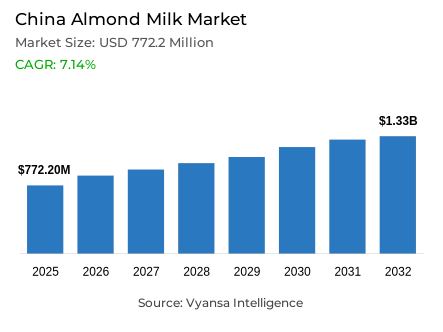
The almond milk market covers ready-to-drink and packaged almond-based milk sold for household, foodservice, and broader consumer use, including products positioned around plant protein, dairy substitution, wellness, and everyday refreshment. Demand is being shaped by nutrition awareness, lower-sugar preferences, wider consumption occasions, and expanding retail access. The China almond milk industry is forecast to grow at a CAGR of 7.14% during 2026–2032, while formulation, labelling, production efficiency, and geographic distribution increasingly determine product acceptance and repeat purchase.
Key Highlights of the China Almond Milk Market
- The China almond milk market stood at USD 772.2 million in 2025 and is at USD 878.0 million in 2026.
- The market is forecast to reach USD 1.33 billion by 2032, representing steady value expansion at a 7.14% CAGR during 2026–2032.
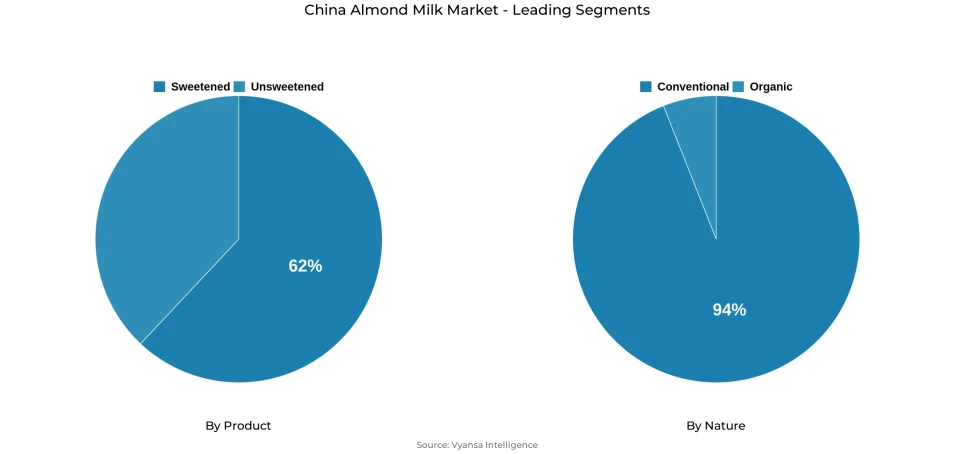
- Sweetened almond milk led the formulation segment with a 62% market share in 2026.
- Additionally, unsweetened almond milk is the fastest-growing formulation, projected to expand at a 9.2% CAGR during 2026–2032.
- Conventional dominated the nature segment with a 94% market share in 2026.
- Furthermore, organic is projected to be the fastest-growing nature segment, expanding at a 16.66% CAGR during 2026–2032.
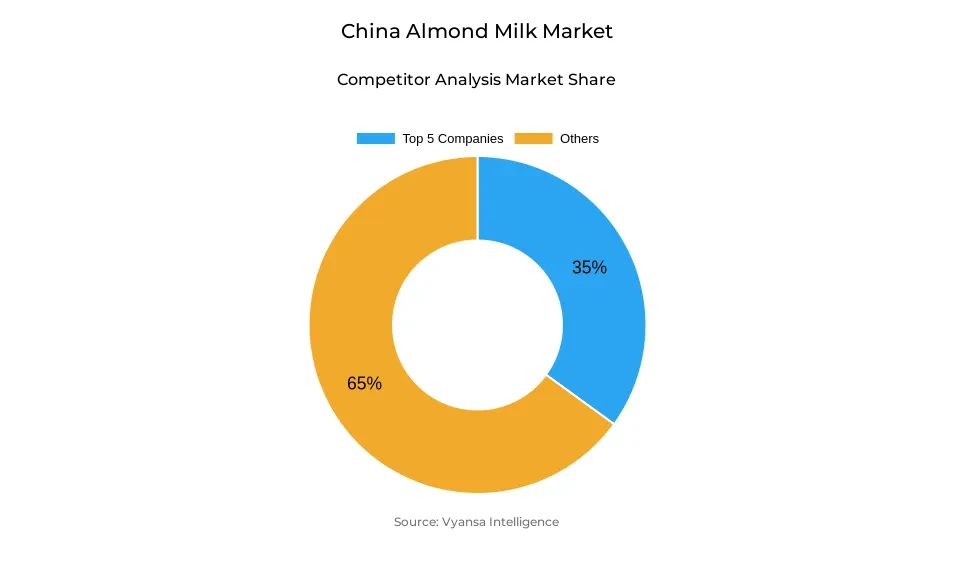
- The top five companies collectively held a 35% market share in 2026, indicating a moderately fragmented competitive landscape.
The China almond milk market is benefiting from a large, increasingly urbanized consumer base, growing health awareness, and rising acceptance of plant-based diets. China had 1.405 billion people in 2025, with 953.8 million urban residents, equivalent to a 67.9% urbanization rate, creating a substantial addressable population concentrated in cities where premium and functional beverages are more readily available. Per-capita disposable income also reached USD 6,455 in 2025, rising 5.0% year-on-year, supporting consumers’ willingness to explore higher-value dairy alternatives.
Importantly, plant-based milk has moved beyond a niche vegan product. Worldpanel data indicates that plant-based milk penetration in China reached approximately 74% in 2025, demonstrating broad consumer exposure and acceptance. Supporting this, demand for plant-based dairy in China is projected to grow from USD 5.16 billion to USD 5.44 billion in 2032, at a CAGR of 0.76%. Although strict veganism remains a relatively small consumer segment, a Chinese consumer study found 7% of respondents followed a vegan or vegetarian diet, indicating a meaningful lifestyle-driven demand base for dairy-free beverages.
Lactose malabsorption further strengthens the opportunity for almond milk as a naturally dairy-free alternative. Estimates indicate that 85–90% of Chinese adults exhibit some degree of lactose malabsorption, expanding the potential consumer pool beyond vegans to individuals seeking easier-to-digest beverages. Meanwhile, consumer awareness is becoming more nutrition-oriented: 63.6% of surveyed Chinese consumers identified nutritional value as an important plant-milk purchase factor, followed by taste at 56.3% and calorie content at 42.8%. Consequently, almond milk is increasingly positioned around lactose-free nutrition, lower-calorie consumption, wellness, and plant-based lifestyles, supporting continued market penetration.
Government Regulations Shaping the China Almond Milk Market
China’s evolving food-labelling and import-trade regulations are becoming increasingly relevant to almond milk manufacturers and importers. In 2025, China issued GB 28050-2025, the revised national standard for nutrition labelling of prepackaged foods, which will take effect on March 16, 2027. The standard requires nutrition panels to disclose energy, protein, fat, saturated fat, carbohydrates, sugars, and sodium, while also tightening requirements governing nutrition claims and their presentation. This will increase the need for accurate nutritional testing, label verification, packaging updates, and compliance management among almond milk brands.
China’s import policies also influence the cost and competitiveness of almond-based beverages by affecting the economics of imported raw almonds. Consequently, changes in tariffs and preferential treatment across supplying countries can encourage manufacturers to diversify sourcing, strengthen supplier traceability, and optimize procurement strategies. For the China almond milk industry, regulatory compliance is therefore increasingly linked with transparent ingredient disclosure, substantiated nutrition claims, accurate Chinese-language labelling, and adaptable packaging systems. The upcoming implementation of GB 28050-2025 also gives established manufacturers an advantage where they already have standardized quality-control, nutrition-testing, and packaging-compliance processes.
The regulatory theme is valid, but I would definitely re-check the 45%/25%/zero-tariff figures before publication. Those are the most vulnerable statements in the current version.
China Almond Milk Market Drivers
Rising Nutrition Awareness Is Expanding the Role of Plant-Based Beverages
Rising attention to adequate protein intake is strengthening the relevance of almond-based beverages within everyday nutrition choices. Consumers seeking convenient plant-derived options can use almond milk at breakfast, between meals, or as a dairy alternative without changing established beverage routines. This creates repeat-purchase potential rather than one-off trial demand. For the China Almond Milk Market, the driver is strongest where brands connect recognizable almond positioning with accessible taste, credible nutrition communication, and formats suited to regular household daily consumption patterns.
Evidence of a protein-intake gap provides a foundation for this demand mechanism. The China Nutrition Society’s 2025 national protein intake survey reported that 45% of Chinese adults were at risk of insufficient protein intake, while national nutrition messaging emphasized informed protein choices. This does not make almond milk a complete protein solution, but it increases consumer attention to plant-protein beverages. The China almond milk industry can convert that awareness through clearer positioning, routine-use formats, balanced nutrition claims, and wider retail access.
China Almond Milk Market Challenges
Slower Sell-Through Raises Inventory and Product-Relevance Pressure
The main challenge is sustaining sell-through as the traditional almond-drink proposition becomes less distinctive against expanding plant-based beverage choices. Established canned formats and familiar sweet profiles still support legacy demand, but they can struggle to recruit consumers seeking lower sugar, new flavours, portable packaging, or fresher wellness positioning. For the China almond milk industry, this creates a commercialization problem: manufacturers must refresh products without alienating core buyers, while distributors face risk when inventory moves slower than expected through retail channels.
The category therefore faces margin, promotional, and inventory-management pressure when supply growth runs ahead of consumer offtake in mature regional markets and domestic channels across established retail networks.
China Almond Milk Market Opportunities
Low-Sugar and Wellness-Oriented Almond Milk Formulations
The growing emphasis on low-sugar, lighter, and wellness-oriented beverages presents a near-term opportunity for almond milk brands in China to expand beyond traditional consumption occasions. Younger and health-conscious consumers are increasingly seeking beverages that combine familiar nut flavors with lower sweetness, convenient formats, and contemporary nutritional positioning. This creates scope for manufacturers to introduce low-sugar, no-added-sugar, low-calorie, and nutritionally fortified almond milk variants, thereby strengthening their appeal as everyday beverages rather than occasional or traditional products.
The opportunity is reinforced by Chengde Lulu’s April 2026 launch of its Lulu plant-based sub-line, which emphasizes low sugar, light wellness, and redesigned packaging. The move demonstrates how established almond-beverage producers can modernize the category through formulation and lifestyle repositioning while retaining their existing plant-protein identity. For the China almond milk market, similar product innovation could help brands capture consumers who are actively moderating sugar intake while seeking convenient plant-based beverages. Manufacturers can further differentiate through multiple sweetness levels, clean-label positioning, modern packaging, smaller on-the-go formats, and functional additions such as calcium, vitamins, protein, or dietary fiber. Consequently, low-sugar wellness positioning offers brands an opportunity to increase consumption frequency, attract younger consumers, and broaden almond milk’s role within China’s rapidly evolving better-for-you beverage landscape.
Unlock Market Intelligence
Explore the market potential with our data-driven report
China Almond Milk Market Segmentation Analysis
By Product
- Sweetened
- Unsweetened
Sweetened Holds Approximately 62% of Product Demand while Unsweetened is the Fastest Growing
Sweetened almond milk leads the China product segment because sweetness remains important for improving palatability and reducing the natural bitterness associated with almond-based beverages. The format also aligns with established Chinese preferences for mildly sweet nut and grain beverages, supporting consumption across households and convenient packaged drink occasions. Its established taste profile, broad consumer familiarity, and strong compatibility with shelf-stable formats give sweetened products a wider mainstream base than newer unsweetened alternatives.
Unsweetened almond milk is gaining momentum as Chinese consumers increasingly pay attention to sugar intake, nutritional composition, and healthier everyday beverage choices. The segment also benefits from growing demand among younger urban consumers who are more receptive to plant-based beverages and premium functional products. Its compatibility with coffee, breakfast applications, and direct consumption further expands usage occasions. This combination is expected to support Unsweetened almond milk at approximately a 9.2% CAGR during 2026 to 2032, making it the fastest-growing product segment.
By Nature
- Conventional
- Organic
Conventional Products Dominate Scale, While Organic Builds Premium Demand
Conventional products lead by nature, holding a 94% share in 2026. Their dominance reflects established ingredient sourcing, mature production processes, broad retail availability, and price points suited to mass consumption. Large beverage manufacturers can procure conventional inputs at scale and maintain consistent taste across high-volume batches, supporting national distribution and repeat household purchase. Organic alternatives remain less widely available and typically require more controlled sourcing, so conventional almond milk retains advantages in affordability, supply continuity, positioning, and mainstream channel penetration.
Organic almond milk is forecast to expand fastest at a 16.66% CAGR during 2026–2032. Growth is driven by a smaller but relevant consumer group seeking verified sourcing, cleaner ingredient narratives, and premium wellness positioning. Organic products can differentiate beyond flavor by emphasizing agricultural practices and ingredient provenance, supporting higher-value placement in specialty retail and e-commerce. Although conventional products will remain structurally larger, organic offerings can grow more rapidly as premium shoppers accept higher prices for stronger sourcing and quality cues.
Unlock Market Intelligence
Explore the market potential with our data-driven report
China Almond Milk Market Competitive Landscape
Competition is moderately fragmented, combining an established national almond-beverage franchise with smaller regional specialists and broader plant-protein beverage companies competing for similar shelf space. The top five companies such as Chengde Lulu Co., Ltd., Inner Mongolia Desert Flower Ecological Industry Technology Co., Ltd., Inner Mongolia Gaoyuan Almond Dew Co., Ltd., Chengde Leye Food Co., Ltd., and Hemo Fang Beverage Technology Co., Ltd, holds the share of 35% in 2026.
Prominent Companies in the China Almond Milk Market
- Chengde Lulu Co., Ltd.
- Inner Mongolia Desert Flower Ecological Industry Technology Co., Ltd.
- Inner Mongolia Gaoyuan Almond Dew Co., Ltd.
- Chengde Leye Food Co., Ltd.
- Hemo Fang Beverage Technology Co., Ltd.
- Chengde Shuntian Food Co., Ltd.
- Chengde Rehelu Beverage Co., Ltd.
- Chengde Senyuan Green Food Co., Ltd.
- Chengde Lumeida Beverage Co., Ltd.
- Chengde Xingzhiyuan Beverage Co., Ltd.
- Others
Recent Developments in the China Almond Milk Market
- 2026: Inner Mongolia Desert Flower advanced commissioning of its new intelligent beverage production and warehousing project. Government sources describe three planned production lines and eventual annual capacity of 100,000 tonnes, expanding the company’s ability to process regional plant resources and scale almond and sea-buckthorn beverages beyond its existing manufacturing base.
- 2026: Chengde Lulu disclosed that 70,000 tonnes of plant-beverage capacity was under construction at its Chunan project within a larger planned facility. The expansion is intended to strengthen production closer to eastern Chinese consumption markets, improving supply flexibility as the company develops demand beyond its traditional northern base.
Frequently Asked Questions
Related Report
- Market Segmentation
- Research Scope
- Research Methodology
- Definitions and Assumptions
- Executive Summary
- China Almond Milk Market Policies, Regulations, and Standards
- China Almond Milk Market Dynamics
- Growth Factors
- Challenges
- Trends
- Opportunities
- China Almond Milk Market Statistics, 2022-2032F
- Market Size & Growth Outlook
- By Revenues in USD Million
- Market Segmentation & Growth Outlook
- By Product
- Sweetened- Market Insights and Forecast 2022-2032, USD Million
- Unsweetened- Market Insights and Forecast 2022-2032, USD Million
- By Flavour
- Flavoured- Market Insights and Forecast 2022-2032, USD Million
- Unflavoured- Market Insights and Forecast 2022-2032, USD Million
- By Nature
- Conventional- Market Insights and Forecast 2022-2032, USD Million
- Organic- Market Insights and Forecast 2022-2032, USD Million
- By Storage Format
- Refrigerated Almond Milk- Market Insights and Forecast 2022-2032, USD Million
- Shelf-Stable Almond Milk- Market Insights and Forecast 2022-2032, USD Million
- By Packaging Type
- Cartons- Market Insights and Forecast 2022-2032, USD Million
- Bottles- Market Insights and Forecast 2022-2032, USD Million
- Flexible Packaging- Market Insights and Forecast 2022-2032, USD Million
- Others- Market Insights and Forecast 2022-2032, USD Million
- By End Use
- Household- Market Insights and Forecast 2022-2032, USD Million
- Foodservice- Market Insights and Forecast 2022-2032, USD Million
- Food & Beverage Manufacturing- Market Insights and Forecast 2022-2032, USD Million
- By Distribution Channel
- Supermarkets & Grocery Stores- Market Insights and Forecast 2022-2032, USD Million
- Mass Merchandisers & Warehouse Clubs- Market Insights and Forecast 2022-2032, USD Million
- Specialty Stores- Market Insights and Forecast 2022-2032, USD Million
- Convenience Stores- Market Insights and Forecast 2022-2032, USD Million
- Online Retail- Market Insights and Forecast 2022-2032, USD Million
- Direct/B2B- Market Insights and Forecast 2022-2032, USD Million
- By Region
- North China- Market Insights and Forecast 2022-2032, USD Million
- Central China- Market Insights and Forecast 2022-2032, USD Million
- South China- Market Insights and Forecast 2022-2032, USD Million
- East China- Market Insights and Forecast 2022-2032, USD Million
- Northeast China- Market Insights and Forecast 2022-2032, USD Million
- Southwest China- Market Insights and Forecast 2022-2032, USD Million
- Northwest China- Market Insights and Forecast 2022-2032, USD Million
- By Competitors
- Competition Characteristics
- Market Share & Analysis
- By Product
- Market Size & Growth Outlook
- China Sweetened Almond Milk Market Statistics, 2022-2032
- Market Size & Growth Outlook
- By Revenues in USD Million
- Market Segmentation & Growth Outlook
- By Nature- Market Insights and Forecast 2022-2032, USD Million
- By Storage Format- Market Insights and Forecast 2022-2032, USD Million
- By Packaging Type- Market Insights and Forecast 2022-2032, USD Million
- By End Use- Market Insights and Forecast 2022-2032, USD Million
- By Distribution Channel- Market Insights and Forecast 2022-2032, USD Million
- By Region- Market Insights and Forecast 2022-2032, USD Million
- Market Size & Growth Outlook
- China Unsweetened Almond Milk Market Statistics, 2022-2032
- Market Size & Growth Outlook
- By Revenues in USD Million
- Market Segmentation & Growth Outlook
- By Nature- Market Insights and Forecast 2022-2032, USD Million
- By Storage Format- Market Insights and Forecast 2022-2032, USD Million
- By Packaging Type- Market Insights and Forecast 2022-2032, USD Million
- By End Use- Market Insights and Forecast 2022-2032, USD Million
- By Distribution Channel- Market Insights and Forecast 2022-2032, USD Million
- By Region- Market Insights and Forecast 2022-2032, USD Million
- Market Size & Growth Outlook
- Competitive Outlook
- Company Profiles
- Chengde Lulu Co., Ltd.
- Business Description
- Product Portfolio
- Collaborations & Alliances
- Recent Developments
- Financial Details
- Others
- Inner Mongolia Desert Flower Ecological Industry Technology Co., Ltd.
- Business Description
- Product Portfolio
- Collaborations & Alliances
- Recent Developments
- Financial Details
- Others
- Inner Mongolia Gaoyuan Almond Dew Co., Ltd.
- Business Description
- Product Portfolio
- Collaborations & Alliances
- Recent Developments
- Financial Details
- Others
- Chengde Leye Food Co., Ltd.
- Business Description
- Product Portfolio
- Collaborations & Alliances
- Recent Developments
- Financial Details
- Others
- Hemo Fang Beverage Technology Co., Ltd.
- Business Description
- Product Portfolio
- Collaborations & Alliances
- Recent Developments
- Financial Details
- Others
- Chengde Shuntian Food Co., Ltd.
- Business Description
- Product Portfolio
- Collaborations & Alliances
- Recent Developments
- Financial Details
- Others
- Chengde Rehelu Beverage Co., Ltd.
- Business Description
- Product Portfolio
- Collaborations & Alliances
- Recent Developments
- Financial Details
- Others
- Chengde Senyuan Green Food Co., Ltd.
- Business Description
- Product Portfolio
- Collaborations & Alliances
- Recent Developments
- Financial Details
- Others
- Chengde Lumeida Beverage Co., Ltd.
- Business Description
- Product Portfolio
- Collaborations & Alliances
- Recent Developments
- Financial Details
- Others
- Chengde Xingzhiyuan Beverage Co., Ltd.
- Business Description
- Product Portfolio
- Collaborations & Alliances
- Recent Developments
- Financial Details
- Others
- Chengde Lulu Co., Ltd.
- Company Profiles
- Disclaimer
| Segment | Sub-Segment |
|---|---|
| By Product |
|
| By Flavour |
|
| By Nature |
|
| By Storage Format |
|
| By Packaging Type |
|
| By End Use |
|
| By Distribution Channel |
|
| By Region |
|
Research Methodology
This study followed a structured approach comprising four key phases to assess the size and scope of the electro-oxidation market. The process began with thorough secondary research to collect data on the target market, related markets, and broader industry context. These findings, along with preliminary assumptions and estimates, were then validated through extensive primary research involving industry experts from across the value chain. To calculate the overall market size, both top-down and bottom-up methodologies were employed. Finally, market segmentation and data triangulation techniques were applied to refine and validate segment-level estimations.
Secondary Research
The secondary research phase involved gathering data from a wide range of credible and published sources. This step helped in identifying industry trends, defining market segmentation, and understanding the market landscape and value chain.
Sources consulted during this phase included:
- Company annual reports, investor presentations, and press releases
- Industry white papers and certified publications
- Trade directories and market-recognized databases
- Articles from authoritative authors and reputable journals
- Gold and silver standard websites
Secondary research was critical in mapping out the industry's value chain and monetary flow, identifying key market segments, understanding regional variations, and tracking significant industry developments.
Other key sources:
- Financial disclosures
- Industry associations and trade bodies
- News outlets and business magazines
- Academic journals and research studies
- Paid industry databases
Primary Research
To validate secondary data and gain deeper market insights, primary research was conducted with key stakeholders across both the supply and demand sides of the market.
On the demand side, participants included decision-makers and influencers from end-user industries—such as CIOs, CTOs, and CSOs—who provided first-hand perspectives on market needs, product usage, and future expectations.
On the supply side, interviews were conducted with manufacturers, industry associations, and institutional participants to gather insights into current offerings, product pipelines, and market challenges.
Primary interviews provided critical inputs such as:
- Market size and revenue data
- Product and service breakdowns
- Market forecasts
- Regional and application-specific trends
Stakeholders consulted included:
- Leading OEM and solution providers
- Channel and distribution partners
- End users across various applications
- Independent consultants and industry specialists
Market Size Estimation and Data Triangulation
- Identifying Key Market Participants (Secondary Research)
- Goal: To identify the major players or companies in the target market. This typically involves using publicly available data sources such as industry reports, market research publications, and financial statements of companies.
- Tools: Reports from firms like Gartner, Forrester, Euromonitor, Statista, IBISWorld, and others. Public financial statements, news articles, and press releases from top market players.
- Extracting Earnings of Key Market Participants
- Goal: To estimate the earnings generated from the product or service being analyzed. This step helps in understanding the revenue potential of each market player in a specific geography.
- Methods: Earnings data can be gathered from:
- Publicly available financial reports (for listed companies).
- Interviews and primary data sources from professionals, such as Directors, VPs, SVPs, etc. This is especially useful for understanding more nuanced, internal data that isn't publicly disclosed.
- Annual reports and investor presentations of key players.
- Data Collation and Development of a Relevant Data Model
- Goal: To collate inputs from both primary and secondary sources into a structured, data-driven model for market estimation. This model will incorporate key market KPIs and any independent variables relevant to the market.
- Key KPIs: These could include:
- Market size, growth rate, and demand drivers.
- Industry-specific metrics like market share, average revenue per customer (ARPC), or average deal size.
- External variables, such as economic growth rates, inflation rates, or commodity prices, that could affect the market.
- Data Modeling: Based on this data, the market forecasts are developed for the next 5 years. A combination of trend analysis, scenario modeling, and statistical regression might be used to generate projections.
- Scenario Analysis
- Goal: To test different assumptions and validate how sensitive the market is to changes in key variables (e.g., market demand, regulatory changes, technological disruptions).
- Types of Scenarios:
- Base Case: Based on current assumptions and historical data.
- Best-Case Scenario: Assuming favorable market conditions, regulatory environments, and technological advancements.
- Worst-Case Scenario: Accounting for adverse factors, such as economic downturns, stricter regulations, or unexpected disruptions.












