Vietnam Skin Care Market Report: Trends, Growth and Forecast (2026-2032)
By Product Type (Facial Care (Facial Cleansers and Makeup Removers, Toners and Facial Mists, Moisturizers and Creams, Serums and Essences, Face Masks, Eye Care, Facial Exfoliators, Cosmetic Acne and Spot Care, Other Facial Care), Body Care (Body Lotions and Creams, Hand Care, Foot Care, Body Oils, Body Exfoliators, Other Body Care), Sun Care, Others), By Category (Mass, Premium), By Ingredient Type (Natural, Synthetic), By Target Gender (Women, Men, Unisex), By Age Group (Baby Care, Adult Care, Mature Skin/Anti-Ageing), By Packaging (Tubes, Bottles, Jars, Others), By Sales Channel (Supermarkets and Hypermarkets, Convenience Stores, Pharmacies and Drug Stores, Exclusive/Multi-Brand Stores, Online Stores, Others) ... Read more
|
Major Players
|
Vietnam Skin Care Market Size, Share & Forecast (2026-2032)
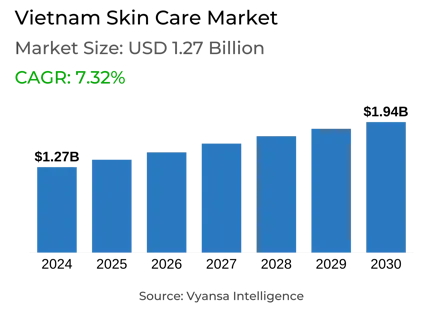
The skin care market covers facial, body, sun, lip, and baby skin care products used for cleansing, hydration, protection, treatment support, and routine appearance management. The skin care industry in Vietnam is supported nationally by broad retail availability, frequent product replenishment, stronger ingredient awareness, and a competitive mix of mass, premium, multinational, Korean, Japanese, and specialist brands. As a result, the demand for skin care in Vietnam is projected to grow at a CAGR of 5.92% during 2026-2032.
Key Highlights of the Vietnam Skin Care Market
- The Vietnam skin care market reached USD 1.88 billion in 2025, establishing the historical base for the report’s 2026-2032 growth assessment.
- The market is valued at USD 1.99 billion in 2026, the opening year of the stated forecast period.
- The market is projected to reach USD 2.81 billion by 2032.
- The market is expected to expand at a CAGR of 5.92% during 2026-2032.
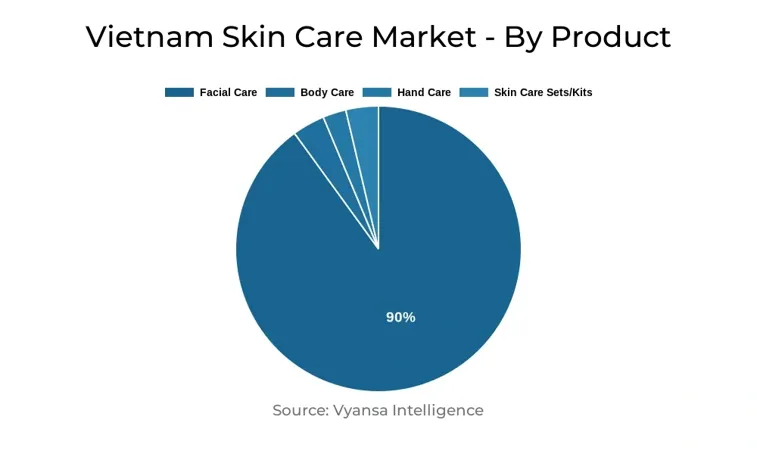
- Facial care is the leading product type with 90% market share in 2026.
- Sun care is the fastest-growing product type with a CAGR of 14.55% in the projected years.
- Mass is the leading market-positioning segment, having a 64% market share in 2026.
- Premium is the fastest-growing positioning segment with a CAGR of 7.34% during the forecasted period.
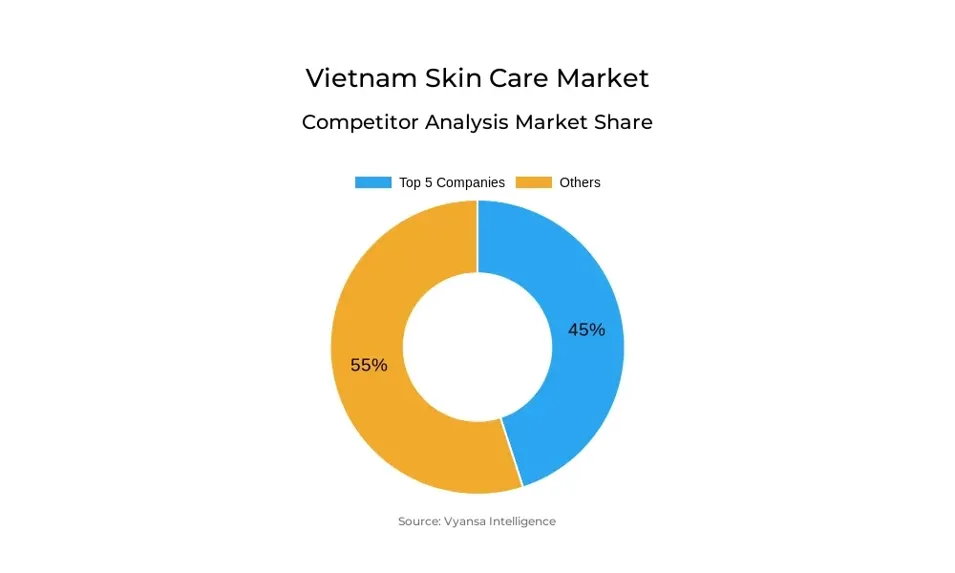
- The market is moderately consolidated, with the top five companies accounting for 51% of shares.
Vietnam’s skincare demand is being strengthened by high-frequency usage, expanding digital reach, international-brand penetration, and changing consumer preferences. More than 60% of Vietnamese consumers reportedly use skincare products daily, while a Q&Me study found that 95% of Vietnamese women aged 25–45 use skincare products regularly, spending an average of VND 740,000 (around USD 30) per month. This indicates that skincare is increasingly a recurring-consumption category rather than an occasional purchase.
Digitalization is further widening product access and accelerating discovery. Vietnam had approximately 80 million internet users at the beginning of 2025, equivalent to 75% internet penetration, with beauty products among the most popular online-purchased categories. In 2025, online beauty and personal-care sales reached approximately VND 74.4 trillion (USD 2.83 billion), registering nearly 30% year-on-year growth, demonstrating the increasing importance of e-commerce and social-commerce channels.
Ingredient-led and efficacy-focused consumption is becoming a deeper structural shift in Vietnam’s skincare market, moving consumers away from purely brand-led purchasing toward problem-solution products backed by recognizable actives and dermatological credibility. Euromonitor identifies ingredient-led skincare as the category capturing the highest share of wallet, while brands are increasingly using science-backed claims and transparent formulations to build trust. This is particularly evident in sun care: Vietnam’s online sunscreen category generated USD 74 million in H1 2025, up 16% year-on-year, while tone-up sunscreen sales on TikTok Shop surged 190%, demonstrating how functional benefits are being combined with cosmetic effects.
At the same time, regulatory scrutiny is becoming more important for market access, with Vietnam’s Drug Administration updating ASEAN cosmetic requirements in 2025–26, including rules covering product classification, ingredients and product notification. Therefore, competitive advantage is increasingly shifting toward brands that can combine clinical efficacy, transparent ingredients, climate-specific functionality, digital education and regulatory compliance, rather than relying solely on brand recognition or price.
Government Regulations Shaping the Vietnam Skin Care Market
Vietnam is strengthening regulatory oversight of cosmetics while simultaneously increasing accountability across digital sales channels. A major development is the Law on E-commerce No. 122/2025/QH15 and Decree No. 248/2026/ND-CP, which took effect on July 1, 2026. The framework requires e-commerce platforms to verify seller identities and strengthens obligations related to seller information, product information, livestream selling, affiliate marketing, complaints, and traceability. For skin care brands, this increases the importance of authentic seller identification and accurate product claims across online channels.
At the cosmetics-product level, Vietnam is also moving toward a more updated regulatory framework. On May 29, 2026, Vietnam notified the WTO of G/TBT/N/VNM/407, Draft Decree on the Management of Cosmetics, indicating continued revision of the country's cosmetics-management system. Meanwhile, the Drug Administration continued active enforcement in 2026, including the withdrawal of cosmetic product notification numbers for multiple companies in February, demonstrating that compliance remains an active market-access consideration. Together, these developments are pushing skin care companies toward stronger product documentation, seller traceability, claim substantiation, notification compliance, and digital-channel governance.
Vietnam Skin Care Market Drivers
Expansion of E-commerce and Social Commerce
E-commerce and social commerce are becoming central to skin care discovery because shoppers can compare ingredients, routines, prices, reviews, demonstrations, and promotions without visiting several stores. Livestreams also let brands explain application methods and answer questions in real time. For the skin care industry in Vietnam, this shortens the path from awareness to purchase and gives both established and smaller brands access to consumers beyond major urban retail locations.
Rohto-Mentholatum (Vietnam) Co., Ltd.’s official Lazada storefront, covering Hada Labo, Acnes, Sunplay, and LipIce, recorded 2.5-times year-on-year revenue growth in the first quarter of 2026. Company-attributed Metric.vn data also placed cosmetics and beauty e-commerce gross merchandise value above USD 3.3 billion between May 2025 and April 2026, up 27% year-on-year. These results show that verified brand stores can convert online attention into measurable sales.
During 2026-2032, brands are likely to increase spending on marketplace operations, creator partnerships, livestream education, fulfilment, and channel-specific packs. This will support faster product trials and repeat ordering, especially for cleansers, acne care, serums, and sun protection. Skin care companies that maintain authentic listings, reliable delivery, responsive consultation, and consistent pricing should capture a larger share of digital demand across the Vietnam skin care industry.
Vietnam Skin Care Market Restraints
Product-Compliance and Quality-Control Risk Even Among Established Multinational Distributors.
Product compliance and quality control remain critical because a cosmetic sold in Vietnam must match its notified formulation, ingredient declaration, label, and supporting dossier. Any difference between the approved information and the marketed product can lead to recalls, destruction costs, filing restrictions, retailer disruption, and reputational damage. The risk affects multinational distributors as well as smaller importers because responsibility continues after a product enters commercial circulation.
In March 2026, the drug administration of Vietnam ordered the nationwide recall and destruction of NIVEA Extra Bright Night Nourish distributed by Beiersdorf Vietnam Limited Liability Company. Authorities reported propylparaben at 0.1% even though it was not declared in the approved notification dossier, and suspended acceptance of the company’s new cosmetic-notification filings for six months. The incident shows how one dossier-control failure can interrupt portfolio expansion and channel supply.
Companies must therefore strengthen formula verification, supplier documentation, batch release, label review, and communication between overseas manufacturers and local regulatory teams. These controls raise operating costs but reduce the chance of launch delays and forced withdrawals. Through the forecast period, compliance capability will influence retailer confidence and market entry, making disciplined quality systems an important competitive requirement across the Vietnam skin care market.
Vietnam Skin Care Market Recent Trends
Sustainable/Refillable Packaging Commitments from Established Multinational-Owned Brands
Packaging is moving beyond visual branding toward lower-material, refillable, and more recyclable formats. Skin care consumers increasingly assess whether bottles, pouches, pumps, and outer packs are practical to use and easier to recover after consumption. For brands, sustainable packaging can support trust and differentiation without changing the product’s core routine, while refill options can encourage consumers to repurchase the same formulation rather than switch between competing products.
Rohto-Mentholatum (Vietnam) Co., Ltd. has stated that Hada Labo and Sunplay use biomass-based bioplastic packaging and fully recyclable bags, while refill formats reduce virgin-plastic use. The company also reported recovering and recycling 110,000 glass bottles by December 2024. This evidence shows how a multinational-owned portfolio is linking packaging design, collection activity, and brand communication within the Vietnam skin care industry.
From 2026 to 2032, more suppliers may introduce lightweight packs, refill pouches, mono-material components, and clearer disposal instructions, particularly in high-replenishment categories. Adoption will depend on product protection, leak resistance, user convenience, and acceptable pricing. Companies that balance sustainability with hygiene and shelf stability can improve brand credibility, reduce packaging intensity, and build repeat demand without asking consumers to compromise on performance.
AI-Powered Skin Diagnostics Tied to Companies Active in Vietnam
AI-supported diagnostics are shifting skin care consultation from broad product matching toward measured, personalised recommendations. Camera systems, sensor patches, proteomic analysis, and trained datasets can assess concerns such as pigmentation, pores, redness, wrinkles, and ageing signals. Commercially, these tools can help consumers understand product suitability, improve consultation quality, and reduce trial-and-error purchasing, although accuracy, privacy, affordability, and local validation remain important adoption conditions.
L’Oréal unveiled Cell BioPrint at CES 2025 as a tabletop device providing a personalised skin assessment in five minutes, including biological-age and ingredient-responsiveness insights. Amorepacific presented Skinsight at CES 2026, an electronic-skin platform using a sensor patch and AI to analyse ageing factors and recommend care. Both companies operate in Vietnam, but the cited technologies were announced globally, and verified local deployment has not been established.
These systems indicate a future direction rather than current nationwide availability. In the Vietnam skin care market, adoption may begin through premium counters, dermatology-linked retail, flagship stores, and controlled consultation settings where staff can explain results. Brands that localise datasets, protect consumer information, connect recommendations to available products, and demonstrate consistent outcomes may use diagnostics to strengthen premium positioning and long-term consumer relationships.
Vietnam Skin Care Market Future Opportunities
Global-Portfolio Brand Consolidation Bringing Fresh Capital and Scale to Vietnam-Linked Manufacturing
Global ownership changes can create opportunities when new investors provide capital, expertise, and expansion discipline to brands with a Vietnam manufacturing link. FineToday’s SENKA portfolio already addresses mass and masstige cleansing demand, while a local production base can support shorter supply routes and regional distribution. The opportunity lies in using investment to improve capacity, product adaptation, quality systems, and cross-border scale rather than relying only on imported finished goods.
Bain Capital agreed in February 2026 to acquire all shares of FineToday Holdings from a CVC-advised owner, and FineToday confirmed completion on June 1, 2026. FineToday’s portfolio includes SENKA and uno, and supplied research links the group’s Southeast Asian strategy to its Vietnam manufacturing asset. The transaction therefore signals investor confidence in Asian personal-beauty platforms with established brands, manufacturing capability, and regional growth potential.
For the Vietnam skin care industry, fresh ownership support could expand contract manufacturing, sourcing, packaging, technical employment, and locally suited product development. Commercial capture will depend on maintaining quality while widening affordable product access and using Vietnam as part of a broader ASEAN supply network. Local suppliers that meet multinational documentation, material, and delivery requirements may also gain business as the platform develops under its new shareholder.
Unlock Market Intelligence
Explore the market potential with our data-driven report
Vietnam Skin Care Market Segmentation Analysis
By Product Type
- Facial Care
- Facial Cleansers and Makeup Removers
- Toners and Facial Mists
- Moisturizers and Creams
- Serums and Essences
- Face Masks
- Eye Care
- Facial Exfoliators
- Cosmetic Acne and Spot Care
- Other Facial Care
- Body Care
- Body Lotions and Creams
- Hand Care
- Foot Care
- Body Oils
- Body Exfoliators
- Other Body Care
- Sun Care
- Facial Sun Care
- Body Sun Care
- After-Sun Care
- Non-Colour Lip Care
- Baby and Child Skin Care
- Others
Facial Care Led the Vietnam Skin Care Market with Broad Routine-Based Product Demand
Facial Care accounted for 90% of the market in 2026, supported by the breadth and frequency of facial routines. Cleansers, makeup removers, toners, mists, moisturizers, creams, serums, essences, masks, eye care, exfoliators, and cosmetic acne products address multiple needs. The segment benefits from layered routines, targeted concerns, varied textures, and broad pricing, allowing brands to serve first-time users and experienced consumers with extensive product combinations.
Sun Care is projected to record the fastest growth, at a CAGR of 14.55% during 2026-2032. Facial sunscreen, body sunscreen, and after-sun products can gain demand as protection becomes a more regular step rather than an occasional holiday purchase. Growth will depend on lightweight textures, comfortable wear in humid conditions, compatibility with makeup, clear protection claims, and formats suited to commuting, outdoor work, sport, and family use.
By Category
- Mass
- Premium
Mass Market Positioning Dominated Due to Affordable Pricing and Wide Accessibility
Mass products held 64% of the market in 2026 because they combine familiar brands, practical claims, accessible pack sizes, and wide availability. Cleansers, moisturizers, acne care, body lotions, lip care, and sunscreens are commonly replenished, making affordability important for routine use. Supermarkets, pharmacies, beauty stores, and marketplaces help mass brands reach households seeking dependable performance without moving into high-ticket prestige purchasing.
Premium positioning is forecast to grow at a CAGR of 7.34% during 2026-2032. Demand can expand through concentrated serums, anti-aging products, specialist exfoliants, advanced moisturizers, prestige sun care, and guided routines that offer differentiated ingredients or sensorial benefits. Premium growth will be strongest where brands support higher prices with consultation, credible product information, distinctive packaging, controlled distribution, and a clear reason for consumers to trade upward.
The two positions will increasingly overlap through masstige products that combine advanced claims with prices below traditional luxury ranges. This creates room for smaller trial sizes, starter kits, routine bundles, and selective promotions that reduce the risk of first purchase. Across the Vietnam Skin Care Industry, success will depend on maintaining a clear value ladder so consumers understand the functional difference between basic, upgraded, and prestige offers.
Unlock Market Intelligence
Explore the market potential with our data-driven report
Vietnam Skin Care Market Competitive Landscape
The market is moderately consolidated, with the top five companies accounting for 51% of shares. The companies operating in this industry are, L’Oréal Vietnam Co., Ltd., Unilever Vietnam international company limited, Amorepacific Vietnam Co., Ltd, Estée Lauder (Vietnam) LLC, Paula’s Choice Vietnam company limited, Shiseido Cosmetics Vietnam Co., Ltd, Procter & Gamble Vietnam company limited, Rohto-Mentholatum (Vietnam) Co., Ltd, Beiersdorf Vietnam limited liability company, FT Industries Vietnam Co., Ltd. (SENKA).
Key Companies in the Vietnam Skin Care Market
- L’Oréal Vietnam Co., Ltd.
- Unilever Vietnam International Company Limited
- Amorepacific Vietnam Co., Ltd.
- Estée Lauder (Vietnam) LLC
- Paula’s Choice Vietnam Company Limited
- Shiseido Cosmetics Vietnam Co., Ltd.
- Procter & Gamble Vietnam Company Limited
- Rohto-Mentholatum (Vietnam) Co., Ltd.
- Beiersdorf Vietnam Limited Liability Company
- FT Industries Vietnam Co., Ltd. (SENKA)
Recent Developments in the Vietnam Skin Care Market
- February 2026: L’Oréal’s official 2025 annual results release identified Vietnam as one of the key contributors to growth in the SAPMENA-SSA region. The disclosure confirms strong commercial momentum for a major participant and supports continued portfolio, channel, and brand investment in the country’s beauty and skin care business.
Frequently Asked Questions
Related Report
- Market Segmentation
- Research Scope
- Research Methodology
- Definitions and Assumptions
- Executive Summary
- Vietnam Skin Care Production Trend 2022-2032
- Vietnam Skin Care Production Trend by Product Type
- Facial Care
- Body Care
- Sun Care
- Company-Wise Production Plants and Statistics
- Installed Production Capacity
- Actual Production
- Planned Production Target
- Vietnam Skin Care Production Trend by Product Type
- Vietnam Skin Care Pricing Analysis 2022-2032
- Vietnam Skin Care Pricing Trend 2022-2032
- Vietnam Skin Care Pricing by Product Type 2022-2032
- Facial Care
- Body Care
- Sun Care
- Others
- Vietnam Skin Care Value Chain Analysis
- Vietnam Skin Care Import & Export Trend Analysis 2022-25
- Vietnam Skin Care Market Policies, Regulations, and Standards
- Vietnam Skin Care Market Dynamics
- Growth Factors
- Challenges
- Trends
- Opportunities
- Vietnam Skin Care Market Statistics, 2022-2032F
- Market Size & Growth Outlook
- By Revenues in USD Million
- Market Segmentation & Growth Outlook
- By Product Type
- Facial Care- Market Insights and Forecast 2022-2032, USD Million
- Facial Cleansers and Makeup Removers- Market Insights and Forecast 2022-2032, USD Million
- Toners and Facial Mists- Market Insights and Forecast 2022-2032, USD Million
- Moisturizers and Creams- Market Insights and Forecast 2022-2032, USD Million
- Serums and Essences- Market Insights and Forecast 2022-2032, USD Million
- Face Masks- Market Insights and Forecast 2022-2032, USD Million
- Eye Care- Market Insights and Forecast 2022-2032, USD Million
- Facial Exfoliators- Market Insights and Forecast 2022-2032, USD Million
- Cosmetic Acne and Spot Care- Market Insights and Forecast 2022-2032, USD Million
- Other Facial Care- Market Insights and Forecast 2022-2032, USD Million
- Body Care- Market Insights and Forecast 2022-2032, USD Million
- Body Lotions and Creams- Market Insights and Forecast 2022-2032, USD Million
- Hand Care- Market Insights and Forecast 2022-2032, USD Million
- Foot Care- Market Insights and Forecast 2022-2032, USD Million
- Body Oils- Market Insights and Forecast 2022-2032, USD Million
- Body Exfoliators- Market Insights and Forecast 2022-2032, USD Million
- Other Body Care- Market Insights and Forecast 2022-2032, USD Million
- Sun Care- Market Insights and Forecast 2022-2032, USD Million
- Others- Market Insights and Forecast 2022-2032, USD Million
- Facial Care- Market Insights and Forecast 2022-2032, USD Million
- By Category
- Mass- Market Insights and Forecast 2022-2032, USD Million
- Premium Market Insights and Forecast 2022-2032, USD Million
- By Ingredient Type
- Natural- Market Insights and Forecast 2022-2032, USD Million
- Synthetic- Market Insights and Forecast 2022-2032, USD Million
- By Target Gender
- Women- Market Insights and Forecast 2022-2032, USD Million
- Men- Market Insights and Forecast 2022-2032, USD Million
- Unisex- Market Insights and Forecast 2022-2032, USD Million
- By Age Group
- Baby Care- Market Insights and Forecast 2022-2032, USD Million
- Adult Care- Market Insights and Forecast 2022-2032, USD Million
- Mature Skin/Anti-Ageing- Market Insights and Forecast 2022-2032, USD Million
- By Packaging
- Tubes- Market Insights and Forecast 2022-2032, USD Million
- Bottles- Market Insights and Forecast 2022-2032, USD Million
- Jars- Market Insights and Forecast 2022-2032, USD Million
- Others- Market Insights and Forecast 2022-2032, USD Million
- By Sales Channel
- Supermarkets and Hypermarkets- Market Insights and Forecast 2022-2032, USD Million
- Convenience Stores- Market Insights and Forecast 2022-2032, USD Million
- Pharmacies and Drug Stores- Market Insights and Forecast 2022-2032, USD Million
- Exclusive/Multi-Brand Stores- Market Insights and Forecast 2022-2032, USD Million
- Online Stores- Market Insights and Forecast 2022-2032, USD Million
- Others- Market Insights and Forecast 2022-2032, USD Million
- By Competitors
- Competition Characteristics
- Market Share & Analysis
- By Product Type
- Market Size & Growth Outlook
- Vietnam Facial Care Market Statistics, 2022-2032
- Market Size & Growth Outlook
- By Revenues in USD Million
- Market Segmentation & Growth Outlook
- By Category- Market Insights and Forecast 2022-2032, USD Million
- By Ingredient Type- Market Insights and Forecast 2022-2032, USD Million
- By Target Gender- Market Insights and Forecast 2022-2032, USD Million
- By Age Group- Market Insights and Forecast 2022-2032, USD Million
- By Packaging- Market Insights and Forecast 2022-2032, USD Million
- By Sales Channel- Market Insights and Forecast 2022-2032, USD Million
- Market Size & Growth Outlook
- Vietnam Body Care Market Statistics, 2022-2032
- Market Size & Growth Outlook
- By Revenues in USD Million
- Market Segmentation & Growth Outlook
- By Category- Market Insights and Forecast 2022-2032, USD Million
- By Ingredient Type- Market Insights and Forecast 2022-2032, USD Million
- By Target Gender- Market Insights and Forecast 2022-2032, USD Million
- By Age Group- Market Insights and Forecast 2022-2032, USD Million
- By Packaging- Market Insights and Forecast 2022-2032, USD Million
- By Sales Channel- Market Insights and Forecast 2022-2032, USD Million
- Market Size & Growth Outlook
- Vietnam Sun Care Market Statistics, 2022-2032
- Market Size & Growth Outlook
- By Revenues in USD Million
- Market Segmentation & Growth Outlook
- By Category- Market Insights and Forecast 2022-2032, USD Million
- By Ingredient Type- Market Insights and Forecast 2022-2032, USD Million
- By Target Gender- Market Insights and Forecast 2022-2032, USD Million
- By Age Group- Market Insights and Forecast 2022-2032, USD Million
- By Packaging- Market Insights and Forecast 2022-2032, USD Million
- By Sales Channel- Market Insights and Forecast 2022-2032, USD Million
- Market Size & Growth Outlook
- Competitive Outlook
- Company Profiles
- L'Oréal Vietnam Co., Ltd.
- Business Description
- Product Portfolio
- Collaborations & Alliances
- Recent Developments
- Financial Details
- Others
- Unilever Vietnam International Company Limited
- Business Description
- Product Portfolio
- Collaborations & Alliances
- Recent Developments
- Financial Details
- Others
- Amorepacific Vietnam Co., Ltd.
- Business Description
- Product Portfolio
- Collaborations & Alliances
- Recent Developments
- Financial Details
- Others
- Estée Lauder Vietnam LLC
- Business Description
- Product Portfolio
- Collaborations & Alliances
- Recent Developments
- Financial Details
- Others
- Paula’s Choice Vietnam Company Limited
- Business Description
- Product Portfolio
- Collaborations & Alliances
- Recent Developments
- Financial Details
- Others
- Shiseido Cosmetics Vietnam Co., Ltd.
- Business Description
- Product Portfolio
- Collaborations & Alliances
- Recent Developments
- Financial Details
- Others
- Procter & Gamble Indochina Company Limited
- Business Description
- Product Portfolio
- Collaborations & Alliances
- Recent Developments
- Financial Details
- Others
- Rohto-Mentholatum Co., Ltd.
- Business Description
- Product Portfolio
- Collaborations & Alliances
- Recent Developments
- Financial Details
- Others
- Beiersdorf Vietnam Limited Liability Company
- Business Description
- Product Portfolio
- Collaborations & Alliances
- Recent Developments
- Financial Details
- Others
- FT Industries Vietnam Co., Ltd.
- Business Description
- Product Portfolio
- Collaborations & Alliances
- Recent Developments
- Financial Details
- Others
- L'Oréal Vietnam Co., Ltd.
- Company Profiles
- Disclaimer
| Segment | Sub-Segment |
|---|---|
| By Product Type |
|
| By Category |
|
| By Ingredient Type |
|
| By Target Gender |
|
| By Age Group |
|
| By Packaging |
|
| By Sales Channel |
|
Research Methodology
This study followed a structured approach comprising four key phases to assess the size and scope of the electro-oxidation market. The process began with thorough secondary research to collect data on the target market, related markets, and broader industry context. These findings, along with preliminary assumptions and estimates, were then validated through extensive primary research involving industry experts from across the value chain. To calculate the overall market size, both top-down and bottom-up methodologies were employed. Finally, market segmentation and data triangulation techniques were applied to refine and validate segment-level estimations.
Secondary Research
The secondary research phase involved gathering data from a wide range of credible and published sources. This step helped in identifying industry trends, defining market segmentation, and understanding the market landscape and value chain.
Sources consulted during this phase included:
- Company annual reports, investor presentations, and press releases
- Industry white papers and certified publications
- Trade directories and market-recognized databases
- Articles from authoritative authors and reputable journals
- Gold and silver standard websites
Secondary research was critical in mapping out the industry's value chain and monetary flow, identifying key market segments, understanding regional variations, and tracking significant industry developments.
Other key sources:
- Financial disclosures
- Industry associations and trade bodies
- News outlets and business magazines
- Academic journals and research studies
- Paid industry databases
Primary Research
To validate secondary data and gain deeper market insights, primary research was conducted with key stakeholders across both the supply and demand sides of the market.
On the demand side, participants included decision-makers and influencers from end-user industries—such as CIOs, CTOs, and CSOs—who provided first-hand perspectives on market needs, product usage, and future expectations.
On the supply side, interviews were conducted with manufacturers, industry associations, and institutional participants to gather insights into current offerings, product pipelines, and market challenges.
Primary interviews provided critical inputs such as:
- Market size and revenue data
- Product and service breakdowns
- Market forecasts
- Regional and application-specific trends
Stakeholders consulted included:
- Leading OEM and solution providers
- Channel and distribution partners
- End users across various applications
- Independent consultants and industry specialists
Market Size Estimation and Data Triangulation
- Identifying Key Market Participants (Secondary Research)
- Goal: To identify the major players or companies in the target market. This typically involves using publicly available data sources such as industry reports, market research publications, and financial statements of companies.
- Tools: Reports from firms like Gartner, Forrester, Euromonitor, Statista, IBISWorld, and others. Public financial statements, news articles, and press releases from top market players.
- Extracting Earnings of Key Market Participants
- Goal: To estimate the earnings generated from the product or service being analyzed. This step helps in understanding the revenue potential of each market player in a specific geography.
- Methods: Earnings data can be gathered from:
- Publicly available financial reports (for listed companies).
- Interviews and primary data sources from professionals, such as Directors, VPs, SVPs, etc. This is especially useful for understanding more nuanced, internal data that isn't publicly disclosed.
- Annual reports and investor presentations of key players.
- Data Collation and Development of a Relevant Data Model
- Goal: To collate inputs from both primary and secondary sources into a structured, data-driven model for market estimation. This model will incorporate key market KPIs and any independent variables relevant to the market.
- Key KPIs: These could include:
- Market size, growth rate, and demand drivers.
- Industry-specific metrics like market share, average revenue per customer (ARPC), or average deal size.
- External variables, such as economic growth rates, inflation rates, or commodity prices, that could affect the market.
- Data Modeling: Based on this data, the market forecasts are developed for the next 5 years. A combination of trend analysis, scenario modeling, and statistical regression might be used to generate projections.
- Scenario Analysis
- Goal: To test different assumptions and validate how sensitive the market is to changes in key variables (e.g., market demand, regulatory changes, technological disruptions).
- Types of Scenarios:
- Base Case: Based on current assumptions and historical data.
- Best-Case Scenario: Assuming favorable market conditions, regulatory environments, and technological advancements.
- Worst-Case Scenario: Accounting for adverse factors, such as economic downturns, stricter regulations, or unexpected disruptions.












