India Baby and Child-Specific Products Market Report: Trends, Growth and Forecast (2026-2032)
Product (Hair Care, Skin Care, Sun Care, Toiletries, Baby Wipes, Diapers, Medicated), Category (Premium, Mass), Sales Channel (Retail Online, Retail Offline) ... Read more
|
Major Players
|
India Baby and Child-Specific Products Market Statistics and Insights, 2026
- Market Size Statistics
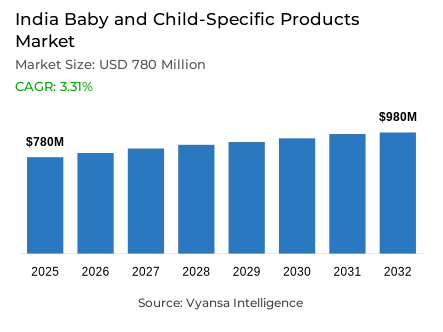
- Baby and child-specific products in India is estimated at USD 780 million in 2025.
- The market size is expected to grow to USD 980 million by 2032.
- Market to register a cagr of around 3.31% during 2026-32.
- Product Shares
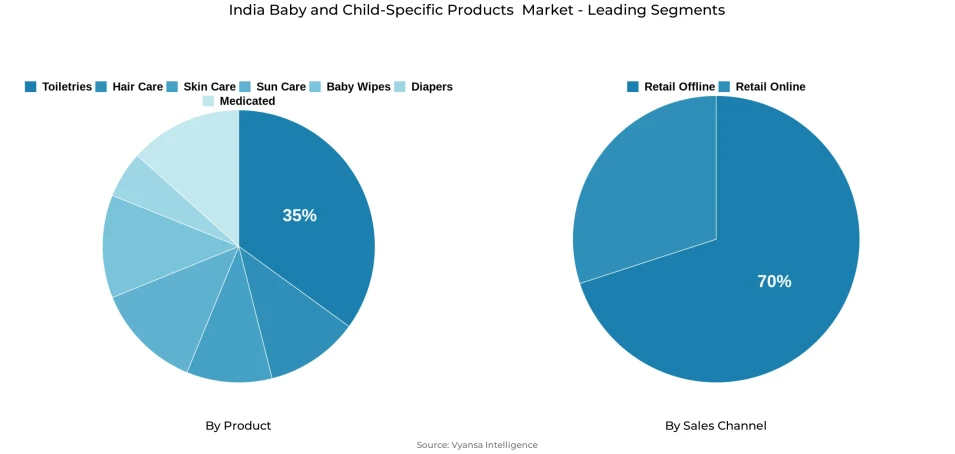
- Toiletries grabbed market share of 35%.
- Competition
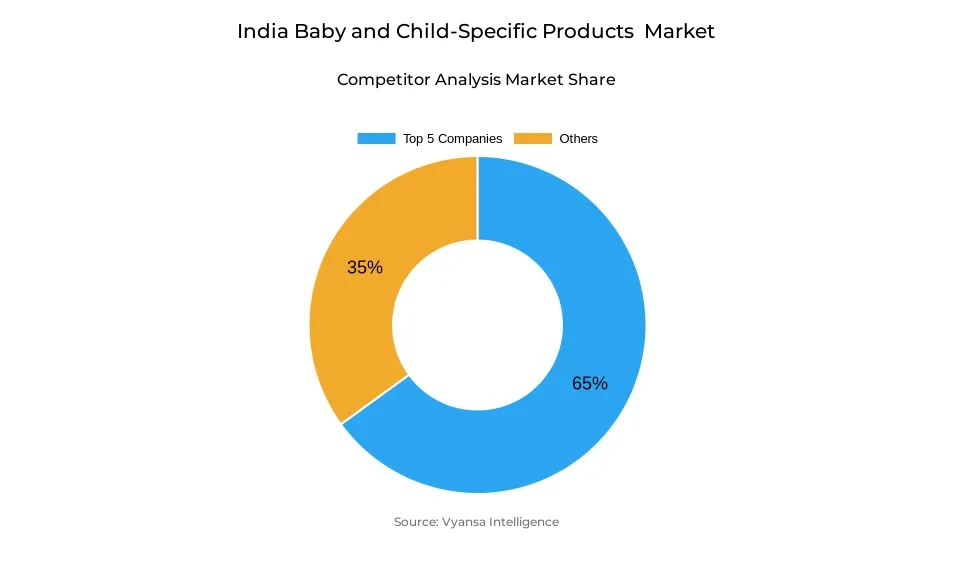
- More than 10 companies are actively engaged in producing baby and child-specific products in India.
- Top 5 companies acquired around 65% of the market share.
- Artsana India Pvt Ltd; Wipro Consumer Care & Lighting Ltd; VVF Ltd; Johnson & Johnson (India) Ltd; Himalaya Drug Co, The etc., are few of the top companies.
- Sales Channel
- Retail offline grabbed 70% of the market.
India Baby and Child-Specific Products Market Outlook
The India Baby and Child-Specific Products market is set for steady expansion, rising from USD 780 million in 2025 to USD 980 million by 2032, at a CAGR of 3.31%. Growth will be supported by rising hygiene awareness, higher disposable incomes, and a shift toward specialised care routines. Toiletries, which hold a 35% share, will remain the largest segment, with baby wipes continuing to grow the fastest as D2C brands expand their hygiene portfolios. Parents are seeking gentle, safe, and high-quality products, reinforcing demand across both mass and premium ranges.
Competition is becoming more fragmented as brands target distinct end user groups. Established FMCG companies continue to lead in core categories due to trust, medical credibility, and strong offline reach. Meanwhile, premium ayurvedic and natural brands—such as Baby Forest, Maate, and Nat Habit—are gaining attention with ingredient-led storytelling, clean-label claims, and digital-first marketing. This diversification reflects a market where parents increasingly prioritise natural formulations and holistic baby care. Retail offline channels, which account for 70% of sales, will remain dominant, though online platforms continue to grow rapidly by offering accessibility, product education, and curated selections.
Over the forecast period, premiumisation is expected to accelerate as parents adopt plant-based, ayurvedic, and toxin-free alternatives. Functional products that blend personal care with wellness—such as sleep-enhancing oils, congestion rubs, and skin barrier creams—will gain momentum. Rising concern about allergens, environmental stressors, and sensitive skin is reshaping baby care into a more holistic wellness routine for modern families.
Innovation will play a key role in attracting new parents and increasing product adoption. Targeted launches, such as SPF-based baby sunscreens, travel-friendly kits, seasonal care solutions, and all-in-one formats, will expand usage occasions. As brands focus on safe ingredients, user-friendly packaging, and convenience-driven formats, the category is expected to see stronger trial, higher repurchase rates, and long-term loyalty, supporting sustained growth
India Baby and Child-Specific Products Market Growth Driver
Expansion of D2C Brands Enhancing Market Reach
India Baby and Child-Specific Products Market is thriving due to the increased popularity of Direct-To-end user companies. D2C companies have changed how new parents buy and use baby care items. D2C companies use the Internet as their primary channel, allowing them to have greater transparency, clarity of ingredients, and the ability to provide their end users with a more personalised experience so they can build trust with young, tech-savvy parents. By selling directly to the end user, D2C companies eliminate the need for third-party sellers, as well as allow for greater flexibility in meeting end users’ changing needs and access to affordable baby care products.
Bumtum and Mamaearth are prime examples of this transition to D2C companies. Both brands started off with one product category before expanding into a full baby hygiene portfolio. In addition, they utilise social media and influencer marketing to reach their target audiences in both metro and non-metro areas. Through their growing online presence and the D2C business model, Bumtum and Mamaearth are not only allowing new parents to access premium baby care products, but they are also increasing brand awareness, pushing product innovation and altering the competitive landscape for Baby and Child-specific Products in India.
India Baby and Child-Specific Products Market Challenge
Increasing Market Fragmentation and Intense Competition
The baby and child-specific products market in India is becoming increasingly fragmented due to the entry of new players with niche and specialized product offerings. While established FMCG companies continue to dominate with large market shares in categories such as baby oil, baby powder and baby soap, there has been increased competition from smaller and newer brands who have positioned themselves uniquely and are entering the market competitively.
There are many examples of the way brands have begun to establish their identity and presence in the market through the use of ayurvedic-inspired and luxury-inspired products as well as natural and clean formulation products. This has led to more segmentation in the marketplace, and today there are various groups of end users buying products based on their price range, preferences, and values. With this higher level of segmentation, it is becoming increasingly difficult for brands to retain customer loyalty, and brands must continuously innovate, differentiate themselves from competitors, and deliver clear value propositions to stand out in the marketplace.
Unlock Market Intelligence
Explore the market potential with our data-driven report
India Baby and Child-Specific Products Market Trend
Premiumisation Driven by Natural and Ayurvedic Formulations
A significant trend in the development of the Indian Baby and Child Care Products Market is the increase in “premiumisation”, characterised by an increase in the number of parents who prefer and seek out natural, toxin-free, and Ayurvedic products. As knowledge of hazardous chemicals grows, parents are now focusing on selecting only the best, natural, and plant-based products for their children’s daily personal hygiene. Many parents are now incorporating more naturally-derived ingredients and holistic approaches into their children’s daily care routines in line with the recent rise of wellness in India.
Companies such as The Moms Co, Mother Sparsh, and Maate are leading this movement by providing high-quality, premium-priced products with an emphasis on product safety and traditional wellness practices. A growing trend towards premiumisation is indicative of the changing lifestyles of urban Indian families with a higher level of disposable income and education than ever before. As premiumisation continues to rise in India, so does the belief that premium products are the purest and most trustworthy products, which is also aiding in creating strong brand loyalty and facilitating the continued growth of the Indian Baby and Child Care Products Market.
India Baby and Child-Specific Products Market Opportunity
Functional and Health-Focused Product Innovation
The opportunity for growth within the Indian Baby & Child-Specific Products Market is immense as parent demands continues to evolve as parents seek products that provide more than just basic baby care. Future opportunities exist to provide Baby & Child-Specific Products that solve the functional health and wellness concerns of parents, their babies, and children, including products that help protect against pollution, improve sleep, and soothe sensitive skin. By providing functional innovations that provide the functional support needed for Baby Care Routines to be holistic in nature, the opportunity exists to provide Baby Care Routines with a focus on the Health aspects of Baby Care rather than simply providing basic care services.
Investors can create new brand investments in Baby & Child-Specific Products that address the growing demand for multi-benefit and problem-solving products by continuing to invest in functional innovation. The introduction and use of innovative format products such as sleep-inducing oils, barrier creams, and anti-inflammatory lotions will create new parents, especially first-time parents, that will purchase these products for preventive and therapeutic benefits for their children. This focus on meeting the functional needs of future-first time parents, as well as ongoing brand loyalty, will serve to build a foundation for the long-term growth of the Baby & Child-Specific Products market by creating the potential for a premium value for Baby & Child-Specific Products.
Unlock Market Intelligence
Explore the market potential with our data-driven report
India Baby and Child-Specific Products Market Segmentation Analysis
By Product
- Hair Care
- Skin Care
- Sun Care
- Toiletries
- Baby Wipes
- Diapers
- Medicated
The segment with highest market share under Product Shares is of Toiletries, accounting for nearly 35% of the india baby & child specific products market share. Toiletries have a huge market share because they are used every day as part of a typical baby care routine. There is a growing preference among parents for gentle, safe and dermatologically tested products that will not irritate their baby's sensitive skin. The increased focus on Hygiene and the need for quality and specific products has only added to the strength of this segment.
There is a high degree of brand loyalty to brands in the Toiletries Segment by both new and established Players that cater to the needs and wants of parents. Many products, such as Baby Wipes, Shampoos, and Body Washes are broadly utilized in Urban and Suburban households, creating a steady or growing demand for these products. Based on the increasing Awareness and Discretionary Income levels of the population, the segment in terms of total dollar value and unit volume amounts continues to show strong growth.
By Sales Channel
- Retail Online
- Retail Offline
The segment with highest market share under sales channel is retail offline accounts for approximately 70% of share. Parents prefer going to traditional retail outlets, including supermarkets, pharmacies and baby specialty stores, because they feel that they can trust their authenticity, product availability and to see & feel the items before purchasing. Many parents still buy their personal care products for babies from local stores because they know that these stores will provide them with the convenience and the trust factor for much-needed products like toiletries and baby wipes.
Retail offline is still the dominant form and is serving both urban and semi-urban households through the excellent distribution network of established FMCG's. Supermarket and pharmacy chains have a considerable influence on the availability and visibility of baby & child-specific products as they have some of the biggest brands associated with them and ensure maximum availability and visibility. This trend is expected to continue through the forecasted period.
List of Companies Covered in India Baby and Child-Specific Products Market
The companies listed below are highly influential in the India baby and child-specific products market, with a significant market share and a strong impact on industry developments.
- Artsana India Pvt Ltd
- Wipro Consumer Care & Lighting Ltd
- VVF Ltd
- Johnson & Johnson (India) Ltd
- Himalaya Drug Co, The
- Dabur India Ltd
- Honasa Consumer Pvt Ltd
- USV Pvt Ltd
- Me n Moms Pvt Ltd
- Unicharm India Pvt Ltd
Frequently Asked Questions
Related Report
1. Market Segmentation
1.1. Research Scope
1.2. Research Methodology
1.3. Definitions and Assumptions
2. Executive Summary
3. India Baby and Child-Specific Product Market Policies, Regulations, and Standards
4. India Baby and Child-Specific Product Market Dynamics
4.1. Growth Factors
4.2. Challenges
4.3. Trends
4.4. Opportunities
5. India Baby and Child-Specific Product Market Statistics, 2022-2032F
5.1. Market Size & Growth Outlook
5.1.1.By Revenues in US$ Million
5.2. Market Segmentation & Growth Outlook
5.2.1.By Product
5.2.1.1. Hair Care- Market Insights and Forecast 2022-2032, USD Million
5.2.1.2. Skin Care- Market Insights and Forecast 2022-2032, USD Million
5.2.1.3. Sun Care- Market Insights and Forecast 2022-2032, USD Million
5.2.1.4. Toiletries- Market Insights and Forecast 2022-2032, USD Million
5.2.1.5. Baby Wipes- Market Insights and Forecast 2022-2032, USD Million
5.2.1.6. Diapers- Market Insights and Forecast 2022-2032, USD Million
5.2.1.7. Medicated- Market Insights and Forecast 2022-2032, USD Million
5.2.2.By Category
5.2.2.1. Premium- Market Insights and Forecast 2022-2032, USD Million
5.2.2.2. Mass- Market Insights and Forecast 2022-2032, USD Million
5.2.3.By Sales Channel
5.2.3.1. Retail Online- Market Insights and Forecast 2022-2032, USD Million
5.2.3.2. Retail Offline- Market Insights and Forecast 2022-2032, USD Million
5.2.4.By Competitors
5.2.4.1. Competition Characteristics
5.2.4.2. Market Share & Analysis
6. India Baby and Child-Specific Hair Care Product Market Statistics, 2022-2032F
6.1. Market Size & Growth Outlook
6.1.1.By Revenues in US$ Million
6.2. Market Segmentation & Growth Outlook
6.2.1.By Category- Market Insights and Forecast 2022-2032, USD Million
6.2.2.By Sales Channel- Market Insights and Forecast 2022-2032, USD Million
7. India Baby and Child-Specific Skin Care Product Market Statistics, 2022-2032F
7.1. Market Size & Growth Outlook
7.1.1.By Revenues in US$ Million
7.2. Market Segmentation & Growth Outlook
7.2.1.By Category- Market Insights and Forecast 2022-2032, USD Million
7.2.2.By Sales Channel- Market Insights and Forecast 2022-2032, USD Million
8. India Baby and Child-Specific Sun Care Product Market Statistics, 2022-2032F
8.1. Market Size & Growth Outlook
8.1.1.By Revenues in US$ Million
8.2. Market Segmentation & Growth Outlook
8.2.1.By Category- Market Insights and Forecast 2022-2032, USD Million
8.2.2.By Sales Channel- Market Insights and Forecast 2022-2032, USD Million
9. India Baby and Child-Specific Toiletries Product Market Statistics, 2022-2032F
9.1. Market Size & Growth Outlook
9.1.1.By Revenues in US$ Million
9.2. Market Segmentation & Growth Outlook
9.2.1.By Category- Market Insights and Forecast 2022-2032, USD Million
9.2.2.By Sales Channel- Market Insights and Forecast 2022-2032, USD Million
10. India Baby and Child-Specific Baby Wipes Market Statistics, 2022-2032F
10.1. Market Size & Growth Outlook
10.1.1. By Revenues in US$ Million
10.2. Market Segmentation & Growth Outlook
10.2.1. By Category- Market Insights and Forecast 2022-2032, USD Million
10.2.2. By Sales Channel- Market Insights and Forecast 2022-2032, USD Million
11. India Baby and Child-Specific Diapers Market Statistics, 2022-2032F
11.1. Market Size & Growth Outlook
11.1.1. By Revenues in US$ Million
11.2. Market Segmentation & Growth Outlook
11.2.1. By Category- Market Insights and Forecast 2022-2032, USD Million
11.2.2. By Sales Channel- Market Insights and Forecast 2022-2032, USD Million
12. India Baby and Child-Specific Medicated Product Market Statistics, 2022-2032F
12.1. Market Size & Growth Outlook
12.1.1. By Revenues in US$ Million
12.2. Market Segmentation & Growth Outlook
12.2.1. By Category- Market Insights and Forecast 2022-2032, USD Million
12.2.2. By Sales Channel- Market Insights and Forecast 2022-2032, USD Million
13. Competitive Outlook
13.1. Company Profiles
13.1.1. Johnson & Johnson (India) Ltd
13.1.1.1. Business Description
13.1.1.2. Product Portfolio
13.1.1.3. Collaborations & Alliances
13.1.1.4. Recent Developments
13.1.1.5. Financial Details
13.1.1.6. Others
13.1.2. Himalaya Drug Co, The
13.1.2.1. Business Description
13.1.2.2. Product Portfolio
13.1.2.3. Collaborations & Alliances
13.1.2.4. Recent Developments
13.1.2.5. Financial Details
13.1.2.6. Others
13.1.3. Dabur India Ltd
13.1.3.1. Business Description
13.1.3.2. Product Portfolio
13.1.3.3. Collaborations & Alliances
13.1.3.4. Recent Developments
13.1.3.5. Financial Details
13.1.3.6. Others
13.1.4. Honasa Consumer Pvt Ltd
13.1.4.1. Business Description
13.1.4.2. Product Portfolio
13.1.4.3. Collaborations & Alliances
13.1.4.4. Recent Developments
13.1.4.5. Financial Details
13.1.4.6. Others
13.1.5. USV Pvt Ltd
13.1.5.1. Business Description
13.1.5.2. Product Portfolio
13.1.5.3. Collaborations & Alliances
13.1.5.4. Recent Developments
13.1.5.5. Financial Details
13.1.5.6. Others
13.1.6. Artsana India Pvt Ltd
13.1.6.1. Business Description
13.1.6.2. Product Portfolio
13.1.6.3. Collaborations & Alliances
13.1.6.4. Recent Developments
13.1.6.5. Financial Details
13.1.6.6. Others
13.1.7. Wipro Consumer Care & Lighting Ltd
13.1.7.1. Business Description
13.1.7.2. Product Portfolio
13.1.7.3. Collaborations & Alliances
13.1.7.4. Recent Developments
13.1.7.5. Financial Details
13.1.7.6. Others
13.1.8. VVF Ltd
13.1.8.1. Business Description
13.1.8.2. Product Portfolio
13.1.8.3. Collaborations & Alliances
13.1.8.4. Recent Developments
13.1.8.5. Financial Details
13.1.8.6. Others
13.1.9. Me n Moms Pvt Ltd
13.1.9.1. Business Description
13.1.9.2. Product Portfolio
13.1.9.3. Collaborations & Alliances
13.1.9.4. Recent Developments
13.1.9.5. Financial Details
13.1.9.6. Others
13.1.10. Unicharm India Pvt Ltd
13.1.10.1.Business Description
13.1.10.2.Product Portfolio
13.1.10.3.Collaborations & Alliances
13.1.10.4.Recent Developments
13.1.10.5.Financial Details
13.1.10.6.Others
14. Disclaimer
| Segment | Sub-Segment |
|---|---|
| By Product |
|
| By Category |
|
| By Sales Channel |
|
Research Methodology
This study followed a structured approach comprising four key phases to assess the size and scope of the electro-oxidation market. The process began with thorough secondary research to collect data on the target market, related markets, and broader industry context. These findings, along with preliminary assumptions and estimates, were then validated through extensive primary research involving industry experts from across the value chain. To calculate the overall market size, both top-down and bottom-up methodologies were employed. Finally, market segmentation and data triangulation techniques were applied to refine and validate segment-level estimations.
Secondary Research
The secondary research phase involved gathering data from a wide range of credible and published sources. This step helped in identifying industry trends, defining market segmentation, and understanding the market landscape and value chain.
Sources consulted during this phase included:
- Company annual reports, investor presentations, and press releases
- Industry white papers and certified publications
- Trade directories and market-recognized databases
- Articles from authoritative authors and reputable journals
- Gold and silver standard websites
Secondary research was critical in mapping out the industry's value chain and monetary flow, identifying key market segments, understanding regional variations, and tracking significant industry developments.
Other key sources:
- Financial disclosures
- Industry associations and trade bodies
- News outlets and business magazines
- Academic journals and research studies
- Paid industry databases
Primary Research
To validate secondary data and gain deeper market insights, primary research was conducted with key stakeholders across both the supply and demand sides of the market.
On the demand side, participants included decision-makers and influencers from end-user industries—such as CIOs, CTOs, and CSOs—who provided first-hand perspectives on market needs, product usage, and future expectations.
On the supply side, interviews were conducted with manufacturers, industry associations, and institutional participants to gather insights into current offerings, product pipelines, and market challenges.
Primary interviews provided critical inputs such as:
- Market size and revenue data
- Product and service breakdowns
- Market forecasts
- Regional and application-specific trends
Stakeholders consulted included:
- Leading OEM and solution providers
- Channel and distribution partners
- End users across various applications
- Independent consultants and industry specialists
Market Size Estimation and Data Triangulation
- Identifying Key Market Participants (Secondary Research)
- Goal: To identify the major players or companies in the target market. This typically involves using publicly available data sources such as industry reports, market research publications, and financial statements of companies.
- Tools: Reports from firms like Gartner, Forrester, Euromonitor, Statista, IBISWorld, and others. Public financial statements, news articles, and press releases from top market players.
- Extracting Earnings of Key Market Participants
- Goal: To estimate the earnings generated from the product or service being analyzed. This step helps in understanding the revenue potential of each market player in a specific geography.
- Methods: Earnings data can be gathered from:
- Publicly available financial reports (for listed companies).
- Interviews and primary data sources from professionals, such as Directors, VPs, SVPs, etc. This is especially useful for understanding more nuanced, internal data that isn't publicly disclosed.
- Annual reports and investor presentations of key players.
- Data Collation and Development of a Relevant Data Model
- Goal: To collate inputs from both primary and secondary sources into a structured, data-driven model for market estimation. This model will incorporate key market KPIs and any independent variables relevant to the market.
- Key KPIs: These could include:
- Market size, growth rate, and demand drivers.
- Industry-specific metrics like market share, average revenue per customer (ARPC), or average deal size.
- External variables, such as economic growth rates, inflation rates, or commodity prices, that could affect the market.
- Data Modeling: Based on this data, the market forecasts are developed for the next 5 years. A combination of trend analysis, scenario modeling, and statistical regression might be used to generate projections.
- Scenario Analysis
- Goal: To test different assumptions and validate how sensitive the market is to changes in key variables (e.g., market demand, regulatory changes, technological disruptions).
- Types of Scenarios:
- Base Case: Based on current assumptions and historical data.
- Best-Case Scenario: Assuming favorable market conditions, regulatory environments, and technological advancements.
- Worst-Case Scenario: Accounting for adverse factors, such as economic downturns, stricter regulations, or unexpected disruptions.












