Vietnam Hi-tech Medical Devices Market Report: Trends, Growth and Forecast (2027-2033)
By Product Type (Diagnostic Imaging Equipment, Cardiovascular Devices, In-Vitro Diagnostic Devices, Surgical Equipment and Robotics, Orthopedic Devices, Neurology Devices, Ophthalmic Devices, Dental Care Devices, Diabetes Care Devices, Anesthesia and Respiratory Devices, Nephrology and Urology Devices, ENT Devices, Monitoring and Digital Health Devices, Others), By Technology (AI-Enabled Medical Devices, Robotics-Assisted Medical Devices, IoT / Connected Medical Devices, Wearable Medical Devices, Minimally Invasive Systems, Imaging and Visualization Systems), By Application (Diagnosis, Monitoring, Therapeutics / Treatment, Surgical Procedures, Rehabilitation), By End User (Hospitals and Clinics, Diagnostic and Imaging Centers, Ambulatory Surgical Centers, Research and Academic Institutes, Home Care Settings) ... Read more
|
Major Players
|
Vietnam Hi-tech Medical Devices Market Overview
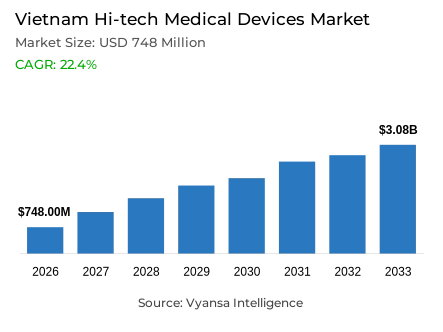
Hi-tech medical devices in Vietnam are advanced diagnostic, therapeutic and monitoring systems, including imaging scanners, robotic surgical platforms and connected monitors. Public hospitals, private hospital groups, diagnostic centers, ambulatory surgical centers and home care users consume them for diagnosis, monitoring, treatment, surgery and rehabilitation. The Vietnam hi-tech medical devices market is forecast to grow at a CAGR of 22.40% between 2027 and 2033.
Key Highlights of the Vietnam Hi-tech Medical Devices Market
- The hi-tech medical devices market in Vietnam was valued at USD 748 million in 2026. The market is estimated at USD 916 million in 2027 and is projected to reach USD 3.08 billion by 2033.
- The market is forecast to expand at an overall CAGR of 22.40% across the 2027 to 2033 forecast period.
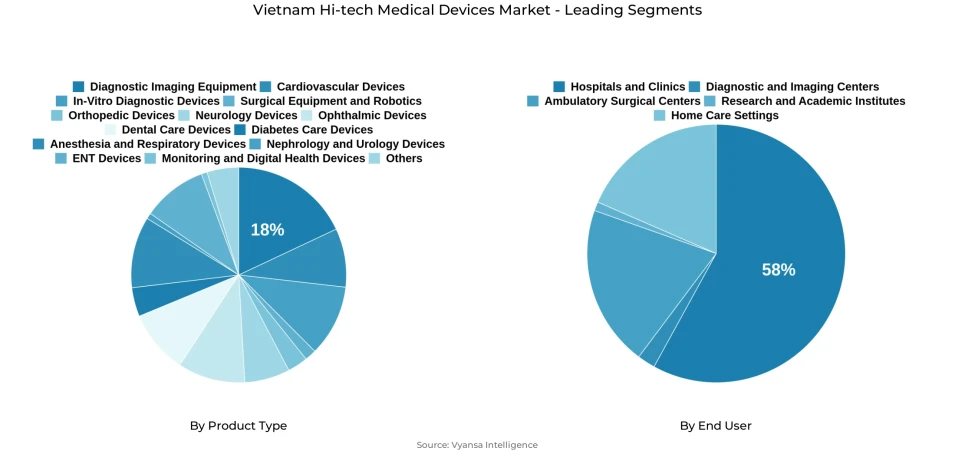
- By product type, diagnostic imaging equipment is the leading segment with an 18% share in 2026.
- Monitoring and digital health devices is the fastest-growing product type segment, expanding at a 31.64% CAGR across the 2027 to 2033 forecast period.
- By end user, hospitals and clinics is the leading segment with a 58% share in 2026.
- Home care settings is the fastest-growing end user segment, expanding at a 29.90% CAGR across the 2027 to 2033 forecast period.
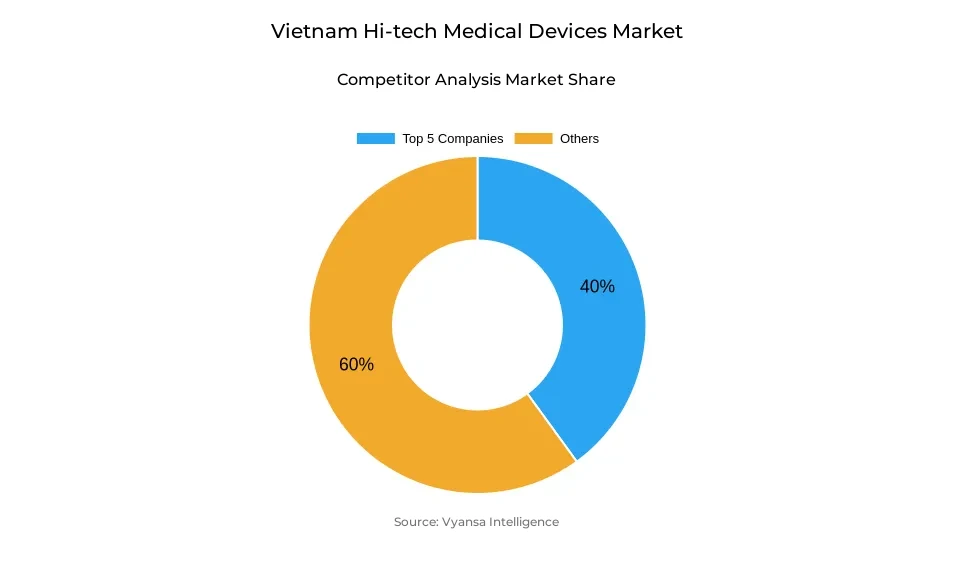
- The industry is moderately fragmented, with the top five companies holding a combined 40% share in 2026.
Vietnam’s demand for hi-tech medical devices is supported by a healthcare system that remains heavily dependent on imported technology. Approximately 90% of the country’s medical equipment is imported, including diagnostic imaging, orthopedic products and patient-support devices. This creates an accessible market for international manufacturers, while making local distribution, product registration, technical service and clinician training important to converting equipment demand into completed installations.
The clinical need for advanced diagnosis and monitoring is also substantial. Non-communicable diseases, including cardiovascular conditions, cancer, diabetes and chronic respiratory disorders, account for about 80% of deaths in Vietnam. At the end of 2025, health insurance covered approximately 95.2% of the population. Together, a large disease burden and broad insurance participation create sustained patient volumes for imaging, laboratory testing, surgical treatment and long-term monitoring.
Demand should extend beyond major tertiary hospitals as Vietnam strengthens preventive care, provincial hospitals and digitally connected health services. International companies will remain important, but future competitive strength will depend on registration readiness, local service coverage, equipment uptime and the ability to train clinical teams. Through the forecast period, suppliers that combine advanced hardware with software, maintenance and workflow support will be better positioned to serve Vietnam’s expanding healthcare network.
Vietnam Hi-tech Medical Devices Market Government Compliance
Medical Device Registration and Procurement Rules Shape Market Access
Vietnam consolidated its principal medical-device management requirements in March 2026. The consolidated framework brings the main provisions governing classification, registration, importation, circulation, pricing and post-market responsibilities into a single reference. This provides suppliers with a clearer regulatory route, although high-risk devices must still complete the required registration and documentation procedures before commercial distribution.
Administrative procedures introduced in November 2025 assigned responsibility for Class C and Class D circulation numbers, import licences and related device approvals to specialized authorities within the Ministry of Health. These procedures directly affect the availability of advanced imaging, surgical and monitoring systems because an unregistered model cannot move into routine hospital procurement, even where funding and clinical demand already exist.
Procurement classifications issued in December 2025 divide medical devices into six groups according to technical and quality criteria. The classification requirements apply to relevant tenders from January 2027. Hospitals can therefore compare devices using recognized technical standards and market authorizations rather than price alone. Suppliers with registered portfolios, recognized approvals, service networks and complete technical dossiers are consequently better positioned to compete for public-sector equipment demand.
Vietnam Hi-tech Medical Devices Market Drivers
Nationwide Preventive Screening Expands Equipment Demand
Vietnam began implementing at least one free annual health check-up or screening for every citizen from 2026. The programme moves healthcare activity toward earlier detection and creates repeat demand for X-ray systems, ultrasound equipment, laboratory analyzers and connected patient records. Because screenings must be delivered across the population rather than only to patients entering tertiary hospitals, equipment requirements extend into provincial, district and commune-level facilities.
The national target program for healthcare, population and development has been allocated approximately USD 3.37 billion for 2026–2030. Its objectives include strengthening primary healthcare, managing health throughout the patient’s life cycle and improving the ability of local facilities to detect disease. A portion of this investment will require diagnostic, monitoring and digital infrastructure capable of supporting higher screening volumes and transmitting results across different levels of care.
The program makes device demand more recurring and geographically dispersed. Screening sites require equipment that can process routine patient volumes, connect with electronic records and operate reliably outside major specialist hospitals. Manufacturers offering compact systems, remote technical support, user training and financing arrangements can address facilities that need modern equipment but cannot support the purchasing and staffing model used by large urban hospitals.
Vietnam Hi-tech Medical Devices Market Challenges
Approval Delays and Workforce Shortages Slow Equipment Deployment
Advanced medical devices must complete registration before they can be supplied routinely to hospitals. In October 2024, only 4,878 of approximately 11,300 submitted medical-device dossiers had received circulation numbers. Although processing has subsequently improved, the earlier backlog demonstrates how administrative capacity can delay the entry of new models and keep hospitals dependent on equipment that already holds valid approval.
Public procurement adds another layer of delay because hospitals must assess technical specifications, reference prices, quality documentation and after-sales support before awarding contracts. Tender committees can consequently favor familiar platforms with established registrations and service records. New entrants may have technically suitable products but still face longer sales cycles while establishing authorized distribution, clinical references and local maintenance capacity.
Equipment delivery also does not guarantee effective utilization. Commune and provincial facilities continue to report shortages of doctors and specialized technicians, while some installed machines remain underused because trained personnel are unavailable. This weakens the near-term return on equipment investment and can postpone purchases in facilities that cannot demonstrate operational readiness. Suppliers that provide structured training and continuing technical support are better placed to overcome this constraint.
Vietnam Hi-tech Medical Devices Market Recent Trends
Hospital Partnerships Increase Lifecycle Technology Adoption
Vietnamese hospitals are increasingly forming multi-year relationships with technology suppliers rather than purchasing equipment through isolated transactions. These agreements combine equipment access with clinical training, research, protocol development and technical support. The approach helps hospitals develop the skills required to use advanced systems consistently while giving suppliers reference sites and continuing involvement after installation.
In May 2025, GE HealthCare and Nghe An Friendship General Hospital established cooperation covering clinical training, scientific conferences and medical research. The hospital can contribute clinical evidence and professional feedback for new technologies, while its medical teams receive continuing exposure to equipment and applications. This connects supplier participation with the hospital’s clinical-development program rather than limiting it to the initial equipment sale.
Vietnam’s first integrated high-tech robotic-surgery network was launched by Vinmec in June 2026, connecting robotic capabilities across several hospitals through a coordinated clinical center. Network-based deployment can standardize training and treatment protocols while allowing expensive platforms to support a broader patient base. Through 2033, this model should increase demand for service agreements, software upgrades, specialized instruments and clinician training alongside the underlying equipment.
AI-Enabled Imaging Improves Diagnostic Throughput
Artificial intelligence is being incorporated directly into imaging equipment to support scan planning, image reconstruction, dose management and clinical interpretation. These functions allow hospitals to process complex examinations more consistently and reduce the number of manual adjustments required from technicians. The commercial value therefore comes from greater equipment utilization and faster patient movement through diagnostic departments.
In March 2026, Hong Hung General Hospital placed Vietnam’s first SOMATOM Pro Pulse system into operation. The dual-source computed tomography platform uses AI-supported imaging and provides temporal resolution of up to 86 milliseconds. The system enables cardiac imaging for patients with high or irregular heart rates while reducing preparation requirements that can otherwise delay examinations.
As hospitals evaluate equipment according to patient throughput and clinical capability, AI functions will increasingly influence replacement and procurement decisions. Adoption also creates connected demand for application software, upgrades, clinician training and data integration. Vendors that can demonstrate improvements under Vietnamese clinical conditions and support users after installation should be better positioned than suppliers competing mainly through hardware specifications.
Vietnam Hi-tech Medical Devices Market Future Opportunities
Decentralized Dialysis Capacity Creates Recurring Demand
Vietnam has more than 10 million people living with chronic kidney disease, including approximately 26,000 patients who have reached the stage requiring periodic dialysis or transplantation. The continuing nature of dialysis makes capacity expansion commercially significant because every new treatment station creates recurring demand for machines, filters, tubing, monitoring equipment, water treatment systems and maintenance.
Existing facilities indicate a shortage of treatment capacity. Cho Ray Hospital operated 74 dialysis machines for 427 routine patients in mid-2026, with machines running several sessions daily. Expanding only within large tertiary hospitals is difficult because space, staffing and operating hours are already constrained. Satellite dialysis centers, provincial units and hospital-linked home peritoneal-dialysis programs provide practical routes for placing capacity closer to patients.
In September 2026, Ho Chi Minh City introduced support for health-insurance co-payments for eligible patients receiving regular haemodialysis or peritoneal dialysis. Reducing the patient’s continuing treatment burden can make utilization more predictable and improve the viability of additional capacity. Suppliers with reliable machine fleets, consumable distribution, water-quality support and trained service teams are positioned to benefit as renal replacement services expand beyond saturated referral hospitals.
Unlock Market Intelligence
Explore the market potential with our data-driven report
Vietnam Hi-tech Medical Devices Market Segmentation Analysis
By Product Type:
- Diagnostic Imaging Equipment
- Cardiovascular Devices
- In-Vitro Diagnostic Devices
- Surgical Equipment and Robotics
- Orthopedic Devices
- Neurology Devices
- Ophthalmic Devices
- Dental Care Devices
- Diabetes Care Devices
- Anesthesia and Respiratory Devices
- Nephrology and Urology Devices
- ENT Devices
- Monitoring and Digital Health Devices
- Others
Diagnostic Imaging Equipment Anchors Device Demand with an 18% Share
Diagnostic Imaging Equipment leads because every screening, cancer and stroke pathway starts with a scan, and each system is high-value capital concentrated in tertiary and private hospitals. On 11 October 2025, Siemens Healthineers introduced the ACUSON Origin, an all-in-one ultrasound system for diagnostic, structural heart, electrophysiology and paediatric applications. By 3 November 2025, GE HealthCare had handed over an AI-integrated SIGNA Premier 3.0T magnetic resonance imaging (MRI) system to Cho Ray Hospital. Imaging should hold its lead through 2033, with the gap narrowing, unless scanner replacement stalls in hospitals.
Monitoring and Digital Health Devices is the fastest-growing segment, expanding at a 31.64% CAGR between 2027 and 2033 as records and AI networks connect bedside devices. In March 2026, the National Health Information Center reported about 30 million electronic health records integrated into the VNeID app. On 14 January 2026, the ministry of health launched the Vietnam responsible health AI network, planning AI applications at 3,321 commune and ward health stations. It outgrows imaging because it scales with connected facilities rather than scanner replacement cycles, from a small base.
By End User:
- Hospitals and Clinics
- Diagnostic and Imaging Centers
- Ambulatory Surgical Centers
- Research and Academic Institutes
- Home Care Settings
Hospitals and Clinics Command 58% of End User Demand
Hospitals and clinics lead because the tiered public network, with 47 central, 419 provincial and 684 district hospitals according to the Stop TB Partnership in February 2025, is the channel through which insured care and equipment procurement run. Private groups add premium capacity: Vinmec Ocean Park 2 in Greater Hanoi opened in March 2026 with Vietnam's first 3.0T MAGNETOM Vida XT, and Binh Dan Hospital was licensed in early 2026 to run basic robotic-surgery training. This position should hold through 2033 unless care shifts to non-hospital sites faster than expected.
Home Care Settings is the fastest-growing end user segment, expanding at a 29.90% CAGR between 2027 and 2033. The national statistics office reported in January 2026 that the share of Vietnamese aged 60 and over rose from 14.0% to 14.5%. Older people typically carry more than two chronic conditions, per the pasteur institute in Ho Chi Minh City in May 2025, which moves monitoring devices toward the home. It outgrows hospitals because it adds end users from a small base, while hospital demand scales from a mature installed base across the industry.
Unlock Market Intelligence
Explore the market potential with our data-driven report
Vietnam Hi-tech Medical Devices Market Competitive Landscape
The industry is moderately fragmented, with the top five companies holding a combined 40% share in 2026. The five leading companies are GE Vietnam Limited (GE HealthCare), Siemens Healthcare Limited (Siemens Healthineers), Philips Vietnam Company Limited, Medtronic Vietnam Company Limited and Representative Office of Abbott Laboratories GmbH in Ho Chi Minh City (Abbott).
Key Companies in the Vietnam Hi-tech Medical Devices Market
- GE Vietnam Limited (GE HealthCare)
- Siemens Healthcare Limited (Siemens Healthineers)
- Philips Vietnam Company Limited
- Medtronic Vietnam Company Limited
- Abbott Laboratories GmbH (Abbott)
- Roche Vietnam Company Limited
- Canon Medical Systems Asia Pte Ltd
- FUJIFILM VIETNAM Co.,Ltd.
- Olympus Medical Systems Vietnam Co., Ltd.
- Mindray Medical Vietnam Co.,Ltd
Company Profiling
The following profiles cover the five leading companies in this industry.
GE Vietnam Limited (GE HealthCare): GE HealthCare supplies imaging, ultrasound, anaesthesia and clinical-care technologies to Vietnamese hospitals. Its local participation is supported by training, research relationships and authorised distribution. In November 2025, GE HealthCare handed over an AI-integrated SIGNA Premier 3.0T MRI system to Cho Ray Hospital, strengthening its position in advanced diagnostic imaging.
Siemens Healthcare Limited (Siemens Healthineers): Siemens Healthineers participates through computed tomography, magnetic resonance imaging, ultrasound and related clinical software. Its reference hospitals and technical support capabilities are important in a market where equipment performance must be maintained throughout long operating cycles. In April 2026, the company signed a memorandum with Bach Mai Hospital covering training, research and clinical application of NAEOTOM Alpha photon-counting CT technology.
Philips Vietnam Company Limited: Philips Vietnam Company Limited supplies diagnostic imaging, patient monitoring, clinical informatics and connected-care systems. Its portfolio allows the company to participate in both capital-equipment procurement and the digital connection of hospital departments. In August 2026, Philips introduced the Verida spectral CT and BlueSeal Horizon 3.0T MRI platforms at the Vietnamese Congress of Radiology and Nuclear Medicine.
Medtronic Vietnam Company Limited: Medtronic Vietnam Company Limited operates across cardiovascular treatment, neuroscience and minimally invasive surgical technologies. Clinician education is central to its market position because adoption depends on physicians being trained to use specialised devices safely. In October 2025, Medtronic signed its third memorandum with Hue Central Hospital, beginning a two-year collaboration covering training and technology adoption in cardiovascular, neuroscience and minimally invasive treatment.
Abbott Laboratories GmbH (Abbott): Abbott participates in Vietnam through diabetes care and connected patient-monitoring technologies. Its consumer-facing devices extend medical-device use beyond hospital departments into everyday disease management. In June 2026, Abbott introduced the FreeStyle Libre 2 Plus glucose-monitoring sensor in Vietnam, providing automatic readings every minute and optional alerts.
Recent Developments in the Vietnam Hi-tech Medical Devices Market
- February 2026: Vietnam’s Prime Minister called for faster public-private partnerships in medical facilities, diagnostic centers, testing centers and laboratories. Greater private participation can expand the number of organizations purchasing advanced diagnostic equipment and create opportunities for suppliers able to combine equipment with financing, technical support and staff training.
- April 2026: In April 2026, the Ministry of Health approved a plan requiring all healthcare facilities to implement electronic medical records by 2030. More than 75% of hospitals had already announced implementation by April 2026. Wider electronic-record coverage increases the value of monitors, imaging systems and diagnostic devices that can exchange information with hospital platforms.
- April 2026: In April 2026, 58 hospitals and medical centres conducted free specialist screening across 64 wards and communes in Ho Chi Minh City. The programme included screening for breast, cervical and thyroid cancers. Coordinated screening at this scale generates demand for portable ultrasound, imaging, laboratory and digital-record equipment across both specialist hospitals and community facilities.
Frequently Asked Questions
Related Report
- Market Segmentation
- Research Scope
- Research Methodology
- Definitions and Assumptions
- Executive Summary
- Vietnam Hi-tech Medical Devices Market Policies, Regulations, and Standards
- Vietnam Hi-tech Medical Devices Market Dynamics
- Growth Factors
- Challenges
- Trends
- Opportunities
- Vietnam Hi-tech Medical Devices Market Statistics, 2023-2033F
- Market Size & Growth Outlook
- By Revenues in USD Million
- Market Segmentation & Growth Outlook
- By Product Type
- Diagnostic Imaging Equipment- Market Insights and Forecast 2023-2033, USD Million
- Cardiovascular Devices- Market Insights and Forecast 2023-2033, USD Million
- In-Vitro Diagnostic Devices- Market Insights and Forecast 2023-2033, USD Million
- Surgical Equipment and Robotics- Market Insights and Forecast 2023-2033, USD Million
- Orthopedic Devices- Market Insights and Forecast 2023-2033, USD Million
- Neurology Devices- Market Insights and Forecast 2023-2033, USD Million
- Ophthalmic Devices- Market Insights and Forecast 2023-2033, USD Million
- Dental Care Devices- Market Insights and Forecast 2023-2033, USD Million
- Diabetes Care Devices- Market Insights and Forecast 2023-2033, USD Million
- Anesthesia and Respiratory Devices- Market Insights and Forecast 2023-2033, USD Million
- Nephrology and Urology Devices- Market Insights and Forecast 2023-2033, USD Million
- ENT Devices- Market Insights and Forecast 2023-2033, USD Million
- Monitoring and Digital Health Devices- Market Insights and Forecast 2023-2033, USD Million
- Others- Market Insights and Forecast 2023-2033, USD Million
- By Technology
- AI-Enabled Medical Devices- Market Insights and Forecast 2023-2033, USD Million
- Robotics-Assisted Medical Devices- Market Insights and Forecast 2023-2033, USD Million
- IoT / Connected Medical Devices- Market Insights and Forecast 2023-2033, USD Million
- Wearable Medical Devices- Market Insights and Forecast 2023-2033, USD Million
- Minimally Invasive Systems- Market Insights and Forecast 2023-2033, USD Million
- Imaging and Visualization Systems- Market Insights and Forecast 2023-2033, USD Million
- By Application
- Diagnosis- Market Insights and Forecast 2023-2033, USD Million
- Monitoring- Market Insights and Forecast 2023-2033, USD Million
- Therapeutics / Treatment- Market Insights and Forecast 2023-2033, USD Million
- Surgical Procedures- Market Insights and Forecast 2023-2033, USD Million
- Rehabilitation- Market Insights and Forecast 2023-2033, USD Million
- By End User
- Hospitals and Clinics- Market Insights and Forecast 2023-2033, USD Million
- Diagnostic and Imaging Centers- Market Insights and Forecast 2023-2033, USD Million
- Ambulatory Surgical Centers- Market Insights and Forecast 2023-2033, USD Million
- Research and Academic Institutes- Market Insights and Forecast 2023-2033, USD Million
- Home Care Settings- Market Insights and Forecast 2023-2033, USD Million
- By Competitors
- Competition Characteristics
- Market Share & Analysis
- By Product Type
- Market Size & Growth Outlook
- Vietnam Diagnostic Imaging Equipment Market Statistics, 2023-2033
- Market Size & Growth Outlook
- By Revenues in USD Million
- Market Segmentation & Growth Outlook
- By Technology- Market Insights and Forecast 2023-2033, USD Million
- By Application- Market Insights and Forecast 2023-2033, USD Million
- By End User- Market Insights and Forecast 2023-2033, USD Million
- Market Size & Growth Outlook
- Vietnam Cardiovascular Devices Market Statistics, 2023-2033
- Market Size & Growth Outlook
- By Revenues in USD Million
- Market Segmentation & Growth Outlook
- By Technology- Market Insights and Forecast 2023-2033, USD Million
- By Application- Market Insights and Forecast 2023-2033, USD Million
- By End User- Market Insights and Forecast 2023-2033, USD Million
- Market Size & Growth Outlook
- Vietnam In-Vitro Diagnostic Devices Market Statistics, 2023-2033
- Market Size & Growth Outlook
- By Revenues in USD Million
- Market Segmentation & Growth Outlook
- By Technology- Market Insights and Forecast 2023-2033, USD Million
- By Application- Market Insights and Forecast 2023-2033, USD Million
- By End User- Market Insights and Forecast 2023-2033, USD Million
- Market Size & Growth Outlook
- Vietnam Surgical Equipment and Robotics Market Statistics, 2023-2033
- Market Size & Growth Outlook
- By Revenues in USD Million
- Market Segmentation & Growth Outlook
- By Technology- Market Insights and Forecast 2023-2033, USD Million
- By Application- Market Insights and Forecast 2023-2033, USD Million
- By End User- Market Insights and Forecast 2023-2033, USD Million
- Market Size & Growth Outlook
- Vietnam Orthopedic Devices Market Statistics, 2023-2033
- Market Size & Growth Outlook
- By Revenues in USD Million
- Market Segmentation & Growth Outlook
- By Technology- Market Insights and Forecast 2023-2033, USD Million
- By Application- Market Insights and Forecast 2023-2033, USD Million
- By End User- Market Insights and Forecast 2023-2033, USD Million
- Market Size & Growth Outlook
- Vietnam Neurology Devices Market Statistics, 2023-2033
- Market Size & Growth Outlook
- By Revenues in USD Million
- Market Segmentation & Growth Outlook
- By Technology- Market Insights and Forecast 2023-2033, USD Million
- By Application- Market Insights and Forecast 2023-2033, USD Million
- By End User- Market Insights and Forecast 2023-2033, USD Million
- Market Size & Growth Outlook
- Vietnam Ophthalmic Devices Market Statistics, 2023-2033
- Market Size & Growth Outlook
- By Revenues in USD Million
- Market Segmentation & Growth Outlook
- By Technology- Market Insights and Forecast 2023-2033, USD Million
- By Application- Market Insights and Forecast 2023-2033, USD Million
- By End User- Market Insights and Forecast 2023-2033, USD Million
- Market Size & Growth Outlook
- Vietnam Dental Care Devices Market Statistics, 2023-2033
- Market Size & Growth Outlook
- By Revenues in USD Million
- Market Segmentation & Growth Outlook
- By Technology- Market Insights and Forecast 2023-2033, USD Million
- By Application- Market Insights and Forecast 2023-2033, USD Million
- By End User- Market Insights and Forecast 2023-2033, USD Million
- Market Size & Growth Outlook
- Vietnam Diabetes Care Devices Market Statistics, 2023-2033
- Market Size & Growth Outlook
- By Revenues in USD Million
- Market Segmentation & Growth Outlook
- By Technology- Market Insights and Forecast 2023-2033, USD Million
- By Application- Market Insights and Forecast 2023-2033, USD Million
- By End User- Market Insights and Forecast 2023-2033, USD Million
- Market Size & Growth Outlook
- Vietnam Anesthesia and Respiratory Devices Market Statistics, 2023-2033
- Market Size & Growth Outlook
- By Revenues in USD Million
- Market Segmentation & Growth Outlook
- By Technology- Market Insights and Forecast 2023-2033, USD Million
- By Application- Market Insights and Forecast 2023-2033, USD Million
- By End User- Market Insights and Forecast 2023-2033, USD Million
- Market Size & Growth Outlook
- Vietnam Nephrology and Urology Devices Market Statistics, 2023-2033
- Market Size & Growth Outlook
- By Revenues in USD Million
- Market Segmentation & Growth Outlook
- By Technology- Market Insights and Forecast 2023-2033, USD Million
- By Application- Market Insights and Forecast 2023-2033, USD Million
- By End User- Market Insights and Forecast 2023-2033, USD Million
- Market Size & Growth Outlook
- Vietnam ENT Devices Market Statistics, 2023-2033
- Market Size & Growth Outlook
- By Revenues in USD Million
- Market Segmentation & Growth Outlook
- By Technology- Market Insights and Forecast 2023-2033, USD Million
- By Application- Market Insights and Forecast 2023-2033, USD Million
- By End User- Market Insights and Forecast 2023-2033, USD Million
- Market Size & Growth Outlook
- Vietnam Monitoring and Digital Health Devices Market Statistics, 2023-2033
- Market Size & Growth Outlook
- By Revenues in USD Million
- Market Segmentation & Growth Outlook
- By Technology- Market Insights and Forecast 2023-2033, USD Million
- By Application- Market Insights and Forecast 2023-2033, USD Million
- By End User- Market Insights and Forecast 2023-2033, USD Million
- Market Size & Growth Outlook
- Vietnam Others Market Statistics, 2023-2033
- Market Size & Growth Outlook
- By Revenues in USD Million
- Market Segmentation & Growth Outlook
- By Technology- Market Insights and Forecast 2023-2033, USD Million
- By Application- Market Insights and Forecast 2023-2033, USD Million
- By End User- Market Insights and Forecast 2023-2033, USD Million
- Market Size & Growth Outlook
- Competitive Outlook
- Company Profiles
- GE Vietnam Limited (GE HealthCare)
- Business Description
- Product Portfolio
- Collaborations & Alliances
- Recent Developments
- Financial Details
- Others
- Siemens Healthcare Limited (Siemens Healthineers)
- Business Description
- Product Portfolio
- Collaborations & Alliances
- Recent Developments
- Financial Details
- Others
- Philips Vietnam Company Limited
- Business Description
- Product Portfolio
- Collaborations & Alliances
- Recent Developments
- Financial Details
- Others
- Medtronic Vietnam Company Limited
- Business Description
- Product Portfolio
- Collaborations & Alliances
- Recent Developments
- Financial Details
- Others
- Abbott Laboratories GmbH (Abbott)
- Business Description
- Product Portfolio
- Collaborations & Alliances
- Recent Developments
- Financial Details
- Others
- Roche Vietnam Company Limited
- Business Description
- Product Portfolio
- Collaborations & Alliances
- Recent Developments
- Financial Details
- Others
- Canon Medical Systems Asia Pte Ltd
- Business Description
- Product Portfolio
- Collaborations & Alliances
- Recent Developments
- Financial Details
- Others
- FUJIFILM VIETNAM Co., Ltd.
- Business Description
- Product Portfolio
- Collaborations & Alliances
- Recent Developments
- Financial Details
- Others
- Olympus Medical Systems Vietnam Co., Ltd.
- Business Description
- Product Portfolio
- Collaborations & Alliances
- Recent Developments
- Financial Details
- Others
- Mindray Medical Vietnam Co., Ltd.
- Business Description
- Product Portfolio
- Collaborations & Alliances
- Recent Developments
- Financial Details
- Others
- GE Vietnam Limited (GE HealthCare)
- Company Profiles
- Disclaimer
| Segment | Sub-Segment |
|---|---|
| By Product Type |
|
| By Technology |
|
| By Application |
|
| By End User |
|
Research Methodology
This study followed a structured approach comprising four key phases to assess the size and scope of the electro-oxidation market. The process began with thorough secondary research to collect data on the target market, related markets, and broader industry context. These findings, along with preliminary assumptions and estimates, were then validated through extensive primary research involving industry experts from across the value chain. To calculate the overall market size, both top-down and bottom-up methodologies were employed. Finally, market segmentation and data triangulation techniques were applied to refine and validate segment-level estimations.
Secondary Research
The secondary research phase involved gathering data from a wide range of credible and published sources. This step helped in identifying industry trends, defining market segmentation, and understanding the market landscape and value chain.
Sources consulted during this phase included:
- Company annual reports, investor presentations, and press releases
- Industry white papers and certified publications
- Trade directories and market-recognized databases
- Articles from authoritative authors and reputable journals
- Gold and silver standard websites
Secondary research was critical in mapping out the industry's value chain and monetary flow, identifying key market segments, understanding regional variations, and tracking significant industry developments.
Other key sources:
- Financial disclosures
- Industry associations and trade bodies
- News outlets and business magazines
- Academic journals and research studies
- Paid industry databases
Primary Research
To validate secondary data and gain deeper market insights, primary research was conducted with key stakeholders across both the supply and demand sides of the market.
On the demand side, participants included decision-makers and influencers from end-user industries—such as CIOs, CTOs, and CSOs—who provided first-hand perspectives on market needs, product usage, and future expectations.
On the supply side, interviews were conducted with manufacturers, industry associations, and institutional participants to gather insights into current offerings, product pipelines, and market challenges.
Primary interviews provided critical inputs such as:
- Market size and revenue data
- Product and service breakdowns
- Market forecasts
- Regional and application-specific trends
Stakeholders consulted included:
- Leading OEM and solution providers
- Channel and distribution partners
- End users across various applications
- Independent consultants and industry specialists
Market Size Estimation and Data Triangulation
- Identifying Key Market Participants (Secondary Research)
- Goal: To identify the major players or companies in the target market. This typically involves using publicly available data sources such as industry reports, market research publications, and financial statements of companies.
- Tools: Reports from firms like Gartner, Forrester, Euromonitor, Statista, IBISWorld, and others. Public financial statements, news articles, and press releases from top market players.
- Extracting Earnings of Key Market Participants
- Goal: To estimate the earnings generated from the product or service being analyzed. This step helps in understanding the revenue potential of each market player in a specific geography.
- Methods: Earnings data can be gathered from:
- Publicly available financial reports (for listed companies).
- Interviews and primary data sources from professionals, such as Directors, VPs, SVPs, etc. This is especially useful for understanding more nuanced, internal data that isn't publicly disclosed.
- Annual reports and investor presentations of key players.
- Data Collation and Development of a Relevant Data Model
- Goal: To collate inputs from both primary and secondary sources into a structured, data-driven model for market estimation. This model will incorporate key market KPIs and any independent variables relevant to the market.
- Key KPIs: These could include:
- Market size, growth rate, and demand drivers.
- Industry-specific metrics like market share, average revenue per customer (ARPC), or average deal size.
- External variables, such as economic growth rates, inflation rates, or commodity prices, that could affect the market.
- Data Modeling: Based on this data, the market forecasts are developed for the next 5 years. A combination of trend analysis, scenario modeling, and statistical regression might be used to generate projections.
- Scenario Analysis
- Goal: To test different assumptions and validate how sensitive the market is to changes in key variables (e.g., market demand, regulatory changes, technological disruptions).
- Types of Scenarios:
- Base Case: Based on current assumptions and historical data.
- Best-Case Scenario: Assuming favorable market conditions, regulatory environments, and technological advancements.
- Worst-Case Scenario: Accounting for adverse factors, such as economic downturns, stricter regulations, or unexpected disruptions.