India Pressure Sensor Market Report: Trends, Growth and Forecast (2027-2033)
By Sensor Connectivity (Wired, Wireless), By Product Type (Absolute, Differential, Gauge), By Technology (Piezoresistive, Electromagnetic, Capacitive, Resonant Solid-State, Optical Transducers, Other Technologies), By Application (Automotive, Medical, Consumer Electronics, Industrial, Aerospace and Defense, Food and Beverage, HVAC), By Region (North, East, West, South) ... Read more
|
Major Players
|
India Pressure Sensor Market Overview
A pressure sensor converts mechanical pressure into an electrical signal that vehicles, industrial machinery, medical devices, and consumer electronics use to monitor, control, and protect their systems. Automotive manufacturers, industrial-process operators, medical-device makers, and electronics brands across India install these components in engine, braking, process-monitoring, and appliance applications. The India pressure sensor market is forecast to grow at a CAGR of 10.72% between 2027 and 2033.
Key Highlights of the India Pressure Sensor Market
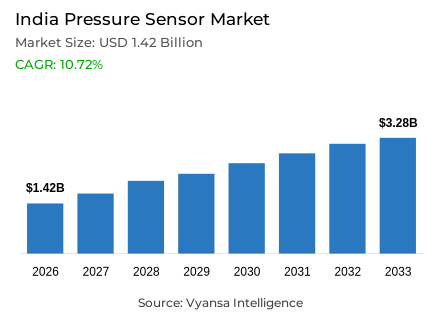
- The pressure sensor market in India was valued at USD 1.42 billion in 2026, is estimated at USD 1.78 billion in 2027, and is forecast to reach USD 3.28 billion by 2033.
- The market is forecast to expand at an overall CAGR of 10.72% across the 2027 to 2033 forecast period.
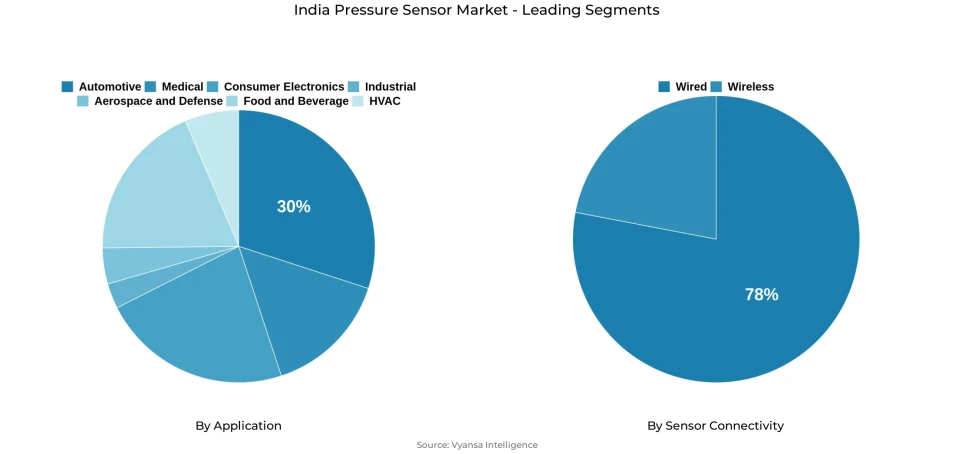
- By application, the automotive segment led the market with a 30% share in 2026.
- Medical segment is the fastest-growing application segment, expanding at a CAGR of 11.47% between 2027 and 2033.
- By sensor connectivity, wired sensors led the market with a 78% share in 2026.
- Wireless sensors are the fastest-growing connectivity segment, expanding at a CAGR of 14.82% between 2027 and 2033.
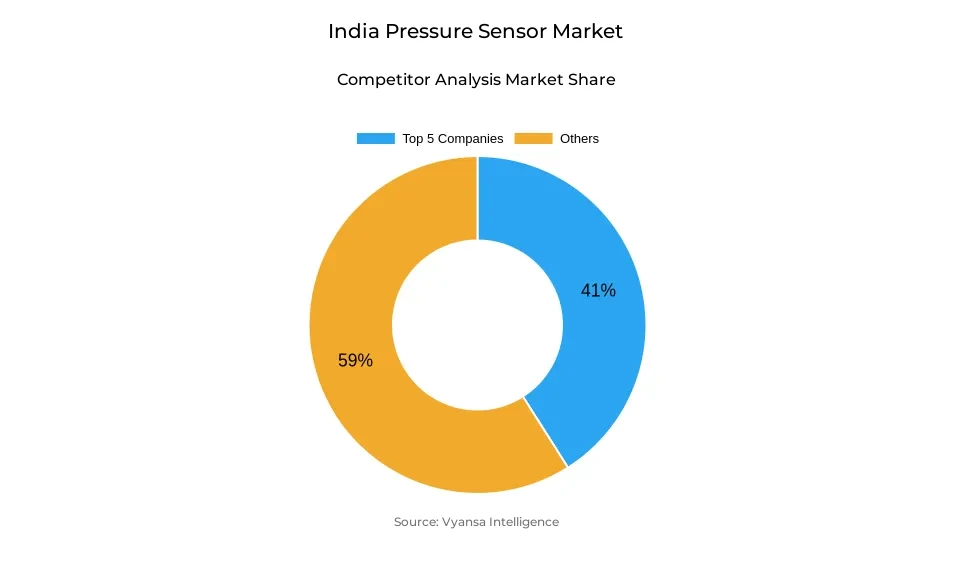
- The market structure is moderately fragmented, with the top five companies together holding a combined 41% share of industry revenue as of 2026.
India’s pressure sensor demand is expanding with the production of vehicles, automated machinery and medical equipment that depend on electronic measurement and control. SIAM reported approximately 34.71 million vehicles produced during FY2025–26, providing a substantial manufacturing base for sensors used in braking, air intake, fluid systems, and other applications. The commercial significance extends beyond production volumes: manufacturers need pressure measurements at several points within an operating system, creating recurring component demand across successive equipment generations.
Industrial automation is widening this demand base. India installed approximately 10,500 industrial robots in 2025, up 15%, according to the International Federation of Robotics. Automated production also requires monitoring of surrounding pneumatic, hydraulic and process systems, where pressure readings help maintain consistent operation. Medical manufacturing provides another source of demand: by September 2025, 21 projects under India’s medical-device manufacturing incentive scheme had begun production, including equipment used in dialysis. These developments create opportunities for sensors integrated into locally manufactured equipment.
Over the forecast period, growth should come from both a larger equipment base and more electronically controlled functions within that equipment. Demand will vary by application, with vehicle manufacturers, process operators and medical-device makers requiring different performance and integration capabilities. Suppliers combining dependable measurement with suitable packaging, local engineering and responsive support should be well positioned to secure repeat orders as Indian manufacturers develop more sophisticated products.
India Pressure Sensor Market Driver
Rising Sensor Content in Electric Vehicles is Expanding Automotive Pressure Sensor Demand
Vehicle electrification increases the number of systems that require continuous pressure monitoring. Electric vehicles use pressure sensors across thermal-management circuits, refrigerant systems, braking and other fluid-control applications where electronic monitoring is needed to maintain safety and efficiency. This means pressure-sensor demand can grow faster than vehicle production because newer vehicle platforms incorporate more sensing points than simpler mechanical architectures.
India registered approximately 1.97 million electric vehicles during FY2024-25, with EV penetration rising to 7.5% from 6.82% a year earlier. At the same time, India's automotive industry produced approximately 31 million vehicles during FY2024-25, providing a large manufacturing base across which rising electronic sensor content can scale.
Pressure sensing is also becoming more specialized as EV thermal systems evolve. Sensata's September 2026 introduction of a combined pressure and temperature sensor for next-generation EV refrigerant systems illustrates how electrification creates new measurement requirements beyond conventional engine applications. As EV penetration increases, these additional thermal-management and braking requirements should translate directly into higher pressure-sensor content per vehicle.
India Pressure Sensor Market Challenge
Dependence on Imported Sensor Dies Limits Domestic Value Addition
India has developed meaningful capability in electronics assembly, calibration and system integration, but advanced semiconductor manufacturing is still at an earlier stage of development. Pressure sensors based on MEMS technology depend on specialized sensing dies and supporting integrated circuits, leaving domestic suppliers exposed when these high-value components must be sourced through international semiconductor supply chains.
India is rapidly expanding its broader semiconductor ecosystem, with 12 fabrications and packaging projects approved under the Semicon India program by May 2026. However, building a semiconductor ecosystem does not immediately create a mature domestic supply base for automotive and industrial pressure-sensor MEMS dies, which require specialized fabrication, packaging and long customer-qualification cycles.
The result is that Indian pressure sensor manufacturers can increase local assembly and engineering faster than they can localize the core sensing semiconductor. Companies with global wafer supply relationships therefore retain an advantage in continuity and product qualification, while domestic manufacturers need sustained investment in semiconductor design, fabrication and testing before a larger share of sensor value can be captured locally.
India Pressure Sensor Market Trends
Wireless and Industrial IoT Sensors are Shifting Industrial Monitoring Toward Predictive Maintenance
Industrial pressure measurement is moving beyond standalone gauges and locally wired alarms toward connected sensors that continuously transmit operating data into plant monitoring systems. Instead of waiting for an operator to identify an abnormal pressure reading during routine inspection, connected systems can combine live sensor signals with analytics to identify deviations earlier and schedule maintenance before equipment failure.
In September 2025, L&T Technology Services expanded its partnership with Siemens to deliver AI-led engineering, industrial automation and industrial IoT solutions across Indian manufacturing environments. The collaboration connects field-level industrial data with digital platforms capable of supporting simulation, analytics and smarter operational decisions.
Pressure-sensor manufacturers are responding with more digitally connected products. WIKA, for example, offers wireless industrial pressure sensors designed for remote monitoring and condition-based maintenance, while its connected pressure products support direct integration with industrial control systems. Through 2033, this shift should support particularly strong growth in wireless pressure sensing across brownfield factories and difficult-to-wire assets.
India Pressure Sensor Market Opportunity
Domestic MEMS Pressure Sensor Fabrication Creates a Long-Term Import-Substitution Opportunity
India has a large downstream market for automotive, industrial and medical pressure sensors, but deeper value capture depends on developing domestic fabrication capability for the semiconductor sensing elements inside these products. Local MEMS production would allow Indian manufacturers to move beyond assembly and calibration toward the highest-value stage of the sensor supply chain.
The addressable demand base is already substantial. India produced approximately 31 million vehicles during FY2024-25, while industrial automation and medical electronics continue expanding alongside the automotive sector. The India Semiconductor Mission also explicitly provides support for sensor, including MEMS, fabrication projects, creating a policy route through which specialized sensor manufacturing can be established domestically.
The opportunity is longer term because automotive and industrial sensing dies require expensive fabrication infrastructure and extensive customer qualification. Global sensor companies, semiconductor manufacturers and Indian electronics groups working through partnerships or joint ventures are therefore the most credible participants. Successful localization would reduce import dependence while allowing a larger portion of India's growing pressure-sensor market value to remain within the domestic manufacturing ecosystem.
Unlock Market Intelligence
Explore the market potential with our data-driven report
India Pressure Sensor Market Segmentation Analysis
By Application:
- Automotive
- Medical
- Consumer Electronics
- Industrial
- Aerospace and Defense
- Food and Beverage
- HVAC
Automotive Commands 30% of Application Demand
Automotive accounts for the largest application share at 30% in 2026 because vehicles incorporate pressure measurement across several systems rather than relying on a single sensor. Tyre monitoring, braking, thermal control, fuel and air systems create multiple installation points, giving automotive production significantly greater sensor intensity than many individual industrial or consumer applications.
India's manufacturing scale reinforces this leadership. The automotive industry produced approximately 31 million vehicles during FY2024-25, while electric-vehicle penetration continued increasing. As newer models incorporate more electronically controlled thermal, braking, and safety functions, pressure-sensor content can rise even without equivalent growth in total vehicle production.
Medical is the fastest-growing application at an 11.47% CAGR during 2027 to 2033. Pressure sensing is required across devices such as respiratory equipment, pumps, diagnostic systems, and other electronically controlled medical equipment. Growth from a smaller existing base allows the medical segment to expand faster than the much larger automotive category.
By Sensor Connectivity:
- Wired
- Wireless
Wired Sensors Hold 78% of Connectivity Demand
Wired sensors account for 78% of sensor connectivity demand in 2026 because permanently installed automotive and industrial systems prioritize continuous signal availability, predictable power supply and reliable integration with existing control systems. These characteristics keep wired connections dominant in factory machinery, process equipment and vehicle applications where sensors are designed into the system from the beginning.
Connected industrial platforms are nevertheless increasing the functionality of wired sensors as digital interfaces enable diagnostics and machine-level data exchange. WIKA currently offers pressure sensors designed around industrial digital communication, reflecting how conventional wired sensing is becoming more intelligent rather than being replaced outright by wireless technology.
Wireless is the fastest-growing connectivity segment at a 14.82% CAGR during 2027 to 2033. It is particularly useful for brownfield plants, mobile equipment and remote monitoring points where installing new cabling is expensive or impractical. Wireless therefore creates additional measurement locations that would otherwise remain unmonitored rather than simply replacing the established wired sensor base.
Unlock Market Intelligence
Explore the market potential with our data-driven report
India Pressure Sensor Market Competitive Landscape
The India pressure sensor industry is moderately fragmented, with the five leading companies holding a combined 41% share in 2026. The major companies in the market are Honeywell Automation India Limited, Sensata Technologies India Private Limited, WIKA Instruments India Pvt. Ltd., TE Connectivity India Private Limited and Bosch Limited. These five companies represent the principal participants profiled across automotive sensing, industrial instrumentation and connected pressure-measurement applications.
Key Companies in the India Pressure Sensor Market
- Honeywell Automation India Limited
- Sensata Technologies India Private Limited
- WIKA Instruments India Pvt. Ltd.
- TE Connectivity India Private Limited
- Bosch Limited
- Infineon Technologies India Private Limited
- STMicroelectronics Pvt Ltd
- Siemens Ltd.
- Danfoss Industries Pvt Ltd
- ifm electronic India Private Limited
Company Profiling
The following profiles cover the five leading companies shaping supply, calibration capability and product development in India's pressure-sensor industry.
Honeywell Automation India Limited: Honeywell participates in pressure sensing through industrial instrumentation and sensing products used across process industries and high-purity manufacturing environments. In September 2025, Honeywell introduced a new pressure sensor designed for cleanroom and ultra-high-purity manufacturing applications, including semiconductor, biopharmaceutical and medical-equipment production. The product expands Honeywell's pressure-sensing portfolio toward manufacturing processes requiring particularly stable and contamination-controlled measurement.
Sensata Technologies India Private Limited: Sensata supplies pressure sensors and other sensing products to automotive and industrial customers, with particular strength in vehicle applications. In September 2026, the company launched a combined pressure and temperature sensor designed for next-generation EV thermal-management systems using lower-emission refrigerants. The development is directly relevant to India's expanding electric-vehicle market because thermal-management complexity increases the need for precise pressure monitoring.
WIKA Instruments India Pvt. Ltd.: WIKA maintains Indian manufacturing and service operations supplying pressure sensors, transmitters, switches and broader pressure-measurement products to industrial customers. Its current portfolio includes both digitally connected sensors and wireless pressure-monitoring products designed for Industry 4.0 and remote condition-monitoring applications. This gives WIKA exposure to the shift from conventional process instrumentation toward connected industrial sensing.
TE Connectivity India Private Limited: TE Connectivity participates through automotive and industrial sensing products, including MEMS-based pressure sensors used across vehicle and equipment applications. In 2025, the company expanded its connectivity portfolio for next-generation vehicle electronic architectures, strengthening its position across the broader sensor and electronics systems being integrated into increasingly software-defined vehicles. TE's pressure-sensor portfolio also spans automotive and commercial-vehicle applications requiring compact embedded measurement.
Bosch Limited: Bosch supplies pressure-linked automotive sensing and control technologies across passenger vehicles, two-wheelers and other mobility applications in India. In 2026, Bosch Limited completed the integration of Bosch Chassis Systems India, strengthening its position in braking and vehicle-control systems where pressure measurement forms part of electronically controlled safety functions. Bosch also operates its largest engineering and development center outside Germany in India, providing substantial local design capability for mobility electronics.
Recent Developments in the India Pressure Sensor Market
- September 2026: Sensata introduced a combined pressure and temperature sensor for electric-vehicle thermal-management systems, addressing emerging refrigerant and leakage-monitoring requirements in electrified vehicles.
Frequently Asked Questions
Related Report
- Market Segmentation
- Research Scope
- Research Methodology
- Definitions and Assumptions
- Executive Summary
- India Pressure Sensor Market Policies, Regulations, and Standards
- India Pressure Sensor Market Dynamics
- Growth Factors
- Challenges
- Trends
- Opportunities
- India Pressure Sensor Market Statistics, 2023-2033F
- Market Size & Growth Outlook
- By Revenues in USD Million
- Market Segmentation & Growth Outlook
- By Sensor Connectivity
- Wired- Market Insights and Forecast 2023-2033, USD Million
- Wireless- Market Insights and Forecast 2023-2033, USD Million
- By Product Type
- Absolute- Market Insights and Forecast 2023-2033, USD Million
- Differential- Market Insights and Forecast 2023-2033, USD Million
- Gauge- Market Insights and Forecast 2023-2033, USD Million
- By Technology
- Piezoresistive- Market Insights and Forecast 2023-2033, USD Million
- Electromagnetic- Market Insights and Forecast 2023-2033, USD Million
- Capacitive- Market Insights and Forecast 2023-2033, USD Million
- Resonant Solid-State- Market Insights and Forecast 2023-2033, USD Million
- Optical Transducers- Market Insights and Forecast 2023-2033, USD Million
- Other Technologies- Market Insights and Forecast 2023-2033, USD Million
- By Application
- Automotive- Market Insights and Forecast 2023-2033, USD Million
- Medical- Market Insights and Forecast 2023-2033, USD Million
- Consumer Electronics- Market Insights and Forecast 2023-2033, USD Million
- Industrial- Market Insights and Forecast 2023-2033, USD Million
- Aerospace and Defense- Market Insights and Forecast 2023-2033, USD Million
- Food and Beverage- Market Insights and Forecast 2023-2033, USD Million
- HVAC- Market Insights and Forecast 2023-2033, USD Million
- By Region
- North- Market Insights and Forecast 2023-2033, USD Million
- East- Market Insights and Forecast 2023-2033, USD Million
- West- Market Insights and Forecast 2023-2033, USD Million
- South- Market Insights and Forecast 2023-2033, USD Million
- By Competitors
- Competition Characteristics
- Market Share & Analysis
- By Sensor Connectivity
- Market Size & Growth Outlook
- India Wired Pressure Sensor Market Statistics, 2023-2033
- Market Size & Growth Outlook
- By Revenues in USD Million
- Market Segmentation & Growth Outlook
- By Product Type- Market Insights and Forecast 2023-2033, USD Million
- By Technology- Market Insights and Forecast 2023-2033, USD Million
- By Application- Market Insights and Forecast 2023-2033, USD Million
- By Region- Market Insights and Forecast 2023-2033, USD Million
- Market Size & Growth Outlook
- India Wireless Pressure Sensor Market Statistics, 2023-2033
- Market Size & Growth Outlook
- By Revenues in USD Million
- Market Segmentation & Growth Outlook
- By Product Type- Market Insights and Forecast 2023-2033, USD Million
- By Technology- Market Insights and Forecast 2023-2033, USD Million
- By Application- Market Insights and Forecast 2023-2033, USD Million
- By Region- Market Insights and Forecast 2023-2033, USD Million
- Market Size & Growth Outlook
- Competitive Outlook
- Company Profiles
- Honeywell Automation India Limited
- Business Description
- Product Portfolio
- Collaborations & Alliances
- Recent Developments
- Financial Details
- Others
- Sensata Technologies India Private Limited
- Business Description
- Product Portfolio
- Collaborations & Alliances
- Recent Developments
- Financial Details
- Others
- WIKA Instruments India Pvt. Ltd.
- Business Description
- Product Portfolio
- Collaborations & Alliances
- Recent Developments
- Financial Details
- Others
- TE Connectivity India Private Limited
- Business Description
- Product Portfolio
- Collaborations & Alliances
- Recent Developments
- Financial Details
- Others
- Bosch Limited
- Business Description
- Product Portfolio
- Collaborations & Alliances
- Recent Developments
- Financial Details
- Others
- Infineon Technologies India Private Limited (XENSIV™)
- Business Description
- Product Portfolio
- Collaborations & Alliances
- Recent Developments
- Financial Details
- Others
- STMicroelectronics Pvt Ltd
- Business Description
- Product Portfolio
- Collaborations & Alliances
- Recent Developments
- Financial Details
- Others
- Siemens Ltd.
- Business Description
- Product Portfolio
- Collaborations & Alliances
- Recent Developments
- Financial Details
- Others
- Danfoss Industries Pvt Ltd
- Business Description
- Product Portfolio
- Collaborations & Alliances
- Recent Developments
- Financial Details
- Others
- ifm electronic India Private Limited
- Business Description
- Product Portfolio
- Collaborations & Alliances
- Recent Developments
- Financial Details
- Others
- Honeywell Automation India Limited
- Company Profiles
- Disclaimer
| Segment | Sub-Segment |
|---|---|
| By Sensor Connectivity |
|
| By Product Type |
|
| By Technology |
|
| By Application |
|
| By Region |
|
Research Methodology
This study followed a structured approach comprising four key phases to assess the size and scope of the electro-oxidation market. The process began with thorough secondary research to collect data on the target market, related markets, and broader industry context. These findings, along with preliminary assumptions and estimates, were then validated through extensive primary research involving industry experts from across the value chain. To calculate the overall market size, both top-down and bottom-up methodologies were employed. Finally, market segmentation and data triangulation techniques were applied to refine and validate segment-level estimations.
Secondary Research
The secondary research phase involved gathering data from a wide range of credible and published sources. This step helped in identifying industry trends, defining market segmentation, and understanding the market landscape and value chain.
Sources consulted during this phase included:
- Company annual reports, investor presentations, and press releases
- Industry white papers and certified publications
- Trade directories and market-recognized databases
- Articles from authoritative authors and reputable journals
- Gold and silver standard websites
Secondary research was critical in mapping out the industry's value chain and monetary flow, identifying key market segments, understanding regional variations, and tracking significant industry developments.
Other key sources:
- Financial disclosures
- Industry associations and trade bodies
- News outlets and business magazines
- Academic journals and research studies
- Paid industry databases
Primary Research
To validate secondary data and gain deeper market insights, primary research was conducted with key stakeholders across both the supply and demand sides of the market.
On the demand side, participants included decision-makers and influencers from end-user industries—such as CIOs, CTOs, and CSOs—who provided first-hand perspectives on market needs, product usage, and future expectations.
On the supply side, interviews were conducted with manufacturers, industry associations, and institutional participants to gather insights into current offerings, product pipelines, and market challenges.
Primary interviews provided critical inputs such as:
- Market size and revenue data
- Product and service breakdowns
- Market forecasts
- Regional and application-specific trends
Stakeholders consulted included:
- Leading OEM and solution providers
- Channel and distribution partners
- End users across various applications
- Independent consultants and industry specialists
Market Size Estimation and Data Triangulation
- Identifying Key Market Participants (Secondary Research)
- Goal: To identify the major players or companies in the target market. This typically involves using publicly available data sources such as industry reports, market research publications, and financial statements of companies.
- Tools: Reports from firms like Gartner, Forrester, Euromonitor, Statista, IBISWorld, and others. Public financial statements, news articles, and press releases from top market players.
- Extracting Earnings of Key Market Participants
- Goal: To estimate the earnings generated from the product or service being analyzed. This step helps in understanding the revenue potential of each market player in a specific geography.
- Methods: Earnings data can be gathered from:
- Publicly available financial reports (for listed companies).
- Interviews and primary data sources from professionals, such as Directors, VPs, SVPs, etc. This is especially useful for understanding more nuanced, internal data that isn't publicly disclosed.
- Annual reports and investor presentations of key players.
- Data Collation and Development of a Relevant Data Model
- Goal: To collate inputs from both primary and secondary sources into a structured, data-driven model for market estimation. This model will incorporate key market KPIs and any independent variables relevant to the market.
- Key KPIs: These could include:
- Market size, growth rate, and demand drivers.
- Industry-specific metrics like market share, average revenue per customer (ARPC), or average deal size.
- External variables, such as economic growth rates, inflation rates, or commodity prices, that could affect the market.
- Data Modeling: Based on this data, the market forecasts are developed for the next 5 years. A combination of trend analysis, scenario modeling, and statistical regression might be used to generate projections.
- Scenario Analysis
- Goal: To test different assumptions and validate how sensitive the market is to changes in key variables (e.g., market demand, regulatory changes, technological disruptions).
- Types of Scenarios:
- Base Case: Based on current assumptions and historical data.
- Best-Case Scenario: Assuming favorable market conditions, regulatory environments, and technological advancements.
- Worst-Case Scenario: Accounting for adverse factors, such as economic downturns, stricter regulations, or unexpected disruptions.












