US Healthy Biscuits Market Report: Trends, Growth and Forecast (2026-2032)
By Product Type (Digestive & High-Fibre Biscuits, Reduced-Fat & Low-Calorie Biscuits, Gluten-Free Biscuits, Protein-Enriched Biscuits, Others), By Ingredient (Wheat-Based, Oat-Based, Multigrain-Based, Millet-Based, Nut & Seed-Based, Fruit-Based, Others), By Consumers (Children, Teenagers, Adults, Seniors), By Dietary Preference (Vegan, Gluten-Free, Keto-Friendly, Low-Carb, High-Protein, Sugar-Free/Diabetic-Friendly, Others), By Sales Channel (Retail Offline (Supermarkets & Hypermarkets, Convenience Stores, Traditional Grocery & Independent Retailers, Specialty Food & Health Stores), Retail Online (E-commerce Marketplaces, Online Grocery & Quick-Commerce Platforms, Brand-Owned Direct-to-Consumer Websites)), By Packaging Format (Flexible Packs & Pouches, Cartons & Boxes, Tins & Canisters, Others), By Nature (Conventional, Certified Organic), By Region (West, Midwest, South, North, Northeast) ... Read more
|
Major Players
|
US Healthy Biscuits Market Overview
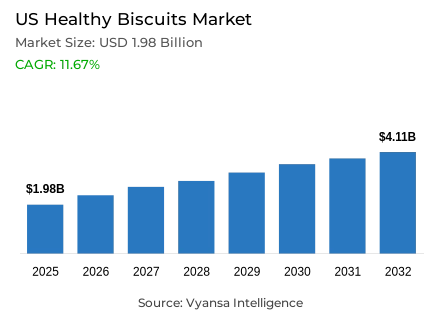
Healthy biscuits are nutritionally enhanced baked products formulated with whole grains, dietary fiber, protein, reduced sugar, and functional ingredients to support healthier snacking. In the United States, they are widely consumed as breakfast alternatives, between-meal snacks, lunchbox staples, and convenient on-the-go refreshments by health-conscious consumers across all age groups. The healthy biscuits market in the United States is projected to expand at a CAGR of 11.67% during 2026–2032.
Key Highlights of the US Healthy Biscuits Market:
- The US healthy biscuits market reached USD 2.12 billion in 2026 and is projected to attain USD 4.11 billion by 2032.
- The market is anticipated to grow at a CAGR of 11.67% during 2026–2032.
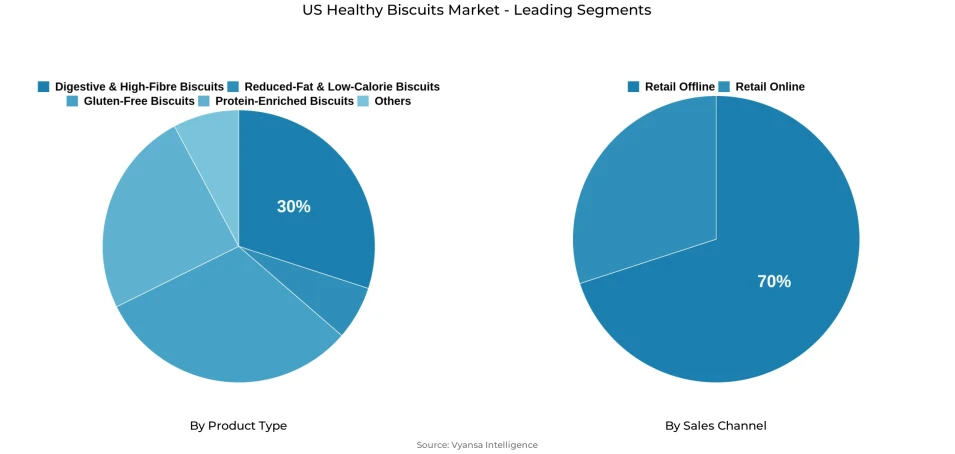
- Digestive & high-fibre biscuits led the market with a 30% share in 2026.
- Gluten-free biscuits are projected to be the fastest-growing product type, at a 14.57% CAGR.
- Retail offline dominated distribution with a 70% market share in 2026.
- Retail online is expected to register the fastest growth, at a 16.66% CAGR.
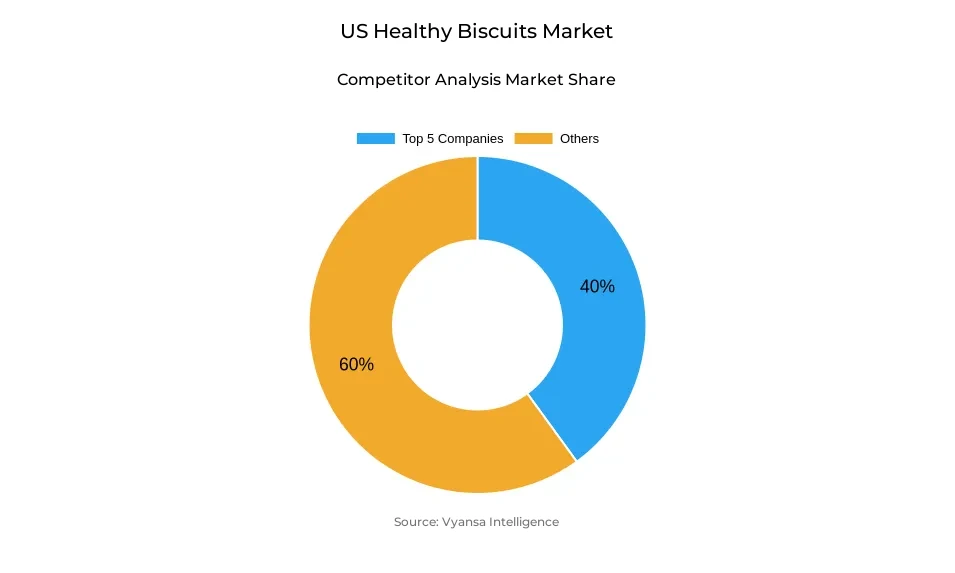
- The top five companies held a 40% market share, indicating a moderately fragmented market.
The United States healthy biscuits market is growing as consumers increasingly choose snacks that are convenient, filling, and better suited to their health goals. Demand is rising for biscuits made with whole grains, dietary fiber, reduced sugar, protein, nuts, seeds, and plant-based ingredients. These products are gaining wider use as breakfast options, between-meal snacks, and on-the-go foods. Strong availability across supermarkets, convenience stores, online platforms, and health-focused retailers is further helping healthy biscuits reach a larger consumer base.
Key players in healthy biscuits are responding to this demand by expanding their ranges of clean-label, gluten-free, high-protein, low-sugar, and plant-based biscuits. Product development is focused on improving nutritional value without reducing taste, texture, or shelf life. Manufacturers are improving production consistency, formulation control, and packaging formats to support wider product availability. These improvements support consistent product quality, larger production volumes, and faster launches of new products designed for different consumer needs.
Government Regulations Shaping the US Healthy Biscuits Market
FDA's Updated "Healthy" Claim Rule
The U.S. Food and Drug Administration (FDA) updated the criteria governing the voluntary use of the healthy nutrient content claim, requiring qualifying products to contain nutritionally beneficial food groups such as whole grains while complying with revised limits for saturated fat, sodium, and added sugars. The regulation is strengthening the US healthy biscuits industry by encouraging reformulation toward nutrient-dense ingredients and cleaner nutritional profiles. Compliance is accelerating innovation in whole-grain and reduced-sugar biscuit formulations, improving product standardization and label credibility. These developments are supporting portfolio diversification, strengthening competitive differentiation, and reinforcing sustained market growth over the forecast period.
Gluten-Free Labeling Rule (21 CFR 101.91)
The FDA's Gluten-Free Labeling Rule (21 CFR 101.91) establishes the federal standard for products marketed as gluten-free, requiring food products to contain less than 20 parts per million (ppm) of gluten while meeting prescribed labeling and manufacturing requirements. The regulation is supporting the US healthy biscuits market by strengthening regulatory confidence in gluten-free product claims and encouraging investments in dedicated production lines, ingredient traceability, quality assurance, and testing capabilities. Standardized compliance is facilitating broader commercialization of gluten-free biscuit portfolios, supporting premium product positioning, expanding retail availability, and contributing to sustained demand across the healthy biscuits category.
US Healthy Biscuits Market Drivers
Rising Lifestyle Diseases Drive Demand for Healthier Snacking
The increasing prevalence of obesity, diabetes, cardiovascular diseases, and other diet-related chronic conditions is encouraging U.S. consumers to replace traditional high-sugar snacks with healthier alternatives. Healthy biscuits formulated with whole grains, dietary fiber, protein, reduced sugar, and functional ingredients provide a convenient way to satisfy snacking needs while supporting weight management, blood sugar control, and heart health. As preventive healthcare becomes a greater priority, consumers are actively seeking nutritious, portion-controlled snacks that align with healthier lifestyles.
According to the Centers for Disease Control and Prevention (CDC), more than 40% of U.S. adults have obesity, while approximately 38.4 million Americans (11.6% of the population) are living with diabetes, according to the American Diabetes Association (ADA). Additionally, the CDC estimates that nearly 129 million U.S. adults have at least one major chronic disease, including heart disease, cancer, diabetes, obesity, or hypertension. These conditions are strongly associated with poor dietary habits and excessive consumption of foods high in refined carbohydrates, saturated fats, and added sugars, encouraging consumers to seek healthier snack alternatives.
Changing eating patterns further reinforce this shift. The International Food Information Council (IFIC) 2025 Food & Health Survey found that 70% of Americans snack at least once daily, while 62% regularly or occasionally replace traditional meals with snacks or smaller meals. This behavior has increased demand for nutritious, portable, and shelf-stable snack options that offer functional health benefits without compromising convenience.
As health awareness continues to grow, healthy biscuits are increasingly being positioned as breakfast alternatives, lunchbox additions, office snacks, and controlled evening refreshments. Manufacturers are responding through the introduction of high-protein, high-fiber, low-sugar, gluten-free, and clean-label formulations that cater to consumers managing weight, diabetes, digestive health, and cardiovascular wellness. Consequently, the rising burden of lifestyle diseases, combined with the growing preference for healthier snacking, is expected to remain a key driver of the U.S. healthy biscuits market throughout the forecast period.
US Healthy Biscuits Market Restraints
Taste and Texture Challenges in Healthier Formulations
Maintaining the familiar taste and texture of traditional biscuits while improving nutrition remains a major challenge for the US healthy biscuits market. Manufacturers are reducing added sugar, refined flour, and fat while increasing whole grains, fiber, and plant-based ingredients. However, these changes can affect sweetness, crispness, softness, and overall eating quality, making healthier products harder to match with consumer expectations.
The USDA Agricultural Research Service found that replacing 30% of the fat and flour in cookies with a fiber-based ingredient produced biscuits that were significantly harder and more difficult to chew. This finding shows how healthier formulations can reduce product appeal. Manufacturers therefore face higher development needs, repeated testing, and longer reformulation cycles before achieving acceptable nutrition, taste, and texture.
This challenge can reduce repeat purchases because taste strongly influences food choices. When products fail to meet expectations for flavor and texture, product demand is less likely to be sustained, which can directly impact brand loyalty and long-term sales. At the same time, manufacturers face increasing pressure to improve nutritional profiles without compromising overall product quality, making formulation decisions more complex and potentially slowing product adoption in the market.
US Healthy Biscuits Market Recent Trends
Claim-Specific Purchasing Replaces Broad Wellness Positioning
The United States healthy biscuits industry is shifting from broad wellness claims toward clearly defined nutritional benefits. Manufacturers are expanding gluten-free, plant-based, whole-grain, low-sugar, high-protein, and allergen-friendly products to meet different dietary needs. This change allows brands to compete through measurable product features instead of general health messaging, supporting stronger differentiation, premium positioning, and wider category development across major retail channels.
Manufacturers are aligning with FDA Nutrition Facts label updates that improve visibility of calories, added sugars, and serving sizes, responding to demand for transparency. With 82% of U.S. adults valuing taste and 63% prioritizing nutrition, clearer labeling is essential. USDA and HHS Dietary Guidelines and MyPlate further reinforce whole grains, reduced sugars, and simplified nutrition communication for increasingly frequent snack-based eating occasions.
As claim-specific purchasing grows, competition will increasingly focus on ingredients, flavors, packaging, and verified product benefits. Brands that communicate clear nutritional value and provide convenient formats can reach both mainstream and specialty customers. This trend will support premium product launches, wider shelf presence, and stronger online visibility, helping the US healthy biscuits market maintain demand and expand throughout the forecast period.
US Healthy Biscuits Market Future Opportunities
Affordable Private-Label Healthy Biscuits in Mainstream Retail
The United States healthy biscuits industry has an opportunity to expand beyond premium health-focused buyers through affordable private-label products in mainstream retail. Retailers and manufacturers can use larger family packs, value multipacks, simpler packaging, efficient sourcing, and broad shelf placement to improve affordability. This approach can attract price-conscious households without repeating the market’s existing consumption, formulation, or nutritional-positioning themes more effectively.
For instance, Walmart’s bettergoods launch introduced more than 300 private-label food items, with most priced below USD 5. Meanwhile, the United States Department of Agriculture (USDA) reported food-at-home prices increased 2.3% in 2025, supporting demand for value-led alternatives nationally.
During 2026–2032, affordable private-label healthy biscuits can widen market access through supermarkets, mass merchants, club stores, and online grocery channels. Retailers can use value pricing and exclusive ranges to attract new buyers, while manufacturers can secure larger production contracts and steadier volumes. This opportunity supports category expansion by improving affordability and availability rather than depending on premium positioning alone nationally.
Unlock Market Intelligence
Explore the market potential with our data-driven report
US Healthy Biscuits Market Segmentation Analysis
By Product Type
- Digestive & High-Fibre Biscuits
- Reduced-Fat & Low-Calorie Biscuits
- Gluten-Free Biscuits
- Protein-Enriched Biscuits
Fibre Leadership and Gluten-Free Acceleration
Digestive & high-fibre biscuits held the largest share of the US healthy biscuits market in 2026, supported by widespread availability, established nutritional positioning, and versatile formulations using whole grains, oats, and dietary fibre. Their suitability across breakfast, snack, and portion-controlled formats strengthens market penetration through mainstream retail. The 2025 IFIC Food & Health Survey found that 28% of respondents identified fibre as a key indicator of healthy food, reinforcing sustained demand for fibre-rich biscuit formulations across the industry.
While Digestive & High-Fibre Biscuits continue to dominate the US healthy biscuits market, gluten-free biscuits are projected to record the fastest growth, registering a CAGR of 14.57% during 2026–2032. The segment is benefiting from FDA-compliant gluten-free labeling, broader retail distribution, and continuous innovation incorporating whole grains, seeds, plant-based ingredients, and functional nutrition. Ongoing portfolio expansion and improvements in taste and texture are further strengthening category adoption, positioning gluten-free biscuits as a major growth avenue throughout the forecast period.
By Sales Channel
- Retail Offline
- Supermarkets & Hypermarkets
- Convenience Stores
- Traditional Grocery & Independent Retailers
- Specialty Food & Health Stores
- Retail Online
- E-commerce Marketplaces
- Online Grocery & Quick-Commerce Platforms
- Brand-Owned Direct-to-Consumer Websites
Physical Retail Leadership and Digital Channel Expansion
Retail offline accounted for the largest share of the US healthy biscuits market in 2026, supported by the extensive presence of supermarkets, hypermarkets, convenience stores, independent retailers, and specialty health outlets. These channels offer broad product assortments, promotional visibility, immediate product availability, and efficient merchandising across multiple price points. Their established distribution infrastructure enables healthy biscuit brands to strengthen shelf presence, expand regional reach, and maintain consistent product availability across routine grocery and health-focused retail environments.
While retail offline continues to dominate the US healthy biscuits market, retail online is projected to register the fastest growth, expanding at a CAGR of 16.66% during 2026–2032. Growth is supported by rapid expansion of e-commerce marketplaces, online grocery platforms, and direct-to-consumer websites offering wider product assortments, subscription models, and personalized recommendations. Continuous improvements in digital merchandising, fulfillment networks, and nationwide delivery capabilities are further strengthening online accessibility, positioning digital channels as a key contributor to future market expansion.
Unlock Market Intelligence
Explore the market potential with our data-driven report
US Healthy Biscuits Market Competitive Landscape
The US healthy biscuits market is moderately fragmented, with the top five companies holding 40% of market share. Competition is driven by multinational food companies and health-focused brands through product innovation, functional ingredients, manufacturing scale, retail partnerships, and expanding e-commerce presence, while continuous portfolio diversification supports long-term competitive positioning.
Key Companies in the US Healthy Biscuits Market
- Mondelēz International Inc.
- Mars Incorporated (Nature’s Bakery)
- Simple Mills Inc.
- The Campbell’s Company
- General Mills Inc.
- Barilla America Inc.
- The Simply Good Foods Company
- TH Foods Inc. (Crunchmaster)
- Conagra Brands Inc. (Glutino)
- Dare Foods Limited
Company Profiles
Profiles evaluate how leading participants in the US healthy biscuits industry combine legal presence, relevant brands, product breadth, manufacturing capacity, retail reach, and channel influence.
Mondelēz International Inc.
Mondelēz International Inc., headquartered in Chicago, operates a broad US biscuits and baked-snacks portfolio through belVita, Triscuit, Wheat Thins, Ritz, and Enjoy Life Foods. Relevant offerings span breakfast biscuits, whole-grain crackers, and dietary-positioned snacks serving breakfast, workplace, travel, and household occasions. The company reported approximately USD 38.5 billion in 2025 global revenue and sells products through extensive grocery, mass, convenience, and digital channels. Its scale, brand portfolio, merchandising capability, and product-development resources position it as a high-volume, distribution-led participant.
Mars Incorporated (Nature’s Bakery)
Mars Incorporated participates through Nature’s Bakery, acquired within its better-for-you snacking platform. The brand supplies whole-wheat fig bars, certified gluten-free fig bars, oatmeal crumble bars, brownies, and protein-oriented Hearty Bars for family, lunchbox, and on-the-go use. Nature’s Bakery products are available in approximately 100,000 US stores. Mars opened a USD 240 million Salt Lake City facility in July 2025 with capacity exceeding one billion bars annually, strengthening western production, national replenishment, product innovation, and the brand’s role as a scaled wholesome-snacking specialist.
Simple Mills Inc.
Simple Mills Inc. became part of Flowers Foods Inc. in February 2025 while retaining its distinctive natural-food positioning. Its portfolio includes almond-flour crackers, organic seed-flour crackers, vegetable-flour pita crackers, crunchy almond-flour cookies, and nut-butter sandwich cookies. Products address gluten-free, grain-free, vegan, organic, and ingredient-transparency requirements across mainstream and natural channels. Flowers Foods reported distribution in more than 30,000 stores nationwide. Nutrient-dense formulations, broad dietary relevance, premium positioning, and established natural-channel visibility make Simple Mills a product-innovation specialist within the category.
The Campbell’s Company
The Campbell’s Company, headquartered in Camden, New Jersey, operates a US Snacks division covering Pepperidge Farm cookies and crackers, Goldfish, Lance, and other snack brands. Within the defined category, Goldfish Baked with Whole Grain provides 12 grams of whole grain per serving, supporting child, family, and lunchbox occasions. Campbell’s reported fiscal 2025 net sales of USD 10.3 billion across Meals & Beverages and Snacks. Its bakery capabilities, household penetration, national retailer relationships, and broad pack architecture support its position as a mass-market manufacturer and brand owner.
General Mills Inc.
General Mills Inc., headquartered in Minneapolis, participates through Nature Valley and other US snack brands. Nature Valley Biscuit Sandwiches use whole-grain oats with peanut, coconut, or almond-butter fillings, while its blueberry biscuits combine oats with dried fruit for breakfast and portable snacking occasions. The company generated USD 19 billion in fiscal 2025 net sales. Established grocery distribution, multipack capability, ingredient-led positioning, and integration across retail and ecommerce make General Mills a large-scale brand owner serving mainstream whole-grain and oat-based demand.
Recent Developments in the US Healthy Biscuits Industry
- February 2025: Flowers Foods Inc. completed its acquisition of Simple Mills, adding a portfolio of better-for-you crackers, cookies, snack bars, and baking mixes. The transaction gives Simple Mills access to broader distribution capabilities while strengthening Flowers Foods’ exposure to premium natural and dietary-positioned snacking.
- December 2025: Mondelēz International announced the launch of Oreo Zero Sugar and Oreo Double Stuf Zero Sugar in the U.S., with nationwide availability from January 2026. The products were developed over four years to deliver the classic Oreo taste without added sugar, enabling the brand to enter the growing better-for-you cookie segment and address increasing consumer demand for healthier snacking options.
Frequently Asked Questions
Related Report
- Market Segmentation
- Research Scope
- Research Methodology
- Definitions and Assumptions
- Executive Summary
- US Healthy Biscuits Market Policies, Regulations, and Standards
- US Healthy Biscuits Production Trend 2022-2032
- US Healthy Biscuits Production Trend By Product Type
- Digestive & High-Fibre Biscuits
- Reduced-Fat & Low-Calorie Biscuits
- Gluten-Free Biscuits
- Protein-Enriched Biscuits
- Others
- Company Wise Production Plants and Statistics
- Installed Production Capacity
- Actual Production
- Planned Production Target
- US Healthy Biscuits Production Trend By Product Type
- US Healthy Biscuits Pricing Analysis 2022-2032
- US Healthy Biscuits Pricing Trend (USD) 2022-2032
- US Healthy Biscuits Pricing Trend (USD) By Regions 2022-2032
- West
- Midwest
- South
- North
- Northeast
- US Healthy Biscuits Pricing Trend (USD) By Product Type 2022-2032
- Digestive & High-Fibre Biscuits
- Reduced-Fat & Low-Calorie Biscuits
- Gluten-Free Biscuits
- Protein-Enriched Biscuits
- Others
- US Healthy Biscuits Market Dynamics
- Growth Factors
- Challenges
- Trends
- Opportunities
- US Healthy Biscuits Market Statistics, 2022-2032
- Market Size & Growth Outlook
- By Revenues in USD Million
- Market Segmentation & Growth Outlook
- By Product Type
- Digestive & High-Fibre Biscuits- Market Insights and Forecast 2022-2032, USD Million
- Reduced-Fat & Low-Calorie Biscuits- Market Insights and Forecast 2022-2032, USD Million
- Gluten-Free Biscuits- Market Insights and Forecast 2022-2032, USD Million
- Protein-Enriched Biscuits- Market Insights and Forecast 2022-2032, USD Million
- Others- Market Insights and Forecast 2022-2032, USD Million
- By Ingredient
- Wheat-Based- Market Insights and Forecast 2022-2032, USD Million
- Oat-Based- Market Insights and Forecast 2022-2032, USD Million
- Multigrain-Based- Market Insights and Forecast 2022-2032, USD Million
- Millet-Based- Market Insights and Forecast 2022-2032, USD Million
- Nut & Seed-Based- Market Insights and Forecast 2022-2032, USD Million
- Fruit-Based- Market Insights and Forecast 2022-2032, USD Million
- Others- Market Insights and Forecast 2022-2032, USD Million
- By Consumers
- Children- Market Insights and Forecast 2022-2032, USD Million
- Teenagers- Market Insights and Forecast 2022-2032, USD Million
- Adults- Market Insights and Forecast 2022-2032, USD Million
- Seniors- Market Insights and Forecast 2022-2032, USD Million
- By Dietary Preference
- Vegan- Market Insights and Forecast 2022-2032, USD Million
- Gluten-Free- Market Insights and Forecast 2022-2032, USD Million
- Keto-Friendly- Market Insights and Forecast 2022-2032, USD Million
- Low-Carb- Market Insights and Forecast 2022-2032, USD Million
- High-Protein- Market Insights and Forecast 2022-2032, USD Million
- Sugar-Free/Diabetic-Friendly- Market Insights and Forecast 2022-2032, USD Million
- Others- Market Insights and Forecast 2022-2032, USD Million
- By Sales Channel
- Retail Offline- Market Insights and Forecast 2022-2032, USD Million
- Supermarkets & Hypermarkets- Market Insights and Forecast 2022-2032, USD Million
- Convenience Stores- Market Insights and Forecast 2022-2032, USD Million
- Traditional Grocery & Independent Retailers- Market Insights and Forecast 2022-2032, USD Million
- Specialty Food & Health Stores- Market Insights and Forecast 2022-2032, USD Million
- Retail Online- Market Insights and Forecast 2022-2032, USD Million
- E-commerce Marketplaces- Market Insights and Forecast 2022-2032, USD Million
- Online Grocery & Quick-Commerce Platforms- Market Insights and Forecast 2022-2032, USD Million
- Brand-Owned Direct-to-Consumer Websites- Market Insights and Forecast 2022-2032, USD Million
- Retail Offline- Market Insights and Forecast 2022-2032, USD Million
- By Packaging Format
- Flexible Packs & Pouches- Market Insights and Forecast 2022-2032, USD Million
- Cartons & Boxes- Market Insights and Forecast 2022-2032, USD Million
- Tins & Canisters- Market Insights and Forecast 2022-2032, USD Million
- Others- Market Insights and Forecast 2022-2032, USD Million
- By Nature
- Conventional- Market Insights and Forecast 2022-2032, USD Million
- Certified Organic- Market Insights and Forecast 2022-2032, USD Million
- By Region
- West- Market Insights and Forecast 2022-2032, USD Million
- Midwest- Market Insights and Forecast 2022-2032, USD Million
- South- Market Insights and Forecast 2022-2032, USD Million
- North- Market Insights and Forecast 2022-2032, USD Million
- Northeast- Market Insights and Forecast 2022-2032, USD Million
- By Competitors
- Competition Characteristics
- Market Share & Analysis
- By Product Type
- Market Size & Growth Outlook
- US Digestive & High-Fibre Biscuits Market Statistics, 2022-2032
- Market Size & Growth Outlook
- By Revenues in USD Million
- Market Segmentation & Growth Outlook
- By Ingredient- Market Insights and Forecast 2022-2032, USD Million
- By Consumers- Market Insights and Forecast 2022-2032, USD Million
- By Dietary Preference- Market Insights and Forecast 2022-2032, USD Million
- By Sales Channel- Market Insights and Forecast 2022-2032, USD Million
- By Packaging Format- Market Insights and Forecast 2022-2032, USD Million
- By Nature- Market Insights and Forecast 2022-2032, USD Million
- By Region- Market Insights and Forecast 2022-2032, USD Million
- Market Size & Growth Outlook
- US Reduced-Fat & Low-Calorie Biscuits Market Statistics, 2022-2032
- Market Size & Growth Outlook
- By Revenues in USD Million
- Market Segmentation & Growth Outlook
- By Ingredient- Market Insights and Forecast 2022-2032, USD Million
- By Consumers- Market Insights and Forecast 2022-2032, USD Million
- By Dietary Preference- Market Insights and Forecast 2022-2032, USD Million
- By Sales Channel- Market Insights and Forecast 2022-2032, USD Million
- By Packaging Format- Market Insights and Forecast 2022-2032, USD Million
- By Nature- Market Insights and Forecast 2022-2032, USD Million
- By Region- Market Insights and Forecast 2022-2032, USD Million
- Market Size & Growth Outlook
- US Gluten-Free Biscuits Market Statistics, 2022-2032
- Market Size & Growth Outlook
- By Revenues in USD Million
- Market Segmentation & Growth Outlook
- By Ingredient- Market Insights and Forecast 2022-2032, USD Million
- By Consumers- Market Insights and Forecast 2022-2032, USD Million
- By Dietary Preference- Market Insights and Forecast 2022-2032, USD Million
- By Sales Channel- Market Insights and Forecast 2022-2032, USD Million
- By Packaging Format- Market Insights and Forecast 2022-2032, USD Million
- By Nature- Market Insights and Forecast 2022-2032, USD Million
- By Region- Market Insights and Forecast 2022-2032, USD Million
- Market Size & Growth Outlook
- US Protein-Enriched Biscuits Market Statistics, 2022-2032
- Market Size & Growth Outlook
- By Revenues in USD Million
- Market Segmentation & Growth Outlook
- By Ingredient- Market Insights and Forecast 2022-2032, USD Million
- By Consumers- Market Insights and Forecast 2022-2032, USD Million
- By Dietary Preference- Market Insights and Forecast 2022-2032, USD Million
- By Sales Channel- Market Insights and Forecast 2022-2032, USD Million
- By Packaging Format- Market Insights and Forecast 2022-2032, USD Million
- By Nature- Market Insights and Forecast 2022-2032, USD Million
- By Region- Market Insights and Forecast 2022-2032, USD Million
- Market Size & Growth Outlook
- Competitive Outlook
- Company Profiles
- Mondelēz International Inc.
- Business Description
- Product Portfolio
- Collaborations & Alliances
- Recent Developments
- Financial Details
- Others
- Mars Incorporated (Nature’s Bakery)
- Business Description
- Product Portfolio
- Collaborations & Alliances
- Recent Developments
- Financial Details
- Others
- Simple Mills Inc.
- Business Description
- Product Portfolio
- Collaborations & Alliances
- Recent Developments
- Financial Details
- Others
- The Campbell’s Company
- Business Description
- Product Portfolio
- Collaborations & Alliances
- Recent Developments
- Financial Details
- Others
- General Mills Inc.
- Business Description
- Product Portfolio
- Collaborations & Alliances
- Recent Developments
- Financial Details
- Others
- Barilla America Inc.
- Business Description
- Product Portfolio
- Collaborations & Alliances
- Recent Developments
- Financial Details
- Others
- The Simply Good Foods Company
- Business Description
- Product Portfolio
- Collaborations & Alliances
- Recent Developments
- Financial Details
- Others
- TH Foods Inc. (Crunchmaster)
- Business Description
- Product Portfolio
- Collaborations & Alliances
- Recent Developments
- Financial Details
- Others
- Conagra Brands Inc. (Glutino)
- Business Description
- Product Portfolio
- Collaborations & Alliances
- Recent Developments
- Financial Details
- Others
- Dare Foods Limited
- Business Description
- Product Portfolio
- Collaborations & Alliances
- Recent Developments
- Financial Details
- Others
- Mondelēz International Inc.
- Company Profiles
- Disclaimer
| Segment | Sub-Segment |
|---|---|
| By Product Type |
|
| By Ingredient |
|
| By Consumers |
|
| By Dietary Preference |
|
| By Sales Channel |
|
| By Packaging Format |
|
| By Nature |
|
| By Region |
|
Research Methodology
This study followed a structured approach comprising four key phases to assess the size and scope of the electro-oxidation market. The process began with thorough secondary research to collect data on the target market, related markets, and broader industry context. These findings, along with preliminary assumptions and estimates, were then validated through extensive primary research involving industry experts from across the value chain. To calculate the overall market size, both top-down and bottom-up methodologies were employed. Finally, market segmentation and data triangulation techniques were applied to refine and validate segment-level estimations.
Secondary Research
The secondary research phase involved gathering data from a wide range of credible and published sources. This step helped in identifying industry trends, defining market segmentation, and understanding the market landscape and value chain.
Sources consulted during this phase included:
- Company annual reports, investor presentations, and press releases
- Industry white papers and certified publications
- Trade directories and market-recognized databases
- Articles from authoritative authors and reputable journals
- Gold and silver standard websites
Secondary research was critical in mapping out the industry's value chain and monetary flow, identifying key market segments, understanding regional variations, and tracking significant industry developments.
Other key sources:
- Financial disclosures
- Industry associations and trade bodies
- News outlets and business magazines
- Academic journals and research studies
- Paid industry databases
Primary Research
To validate secondary data and gain deeper market insights, primary research was conducted with key stakeholders across both the supply and demand sides of the market.
On the demand side, participants included decision-makers and influencers from end-user industries—such as CIOs, CTOs, and CSOs—who provided first-hand perspectives on market needs, product usage, and future expectations.
On the supply side, interviews were conducted with manufacturers, industry associations, and institutional participants to gather insights into current offerings, product pipelines, and market challenges.
Primary interviews provided critical inputs such as:
- Market size and revenue data
- Product and service breakdowns
- Market forecasts
- Regional and application-specific trends
Stakeholders consulted included:
- Leading OEM and solution providers
- Channel and distribution partners
- End users across various applications
- Independent consultants and industry specialists
Market Size Estimation and Data Triangulation
- Identifying Key Market Participants (Secondary Research)
- Goal: To identify the major players or companies in the target market. This typically involves using publicly available data sources such as industry reports, market research publications, and financial statements of companies.
- Tools: Reports from firms like Gartner, Forrester, Euromonitor, Statista, IBISWorld, and others. Public financial statements, news articles, and press releases from top market players.
- Extracting Earnings of Key Market Participants
- Goal: To estimate the earnings generated from the product or service being analyzed. This step helps in understanding the revenue potential of each market player in a specific geography.
- Methods: Earnings data can be gathered from:
- Publicly available financial reports (for listed companies).
- Interviews and primary data sources from professionals, such as Directors, VPs, SVPs, etc. This is especially useful for understanding more nuanced, internal data that isn't publicly disclosed.
- Annual reports and investor presentations of key players.
- Data Collation and Development of a Relevant Data Model
- Goal: To collate inputs from both primary and secondary sources into a structured, data-driven model for market estimation. This model will incorporate key market KPIs and any independent variables relevant to the market.
- Key KPIs: These could include:
- Market size, growth rate, and demand drivers.
- Industry-specific metrics like market share, average revenue per customer (ARPC), or average deal size.
- External variables, such as economic growth rates, inflation rates, or commodity prices, that could affect the market.
- Data Modeling: Based on this data, the market forecasts are developed for the next 5 years. A combination of trend analysis, scenario modeling, and statistical regression might be used to generate projections.
- Scenario Analysis
- Goal: To test different assumptions and validate how sensitive the market is to changes in key variables (e.g., market demand, regulatory changes, technological disruptions).
- Types of Scenarios:
- Base Case: Based on current assumptions and historical data.
- Best-Case Scenario: Assuming favorable market conditions, regulatory environments, and technological advancements.
- Worst-Case Scenario: Accounting for adverse factors, such as economic downturns, stricter regulations, or unexpected disruptions.












