Indonesia Skin Care Market Report: Trends, Growth and Forecast (2026-2032)
By Product Type (Facial Care (Facial Cleansers and Makeup Removers, Toners and Facial Mists, Moisturizers and Creams, Serums and Essences, Face Masks, Eye Care, Facial Exfoliators, Cosmetic Acne and Spot Care, Other Facial Care), Body Care (Body Lotions and Creams, Hand Care, Foot Care, Body Oils, Body Exfoliators, Other Body Care), Sun Care, Others), By Category (Mass, Premium), By Ingredient Type (Natural, Synthetic), By Target Gender (Women, Men, Unisex), By Age Group (Baby Care, Adult Care, Mature Skin/Anti-Ageing), By Packaging (Tubes, Bottles, Jars, Others), By Sales Channel (Supermarkets and Hypermarkets, Convenience Stores, Pharmacies and Drug Stores, Exclusive/Multi-Brand Stores, Online Stores, Others), By Region (Sumatra, Java, Kalimantan, Sulawesi, Others) ... Read more
|
Major Players
|
Indonesia Skin Care Market Overview
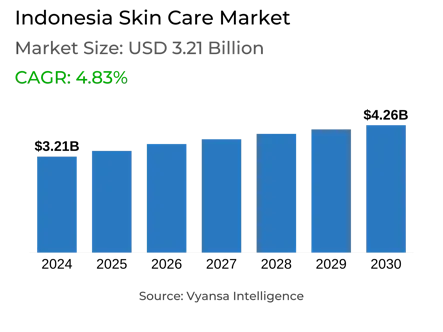
Skin care products are non-therapeutic topical preparations used to cleanse, moisturize, protect, exfoliate, and improve the appearance of facial and body skin. The skin care market includes facial cleansers, toners, moisturizers, serums, masks, exfoliators, cosmetic acne products, body lotions, hand and foot care, body oils, and sun care products. The demand for skin care in Indonesia is forecast to grow at a CAGR of 5.45% during 2026–2032.
Key Highlights of the Indonesia Skin Care Market
- The Indonesia skin care market was valued at USD 3.14 billion in 2025, increased to USD 3.31 billion in 2026, and is projected to reach USD 4.55 billion by 2032.
- The market is expected to grow at a CAGR of approximately 5.45% during 2026–2032.
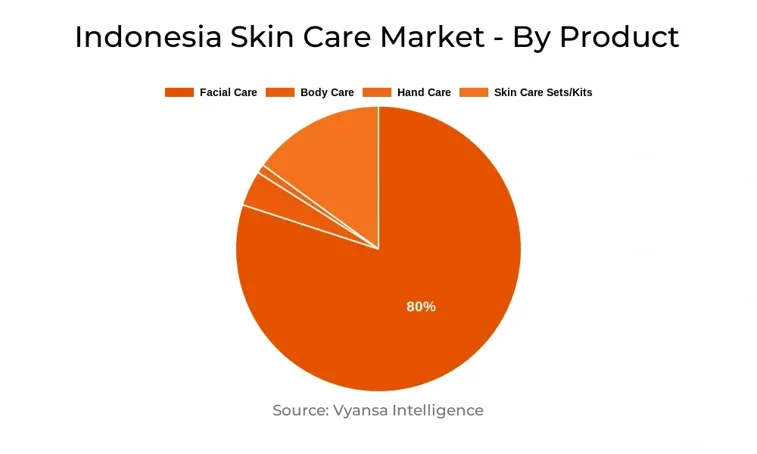
- Facial Care led the product type segment with an 80% market share in 2026.
- Body Care is projected to grow fastest by product type at a CAGR of approximately 6.99%.
- Synthetic ingredients accounted for 55% of total market value in 2026.
- Natural ingredients are expected to grow fastest by ingredient type at a CAGR of approximately 6.95%.
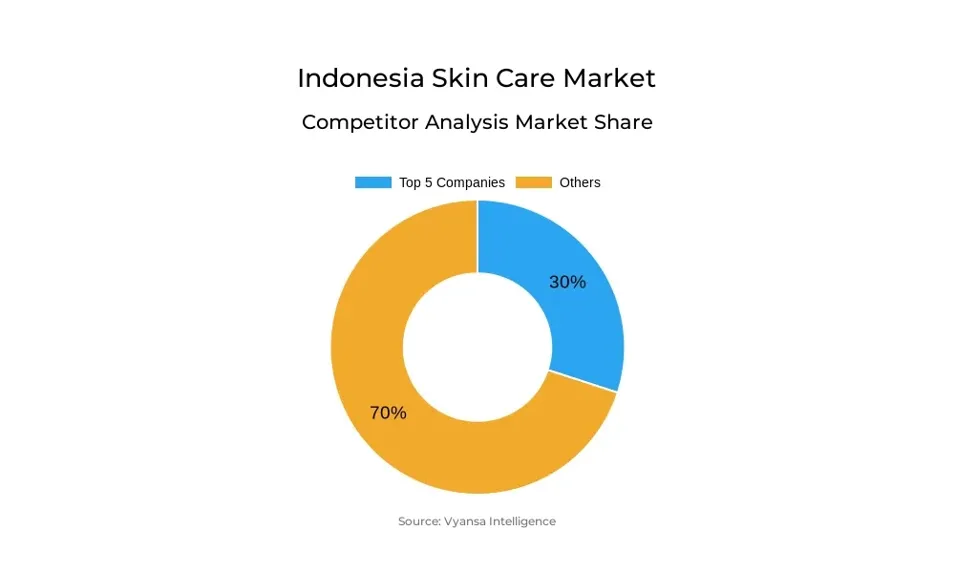
- The market is moderately fragmented, with the top five companies collectively accounting for approximately 39% of market revenue.
Indonesia’s large and relatively young consumer base is expected to remain a key driver of skincare demand and volume growth. The Ministry of Industry has identified a female population of more than 141.8 million as a significant structural foundation for the country’s cosmetics industry. Increasing awareness of skin health, greater access to product information, and expanding availability across mass-market, masstige, dermocosmetic, halal, and premium segments are enabling skincare companies to address diverse consumer needs and income levels.
At the same time, the rapid expansion of digital marketplaces and social media is transforming the consumer purchase journey. Consumers can discover products, evaluate ingredients and claims, compare prices, review user feedback, watch demonstrations, and complete purchases within a single digital ecosystem. However, offline channels remain important, particularly for consumers seeking product trials, professional recommendations, immediate availability, and assurance of product authenticity. Consequently, companies are increasingly required to adopt integrated online and offline distribution strategies to maximize market reach.
From 2026 to 2032, market growth is expected to increasingly favor products that combine demonstrable functional benefits, accessible pricing, credible claims, and suitability for Indonesia’s tropical climate and consumer preferences. Companies that maintain rapid innovation cycles, strengthen digital engagement, ensure regulatory compliance, and develop high-replenishment product categories will be better positioned to convert rising consumer awareness into repeat purchases and sustained revenue growth.
Government Regulations Strengthen Compliance Requirements in Indonesia’s Skin Care Market
BPOM Regulation No. 25 of 2025 Updates Cosmetic Ingredient Standards: BPOM Regulation No. 25 of 2025, effective October 3, 2025, updates Indonesia’s technical requirements for cosmetic ingredients and replaces the previous framework. It revises requirements covering restricted ingredients, permitted colorants, preservatives, UV filters, and prohibited substances. Products notified before October 3, 2025, are subject to a transition period and must comply with the updated requirements by October 3, 2026, requiring companies to review formulations and supporting documentation.
Mandatory Halal Certification Raises Market-Access Requirements: Government Regulation No. 42 of 2024 establishes the implementation framework for Indonesia’s Halal Product Assurance system. Cosmetics are subject to mandatory halal certification from October 17, 2026. Companies must strengthen controls over raw materials, production processes, storage, packaging, distribution, and documentation to demonstrate compliance. This requirement is expected to increase compliance responsibilities for domestic and international skincare brands.
BPOM Regulation No. 8 of 2026 Strengthens CPKB Certification: Effective April 29, 2026, BPOM Regulation No. 8 of 2026 updates procedures and technical requirements for Cosmetic Good Manufacturing Practices (CPKB) certification, replacing Regulation No. 33 of 2021. The regulation reinforces certification, renewal, facility, documentation, and compliance requirements, strengthening manufacturing quality and regulatory oversight across Indonesia’s cosmetics industry.
Indonesia Skin Care Market Drivers
Social Commerce Has Become the Primary Skin Care Sales Channel
Social commerce is changing how Indonesian consumers discover, compare, and purchase skin care products. Video demonstrations, livestreams, creator recommendations, customer reviews, limited-time promotions, and direct checkout can now occur within the same digital environment. This reduces the distance between product awareness and purchase while allowing brands to explain ingredients, routines, texture, usage, and expected cosmetic benefits visually.
In July 2026, BPOM reported that care, beauty, and skin care products were the highest-revenue product category on TikTok Shop. The regulator cited aggregate category revenue equivalent to approximately USD 1.99 billion and growth of 79.73%. However, BPOM’s release did not specify the exact measurement period attached to the revenue figure, so it should be treated as a platform-level indicator rather than a complete national market value.
This channel particularly benefits products requiring explanation, including serums, sunscreens, exfoliators, masks, acne-care products, and barrier-care formulations. During 2026–2032, brands that combine educational content with verified claims, trusted creators, competitive bundles, and dependable fulfilment will be more capable of converting engagement into sales. However, social-commerce growth also increases the need for monitoring sellers, preventing counterfeit circulation, and protecting consumers from misleading claims.
Indonesia Skin Care Market Restraints
Illegal and Unregistered Imported Products Are Flooding Digital Channels
Rapid digital-marketplace expansion has made it easier for unauthorized products and sellers to reach Indonesian consumers. Illegal products can avoid formal notification, ingredient review, import documentation, halal preparation, authorized distribution, and compliant labelling. They can consequently be sold at prices that formally registered brands may find difficult to match, creating unfair competition and weakening consumer confidence in the wider category.
During a nationwide inspection conducted from May 11 to May 22, 2026, BPOM inspected 190 cosmetics production and distribution facilities and found 128, or 67.37%, to be non-compliant. The regulator identified 2,205 product items comprising more than 2.12 million pieces, with an estimated economic value of approximately USD 2.00 million. Around 86.83% of the findings involved illegal or unlicensed cosmetics, while 12.58% were imported products without the required import documentation. More than 90% of the illegal products identified were imported.
BPOM also monitored 9,617 online links during the campaign and found approximately 94.2% in violation, with TikTok generating the largest share of problematic listings. This environment increases compliance, authentication, seller-monitoring, and brand-protection costs. During the forecast period, legitimate companies will need serialized supply chains, authorized-seller controls, responsive takedown procedures, visible registration information, and stronger consumer education to distinguish compliant products from illegal alternatives.
Indonesia Skin Care Market Recent Trends
AI Skin Analysis Is Moving from a Marketing Gimmick to Deployed Retail Infrastructure
Artificial intelligence is being integrated into Indonesia’s beauty purchase journey to assess visible skin concerns, personalize routines, and reduce uncertainty when consumers buy products online. Instead of offering only generic questionnaires, newer systems use uploaded or live facial images to evaluate characteristics such as visible spots, texture, pores, lines, and uneven tone before recommending suitable product combinations.
At ParagonCorp’s beauty science & technology 2026 event in Jakarta, Perfect Corp. worked with Make Over to deploy face attribute analysis and virtual try-on functions. More directly for skin care, ParagonCorp brand LABORÉ adopted Perfect Corp.’s AI-powered skin analysis API to support image-based skin assessment, concern tracking, and routine selection. Perfect Corp. reports more than 800 global brand partners and over 1.1 billion downloads of its YouCam applications.
For brands and retailers, these systems can improve product education, recommendation consistency, cross-selling, and first-party consumer insight. Their commercial value will depend on assessment accuracy, data privacy, clear disclaimers, inclusive skin-tone performance, and avoiding medical claims. During 2026–2032, AI analysis is likely to become a permanent feature within brand websites, marketplace stores, retail counters, and consumer loyalty applications.
Indonesia Skin Care Market Future Opportunities
Indonesia as Southeast Asia’s Contract-Manufacturing Base
Indonesia can strengthen its position as a regional OEM and ODM manufacturing location for local brands, international entrants, digital-first labels, and halal-oriented exporters. The opportunity extends beyond filling and packaging to formulation development, stability testing, regulatory support, ingredient sourcing, packaging design, product registration, and rapid small-batch commercialization.
PT Nayue Biotech Indonesia opened a 55,000-square-metre cosmetics manufacturing facility in Cikarang, West Java, in October 2025. The plant has a stated capacity of approximately 150 million units annually and employed more than 1,000 local workers at opening. Nayue initially invested USD 70 million and announced plans to raise cumulative investment to USD 200 million within five years.
The wider supply chain still presents a localization gap. Industry and government representatives reported in May 2026 that approximately 80% of cosmetic raw materials were imported. Indonesia nevertheless has more than 30,000 plant types with medicinal or functional potential, creating scope for standardized botanical extracts, palm-derived ingredients, fragrances, functional actives, and locally adapted formulations.
Developing domestic ingredient, packaging, laboratory, and certification capacity around large contract-manufacturing facilities could shorten launch times and reduce exposure to exchange-rate and shipping disruptions. Suppliers that combine scalable production with halal-compatible processes and export documentation can serve brands targeting Indonesia, Malaysia, Singapore, and Gulf markets.
Unlock Market Intelligence
Explore the market potential with our data-driven report
Indonesia Skin Care Market Segmentation Analysis
By Product Type
- Facial Care
- Facial Cleansers and Makeup Removers
- Toners and Facial Mists
- Moisturizers and Creams
- Serums and Essences
- Face Masks
- Eye Care
- Facial Exfoliators
- Cosmetic Acne and Spot Care
- Other Facial Care
- Body Care
- Body Lotions and Creams
- Hand Care
- Foot Care
- Body Oils
- Body Exfoliators
- Other Body Care
- Sun Care
- Others
Facial Care Sustains Market Dominance as Body Care Growth Accelerates
Facial Care accounted for 80% of market value in 2026. Its leadership is supported by multi-step routines, frequent replenishment, broad product availability, and the large number of concerns addressed by facial products. Cleansers and moisturizers serve everyday needs, while serums, masks, exfoliators, eye products, and cosmetic acne-care formulations raise average spending by adding specialist stages to consumer routines.
Body Care is forecast to grow fastest at a CAGR of 6.99% during 2026–2032. Growth will be supported by the movement of facial-care concepts into body products, including ceramides, exfoliating acids, brightening ingredients, body serums, intensive hand care, and targeted foot care. Consumers are also becoming more aware of dryness, barrier damage, uneven tone, and sun exposure beyond the face. This will encourage suppliers to introduce lighter textures, climate-suitable lotions, treatment-led body products, and larger value packs for frequent application.
By Ingredient Type
- Natural
- Synthetic
Synthetic Ingredients Retain Market Leadership as Natural Formulations Expand
Synthetic ingredients led the market with a 55% share in 2026. These ingredients are widely used because manufacturers can obtain standardized purity, controlled concentration, predictable performance, longer stability, and consistent supply across large production runs. They are particularly important in sunscreens, preservatives, exfoliating formulations, texture systems, cosmetic acne products, brightening products, and high-performance serums. Synthetic formulation does not necessarily indicate lower quality; product safety depends on permitted ingredients, concentration, manufacturing controls, and appropriate product use.
Natural ingredients are forecast to record the fastest CAGR of 6.95% during 2026–2032. Growth will be driven by consumer interest in botanical extracts, plant oils, natural fragrances, sustainability, local sourcing, and culturally familiar ingredients. Indonesia’s biodiversity provides a broad development base, but commercial success requires standardized actives, stable formulations, reproducible performance, safety testing, traceable sourcing, and credible claims.
The strongest future products are likely to combine natural-origin ingredients with scientifically validated formulation systems rather than relying on an entirely natural positioning. This approach can offer local differentiation while maintaining product stability, sensory performance, and scalable manufacturing.
Unlock Market Intelligence
Explore the market potential with our data-driven report
Indonesia Skin Care Market Competitive Landscape
The Indonesia skin care industryis moderately fragmented, with the top five companies collectively accounting for 39% of revenue. The top companies comprise PT L’Oréal Indonesia, PT Paragon Technology and Innovation, PT Unilever Indonesia Tbk, Hong Kong Skin Divatech Limited, and Hong Kong Pure Glow Limited.
Key Companies in the Indonesia Skin Care Market
- PT L’Oréal Indonesia
- PT Paragon Technology and Innovation
- PT Unilever Indonesia Tbk
- Hong Kong Skin Divatech Limited
- Hong Kong Pure Glow Limited
- PT Rohto Laboratories Indonesia
- PT Beaute Haul Indonesia
- PT Beiersdorf Indonesia
- PT Galderma Indonesia Healthcare
- PT Kosmetika Cantik Indonesia
- Others
Recent Developments in the Indonesia Skin Care Market
- June 2026: L’Oréal and Shopee launched the House of Beauty Hyper Brand Day in Indonesia, covering 13 L’Oréal brands and five Shopee-exclusive product launches. A dedicated Skincare Derma Day featured La Roche-Posay CeraVe and Garnier, strengthening digital access to sensitive-skin dermatological and skin-barrier products.
Frequently Asked Questions
Related Report
- Market Segmentation
- Research Scope
- Research Methodology
- Definitions and Assumptions
- Executive Summary
- Indonesia Skin Care Market Policies, Regulations, and Standards
- Indonesia Skin Care Market Dynamics
- Growth Factors
- Challenges
- Trends
- Opportunities
- Indonesia Skin Care Market Statistics, 2022-2032F
- Market Size & Growth Outlook
- By Revenues in USD Million
- Market Segmentation & Growth Outlook
- By Product Type
- Facial Care- Market Insights and Forecast 2022-2032, USD Million
- Facial Cleansers and Makeup Removers- Market Insights and Forecast 2022-2032, USD Million
- Toners and Facial Mists- Market Insights and Forecast 2022-2032, USD Million
- Moisturizers and Creams- Market Insights and Forecast 2022-2032, USD Million
- Serums and Essences- Market Insights and Forecast 2022-2032, USD Million
- Face Masks- Market Insights and Forecast 2022-2032, USD Million
- Eye Care- Market Insights and Forecast 2022-2032, USD Million
- Facial Exfoliators- Market Insights and Forecast 2022-2032, USD Million
- Cosmetic Acne and Spot Care- Market Insights and Forecast 2022-2032, USD Million
- Other Facial Care- Market Insights and Forecast 2022-2032, USD Million
- Body Care- Market Insights and Forecast 2022-2032, USD Million
- Body Lotions and Creams- Market Insights and Forecast 2022-2032, USD Million
- Hand Care- Market Insights and Forecast 2022-2032, USD Million
- Foot Care- Market Insights and Forecast 2022-2032, USD Million
- Body Oils- Market Insights and Forecast 2022-2032, USD Million
- Body Exfoliators- Market Insights and Forecast 2022-2032, USD Million
- Other Body Care- Market Insights and Forecast 2022-2032, USD Million
- Sun Care- Market Insights and Forecast 2022-2032, USD Million
- Others- Market Insights and Forecast 2022-2032, USD Million
- Facial Care- Market Insights and Forecast 2022-2032, USD Million
- By Category
- Mass- Market Insights and Forecast 2022-2032, USD Million
- Premium- Market Insights and Forecast 2022-2032, USD Million
- By Ingredient Type
- Natural- Market Insights and Forecast 2022-2032, USD Million
- Synthetic- Market Insights and Forecast 2022-2032, USD Million
- By Target Gender
- Women- Market Insights and Forecast 2022-2032, USD Million
- Men- Market Insights and Forecast 2022-2032, USD Million
- Unisex- Market Insights and Forecast 2022-2032, USD Million
- By Age Group
- Baby Care- Market Insights and Forecast 2022-2032, USD Million
- Adult Care- Market Insights and Forecast 2022-2032, USD Million
- Mature Skin/Anti-Ageing- Market Insights and Forecast 2022-2032, USD Million
- By Packaging
- Tubes- Market Insights and Forecast 2022-2032, USD Million
- Bottles- Market Insights and Forecast 2022-2032, USD Million
- Jars- Market Insights and Forecast 2022-2032, USD Million
- Others- Market Insights and Forecast 2022-2032, USD Million
- By Sales Channel
- Supermarkets and Hypermarkets- Market Insights and Forecast 2022-2032, USD Million
- Convenience Stores- Market Insights and Forecast 2022-2032, USD Million
- Pharmacies and Drug Stores- Market Insights and Forecast 2022-2032, USD Million
- Exclusive/Multi-Brand Stores- Market Insights and Forecast 2022-2032, USD Million
- Online Stores- Market Insights and Forecast 2022-2032, USD Million
- Others- Market Insights and Forecast 2022-2032, USD Million
- By Region
- Sumatra- Market Insights and Forecast 2022-2032, USD Million
- Java- Market Insights and Forecast 2022-2032, USD Million
- Kalimantan- Market Insights and Forecast 2022-2032, USD Million
- Sulawesi- Market Insights and Forecast 2022-2032, USD Million
- Others- Market Insights and Forecast 2022-2032, USD Million
- By Competitors
- Competition Characteristics
- Market Share & Analysis
- By Product Type
- Market Size & Growth Outlook
- Indonesia Facial Care Market Statistics, 2022-2032
- Market Size & Growth Outlook
- By Revenues in USD Million
- Market Segmentation & Growth Outlook
- By Category- Market Insights and Forecast 2022-2032, USD Million
- By Ingredient Type- Market Insights and Forecast 2022-2032, USD Million
- By Target Gender- Market Insights and Forecast 2022-2032, USD Million
- By Age Group- Market Insights and Forecast 2022-2032, USD Million
- By Packaging- Market Insights and Forecast 2022-2032, USD Million
- By Sales Channel- Market Insights and Forecast 2022-2032, USD Million
- By Region- Market Insights and Forecast 2022-2032, USD Million
- Market Size & Growth Outlook
- Indonesia Body Care Market Statistics, 2022-2032
- Market Size & Growth Outlook
- By Revenues in USD Million
- Market Segmentation & Growth Outlook
- By Category- Market Insights and Forecast 2022-2032, USD Million
- By Ingredient Type- Market Insights and Forecast 2022-2032, USD Million
- By Target Gender- Market Insights and Forecast 2022-2032, USD Million
- By Age Group- Market Insights and Forecast 2022-2032, USD Million
- By Packaging- Market Insights and Forecast 2022-2032, USD Million
- By Sales Channel- Market Insights and Forecast 2022-2032, USD Million
- By Region- Market Insights and Forecast 2022-2032, USD Million
- Market Size & Growth Outlook
- Indonesia Sun Care Market Statistics, 2022-2032
- Market Size & Growth Outlook
- By Revenues in USD Million
- Market Segmentation & Growth Outlook
- By Category- Market Insights and Forecast 2022-2032, USD Million
- By Ingredient Type- Market Insights and Forecast 2022-2032, USD Million
- By Target Gender- Market Insights and Forecast 2022-2032, USD Million
- By Age Group- Market Insights and Forecast 2022-2032, USD Million
- By Packaging- Market Insights and Forecast 2022-2032, USD Million
- By Sales Channel- Market Insights and Forecast 2022-2032, USD Million
- By Region- Market Insights and Forecast 2022-2032, USD Million
- Market Size & Growth Outlook
- Indonesia Others Market Statistics, 2022-2032
- Market Size & Growth Outlook
- By Revenues in USD Million
- Market Segmentation & Growth Outlook
- By Category- Market Insights and Forecast 2022-2032, USD Million
- By Ingredient Type- Market Insights and Forecast 2022-2032, USD Million
- By Target Gender- Market Insights and Forecast 2022-2032, USD Million
- By Age Group- Market Insights and Forecast 2022-2032, USD Million
- By Packaging- Market Insights and Forecast 2022-2032, USD Million
- By Sales Channel- Market Insights and Forecast 2022-2032, USD Million
- By Region- Market Insights and Forecast 2022-2032, USD Million
- Market Size & Growth Outlook
- Competitive Outlook
- Company Profiles
- PT L'Oréal Indonesia
- Business Description
- Product Portfolio
- Collaborations & Alliances
- Recent Developments
- Financial Details
- Others
- PT Paragon Technology and Innovation
- Business Description
- Product Portfolio
- Collaborations & Alliances
- Recent Developments
- Financial Details
- Others
- PT Unilever Indonesia Tbk
- Business Description
- Product Portfolio
- Collaborations & Alliances
- Recent Developments
- Financial Details
- Others
- HONG KONG SKIN DIVATECH LIMITED
- Business Description
- Product Portfolio
- Collaborations & Alliances
- Recent Developments
- Financial Details
- Others
- Hong Kong Pure Glow Limited
- Business Description
- Product Portfolio
- Collaborations & Alliances
- Recent Developments
- Financial Details
- Others
- PT. Rohto Laboratories Indonesia
- Business Description
- Product Portfolio
- Collaborations & Alliances
- Recent Developments
- Financial Details
- Others
- PT Beaute Haul Indonesia
- Business Description
- Product Portfolio
- Collaborations & Alliances
- Recent Developments
- Financial Details
- Others
- PT. Beiersdorf Indonesia
- Business Description
- Product Portfolio
- Collaborations & Alliances
- Recent Developments
- Financial Details
- Others
- PT Galderma Indonesia Healthcare
- Business Description
- Product Portfolio
- Collaborations & Alliances
- Recent Developments
- Financial Details
- Others
- PT. KOSMETIKA CANTIK INDONESIA
- Business Description
- Product Portfolio
- Collaborations & Alliances
- Recent Developments
- Financial Details
- Others
- PT L'Oréal Indonesia
- Company Profiles
- Disclaimer
| Segment | Sub-Segment |
|---|---|
| By Product Type |
|
| By Category |
|
| By Ingredient Type |
|
| By Target Gender |
|
| By Age Group |
|
| By Packaging |
|
| By Sales Channel |
|
| By Region |
|
Research Methodology
This study followed a structured approach comprising four key phases to assess the size and scope of the electro-oxidation market. The process began with thorough secondary research to collect data on the target market, related markets, and broader industry context. These findings, along with preliminary assumptions and estimates, were then validated through extensive primary research involving industry experts from across the value chain. To calculate the overall market size, both top-down and bottom-up methodologies were employed. Finally, market segmentation and data triangulation techniques were applied to refine and validate segment-level estimations.
Secondary Research
The secondary research phase involved gathering data from a wide range of credible and published sources. This step helped in identifying industry trends, defining market segmentation, and understanding the market landscape and value chain.
Sources consulted during this phase included:
- Company annual reports, investor presentations, and press releases
- Industry white papers and certified publications
- Trade directories and market-recognized databases
- Articles from authoritative authors and reputable journals
- Gold and silver standard websites
Secondary research was critical in mapping out the industry's value chain and monetary flow, identifying key market segments, understanding regional variations, and tracking significant industry developments.
Other key sources:
- Financial disclosures
- Industry associations and trade bodies
- News outlets and business magazines
- Academic journals and research studies
- Paid industry databases
Primary Research
To validate secondary data and gain deeper market insights, primary research was conducted with key stakeholders across both the supply and demand sides of the market.
On the demand side, participants included decision-makers and influencers from end-user industries—such as CIOs, CTOs, and CSOs—who provided first-hand perspectives on market needs, product usage, and future expectations.
On the supply side, interviews were conducted with manufacturers, industry associations, and institutional participants to gather insights into current offerings, product pipelines, and market challenges.
Primary interviews provided critical inputs such as:
- Market size and revenue data
- Product and service breakdowns
- Market forecasts
- Regional and application-specific trends
Stakeholders consulted included:
- Leading OEM and solution providers
- Channel and distribution partners
- End users across various applications
- Independent consultants and industry specialists
Market Size Estimation and Data Triangulation
- Identifying Key Market Participants (Secondary Research)
- Goal: To identify the major players or companies in the target market. This typically involves using publicly available data sources such as industry reports, market research publications, and financial statements of companies.
- Tools: Reports from firms like Gartner, Forrester, Euromonitor, Statista, IBISWorld, and others. Public financial statements, news articles, and press releases from top market players.
- Extracting Earnings of Key Market Participants
- Goal: To estimate the earnings generated from the product or service being analyzed. This step helps in understanding the revenue potential of each market player in a specific geography.
- Methods: Earnings data can be gathered from:
- Publicly available financial reports (for listed companies).
- Interviews and primary data sources from professionals, such as Directors, VPs, SVPs, etc. This is especially useful for understanding more nuanced, internal data that isn't publicly disclosed.
- Annual reports and investor presentations of key players.
- Data Collation and Development of a Relevant Data Model
- Goal: To collate inputs from both primary and secondary sources into a structured, data-driven model for market estimation. This model will incorporate key market KPIs and any independent variables relevant to the market.
- Key KPIs: These could include:
- Market size, growth rate, and demand drivers.
- Industry-specific metrics like market share, average revenue per customer (ARPC), or average deal size.
- External variables, such as economic growth rates, inflation rates, or commodity prices, that could affect the market.
- Data Modeling: Based on this data, the market forecasts are developed for the next 5 years. A combination of trend analysis, scenario modeling, and statistical regression might be used to generate projections.
- Scenario Analysis
- Goal: To test different assumptions and validate how sensitive the market is to changes in key variables (e.g., market demand, regulatory changes, technological disruptions).
- Types of Scenarios:
- Base Case: Based on current assumptions and historical data.
- Best-Case Scenario: Assuming favorable market conditions, regulatory environments, and technological advancements.
- Worst-Case Scenario: Accounting for adverse factors, such as economic downturns, stricter regulations, or unexpected disruptions.












