India Air Purifier Market
With 204 of 238 monitored Indian cities exceeding the national PM2.5 limit and rising awareness of indoor air quality, households and institutions are increasingly adopting air purifiers to protect occupants, driving demand for advanced filtration systems, connected purification technologies and replacement filters through 2033. ... Read more
|
Major Players
|
India Air Purifier Market Overview
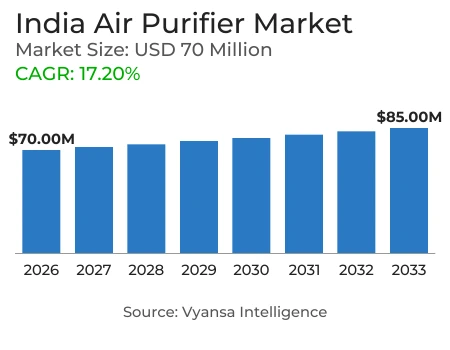
In India, an air purifier is an electric appliance that pulls room air through a filter stack and returns it with fewer fine particles, kept working by replacement filters. Households use it in bedrooms and living rooms, while schools, offices and clinics use it to protect occupants. The India air purifier market is forecast to grow at a compound annual growth rate (CAGR) of 17.20% between 2027 and 2033.
Key Highlights of the India Air Purifier Market
- The India air purifier market was valued at USD 70 million in 2026 and is estimated at USD 85 million in 2027 and is forecast to reach USD 220 million by 2033.
- The market is forecast to expand at a CAGR of 17.20% between 2027 and 2033.
- By technology, high-efficiency particulate air (HEPA) with Activated Carbon led with an 85% share in 2026.
- HEPA with Activated Carbon is also the fastest-growing technology, expanding at a CAGR of 12.89% between 2027 and 2033.
- By end use, Residential led with a 68% share in 2026.
- Commercial and Institutional is the fastest-growing end use, expanding at a CAGR of 15.83% between 2027 and 2033.
- The market is moderately consolidated, with the top five companies holding a combined 52% share in 2026.
The India air purifier market is moving from a winter reaction toward a protective appliance used for specific people in specific rooms. A snapshot of October 2025 to February 2026 from the centre for research on energy and clean air found that 204 of 238 cities with enough monitoring data exceeded the national limit for fine particles (PM2.5), and none of the 79 cities in the Indo-Gangetic Plain with enough data complied. Households therefore treat indoor air as the one space they can control.
Three forces decide how much of this exposure converts into consumption. Filtration cannot be seen, so sensor read-outs, certification and visible air quality numbers act as proof for end users. Running cost decides whether a unit stays in use, because the appliance is a one-time outlay while filters recur. Online retail, where end users compare ratings and prices, saw gross merchandise value grow about 25% to nearly USD 38 billion in the first half of 2026, according to the India brand equity foundation in October 2026.
By the end of the forecast period the market should depend less on the winter peak, provided two conditions hold. Entry prices and filter costs must fall to a level that keeps units running after the smog recedes, and users beyond households must treat purifiers as standard equipment rather than one-off installations. If both hold, demand spreads across more cities, more rooms and more months of the year.
India Air Purifier Market Drivers
Published Health Burden Estimates Turning Smog Exposure into Protective Consumption
Households with children, elderly members or family members with breathing problems now treat particle exposure as a health risk to be managed, not a seasonal discomfort. An air purifier is the one measure an individual can control inside the home, so end users who cannot change outdoor air consume indoor filtration instead. This ties demand in the air purifier industry to every public health signal.
The 2025 Lancet Countdown, released on 29 October 2025, attributed 1,718,000 deaths in India to human-caused fine particle exposure. The union government replied on 11 December 2025 that national data did not conclusively link pollution to deaths at that scale, yet the figure still entered the public debate. By 23 December 2025 a Delhi retail traders' association said the average shop was moving about twenty purifiers a day against about four earlier.
Through the forecast period, each winter episode and each new health estimate widens the group of households keeping a unit in at least one room, starting with children's bedrooms. The driver stays commercially live because exposure repeats every year and the filters in each installed unit need replacing. Health-risk signals therefore convert exposure into first-time unit consumption and recurring filter demand each season.
India Air Purifier Market Challenges
Filter Running Cost and a Fixed Tax Rate Narrow Who Keeps Units in Use
Entry price and filter replacement together decide whether a purifier stays in use beyond its first winter. Units carry the standard goods and services tax (GST) rate at the point of consumption, and filters recur on a schedule set by usage hours and particle load. Brands across the air purifier industry carry this pressure, and it is structural, since filter media and sensing parts cannot be removed without weakening filtration.
On 24 December 2025 the Delhi high court asked the GST Council to weigh a cut, in a petition seeking medical device classification and a 5% rate in place of 18%. On 6 October 2026 the GST fitment committee recommended no cut, citing wider filter use in ventilation, cleanrooms and hospitals and the risk of cheaper imports gaining over domestic manufacturers.
Manufacturers respond by making running cost explicit: Eureka Forbes Limited's May 2026 guidance sets true cost at upfront price, electricity and filter replacement. Households that cannot carry that total defer consumption, while higher-income urban households and institutions that budget for filters carry demand. The constraint therefore relocates volume toward end users who can sustain filter spend. Running cost thus shifts demand toward affluent households and institutions rather than removing it.
India Air Purifier Market Recent Trends
Mandatory Electrical Safety Certification Resets How Purifiers Are Specified
Air purifier supply in India is moving toward compulsory electrical safety certification, and the units on offer must now carry it. This replaces a specification process led by filtration claims and sensor features alone. Importers, assemblers and retailers must specify certified units, which changes what a listing needs before it can be consumed.
On 6 April 2026 the central government's department for promotion of industry and internal trade issued the safety of household, commercial and similar electrical appliances (quality control) order, 2026 (S.O. 1739(E)), which covers 90 items including air-cleaning appliances and applies the electrical safety standard IS 302 (Part 1):2024. The order came into force on 1 October 2026, with a later date for micro and small enterprises, and reaches battery-operated units and units supplied with direct current.
It certifies electrical safety only, not clean air delivery rate (CADR), filter grade or ozone emission, so compliance cost rises while filtration claims stay unverified. Through the forecast period, consumption concentrates toward companies that already hold certified ranges, and public tenders gain a ready screening criterion. Smaller importers with uncertified listings lose shelf access. Certification therefore moves demand toward compliant, established suppliers rather than reducing it.
Multi-Sensor Auto Mode Replaces Manual Fan Control in Connected Purifiers
Connected purifiers now read several pollutants and adjust fan output on their own, which removes manual speed selection. Filtration cannot be seen, so end users either run units at a fixed high speed, which raises noise and filter wear, or switch them off when the air looks clear. Auto mode ties fan speed and filter-life alerts to measured particle load, which keeps the filter stack working only when exposure requires it.
On 25 August 2026 Xiaomi Technology India Private Limited launched the Mijia Smart Air Purifier 6 with five onboard sensors for two particle sizes, dust, temperature and humidity, app control through Xiaomi Home and a rated particle CADR of 443 cubic metres per hour. Xiaomi rates the unit for rooms of up to about 940 square feet at two air changes per hour. These are manufacturer ratings.
Adoption requires reliable Wi-Fi, a smartphone and sensors that stay accurate, so connected units concentrate in urban, higher-income homes. Companies that publish measurable ratings and keep alerts current differentiate on trust rather than price. This lifts consumption of higher-priced connected units and their replacement filters, while basic models compete on entry cost. Sensing therefore moves demand toward units that prove their performance.
India Air Purifier Market Future Opportunities
Public Institution Tenders Open a Contract Route Built Around Filter Replacement
Public bodies consume purifiers for occupants who cannot decide for themselves, such as schoolchildren and patients, through tenders that do not follow the winter calendar. Programmes announced so far describe unit numbers rather than filter replacement and monitoring. That leaves the air purifier industry with a gap between one-time unit supply and the recurring cost of keeping units effective.
On 19 December 2025 the Delhi education minister announced purifiers for 10,000 government school classrooms in a first phase, with tenders floated the same day and an ambition of about 38,000 classrooms. The council on energy, environment and water (CEEW) sized such a programme on one purifier per classroom and 40 to 50 classrooms in each of Delhi's 1,240 government schools. Manufacturers that supply certified units and replace filters on schedule are best placed to win.
Execution needs certified units, installation capacity, a filter replacement schedule and service reach beyond the capital. Established manufacturers with certified ranges and local service teams are positioned to bid, and bundled filter contracts shift value toward recurring supply. Each awarded programme adds consumption on a schedule independent of the winter peak. Public institution tenders therefore add a year-round demand pool beside household consumption.
India Air Purifier Market Segmentation Analysis
By Technology:
- HEPA with Activated Carbon
- HEPA without Activated Carbon
- Non-HEPA Technologies
Combined Particle and Gas Filtration Anchors 85% of Technology Demand
HEPA with Activated Carbon leads because Indian indoor air carries fine particles together with smoke, cooking fumes and odours, and a single filter stack that handles both removes the need for a second device. The lead holds through the forecast period unless a verified performance standard begins to favour particle-only filtration.
In October 2025 Dyson Technology India Private Limited launched the Purifier Cool PC1 (TP11) in India with a sealed HEPA filter rated to capture 99.95% of particles down to 0.1 micron and an activated carbon layer that targets gases and nitrogen dioxide. On 19 August 2026 Indo National Limited launched Nippo Airvue in four models for 300 to 1,500 square feet, with a four-stage filtration system that combines True HEPA and activated carbon.
HEPA with Activated Carbon is also the fastest-growing technology, expanding at a CAGR of 12.89% between 2027 and 2033, against 8.14% for both HEPA without Activated Carbon and Non-HEPA Technologies. Growth comes from first-time households and sensing-led premium models that specify a carbon layer, and from the replacement cycle, since carbon layers saturate and are changed with the particle filter. It outgrows the other two because it treats the full pollutant mix in one unit, while HEPA without Activated Carbon leaves gases untreated and Non-HEPA Technologies capture fewer particles.
By End Use:
- Residential
- Commercial and Institutional
- Industrial
Household Protection Carries 68% of End Use Demand
Residential leads because protection is consumed for particular people in particular rooms, so each household with a child, an elderly member or an allergy-affected member is a potential unit owner, and retail channels across the air purifier industry already carry units at many price points. In December 2025 Dyson Technology India Private Limited launched the HushJet Purifier Compact in India for bedrooms and compact homes, with a smart auto mode that uses sensors to adjust performance. The lead holds through the forecast period unless institutional procurement scales faster than household ownership.
Commercial and Institutional is the fastest-growing end use, expanding at a CAGR of 15.83% between 2027 and 2033, against 10.52% for Residential. The base is large: the unified district information system for education plus (UDISE+) for 2025-26 counts 1,466,682 schools and 247.2 million students, and the 2026-27 union budget raised the allocation under the Ayushman Bharat health infrastructure mission by 67.66%.
In September 2025 Camfil India opened a new high-efficiency filter production line at Manesar for hospitals, cleanrooms and advanced purification systems. Institutions grow faster than households because they procure by tender and specification for fixed occupant numbers, so demand follows built space, not the winter calendar.
India Air Purifier Market Competitive Landscape
The market is moderately consolidated across the air purifier industry, with the top five companies holding a combined 52% share in 2026. The major companies in the market are Dyson Technology India Private Limited, Versuni India Home Solutions Limited (Philips), Xiaomi Technology India Private Limited, Secure Connection Private Limited (Honeywell) and Daikin Airconditioning India Private Limited.
Key Companies in the India Air Purifier Market
- Dyson Technology India Private Limited
- Versuni India Home Solutions Limited (Philips)
- Xiaomi Technology India Private Limited
- SHARP Business Systems (India) Private Limited
- Frootle India Private Limited
- Secure Connection Private Limited (Honeywell)
- Daikin Airconditioning India Private Limited
- Eureka Forbes Limited
- KENT RO SYSTEMS LIMITED
- Crusaders Technologies India Private Limited
Company Profiling
The following five companies are the leading participants in the air purifier industry.
Dyson Technology India Private Limited is the Indian operating entity of the Dyson group and participates through its Purifier Cool, Hot+Cool and HushJet ranges, sold for homes through Dyson.in and Dyson Demo Stores across India. Manufacturing capacity is not publicly disclosed; the nearest verified operational metric is its nationwide Demo Store network. In November 2025 it launched the Purifier Hot+Cool HP2 De-NOx and HP1, adding nitrogen dioxide capture and heating to its purifier range. Dyson is a technology-led premium supplier.
Versuni India Home Solutions Limited, the Indian entity of Versuni listing a Kolkata address, participates through Philips-branded air purifiers sold for homes via its own website and offline and online retailers. Capacity is not publicly disclosed; the nearest verified metric is a four-model range spanning 250 to 600 cubic metres per hour of CADR. In October 2024 it launched that range as the 3200, 4200 Pro and 900 Mini series, adding SilentWings fan technology, HEPA NanoProtect filtration and Air+ app connectivity. Versuni is a brand-led connected-range supplier.
Xiaomi Technology India Private Limited, headquartered in Bengaluru, participates through the Mijia Smart Air Purifier 6, Mijia Smart Air Purifier 4 Compact and Xiaomi Smart Air Purifier 4 Lite, sold online and through quick-commerce platforms for homes. Capacity is not publicly disclosed; the nearest verified metric is a three-model range with particle CADR of up to 443 cubic metres per hour. In August 2026 it introduced the Mijia smart home label in India, opening with air purifiers and reintroducing the Smart Air Purifier 4 Lite. Xiaomi is a connected, value-led distribution participant.
Secure Connection Private Limited, an affiliate of the Hong Kong based Secure Connection Limited, participates through Honeywell-licensed air purifiers such as the Air Touch V1 and V5, sold for homes through retailers and e-commerce platforms. Capacity is not publicly disclosed; the nearest verified metric is a Honeywell-licensed range of five Air Touch models. In October 2024 it launched the Air Touch V1 and V5 with four-stage filtration and app connectivity. Secure Connection is a licence-led, value-focused supplier.
Daikin Airconditioning India Private Limited is the Indian arm of Daikin Industries Ltd of Japan and participates through portable room air purifiers such as the MC30, MC40XVM6 and MC55XVM6 with HEPA and activated carbon filtration, sold for homes and offices. Air purifier capacity is not publicly disclosed; the nearest verified metric is a five-model portable range. In November 2025 the Daikin group company AAF India opened an air filtration plant in Noida, adding domestic filter supply. Daikin is a distribution-led, brand-trusted participant.
Recent Developments in the India Air Purifier Market
- In September 2026 the commission for air quality management (CAQM) revised the graded response action plan (GRAP) for the coming winter on 28 September, adding stricter construction measures and vehicle curbs a day after the Delhi government and the environment ministry discussed the winter plan. The revision signals that authorities expect another season of severe episodes in Delhi and the surrounding region, which sustains pre-season consumption of purifiers and replacement filters among households and institutions that equip rooms ahead of the first episodes.
- In January 2026, on 2 January, CAQM revoked Stage III actions under GRAP and intensified Stage I and II measures as air quality improved. The easing shows how quickly the emergency trigger recedes, and it moderates short-term consumption of purifiers once restrictions lift, which is why the winter peak remains the main swing factor in annual volumes.
Frequently Asked Questions
Related Report
- India Air Purifier Market Segmentation
- India Air Purifier Market Introduction
- Product Definition
- Research Process
- Assumptions
- India Air Purifier Market Executive Summary
- India Air Purifier Market Trends & Developments
- India Air Purifier Market Dynamics
- Growth Factors
- Challenges
- Impact Analysis
- India Air Purifier Market Hotspot & Opportunities
- India Air Purifier Market Outlook (2023-2033)
- Market Size & Outlook
- By Revenues (USD Million)
- By Volume (Million Units)
- Market Segmentation & Outlook
- By Technology - USD Million & Million Units (2023-2033)
- HEPA with Activated Carbon
- HEPA without Activated Carbon
- Non-HEPA Technologies
- By Mounting Type - USD Million & Million Units (2023-2033)
- Portable
- Fixed
- By End Use - USD Million & Million Units (2023-2033)
- Residential
- Commercial and Institutional
- Industrial
- By Distribution Channel - USD Million & Million Units (2023-2033)
- Online
- Offline
- By Geography
- North India
- South India
- East India
- West India
- By Company
- Competition Characteristics
- Market Shares & Analysis
- By Technology - USD Million & Million Units (2023-2033)
- India HEPA with Activated Carbon Market Outlook (2023-2033)
- Market Size & Outlook
- By Revenues (USD Million)
- By Volume (Million Units)
- Market Segmentation & Outlook
- By Technology - USD Million & Million Units (2023-2033)
- By Mounting Type - USD Million & Million Units (2023-2033)
- By End Use - USD Million & Million Units (2023-2033)
- By Distribution Channel - USD Million & Million Units (2023-2033)
- Market Size & Outlook
- India HEPA without Activated Carbon Market Outlook (2023-2033)
- Market Size & Outlook
- By Revenues (USD Million)
- By Volume (Million Units)
- Market Segmentation & Outlook
- By Technology - USD Million & Million Units (2023-2033)
- By Mounting Type - USD Million & Million Units (2023-2033)
- By End Use - USD Million & Million Units (2023-2033)
- By Distribution Channel - USD Million & Million Units (2023-2033)
- Market Size & Outlook
- India Non-HEPA Technologies Market Outlook (2023-2033)
- Market Size & Outlook
- By Revenues (USD Million)
- By Volume (Million Units)
- Market Segmentation & Outlook
- By Technology - USD Million & Million Units (2023-2033)
- By Mounting Type - USD Million & Million Units (2023-2033)
- By End Use - USD Million & Million Units (2023-2033)
- By Distribution Channel - USD Million & Million Units (2023-2033)
- Market Size & Outlook
- Market Size & Outlook
- India Air Purifier Market Key Strategic Imperatives for Success & Growth
- India Air Purifier Market Competitive Outlook
- Dyson Technology India Private Limited
- Business Description
- Product Portfolio
- Collaborations & Alliances
- Recent Developments
- Financial Details
- Others
- Versuni India Home Solutions Limited (Philips)
- Business Description
- Product Portfolio
- Collaborations & Alliances
- Recent Developments
- Financial Details
- Others
- Xiaomi Technology India Private Limited
- Business Description
- Product Portfolio
- Collaborations & Alliances
- Recent Developments
- Financial Details
- Others
- SHARP Business Systems (India) Private Limited
- Business Description
- Product Portfolio
- Collaborations & Alliances
- Recent Developments
- Financial Details
- Others
- Frootle India Private Limited
- Business Description
- Product Portfolio
- Collaborations & Alliances
- Recent Developments
- Financial Details
- Others
- Secure Connection Private Limited (Honeywell)
- Business Description
- Product Portfolio
- Collaborations & Alliances
- Recent Developments
- Financial Details
- Others
- Daikin Airconditioning India Private Limited
- Business Description
- Product Portfolio
- Collaborations & Alliances
- Recent Developments
- Financial Details
- Others
- Eureka Forbes Limited
- Business Description
- Product Portfolio
- Collaborations & Alliances
- Recent Developments
- Financial Details
- Others
- KENT RO SYSTEMS LIMITED
- Business Description
- Product Portfolio
- Collaborations & Alliances
- Recent Developments
- Financial Details
- Others
- Crusaders Technologies India Private Limited
- Business Description
- Product Portfolio
- Collaborations & Alliances
- Recent Developments
- Financial Details
- Others
- Dyson Technology India Private Limited
- Disclaimer
| Segment | Sub-Segment |
|---|---|
| By Technology |
|
| By Mounting Type |
|
| By End Use |
|
| By Distribution Channel |
|
| By Geography |
|
Research Methodology
This study followed a structured approach comprising four key phases to assess the size and scope of the electro-oxidation market. The process began with thorough secondary research to collect data on the target market, related markets, and broader industry context. These findings, along with preliminary assumptions and estimates, were then validated through extensive primary research involving industry experts from across the value chain. To calculate the overall market size, both top-down and bottom-up methodologies were employed. Finally, market segmentation and data triangulation techniques were applied to refine and validate segment-level estimations.
Secondary Research
The secondary research phase involved gathering data from a wide range of credible and published sources. This step helped in identifying industry trends, defining market segmentation, and understanding the market landscape and value chain.
Sources consulted during this phase included:
- Company annual reports, investor presentations, and press releases
- Industry white papers and certified publications
- Trade directories and market-recognized databases
- Articles from authoritative authors and reputable journals
- Gold and silver standard websites
Secondary research was critical in mapping out the industry's value chain and monetary flow, identifying key market segments, understanding regional variations, and tracking significant industry developments.
Other key sources:
- Financial disclosures
- Industry associations and trade bodies
- News outlets and business magazines
- Academic journals and research studies
- Paid industry databases
Primary Research
To validate secondary data and gain deeper market insights, primary research was conducted with key stakeholders across both the supply and demand sides of the market.
On the demand side, participants included decision-makers and influencers from end-user industries—such as CIOs, CTOs, and CSOs—who provided first-hand perspectives on market needs, product usage, and future expectations.
On the supply side, interviews were conducted with manufacturers, industry associations, and institutional participants to gather insights into current offerings, product pipelines, and market challenges.
Primary interviews provided critical inputs such as:
- Market size and revenue data
- Product and service breakdowns
- Market forecasts
- Regional and application-specific trends
Stakeholders consulted included:
- Leading OEM and solution providers
- Channel and distribution partners
- End users across various applications
- Independent consultants and industry specialists
Market Size Estimation and Data Triangulation
- Identifying Key Market Participants (Secondary Research)
- Goal: To identify the major players or companies in the target market. This typically involves using publicly available data sources such as industry reports, market research publications, and financial statements of companies.
- Tools: Reports from firms like Gartner, Forrester, Euromonitor, Statista, IBISWorld, and others. Public financial statements, news articles, and press releases from top market players.
- Extracting Earnings of Key Market Participants
- Goal: To estimate the earnings generated from the product or service being analyzed. This step helps in understanding the revenue potential of each market player in a specific geography.
- Methods: Earnings data can be gathered from:
- Publicly available financial reports (for listed companies).
- Interviews and primary data sources from professionals, such as Directors, VPs, SVPs, etc. This is especially useful for understanding more nuanced, internal data that isn't publicly disclosed.
- Annual reports and investor presentations of key players.
- Data Collation and Development of a Relevant Data Model
- Goal: To collate inputs from both primary and secondary sources into a structured, data-driven model for market estimation. This model will incorporate key market KPIs and any independent variables relevant to the market.
- Key KPIs: These could include:
- Market size, growth rate, and demand drivers.
- Industry-specific metrics like market share, average revenue per customer (ARPC), or average deal size.
- External variables, such as economic growth rates, inflation rates, or commodity prices, that could affect the market.
- Data Modeling: Based on this data, the market forecasts are developed for the next 5 years. A combination of trend analysis, scenario modeling, and statistical regression might be used to generate projections.
- Scenario Analysis
- Goal: To test different assumptions and validate how sensitive the market is to changes in key variables (e.g., market demand, regulatory changes, technological disruptions).
- Types of Scenarios:
- Base Case: Based on current assumptions and historical data.
- Best-Case Scenario: Assuming favorable market conditions, regulatory environments, and technological advancements.
- Worst-Case Scenario: Accounting for adverse factors, such as economic downturns, stricter regulations, or unexpected disruptions.