Egypt Skin Care Market Report: Trends, Growth and Forecast (2026-2032)
By Product Type (Facial Care (Facial Cleansers and Makeup Removers, Toners and Facial Mists, Moisturizers and Creams, Serums and Essences, Face Masks, Eye Care, Facial Exfoliators, Cosmetic Acne and Spot Care, Other Facial Care), Body Care (s), Sun Care, Others), By Category (Mass, Premium), By Ingredient Type (Natural, Synthetic), By Target Gender (Women, Men, Unisex), By Age Group (Bab Care, Adult Care, Mature Skin/Anti-Ageing), By Packaging (Tubes, Bottles, Jars, Sachets and Pouches, Others), By Sales Channel (Supermarkets and Hypermarkets, Convenience Stores, Pharmacies and Drug Stores, Exclusive/Multi-Brand Stores, Online Stores, Direct Selling, Others), By Region (Cairo, Alexandria, Others) ... Read more
|
Major Players
|
Egypt Skin Care Market Overview
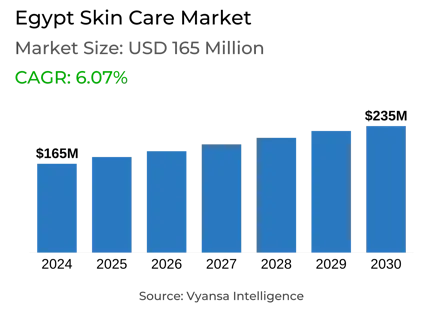
The skin care market covers facial cleansers, moisturizers, serums, masks, eye care, acne and spot products, body lotions, hand and foot care, oils, exfoliators, sun care, and related treatment-led formats. These products support daily cleansing, hydration, protection, appearance management, and skin comfort across mass, premium, pharmacy, direct-selling, and online channels. The market is forecast to grow at a CAGR of 6.05% during 2026–2032.
Key Highlights of the Egypt Skin Care Market
- The Egypt skin care market was valued at USD 838 million in 2025 and reached USD 930 million in 2026. The market is projected to reach USD 1.32 billion by 2032.
- Revenue is forecast to expand at a CAGR of 6.05% during 2026-2032.
- Facial Care remained the leading product type in 2026.
- Additionally, Body Care is expected to be the fastest-growing product type through 2032.
- Synthetic ingredients accounted for the leading ingredient position in 2026.
- Moreover, Natural ingredients are forecast to record the fastest ingredient-type growth.
The Egypt skin care industry is witnessing stronger demand as consumers increasingly treat skincare as a regular health, grooming, and preventive-care routine rather than an occasional beauty purchase. In 2025, Egypt’s skin care category recorded an 18% increase in retail sales value, demonstrating resilient demand despite inflationary pressures.
Demand is particularly supported by growing concerns around acne, dryness, pigmentation, sun exposure, sensitivity, and premature ageing, encouraging consumers to purchase multiple products rather than rely on a single moisturizer or cream. Facial care is gaining importance as consumers adopt structured routines involving cleansers, moisturizers, serums, treatments, and sun protection. Euromonitor also identifies a growing shift toward preventative skincare, with consumers increasingly seeking products before skin concerns become more severe.
Egypt’s climate further reinforces demand for hydration and sun-protection products. Sun care is increasingly being positioned as a daily health product, with consumers showing interest in multifunctional, high-protection formulations rather than purely seasonal products.
Pharmacy recommendations are also strengthening purchase confidence, particularly for dermatologist-tested and efficacy-focused products. Meanwhile, wider product availability through pharmacies and online channels is making specialized skincare more accessible.
Egypt Skin Care Market Drivers
Growing Adoption of Preventative and Treatment-Oriented Skincare Drives Product Demand
Egypt’s skincare demand is increasingly being driven by consumers addressing specific skin concerns rather than relying solely on basic creams and lotions. Concerns including hyperpigmentation, post-acne marks, dryness, sensitivity, and premature ageing are encouraging consumers to incorporate multiple products into their routines, including cleansers, moisturizers, serums, treatments, and sunscreens. A 2026 Egyptian dermatology consensus identified sun protection, barrier support, pigmentation, acne-related hyperpigmentation, and skin ageing among key dermocosmetic use cases, demonstrating the breadth of skincare needs supporting recurring product demand.
The broader skincare category consequently recorded an 18% increase in retail sales value in 2025, indicating that demand remained strong despite economic pressures. This combination of problem-specific treatment, preventative care, and daily sun protection is expanding usage occasions and encouraging higher-frequency skincare purchases across Egypt.
Egypt Skin Care Market Challenges
Counterfeit and Unlicensed Product Circulation
Counterfeit and unlicensed skin care products weaken consumer trust and create uneven competition for registered manufacturers. Unknown formulations, copied labels, poor storage, and unauthorized filling can expose buyers to ineffective or unsafe products while allowing illegal operators to avoid testing, notification, and quality-control costs. The problem is amplified through informal markets and social commerce, where visual similarity and low prices can make origin difficult to verify.
In July 2026, the Egyptian drug authority reported action against 52 unlicensed establishments across 14 governorates and seizures valued at above USD 0.43 million. Inspections identified unlicensed cosmetics manufacturing and packaging activity, machinery, scales, and roughly 15,000 empty containers, cartons, and labels at sites in Gharbia. The scale of packaging material found shows that the issue extends beyond isolated resale into organized imitation and unauthorized production.
Legitimate brands must therefore spend more on tamper-resistant packaging, channel monitoring, distributor control, consumer education, and rapid response to suspected copies. Pharmacies and established retailers gain importance because they provide clearer sourcing and accountability, but enforcement alone cannot eliminate online circulation. During the forecast period, counterfeiting may pressure margins, erode trust in unfamiliar local brands, and increase the advantage of companies with traceable distribution and recognizable packaging.
Egypt Skin Care Market Recent Trends
AI Skin Diagnostics and Beauty Tech
AI skin diagnostics are shifting product discovery from broad skin-type labels toward personalized routines. Smartphone images, guided questionnaires, biomarker analysis, and high-resolution imaging can help identify visible concerns, recommend product combinations, and explain why a cleanser, serum, moisturizer, or treatment fits a user. For Egyptian consumers, this can reduce confusion in crowded assortments and make online purchasing feel closer to an in-store consultation.
L’Oréal’s Longevity AI Cloud analyses more than 260 biomarkers to map skin health and assess potential ingredient effects before physical testing. The company has also demonstrated high-resolution imaging that produces real-time three-dimensional views of living skin, including collagen structure and tissue organization. Oriflame’s Egypt platform offers digital skin diagnosis linked to personalized routine recommendations, showing how diagnostic tools are moving closer to ordinary beauty purchasing rather than remaining confined to laboratories.
Commercial adoption will depend on image quality, local skin-tone representation, privacy safeguards, simple explanations, and recommendations matching products available in Egypt. Brands can use these tools to improve conversion, routine building, and cross-selling, while pharmacies and beauty advisers can support users needing human guidance. Through 2032, diagnostic capability should become an important differentiator for premium, dermocosmetic, and direct-selling portfolios, particularly where consumers expect evidence-based personalization.
Egypt Skin Care Market Future Opportunities
Pharmacy and Digital Expansion Creates Opportunity for Dermocosmetic Skincare
Egypt presents a significant opportunity for skincare companies to expand dermocosmetic and problem-solution products through pharmacies and digital channels. Consumers are increasingly seeking products for acne, pigmentation, sensitivity, dryness, skin ageing, and sun damage, creating opportunities for brands that combine recognizable ingredients with dermatologist-oriented positioning. The opportunity is reinforced by Egypt’s pharmacy-led purchasing environment, where professional recommendations can increase consumer confidence in specialized skincare.
Digital distribution provides an additional route to reach consumers beyond conventional retail. Egypt recorded 96.3 million internet users in January 2025, while mobile internet subscriptions reached 92.6 million by December 2025, creating a substantial digital infrastructure for skincare discovery, education, and purchasing. The Egyptian personal care e-commerce market generated approximately US$100 million in 2025 and grew by 15–20% year on year, demonstrating increasing consumer acceptance of online purchasing for personal-care products.
The opportunity is particularly attractive for brands offering affordable, multifunctional, and locally relevant formulations. Euromonitor notes that Egyptian consumers are prioritizing affordability and multifunctionality, while pharmacies and e-commerce are gaining importance as skincare purchasing channels.
Consequently, companies that combine pharmacy credibility, digital education, targeted formulations, and accessible pricing can broaden skincare adoption and capture underserved demand across Egypt through 2032.
Unlock Market Intelligence
Explore the market potential with our data-driven report
Egypt Skin Care Market Segmentation Analysis
By Product Type
- Facial Care
- Facial Cleansers and Makeup Removers
- Toners and Facial Mists
- Moisturizers and Creams
- Serums and Essences
- Face Masks
- Eye Care
- Facial Exfoliators
- Cosmetic Acne and Spot Care
- Other Facial Care
- Body Care
- Body Lotions and Creams
- Hand Care
- Foot Care
- Body Oils
- Body Exfoliators
- Other Body Care
- Sun Care
- Others
Facial Care Dominance and Faster Body Care Expansion
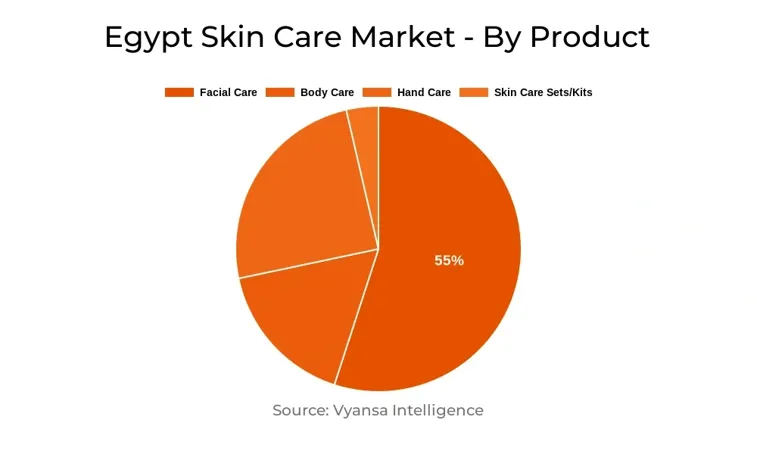
Facial care remains the largest product category in Egypt’s skin care industry, accounting for approximately 55% of market value in 2026. Its leadership is supported by high-frequency consumption and the broad range of concerns addressed, including acne, dryness, pigmentation, sensitivity, and ageing. Cleansers and moisturizers form the core of daily routines, while serums, exfoliators, masks, eye-care products, and targeted treatments increase product penetration and spending across individual users. Strong availability through pharmacies, supermarkets, beauty retailers, and e-commerce further reinforces facial care demand.
Body care represents an important growth opportunity, with the segment projected to expand at a 6.67% CAGR during 2026–2032. Increasing adoption of body lotions, creams, oils, exfoliators, hand creams, and foot-care products reflects the gradual extension of skincare routines beyond facial care. Larger pack sizes and household usage also make body-care products attractive in a price-sensitive market, while growing male grooming participation provides an additional demand pool.
By Ingredient Type
- Natural
- Synthetic
Synthetic Scale and Natural-Led Growth
Synthetic ingredients accounted for 62% of market value in 2026. Their leadership is supported by predictable performance, formulation stability, scalable supply, shelf life, and cost control across high-volume products. Established emollients, humectants, surfactants, preservatives, and active systems help manufacturers deliver consistent textures and claims at accessible prices. This reliability matters for mass-market cleansers, moisturizers, body lotions, and targeted products sold through varied retail conditions.
Natural ingredients are projected to expand at a CAGR of 7.83% during 2026-2032. Consumers increasingly associate botanical oils, plant extracts, naturally derived fragrances, and simpler ingredient stories with gentleness and wellbeing. Growth will be strongest where brands combine natural positioning with proven efficacy, pleasing textures, and clear safety communication. The segment is growing faster, but higher ingredient costs and formulation complexity may restrict reach among highly price-sensitive consumers.
Unlock Market Intelligence
Explore the market potential with our data-driven report
Egypt Skin Care Market Competitive Landscape
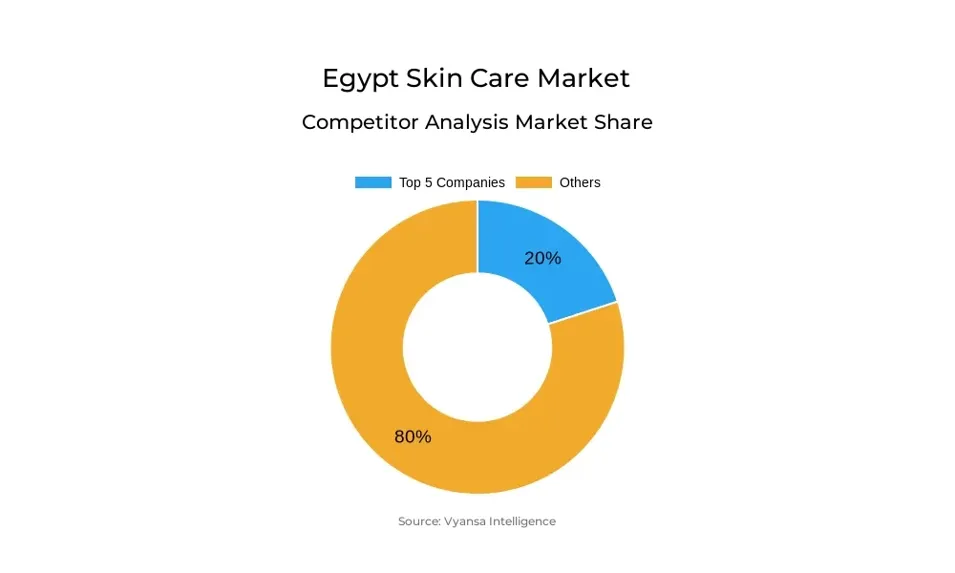
The Egypt skin care industry is moderately fragmented, with the five largest companies accounting for 46% of market value in 2026. Multinational groups like Eva Cosmetics, Beiersdorf AG, L’Oréal S.A., Oriflame Holding AG, and Unilever PLC compete through established brand equity, broad product ladders, formulation expertise, advertising reach, and access to pharmacies, supermarkets, beauty retailers, and digital channels.
Prominent Companies in the Egypt Skin Care Market
- Eva Cosmetics
- Beiersdorf AG
- L’Oréal S.A.
- Oriflame Holding AG
- Unilever PLC
- The Procter & Gamble Company
- Kenvue Inc.
- MACRO GROUP Pharmaceuticals
- Egyptian Company for Cosmetics and Toiletries
- Avon Egypt
Recent Developments in the Egypt Skin Care Market
- 2025: ZO Skin Health launched its first-ever ZO Skin Centre pop-up in Egypt at 5A by The Waterway in Cairo. The three-day activation introduced consumers to the brand's medical-grade skincare portfolio, including vitamin C serums, brightening treatments, and advanced sunscreens. The development is highly relevant to the Egypt skincare market because it represents a direct expansion of a dermatologist-oriented international skincare brand into the Egyptian consumer market and strengthens access to science-backed products addressing pigmentation, ageing, and sun exposure.
Frequently Asked Questions
Related Report
- Market Segmentation
- Research Scope
- Research Methodology
- Definitions and Assumptions
- Executive Summary
- Egypt Skin Care Market Policies, Regulations, and Standards
- Egypt Skin Care Market Dynamics
- Growth Factors
- Challenges
- Trends
- Opportunities
- Egypt Skin Care Market Statistics, 2022-2032F
- Market Size & Growth Outlook
- By Revenues in USD Million
- Market Segmentation & Growth Outlook
- By Product Type
- Facial Care- Market Insights and Forecast 2022-2032, USD Million
- Facial Cleansers and Makeup Removers- Market Insights and Forecast 2022-2032, USD Million
- Toners and Facial Mists- Market Insights and Forecast 2022-2032, USD Million
- Moisturizers and Creams- Market Insights and Forecast 2022-2032, USD Million
- Serums and Essences- Market Insights and Forecast 2022-2032, USD Million
- Face Masks- Market Insights and Forecast 2022-2032, USD Million
- Eye Care- Market Insights and Forecast 2022-2032, USD Million
- Facial Exfoliators- Market Insights and Forecast 2022-2032, USD Million
- Cosmetic Acne and Spot Care- Market Insights and Forecast 2022-2032, USD Million
- Other Facial Care- Market Insights and Forecast 2022-2032, USD Million
- Body Care- Market Insights and Forecast 2022-2032, USD Million
- s- Market Insights and Forecast 2022-2032, USD Million
- Sun Care- Market Insights and Forecast 2022-2032, USD Million
- Others- Market Insights and Forecast 2022-2032, USD Million
- Facial Care- Market Insights and Forecast 2022-2032, USD Million
- By Category
- Mass- Market Insights and Forecast 2022-2032, USD Million
- Premium- Market Insights and Forecast 2022-2032, USD Million
- By Ingredient Type
- Natural- Market Insights and Forecast 2022-2032, USD Million
- Synthetic- Market Insights and Forecast 2022-2032, USD Million
- By Target Gender
- Women- Market Insights and Forecast 2022-2032, USD Million
- Men- Market Insights and Forecast 2022-2032, USD Million
- Unisex- Market Insights and Forecast 2022-2032, USD Million
- By Age Group
- Bab Care- Market Insights and Forecast 2022-2032, USD Million
- Adult Care- Market Insights and Forecast 2022-2032, USD Million
- Mature Skin/Anti-Ageing- Market Insights and Forecast 2022-2032, USD Million
- By Packaging
- Tubes- Market Insights and Forecast 2022-2032, USD Million
- Bottles- Market Insights and Forecast 2022-2032, USD Million
- Jars- Market Insights and Forecast 2022-2032, USD Million
- Sachets and Pouches- Market Insights and Forecast 2022-2032, USD Million
- Others- Market Insights and Forecast 2022-2032, USD Million
- By Sales Channel
- Supermarkets and Hypermarkets- Market Insights and Forecast 2022-2032, USD Million
- Convenience Stores- Market Insights and Forecast 2022-2032, USD Million
- Pharmacies and Drug Stores- Market Insights and Forecast 2022-2032, USD Million
- Exclusive/Multi-Brand Stores- Market Insights and Forecast 2022-2032, USD Million
- Online Stores- Market Insights and Forecast 2022-2032, USD Million
- Direct Selling- Market Insights and Forecast 2022-2032, USD Million
- Others- Market Insights and Forecast 2022-2032, USD Million
- By Region
- Cairo- Market Insights and Forecast 2022-2032, USD Million
- Alexandria- Market Insights and Forecast 2022-2032, USD Million
- Others- Market Insights and Forecast 2022-2032, USD Million
- By Competitors
- Competition Characteristics
- Market Share & Analysis
- By Product Type
- Market Size & Growth Outlook
- Egypt Facial Care Market Statistics, 2022-2032
- Market Size & Growth Outlook
- By Revenues in USD Million
- Market Segmentation & Growth Outlook
- By Category- Market Insights and Forecast 2022-2032, USD Million
- By Ingredient Type- Market Insights and Forecast 2022-2032, USD Million
- By Target Gender- Market Insights and Forecast 2022-2032, USD Million
- By Age Group- Market Insights and Forecast 2022-2032, USD Million
- By Packaging- Market Insights and Forecast 2022-2032, USD Million
- By Sales Channel- Market Insights and Forecast 2022-2032, USD Million
- By Region- Market Insights and Forecast 2022-2032, USD Million
- Market Size & Growth Outlook
- Egypt Body Care Market Statistics, 2022-2032
- Market Size & Growth Outlook
- By Revenues in USD Million
- Market Segmentation & Growth Outlook
- By Category- Market Insights and Forecast 2022-2032, USD Million
- By Ingredient Type- Market Insights and Forecast 2022-2032, USD Million
- By Target Gender- Market Insights and Forecast 2022-2032, USD Million
- By Age Group- Market Insights and Forecast 2022-2032, USD Million
- By Packaging- Market Insights and Forecast 2022-2032, USD Million
- By Sales Channel- Market Insights and Forecast 2022-2032, USD Million
- By Region- Market Insights and Forecast 2022-2032, USD Million
- Market Size & Growth Outlook
- Egypt Sun Care Market Statistics, 2022-2032
- Market Size & Growth Outlook
- By Revenues in USD Million
- Market Segmentation & Growth Outlook
- By Category- Market Insights and Forecast 2022-2032, USD Million
- By Ingredient Type- Market Insights and Forecast 2022-2032, USD Million
- By Target Gender- Market Insights and Forecast 2022-2032, USD Million
- By Age Group- Market Insights and Forecast 2022-2032, USD Million
- By Packaging- Market Insights and Forecast 2022-2032, USD Million
- By Sales Channel- Market Insights and Forecast 2022-2032, USD Million
- By Region- Market Insights and Forecast 2022-2032, USD Million
- Market Size & Growth Outlook
- Egypt Others Market Statistics, 2022-2032
- Market Size & Growth Outlook
- By Revenues in USD Million
- Market Segmentation & Growth Outlook
- By Category- Market Insights and Forecast 2022-2032, USD Million
- By Ingredient Type- Market Insights and Forecast 2022-2032, USD Million
- By Target Gender- Market Insights and Forecast 2022-2032, USD Million
- By Age Group- Market Insights and Forecast 2022-2032, USD Million
- By Packaging- Market Insights and Forecast 2022-2032, USD Million
- By Sales Channel- Market Insights and Forecast 2022-2032, USD Million
- By Region- Market Insights and Forecast 2022-2032, USD Million
- Market Size & Growth Outlook
- Competitive Outlook
- Company Profiles
- Eva Cosmetics (including brands)
- Business Description
- Product Portfolio
- Collaborations & Alliances
- Recent Developments
- Financial Details
- Others
- Beiersdorf AG (including brands)
- Business Description
- Product Portfolio
- Collaborations & Alliances
- Recent Developments
- Financial Details
- Others
- L'Oréal S.A. (including brands)
- Business Description
- Product Portfolio
- Collaborations & Alliances
- Recent Developments
- Financial Details
- Others
- Oriflame Holding AG
- Business Description
- Product Portfolio
- Collaborations & Alliances
- Recent Developments
- Financial Details
- Others
- Unilever PLC (including brands)
- Business Description
- Product Portfolio
- Collaborations & Alliances
- Recent Developments
- Financial Details
- Others
- The Procter & Gamble Company (Olay)
- Business Description
- Product Portfolio
- Collaborations & Alliances
- Recent Developments
- Financial Details
- Others
- Kenvue Inc. (including brands)
- Business Description
- Product Portfolio
- Collaborations & Alliances
- Recent Developments
- Financial Details
- Others
- MACRO GROUP Pharmaceuticals (including brands)
- Business Description
- Product Portfolio
- Collaborations & Alliances
- Recent Developments
- Financial Details
- Others
- Egyptian Company for Cosmetics and Toiletries
- Business Description
- Product Portfolio
- Collaborations & Alliances
- Recent Developments
- Financial Details
- Others
- Avon Egypt
- Business Description
- Product Portfolio
- Collaborations & Alliances
- Recent Developments
- Financial Details
- Others
- Eva Cosmetics (including brands)
- Company Profiles
- Disclaimer
| Segment | Sub-Segment |
|---|---|
| By Product Type |
|
| By Category |
|
| By Ingredient Type |
|
| By Target Gender |
|
| By Age Group |
|
| By Packaging |
|
| By Sales Channel |
|
| By Region |
|
Research Methodology
This study followed a structured approach comprising four key phases to assess the size and scope of the electro-oxidation market. The process began with thorough secondary research to collect data on the target market, related markets, and broader industry context. These findings, along with preliminary assumptions and estimates, were then validated through extensive primary research involving industry experts from across the value chain. To calculate the overall market size, both top-down and bottom-up methodologies were employed. Finally, market segmentation and data triangulation techniques were applied to refine and validate segment-level estimations.
Secondary Research
The secondary research phase involved gathering data from a wide range of credible and published sources. This step helped in identifying industry trends, defining market segmentation, and understanding the market landscape and value chain.
Sources consulted during this phase included:
- Company annual reports, investor presentations, and press releases
- Industry white papers and certified publications
- Trade directories and market-recognized databases
- Articles from authoritative authors and reputable journals
- Gold and silver standard websites
Secondary research was critical in mapping out the industry's value chain and monetary flow, identifying key market segments, understanding regional variations, and tracking significant industry developments.
Other key sources:
- Financial disclosures
- Industry associations and trade bodies
- News outlets and business magazines
- Academic journals and research studies
- Paid industry databases
Primary Research
To validate secondary data and gain deeper market insights, primary research was conducted with key stakeholders across both the supply and demand sides of the market.
On the demand side, participants included decision-makers and influencers from end-user industries—such as CIOs, CTOs, and CSOs—who provided first-hand perspectives on market needs, product usage, and future expectations.
On the supply side, interviews were conducted with manufacturers, industry associations, and institutional participants to gather insights into current offerings, product pipelines, and market challenges.
Primary interviews provided critical inputs such as:
- Market size and revenue data
- Product and service breakdowns
- Market forecasts
- Regional and application-specific trends
Stakeholders consulted included:
- Leading OEM and solution providers
- Channel and distribution partners
- End users across various applications
- Independent consultants and industry specialists
Market Size Estimation and Data Triangulation
- Identifying Key Market Participants (Secondary Research)
- Goal: To identify the major players or companies in the target market. This typically involves using publicly available data sources such as industry reports, market research publications, and financial statements of companies.
- Tools: Reports from firms like Gartner, Forrester, Euromonitor, Statista, IBISWorld, and others. Public financial statements, news articles, and press releases from top market players.
- Extracting Earnings of Key Market Participants
- Goal: To estimate the earnings generated from the product or service being analyzed. This step helps in understanding the revenue potential of each market player in a specific geography.
- Methods: Earnings data can be gathered from:
- Publicly available financial reports (for listed companies).
- Interviews and primary data sources from professionals, such as Directors, VPs, SVPs, etc. This is especially useful for understanding more nuanced, internal data that isn't publicly disclosed.
- Annual reports and investor presentations of key players.
- Data Collation and Development of a Relevant Data Model
- Goal: To collate inputs from both primary and secondary sources into a structured, data-driven model for market estimation. This model will incorporate key market KPIs and any independent variables relevant to the market.
- Key KPIs: These could include:
- Market size, growth rate, and demand drivers.
- Industry-specific metrics like market share, average revenue per customer (ARPC), or average deal size.
- External variables, such as economic growth rates, inflation rates, or commodity prices, that could affect the market.
- Data Modeling: Based on this data, the market forecasts are developed for the next 5 years. A combination of trend analysis, scenario modeling, and statistical regression might be used to generate projections.
- Scenario Analysis
- Goal: To test different assumptions and validate how sensitive the market is to changes in key variables (e.g., market demand, regulatory changes, technological disruptions).
- Types of Scenarios:
- Base Case: Based on current assumptions and historical data.
- Best-Case Scenario: Assuming favorable market conditions, regulatory environments, and technological advancements.
- Worst-Case Scenario: Accounting for adverse factors, such as economic downturns, stricter regulations, or unexpected disruptions.












